|
(11) | EP 0 125 888 A1 |

| (12) | EUROPEAN PATENT APPLICATION |
|
|
|
|
|||||||||||||||||||||||||||
| (54) | Poly(butylene terephthalate) based moulding resins |
| (57) There is provided an improved moulding resin especially for use in high temperature
environments (for example metallic electrical assemblies); the resin is capable of
being moulded into an article exhibiting reduced tendency to corrode a copper surface
when the moulded resin and the copper surface are placed in spaced relationship in
a common unventilated atmosphere at elevated temperatures, as measured by the Bell
Telephone Laboratories Copper Corrosion Test at temperatures within the range from
150°to 175°C. wherein the moulding resin comprises the combination of (a) a poly(butylene
terephthalate) based polymer and aromatic halogen groups in a flame-retardant amount,
and (b) an alkylhydroxyphenyl-alkanoyl hydrazine in an amount that is within the range
from 0.05 to 0.6% by weight, based on the weight of the moulding resin, and less than
0.8% by weight based on the polymer. |
[0002] The improved poly(butylene terephthalate) polymer based moulding resins of the invention are especially useful for making components for use in metallic electrical assemblies in a high temperature environment: It has surprisingly been found that such components suitable for use in high temperature environments, for example those in which the ambient temperature is from 100°C. to 18O°C., can be prepared from flame-retardant halogen-containing moulding compositions that contain defined amounts of an alkylhydroxyphenylalkanoyl- hydrazine.
[0003] In particular, the invention provides moulding resins for making components having reduced tendency to corrode a copper surface exposed to a common unventilated atmosphere at ambient temperatures within the range 100°C. to 180°C.
[0004] Components prepared from flame-retardant moulding resins containing at least 50 weight percent poly(1,4-butylene terephthalate) based polymer and aromatic halogen groups have been widely used in metallic electrical assemblies in unventilated environments at temperatures below 100°C. However, electrical equipment manufacturers have been hesitant to use such components in more recent electrical applications wherein there is a high temperature environment which may be within the range from 120°C to 150°C. because of fear of corrosion of fine metal electronic parts having surfaces not in direct contact with the polymer. Such more recent applications include for example telephone connector assemblies that are compact and carry high currents.
[0005] Bell Telephone Laboratories has developed a screening test for predicting the suitability of a given moulding composition for such applications. The test is fully described hereinafter in Example 3.
[0006] Example 1 of U.S. Patent 4,104,242 describes moulded articles comprising poly(1,4-butylene terephthalate), commonly known as PBT, and N,N'-bis(3,5-di-tert-butyl-4- hydvoxyhydrocinnamoyl)-hydrazine(Ciba-Geigy Corporation, Irganox MD-1O24). (Irganox is a Trade Mark). The articles had improved "long term (high) voltage breakdown resistance" when tested in the form of rotors for distributors of automotive ignition .systems. Nowhere does the Patent refer to the corrosion rate of the metallic portion of the rotor and/or distributor. The Example does not use a flame-retardant composition, although elsewhere it is stated that the moulding powder formulations may contain flame retardants etc. (column 5, lines 55-58). The Example does not state the temperature reached by the rotor in the test, but it was evidently quite low since rotors can be readily removed from hot automobile engines without the use of gloves.
[0007] Ciba-Geigy's product bulletin "Irganox MD-1024" (undated) describes MD-1024 as a metal deactivator and antioxidant which when incorporated into polymeric materials such as polyolefins and nylons will prevent failure of the polymer when these materials are used as insulation in direct contact with metals, such as copper. The bulletin does not specifically refer to polyesters. It often recommends the use of Irganox 1010 (a high performance phenolic antioxidant that is free of nitrogen) in conjunction with Irganox MD-1024. In Figure 2 of the product bulletin, increasing the concentration of blends of Irganox MD-1024 and Irganox 1010, up to 0.8%, clearly shows a nearly directly linear increase in stabiliser performance. The product bulletin also teaches that "(i)t is also expected that Irganox MD-1024 may have utility in deactivating titanium and other metal catalyst residue present in polyolefins and other polymers, thereby improving end-use thermal and light stability." The bulletin further cites two Patents (both of Ciba-Geigy): U.S. Patents 3,660,438 and 3,773,722.
[0008] U.S. Patent 3,660,438 discloses alkylhydroxyphenyl- alkanoyl hydrazines as stabilisers against oxidative and/or thermal degradation for organic materials (column 1, lines 35-38). Examples of organic materials are listed as: vinyl resins, vinyl esters, butadienes, styrenes, polyolefins, polyurethanes, polyamides, polyacetals and polyesters, such as polyethylene terephthalate. The claims of that Patent are directed to the compound - alkylhydroxyphenylalkanoyl hydrazine.
[0009] U.S. Patent 3,773,722 is a divisional of 3,660,438 and discloses identical subject matter. The claims of 3,773,722 are directed to the composition comprising polymeric materials with up to 5% of an alkylhydroxyphenyl- alkanoyl hydrazine compound as a stabiliser.
[0010] U.S. Patent 3,888,824 is a continuation-in-part of 3,660,438andis of general interest in that it discloses an alkylhydroxyphenylalkanoyl hydrazine for the stabilisation of polyesters such polyethylene terephthalate (column 4, lines 28-29).
[0011] There is nothing in the prior art to lead the skilled reader to suppose that it might be possible to produce a particularly useful moulding resin based on poly(butylene terephthalate) capable of use in electrical components subjected to high temperature atmospheres.
[0012] It has surprisingly been discovered that a flame-retardant moulding resin can be produced that is also capable of being moulded into an,article exhibiting reduced tendency to corrode a copper surface when the moulded resin and the copper surface are placed in spaced relationship in a common unventilated atmosphere at elevated temperatures (as measured by the Bell Telephone Laboratories Copper Corrosion Test at .temperatures within the range of from 150° to 175°C.) if the moulding resin comprises the combination of (a) a poly(butylene terephthalate) based polymer composition containing aromatic halogen groups in a flame-retardant amount , and (b) an alkylhydroxyphenylalkanoyl'hydrazine in an amount that is within the range from 0.05 to 0.6% by weight, based on the weight of the poly(butylene terephthalate) based polymer composition and that is less than 0.8% by weight based on the polymer itself.
[0013] The surprising nature of this discovery is emphasised by a variety of factors among which are the following: Firstly, two experimental studies have suggested that the anti-corrosion effectiveness of adding small amounts (e.g. 0.2%) of Irganox MD-1024 to poly(l,4-butylene terephthalate) based resins is not a result of inhibiting the oxidative or thermal degradation of such resins. In particular, a subsequent hot air aging study at 190°C. by A. DeGuia (unpublished) showed that the addition of 0.2% Irganox MD-1024 to a PBT based moulding resin did not improve its oxidativefthermal stability, as measured by percent tensile strength retention at 190°C. Also, Richard M. Lum of Bell Laboratories made a study of the pyrolytic reactions during thermal degradation of PBT ("Polymer Preprints", Vol. 19, No. 2, September, 1978 published by American Chemical Society). Lum does not list any major volatile decomposition products which both corrode copper and have boiling points below those used in the Bell corrosion test.
[0014] Secondly, even if it were assumed arguendo that the additive does inhibit degradation of the PBT resin, then it is surprising (1) that amounts as small as those mentioned gbove could be effective; (2) that the presence of more additive is harmful; (3) that the presence of the phenolic antioxidant Irganox MD-1010 is harmful, rather than beneficial; and (4) that high weight ratios of titanium dioxide to Irganox MD-1024 can be tolerated.
[0015] The moulding resin of the invention is capable of exhibiting a reduced tendency to corrode a copper surface if the moulding resin and the copper surface are placed in spaced relationship in a common unventilated atmosphere at an elevated temperature, as measured by the Bell Telephone Laboratories Copper Corrosion Test at temperatures within the range from 150° to 175°C.
[0016] Figure 1 is a semi-diagrammatic front elevation of the Bell Telephone Laboratories Copper Corrosion Test, which will be described in Example 3.
[0017] Some preferred embodiments of the invention will be found in the Examples which are to be contrasted to the Comparative Examples. Such Examples are not intended to limit the scope of the invention.
EXAMPLE 1 (Polymer Preparation)
[0018] This Examples describes methods of preparing two poly-(butylene terephthalate) based polymers used in preparing moulding resins in Example 2 (Moulding Resin Preparation) that were subsequently evaluated by the Bell Corrosion Test as described in Example 3. It is perhaps relevant to the claimed invention since it is believed that Irganox MD-1024 is a corrosion inhibitor by the Bell Corrosion Test on account, of its ability to react with volatile corrosive trace impurities in PBT based polymers to form products of reduced volatility. However, most if not all processes for making PBT polymer would result in the contaminants listed hereinafter.
[0019] Two types of conventional PBT based polymer were prepared. PBT-lwas essentially poly(1,4-butylene terephthalate) polymer. PBT-2 was essentially a brominated copolyester.
[0020] PBT-1 was a commercially-available polymer prepared essentially in the following manner. A commercial two- stage batch polymerisation line was utilised to produce PBT-1. A dimethyl terephthalate 1/2.1-2.2 molar proportion 1.4-butylene glycol mixture was heated from 150°C. to approximately 210°C. Evolved methanol was completely removed. Following methanol removal the temperature of the reactants was raised to 270 - 300°C. and vacuum was applied while mixing. Excess 1,4-butylene glycol above 1.0 molar proportion was removed by use of about 0.06 weight percent of a titanium dioxide catalyst and internal pressure of O.5 - 1.0 mm.Hg. in an alcoholysis interchange reaction. After polymerisation, triphenylphosphite was added at a level of about 0.01 percent by weight, as a stabiliser.
[0021] PBT-1 had an inherent viscosity of 0.75 dl/gm and, according to tests on similarly prepared product, contained trace contaminants of tetrahydrofuran; furan; butenal; butanal; acrolein and propionaldehyde.
[0022] PBT-2 was prepared essentially in the same manner as PBT-1, except that a portion of the 1,4-butylene glycol was replaced by 2,3,5,6-tetrabromo-1,4-bis(2-hydroxy) ethylene benzene. The brominated monomer was added at 14 weight percent of total,polymer. PBT-2 had essentially the same inherent viscosity as PBT-1 and also contained the fore- mentioned types of trace contaminants.
EXAMPLE 2 (Moulding Resin Preparation)
[0023] Table 1 summarises the composition of five different flame-retardant, reinforced, moulding resins "Ml" - "M5" that were prepared from either PBT-1 or PBT-2, and which were used in the Comparative Examples hereinafter.
[0024] The typical method of preparation was essentially as follows. All ingredients were salt and pepper tumble blended; passed through a 1" (2.54 cm) Brabender extruder with barrel and die temperatures set to give a 480°F. (249°C.) melt, and with a screw speed of about 80 RPM, to form pellets; the pellets were pulverised in a Mikro Pulveriser and screened. Only those particles which passed through a 30 mesh screen and were retained by a 50 mesh screen were used in the corrosion test described in Example 3. While the ingredients were not dried prior to extrusion it should be noted that drying PBT polymer typically removes moisture at or close to the surface of the particles, but does not remove trace contaminants below the surface of the particles. The named additives blended with the polymer are well known to those skilled in the art.
EXAMPLE 3 (Copper-Corrosion-Test)
[0025] The Bell Laboratories Copper Corrosion Test is described below and illustrated by Figure 1. Figure 1 shows a special test tube (1) mounted vertically (by means not shown) with the test material (2) in the bottom of the special test tube. The test tube is partially immersed in oil (3) in a heated oil bath (not shown) such that the upper level of the test material is below the level of the oil. The open end of the test tube is plugged with a cork (4) wrapped in aluminium foil (5). The test tube has two vertical portions (lA and 1B) each around 14 cm. long, which are connected by a horizontal portion or step (lC) about 3.7 cm. long. The test tube is formed from glass tubing having an internal diameter of 1.0 cm. and an external diameter of 1.2 cm. A copper mirror (6) is in the step of the test tube in an inclined position with angle 9 degrees of about 30-60 degrees. The copper side (6A) of the mirror is the upper side. It should be noted that in Examples 4C-24 a minor precautionary modification was made to the standard Bell test. In particular, a small amount of spun fibreglass (7) was placed directly below the copper mirror, beneath the bend in the test tube, to prevent the mirror from falling into the powdered resin in the bottom of the tube. The . written test description, as provided by Bell, now essentially follows.
1. Outline-of-Method
[0026] A thin copper film is exposed under controlled conditions to gaseous, solid or liquid materials. The effect on the copper film is noted after a specified exposure period.
2. Materials
2.1 Copper Mirror
[0027] A copper mirror consists of a vacuum-deposited film of copper metal (having a thickness equivalent to 10 ± 5 percent transmission of normal incident light of 5000 angstroms) on a plane sheet of clear, transparent, polished glass. A convenient size is a 2.54 cm. by 7.6 cm. (1-inch by 3-inch) microscope slide. These mirrors may be obtained from Evaporated Metal Films Corporation, Ithaca, N.Y. It is recommended that these mirrors be purchased in plastic tubes (2 mirrors per tube) which have been flushed with nitrogen. For long term storage, place the plastic containers in a convenient size dessicatorwhich has been flushed with nitrogen.
2.1.1 Pretest Routine for Copper Mirrors
[0028] Before using a mirror for test, visually check for the presence of an excessive oxide film. If a visible oxide film is present, immerse the copper mirror in a 5 percent solution of ethylene diamine tetracetic acid (EDTA) or similar chelating agent for copper oxide. Wash the plate thoroughly in running water. Immerse in clean ethyl or methyl alcohol. Dry with clean, oil-free air. The mirror is acceptable if monoxide film is visible and the copper film has not been visibly damaged. View copper film in good light.
3. Testing
3.1 Method B (Solid Material)
[0029] Place about 1-1/2 grams of material to be tested in the bottom of a test tube formed by fusing a 10 to 12 mm diameter glass tube 30.5 to 35.5 cm. (12 to 14 inches) in length. Make two bends at approximately right angles to divide the tubing into two similar compartments. (See Figure 1.) Cut a 2.54 cm. by 7.6 cm. (1-inch by 3-inch) mirror into a size which fits easily into the upper compartment [pproximately 2.54 by 0.64 cm. (1 by 0.25 inch)]. Place it in the upper compartment. Seal the tubing with a tight-fitting cork stopper wrapped in aluminium foil. Place the lower compartment of the glass tubing (which contains the material)-in an oven or oil bath heated to the temperature specified. The upper compartment shall be placed so that the copper mirror is sufficiently removed from the source of heat.
[0030] After the specified test period, remove_the copper mirror and examine it visually by placing it against a white background using a standard light source per ASTM D 1729. Any complete removal of the copper film in any part of the mirror as evidenced by the white background showing through constitutes failure and shall be cause for rejection. Discolouration of the copper film or a partial reduction of its thickness shall not be cause for rejection. This test shall be run in duplicate. Failure in one mirror shall be cause for rejection. The copper mirror may be observed for failure in situ.
3.2 Testing-Conditions
[0032] Various moulding resins were made and tested as shown in Table 2. All the moulding resins contained PBT-2 polymer whose method of preparation is given in Example 1. It will be noted that the moulding resin formulations given in Table 2 incorporate by reference the "Ml" formulation given in Table 1. All of the moulding resins were tested at 175°C. according to the Bell Corrosion Test given in Example 3, except that "life" to failure was determined by the earliest failure of any sample out of 3, rather than 2, samples. Examples having the suffix "C"afterthe number are all Comparative Examples; they are therefore not within the present invention.
[0033] The data in Table 2 suggest the following conclusions. Resins containing no MD-1024 caused corrosion very rapidly, in several hours (Comparative Examples 4C, 5C and 6C.) The addition of very small amounts of MD-1024 (e.g. 0.05% on moulding resins and 0.08% on PBT-2 polymer in Example 7); dramatically reduced corrosion (Examples 7, 8 and 9 contrasted to Comparative Example 4C). The addition of excess MD-1024 appears to be harmful (Example 10 compared with Example 9). The addition of Irganox 1010 (a phenolic antioxidant which is free of nitrogen) to MD-1024 is harmful, rather than beneficial (Comparative Examples 9C1 and 9C2 contrasted with Example 9).-
EXAMPLES AND COMPARATIVE EXAMPLES ···11G-23···
[0034] Various moulding resins were made and tested as shown in Table 3. All the moulding resins contained PBT-2 polymer whose method of preparation is given in Example 1. It will be noted that the moulding resin formulations given in Table 3 incorporate by reference the "M2" - "M4" formulations given in Table 1. All of the moulding resins were tested at 150°C. and/or 175°C. according to the Bell Corrosion Test given in Example 3, except that "life" to failure was determined by the earliest failure of any sample out of 4, rather than 2, samples. Examples having the suffix "C" are Comparative Examples.
[0035] The Bell Corrosion Test data in Table 3 demonstrate the effectiveness of Irganox MD-1024 in reducing corrosion from PBT-1 vapours, at temperatures of 150°C. as well as 175°C. It also shows the significant effect of temperature upon corrosion rate. It should be noted that Example 20C repeated Example 17C and Example 20 repeated Example 17.
[0036] The results of Example 17C appear to be spurious at first sight. However, the test method implies variability between apparently identical samples.
EXAMPLE 24 AND COMPARATIVE EXAMPLE 24G
[0037] Examples 24 and 24C correspond to Examples 16 and 16C respectively, except that the moulding resin also included 1% by weight of a light gray pigment. The pigment was predomin- anally titanium dioxide, with most of the remainder being carbon black. Bell Corrosion Test results at 175°C. indicated that lives were not less than those obtained without pigment in Example 16 and Comparative Example 16C. This suggests that high weight ratios of titanium dioxide to Irganox MD-1024 can be tolerated.
[0038] It is believed that the results obtained in the foregoing Examples and Comparative Examples are best explained by the hypothesis that the Irganox MD-1024 is a corrosion inhibitor by the Bell Corrosion Test on account of its ability to react with pre-existing volatile corrosive trace impuritiess in PBT based polymers, rather than as a stabiliser for the PBT polymer. Such pre-existing impurities are formed during polymerisation in the molten state, rather than degradation in the solid state. The boiling points of some trace impurities, in unoxidised and oxidised form are as follows: tetrahydrofuran (65°C.); furan (32°C.); succinic acid (235°C.); butenal (104°C.); butanal (76°C.); butanoic acid (164°C.); acrolein (53°C.); propionaldehyde (6O°C.); propenoic acid (142°C.)
1. A moulding resin capable of being moulded into an article for use in high temperature
environments which comprises the combination of (a) a poly(butylene'terephthalate)
based polymer composition containing aromatic halogen groups in a flame-retardant
amount, and (b) an alkylhydroxyphenyl- alkanoyl hydrazine in an amount that is within
the range from 0.05 to 0.6% by weight, based on the weight of the moulding resin,
and less than 0.8% by weight based on the polymer itself.
2. A resin of claim 1, wherein the alkylhydroxyphenyl- alkanoyl hydrazine is represented
by the formula:
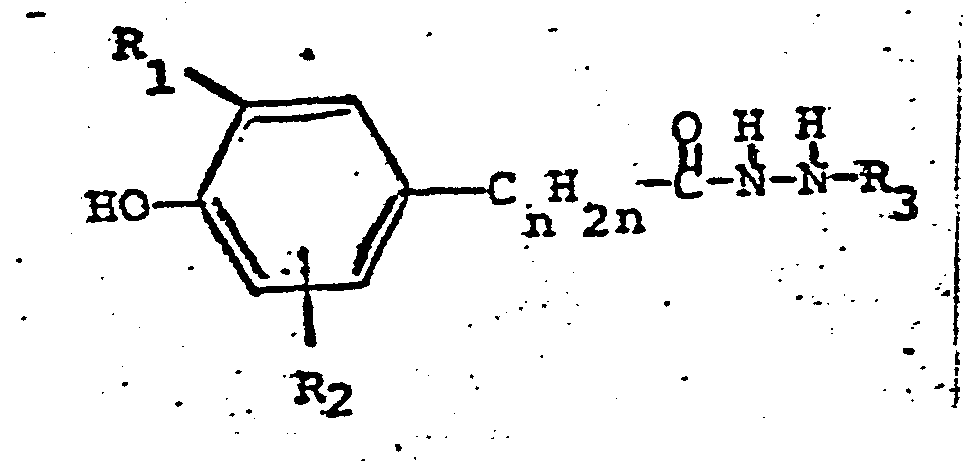
wherein R1 is an alkyl group containing from 1 to 6 carbon atoms, R2 is selected from hydrogen and alkyl containing from 1 to 6 carbon atoms, R3 is selected from hydrogen, alkanoyl containing from 2 to 18 carbon atoms and a group represented by the formula:
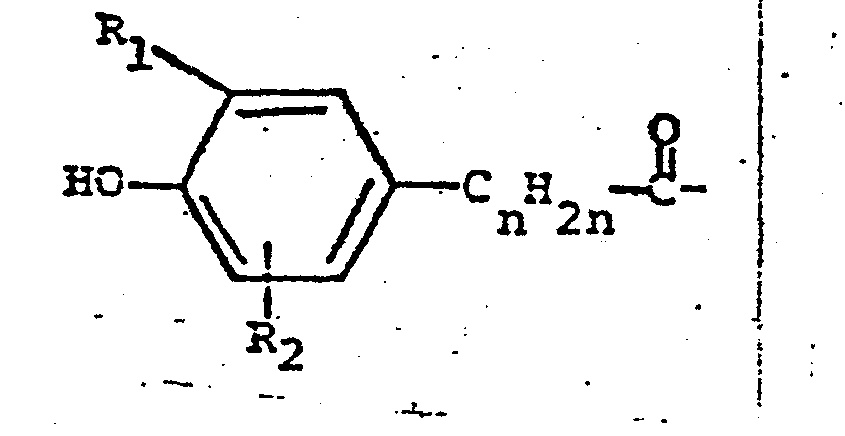
wherein R1 and R2 are as defined above and n is a number from 0 to 5.
wherein R1 is an alkyl group containing from 1 to 6 carbon atoms, R2 is selected from hydrogen and alkyl containing from 1 to 6 carbon atoms, R3 is selected from hydrogen, alkanoyl containing from 2 to 18 carbon atoms and a group represented by the formula:
wherein R1 and R2 are as defined above and n is a number from 0 to 5.
3. A resin of claim 1 wherein the alkylhydroxyphenyl- alkanoyl hydrazine is represented
by the following structure:
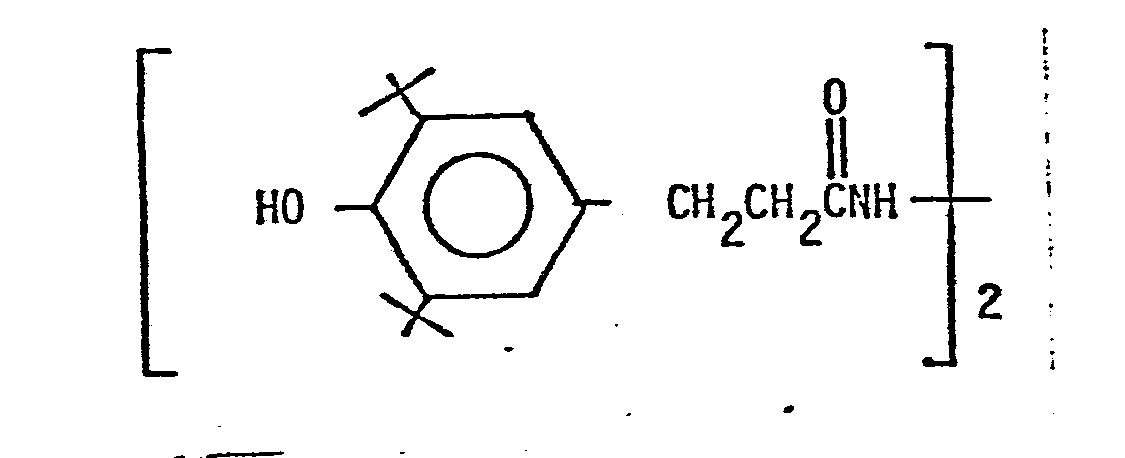
4. A resin of claim 1, wherein the alkylhydroxyphenyl- alkanoyl hydrazine is N-N'-bis[3-(3,5-di
t-butyl-4-hydroxy phenyl propionyl)]-hydrazine and is present in an amount of less
than 0.4% by weight based on the moulding resin, and less than 0.5% by weight based
on the polymer itself.
5. A resin of any of claims 1 - 4 which comprises from 0 to less than 0.2% by weight
of a phenolic antioxidant that is free of nitrogen.
6. A resin of any of claims 1 - 5 wherein component (a) comprises poly (1,4-butylene
terephthalate) polymer having an intrinsic viscosity within the range from 0.7 to
1.1 dl/gm and decabromo diphenyl oxide in an amount from 3 to 10 percent by weight
based on the moulding resin and the alkylhydroxyphenylalkanoyl hydrazine in an amount
that is within the range from 0.05 to 0.3% by weight, based on the weight of the moulding
resin.
7. A resin of any of claims 1 - 5 wherein component (a) comprises a brominated copolyester
having an intrinsic viscosity within the range from 0.7 to 111 dl/gm and the alkylhydroxyphenylalkanoyl
hydrazine in an amount that is within the range from 0.05 to 0.3% by weight, based
on the weight of the moulding resin.
8. A component for incorporation in metallic electrical assemblies which generate
ambient temperatures over 120°C. in use, the component being formed from a moulding
resin of any of claimsl - 7.