|
(11) | EP 0 125 906 B1 |

| (12) | EUROPEAN PATENT SPECIFICATION |
|
|
| (54) |
Accelerators for the cure of epoxy resins Härtungsbeschleuniger für Epoxydharze Activateurs pour le durcissement de résines époxydes |
|
|
|||||||||||||||||||||||||||||||
| Note: Within nine months from the publication of the mention of the grant of the European patent, any person may give notice to the European Patent Office of opposition to the European patent granted. Notice of opposition shall be filed in a written reasoned statement. It shall not be deemed to have been filed until the opposition fee has been paid. (Art. 99(1) European Patent Convention). |
[0001] Epoxy resins can be cured by acid anhydrides and the applicatidn of heat. Typical of the anhydrides used are those of phthalic, hexahydrophthalic, succinic, dodecenyl succinic, maleic, the adduct of methyl cyclopentadiene and maleic, methyl tetrahydrophthalic and trimetallitic acid and 3,3', 4,4'-benzophenone tetracarboxylic dianhydride. The anhydride ring must open for cure to occur and this can be accelerated or caused to happen at lower temperatures by the addition of small quantities of proton containing compounds e.g. amines. Typical conventional cure accelerators used in epoxy/anhydride systems are benzyldimethylamine, 2,4,6-tris (dimethylaminomethyl) phenol, 2-ethyl-4-methylimidazole
and stannous octoate.
[0002] SU-A-276401 discloses the curing of a composition containing an epoxy resin and isomethyltetrahydrophthalic anhydride in the presence of 2 parts, by weight of epoxy resin of 1,2,3-benzotriazole. The composition is cured at 120°C for 8 hours.
[0003] Epoxy resins will also react with carboxylic acids at elevated temperature and this fact is made use of in powder coatings where solid epoxy resins are mixed with solid polyester resins which contain free carboxyl groups either at the ends of chains or on side chains and heated to effect cure. In this application accelerators are often used and amongst those described in the literature are choline chloride (EP-A-0010806) and heterocyclics e.g. imidazole and 2-methylimidazole (GB-A-1516077 and GB-A-1558303).
[0004] We now find that benzotriazoles including those with aromatic ring substitution behave as cure accelerators or catalysts for the reaction between epoxy resins and polyesters containing free carboxylic acid groups, which may be at the ends of chains or on branched chains.
[0005] Preferably, such benzotriazoles have the formula:-
where R is hydrogen or is lower alkyl such as Cl-4 alkyl, e.g. CH3.
[0006] The group R may assume any position on the benzene nucleus, and a mixture of isomers may be used.
[0007] In particular excellent powder coatings can be obtained from epoxide resins based on bisphenol A such as Epikote® 1055 or Araldite® GT 7004 or epoxy-containing compounds such as triglycidyl isocyanurate (e.g. Araldite® PT 810). Other types of epoxy resins can be used e.g. those based on novolaks having e.g. a melting point above 50°C.
[0008] Typical polyester resins that can be used are those based on a symmetrical glycol e.g. neopentyl glycol and one or more aromatic dicarboxylic acids e.g. isophthalic acid or terephthalic acid, the acid content optionally additionally being provided by an aliphatic mono or dicarboxylic acid e.g. pelargonic acid, adipic acid or trimellitic anhydride. The polyester should preferably have an acid value of 30-100 mg KOH/g, a melting point of 50-70°C and a melt viscosity of 1 to 4 Pa.s (10-40 poises) at 200°C (as measured using an I.C.I. Cone and Plate Viscometer).
[0009] The powder coatings can include in addition to epoxy, polyester and cure accelerator, pigments to obtain the desired colour, flow control agents and light stabilisers.
[0010] Preferred reactions embodying the invention will now be described with reference to the following Examples, which include a comparison between the performance of an accelerator used in a reaction embodying the invention and reactions carried out with conventional accelerators.
Example I
[0011] A polyester was prepared from 5.3 mole neopentyl glycol and 4.3 mole terephthalic acid reacted at 200-240°C to an acid value less than 10 mg KOH/g. 1 mole of trimellitic anhydride was added and further reaction carried out at 190-2000C until an acid value of 80-90 mg KOH/g was reached. On cooling, a solid resin was obtained which could be easily powdered.
[0013] After dry blending, the constituents were passed through an extruder at 100°C and ground to a powder. Gel times of the various formulations were determined at 155°C using the "stroke gel time" on a hot plate (B.S. 2782 Method 835D: 1980). The results, shown in Figure 1, indicate that benzotriazole is a cure accelerator and that it is even more efficient than choline or imidazole.
Example II
[0014] A polyester resin was prepared by heating:-
to a temperature of 200-240°C until an acid value of below 10 mg KOH/g was obtained. The water was present to allow a slurry to be formed so that the reaction could be stirred. 141 g of trimellitic anhydride was then added and further condensation carried out until an acid value of 80 ± 5 mg KOH/g had been reached.
[0015] The solid polyester had a melting point of 57°C and a melt viscosity of approximately 2 Pa.s (20 poises) at 200°C.
[0016] A powder coating was prepared from the above resin by powdering and dry blending the following materials:-
[0017] The mixture was then extruded at a melt temperature of 120-125°C and the cooled product ground to give a powder paint with a particle size of below 100µm. It can be electrostatically sprayed and cured at a temperature of 200°C for 10 minutes.
[0018] It is desirable to reduce the temperature and duration of cure to save energy costs and this can be done by incorporating a cure accelerator. The stroke gel time is a measure of the time needed to cure. The results are shown in Table I.
[0019] These figures again show the greater efficiency of benzotriazole as a cure accelerator as compared with the conventional accelerators choline chloride and imidazole.
Example III
[0020] A polyester resin was prepared by condensing the following at 200-240°C until an acid value below 20 mg KOH/g was obtained.
42.6 g of trimellitic anhydride were then added and the reaction continued to an acid value of 35 ± 5 mg KOH/g.
[0021] Mixtures of 90 pbw of the above polyester, 10 pbw Araldite° PT810 (triglycidyl isocyanurate), 50 pbw titanium dioxide pigment, 1 pbw flow control agent and 0, 0.1% and 0.3% benzotriazole were made,, extruded and powdered.
Example IV
[0024] A polyester resin was prepared by heating:-
to a temperature of 200-240°C until an acid value below 10 mg KOH/g was obtained. The water was present to allow a slurry to be formed so that the reaction mixture could be stirred. 141 g of trimellitic anhydride was then added and further condensation carried out until an acid value of 80 ± 5 mg KOH/g has been reached.
1. A method of reacting an epoxy resin with a polyester containing free carboxylic
acid groups which comprises heating a mixture of the epoxy resin and the said polyester
in the presence of an accelerator characterized in that the accelerator is a benzotriazole
optionally substituted in the aromatic ring.
2. A method according to claim 1, wherein the benzotriazole has the formula
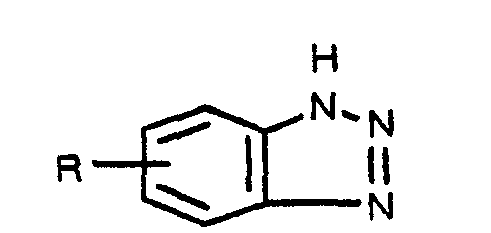
where R is hydrogen or is C1-4 alkyl.
where R is hydrogen or is C1-4 alkyl.
3. A method according to claim 2, wherein the benzotriazole is unsubstituted benzotriazole
or tolyltriazole.
4. A method according to any preceding claim, wherein the epoxy resin is based on
bisphenol A.
5. A method according to claim 1, claim 2 or claim 3, wherein the epoxy resin is triglycidyl
isocyanurate.
6. A method according to any preceding claim, wherein the polyester includes glycol
units derived from neopentyl glycol and acid units derived from one or more of terephthalic
and isophthalic acids, the acid residues optionally additionally including units derived
from another, mono- or di-carboxylic acid.
7. Use of a benzotriazole optionally substituted in the aromatic ring thereof as an
accelerator for the reaction between an epoxy resin and a polyester containing free
carboxyl groups.
8. Use according to claim 7 of a benzotriazole as an accelerator for the reaction
between an epoxy resin and a polyester containing free carboxyl groups.
1. Verfahren zum Umsetzen eines Epoxyharzes mit einem Polyester mit freien Carboxysäuregruppen
durch Erhitzen einer Mischung des Epoxyharzes und des Polyesters in Gegenwart eines
Beschleunigers dadurch gekennzeichnet, daß der Beschleuniger ein gegebenenfalls im
aromatischen Ring substituiertes Benzotriazol ist.
2. Verfahren nach Anspruch 1, bei dem das Benzotriazol die folgende Formel hat
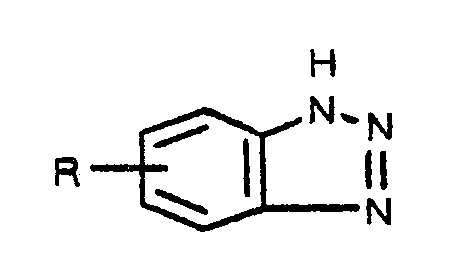
worin R Wasserstoff oder eine C,_4-Alkytgruppe ist.
worin R Wasserstoff oder eine C,_4-Alkytgruppe ist.
3. Verfahren nach Anspruch 2, wobei das Benzotriazol unsubstituiertes Benzotriazol
oder Tolyltriazol ist.
4. Verfahren nach irgendeinem vorhergehenden Anspruch, bei dem das Epoxyharz auf Bisphenol-A
beruht.
5. Verfahren nach Anspruch 1, 2 oder 3, worin das Epoxyharz Triglycidylisocyanurat
ist.
6. Verfahren nach irgendeinem vorhergehenden Anspruch, worin der Polyester von Neopentylglykol
abgeleitete Glykoleinheiten und von Terephthal- und/oder Isophthalsäure abgeleitete
Säureeinheiten enthält, wobei die Säureeinheiten gegebenenfalls zusätzlich Einheiten
einschließen, die von einer anderen Mono- oder Dicarboxylsäure abgeleitet sind.
7. Verwendung eines gegebenenfalls im aromatischen Ring substituierten Benzotriazols
als Beschleuniger der Umsetzung zwischen einem Epoxyharz und einem freie Carboxylgruppen
enthaltenden Polyester.
8. Verwendung nach Anspruch 7 eines benzotriazols als Beschleuniger für die Umsetzung
zwischen einem Epoxyharz und einem freie Carboxylgruppen enthaltenden Polyester.
1. Procédé de réaction d'une résine époxyde avec un polyester contenant des groupes
acides carboxyliques libres qui consiste à chauffer un mélange de la résine époxyde
et dudit polyester en présence d'un accélérateur caractérisé en ce que l'accélérateur
est un benzotriazole facultativement substitué dans le noyau aromatique.
2. Procédé selon la revendication 1 où le benzotriazole a pour formule
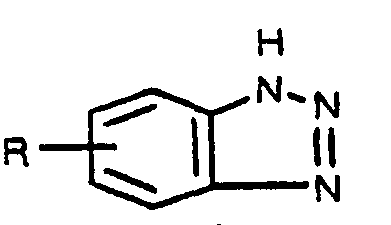
où R est hydrogène ou alcoyle Ci-4.
où R est hydrogène ou alcoyle Ci-4.
3. Procédé selon la revendication 2 où le benzotriazole est un benzotriazole non substitué
ou un tolyltriazole.
4. Procédé selon l'une quelconque des revendications précédentes où la résine époxyde
est à base de bisphénol A.
5. Procédé selon la revendication 1, la revendication 2 ou la revendication 3 où la
résine époxyde et le triglycidyl isocyanurate.
6. Procédé selon l'une quelconque des revendications précédentes où le polyester contient
des unités de glycol dérivées du néopentyl glycol et des unités d'acide dérivées d'un
ou plusieurs des acides téréphtalique et isophtalique, les résidus d'acide contenant
facultativement additionnellement des unités dérivées d'un autre acide mono- ou di-carboxylique.
7. Utilisation d'un benzotriazole facultativement substitué dans son noyau aromatique
en tant qu'accélérateur pour la réaction entre une résine époxyde et un polyester
contenant des groupes carboxyliques libres.
8. Utilisation selon la revendication 7 d'un benzotriazole en tant qu'accélérateur
pour la réaction entre une résine époxyde et un polyester contenant des groupes carboxyliques
libres.