| (19) |
 |
|
(11) |
EP 0 127 929 B1 |
| (12) |
EUROPEAN PATENT SPECIFICATION |
| (45) |
Mention of the grant of the patent: |
|
02.11.1988 Bulletin 1988/44 |
| (22) |
Date of filing: 14.03.1984 |
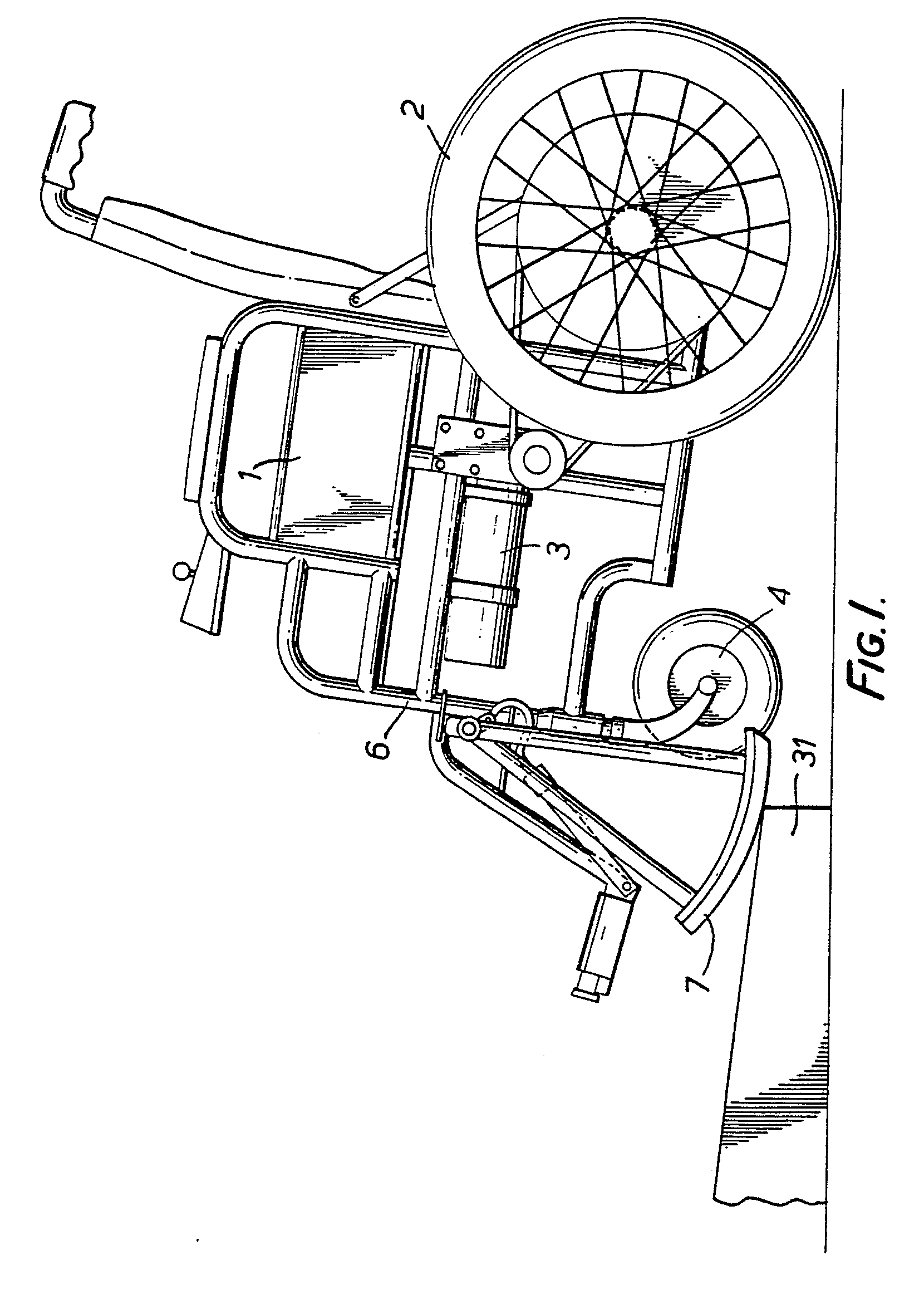
|
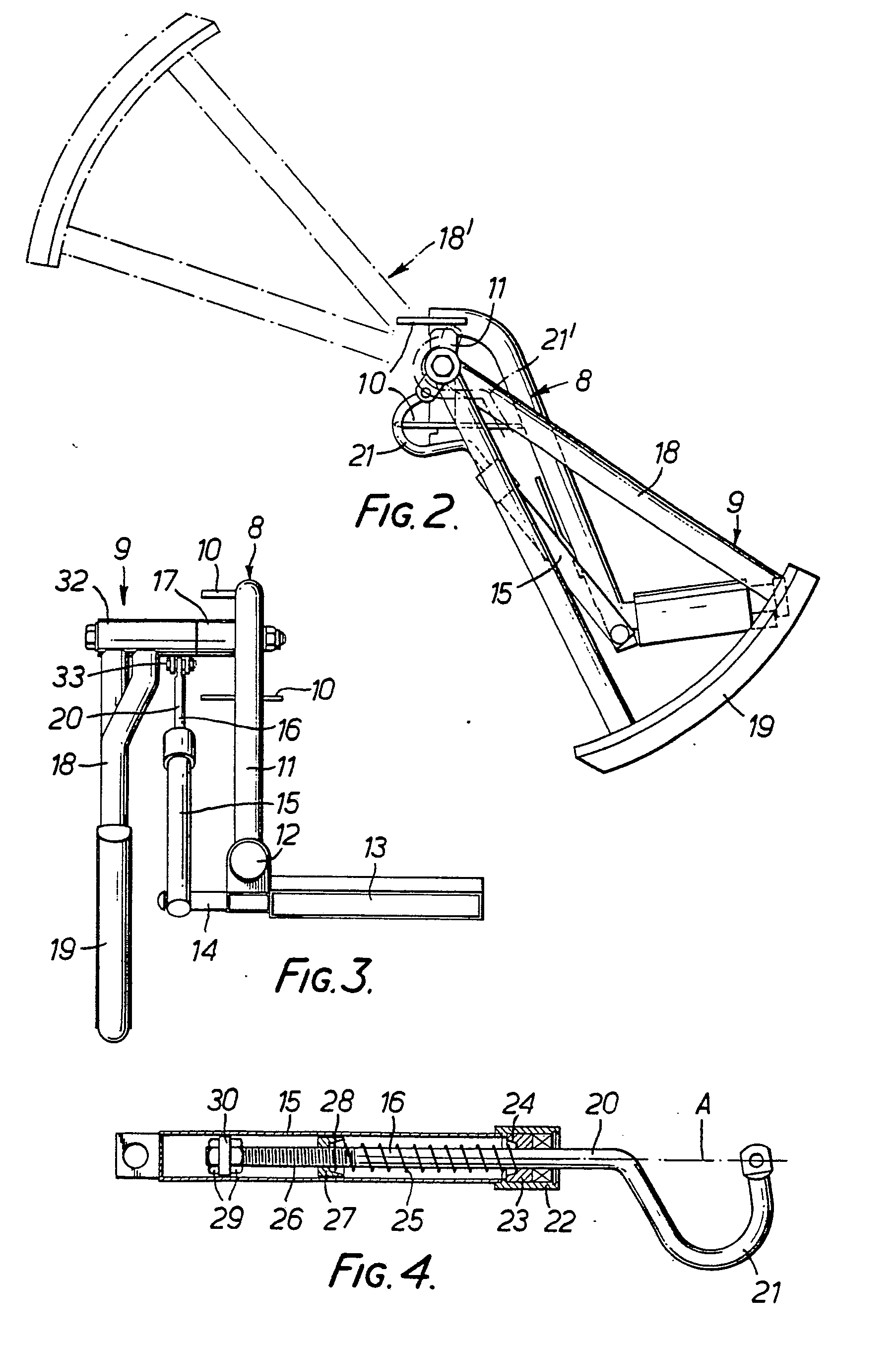
| (51) |
International Patent Classification (IPC)4: A61G 5/00 |
|
| (54) |
Kerb-climbing device for a wheeled vehicle
Bordkantensteige-Vorrichtung für ein Fahrzeug auf Rädern
Dispositif de franchissement de trottoir pour véhicule à roues
|
| (84) |
Designated Contracting States: |
|
AT BE CH DE FR GB IT LI NL SE |
| (30) |
Priority: |
16.03.1983 GB 8307295
|
| (43) |
Date of publication of application: |
|
12.12.1984 Bulletin 1984/50 |
| (73) |
Proprietor: CARTERS (J&A) LIMITED |
|
Westbury
Wiltshire (GB) |
|
| (72) |
Inventor: |
|
- Parker, Henry Noel
Cardiff
Wales (GB)
|
| (74) |
Representative: Burrows, Anthony Gregory et al |
|
Haseltine Lake & Co.
Hazlitt House
28 Southampton Buildings
Chancery Lane
London, WC2 1AT
London, WC2 1AT (GB) |
| (56) |
References cited: :
DE-A- 2 922 963
US-A- 2 612 379
US-A- 3 722 638
|
FR-A- 2 373 428
US-A- 3 239 872
|
|
| |
|
|
|
|
| |
|
| Note: Within nine months from the publication of the mention of the grant of the European
patent, any person may give notice to the European Patent Office of opposition to
the European patent
granted. Notice of opposition shall be filed in a written reasoned statement. It shall
not be deemed to
have been filed until the opposition fee has been paid. (Art. 99(1) European Patent
Convention).
|
[0001] This invention relates to a wheeled vehicle and an attachment therefor. The invention
is particularly concerned with kerb-climbing devices of wheelchairs.
[0002] GB-A-1 569 166 discloses a powered wheelchair with two large-diameter rear driven
wheels and two small-diameter front castor wheels. Mounted on the wheelchair frame
at respective locations above the castor wheels are two footrests turnable about respective
vertical axes, and also two kerb-climbing devices including respective struts turnable
about a horizontal axis. Each kerb-climbing device is fixed to the frame by fixing
means including a bolt and a wing nut. Each strut includes an arcuate rocker end which
contacts the kerb to be climbed. Acting between the wheelchair frame and the strut
is a return sping.
[0003] Each strut is turnable rearwards from a ready position in which it extends downwards
and forwards, against the action of the spring. In one version disclosed, when the
spring returns the strut to its ready position, an arm of the kerb-climbing device
strikes a locking plunger mounted on the wheelchair frame. Each plunger can be withdrawn
manually by a knurled pin against the action of a spring, to allow the strut to be
swung rearwards, against the action of its return spring, past the plunger, and then
the plunger is released to detain the strut in an idle position in which it extends
rearwards and upwards. Each arm is pivotally mounted at one end on its strut and at
the other end is urged against a stop by a spring, so that, if an abnormal force urges
the arm against its plunger, for example when the wheelchair is descending a kerb
backwards, the spring yields whilst the arm remains in contact with its plunger, and
no damage is done. In another version disclosed, each strut return spring is housed
in a cylinder which is turnably mounted on the wheelchair frame and through which
extends a rod encircled by the spring and articulated to the strut. In the ready position
of the strut, a circlip on the rod abuts against an annular disc supported by the
strut return spring. To bring the strut into an idle position in which it extends
upwards and rearwards it is swung forwards and over its pivot, to carry it through
a dead-centre position of the cylinder and the rod into the idle position, in which
the circlip again abuts against the annular disc. In a third version, each strut return
spring is a prestressed helical torsion spring the ends of which, in the ready position,
press on opposite edges of projections fixed to walls of an assembly. To bring the
strut to an idle position, a reciprocable pin is manually disengaged to release the
assembly for turning relative to the wheelchair frame, and after turning of the strut
and the assembly, the assembly is then re-connected to the frame by engagement of
the pin.
[0004] Such kerb-climbing devices have various disadvantages. Firstly, the striking of the
strut abutments against the frame abutments on return to the ready positions produces
jolts and noise which can be distressing and embarrassing for the patient in the wheelchair.
Secondly, compared to the conventional, simple arrangements permitting easy detachment
of footrests or leg- rests from wheelchair frames, the bolt-and wing- nut-arrangements
make detachment of the kerb-climbing devices from the frame difficult, particularly
for the patient in the wheelchair. Thirdly, in moving the strut from its ready position
to its idle position, either some detent, i.e. the plunger or the pin, has to be disengaged
beforehand, which can be awkward particularly for the patient in the wheelchair, or
circlips and discs come to abut each other, thereby creating jolts and noise.
[0005] US-A-2,612,379 discloses attachments which can be applied to a vehicle such as a
hand truck and which enable the truck to be drawn smoothly over a flight of steps.
The attachments each include a sectorial strut pivotally mounted on the frame of the
truck and having an arcuate rocker end which contacts the edge of the step. Connected
between the strut and the frame are a piston-and-cylinder device of which the piston
is interposed between two helical springs for maintaining the strut in its ready position.
The piston-and-cylinder device has substantially no damping effect. This attachment
has a number of disadvantages which make it unsuitable particularly for use on an
invalid carriage. Firstly, the actual position of the strut in its ready condition
is liable to vary considerably, since the springs allow the strut to swing to-and-fro,
which is most likely to occur if the truck is being roughly handled over rough ground,
with the result that the arcuate rocker end misses the step edge and the vehicle runs
hard up against the step. Secondly, the attachments are not readily detachable from
the vehicle.
[0006] There is known from DE-A-2 922 963 a double- acting shock-absorbing device for sliding
doors and the like, comprised of a cylinder containing, near respective ends of the
cylinder, two pistons with one or two compression springs between them. Through the
pistons extend respective piston rods which not only project axially outwardly from
the housing for connection to sliding door parts, but also project axially inwardly
from the pistons and are there hollow for enabling a damping fluid contained in the
cylinder to flow to the spaces between the pistons and their adjacent cylinder ends.
Fixed co-axially in the hollow inner end of one of the piston rods is a piece of tube
extending towards the other piston rod. As the pistons are moved towards each other
from their outer end positions, this tube piece approaches the hollow inner end of
the other piston rod and then begins to penetrate it. Since the latter hollow inner
end narrows conically axially outwardly, the free gap between the tube piece and the
hollow inner end continuously decreases. This arrangement gives a progressively greater
damping effect by the damping fluid. In the rest condition of this shock-absorbing
device, the pistons lie against shoulders on the inside of the cylinder.
[0007] This shock-absorbing device is unsuitable for use in obstruction-climbing devices
of vehicles, because the pistons lie against abutments in the rest condition and there
is no significant damping effect in the rest condition.
[0008] According to a first aspect of the present invention, there is provided a wheeled
vehicle, at least one wheel of which has associated therewith a device for facilitating
negotiation by said wheel of a kerb or similar obstruction, said device comprising
a strut mounted on the vehicle for turning about a horizontal axis higher than the
axis of the wheel, characterised in that said device comprises a liquid damping means
arranged to damp said turning movement in a ready position of said strut.
[0009] An advantage of this vehicle is that the strut can be reliably maintained in a relatively
unvarying ready position, without the return of the strut to its ready position producing
any substantial jolting or noise.
[0010] According to a second aspect of the present invention, there is provided an attachment
for detachably mounting on a frame of a wheeled vehicle, said attachment comprising
a rest for a foot or a leg of an occupant of the vehicle, characterised in that said
attachment also comprises a device for association with a wheel of said vehicle for
facilitating negotiation by said wheel of a kerb or similar obstruction, said device
comprising a strut mounted for turning about an axis which is horizontal when said
attachment is mounted on said frame of said wheeled vehicle, and liquid damping means
arranged to damp the turning movement of said strut.
[0011] Such combining together of an obstruction-climbing device and a foot-or leg-rest
enables the combined attachment to be readily removable as a single unit from the
vehicle..
[0012] In order that the invention may be clearly understood and readily carried into effect,
reference will now be made, by way of example, to the accompanying drawings, in which:-
Figure 1 shows a side view of an occupied, motorized wheelchair climbing a kerb-like
obstruction,
Figure 2 shows a side elevation of an attachment of the wheelchair, the attachment
including an obstruction-climbing device which is shown in full lines in a ready position
and in dot-dash lines in an idle position,
Figure 3 shows a front elevation of the attachment, with the obstruction-climbing
device in its ready position, and
Figure 4 shows an axial sectional view through a piston-and-cylinder device of the
obstruction-climbing device.
[0013] Referring to the drawings, the wheelchair 1 has two large-diameter rear wheels (of
which one is seen and referenced 2) reversibly driven by respective electric motors
(of which one is seen and referenced 3). The wheelchair 1 also includes two small-diameter,
castor, front wheels 4, the wheels 2 and 4 being mounted on a transversely collapsible
frame of the wheelchair. At its front, the frame of the wheelchair includes two uprights
(of which one is seen and referenced 6), on which respective attachments 7 are so
mounted as to be swingable about the uprights from the forwardly projecting positions
shown in Figure 1 outwardly into positions in which they are detachable from the uprights.
[0014] Each attachment 7 comprises a footrest 8 and an obstruction-climbing device 9 mounted
on the footrest 8. Thereby the footrest 8 and the device 9 can be removed as a unit
from the wheelchair frame to facilitate replacement temporarily by a conventional
footrest unit where necessary to reduce the wheelchair width for passing through doorways,
for example, or where kerb-climbing ability is not required. In a conventional manner,
the footrest 8 includes two horizontal plates 10 by way of which it is mounted on
two vertical pivot pins fixed to the upright 6. The plates 10 are fixed to a tubular
bracket 11, a forwardly projecting part 12 of which pivotally supports a foot pad
13. Fixed to and projecting laterally outwards from the part 12 is a horizontal pivot
pin 14 on which is pivotally mounted the lower end of a cylinder 15 of a piston-and-cylinder
device 15, 16 of the device 9. Fixed to the upper part of the bracket 11 is a horizontal
axle 17 on which a sectorial strut 18 is pivotally mounted. The strut 18 includes
an arcuate obstruction-contacting part 19. The piston 16 includes a piston rod 20
the upper end zone 21 of which is in the shape of a hook and terminates on the axis
A of the device 15, 16. At this terminal end it is horizontally articulated to a horizontal
bush 32 of the strut 18 by way of a horizontal nut-and-bolt device 33. The cylinder
15 is oil-filled and sealed in a liquid-tight manner at each end. At its upper end,
it is sealed by a stopper 22 which sealingly encircles the piston rod 20. The stopper
22 includes a bush 23 formed with an axially downwardly facing frusto-conical bearing
surface 24 which bears an upper end of a helical compression spring 25 encircling
the piston rod 20. The lower end zone of the piston rod 20 is formed with external
screwthreading 26 on which is screwed an internally threaded bush 27 formed with an
axially upwardly facing frusto-conical bearing surface 28 which bears the lower end
of the spring 25. Two nuts 29 are screwed onto the lower end of the piston rod 20
and clamp a washer 30 between them. Between the washer 30 and the inner cylindrical
wall of the cylinder 15 is a clearance through which the oil in the cylinder can be
forced to flow.
[0015] The method of use of the obstruction-climbing device 9 is as follows:-
[0016] The strut 18 normally occupies its ready position shown in Figure 2, in which it
is maintained by the clockwise moment produced by its own weight being opposed by
the anti-clockwise moment produced by the spring 25. The damping provided by the oil
in the cylinder 15 substantially prevents any undesired oscillatory movement of the
ready strut 18 during travel of the wheelchair. During such travel, the castor wheels
4 themselves cope with any small obstructions on the ground or floor, such as those
which are about 2 1/2 cm (1") or 5cm. (2") high. However, any obstructions above that
general height and up to about 121/2 cm. (5") high are encountered by and negotiated
with the aid of the device 9. As the wheelchair advances towards the obstruction 31,
the obstruction-contacting parts 19 come to bear against the obstruction. The continued
operation of the motors of the wheelchair and thus the continued driving of its rear
wheels causes each strut 18 to rock upon the obstruction while the wheelchair advances
against the action of the spring 25 and against the damping action of the oil in the
cylinder 15, so lifting the front of the wheelchair (through for example the condition
shown in Figure 1), until the wheels 4 ride up onto the obstruction 31. Thereupon,
each strut 18 is swung back into its ready position shown in Figure 2 by the spring
25, but against the damping action of the oil in the cylinder 15. The rear wheels
are of course of a sufficient diameter to be able to ride up onto the obstruction
31 simply under the action'of the motors. In order that the strut 18 can be put into
an idle position in which it is out of the way of the footrest 8, to facilitate manoeuvering
in level, but cramped, conditions, it can be swung clockwise from the ready position
shown in Figure 2 into an idle position 18' indicated in dot-dash lines in Figure
2. In this condition of the device 9, the hook-shaped zone 21 is hooked over and bears
against the bush 32, as indicated at 21', in which condition the axis A has been displaced
in a vertical plane and through the horizontal axis of the axle 17, so that the spring
25 is applying to the strut 18 a clockwise moment, which moment is significantly greater
than the anti-clockwise moment produced by the weight of the strut in its position
18'. The strut 18 is thereby maintained in that position until it is desired to return
it anti-clockwise to its ready position, which the occupant can initiate by simply
pressing the strut 18 downwards through the dead-centre position. That end of the
spring 25 adjacent the bush 27 remains in contact therewith throughout movement of
the piston rod 20 relativeto the cylinder 15.
[0017] The connection of the upper end of the piston rod 20 to the bush 32 by way of the
nut-and-bolt device 33 allows the piston rod 20 to be disconnected from the bush 32
and rotated about the axis A. Such rotation is required to adjust the compression
in the spring 25 for a given length of the device 15, 16, so as to permit angular
setting of the ready position of the strut 18. Rotation of the piston rod 20 achieves
such adjustment because it screws the bush 27 along the piston rod 20, the bush 27
being held against rotation with the piston rod 20 by the frictional forces between
the ends of the spring 25 and the frusto-conical bearing surfaces 24 and 28 of the
bushes 23 and 27.
1. A wheeled vehicle, at least one wheel (4) of which has associated therewith a device
(9) for facilitating negotiation by said wheel (4) of a kerb or similar obstruction
(31), said device (9) comprising a strut (18) mounted on the vehicle (1) for turning
about a horizontal axis higher than the axis of the wheel (4), characterised in that
said device (9) comprises a liquid damping means (15, 16) arranged to damp said turning
movement in a ready position of said strut (18).
2. A vehicle according to claim 1, wherein said liquid damping means (15, 16) comprises
a cylinder (15) containing the damping liquid, a piston head (29, 30) in said cylinder,
a piston rod (20) connected to said piston head (29, 30), aperture means whereby said
liquid can flow from one axial side of said piston head (29, 30) to the other in a
throttled manner, and a return spring (25) arranged to return said strut (18) to said
ready position after said strut (18) has rocked on said obstruction (31).
3. A vehicle according to claim 2, wherein said return spring (25) extends between
said piston head (29,30) and one end of said cylinder (15) and encircles said piston
rod (20), which is connected to an end portion of said spring (25) which remains in
a substantially fixed position relative to said rod (20) throughout movement of said
strut (18).
4. A vehicle according to claim 2, wherein said return spring (25) extends between
said piston head (29, 30) and one end of said cylinder (15) and encircles said piston
rod (20), and there is on said piston rod (20) an abutment (27) bearing one end of
said spring (25) and arranged to move longitudinally with the piston (16), said piston
(16) and said cylinder (15) being turnable relative to each other about the axis of
the cylinder (15) to adjust said abutment (27) along said piston rod (20) thereby
to adjust said one end of said spring (25) along said piston rod (20).
5. A vehicle according to claim 4, wherein said abutment (27) has means (28) serving
to discourage rotation of said abutment (27) relative to said piston rod (20) about
said piston rod (20), and wherein the other end of said spring (25) bears on said
cylinder (15) by way of means (24) serving to discourage rotation of said spring (25)
relative to said cylinder (15).
6. A vehicle according to claim 5, wherein each said means (24, 28) serving to discourage
rotation comprises a frusto-conical bearing surface (24, 28) facing said spring (25)
and substantially coaxial with said piston rod (20).
7. A vehicle according to any preceding claim wherein said strut (18) is turnable
from said ready position, in which said spring (25) applies a moment to said strut
(18) in one sense round said axis, into an idle position (18'), in which said spring
(25) applies a moment to said strut (18) in the opposite sense and stop means (21,
32) detains said strut (18) in said idle position (18').
8. A vehicle according to claim 7, wherein said cylinder (15) is mounted for turning
about a transverse horizontal axis remote from the outer end (21) of said piston rod
(20), and said stop means (21, 32) comprises a stop (32) arranged on the axis of turning
of said strut (18), and a hook- form part (21) of said piston rod (20) outside said
cylinder (15) and arranged to hook about and bear against said stop (32) in said idle
position (18') of said strut (18).
9. A vehicle according to claim 8, wherein said stop (32) is fixed to said strut (18)
and pivotally mounts the outer end (21) of said piston rod (20).
10. A vehicle according to any preceding claim, and including a frame (6) and an attachment
(7) detachably mounted on said frame (6), said attachment (7) comprising said device
(9) and a rest (8) for a foot or a leg of an occupant of the vehicle (1).
11. An attachment for detachably mounting on a frame of a wheeled vehicle, said attachment
(7) comprising a rest (8) for a foot or a leg of an occupant of the vehicle (1), characterised
in that said attachment (7) also comprises a device (9) for association with a wheel
(4) of said vehicle (1) for facilitating negotiation by said wheel (4) of a kerb or
similar obstruction (31), said device comprising a strut (18) mounted for turning
about an axis which is horizontal when said attachment is mounted on said frame of
said wheeled vehicle, and liquid damping means (15,16) arranged to damp the turning
movement of said strut (18).
1. Fahrzeug mit Rädern, bei dem wenigstens einem Rad (4) eine Vorrichtung (9) zur
Erleichterung der Überwindung einer Bordkante oder eines ähnlichen Hindernisses (31)
durch dieses Rad (4) zugeordnet ist, wobei die genannte Vorrichtung (9) eine Strebe
(18) enthält, die um eine horizontale Achse, welche höher liegt als die Achse des
Rads (4), drehbar am Fahrzeug (1) angebracht ist, dadurch gekennzeichnet, daß die
genannte Vorrichtung (9) eine Flüssigkeitsdämpfungseinrichtung (15, 16) enthält, um
die Schwenkbewegung der Strebe (18) in einer einsatzbereiten Position der genannten
Strebe (18) zu dämpfen.
2. Fahrzeug nach Anspruch 1, wobei die Flüssigkeitsdämpfungseinrichtung (15, 16) einen
Zylinder (15) mit der Dämpfungsflüssigkeit, einen Kolbenkopf (29, 30) in dem genannten
Zylinder, eine mit dem genannten Kolbenkopf (29, 30) verbundene Kolbenstange (20),
Durchströmeinrichtungen anhand der die genannte Flüssigkeit von einer axialen Seite
des genannten Kolbenkopfes (29, 30) zur anderen in gedrosselter Weise strömen kann,
sowie eine Rückstellfeder (25) aufweist, die so angeordnet ist, daß die genannte Strebe
(18) in die genannte einsatzbereite Position zurückkehrt, nachdem die genannte Strebe
(18) an dem genannten Hindernis (31) eine Schwenkbewegung ausgeführt hat.
3. Fahrzeug nach Anspruch 2, wobei sich die genannte Rückstellfeder (25) zwischen
dem genannten Kolbenkopf (29, 30) und einem Ende des genannten Zylinders (15) erstreckt
und die genannte Kolbenstange (20) umgibt, die mit einem Endbereich der genannten
Feder (25) verbunden ist, die während der ganzen Bewegung der genannten Strebe (18)
in einer im wesentlichen fixen Position relativ zur genannten Kolbenstange (20) verbleibt.
4. Fahrzeug nach Anspruch 2, wobei sich die genannte Rückstellfeder (25) zwischen
dem genannten Kolbenkopf (29, 30) und einem Ende des genannten Zylinders (15) erstreckt
und die genannte Kolbenstange (20) umgibt, und dabei ist auf der genannten Kolbenstange
(20) ein Widerlager (27) vorgesehen, das ein Ende der genannten Feder (25) abstützt
und so angeordnet ist, daß es sich mit dem Kolben (60) in Längsrichtung bewegt, wobei
der genannte Kolben (16) und der genannte Zylinder (15) relativ zueinander um die
Achse des Zylinders (15) drehbar sind, um das genannte Widerlager (27) entlang der
genannten Kolbenstange (20) einzustellen und dementsprechend das eine Ende der genannten
Feder (25) entlang der genannten Kolbenstange (20) einzustellen.
5. Fahrzeug nach Anspruch 4, wobei das genannte Widerlager (27) Mittel (28) zum Verhindern
einer Drehung des genannten Widerlagers (27) relativ zu der genannten Kolbenstange
(20) aufweist und wobei das andere Ende der genannten Feder (25) unter Verwendung
von Mitteln (24), die dazu dienen, eine Drehung der genannten Feder (25) relativ zum
genannten Zylinder (15) zu verhindern, am genannten Zylinder (15) abgestützt ist.
6. Fahrzeug nach Anspruch 5, wobei jedes der genannten Mittel (24, 28) zur Verhinderung
einer Drehung eine kegelstumpfförmige Lagerfläche (24, 28) aufweist, welche die genannte
Feder (25) berührt und im wesentlichen koaxial zur genannten Kolbenstange (20) verläuft.
7. Fahrzeug nach einem der vorhergehenden Ansprüche, wobei die genannte Strebe (18)
von der genannten einsatzbereiten Stellung, in welcher die genannte Feder (25) ein
Moment in der einen Richtung um die genannte Achse auf die genannte Strebe (18) ausübt,
in eine Schwenkstellung (18'), in welcher die genannte Feder (25) ein Moment in der
entgegengesetzten Richtung auf die genannte Strebe (18) ausübt, schwenkbar ist, und
wobei Anschlagmittel (21, 32) die genannte Strebe (18) in der Schwenkstellung (18')
aufhalten.
8. Fahrzeug nach Anspruch 7, wobei der genannte Zylinder (15) um eine quer verlaufende,
horizontale Achse, die vom äußeren Ende (21) der genannten Kolbenstange (20) entfernt
ist, drehbar ist, und wobei die Anschlagmittel (21, 32) einen auf der Drehachse der
genannten Strebe (18) angeordneten Anschlag (32) und einen hakenförmigen Bereich (21)
der genannten Kolbenstange (20) enthalten, der sich außerhalb des genannten Zylinders
(15) befindet und so angeordnet ist, daß er den genannten Anschlag (32) in der genannten
Schwenkstellung (18') der genannten Strebe (18) übergreift und hieran anliegt.
9. Fahrzeug nach Anspruch 8, wobei der genannte Anschlag (32) an der genannten Strebe
(18) befestigt ist und das äußere Ende (21) der genannten Kolbenstange (20) schwenkbar
trägt.
10. Fahrzeug nach einem der vorhergehenden Ansprüche und mit einem Rahmen (6) und
einer Zusatzeinrichtung (7), die abnehmbar an dem genannten Rahmen (7) gehalten ist,
wobei die genannte Zusatzeinrichtung (7) die genannte Vorrichtung (9) und eine Stütze
(8) für einen Fuß oder ein Bein des Benutzers des Fahrzeugs (1) enthält.
11. Anbaueinrichtung, die abnehmbar am Rahmen eines mit Rädern versehenen Fahrzeugs
aufnehmbar ist und die eine Stütze (8) für einen Fuß oder ein Bein des Benutzers des
Fahrzeugs (8) enthält, dadurch gekennzeichnet, daß die genannte Anbauvorrichtung (7)
auch eine mit einem Rad (4) des genannten Fahrzeugs (1) zusammenwirkende Vorrichtung
(9) zur Erleichterung der Überwindung der einer Bordkante oder eines ähnlichen Hindernisses
(31) enthält, wobei die genannte Vorrichtung eine Strebe (18) enthält, die um eine
in der an den genannten Rahmen des genannten, mit Rädern versehenen Fahrzeugs angebauten
Stellung der Anbaueinrichtung horizontale Achse drehbar ist, und daß die Anbaueinrichtung
(7) ferner eine Flüssigkeitsdämpfungseinrichtung (15, 16) enthält, um die Schwenkbewegung
der genannten Strebe (18) zu dämpfen.
1. Véhicule roulant, dont à au moins une roue (4) est associé un dispositif (9) destiné
à faciliter une négociation par ladite roue (4) d'une bordure de trottoir ou d'un
obstacle similaire (31), ce dispositif (9) comprenant une jambe (18) montée sur le
véhicule (1) pour tourner autour d'un axe horizontal situé plus haut que l'axe de
la roue (4), caractérisé en ce que le dispositif (9) comprend un moyen amortisseur
(15,16) à liquide agencé de manière à amortir ledit mouvement de rotation dans une
position prête à fonctionner de ladite jambe (18).
2. Véhicule selon la revendication 1, dans leqel ledit moyen amortisseur (15, 16)
à liquide comprend un cylindre (15) contenant le liquide amortisseur, une tête (29,
30) de piston dans ledit cylindre, une tige (20) de piston reliée à ladite tête (29,
30) de piston, un moyen formant ouverture grâce auquel le liquide peut s'écouler d'un
des côtés axiaux de ladite tête (29, 30) de piston jusqu'à l'autre côté d'une manière
étranglée, et un ressort (25) de rappel disposé de manière à rappeler ladite jambe
(18) jusqu'à ladite position prête à fonctionner après que la jambe (18) a basculé
sur ledit obstacle (31).
3. Véhicule selon la revendication 2, dans lequel le ressort (25) de rappel s'étend
entre la tête (29, 30) de piston et une des extrémités du cylindre (15) et entoure
la tige (20) de piston qui est reliée à une partie terminale du ressort (25) lequel
reste dans une position sensiblement fixe par rapport à la tige (20) pendant tout
le déplacement de la jambe (18).
4. Véhicule selon la revendication 2, dans lequel le ressort (25) de rappel s'étend
entre la tête (29, 30) de piston et une des extrémités du cylindre (15) et entoure
la tige (20) de piston, et sur la tige (20) de piston se trouve un élément de butée
(27) portant contre une première extrémité du ressort (25) et agencé de manière à
se déplacer longitudinalement avec le piston (16), le piston (16) et le cylindre (15)
pouvant être déplacés en rotation l'un par rapport à l'autre autour de l'axe du cylindre
(15) pour ajuster ledit élément de butée (27) le long de la tige (20) de piston, de
manière à ajuster ainsi ladite première extrémité du ressort (25) le long de la tige
(20) de piston.
5. Véhicule selon la revendication 4, dans lequel l'élément de butée (27) comporte
un moyen (28) servant à s'opposer à la rotation de l'élément de butée (27) par rapport
à la tige (20) de piston autour de cette tige (20) de piston, et dans lequel la seconde
extrémité du ressort (25) porte contre le cylindre (15) par l'intermédiaire d'un moyen
(24) servant à s'opposer à la rotation du ressort (25) par rapport au cylindre (15).
6. Véhicule selon la revendication 5, dans lequel chacun des moyens (24, 28) servant
à s'opposer à la rotation comprend une surface de portée tronconique (24, 28) qui
se trouve en regard du ressort (25) et est sensiblement coaxiale à la tige (20) de
piston.
7. Véhicule selon l'une quelconque des revendications précédentes, dans lequel la
jambe (18) peut pivoter depuis ladite position prête à fonctionner, dans laquelle
le ressort (25) applique un moment à la jambe (18) dans un premier sens autour dudit
axe, jusqu'à une position de repos (18') dans laquelle le ressort (25) applique un
moment à la jambe (18) en sens opposé et un moyen de butée (21,32) retient la jambe
(18) dans la position de repos (18').
8. Véhicule selon la revendication 7, dans lequel le cylindre (15) est monté en vue
de tourner autour d'un axe horizontal transversal, distant de l'extrémité extérieure
(21) de la tige (20) de piston, et le moyen d'arrêt (21, 32) comprend une butée (32)
disposée sur l'axe de rotation de ladite jambe (18), et une partie (21) en forme de
crochet de la tige (20) de piston à l'extérieur du cylindre (15) et agencée de manière
à accrocher la butée (32) et à porter contre cette butée dans la position de repos
(18') de la jambe (18).
9. Véhicule selon la revendication 8, dans leqel la butée (32) est fixée à la jambe
(18) et supporte de façon pivotante l'extrémité extérieure (21) de la tige (20) de
piston.
10. Véhicule selon l'une quelconque des revendications précédentes, et comprenant
un bâti (6) et un agencement auxiliaire (7) monté de façon amovible sur la bâti (6),
ledit agencement auxiliaire (7) comprenant le dispositif (9) et un repose pied (8)
pour un pied ou une jambe d'un occupant du véhicule (1).
11. Agencement auxiliaire destiné à être monté de façon amovible sur un bâti d'un
véhicule roulant, cet agencement auxiliaire (7) comprenant un repose pied (8) pour
un pied ou une jambe d'un occupant d'un véhicule (1), caractérisé en ce que l'agencement
auxiliaire (7) comprend aussi un dispositif (9) destiné à être associé à une roue
(4) du véhicule (1) pour faciliter la négociation par ladite roue (4) d'une bordure
de trottoir ou d'un obstacle similaire (31), le dispositif précité comprenant une
jambe (18) montée en vue d'une rotation autour d'un axe qui est horizontal lorsque
l'agencement auxiliaire est monté sur le bâti du véhicule roulant, et un moyen amortisseur
(15,16) à liquide agencé de manière à amortir ou freiner le mouvement de rotation
de la jambe (18).