| (19) |
 |
|
(11) |
EP 0 128 017 B1 |
| (12) |
EUROPEAN PATENT SPECIFICATION |
| (45) |
Mention of the grant of the patent: |
|
25.07.1990 Bulletin 1990/30 |
| (22) |
Date of filing: 31.05.1984 |
|
|
| (54) |
Oven for heating can ends
Ofen zum Beheizen von Dosendeckeln
Four pour le chauffage des fonds de boites métalliques
|
| (84) |
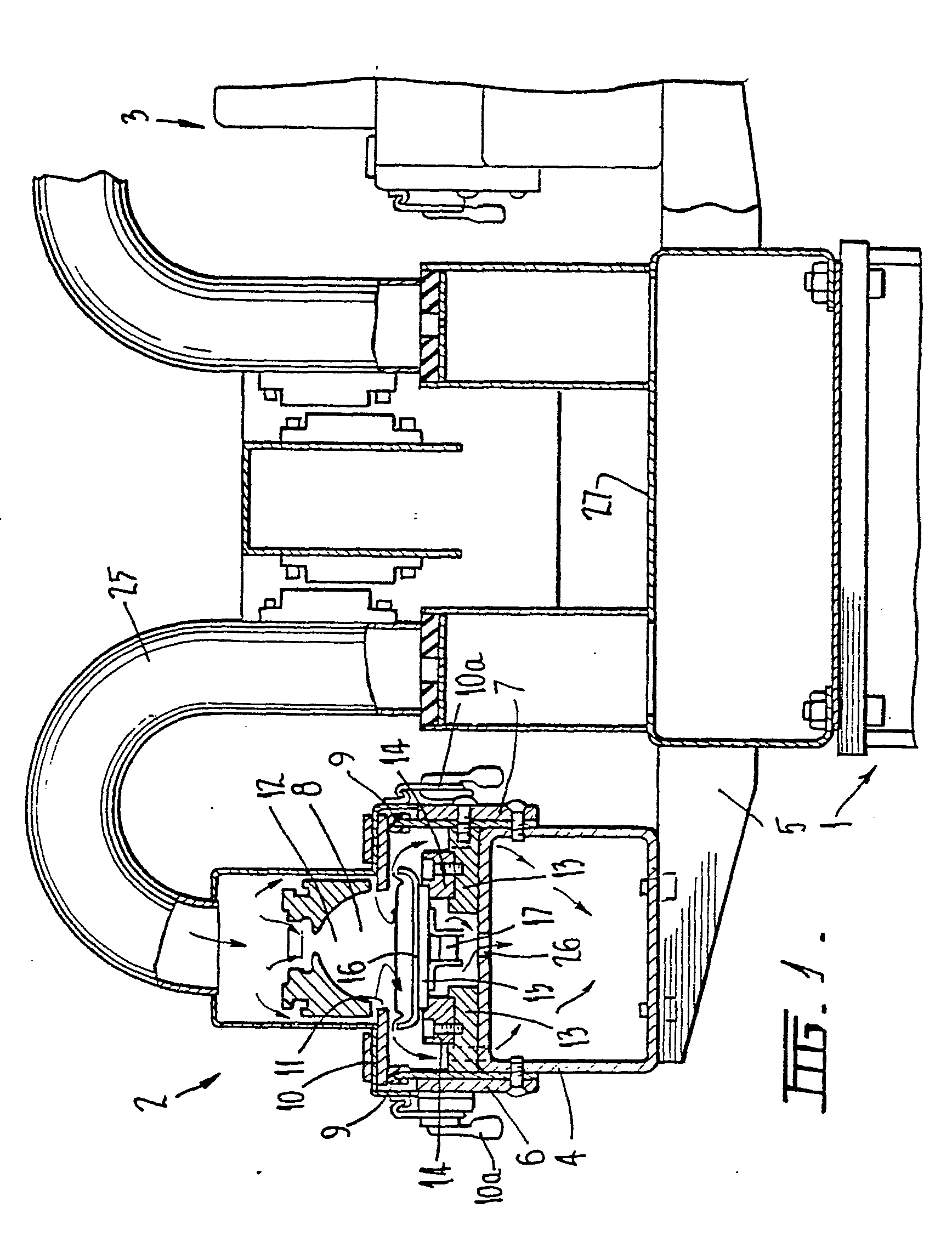
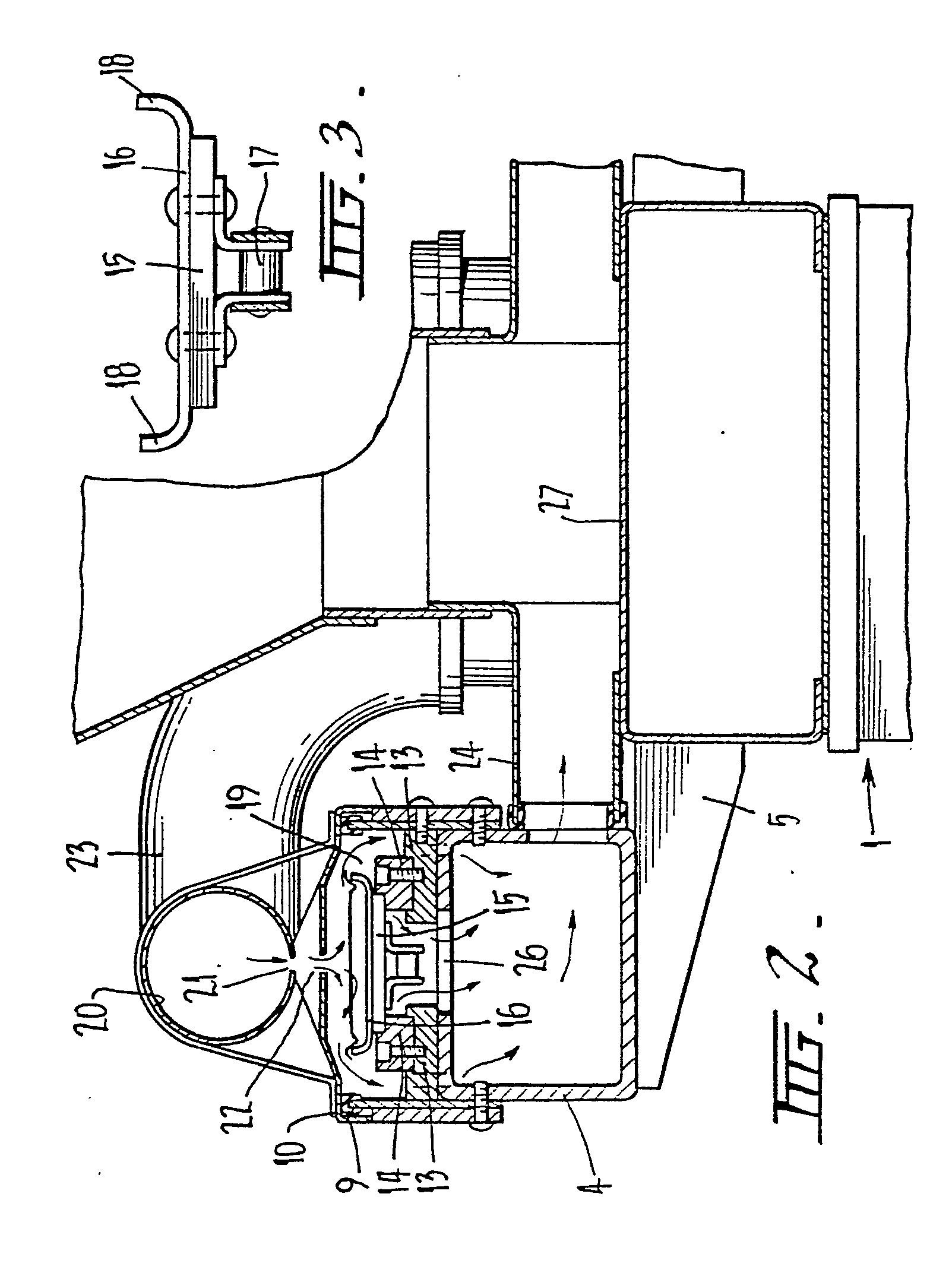
Designated Contracting States: |
|
AT BE CH DE FR GB IT LI LU NL SE |
| (30) |
Priority: |
02.06.1983 AU 9664/84
|
| (43) |
Date of publication of application: |
|
12.12.1984 Bulletin 1984/50 |
| (73) |
Proprietor: THE BROKEN HILL PROPRIETARY
COMPANY LIMITED |
|
Melbourne, Victoria 3000 (AU) |
|
| (72) |
Inventors: |
|
- Debenham, Michael
Victoria (AU)
- Farfor, James Douglas
Victoria (AU)
|
| (74) |
Representative: Kirk, Geoffrey Thomas et al |
|
BATCHELLOR, KIRK & CO.
2 Pear Tree Court
Farringdon Road
London EC1R 0DS
London EC1R 0DS (GB) |
| (56) |
References cited: :
FR-A- 2 517 041
US-A- 3 995 075
|
US-A- 2 846 972
US-A- 4 327 665
|
|
| |
|
|
|
|
| |
|
| Note: Within nine months from the publication of the mention of the grant of the European
patent, any person may give notice to the European Patent Office of opposition to
the European patent
granted. Notice of opposition shall be filed in a written reasoned statement. It shall
not be deemed to
have been filed until the opposition fee has been paid. (Art. 99(1) European Patent
Convention).
|
[0001] This invention relates to improvements in ovens and transporting systems for ovens
for the curing of sealants and baking of lacquers applied to ends for containers such
as cans.
[0002] Easy-opening can ends of the push-in type, such as those described in Australian
Patents Nos. 444,068, 518,940, 523,783, 528,006 require discrete areas of sealant
to be applied in the region of the edges of the push-in tabs to hermetically seal
the can end. Sealant is usually applied to discrete areas covering the cut edges of
the tabs and openings, for example by the system described in Australian Patent No.
477,562.
[0003] US-A-4 327 665 describes a method of coating lacquer coatings on the inside of can
bodies to protect their content from possible metal contamination by exposing the
coatings on the can to infrared radiation from a plurality of serially arranged lamps
as the cans are moved on the conveyor.
[0004] In the case of so-called "ring-pull ends", it is sometimes necessary to apply repair
lacquer to the can end in the region of the score defining the tab and this lacquer
is usually subsequently baked to drive off volatiles.
[0005] Where easy-opening can ends of the push-in type are manufactured from steel, it is
desirable to protect the short edges of the opening(s) formed by the end conversion
process and this may be done by spraying repair lacquer or some other form of repair
coating onto the can end in that region of the end. This protective material must
similarly be baked to drive off volatiles and to ensure that the lacquer is substantially
dry before the can ends are stored or packaged for future use.
[0006] Until the present invention, ovens used in the can manufacturing industry have been
extremely large, inefficient and not particularly suited to the efficient curing of
sealant applied to push-in tab ends or to the efficient baking of repair lacquer applied
to such ends. Known ovens not only occupy much available floor space in a can manufacturing
plant but also cause the surrounding areas of the plant to be undesirably heated making
it uncomfortable for the plant operators.
[0007] It is the object of the present invention to provide several distinct and desirable
improvements to ovens suitable for heating can ends for the above described and other
purposes.
[0008] In a first aspect, the present invention provides an oven for heating metal can ends
having a curled edge comprising a generally elongate heating chamber; conveying means
for conveying the metal can ends through the chamber; a source of radiant heat arranged
such that, in use, heat from the source is directed on to the adjacent surface of
each can end as it is conveyed through the chamber; said conveying means comprising
slatted elements constructed and arranged to engage each can end only at two regions
of its curled edge so that a sealant or lining compound disposed on that surface of
the can end which is remote from the source of radiant heat is spaced from the conveying
means.
[0009] By conveying the can ends through the heating chamber in the above manner, heat is
applied principally to the upper surface of the end and the metal is heated to ensure
that the sealant applied to the opposite surface is heated by a conduction process
through the metal and then outwardly through the sealant rather than from the outside
surface of the sealant inwardly. Thus, the non-critical outside surface of the end
is heated and the likelihood of a cured skin forming over the surface of any repair
lacquer on the end is reduced whereby the proper curing of the sealant and the proper
escape of volatiles is enhanced.
[0010] Furthermore, since the sealant is directed downwardly, it tends to retain its discrete
'printed' shape and profile and has less tendency to spread as it is heated.
[0011] The heat source is a radiant heat source located within the elongate heating chamber
and preferably incorporates means for directing radiant heat on to the upwardly directed
surface of the can ends as they pass through the heating chamber. More preferably,
the heat source is an infra-red heat source having a high density short-wave length
emanation which is selected to penetrate any repair lacquer applied to the upwardly
directed surface of the can end so as to directly heat the metal of the end. The wave
length of the emanation is preferably of the order of 1 micron and the temperature
of the heat source is preferably of the order of 2120°C.
[0012] In a second aspect of the invention, there is provided a method of heating can ends
in an oven, said can ends having an upper surface and a lower surface, said lower
surface being at least partially coated with a heat curable coating, the oven comprising
an elongate heating chamber, a source of heat disposed within said heating chamber
and operable to heat said chamber, and conveying means disposed beneath said source
of heat for conveying the can ends through the heating chamber, said conveying means
including support means engageable of said can ends and supporting said can ends without
contacting the heat curable coating, said method comprising supporting said can ends
on said support means with said lower surface directed downwardly, conveying said
so-supported can ends beneath said source of heat so that said source of heat is operable
principally to heat the upper surface of said can ends whereby said heat-curable coating
is cured principally by heat absorbed by said can ends.
[0013] It will be appreciated that contact with the curled edge of a can is relatively non-critical
since it is turned in when the end is applied to a can body. Therefore, the contact
between the conveyor and the end is in a region which will not be exposed to the final
product.
[0014] The supporting of the can ends in the above described manner also ensures that the
countersink portion of the end is not in contact with the conveyor so that any protective
lacquer coating applied to the underside of the can end will remain undamaged. Furthermore,
the sealant applied to the downwardly directed surface of the end is similarly untouched
by the conveyor during its passage through the oven.
[0015] The conveyor is preferably constructed from a plurality of interconnected slat-like
elements having upturned edges so that each link is in the form of a shallow U-profile.
As described above the spacing between the upturned edges is selected to that the
edges engage only narrow portions of the curled edge of each can end. This arrangement
ensures that any protective coatings on critical portions of the end which are exposed
to the contents of the can in use are less likely to be damaged during the heating
and cooling processes.
[0016] Preferably said generally elongate heating chamber closely surrounds the conveyorto
reduce the surface area of the chamber exposed to said heat source.
[0017] The walls of the chamber and the upper surface of the conveyor are preferably reflective
to ensure that the heat source is concentrated on the can ends.
[0018] The heat source is a radiant heat and source and preferably incorporates a reflector
which concentrates the heat energy is a generally narrow band which corresponds generally
in width to the width of the region of the can end to which the sealant and/or repair
lacquer has been applied. The heat source preferably has a parabolic reflector and
is an infra-red heat source.
[0019] The oven preferably has a cooling chamber following the heating chamber and of similar
dimensions to the heating chamber, said cooling chamber including means for directing
a stream of cool gas onto a central region of the can end as it is conveyed through
the oven.
[0020] In a preferred embodiment of the invention, any combination of the first and second
aspects of the invention and the described preferments may be incorporated into the
oven. Preferably all of the features described above are incorporated in the oven.
Brief Description of the Drawings
[0021] One presently preferred embodiment of the invention will now be described with reference
to the accompanying drawings in which:
Figure 1 is a sectional end elevation of the oven embodying the invention through
part of the heating zone of the oven;
Figure 2 is a similar sectional end elevation through part of the cooling region of
the oven, and
Figure 3 shows details of the slats of the conveyor assembly.
[0022] Referring firstly to Figure 1 of the drawings, the apparatus will be seen to comprise
a central supporting strand 1 supporting two identical oven assemblies 2 only one
of which is shown and only one of which will be described in further detail. The oven
assemblies 2 are provided to accept can ends from the respective lanes of a two lane
end conversion press of known construction.
[0023] The oven assembly 2 comprises a base tube 4 mounted on supporting arms 5 extending
from the central stand 1 and to the upper portions of the sides of which parallel
side elements 6, 7 are secured as shown to define an elongate oven zone 8 of rectangular
cross-section. The upper edges of the side walls 6, 7 have seals 9 fitted thereto
and the top of the oven zone 8 is closed by means of a closure lid 10 which is held
in position on the side walls 6, by releasable clamping mechanisms 10a as shown.
[0024] At a plurality of positions along an initial portion of the length of the oven, the
cover 10 is formed with an opening 11 over which infra-red radiation lamps 12 are
mounted to direct infra-red radiant heat into the heating zone 8. In the present embodiment,
four Phillips parabolic reflector infra-red heaters having a type IGR-P790 and 13230X
lamps are arranged substantially end to end over the opening 11. The number of lamps
selected in the present case was to ensure that the oven performed adequately in a
cold climate and it may be possible to reduce the number of lamps in a warmer climate.
[0025] The upper surface of the support tube 4 has spaced pairs of mounting blocks 13 secured
thereto as shown. Stepped wear strips 14 are mounted on the support blocks 13 as shown
and are engaged by wear pieces 15 secured to conveyor slats 16 and to a roller chain
17 driven by suitable sprockets (not shown) to move the conveyor through the oven.
[0026] As is shown in more detail in Figure 3 of the drawings, each slat 16 is of shallow
U configuration providing narrow upstanding edges 18 by means of which can ends are
supported by means of engagement with short and narrow areas of their curled edges.
The slats 16 are spaced apart by a short distance along the length of the conveyor
to give the conveyor the necessary flexibility to pass around its endless path.
[0027] Referring now to Figure 2 of the drawings, a second portion of the oven following
the heating zone 8 provides a cooling zone 19. In this zone 19 the cover 10 is modified
to support an elongate tube 20 having slots 21 in its lowermost portion overlying
wider slots 22 in the cover 10. Cooling air is delivered to the tube 20 through a
conduit 23 and passes through the slots 21 and 22 onto the upper surface of the can
ends supported by the conveyor. The cooling air impinges onto the top surface of the
can ends and thence downwardly through apertures in the support tube 4 at either side
of the conveyor and also between the can ends and through the spaces between the slat
and wear pieces and through holes 26 in the top of the support tube 4. An air evacuation
duct 24 is connected to the support tube 4 to draw the cooling air therefrom. Following
the cooling zone, the conveyor delivers the can ends to a collection chute or the
like (not shown).
[0028] In the case of the heating zone, each heating lamp 12 has an air duct 25 located
centrally thereof to deliver air for cooling each lamp 12 and for purging undesirable
gases and volatiles from the heating zone 8. It will be noted from Figure 1 that the
air circulates around the back of the lamp through apertures in the lamp body into
a cavity behind the lamp reflector and also circulates down the sides of the lamp
through holes (not shown) in the portions of the lid 10 supporting the lamps 12 across
the top of the can end down the sides of the conveyor between the supports 13 and
through openings in the top of the support tube 4 near the sides thereof and also
between the can ends and between the slats and wear pieces under the conveyor and
through central openings 26 in the top of the support tube 4. A suitable fan or fans
(not shown) drive the air through the inlet tubes 25 and draw the air through the
outlet duct 24 via a central duct 27 which services both ovens 2.
[0029] Each heater 12 is arranged to direct a relatively coherent narrow beam of radiant
energy onto the upwardly directed surface of each can end supported by the conveyor.
For this reason, the orientation of the can ends as they enter the oven should be
arranged such that the closure tabs, for example, in the form shown in any one of
the previously described Australian patents, is aligned with the directions of travel
of the conveyor so that the sealant applied to the downwardly directed side of the
can end and any repair lacquer applied to the upwardly directed side of the can end
in the region of the tabs is appropriately heated. Where it is necessary to apply
repair lacquer, a suitable spray nozzle may be arranged near the entry to the oven
to spray a band of repair lacquer across the panel portion of each can end including
the region in which the tabs are formed.
[0030] Since the can ends are supported by the conveyor with the sealant applied thereto
directed downwardly, the radiant energy applied to the upwardly directed surface of
the can end will heat the can end so that the sealant is heated by the metal surface
outwardly rather than from the outer surface of the sealant inwardly. This arrangement
is advantageous for several reasons:
1) the heat is applied to the less critical side of the end,
2) any lacquer applied to the end is also heated before the sealant is heated to promote
adhesion between the sealant, usually a pvc plastisol, and the lacquer,
3) the heating of the sealant is primarily by conduction through the metal which is
more positive than say by the use of hot gases within the heating zone, and
4) direct radiant energy heating of the can end is a more efficient conversion of
the heat energy for the required purpose than in the case of hot gas heating.
[0031] It will be noted from Figure 1 of the drawings that the surfaces defining the heating
zone 8 are closely adjacent the conveyor such that the volume of the heating zone
is as small as possible. Furthermore, the slat 16 and the inner surfaces of the side
walls and top are preferably highly reflective to ensure that the radiant heat energy
is concentrated on the can ends carried by the conveyor. Furthermore as mentioned
above, the supporting of the can ends by the upstanding edges 18 of the slats 16 not
only ensures that the ends are supported at the less critical curl of the ends but
also that the metal to metal contact between the ends and the conveyor is minimized.
[0032] By virtue of the features described in greater detail above, the cross-sctional dimensions
of the oven are substantially smaller than the cross- sectional dimensions of the
known ovens used in the can making industry and the processing time is substantially
reduced from a time of the order of 40 to 60 seconds to a time of the order of 5 to
10 seconds. With the oven of the present invention, the can ends are arranged closely
adjacent to each other in single file rather than being spread somewhat randomly across
a much wider wire mesh conveyor as used in the prior art ovens. Thus the efficiency
of the processing operation is markedly improved and the heat losses from the oven
are substantially reduced.
1. An oven for heating metal can ends having a curled edge comprising a generally
elongate heating chamber; conveying means for conveying the metal can ends through
the chamber; a source of radiant heat arranged such that, in use, heat from the source
is directed on to the adjacent surface of each can end as it is conveyoed through
the chamber; said conveying means comprising slatted elements constructed and arranged
to engage each can end only at two regions of its curled edge so that a sealant or
lining compound disposed on that surface of the can end which is remote from the source
of radiant heat is spaced from the conveying means.
2. The oven of claim 1, in which said heat source is a radiant heat source located
within the elongate heating chamber and incorporating means for directing radiant
heat on to the upwardly directed surface of the can ends as they pass through the
heating chamber.
3. The oven of claim 1 or 2, wherein said heat source is an infra-red heat source
having a high density short-wave length emanation which is selected to penetrate any
repair lacquer applied to the upwardly directed surface of the can and so as to directly
heat the metal of the end.
4. The oven of claim 3, wherein the wave length of the emanation is of the order of
1 pm and the temperature of the heat source is of the order of 2120°C.
5. The oven of any preceding claim wherein the conveying means has relatively narrow
upstanding edges which are spaced so as to support each can end at two narrow regions
of its curled edge.
6. The oven of claim 5, wherein the conveyor comprises a plurality of interconnected
slat-like elements having upturned edges so that each link is in the form of a shallow
U-profile, the spacing between said upturned edges being selected so that said edges
engage only narrow portions of the curled edge of each can end.
7. The oven of any preceding claim, wherein said elongate heating chamber closely
surrounds said conveyor to reduce the surface area of the chamber exposed to said
heat source.
8. The oven of claim 7, wherein the walls of said chamber and the upper surface of
said conveyor is reflective to ensure that said heat source is concentrated on said
can ends.
9. The oven of any preceding claim, wherein said heat source is a radiant heat source
incorporating a reflector which concentrates the heat energy in a generally narrow
band which corresponds generally in width to the width of the region of the can end
to which the sealant and/or repair lacquer has been applied.
10. The oven of claim 9 wherein the heat source has a parabolic reflector and is an
infra-red heat source.
11. The oven of any preceding claim with the addition of a cooling chamber following
said heating chamber and of similar dimensions to the heating chamber, said cooling
chamber including means for directing a stream of cool gas on to a central region
of the can end as it is conveyed through the oven.
12. A method of heating can ends in an oven, said can ends having an upper surface
and a lower surface, said lower surface being at least partially coated with a heat
curable coating, the oven comprising an elongate heating chamber (8), a source of
heat (12) disposed within said heating chamber (8) and operable to heat said chamber
(8), and conveying means (15, 17) disposed beneath said source of heat (12) for conveying
the can ends through the heating chamber (8), said conveying means (15, 17) including
support means engageable of said can ends and supporting said can ends without contacting
the heat curable coating, said method comprising supporting said can ends on said
support means with said lower surface directed downwardly, conveying said so-supported
can ends beneath said source of heat (12) so that said source of heat (12) is operable
principally to heat the upper surface of said can ends whereby said heat-curable coating
is cured principally by heat absorbed by said can ends.
13. A method of heating can ends in an oven, said can ends having an upper surface
and a lower surface, said method comprising at least partially coating said lower
surface of said can ends with a heat-curable coating, providing an oven comprising
an elongate heating chamber, a source of heat disposed within said heating chamber,
and conveying means disposed beneath said source of heat for conveying said can ends
through said heating chamber, said conveying means including support means, engageable
of said can ends and supporting said can ends without contacting said heat-curable
coating, supporting said can ends on said support means with said lower surface directed
downwardly, conveying said so-supported can ends through said elongate heating chamber
on said conveying means beneath said source of heat, applying heat from said source
of heat to said upper surface of said can ends to heat said upper surface of said
can ends, conducting heat through said can ends from said heated upper surface to
said lower surface to cure said heat-curable coating on said lower surface, whereby
said heat-curable coating is cured principally by heat absorbed by said can ends.
1. Ofen zum Erwärmen von einen gewellten Rand aufweisenden Metalldosendekkeln mit
einer im allgemeinen langgestreckten Heizkammer, mit Beförderungs-Vorrichtungen zum
Transportieren der Metalldosendeckel durch die Heizkammer und mit einer Strahlungswärmequelle
in einer derartigen Anordnung, daß während des Betriebs ihre Wärme auf die anliegende
Fläche jedes Dosendeckels bei seinem Transport durch die Heizkammer gerichtet wird,
wobei gerippte Elemente der Beförderungs-Vorrichtungen derart konstruiert und angeordnet
sind, daß sie jeden Dosendeckel nur an zwei Bereichen seines gewellten Randes ergreifen,
so daß ein Dichtungsmittel oder ein Füllmittel auf jener Fläche des Dosendeckels,
die von der Strahlungswärmequelle abgewendet ist, von der BeförderungsVorrichtung
einen Abstand hat.
2. Ofen des Anspruches 1 bei dem die Heizquelle als Strahlungswärmequelle innerhalb
der langgestreckten Heizkammer angeordnet ist und Hilfsmittel zur Lenkung der Strahlungswärme
auf die nach oben gewendete Fläche der Dosendekkel während ihres Durchganges durch
die Heizkammer enthält.
3. Ofen des Anspruches 1 oder 2, bei dem die Heizquelle als infrarote Wärmequelle
kurze Wellenlängen in hoher Dichte abstrahlt, die einen beliebigen der Reparatur dienenden
Lack durchdringen, der auf der nach oben gewendeten Fläche der Dose aufgebracht ist,
um so das Metall des Deckels unmittelbar zu erhitzen.
4. Ofen des Anspruches 3, bei dem die abgestrahlte Wellenlänge in der Größenordnung
von 1 pm und die Temperatur der Wärmequelle in der Größenordnung von 2120°C liegt.
5. Ofen eines beliebigen vorausgehenden Anspruches, bei dem die Beförderungs-Vorrichtungen
ziemlich schmale, aufrechtstehende Rände aufweisen, die so weit voneinander getrennt
sind, daß die jeden Dosendecke! an zwei schmalen Bereichen seines gewellten Randes
abstützen.
6. Ofen des Anspruches 5, bei dem das Beförderungsgerät mehrere untereinander verbundene,
rippenartige Elemente mit hochgedrehten Rändern enthält, so daß jedes Glied die Gestalt
eines flachen U-Profils besitzt und der Abstand zwischen den hochgedrehten Rändern
derart gewählt ist, daß die Ränder nur schmale Abschnitte des gewellten Randes jedes
Dosendeckels ergreifen.
7. Ofen eines beliebigen vorausgehenden Anspruches, bei dem die langgestreckte Heizkammer
das Beförderungsgerät dicht umschließt, um den der Wärmequelle ausgesetzten Flächen
bereich der Kammer zu vermindern.
8. Ofen des Anspruches 7, bei dem die Kammerwände und die obere Fläche des Beförderungsgerätes
reflektierend sind, um sicherzustellen, daß die Wärmequelle auf die Dosendeckel konzentriert
wird.
9. Ofen eines beliebigen vorausgehenden Anspruches, bei dem die Wärmequelle eines
Strahlungswärmequelle mit einem Reflektor ist, der die Wärmeenergie in einem im allgemeinen
schmalen Band konzentriert, dessen Breite im allgemeinen der Breite des Bereiches
des Dosendeckels entspricht, an dem das Dichtungsmittel und/oder der der Reparatur
dienende Lack aufgebracht ist.
10. Ofen des Anspruches 9, bei dem die Wärmequelle als infrarote Heizquelle einen
parabolischen Reflektor aufweist.
11. Ofen eines beliebigen vorausgehenden Anspruches mit einer zusätzlichen, auf die
Heizkammer folgenden Kühlkammer, deren Abmessungen denen der Heizkammer ähnlich sind,
bei dem die Kühlkammer Einrichtungen zur Lenkung einer Strömung des Kühlgases auf
einen Mittelbereich des Dosendeckel enthält, wenn dieser durch den Ofen befördert
wird.
12. Verfahren zum Erwärmen von eine Ober-und Unterseite aufweisenden Dosendeckeln
in einem Ofen, wobei die Unterseite mindestens teilweise mit einem hitzehärtenden
Überzug bedeckt ist, der Ofen eine langgestreckte Heizkammer (8) enthält, eine Wärmequelle
(12) innerhalb der Heizkammer (8) angeordnet ist und die Kammer (8) beheizt, sowie
Beförderungs-Vorrichtungen (15, 17) unterhalb der Wärmequelle (12) zum Transport der
Dosendeckel durch die Heizkammer (8) angeordnet sind und Halterungen enthalten, die
die Dosendekkel ergreifen können und sie ohne Berührung mit dem in der Hitze härtbaren
Überzug abstützen, mit den Arbeitsschritten:
die Dosendeckel auf den Halterungen mit der nach unten gewendeten Seite abzustützen
und die derart abgestützten Dosendeckel unterhalb der Wärmequelle (12) so zu transportieren,
daß die Wärmequelle (12) hauptsächlich die Oberseite der Dosendeckel beheizt, wodurch
der in der Hitze härtbare Überzug hauptsächlich durch die von den Dosendeckeln absorbierte
Wärme gehärtet wird.
13. Verfahren zum Erwärmen von eine Ober-und Unterseite aufweisenden Dosendeckeln
in einem Ofen, wobei die Unterseite der Dosendekkel mindestens teilweise mit einem
in der Hitze härtbaren Überzug bedeckt wird, ein Ofen mit einer langgestreckten Heizkammer,
mit einer in dieser untergebrachten Wärmequelle und mit Beförderungs-Vorrichtungen
vorgesehen wird, die unterhalb der Wärmequelle zum Transport der Dosendeckel durch
die Heizkammer angeordnet sind, und die die Dosendeckel ergreifende Halterungen aufweisen,
die die Dosendeckel ohne Berührung mit dem in der Hitze härtbaren Überzug abstützen,
wobei die Beförderungs-Vorrichtungen die Dosendeckel auf den Halterungen derart abstützen,
daß ihre Unterseite nach unten gewendet ist, und die auf diese Weise abgestützten
Dosendeckel durch die langgestreckte Heizkammer unterhalb der Wärmequelle transportieren,
wobei ferner zur Erwärmung der Oberseite der Dosendeckel die Wärme der Wärmequelle
auf die Oberseite der Dosendeckel aufgebracht wird, und wobei die Wärme durch die
Dosendeckel von der Oberseite zu der Unterseite geleitet wird, um den in der Hitze
härtbaren Überzug an der Unterseite zu härten, wodurch der in der Hitze härtbare Überzug
hauptsächlich durch die von den Dosendeckeln absorbierte Wärme gehärtet wird.
1. Four pour le chauffage de fonds de boîte métallique ayant un bord ondulé, comprenant
une chambre de chauffage allongée dans l'ensemble; un convoyeur pour transporter les
fonds de boîte métallique à travers la chambre; une source de chaleur radiante disposée
de sorte que, pendant le fonctionnement, la chaleur de la source est dirigée sur la
surface voisine de chaque fond de boîte à mesure que ce dernier est transporté à travers
la chambre; ce convoyeur comprenant des éléments du type d'une lame construits et
disposés pour s'engager chacun avec un fond de boîte seulement en deux endroits du
bord ondulé de ce dernier de sorte qu'un composant d'étanchéité ou de revêtement disposé
sur la surface du fond de boîte qui est éloignée de la source de chaleur radiante
est espacée du convoyeur.
2. Four selon la revendication 1, dans lequel la source de chaleur est une source
de chaleur radiante située à l'intérieur de la chambre de chauffage allongée et comprenant
des moyens pour diriger la chaleur radiante sur la surface tournée vers le haut des
fonds de boîte pendant que ceux-ci passent à traverse la chambre de chauffage.
3. Four selon la revendication 1 ou 2, dans lequel la source de chaleur est une source
de chaleur infrarouge ayant une émission à densité élevée en ondes de courte longueur
qui est choisie pour pénétrer toute laque de réparation appliquée sur la surface tournée
vers le haut du fond et ainsi chauffer directement le métal du fond.
4. Four selon la revendication 3, dans lequel la longueur d'onde de l'émission est
de l'ordre de 1 pm et la température de la source de chaleur est de l'ordre de 2120°C.
5. Four selon l'une quelconque des revendications précédentes dans lequel le convoyeur
a des bords dressés relativement étroits qui sont espacés de manière à supporter chaque
fond de boîte en deux régions étroites de son bord ondulé.
6. Four selon la revendication 5, dans lequel le convoyeur comprend une pluralité
d'éléments analogues à des lattes interconnectés ayant des bords incurvés vers le
haut si bien que chaque maillon a la forme d'un profil creux en U, l'espacement entre
les bords incurvés vers le haut étant choisi pour que ces bords s'engagent seulement
avec les parties étroites du bord ondulé de chaque fond de boîte.
7. Four selon l'une quelconque des revendications précédentes dans lequel la chambre
de chauffage allongée entoure étroitement le convoyeur pour réduire la surface de
la chambre exposée à la source de chaleur.
8. Four selon la revendication 7, dans lequel les parois de la chambre et la surface
supérieure du convoyeur sont réfléchissantes pour garantir que la source de chaleur
est concentrée sur les fonds de boîte.
9. Four selon l'une quelconque des revendications précédentes dans lequel la source
de chaleur est une source de chaleur radiante comprenant un réflecteur qui concentre
l'énergie calorifique dans une bande étroite dans l'ensemble qui correspond dans l'ensemble
en largeur à la largeur de la région du fond de boîte sur laquelle la laque d'étanchéité
et/ou de réparation a été appliquée.
10. Four selon la revendication 9, dans lequel la source de chaleur a un réflecteur
parabolique et elle est une source de chaleur infrarouge.
11. Four selon l'une quelconque des revendications précédentes avec l'adjonction d'une
chambre de refroidissement à la suite de la chambre de chauffage, de dimensions similaires
à celles de cette dernière, cette chambre de refroidissement comprenant des moyens
pour diriger un courant de gaz froid sur une région centrale du fond de la boîte pendant
qu'il est transporté à travers le four.
12. Procédé de chauffage de fonds de boîte dans un four, ces fonds de boîte ayant
une surface supérieure et une surface inférieure, la surface inférieure étant au moins
partiellement couverte d'une couche durcissante à la chaleur, le four comprenant une
chambre de chauffage allongée (8), une source de chaleur (12) disposée à l'intérieure
de la chambre de chauffage (8) et fonctionnant pour chauffer ladite chambre (8), et
un transporteur (15, 17) disposé en-dessous de la source de chaleur (12) pour transporter
les fonds de boîte à traverse la chambre de chauffage (8), ce transporteur (15, 17)
comprenant des moyens porteurs pouvant s'engager avec les fonds de boîte et portant
ces fonds de boîte sans contact avec la couche durcissante à la chaleur, ledit procédé
comprenant le soutien des fonds de boîte par les moyens porteurs par ladite surface
inférieure tournée vers le bas, le transport des fonds de boîte ainsi portés en-dessous
de la source de chaleur (12) pour que cette source de chaleur (12) agisse principalement
pour chauffer la surface supérieure des fonds de boîte afin que le revêtement durcissable
à la chaleur soit durci principalement par la chaleur absorbée par les fonds de boîte.
13. Procédé de chauffage de fonds de boîte dans un four, ces fonds de boîte ayant
une surface supérieure et une surface inférieure, ce procédé comprenant le revêtement
au moins partiel de la surface inférieure des fonds de boîte par un revêtement durcissable
à la chaleur, l'utilisation d'un four comprenant une chambre de chauffage allongée,
une source de chaleur disposée à l'intérieur de cette chambre de chauffage et un transporteur
disposé en dessous de la source de chaleur pour transporter les fonds de boîte à travers
cette chambre de chauffage, ce transporteur comprenant des moyens porteurs pouvant
s'engager avec les fonds de boîte et porter ces derniers sans contact avec le revêtement
durcissable à la chaleur, le soutien des fonds de boîte par les moyens porteurs par
la surface inférieure tournée vers le bas, le transport des fonds de boîte ainsi portés
sur le transporteur à travers la chambre de chauffage allongée au-dessous de la source
de chaleur, l'application à la surface supérieure des fonds de boîte de chaleur provenant
de la source de chaleur pour chauffer cette surface supérieure des fonds de boîte,
la conduction de la chaleur à travers ces fonds de boîte en provenance de la surface
supérieure chauffée jusqu'à la surface inférieure pour le durcissement du revêtement
durcissable à la chaleur sur ladite surface inférieure, de sorte que le revêtement
durcissable à la chaleur est durci principalement par la chaleur absorbée par les
fonds de boîte.