|
(11) | EP 0 128 564 B1 |

| (12) | EUROPEAN PATENT SPECIFICATION |
|
|
| (54) |
Monoazo dyestuff mixtures Gemische von Monoazofarbstoffen Mélanges de colorants monoazoiques |
|
|
|||||||||||||||||||||||||||||||
| Note: Within nine months from the publication of the mention of the grant of the European patent, any person may give notice to the European Patent Office of opposition to the European patent granted. Notice of opposition shall be filed in a written reasoned statement. It shall not be deemed to have been filed until the opposition fee has been paid. (Art. 99(1) European Patent Convention). |
[0001] This invention relates to monoazo dyestuff mixtures for polyester fibers. More specifically, it relates to monoazo dyestuff mixtures which dye polyester fibers in yellow colors excellent in various fastness properties, in particular, light fastness, sublimation fastness, washing fastness, perspiration fastness and water fastness, and which are also excellent in heat resistance and alkali discharge printing properties.
[0002] Recently, an alkali discharge printing process has been increasingly frequently carried out as a new dyeing process for polyester fibers. The principle of the alkali discharge printing is to hydrolyze a dyestuff with alkali, thereby depriving it of its affinity to polyester fibers.
[0003] Therefore, the dyestuffs intended for that purpose contained carboxylate ester groups, hydroxyl groups etc. which has great hydrophilic properties and were easily reactive with alkali in their backbone structure, and for that reason, they had a disadvantage that their wet fastness, such as washing fastness, perspiration fastness, water fastness etc. and also heat resistance were poor.
[0004] Heretofore, dyestuffs having similar structures to those of this invention are known from Japanese Patent Publication No. 5456/1978 and Japanese Patent Application Laid-open No. 49661/1982, but it has been desired that their wet fastness and heat resistance be more improved while good alkali discharge printing properties be maintained.
[0005] Previously, the present inventors had invented dyestuffs of the general formula [I] below which dye polyester fibers in yellow colors and provide dyed cloths excellent in various fastness properties such as light, sublimation, wet and the like fastness properties and had filed an application for a patent (Japanese Patent Application No. 10229/1983):
wherein R1 represents an alkyl group, a phenoxyalkyl group, an alkoxyalkyl group or an aralkyl group.
[0006] However, when used singly, these dyestuffs had been expected to be further improved in an aspect of dyeing characteristics such as dyeing affinity, temperature dependence at the time of dyeing, build-up properties etc. although their various fastness properties such as light, sublimation, wet and the like fastness properties, and alkali discharge printing properties were excellent. A further study has been carried out to improve dyeing characteristics such as dyeing affinity, temperature dependence at the time of dyeing, build-up properties etc. of the yellow monoazo dyestuffs of the above general formula [I], and, as a result, it has also been discovered that mixtures of dyestuffs of the general formulae [II] and [III] hereinbelow at certain mixing ratios are excellent in the above-described dyeing characteristics while maintaining or even improving the above-described advantages, i.e., various fastness properties, heat resistance, alkali discharge printing properties.
Summary of the Invention
[0007] According to an aspect of this invention, there is provided a monoazo dyestuff mixture which comprises 90-30% by weight of a monoazo dyestuff of the general formula [II]:
wherein R2 is C3-6 alkyl, C1-4 alkoxyalkyl, phenoxyalkyl- or aralkyl and 10-70% by weight of a monoazo dyestuff of the general formula [III]:
Detailed Description of the Preferred Embodiments
[0008] The dyestuffs of the general formula [11] and [III] above may be produced by coupling 4-phenoxyethoxycarbonylaniline with a pyrazolone of the general formula [IV]:
wherein R is ethyl or R2 as defined above. Examples of R2 in the general formula [II] above include C3-6 alkyl such as straight-chain. or branched-chain propyl, butyl, pentyl, hexyl, C1-4 alkoxyalkyl such as methoxyethyl, ethoxyethyl, butoxyethyl, phenoxyalkyl such as phenoxyethyl etc., and aralkyl such as benzyl, phenetyl etc.
[0009] The mixtures of monoazo dyestuffs of this invention may be prepared by producing separately a monoazo dyestuff of the general formula [II] above and a monoazo dyestuff of the formula [III] above and subsequently mixing both, or since the diazo components for the monoazo dyestuffs of the formulae [II] and [III] above are common to each other, they may be prepared instantaneously by using a coupling solution containing coupling components for the dyestuffs of the formulae [II] and [III] above at a predetermined ratio at the time of coupling to prepare said monoazo dyestuffs.
[0010] Examples of fibers which can be dyed with the monoazo dyestuff mixtures of this invention include fibers composed of synthetic polymeric materials such as polyesters, polyester ethers etc. or mixed spun products of two or more of these synthetic fibers or mixed spun products of these fibers with natural fibers such as cotton, silk, wool etc., in particular, fibers composed of polyesters such as polyethylene terephthalate, a polycondensate of terephthalic acid and 1,4-bis-(hydroxymethyl)cyclohexane, etc. are preferred.
[0011] Dyeing of a polyester fiber with the dyestuff of this invention may be achieved in the conventional manner, for example, by dispersing the monoazo dyestuff mixtures above in an aqueous medium using a dispersing agent such as a condensate of naphthalenesulfonic acid and formaldehyde, a higher alcohol sulfuric acid ester, a higher alkylbenzenesulfonic acid salt etc. to prepare a dyeing bath or printing paste, and conducting dip dyeing or print dyeing. For example, where dip dyeing is conducted, by applying a conventional dyeing process, e.g., high temperature process, carrier process, thermosol process etc., polyester fibers or their mixed spun or mixed woven products can be dyed in colors excellent in fastness properties may be obtained. In addition, even better results may sometimes be obtained by adding an acidic substance such as formic acid, acetic acid, phosphoric acid, ammonium sulfate etc. to the dyeing bath.
Example 1
(A) Preparation of a Monoazo Dyestuff Mixture:
[0013] 15.9 g of sodium carbonate was dissolved in 1500 ml of water, and 24 g of 1-phenyl-3-n-propoxycarbonylpyrazolone was added to the obtained solution to prepare a coupling solution.
[0014] 25.7 g 4-phenoxyethoxycarbonylaniline was dispersed in 100 g of ice-water containing 7.7 g of sodium nitrite, and the obtained dispersion was added dropwise to 240 g of 10% by weight hydrochloric acid to prepare a diazo solution.
[0015] The above-obtained diazo solution was added dropwise to the coupling solution at 10°C or below, and the separated crystals were filtered out and dried to produce 46.3 g of a monoazo dyestuff of the following formula [V]:
[0016] Thereafter, procedures similar to the procedures to prepare the above-described coupling solution were conducted except that the 1-phenyl-3-propoxycarbonylpyrazolone was replaced by 24 g of 1-phenyl-3-ethoxycarbonylpyrazolone to produce 45.6 g of the monoazo dyestuff of the formula [III] above of this invention.
[0017] The respective monoazo dyestuffs of the formulae [V] and [III] obtained above were mixed one g each to obtain a monoazo dyestuff mixture of this invention having a \max (acetone) of 413 nm.
(B) Dyeing Method:
[0018] 0.5 g of the monoazo dyestuff mixture of this invention produced in (A) above was dispersed in 3 I of water containing 1.0 g of a naphthalenesulfonic acid-formaldehyde condensate and 2 g of a higher alcohol sulfuric acid ester to prepare a dyeing bath. 100 g of a polyester cloth was dipped in this dyeing bath to effect dyeing at 130°C for 60 minutes, followed by soaping, washing with water and drying to obtain a yellow dyed cloth.
[0019] The obtained dyed cloth was measured for the alkali discharge printing properties, degree of dyeing, temperature dependence and build-up properties, and the results are given in Table 1.
Example 2
[0020] 7 g of the monoazo dyestuff of the formula [V] obtained in Example 1 and 3 g of the monoazo dyestuff of the formula [III] obtained similarly were mixed to obtain a monoazo dyestuff mixture of this invention.
[0021] 0.5 g of the obtained monoazo dyestuff mixture (Àmax in acetone: 413 nm) was mixed with 0.5 g of a naphthalenesulfonic acid - formaldehyde condensate, and pulverized on a paint shaker to obtain a finely particulated dyestuff. This was then adequately mixed with a basal paste having the following composition:
to obtain 100 g of a printing color paste.
[0022] A polyester cloth was print dyed with this printing color paste, provisionally dried at 100°C, then maintained in superheated steam at 170°C for 7 minutes to develop a color, soaped, washed with water and dried.
[0023] The obtained dyed cloth was measured for the alkali discharge printing properties, degree of dyeing, temperature dependence and build-up properties, and the results are given in Table 1.
Comparative Examples 1 and 2
[0024] Polyester cloths were dyed respectively by a printing method similar to that described in Example 1 (B) except that the monoazo dyestuff of the formula [V] and the monoazo dyestuff of the formula [III] both obtained in Example 1 were used singly in amounts of 0.5 g respectively, and the obtained dyed polyester cloths were measured similarly as in Example 1. The obtained results are given in Table 1.
Comparative Example 3
[0025] A polyester cloth was dyed by a printing method similar to that described in Example 1 (B) except that 0.5 g of a monoazo dyestuff mixture obtained by mixing 2 g of the monoazo dyestuff of the formula [V] and 8 g of the monoazo dyestuff of the formula [III], both obtained in Example 1, was used, and the obtained dyed cloth was measured similarly as in Example 1. The obtained results are given in Table 1.
[0026] As shown in Table 1, it is obvious that the monoazo dyestuff mixture of this invention has extremely excellent dyeing affinity, temperature dependence and build-up properties and remarkably improved alkali discharge printing properties.
Examples 3-8
[0027] Using monoazo dyestuff mixtures set forth in Table 2, polyester cloths were dyed by procedures similar to those in Example 1 (B), and the obtained dyed cloths were measured similarly as in Example 1. The obtained results are given in Table 2.
Examples 9-27
[0028] Using monoazo dyestuff mixtures set forth in Table 3, polyester cloths were dyed by procedures similar to those in Example 1 (B), and the obtained dyed cloths were measured similarly as in Example 1. The obtained results are given in Table 3.
Comparative Examples 4 and 5
[0029] For comparison, polyester cloths were dyed using the above-described known dyestuffs by procedures similar to those in Example 1, and their alkali discharge printing properties, washing fastness, perspiration fastness, water fastness and heat resistance were measured, the results of which are shown in Table 4 together with the results of Example 1.
Notes:
1) Known Dyestuff 1: Described in Japanese Patent Publication No. 5456/1978; and
2) Alkali Discharge Printing Properties:
[0031] A dyed cloth previously dyed with the particular dyestuff was coated with a discharge printing paste containing sodium carbonate and polyethylene glycol (average molecular weight: 400), treated with superheated steam at a temperature of 180°C for 7 minutes, then reducingly washed, and the whiteness of the discharged parts of the obtained dyed cloth was judged using a gray scale for staining.
3) Polyurethane Finishing Method:
4) Washing Fastness:
[0033] A multi-fiber was attached to a dyed, polyurethane-finished cloth, and a washing test was conducted according to AATCC Method, Washing No. IIA; the staining of the nylon fiber of the multi-fiber was judged by a gray scale.
5) Perspiration Fastness:
[0034] A dyed, polyurethane-finished cloth was tested according to JIS L-0848 Method A, using a nylon cloth and a silk cloth as attached cloths, and the degree of staining of the silk cloth was judged by a gray scale.
6) Water Fastness:
[0035] A dyed, polyurethane-finished cloth was tested according to JIS L-0846 Method A, except that the attached nylon cloth was preplaced by a silk cloth, and the degree of staining of the silk cloth was judged by a gray scale.
7) Heat Resistance:
1. A monoazo dyestuff mixture which comprises 90-30% by weight of a monoazo dyestuff
of the general formula [II]:
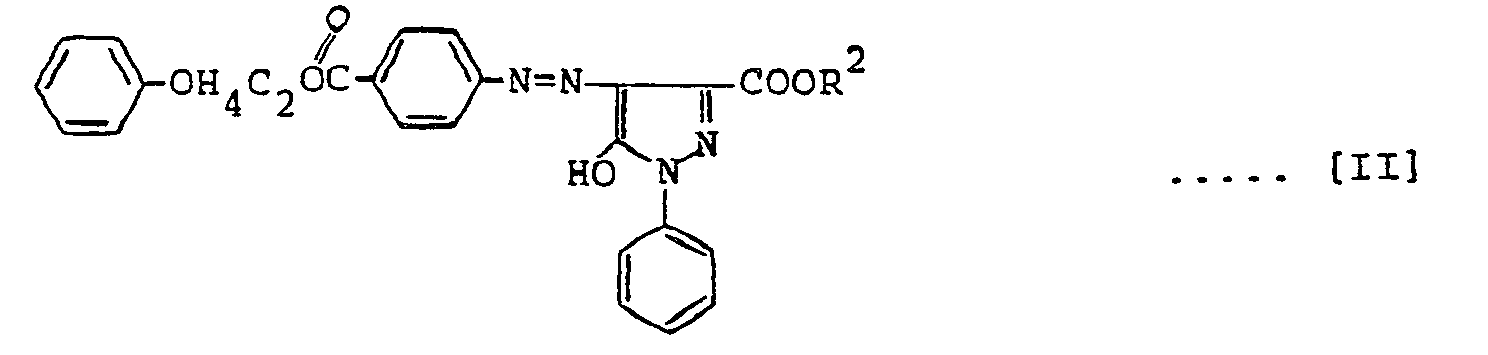
wherein R2 is C3-6 alkyl, C1-4 alkoxyalkyl, phenoxyalkyl or aralkyl and 10-70% by weight of a monoazo dyestuff of the formula [III]:

wherein R2 is C3-6 alkyl, C1-4 alkoxyalkyl, phenoxyalkyl or aralkyl and 10-70% by weight of a monoazo dyestuff of the formula [III]:
2. The monoazo dyestuff mixture according to Claim 1 wherein R2 in the general formula [II] is C3-6 alkyl or C1-4 alkoxyalkyl.
3. The monoazo dyestuff mixture according to Claim 1 wherein R2 in the general formula [II] is C3-5 alkyl or C1-4 alkoxyethyl.
4. The monoazo dyestuff mixture according to Claim 1 which comprises 90-50% by weight
of the monoazo dyestuff of the general formula [II] and 10-50% by weight of the monoazo
dyestuff of the formula [III].
5. The monoazo dyestuff mixture according to Claim 1 which comprises 80-60% by weight
of the monoazo dyestuff of the general formula [II] and 20-40% by weight of the monoazo
dyestuff of the formula [III].
6. The use of the monoazo dyestuff mixture according to any of Claims 1 to 5 for dyeing
polyester fibers.
1. Monoazo-Farbstoff-Gemisch, umfassend 90 bis 30 Gewichtsprozent eines Monoazo-Farbstoffs
der allgemeinen Formel II
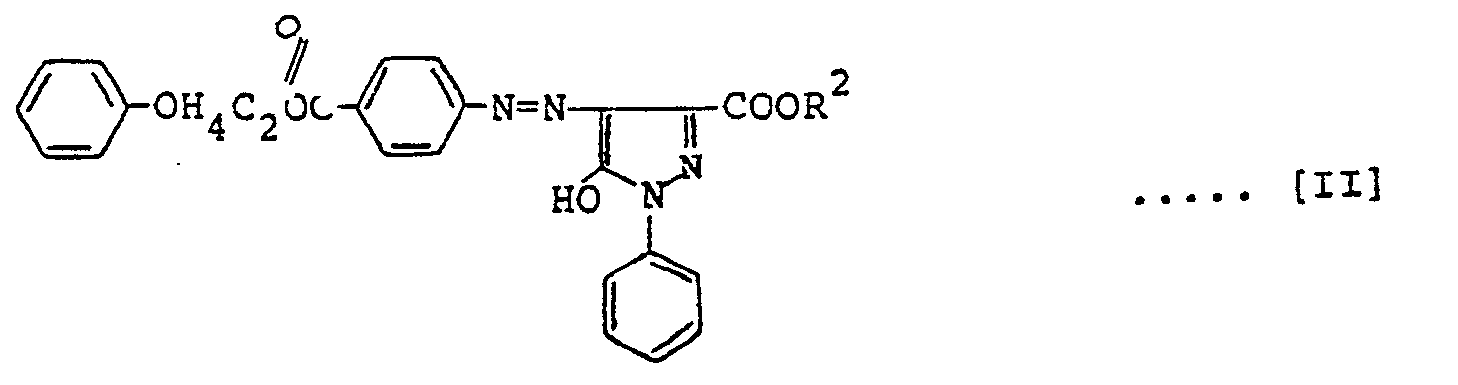
in der R2 einen C3―6-Alkyl-, C1_4-Alkoxyalkyl-, Phenoxyalkyl- oder Aralkylrest bedeutet, und 10 bis 70 Gewichtsprozent eines Monoazo-Farbstoffs der Formel (III)

in der R2 einen C3―6-Alkyl-, C1_4-Alkoxyalkyl-, Phenoxyalkyl- oder Aralkylrest bedeutet, und 10 bis 70 Gewichtsprozent eines Monoazo-Farbstoffs der Formel (III)
2. Monoazo-Farbstoffgemisch nach Anspruch 1, wobei R2 in der allgemeinen Formel (II) einen C3-s-Alkyl- oder C1_4-Alkoxyalkylrest bedeutet.
3. Monoazo-Farbstoff-Gemisch nach Anspruch 1, wobei R2 in der allgemeinen Formel (II) einen C3-5-Alkyl- oder C1_4-Alkoxyäthylrest bedeutet.
4. Monoazo-Farbstoff-Gemisch nach Anspruch 1, umfassend 90 bis 50 Gewichtsprozent
des Monoazo- Farbstoffs der allgemeinen Formel (II) und 10 bis 50 Gewichtsprozent
des Monoazofarbstoffs der Formel (III).
5. Monoazo-Farbstoff-Gemisch nach Anspruch 1, umfassend 80 bis 60 Gewichtsprozent
des Monoazo- Farbstoffs der allgemeinen Formel (II) und 20 bis 40 Gewichtsprozent
des Monoazo-Farbstoffs der Formel (lll).
6. Verwendung des Monoazo-Farbstoff-Gemisches nach einem der Ansprüche 1 bis 5 zum
Färben von Polyesterfasern.
1. Un mélange de colorant monoazoïque, qui comprend 90 à 30% en poids d'un colorant
monoazoïque de formule générale [II]:
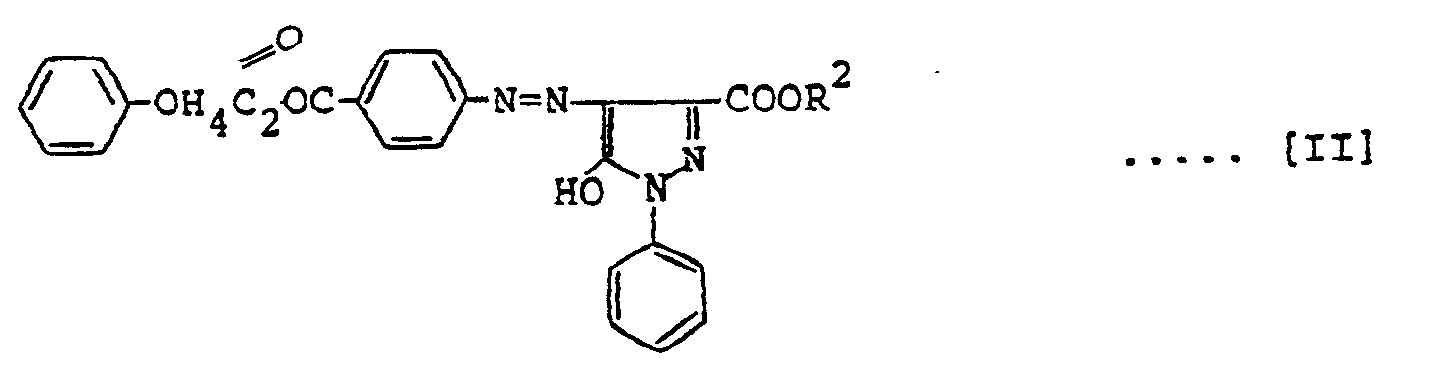
dans laquelle R2 est un groupe alkyle en C3_6, un groupe alcoxyalkyle en C1―4, un groupe phénoxyalkyle ou un groupe aralkyle, et 10 à 70% en poids d'un colorant monoazoïque de formule [III]:

dans laquelle R2 est un groupe alkyle en C3_6, un groupe alcoxyalkyle en C1―4, un groupe phénoxyalkyle ou un groupe aralkyle, et 10 à 70% en poids d'un colorant monoazoïque de formule [III]:
2. Mélange de colorant monoazoïque selon la revendication 1, dans lequel R2 de la formule générale [II] est un groupe alkyle en C3_6 ou un groupe alcoxyalkyle en C1_4.
3. Mélange de colorant monoazoïque selon la revendication 1, dans lequel R2 de la formule générale [II] est un groupe alkyle en C3_5 ou un groupe alcoxyéthyle en C1_4.
4. Mélange de colorant monoazoïque selon la revendication 1, qui contient 90 à 50%
en poids du colorant monoazoïque de formule générale (II] et 10 à 50% en poids du
colorant monoazoïque de formule [III].
5. Mélange de colorant monoazoïque selon la revendication 1, qui contient 80 à 60%
en poids du colorant monoazoïque de formule générale [II] et 20 à 40% en poids du
colorant monoazoïque de formule [III].
6. Application du mélange de colorant monoazoïque selon l'une quelconque des revendications
1 à 5 à la teinture des fibres polyesters.