| (19) |
 |
|
(11) |
EP 0 128 695 A1 |
| (12) |
EUROPEAN PATENT APPLICATION |
| (43) |
Date of publication: |
|
19.12.1984 Bulletin 1984/51 |
| (22) |
Date of filing: 29.05.1984 |
|
| (51) |
International Patent Classification (IPC)3: B60K 17/34 |
|
| (84) |
Designated Contracting States: |
|
DE FR GB IT |
| (30) |
Priority: |
08.06.1983 GB 8315747
|
| (71) |
Applicant: JAGUAR CARS LIMITED |
|
Allesley
Coventry CV4 9DB
West Midlands (GB) |
|
| (72) |
Inventor: |
|
- Cady, John Billington
Hampton in Arden
Warwickshire (GB)
|
| (74) |
Representative: Cundy, Anthony Brian et al |
|
Anthony Cundy & Co.,
1623 Warwick Road
Knowle,
Solihull,
West Midlands B93 9LF
Knowle,
Solihull,
West Midlands B93 9LF (GB) |
|
| |
|
| (54) |
Four-wheel drive transmission system |
(57) @ A transmission system especially useful in performance saloon cars includes a simple
epicyclic gear (2) between an engine (1) and a standard gearbox (MG or AG). The drive
to the front axle (10) is taken from the sun gear (12). The drive to the rear axle
(20) is via the gearbox from the annulus (16). The torque splits in the optimum ratio
between front and rear axles for the gear selected. In first gear and top gear the
front: rear torque ratios are 1:3 and 3:2 respectively.
|
|
[0001] This invention relates to the transmission system for a four-wheel drive vehicle,
and is particularly useful in a high- performance saloon car.
[0002] The invention consists in a four-wheel drive vehicle having an engine, front and
rear axles and a gearbox, further including a simple epicyclic gear having as its
input the drive from the engine, the drive to one axle being taken via the gearbox
from a first output of the epicyclic gear, and the drive to the other axle being taken
directly from a second output of the epicyclic gear.
[0003] In the preferred vehicle, the drive to the rear axle is taken via the gearbox. The
preferred configuration is one in which the epicyclic gear comprises a sun gear, planetary
gears with a planetary gear carrier, and an annulus, the carrier acting as the input
connected to the engine, the annulus acting as the first output connected to drive
the one axle via the gearbox, and the sun gear acting as the second output connected
to drive the said other axle.
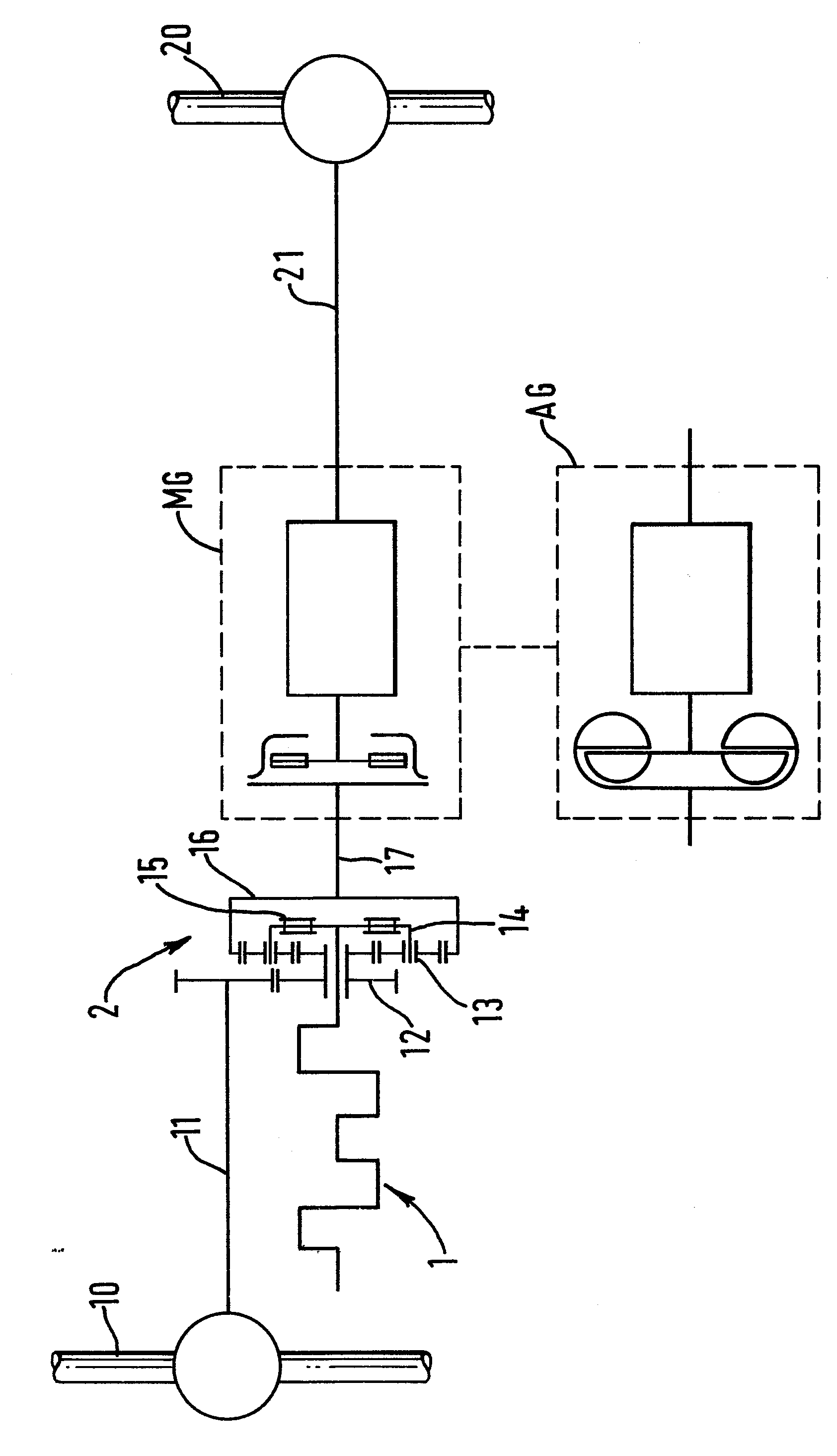
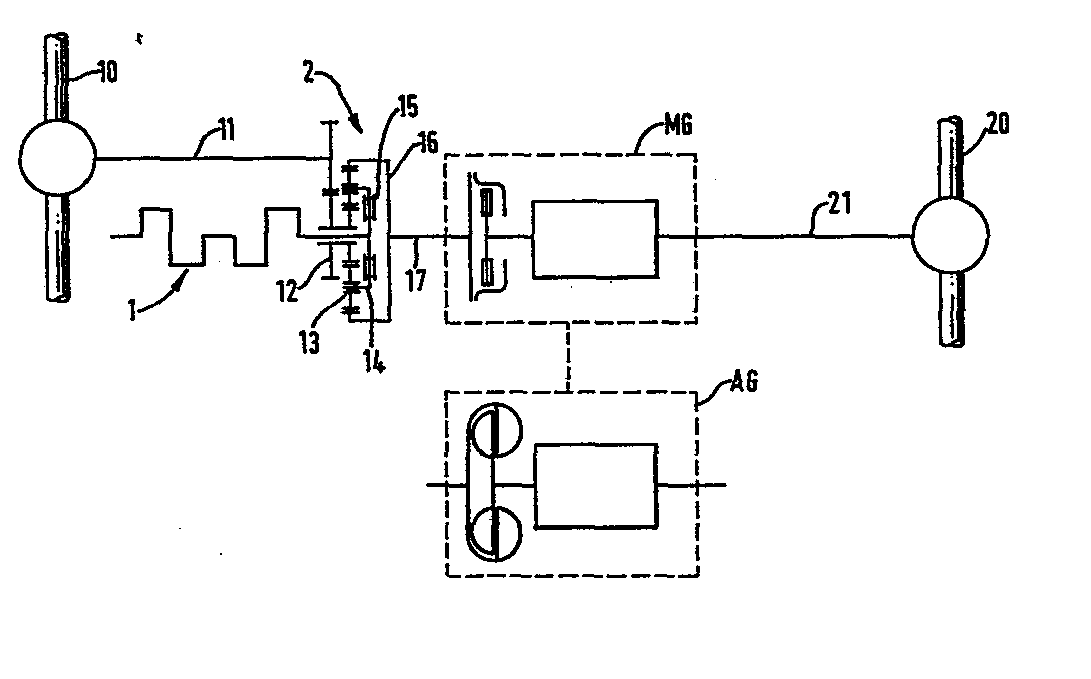
[0004] In order that the invention may be better understood, a preferred embodiment will
now be described with reference to the accompanying schematic drawing showing a four-wheel
drive transmission system with two alternative gearboxes and a simple epicyclic gear.
[0005] Referring now to the drawing, an engine 1 drives the planetary gear 13 carrier 14
of a simple epicyclic gear 2. Drive to the front axle 10 of the vehicle is taken by
the prop shaft 11 from the sun gear 12. Drive to the rear axle 20 of the vehicle is
taken from a conventional gearbox which may be manual (MG) or automatic (AG), the
input 17 of the gearbox being driven by the annulus 16 of the simple epicyclic gear
2. To dampen the input from the engine 1, a torsional vibration damper 15 is mounted
on the carrier 14. This damper is optional, and may be of the dampened mass or viscous
type.
[0006] The torque split between front and rear axles, achieved at the simple epicyclic gear
2, is a function of the gear ratio selected in the gearbox (MG or AG). One effect
of the epicyclic gear 2 is to provide a close ratio gearbox from a standard ratioed
saloon car gearbox.
[0007] The torque splits, achieved by the epicyclic gear 2 in combination with the gearbox,
are designed to be the optimum for the intended use of the vehicle. Table 1 below
shows a typical example of one system, employing a five forward speed standard gearbox.
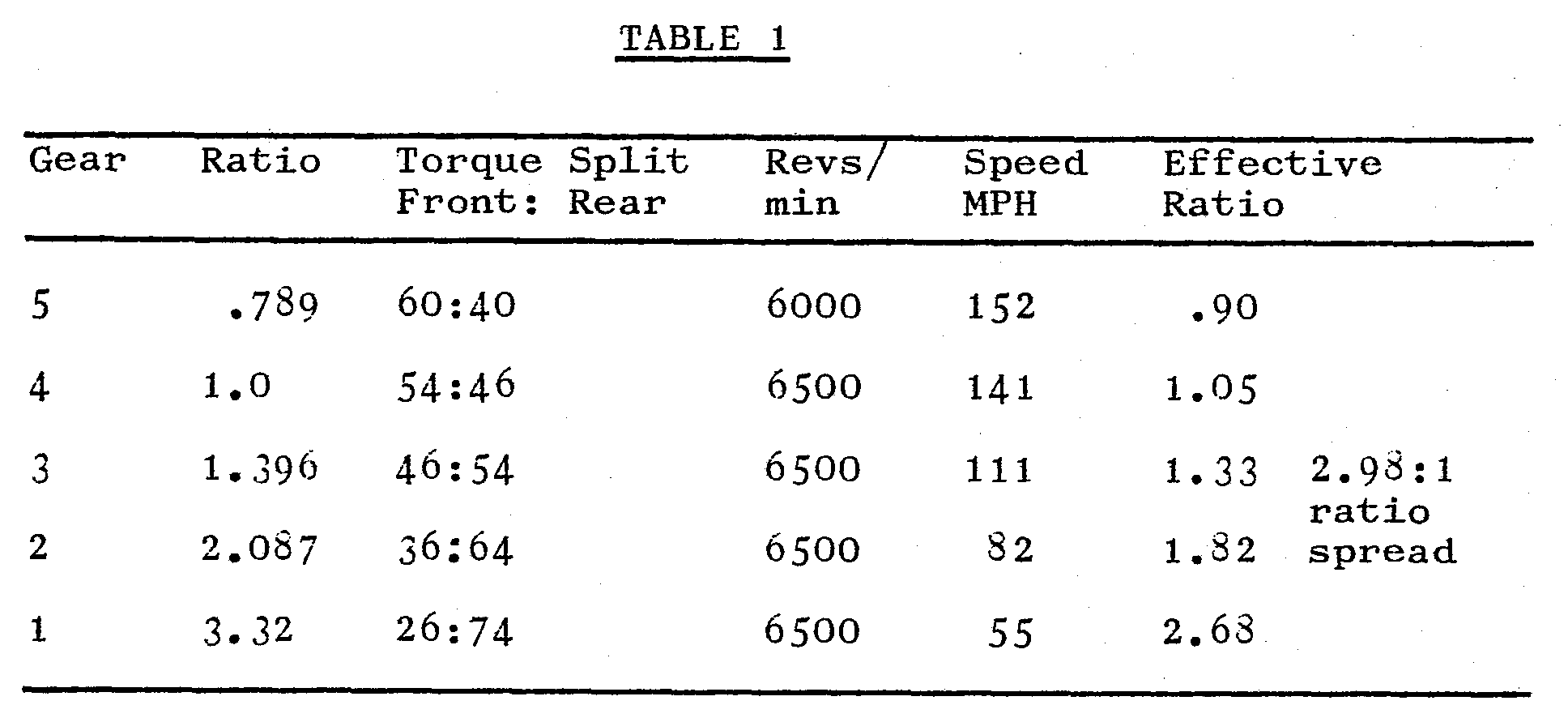
[0008] The torque split in gear 1, first gear, of about 1:3 maximises traction in proportion
to dynamic weight transfer. The split of about 3:2 in top gear gives stability at
speed. Selection of an intermediate gear gives the optimum torque split for starting
the vehicle on a slippery surface. It will also be appreciated that the high torque
ratio given to the rear axle in low gears facilitates throttle steering around low-speed
bends.
[0009] An advantage of the splitting of the torque is that it is possible to use a lighter-rated
standard transmission; for example a 77mm transmission can be rated against a 310
lb ft (4.4 Nm) engine. Moreover, lightweight front axle and drive shaft componentry
can be used, since only a fraction (e.g. 63%) of the maximum engine torque is transmitted
to the front axle; this also results in less torque reaction through the steering.
[0010] The invention has been described in the context of saloon cars, but other four wheel
drive motor vehicles could incorporate the invention.
1. A four-wheel drive vehicle having an engine, front and rear axles and a gearbox,
further including a simple epicyclic gear having as its input the drive from the engine,
the drive to one axle being taken via the gearbox from a first output of the epicyclic
gear, and the drive to the other axle being taken directly from a second output of
the epicyclic gear.
2. A vehicle according to Claim 1, wherein the drive to the rear axle is taken via
the gearbox.
3. A vehicle according to claim 1 or 2, wherein the epicyclic gear comprises a sun
gear, planetary gears with a planetary gear carrier, and an annulus, the carrier acting
as the input connected to the engine, the annulus acting as the first output connected
to drive the one axle via the gearbox, and the sun gear acting as the second output
connected to drive the said other axle.
4. A vehicle according to claim 1, 2 or 3, wherein the gearbox ratios are such that
selection of one forward gear gives a front: rear axle torque split of substantially
1:3, and selection of another forward gear gives a front: rear axle torque split of
substantially 3:2.
5. A vehicle according to claim 1, 2, 3 or 4, wherein the simple epicyclic gear comprises
a torsional damper coupled to the planetary gear carrier.