|
(11) | EP 0 131 306 B1 |

| (12) | EUROPEAN PATENT SPECIFICATION |
|
|
| (54) |
Pulp slurry drainage improver Mittel zur Entwässerung einer Pulpe Agent améliorant l'égouttage d'une suspension de pâte |
|
|
|||||||||||||||||||||||||||||||
|
||||||||||||||||||||||||||||||||
| Note: Within nine months from the publication of the mention of the grant of the European patent, any person may give notice to the European Patent Office of opposition to the European patent granted. Notice of opposition shall be filed in a written reasoned statement. It shall not be deemed to have been filed until the opposition fee has been paid. (Art. 99(1) European Patent Convention). |
[0001] This invention relates to the use of poly-monoallylamine resins as a pulp slurry drainage improver.
[0002] In the paper making industry, various efforts have been made to increase the paper making rate thereby improving the productivity and lowering the production cost. Therefore, an agent for improving drainage of pulp slurry (pulp slurry drainage improver) has been widely used.
[0003] The relationship between the increase of the paper making rate by use of the agent and the decrease of the formation on the dryer is quite delicate. Therefore a high level of techniques is required to improve the drainage of pulp slurry without impairing the uniformity of paper quality.
[0004] As the pulp slurry drainage improver, there has been used a highly polymerized polyethylene imine. However it has drawbacks that (1) in order to achieve desirable drainage, it is required to add it to the pulp slurry in a relatively high amount and (2) it is rather toxic.
[0005] In US-A-4 021 484 novel cationic amino resins are disclosed which can be used as seizing agents for making paper or fiber boards. Allylamine can be one component for said cationic amino resins. According to the teaching of this patent in the production of the cationic amino resins mono-allylamine is first reacted with cyclopentadiene to form 2-aminoethyl-5-norbornene (I) as the result of the Diels-Alder reaction. The 2-aminoethyl-5-norbornene is then thermally polymerized with dicyclopentadiene and styrene.
[0006] Extensive studies by the present inventors have revealed that the water drainage of the pulp slurry can be surprisingly improved without impairing the uniformity of paper quality by adding a specific poly-monoallylamine resin only in a small ratio into the pulp slurry, and the present invention was achieved on the basis of such finding.
[0007] Thus, the present invention is directed to the use of a polymeric material which is selected from the group consisting of poly-monoallylamine resin homopolymers (A) having from 10 to 100,000 recurring units of the following formula:
wherein X is Cl, Br, I, HSO₄, HSO₃, H₂PO₄, H₂PO₃, HCOO, CH₃COO or C₂H₅COO, and m is a number of 0 to 100,000, or a modified resin of the poly-monoallylamine resin, which has been prepared by polymerizing in a polar solvent in the presence of a radical initiator containing in its molecule an azo group and a group having a cationic nitrogen atom or atoms, as a pulp slurry drainage improver in an amount of from 0.005, to 1.0 % by weight, based on the fiber material content of the pulp.
[0008] The poly-monoallylamine resin or their modified resins usable in the present invention are selected from the group consisting of: homopolymers (A) of inorganic acid salts of monoallylamine obtained by polymerizing inorganic acid salts of monoallylamine; homopolymers (A') of monoallylamine obtained by removing inorganic acids from said homopolymers (A), or homopolymers (A'') of organic acid salts of monoallylamine obtained by neutralizing said polymers (A') with an organic acid such as formic acid, acetic acid, propionic acid, and p-toluenesulfonic acid; or of cross-linked polymers (B) obtained by copolymerizing inorganic acid salts of monoallylamine with a small quantity of inorganic acid salts of polymerizable monomer (such as inorganic acid salts of triallylamine) containing two or more double bonds in the molecule, said polymers (B) being soluble in water and identical with said polymers (A) in properties other than those relating to molecular weight; or of cross-linked polymers (C) obtained by reacting a small quantity of the compounds (such as epichlorohydrin) containing two or more groups reactable with amino group in the molecule with said polymers (A), (A'), (A'') or (B), said polymers (C) being soluble in water and identical with said polymers (A), (A'), (A'') and (B) in properties other than those relating to molecular weight.
[0009] The homopolymers (A) of inorganic acid salts of monoallylamine used in this invention are prepared by polymerizing an inorganic acid salt of monoallylamine in a polar solvent in the presence of a radical initiator containing in its molecule an azo group and a group having a cationic nitrogen atom or atoms. The preparation examples are shown in the Referential Examples given later, but the details are described in the specification of Japanese Patent Application No. 54988/83 (Japanese Patent Kokai (Laid-Open) No. 201811/83) filed by the present applicant.
[0010] These poly-monoallylamine resins and their modified resins are found to produce their effect in all types of fiber materials comprising cellulose as their base, but said resins can produce an especially significant practical effect when they are utilized in the field of waste paper (old newspaper) and unbleached kraft pulp. The amount of the resin required to be added for producing the desired effect is in the range of 0.005 to 1.0% by weight, preferably 0.01 to 0.5% by weight, based on the fiber material content of the pulp.
[0011] In practical use of the poly-monoallylamine resin or its modified resin of this invention, it may be treated in the same way as in the case of any ordinary drainage improving agent. The following method is typical example.
[0012] An aqueous solution of the resin stored in a tank is supplied into a mixer by a constant delivery pump and the resin solution is diluted into a low concentration. Such dilution is necessary for allowing uniform mixing of both fiber material and resin in a short contact time. Then, the resin solution is passed through a rotar-meter so that a required amount of the resin solution is added to the pulp slurry. The spot at which the resin solution is to be added to the pulp slurry should be decided by considering the contact time that will allow the pulp slurry to be carried on the wire at a time when the freeness has been maximized, but usually it is suggested to add the resin solution at a point just before the screen.
[0013] The preparation method of the poly-monoallylamine resin and its modified resin used in this invention will be illustrated below as referential examples.
REFERENTIAL EXAMPLE 1
[0014] Shown in this example is a method for producing poly-monoallylamine hydrochloride and poly-monoallylamine.
[0015] 570 g (10 mol) of monoallylamine (a product by shell Chemicals of U.S.; boiling point: 52.5-53°C) is added dropwise into 1.1 kg of concentrated hydrochloric acid (35% by weight) under cooling and stirring at 5-10°C. After said addition is ended, water and excessive hydrogen chloride are distilled off by using a rotary evaporator under a reduced pressure of 26.666 Pa (20 Torr) at 60°C to obtain white crystals. These crystals are dried over drying silica gel under a reduced pressure of 6.665 Pa (5 Torr), at 80°C to obtain monoallylamine hydrochloride (containing about 5% of water).
[0016] 590 g (6 mol) of said monoallylamine hydrochloride and 210 g of distilled water are put into a 2-litre round flask equipped with a stirrer, a thermometer, a reflux condenser and a nitrogen gas inlet tube, and they are stirred and dissolved. Then 7 g of 2,2'-bis-(N-phenyl-amidinyl)-2,2'-azopropane-dihydrochloride, an azo-type initiator containing cationic groups, dissolved in 10 ml of distilled water, is added. The mixture is polymerized under stirring at 48-52°C while passing nitrogen gas therethrough. 10 hours thereafter, 7 g of said initiator dissolved in 10 ml of distilled water is further added to keep on with the polymerization. Heat generation ceases 5 hours thereafter, so stirring is stopped and standing polymerization is continued at 50°C ±1°C for additional 50 hours. There is resultantly obtained a colorless and transparent viscous solution (an aqueous solution of poly-monoallylamine hydrochloride, hereinafter referred to as resin A-1 solution). Although this solution can be immediately used as a drainage improving resin solution in this invention, the solid polymer may be recovered from the solution by the following operation: 415 g of said resin A-1 solution is added into approximately 5 litres of methanol to form a white precipitate of the polymer, and this precipitate, without dried, is finely broken up in methanol and extracted with methanol for 15 hours by using a Soxhlet extractor, removing the unpolymerized monoallylamine hydrochloride. The precipitate is dried under reduced pressure at 50°C to obtain 265 g of the polymer (yield: 90%). This polymer was identified as poly-monoallylamine hydrochloride (hereinafter referred to as resin A-1) by elementary analysis, IR absorption spectral analysis and NMR spectral analysis. The intrinsic viscosity [η] of resin A-1 determined in a 1/lON NaCl solution was 0.43 (g/100 ml).
[0017] Then an aqueous solution formed by dissolving 40 g of sodium hydroxide in 100 g of distilled water is added to 139 g of said resin A-1 solution under cooling. The resulting solution has a smell of amine, so the solution is lightly sucked off under reduced pressure to obtain a NaCl solution of poly-monoallylamine (hereinafter referred to as resin A-2 solution; actual resin concentration: about 18%). This solution can be directly used as a drainage improving resin solution in this invention, but the polymer (poly-monoallylamine) may be recovered from the solution by the following operation: 30 g of said resin A-1 is dissolved in 270 g of distilled water and passed through a strongly basic ion exchange resin (Amberlite® IRA-402) to remove hydrochloric acid, and the filtrate is concentrated and freeze-dried, whereby 16.5 g of white poly-monoallylamine (hereinafter referred to as resin A-2) can be obtained.
REFERENTIAL EXAMPLE 2
[0018] This example shows the method of producing slightly bridged poly-monoallylamine hydrochloride by copolymerizing with a small quantity of triallylamine hydrochloride.
[0019] The same polymerization process as in Referental Example 1 is carried out by adding 10.5 g (6/100 mol) of triallylamine hydrochloride in addition to 590 g (6 mol) of monoallylamine hydrochloride. The amounts of water and catalyst are the same as in Referential Example 1. The polymerization gives a colorless and transparent viscous solution (hereinafter referred to as resin B-1 solution). This solution, in the form as it is, can be used as a drainage improving resin solution in this invention, but the polymer may be recovered in the same way as in Referential Example 1. That is, 210 g of resin B-1 solution is added to about 3 litres of methanol to precipitate resin B-1 and the latter is treated according to the method of Referential Example 1 to obtain 105 g of the polymer (resin B-1) (yield: about 75%). The values of elementary analysis, IR absorption spectrum and NMR spectrum of this resin B-1 were substantially equal to those of resin A-1.
REFERENTIAL EXAMPLE 3
[0021] This example is the method of producing slightly bridged poly-monoallyamine by treating poly-monoallylamine with epichlorohydrin.
[0022] 0.1 g of epichlorohydrin is added to 100 g of a NaCl solution of polyallylamine (resin A-2 solution) (actual resin concentration: 18%) whose production method was shown in Referential Example 1, and the mixture is reacted under stirring at 30 ±2°C for 2 hours, whereby the viscosity of the system increases to form a viscous solution. This solution (hereinafter referred to as resin C-1 solution) can be used immediately as a drainage improving resin solution in this invention.
[0023] Hereinafter, the present invention will be described in detail by way of the embodiments thereof, but it is to be understood that the present invention is not limited by these embodiments.
EXAMPLE 1
[0024] This Example shows the method and results of a drainage improvement test conducted on a pulp slurry prepared from wastepaper (old newspaper).
[0025] 500 g of wastepaper (old newspaper) were immersed in water, washed in the usual way and then macerated by using a 10-litre test beater under the following conditions:
| Liquor ratio: | 1:10 |
| Amount of sodium hydroxide added: | 1% (in ratio to wastepaper) |
| Temperature: | 50°C |
| Time: | 1 hour |
[0027] The pulp concentration at the time of addition of drainage improving agent was adjusted to 2.5 g/l.
[0028] The following five types of poly-monoallylamine resin and, as a comparative sample, a polyethyleneimine (polymerization degree 1000, molecular weight 42,000) were used as the drainage improving agents for the test.
| 1. Resin A-1 solution (Referential Example 1), actual resin concentration: | 64% |
| 2. Resin A-1 (Referential Example 1), actual resin concentration: | 95% |
| 3. Resin A-2 solution (Referential Example 1), actual resin concentration: | 18% |
| 4. Resin B-1 solution (Referential Example 2), actual resin concentration: | 50% |
| 5. Resin C-1 solution (Referential Example 3), actual resin concentration: | 18% |
| 6. Polyethyleneimine (Comparative Example), actual resin concentration: | 33% |
[0029] Each resin was dissolved in or diluted with water to form an aqueous solution with an actual resin concentration of 2.5 g/l.
[0030] A measured amount of each pulp slurry was put into a 5-litre plastic container and a predetermined amount of each improving agent was added thereto under stirring. After allowing contact of the agent with the pulp for a given period of time, the freeness of the pulp slurry was measured in the usual way by using a Canadian standard freeness tester. The results are summarized in Table 1.
Table 1
| Drainage improving agent | Amount of agent added (in % to pulp) | pH at the time of addition | Freeness (C.S.F. mℓ) | |
| No agent added | - | 7.6 | 340 | |
| 1. | Resin A-1 solution | 0.03 | 7.4 | 445 |
| 0.06 | 7.4 | 465 | ||
| 0.09 | 7.4 | 465 | ||
| 2. | Resin A-1 | 0.03 | 7.5 | 462 |
| 0.06 | 7.4 | 482 | ||
| 0.09 | 7.4 | 448 | ||
| 3. | Resin A-2 solution | 0.03 | 7.6 | 530 |
| 0.06 | 7.6 | 482 | ||
| 0.09 | 7.6 | 465 | ||
| 4. | Resin B-1 solution | 0.03 | 7.4 | 536 |
| 0.06 | 7.4 | 520 | ||
| 0.09 | 7.4 | 485 | ||
| 5. | Resin C-1 | 0.03 | 7.6 | 542 |
| 0.06 | 7.6 | 502 | ||
| 0.09 | 7.6 | 483 | ||
| 6. | Polyethylene imine | 0.03 | 7.4 | 400 |
| 0.06 | 7.6 | 443 | ||
| 0.09 | 7.6 | 503 | ||
| Note: Amount of agent added (in % to pulp) was calculated in terms of pure resin matter. | ||||
1 EXAMPLE 2
[0031] The same test as in Example 1 was conducted by using unbleached draft pulp. The freeness of the pulp slurry used was 30 ml in CSF. The results are shown in Table 2.
Table 2
| Drainage improving agent | Amount of agent added (in % to pulp) | pH of the time of addition | Freeness (C.S.F. mℓ) | |
| No agent added | - | 7.1 | 300 | |
| 1 | Resin A-1 solution | 0.03 | 7.4 | 383 |
| 0.06 | 7.4 | 392 | ||
| 0.09 | 7.5 | 390 | ||
| 2. | Resin A-1 | 0.03 | 7.3 | 420 |
| 0.06 | 7.4 | 443 | ||
| 0.09 | 7.4 | 420 | ||
| 3. | Resin A-2 solution | 0.03 | 7.5 | 460 |
| 0.06 | 7.4 | 440 | ||
| 0.09 | 7.5 | 425 | ||
| 4 | Resin B-1 solution | 0.03 | 7.5 | 477 |
| 0.06 | 7.4 | 454 | ||
| 0.09 | 7.4 | 426 | ||
| 5. | Resin C-1 solution | 0.03 | 7.5 | 486 |
| 0.06 | 7.5 | 464 | ||
| 0.09 | 7.4 | 472 | ||
| 6 | Polyethylene imine | 0.03 | 7.4 | 364 |
| 0.06 | 7.5 | 370 | ||
| 0.09 | 7.6 | 426 | ||
| Note: Amount of agent added (in % to pulp) was calculated in terms of pure resin matter. | ||||
1. Use of a polymeric material which is selected from the group consisting of poly-monoallylamine
resin homopolymers (A) having from 10 to 100,000 recurring units of the following
formula:
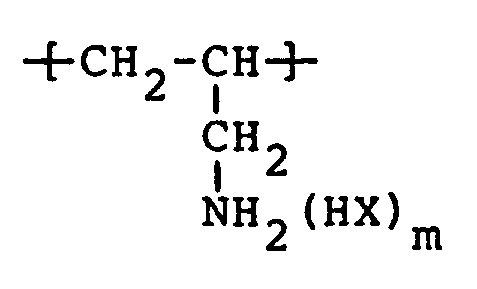
wherein X is Cl, Br, I, HSO₄, HSO₃, H₂PO₄, H₂PO₃, HCOO, CH₃COO or C₂H₅COO, and m is a number of 0 to 100,000, or a modified resin of the poly-monoallylamine resin, wherein the poly-monoallylamine resin or the modified resin of the poly-monoallylamine resin is selected from the group consisting of:
homopolymers (A) of inorganic acid salts of monoallylamine obtained by polymerizing inorganic acid salts of monoallylamine; homopolymers (A') of monoallylamine obtained by removing inorganic acids from said homopolymers (A), or homopolymers (A'') of organic acid salts of monoallylamine obtained by neutralizing said homopolymers (A') with an organic acid such as formic acid, acetic acid, propionic acid, and p-toluenesulfonic acid;
or of cross-linked polymers (B) obtained by copolymerizing inorganic acid salts of monoallylamine with a small quantity of inorganic acid salts of polymerizable monomer containing two or more double bonds in the molecule, such as triallylamine, said polymers (B) being soluble in water and identical with said polymers (A) in properties other than those relating to molecular weight;
or of cross-linked polymers (C) obtained by reacting a small quantity of the compounds containing two or more groups reactable with amino groups in the molecule, such as epichlorohydrin, with said polymers (A), (A'), (A'') or (B), said polymers (C) being soluble in water and identical with said polymers (A), (A'), (A'') and (B) in properties other than those relating to molecular weight,
wherein the polymerisation has been carried out in a polar solvent in the presence of a radical initiator containing in its molecule an azo group and a group having a cationic nitrogen atom or atoms,
as a pulp slurry drainage improver in an amount of from 0.005 to 1.0% by weight, based on the fiber material content of the pulp.
wherein X is Cl, Br, I, HSO₄, HSO₃, H₂PO₄, H₂PO₃, HCOO, CH₃COO or C₂H₅COO, and m is a number of 0 to 100,000, or a modified resin of the poly-monoallylamine resin, wherein the poly-monoallylamine resin or the modified resin of the poly-monoallylamine resin is selected from the group consisting of:
homopolymers (A) of inorganic acid salts of monoallylamine obtained by polymerizing inorganic acid salts of monoallylamine; homopolymers (A') of monoallylamine obtained by removing inorganic acids from said homopolymers (A), or homopolymers (A'') of organic acid salts of monoallylamine obtained by neutralizing said homopolymers (A') with an organic acid such as formic acid, acetic acid, propionic acid, and p-toluenesulfonic acid;
or of cross-linked polymers (B) obtained by copolymerizing inorganic acid salts of monoallylamine with a small quantity of inorganic acid salts of polymerizable monomer containing two or more double bonds in the molecule, such as triallylamine, said polymers (B) being soluble in water and identical with said polymers (A) in properties other than those relating to molecular weight;
or of cross-linked polymers (C) obtained by reacting a small quantity of the compounds containing two or more groups reactable with amino groups in the molecule, such as epichlorohydrin, with said polymers (A), (A'), (A'') or (B), said polymers (C) being soluble in water and identical with said polymers (A), (A'), (A'') and (B) in properties other than those relating to molecular weight,
wherein the polymerisation has been carried out in a polar solvent in the presence of a radical initiator containing in its molecule an azo group and a group having a cationic nitrogen atom or atoms,
as a pulp slurry drainage improver in an amount of from 0.005 to 1.0% by weight, based on the fiber material content of the pulp.
2. The use according to Claim l, wherein the cross-linked polymers (B) are the copolymers
of inorganic acid salts of monoallylamine and a small quantity of inorganic acid salts
of triallylamine.
3. The use according to Claim 1, wherein the cross-linked polymers (C) are the reaction
products of the polymers (A), (A'), (A'') or (B) with epichlorohydrin.
4. The use according to Claim 1, wherein the amount of the poly-monoallylamine resin
is 0.01 to 0.5% by weight, based on the content of pulp fiber material.
1. Verwendung eines Polymermaterials, ausgewählt aus der Gruppe, bestehend aus Polymonoallylaminharz-Homopolymeren
(A) mit 10 bis 100000 wiederkehrenden Einheiten der folgenden Formel:
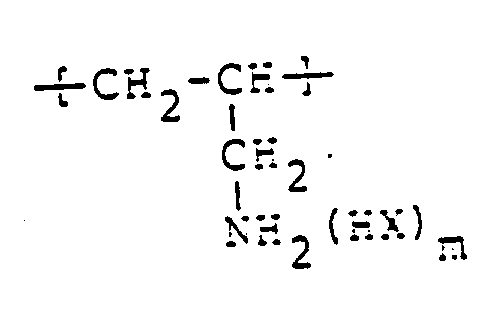
worin X Cl, Br, J, HSO₄, HSO₃, H₂PO₄, H₂PO₃, HCOO, CH₃COO oder C₂H₅COO und m eine Zahl von 0 bis 100000 sind, oder aus einem modifizierten Harz des Polymonoallylaminharzes, worin das Polymonoallylaminharz oder das modifizierte Harz des Polymonoallylaminharzes ausgewählt sind aus der Gruppe, bestehend aus:
Homopolymeren (A) von anorganischen Säuresalzen von Monoallylamin, erhältlich durch Polymerisieren anorganischer Säuresalze von Monoallylamin; Homopolymeren (A') von Monoallylamin, erhältlich durch Entfernung der anorganischen Säuren aus den genannten Homopolymeren (A), oder Homopolymeren (A'') von organischen Säuresalzen von Monoallylamin, erhältlich durch Neutralisieren der genannten Polymere (A') mit einer organischen Säure wie Ameisen-, Essig-, Propion- und p-Toluolsulfonsäure;
oder aus vernetzten Polymeren (B), erhältlich durch Colpolymerisieren anorganischer Säuresalze von Monoallylamin mit einer kleinen Menge von anorganischen Säuresalzen polymerisierbarer Monomerer , enthaltend zwei oder mehr Doppelbindungen im Molekül, wie Triallylamin, wobei die genannten Polymeren (B) in Wasser löslich und mit den genannten Polymeren (A) bezüglich der Eigenschaften, ausgenommen das Molekulargewicht, identisch sind;
oder aus vernetzten Polymeren (C), erhältlich durch Reaktion einer kleinen Menge von Verbindungen, enthaltend zwei oder mehr mit einer Aminogruppe reagierbare Gruppen im Molekül, wie Epichlorhydrin, mit den genannten Polymeren (A), (A'), (A'') oder (B), wobei die genannten Polymeren (C) in Wasser löslich und bezüglich der Eigenschaften, ausgenommen das Molekulargewicht, mit den genannten Polymeren (A), (A'), (A'') und (B) identisch sind,
wobei die Polymerisation in einem Lösungsmittel in Gegenwart eines Radikalinitiators, enthaltend in seinem Molekül eine Azo-Gruppe und eine Gruppe mit einem kationischen Stickstoffatom oder -atomen, durchgeführt worden ist,
als Mittel zur Entwässerung einer Pulpe in einer Menge von 0,005 bis 1,0 Gew.%, bezogen auf Fasermaterialgehalt der Pulpe.
worin X Cl, Br, J, HSO₄, HSO₃, H₂PO₄, H₂PO₃, HCOO, CH₃COO oder C₂H₅COO und m eine Zahl von 0 bis 100000 sind, oder aus einem modifizierten Harz des Polymonoallylaminharzes, worin das Polymonoallylaminharz oder das modifizierte Harz des Polymonoallylaminharzes ausgewählt sind aus der Gruppe, bestehend aus:
Homopolymeren (A) von anorganischen Säuresalzen von Monoallylamin, erhältlich durch Polymerisieren anorganischer Säuresalze von Monoallylamin; Homopolymeren (A') von Monoallylamin, erhältlich durch Entfernung der anorganischen Säuren aus den genannten Homopolymeren (A), oder Homopolymeren (A'') von organischen Säuresalzen von Monoallylamin, erhältlich durch Neutralisieren der genannten Polymere (A') mit einer organischen Säure wie Ameisen-, Essig-, Propion- und p-Toluolsulfonsäure;
oder aus vernetzten Polymeren (B), erhältlich durch Colpolymerisieren anorganischer Säuresalze von Monoallylamin mit einer kleinen Menge von anorganischen Säuresalzen polymerisierbarer Monomerer , enthaltend zwei oder mehr Doppelbindungen im Molekül, wie Triallylamin, wobei die genannten Polymeren (B) in Wasser löslich und mit den genannten Polymeren (A) bezüglich der Eigenschaften, ausgenommen das Molekulargewicht, identisch sind;
oder aus vernetzten Polymeren (C), erhältlich durch Reaktion einer kleinen Menge von Verbindungen, enthaltend zwei oder mehr mit einer Aminogruppe reagierbare Gruppen im Molekül, wie Epichlorhydrin, mit den genannten Polymeren (A), (A'), (A'') oder (B), wobei die genannten Polymeren (C) in Wasser löslich und bezüglich der Eigenschaften, ausgenommen das Molekulargewicht, mit den genannten Polymeren (A), (A'), (A'') und (B) identisch sind,
wobei die Polymerisation in einem Lösungsmittel in Gegenwart eines Radikalinitiators, enthaltend in seinem Molekül eine Azo-Gruppe und eine Gruppe mit einem kationischen Stickstoffatom oder -atomen, durchgeführt worden ist,
als Mittel zur Entwässerung einer Pulpe in einer Menge von 0,005 bis 1,0 Gew.%, bezogen auf Fasermaterialgehalt der Pulpe.
2. Verwendung gemäß Anspruch 1, worin die vernetzten Polymeren (B) Copolymere von anorganischen
Säuresalzen von Monoallylamin und einer kleinen Menge von anorganischen Säuresalzen
von Triallylamin sind.
3. Verwendung gemäß Anspruch 1, worin die vernetzten Polymeren (C) die Reaktionsprodukte
der Polymeren (A), (A'), (A'') oder (B) mit Epichlorhydrin sind.
4. Verwendung gemäß Anspruch 1, worin die Menge des Polymonoallylaminharzes 0,01 bis
0,5 Gew.% beträgt, bezogen auf Gehalt des Pulpenfasermaterials.
1. Utilisation d'une matière polymère qui est choisie dans le groupe formé par les résines
homopolymères de poly-monoallylamine (A) ayant 10 à 100 000 motifs récurrents de formule
suivante :
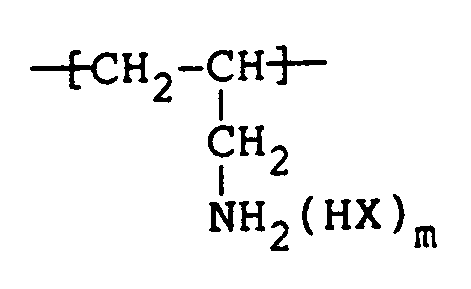
dans laquelle X est Cl, Br, I, HSO₄, HSO₃, H₂PO₄, H₂PO₃, HCOO, CH₃COO ou C₂H₅COO, et m est un nombre de 0 à 100 000, ou une résine modifiée de la résine de poly-monoallylamine, où la résine de poly-monoallylamine ou la résine modifiée de la résine de poly-monoallylamine est choisie dans le groupe formé par :
les homopolymères (A) de sels d'acides minéraux de monoallylamine obtenus en polymérisant des sels d'acides minéraux de monoallylamine ; les homopolymères (A') de monoallylamine obtenus en éliminant les acides minéraux desdits homopolymères (A), ou les homopolymères (A'') de sels d'acides organiques de monoallylamine obtenus en neutralisant lesdits homopolymères (A') avec un acide organique tel que l'acide formique, l'acide acétique, l'acide propionique ou l'acide p-toluènesulfonique ; ou
les polymères réticulés (B) obtenus en copolymérisant des sels d'acides minéraux de monoallylamine avec une petite quantité de sels d'acides minéraux d'un monomère polymérisable dont la molécule contient deux ou plusieurs doubles liaisons, tel que la triallylamine, lesdits polymères (B) étant solubles dans l'eau et identiques auxdits polymères (A) quant aux propriétés autres que celles relatives au poids moléculaire ; ou
les polymères réticulés (C) obtenus en faisant réagir avec lesdits polymères (A), (A'), (A'') ou (B) une petite quantité de composés dont la molécule contient deux ou plusieurs groupes pouvant réagir avec les groupes amino, tels que l'épichlorhydrine, lesdits polymères (C) étant solubles dans l'eau et identiques auxdits polymères (A), (A'), (A'') et (B) quant aux propriétés autres que celles relatives au poids moléculaire, la polymérisation ayant été effectuée dans un solvant polaire en présence d'un initiateur de polymérisation radicalaire dont la molécule contient un groupe azo et un groupe ayant un ou plusieurs atomes d'azote cationique,
comme agent améliorant l'égouttage d'une suspension de pâte, en une quantité de 0,005 à 1,0 % en poids par rapport à la quantité de matière fibreuse de la pâte.
dans laquelle X est Cl, Br, I, HSO₄, HSO₃, H₂PO₄, H₂PO₃, HCOO, CH₃COO ou C₂H₅COO, et m est un nombre de 0 à 100 000, ou une résine modifiée de la résine de poly-monoallylamine, où la résine de poly-monoallylamine ou la résine modifiée de la résine de poly-monoallylamine est choisie dans le groupe formé par :
les homopolymères (A) de sels d'acides minéraux de monoallylamine obtenus en polymérisant des sels d'acides minéraux de monoallylamine ; les homopolymères (A') de monoallylamine obtenus en éliminant les acides minéraux desdits homopolymères (A), ou les homopolymères (A'') de sels d'acides organiques de monoallylamine obtenus en neutralisant lesdits homopolymères (A') avec un acide organique tel que l'acide formique, l'acide acétique, l'acide propionique ou l'acide p-toluènesulfonique ; ou
les polymères réticulés (B) obtenus en copolymérisant des sels d'acides minéraux de monoallylamine avec une petite quantité de sels d'acides minéraux d'un monomère polymérisable dont la molécule contient deux ou plusieurs doubles liaisons, tel que la triallylamine, lesdits polymères (B) étant solubles dans l'eau et identiques auxdits polymères (A) quant aux propriétés autres que celles relatives au poids moléculaire ; ou
les polymères réticulés (C) obtenus en faisant réagir avec lesdits polymères (A), (A'), (A'') ou (B) une petite quantité de composés dont la molécule contient deux ou plusieurs groupes pouvant réagir avec les groupes amino, tels que l'épichlorhydrine, lesdits polymères (C) étant solubles dans l'eau et identiques auxdits polymères (A), (A'), (A'') et (B) quant aux propriétés autres que celles relatives au poids moléculaire, la polymérisation ayant été effectuée dans un solvant polaire en présence d'un initiateur de polymérisation radicalaire dont la molécule contient un groupe azo et un groupe ayant un ou plusieurs atomes d'azote cationique,
comme agent améliorant l'égouttage d'une suspension de pâte, en une quantité de 0,005 à 1,0 % en poids par rapport à la quantité de matière fibreuse de la pâte.
2. L'utilisation selon la revendication 1, dans laquelle les polymères réticulés (B)
sont les copolymères de sels d'acides minéraux de monoallylamine et d'une petite quantité
de sels d'acides minéraux de triallylamine.
3. L'utilisation selon la revendication 1, dans laquelle les polymères réticulés (C)
sont les produits de réaction des polymères (A), (A'), (A'') ou (B) avec l'épichlorhydrine.
4. L'utilisation selon la revendication 1, dans laquelle la quantité de la résine de
poly-monoallylamine est de 0,01 à 0,5 % en poids par rapport à la quantité de matière
fibreuse de la pâte.