|
(11) | EP 0 135 203 B1 |

| (12) | EUROPEAN PATENT SPECIFICATION |
|
|
| (54) |
Composition for an optically readable information carrier Zusammensetzung für einen optisch lesbaren Informationsträger Composition pour un support d'information lisible optiquement |
|
|
|||||||||||||||||||||||||||||||
| Note: Within nine months from the publication of the mention of the grant of the European patent, any person may give notice to the European Patent Office of opposition to the European patent granted. Notice of opposition shall be filed in a written reasoned statement. It shall not be deemed to have been filed until the opposition fee has been paid. (Art. 99(1) European Patent Convention). |
Background of the invention
[0001] The invention relates to an information carrier for optically readable information built up from a carrier of polycarbonate resin and a metal layer provided thereon.
[0002] The invention relates in particular to information carriers on which digital information which can be read by means of a laser beam is provided. The information may be used for reproducing pictures and sound.
[0003] Nowadays, information carriers for pictures and/or sound are commercially available, the carrier being manufactured from a polycarbonate resin. In order to obtain readable information, a metal layer which can reflect the optical radiation used is provided on the carrier.
[0004] In order to obtain a lasting information carrier, a good bonding between the polycarbonate resin and the metal layer is of importance.
[0005] The invention provides an information carrier having an improved bonding between the carrier of polycarbonate resin and the metal layer provided thereon.
Description of the invention
[0006] The information carrier according to the invention is characterized in that the polycarbonate resin consists of a mixture of 90-99.99% by weight of an aromatic polycarbonate having a weight molecular weight of from about 10,000 to 20,000, 0.01-0.5% by weight of an epoxy compound and 0-9.99% by weight of additives usual for polycarbonate resins.
[0007] The carrier used in the information carrier according to the invention is manufactured from a composition comprising polycarbonate resin and an epoxy compound. The presence of the epoxy compound ensures a good bonding between the metal layer and the carrier of polycarbonate resin.
[0008] Polycarbonate resins comprising epoxy compounds are known per se. For this purpose reference may be made to U.S.P. 3,498,946; 4,118,370 and British Patent Specification 1,267,492 (=DE-OS 2,003,432). It is not known from these patent publication that the addition of epoxy compounds to aromatic polycarbonates results in a mixture on which metal layers have a better bonding.
[0009] The information carrier according to the invention is built up from a carrier and a metal layer provided thereon. The information carriers according to the invention may furthermore comprise several constituents such as protective coating layers.
[0010] The information carrier according to the invention is built up from a polycarbonate resins which comprises a mixture of an aromatic polycarbonate, an epoxy compound, and additives which are usual for polycarbonate resins.
[0011] The information is stored in the carrier in the form of very small pits and bosses. In order to be able to easily series-produce carriers with a sufficiently detailed reproduction, the carrier is manufactured by means of injection molding from an aromatic polycarbonate having a weight-averaged molecular weight of from about 10,000 to 20,000.
[0012] Aromatic polycarbonates having such a molecular weight have a better flow than the usual commercially available polycarbonates which usually have a weight-averaged molecular weight from 24,000 to 40,000.
[0013] Aromatic polycarbonates are polymers known perse. These include homopolymers, copolycarbonates and mixtures of various homo- and copolycarbonates comprising units derived from one or several aromatic compounds having at least two hydroxy groups. Particularly suitable are those polycarbonates which comprise units of bis(hydroxy phenyl) alkanes, for example 2,2-bis(4-hydroxy phenyl) propane. Also suitable are aromatic polycarbonates comprising units derived from 2,2-bis(3,5-dimethyl-4-hydroxy phenyl) propane. The so-called branched polycarbonates are also suitable.
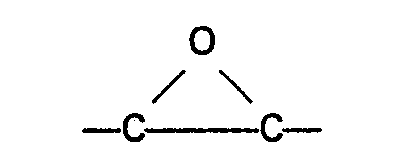
[0014] The resin mixtures according to the invention comprise an epoxy compound in a quantity from 0.01-0.5% by weight. Quantities of less than 0.01% by weight do not provide the desired improvement of the bonding of the metal layer on the carrier. Quantities of more than 0.5% weight do not provide any further improvement of the bonding. An epoxy compound preferably used is an aliphatic or cycloaliphatic epoxy compound which possess at least one 1,2-epoxide group of the formula
[0016] Examples of aliphatic or cycloaliphatic epoxy compounds are the following: butadiene diepoxide, epoxidized polybutadiene, epoxidized soya bean oil, 3,4-epoxycyclohexyl methyl 3,4-epoxycyclohexane carboxylate, 3,4-epoxy-6-methylcyclohexylmethyl-3,4-epoxy-6-methy[cyclohexane carboxylate, 2,3-epoxycyclohexyl methyl-3,4 epoxycyclohexane carboxylate. To be preferred now is 3,4-epoxycyclohexyl methyl 3,4-epoxycyclohexane carboxylate.
[0017] The polycarbonate resin as used in the carrier according to the invention may also comprise 0-9.99% by weight of additives which are usual for polycarbonate resins, for example, stabilizers, release agents and dyes. Dyes which prevent the reading by means of a laser beam may, of course, not be used.
[0018] A metal layer, usually an aluminum layer, is provided on the actual carrier of the information carrier. The metal layer may be provided on the actual carrier according to a usual technique, for example, by vapor-deposition under reduced pressure.
[0019] The invention will be described in greater detail with reference to the ensuing specific examples.
Example
[0020] Four polycarbonate resins (A, B, C and D) were prepared on the basis of an aromatic polycarbonate derived from 2,2-bis(4-hydroxy phenyl) propane and having a weight-averaged molecular weight of 18,000. Resins C and D according to the invention comprise a cycloaliphatic diepoxide, namely 3,4-epoxycyclohexyl methyl-3,4-epoxycyclohexane carboxylate. The composition of the resins is indicated in Table A hereinafter.
[0021] Disk-shaped samples were manufactured from the polycarbonate resins A, B, C and D by means of injection molding. By means of vacuum deposition, an aluminum layer having a thickness of approximately 200 nanometers was vapor-deposited on the resulting disks.
[0022] The resulting examples were immersed in a water bath of 60°C. for 90 hours. The aluminum layer worked loose in the samples manufactured from polycarbonate resins A and B; the aluminum layer did not work loose in the samples C and D manufactured from the polycarbonate resin according to the invention.
1. An information carrier for optically readable information built up from a carrier
of polycarbonate resin and a metal layer provided thereon, characterized in that the
polycarbonate resin consists of a mixture of 90-99.99% by weight of an aromatic polycarbonate
having a weight-averaged molecular weight of from about 10,000 to 20,000, 0.01-0.5%
by weight of an epoxy compound and 0-9.99% by weight of additives usual for polycarbonate
resins.
2. An information carrier as claimed in claim 1 characterized in that an aluminum
layer is provided as the metal layer.
3. An information carrier as claimed in claim 1 or 2 characterized in that the carrier
is manufactured by injection molding from polycarbonate resin.
4. An information carrier in accordance with anyone claims 1-3 wherein the aromatic
polycarbonate is bisphenol-A polycarbonate.
5. An information carrier in accordance with any one claims 1-4 wherein the epoxy
compound is an aliphatic or cycloaliphatic epoxy compound which possess at least one
1,2-epoxide group of the formula
6. An information carrier in accordance with claim 5 wherein the epoxy compound is
a cycloaliphatic epoxy compound having 1,2-cycloaliphatic rings comprising at least
one 1,2-epoxy group in at least one cycloaliphatic ring.
7. An information carrier in accordance with claim 6 wherein the epoxy compound is
3,4-epoxycyclohexyl methyl-3,4-epoxycyclohexane carboxylate.
1. Ein Informationsträger für optisch lesbare Information, aufgebaut aus einem Träger
von Polycarbonatharz und einer darauf ausgebildeten Metallschicht, dadurch gekennzeichnet,
daß das Polycarbonatharz aus einer Mischung von 90 bis 99,99 Gewichtsprozent eines
aromatischen Polycarbonats mit einem Molekulargewicht (Gewichtsmittel) von etwa 10000
bis 20 000, 0,01 bis 0,5 Gewichtsprozent einer Epoxyverbindung und 0 bis 9,99 Gewichtsprozent
an für Polycarbonatharze üblichen Additiven besteht.
2. Ein Informationsträger nach Anspruch 1, dadurch gekennzeichnet, daß eine Aluminiumschicht
als Metallschicht vorgesehen ist.
3. Ein Informationsträger nach Anspruch 1 oder 2, dadurch gekennzeichnet, daß der
Träger durch Spritzgießen aus Polycarbonatharz hergestellt ist.
4. Ein Informationsträger nach einem der Ansprüche 1 bis 3, worin das aromatische
Polycarbonat Bisphenol-A-Polycarbonat ist.
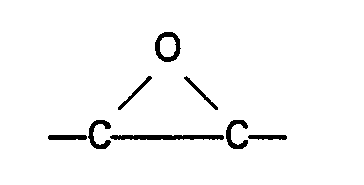
5. Ein Informationsträger nach einem der Ansprüche 1 bis 4, worin die Epoxyverbindung
eine aliphatische oder cycloaliphatische Epoxyverbindung ist, welche zumindest eine
1,2-Epoxidgruppe der Formel
besitzt.
besitzt.
6. Ein Informationsträger nach Anspruch 5, worin die Epoxyverbindung eine cycloaliphatische
Epoxyverbindung mit 1,2-cycloaliphatischen Ringen ist, enthaltend zumindest eine 1,2-Epoxygruppe
in zumindest einem cycloaliphatischen Ring.
7. Ein Informationsträger nach Anspruch 6, worin die Epoxyverbindung 3,4-Epoxycyclohexylmethyl-3,4-epoxycyclohexancarboxylat
ist.
1. Support d'information pour une information lisible optiquement formé à partir d'un
support en résine de polycarbonate et d'une couche métallique appliquée sur ce support,
caractérisé en ce que la résine de polycarbonate est constituée par un mélange de
90 à 99,99% en poids d'un polycarbonate aromatique présentant une masse molaire moyenne
en poids comprise entre environ 10 000 et 20 000, de 0,01 à 0,5% en poids d'un composé
époxy et de 0 à 9,99% en poids d'additifs habituels des résines de polycarbonate.
2. Support d'information selon la revendication 1, caractérisé en ce que la couche
métallique appliquée est une couche d'aluminium.
3. Support d'information selon la revendication 1 ou 2, caractérisé en ce que l'on
fabrique le support par moulage par injection d'une résine de polycarbonate.
4. Support d'information selon l'une quelconque des revendications 1 à 3 dans lequel
le polycarbonate aromatique est un polycarbonate de bisphénol-A.
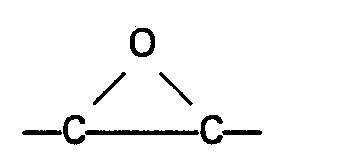
5. Support d'information selon l'une quelconque des revendications 1 à 4 dans lequel
le composé époxy est un composé époxy aliphatique ou cycloaliphatique qui possède
au moins un groupe époxy-1,2 ayant pour formule:
6. Support d'information selon la revendication 5 dans lequel le composé époxy est
un composé époxy cycloaliphatique ayant des cycles 1,2-cycloaliphatique comprenant
au moins un groupe époxy-1,2 dans au moins un cycle cycloaliphatique.
7. Support d'information selon la revendication 6, caractérisé en ce que le composé
époxy est l'époxy-3,4-cyclohexanecarboxylate d'époxy-3,4 cyclohexylméthyle.