| (19) |
 |
|
(11) |
EP 0 135 302 B1 |
| (12) |
EUROPEAN PATENT SPECIFICATION |
| (45) |
Mention of the grant of the patent: |
|
30.03.1988 Bulletin 1988/13 |
| (22) |
Date of filing: 20.07.1984 |
|
| (51) |
International Patent Classification (IPC)4: G01R 31/28 |
|
| (54) |
A method and apparatus for inspecting printed wiring boards
Verfahren und Apparatur zur Untersuchung von gedruckten Schaltungen
Procédé et appareil pour l'examen de circuits imprimés
|
| (84) |
Designated Contracting States: |
|
AT BE CH DE FR IT LI LU NL SE |
| (30) |
Priority: |
25.07.1983 GB 8320016
|
| (43) |
Date of publication of application: |
|
27.03.1985 Bulletin 1985/13 |
| (73) |
Proprietor: LLOYD DOYLE LIMITED |
|
Walton-on-Thames
Surrey KT12 2SD (GB) |
|
| (72) |
Inventors: |
|
- Doyle, Keith Gilbert
Sunbury-on-Thames
Middlesex (GB)
- Lloyd, Roy Anthony
Sunbury-on-Thames
Middlesex (GB)
|
| (74) |
Representative: Adams, William Gordon |
|
RAWORTH, MOSS & COOK
36 Sydenham Road
Croydon
Surrey CR0 2EF
Croydon
Surrey CR0 2EF (GB) |
| (56) |
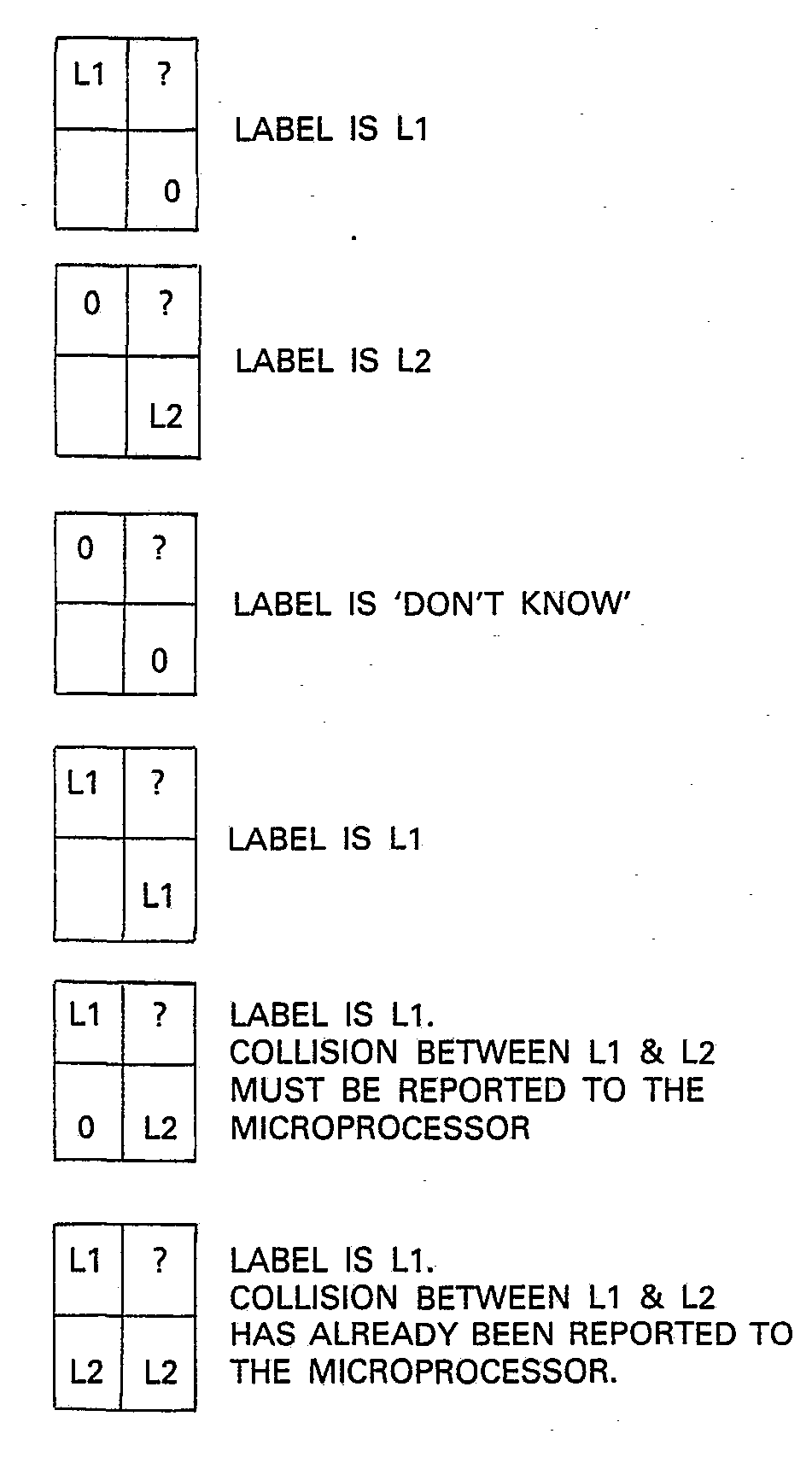
References cited: :
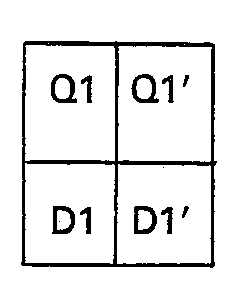
DE-A- 2 700 252
|
US-A- 4 037 941
|
|
| |
|
|
- PROCEEDINGS OF THE FOURTH INTERNATIONAL JOINT CONFERENCE ON PATTERN RECOGNITION, November
1978, Kyoto, JP; N. GOTO et al. "An automatic inspection system for mask patterns",
pages 970-974
|
|
| |
|
| Note: Within nine months from the publication of the mention of the grant of the European
patent, any person may give notice to the European Patent Office of opposition to
the European patent
granted. Notice of opposition shall be filed in a written reasoned statement. It shall
not be deemed to
have been filed until the opposition fee has been paid. (Art. 99(1) European Patent
Convention).
|
[0001] This invention relates to a method and apparatus for inspecting a pattern on a substrate
such as a pattern on a printed wiring board.
[0002] In the manufacture of printed wiring boards it is important to ensure not only that
the printed wiring is complete and to the required layout or pattern but also to ensure
that it meets certain specified criteria, for example that the width of the printed
wiring conductor does not fall below a predetermined minimum value and that the spacing
between adjacent conductors does not fall below another predetermined value, either
of which can result in a substandard printed circuit board which is liable to fail
in use after manufacture.
[0003] A reduction in the effective width of a printed wiring conductor can be caused by
a nick or pinhole in the conductor at a point or points along the conductor as well
as by a length of narrow conductor due to faulty processing or design.
[0004] The simplest boards can be inspected visually but for more complex boards this is
difficult, time consuming and expensive.
[0005] One well known apparatus for testing boards electrically is the tracking or "bed
of nails" tester. Such apparatus can check the continuity between the various connection
points on a board but is unable to detect nicks, pinholes, regions of narrow track,
or partial bridges which can occur if the spacing between adjacent conductors is too
small. Such apparatus also require expensive tooling to enable them to be used in
the inspection of a wide range of boards.
[0006] It is also known to scan printed wiring boards optically, and to process the resulting
data electronically to detect defects. Systems have been devised which can operate
in either a "comparison" or a "non-comparison" mode. To operate by comparison with
a known good board on a pixel-by-pixel basis requires precise alignment of the two
boards and the optics, unless the system is to be limited to detecting very coarse
defects. Systems which operate in a "non-comparison" mode use feature detection to
identify parts of the board which do not conform with what is expected from a normal
interconnection pattern. They have very high "false alarm" rates as they will respond
incorrectly to features such as lettering or small defects which do not affect the
functionality of the board.
[0007] DE-A-2 700 252 discloses a method and apparatus for testing a pattern on a substrate,
such as a semiconductor device, comprising means for optically scanning the surface
of the structure and for generating a plurality of signals representative of image
points thereon, means for storing the signals and means for comparing the signals
with a set of previously stored signals representative of a predetermined set of constructional
rules.
[0008] According to the invention there is provided apparatus for testing a printed wiring
board comprising means for optically scanning a board to be tested in two orthogonal,
X-Y axes such that for each scan in the Y direction it scans a narrow strip of the
board of predetermined width, w, in the X direction, the scanning means being arranged
to provide n · m discrete signals for each scan in the Y direction, wherein n is a
predetermined number of signals representative of characteristics of the board across
the width w of the strip and m is a number dependent upon the dimension of the board
to be scanned in the Y direction, and processing means for processing the signals
in groups of n'xm' where n'<=n and m'<=m to provide signals representative of the
characteristics of the board along said strip and means for storing said signals,
control means arranged to cause the scanning means repeatedly to scan the board in
the Y direction and to step it a predetermined amount in the X direction at the end
of each scan until a required area of the board has been scanned and the processing
means has processed a plurality of said groups of signals, the processing means being
further arranged to identify common areas of each conductive track such that at the
completion of a test, the storage means contains information representative of the
X-Y coordinates of a plurality of datum areas and of the said areas which are interconnected.
[0009] The datum areas may comprise conductive material surrounding holes in the board such
that at the end of a test the stored information is equivalent to a wiring list of
interconnected datum areas.
[0010] The datum areas may comprise edge connector areas.
[0011] The processing means may comprise means for comparing the stored signals with a plurality
of signals representative of the required interconnections for the board (the required
wiring list) thereby to test the quality of the board.
[0012] The apparatus may comprise track contraction means for processing preselected areas
of each group of n1xm1 signals in such a manner as to determine whether the width
of a conductor at any point along it's length is less than a predetermined minimum
width.
[0013] The apparatus may further comprise track expansion means arranged to process the
scanned signals in such a manner as to determine whether the spacing between adjacent
conductors at any point along their length is less than a predetermined value.
[0014] One embodiment of the invention will now be described by way of example with reference
to the accompanying drawings, in which:
Fig. 1 is a block schematic diagram of an apparatus according to the invention for
testing a printed wiring board.
Fig. 2 is a simplified, perspective view of a scanning means suitable for use with
the apparatus of Fig. 1.
Fig. 3 is a simplified view of an optical arrangement and an optical scanning device
suitable for use with Figs. 1 and 2.
Fig. 4 is a simplified representation of a multiple delay circuit for use in the apparatus
of Fig. 1.
Fig. 5 is a part of a table showing the outputs of the circuits of Fig. 4.
Fig. 6 is a simplified block circuit diagram of a track contraction, or expansion,
circuit of Fig. 1.
Fig. 7 is a simplified drawing illustrating the processing of a group of n1xm1 signal
by the circuit of Fig. 6.
Figs. 8 to 11 are tables for use in describing the operation of an interconnection
analyser.
Figs. 12 and 13 are flow charts illustrating part of the operation of an interconnection
analyser.
Fig. 14 is a block diagram of a label allocation request generation circuit.
Fig. 15 is a block circuit diagram of an interconnection analyser.
Figs. 16 and 17 are block diagrams of circuits for use in the circuit of Fig. 15.
Fig. 18 is a block diagram of a hole detection circuit.
[0015] Referring to the drawings, in Fig. 1 there is shown an apparatus 10 for testing the
wiring of a printed wiring board 12 (Figs. 2 and 3).
[0016] The apparatus 10 is controlled by a microcomputer 14 which also includes various
storage elements such as random access memories (RAM's) for use in the operation of
the apparatus and the storage of information for use in testing a board 12.
[0017] The apparatus 10 comprises an optical scanner 16 which is controlled by servo/stepper
motors 18 to traverse backwards and forwards across the surface of the board 12 in
the Y direction and after each traversal it is moved relative to the board a predetermined
distance in the X direction.
[0018] Fig. 2 shows a simple arrangement for such a scanner 16, in which the optical scanning
device 20 can be traversed backwards and forwards in the Y direction while the board
12 can be stepped a discrete distance in the X direction between each Y traversal.
Other arrangements are of course possible, for example the board 12 could be moved
on an X-Y table moveable in both orthogonal axes with the device 20 fixed in position
or the board 12 could be mounted in a fixed position and the scanning device 20 mounted
for movement in the X-Y directions.
[0019] Fig. 3 shows a simplified side view of an optical scanning device 20, utilising a
charge coupled device (CCD) camera 22 such as one sold by Fairchild under type No.
CD1300R.
[0020] Light from a tungsten-halogen lamp 24 is concentrated by an ellipsoidal reflector
26 onto the underside of the board. The light reaches the board at a very wide range
of angles, and can diffuse quite a long way sideways, so that power supply tracks
on the board 12, for example do not completely block out the rear illumination.
[0021] Large ground planes will do so, but this effect can be eliminated by designing them
as a grid with a hole or holes in, which does not significantly affect the electrical
performance.
[0022] Alternatively the board 12 could be scanned with a retroreflective scanner using
either conventional tungsten-halogen or laser light and the reflected light detected
to distinguish track areas from non-track areas and from holes without changing any
of the principles herein described.
[0023] The front surface of the board is imaged by a standard camera or enlarger lens 32
onto a charge-coupled device 22, which contains a linear array of photosites together
with circuitry for reading out the light levels from each photosite.
[0024] In this embodiment there are 1024 photosites arranged to scan a strip about 20 mm
wide in the X direction as the board 12 is scanned in the Y direction, i.e. each photosite
is responsive to a 20 micronx20 micron area (a pixel).
[0025] Thus the linear array of photosites effectively produces a parallel output containing
1024 analogue pieces of information in the X direction. As the board is scanned in
the Y direction the array continues to develop 1024 output signals at discrete positions
20 microns apart for the complete scan in the Y direction.
[0026] The 1024 signals from the CCD scanner device 16 representing a strip 20 mm long in
the X direction and 20 microns wide in the Y direction are coupled serially to the
input of a dual threshold circuit 34 having a first, lower threshold reference voltage
input and a second, higher threshold reference voltage input.
[0027] The circuit 34 distinguishes between track (i.e. conductor), non-track (i.e. insulating
substrate) and holes by comparing each input signal with the two threshold levels.
If the input signal from the scanner 16 is less than the first threshold voltage the
circuit produces a logic signal '1' indicative of track area on output 34b; if it
is greater than the second threshold voltage the circuit 34 produces a logic signal
'1' on the output 34a indicative of a hole in the board and if the input signal has
a level equal to or between the first and second threshold levels it produces a logic
signal '0' indicative of a non-track area on output 34b. These input signals are coupled
to the circuit 34 at a 10 MHz clock rate.
[0028] The binary stream of information indicative of track and non-track pixel areas appearing
at output 34b is fed to a multiple delay circuit 36. The circuit 36 is implemented
using random access memories (RAM's) for low cost, but can be considered conceptually,
and for ease of description, as a set of shift registers 38 each one of which feeds
the next as shown in Fig. 4.
[0029] Each shift register 38 is 1024 bits long so that at time t=
1024 the first shift register 38a could be regarded as containing a full 1024 bits of
information in one 20 mm wide strip of the area being scanned. At time t=2048 the
first 1024 bits of information will have been shifted serially into shift register
38b and shift register 38a will contain the next succeeding 1024 bits of information
and so on.
[0030] As the delay through each shift register is equal to one scan line in the X direction
the parallel outputs 39a to 39m' of the shift registers 38a to 38m' at any time can
be regarded as m' bits of information in a row in the Y direction of scan. Thus the
outputs of the shift registers represent a parallel scan across the width of the scan,
as shown in part in the table of Fig. 5.
[0031] The parallel output signals from the multipole delay circuit 36, that is the outputs
39a to 39m' are coupled in parallel to a pair of circuits 42, 52 whose function is
to determine for each point in the scanned image whether it is within a preset distance
of a track or non-track area. The circuit 42 is called a track contraction circuit
and the circuit 52 a track expansion circuit; the track expansion circuit 52 is similar
to the track contraction circuit 42 with the exception that it's input and output
signals are inverted. Any one of the outputs of the multiple delay circuit 36 (for
preference the middle one of the 39a to 39m') is also fed to the interconnection analyser
40.
[0032] The interconnection analyser 40, to be described hereinafter, is coupled through
a first- in, first-out buffer 120 to the microcomputer 14. It's function is to produce
a set of signals to be stored which are a representation of a wiring diagram for the
printed wiring board 12, that is it provides a set of X-Y coordinate signals representative
of holes in the board and edge connector areas, if any, labelled to indicate which
holes/edge connector areas are interconnected.
[0033] The track contraction circuit 42 will now be described with reference to Fig. 6.
The circuit 42 comprises a plurality of tapped shift registers 44a to 44m' having
inputs 45a to 45m' coupled to the outputs 39a to 39m' respectively of the shift registers
38. Each circuit 44 has a programmable, tapped output 46a to 46m' which is coupled
to the preset input 47a to 47m' of a presettable down counter 48a to 48m' respectively.
The taps on the shift registers 44 are under the control of the microprocessor 14.
[0034] In a practical embodiment m'=40 so that there are forty shift registers 38 and 44
and the shift registers 44 are forty bits long (that is n'=40) so that the set of
shift registers 44 at any one time contain information equivalent to an area 40x40
bits (or pixels) square, although it will be realised that, in operation, bits of
information are being shifted in parallel through the various registers at clock rate.
Thus at a given instant the information contained in the shift registers 44 can be
regarded as a digital image of part of the board. The contraction circuit 42 is arranged
to determine whether or not all of the bits in the shift registers 44 which would
fit in a circle of radius R, where R is equal to half the minimum specified track
width, are a binary '1' to indicate track. The value of R is predetermined for the
board 12 and it's value is set into the computer by the operator. For example in the
40x40 matrix of shift registers 44, the value of R could be made equal to 20 and it
would be possible to look at the bits of the individual cells of the shift registers
to determine their value. If each cell was provided with an output an individual AND
gate could be coupled to various cells in a particular shift register and the outputs
of the individual AND gates coupled to the inputs of another AND gate so that if,
and only if, all of the individual cells contained a binary '1' then the output of
the final AND gate would be a '1' to indicate a complete track in the area of radius
R. However if only a single cell was set to '0' then the output of the final AND gate
would be zero indicating that the track was not entirely complete at the area being
tested at that instant in time.
[0035] In the example given using forty shift registers, each forty bits long the first
and fortieth shift registers could be tapped at, say cells 20 and 21, the middle twentieth
and twenty first shift registers could have every cell tapped and connected to an
associated input of two forty input AND gates. The shift registers two to nineteen
would have progressively more cells tapped and the registers twenty-two to thirty-nine
would have progressively fewer cells tapped so that the outputs from the tapped cells
would approximate to a circle of radius R. However this arrangement would be expensive
in AND gates and quite complex and somewhat difficult to vary in practice and the
circuit of Fig. 6 was devised.
[0036] In Fig. 6 the taps on the shift registers 44 can be set automatically by the microcomputer
14 under the control of the operator and it will be seen that they are variable delays,
the delay being a maximum (20 bits) for the first and fortieth shift registers 44
and a minimum (zero) for, say, the twentieth and twenty-first. The delays for shift
registers 2 to 19 decrease progressively from 19 to 1 bits and for shift registers
22 to 39 increase progressively from 1 to 19 bits. The counters 48a to 48m' can be
preset to a count determined by it's position, i.e. for the first and fortieth counters
the preset count would be a minimum value (say 1 or 2) and for the twentieth and twenty-first
counters to a maximum value (say 40). The other counters are preset to values increasing
and decreasing in the same way as the delays through the shift registers 44 decrease
and increase.
[0037] Fig. 7 is a diagrammatic representation of a simplified circuit of Fig. 6 having
nine preset shift registers 44 each nine bits long. At the instant shown in Fig. 7,
the circuitry is determining whether there are any non-track areas within a distance
R from the point P. Each circuit 44, 48 determines whether there are any non-track
areas along a corresponding strip such as that marked XXXXXXX and the outputs of all
of the counters 48 are combined in AND gate 50 to provide a single output; '1' if
all of the counter outputs indicate track; '0' if any one or more of the counter outputs
indicate the presence of a non-track area. In the example shown the seventh counter
48g would be preset to a count of seven whenever a non-track element is seen at position
Q7. The counter is then counted down to zero so that if all of the elements marked
X contain track, i.e. are at ' 1' then the output of the counter will go to '1'. This
disables further counting of the counter 48g via line 49g until the counter is preset
again. The output of AND gate 50 will thus go high '1' if and only if all of the elements
within a distance R of P contain track. The output of the AND gate is thus a serial
representation of an image similar to that arriving at the threshold circuit 34, except
that it has been delayed, and the track areas have been "thinned down" in accordance
with the minimum track width settings. Thus, if the track is complete but does not
meet the minimum track width requirements at any point along it's length, for example
if there is a nick or a flaw in it the output of AND gate 50 will go to zero at this
point. This information will be processed in an interconnection analyser 54 and the
output fed to the microcomputer 14 via a FIFO buffer 114.
[0038] The track expansion circuit 52 is similar to the track contraction circuit 42 with
the exception that the input to it and the output from it are inverted. It is thus
caused to consider track as non-track and vice versa. In this case if the value R
is made half the minimum allowable spacing between conductors then if the spacing
is adequate the output of it's AND gate (equivalent to AND gate 50) will be a series
of'1's' but if the spacing at any position on the board is less than the minium allowable
the output of the AND gate will go to '0'. The information from the track expansion
circuit will be processed in an interconnection analyser 56 and the output fed to
the microcomputer 14 via the FIFO buffer 122.
[0039] The above explanation has been considerably simplified as if the information is static
but it should be realised that the information is being . shifted through the shift
registers at clock frequency and the testing is taking place continuously on the fly.
[0040] Also it will be remembered that the image is 1024 bits wide in the X direction and
although the delay shift registers 38 are 1024 bits long phe shift registers 44 are
only n'=40 bits long. Thus at say t=1024p where p is an integer the circuit 42 may
be inspecting rows 1 to 40 in the X direction, at t=(1024p+1 clock pulse) rows 2 to
41 and so on. As mentioned the train of output signals from the circuits 42, 52 are
processed by interconnection analysers 54, 56 respectively.
[0041] The function of the interconnection analyser is to determine which holes, and edge
connector areas if any, are connected together to form a wiring list which is stored
in the computer. In this embodiment edge connector areas are designated as holes but
are identifiable as edge connectors by their X-Y coordinates.
[0042] For a good board the wiring lists compiled by the circuits 54, 56 i.e. the "thinned"
and "fattened" images respectively, should be the same but if there are any narrow
cuts, nicks, pinholes or inadequate spacing between conductors the two wiring lists
will differ. They can also be compared with a wiring list obtained from a photographic
or other artwork prepared for the board or from a known good board. Alternatively,
or in addition they can be compared with a wiring list prepared from the interconnection
analyser 40 which, in effect provides a basic list of the various complete interconnections
but regardless of the presence of nicks, pinholes or the like, provided that the circuit
is complete and regardless of the spacing between conductors provided that they do
not actually touch.
[0043] The interconnection analysers 54, 56 scan the data streams from the track contraction
circuit 42 and the track expansion circuits 52 respectively and associate a "label"
with each track area. These labels are binary numbers which are allocated in sequence
whenever a "new" piece of track is scanned. When a hole or termination regarded as
a hole is detected in the board, the label of the corresponding piece of track is
passed to the microprocessor together with the coordinates of the hole. When two pieces
of track which have been given different labels converge, so that they are known to
be connected together, the two labels concerned are passed to the microprocessor with
the information that they are interconnected. The edge of a band 1024 bits wide X
m bits long is defined by the final, or 1024th, bit in each 1024 bits across the width
w of the band. The labels for the edge of a band 1024 bits wide being scanned are
held in a special store (edge RAM) so that they can be used to relate each band to
the next succeeding band adjacent to it. The labelling process is carried in three
stages as illustrated in the tables of Figs. 8, 9, 10 & 11. In each of these figures,
the lower line represents labels that have been determined for the previous scan line,
and the upper line represents the labels that have been determined so far for the
scan line that is currently being labelled. The data for this scan line is traversed
three times before all the labels are correctly allocated. The first traversal is
from right to left, and serves only to identify any region of track which does not
touch any regions of track in the previous line, and which will therefore require
a new label to be allocated to it.
[0044] In the Figures individual areas of track are allocated a code, in which:
O represents a non-track area.
X represents a track area to which a label is to be allocated.
A represents an area where a label request signal has been generated.
A two digit number e.g. 27 represents a label which has been allocated to a track
area.
[0045] Referring to Fig. 8, as mentioned the lower line shows part of a scanned line which
has been labelled and, reading from left to right, the first track areas have been
labelled as track areas 27, from the edge RAM, the next three areas are non-track,
the next two areas have been labelled as track areas 35 and so on.
[0046] The labels are allocated by a label allocation counter (Fig. 16) and are coupled
as 16 bit words to the microprocessor 14 when either a hole or an edge connector on
the board 12 are detected, along with the X-Y coordinates of that feature, and when
a "collision" (to be defined hereinafter) occurs.
[0047] The leftmost digit, 27, is stored in an "edge" RAM which identifies the labels allocated
to areas of track along the edge of the previously scanned 20 mm wide band. This facilitates
identification of the edges of each subsequent band as it is scanned.
[0048] The upper line of Fig. 8 shows the leftmost digit 27 allocated to the first track
area, because it represents an edge of the scanning line and could be numbered by
reference to the "edge RAM". The remainder of the line merely shows areas of non-track
and track to which labels are to be allocated.
[0049] The first label allocation traversal is from right to left as shown in Fig. 9 and,
as mentioned, serves to identify areas of track which do not touch any areas of track
in the lower, immediately proceeding scanned track. If it identifies such track it
allocates a label allocation request A in the first non-track area that occurs after
that particular piece of track. In Fig. 9 there are two such adjacent areas at positions
10 and 11 from the left. As the data is being traversed from right to left the first
available non-track area is position 9 and this is allocated a label allocation request
A as shown.
[0050] A circuit for performing this function is shown in Fig. 14.
[0051] Referring to Fig. 14, input data in serial form and representing the 1024 bits of
information of a scanned line is coupled from the output of the track contraction
circuit 42 to an input 70 of the interconnection analyser 54. A similar circuit to
that of Fig. 14 is used in the interconnection analysers 40 and 56 and so the operation
in relation to these circuits will not be discussed in detail.
[0052] The stream of data coupled to input 70 is coupled to an n-bit delay 72 (n=1024),
a 1-bit delay 74, an n bit data store 76, to the inverting input 78a of an AND gate
78, and to input 80a of an AND gate 80.
[0053] The output of the 1024 bit delay 72 and the AND gate 80 are coupled to reset and
set inputs 82a, 82b of a bistable circuit 82. Thus current data bits corresponding
to the track/non-track areas in the upper row of Fig. 9 are coupled to the set input
82b of the bistable circuit 82 and the corresponding data from ares in the previous
scan line are fed to the reset input 82a of the bistable circuit 82. So long as the
input data is representative of non-track i.e. '0' the AND gate 80 has a '0' on input
80a and a '0' on the line to input 80b due to the 1-bit delay through delay 74 which
is inverted to present a '1' input to the AND gate 80. Thus as soon as a piece of
track is encountered the corresponding '1' bit on input 80a causes the AND gate 80
to provide a '1'on the input 82b to set the bistable circuit 82, which provides a
'1' at the output 82c. If the next piece of input data is a '1' representative of
track the input at 80a is a '1' but the previous '1' input delayed 1-bit arrives at
the input 80b is inverted and the output of AND gate 80 returns to "zero".
[0054] The effect of this is that as soon as a piece of track is encountered at input 70
the output of AND gate 80, is at '1' for one clock pulse duration.
[0055] The delay circuit 72 being 1024 bits long is effectively providing information about
the area of track immediately below the area currently being examined. If the area
in the lower row is also track then a '1' will be applied to the reset input of bistable
82 to rest it's output to '0'. However if the output of the delay 72 is '0' representing
non-track then the bistable will remain set and a '1' will be applied to input 84a
of AND gate 84. However, while the input 70 is receiving track signals the '1' signals
fed to inverting input 78a keep the output of AND gate 78 at '0' and thus inhibit
the AND gate 84. As soon as the input reverts to non-track '0' the output of AND gate
78 goes to '1' and a '1' is fed into the 1024 bit allocation request store 86. This
'1' bit is fed into store in the first non-track area after the track to non-track
transition. For example in Fig. 9 where scanning is taking place from right to left,
track is located at position 11 from the left which is not adjacent to a piece of
track in the previously scanned lower row and a label must be allocated to it. This
'1' coupled to input 80a and the 'O'from the 1-bit delay 74 will provide a '1' on
the output of AND gate 80 to set the bistable 82. However the AND gate 84 will be
inhibited by the corresponding '1' on the inverting input of AND gate 78. The next
'1' input at position 10 from the left will be coupled to AND gate 80 but it's output
will return to '0' because the previous '1' from position 11 delayed 1-bit in delay
74 will appear at inverting input 80b. Thus bistable 82 remains set but can be reset
if a '1' appears at input 82a. At position 9 from the left in Fig. 9 the input signal
at 70 reverts to non-track '0' and this coupled to inverting input 78a of AND gate
78 removes the inhibit signal from AND gate 84 and allows a '1' into the label allocation
request store 86. This is shown as A in Fig. 9 and as aforementioned appears in the
first non-track area after a piece of track to which a label has not been allocated.
[0056] Thus the data store 76 contains the 1024 bits of information of the scanned line
and the LAR store 86 contains a series of '0' and a '1' at the position immediately
to the left of an isolated piece of track to which a label has not been allocated
and which is not adjacent to a piece of track in the line previously scanned.
[0057] The stores 76, 86 are bidirectional so that data can be read out from left to right
during the next traversal (Fig. 10) so that at position 9 from the left a label allocation
request is fed from store 86 to a label allocation counter (to be described in relation
to Figs. 12 and 16) which allocate a new label, in this case 57, to the track areas
10 and 11 from the left and updates the label allocation counter to the next label
to be allocated.
[0058] Also during this traversal from left to right, the track areas are labelled up as
far as possible by reference to the labels in adjacent elements. Some elements may
be impossible to label at this stage, and they are identified by a special 'Don't
Know' code, so that they can be resolved during the third traversal, for example the
track at position 6 from the left in Fig. 10 because it is adjacent to an area of
non-track in the previous line immediately below it. The labels for the previous scan
line are held in a RAM 108 marked RAM 1 in Fig. 15, and the 'left-right traversal
circuit' uses these to generate a set of labels including 'Don't Knows' in the RAM
100 marked RAM 2 in Fig. 15. During the third traversal these values are transferred
back to RAM 1 by the 'right-left traversal circuit' Fig. 17 which also replaces any
'Don't Knows' by the correct labels.
[0059] The output from the 1,024 bit data store 76, being a series of '0' and '1' representing
non-track and track, is coupled to a data input terminal 90 of circuit Fig. 16. Likewise,
the output from the label allocation request (LAR) Store 86, being a series of '0'
but containing a '1' for each new label to be allocated is coupled to input terminal
92 of Fig. 16.
[0060] The logic of the left-right traversal is shown in the flow chart of Fig. 12. Non-track
elements are labelled with 'non-track' code. If a 'label allocation request' code
is encountered, a new label is obtained from the label allocation counter (Fig. 16).
Other elements are labelled by reference to the adjacent elements. In the situations
shown below the elements marked ? is a track element which is to be labelled, L1 &
L2 are differeing labels and a 0 represents a non-track element. The various possibilities
are as follows:
[0061] The flowchart of Fig. 12 represents the logical paths which must be followed to obtain
these results, where the corresponding symbols are:

when
Q is the name of the box to be filled in.
Q' is the name of the box in the same scan line as Q but 1 place to the left.
D is the name of the box underneath Q, i.e. in the last scan line.
D' is the name of the box underneath Q', i.e. in the last scan line.
I/P is the input from the bidirectional shift registers in the Label Allocation Request
Generator.
NT is the code for 'Non-Track'.
LAR is the code for 'Label Allocation Request'.
DK is the code for 'Don't know'
LAC is the output of the Label Allocation Counter.
[0062] Referring to Figs. 16 and 12, data input is coupled to input 90 and label alfocation
request input is coupled to input 92 of a control logic circuit 94.
[0063] In Fig. 12 each bit of data is interrogated to enquire if it is track or non-track
(NT); interrogation (A) if it is NT the action is allocate Q=NTand in Fig. 16 this
is achieved by way of the control logic 94 which sets a five way data selector 96
to couple a 16-bit non-track code from circuit 98 to the input of RAM 100 (Fig. 15).
[0064] If the input is track then it is interrogated (B) to determine whether there is also
a label allocation request signal on input 92. If there is, the logic circuit 94 couples
the output of a label allocation counter 102 to the RAM 100, and then increments the
counter 102 to the next label address.
[0065] If there is not a label allocation request the flow chart enquires whether Q', the
Q in the previously interrogated area is non-track (C). If Q' was track then Q is
a continuation of the track and the label allocated to Q' must also be allocated to
Q. This is achieved by coupling the output of a delay register 104 which is holding
Q' to te RAM 100 by way of the data selector 96. If Q' was non-track, the interrogation
is, was D non-track (D). If it was NT then it is not yet possible to allocate an address
label to Q and it is therefore allocated a 'Don't Know' code from circuit 106. As
before the 'Don't Know' code is coupled to RAM 100 by way of data selector 96. If
D was track, then Q is allocated the same label as D (Q=D) and the appropriate D label
is taken from RAM 108 by way of data selector 96 to RAM 100.
[0066] If Q is track and Q' is track (interrogation C) and Q was made equal to Q' then the
next interrogation is, does Q=D (interrogation E) if it does then no further action
is necessary (Q having been correctly labelled). If however Q is not equal to D then
the next question (interrogation F) is, is D=NT (non-track) if it is then again no
further action is necessary (Q having been correctly labelled). If however D is track
and not equal to Q then there is a situation in which both Q and D are track elements
which have been allocated different labels although they are in fact touching. This
is termed a "collision" in this specification and is detected by comparator 113. It
is necessary to report this collision to the microprocessor 14. To save storage space
in the computer it is only necessary to report the first instance of a collision and
so the next interrogation (G) is, is D'=NT if it is then this must be the first instance
of this collision and the control circuitry will then load the label Q and the label
D to the microprocessor 14 via the FIFO store 114. If D' is equal to track then the
collision must have been reported previously and therefore no further action is necessary.
Such a collision is illustrated at position 19 from the left in Fig. 10 where labels
46 and 31 have been allocated to the same piece of track.
[0067] During the third traversal Fig. 11, the labels are read out from RAM 100 and any
'Don't Knows' are set to the same label as the element on their right by the 'right-left
traversal circuit' Fig. 17 before they are written back into RAM 108, in accordance
with the flowchart of Fig. 13. Such a 'Don't Know' was shown at position 6 from the
left in Fig. 10 and in Fig. 11- it will be seen that it has been allocated label 35.
The corresponding symbols for this flowchart are reversed, so that Q1' is the name
of the box in the same scan line as Q1 but one place to the right.
[0068] The interconnection analysers 40 and 56 operate in a similar way to that of the analyser
54 but the data input in the case of analyser 56 is, in effect, the data after "track
expansion" as hereinbefore described and in the case of analyser 40 is it unmodified
data.
[0069] The function of the hole detection circuit 35 Fig. 18 is to generate a single pulse
when the input data stream from threshold circuit 34 Fig. 1 corresponds to the centre
of a hole in the board 12. Since this hole appears to the threshold circuit as a non-track
area, there will be no label corresponding to the centre of the hole. An additional
register 124 Fig. 17 is therefore provided which is connected to the output of the
interconnection analyser but is clocked only when the label detect circuit 126 detects
a label. This register will therefore contain the last label before the hole was encountered
and this label is sent via the FIFO buffer 128 Fig. 17 to the microprocessor 14 together
with the hole coordinates when the hole detection circuit 35 generates a pulse.
[0070] The hole detection circuit is shown in Fig. 18. The 'expansion circuit' 130 shown
in this figure is identical to that used for track expansion, and is set to a radius
R' slightly greater than the nominal hole size. Initially it's input and output signals
are both zero. When a hole is first encountered in the input data stream, a single
1 bit is generated at the input 130a to the expansion circuitry 130. The output 130b
from the expansion circuit 130 will correspond to a circle slightly larger than the
hole, and centered on it.
[0071] This output is inverted and gated with the input signal at AND gate 134, and therefore
serves to suppress all further signals generated by that hole. The single one bit
that was generated when the hole was first encountered is delayed in the Rn bit delay
132 to bring it to the center of the hole, and passed to the interconnection analysers
40, 54 and 56.
[0072] The information fed to the micro-processor from the interconnection analyser 40 via
the FIFO buffer 120 is sufficient to enable a wiring list to be generated indicating
which holes are connected to which other holes, and this can be compared with the
wiring list obtained from a known good board so that differences between the two can
be indicated to the operator in the same way as with a 'bed-of-nails' tester. The
wiring lists obtained from the 'thinned' and 'fattened' images by way of analysers
54 and 56 and their respective FiFO buffers 114 and 122 can also be compared to determine
the presence of partial breaks and shorts.
[0073] A procedure for determining the wiring list is as follows:
1) Scan a known good board and read the contents of the FIFO buffers into a pair of
store tables called REFHOLES and REFCOLLISIONS in the microcomputer. Each entry in
the table REFHOLES contains the coordinates of a hole and the label of the adjacent
track. Each entry in the table REFCOLLISIONS contains two labels corresponding to
two pieces of track that have been found to be touching.
2) Scan the board under test and read the contents of the FIFO buffers into a corresponding
pair of tables called TESTHOLES and TESTCOLLISIONS. Because of minor differences between
the two boards, these tables will not necessarily be identical to REFHOLES and REFCOLLISIONS
even if the interconnection patterns of the boards are identical.
3) For each entry in TESTHOLES, read all the entries in REFHOLES to determine which
entry has the closest coordinates. Provided that the boards have been aligned to better
than about 1.25 mm, this will give the entry for the corresponding hole in the reference
board. Replace the coordinates of the entry in TESTHOLES with those for the corresponding
entry in REFHOLES, so that corresponding holes now have identical coordinates rather
than just very similar ones.
Steps 4-8 are repeated for every entry in TESTHOLES:
4) Read the label associated with this particular entry in TESTHOLES, and enter it
as the only entry in a storage table called TESTLABELS.
5) Examine all the entries in TESTCOLLISIONS and search for labels which are present
in both TESTLABELS and TESTCOLLISIONS. When one is found, compare the label which
is associated with that label in TESTCOLLISIONS to the list of labels in TESTLABELS
to determime whether it is already present in TESTLABELS. If not, add it to TESTLABELS.
Repeat this procedure until a complete scan of all the entries in TESTCOLLISIONS fails
to find any new labels that are not already present in TESTLABELS. TESTLABELS will
now contain the labels for all those areas of track that are physically connected
together to the hole under consideration.
6) For each entry in TESTLABELS, examine every entry in TESTHOLES to find labels which
are present in both tables. When such a label is found, append the coordinates of
the entry in TESTHOLES to an initially empty list called TESTCOORDS.
7) Sort the entries in TESTCOORDS so that values with smaller X coordinates always
appear before values with greater X coordinates For entries with equal X coordinates,
sort them so that values with smaller Y coordinates always appear before values with
greater Y coordinates. Standard programs for performing this sorting are available.
8) Repeat steps 4-7 for the corresponding entry in REFHOLES, using a table REFLABELS
in an identical fashion to generate a similar sorted list called REFCOORDS. If the
interconnection patterns of the two boards are identical these tables will be identical.
Any discrepancy can be reported to the operator as indicating a fault.
1. Apparatus for testing a pattern on a substrate (12), such as a pattern of tracks
on a printed wiring board, comprising means (16) for optically scanning the substrate
and for generating a plurality of signals representative of characteristics of the
pattern, means for storing and processing said signals to provide information relative
to said pattern characterised in that said scanning means (16) is arranged to optically
scan a substrate to be tested in two orthogonal, X-Y axes such that for each scan
in the Y direction it scans a narrow strip of the substrate of predetermined width,
w in the X direction, the scanning means (16) being arranged to provide n · m discrete
signals for each scan in the Y direction, wherein n is a predetermined number of signals
representative of characteristics of the substrate across the width w of the strip
and m is a number dependent upon the dimension of the substrate to be scanned in the
Y direction, and processing means (34-36, 40, 42, 52, 54, 56) is arranged to process
the signals in groups of n'xm' where n' is less than or equal to n and m' is less
than or equal to m to provide signals representative of the characteristics of the
substrate along said strip to the means (120, 114, 122) for storing said signals,
control means (14) arranged to cause the scanning means repeatedly to scan the substrate
in the Y direction and to step it a predetermined amount in the X direction at the
end of each scan until a required area of the substrate has been scanned and the processing
means has processed a plurality of said groups of signals, the processing means being
further arranged to identify common areas of each conductive track such that at the
completion of a test, the storage means (120,114,122) contains information representative
of the X-Y coordinates of a plurality of datum areas and of the said datum areas which
are interconnected.
2. Apparatus according to claim 1, wherein the processing means comprises means for
comparing the stored signals with a plurality of signals representative of the required
interconnections for the substrate (the required wiring list) thereby to test the
quality of the substrate.
3. Apparatus according to any one of claims 1 or 2, wherein the optical scanning means
(16) is arranged to generate a series m of output signals as the substrate is scanned
in the Y direction, each output signal comprising n analogue information signals representative
of the said characteristics of the substrate across the width w of the strip and wherein
the n analogue information signals are coupled serially to the input of threshold
circuit means (34) arranged to determine from each information signal the characteristics
of the substrate at the position on the substrate corresponding to the information
signal and to provide a first digital signal representative of track, or a second
digital signal representative of non-track, or a third digital output signal representative
of datum areas, such as holes as the case may be.
4. Apparatus according to any one of the preceding claims, wherein the output signals
from the scanning means (16) are converted to first and second digital output signals
representative of track or non-track, and the processing means comprises temporary
storage means (36) arranged to receive and store said digital signals, said temporary
storage means (36) having m' parallel outputs, whereby at any instant in time the
output of the storage means is representative of the characteristics of the substrate
in a row m'-bits long in the Y direction of scan.
5. Apparatus according to claim 4, wherein the control means (14) includes a digital
clock arranged to synchronise operation of the apparatus, the analogue information
signals are coupled to the threshold circuit (34) at clock rate and the stored digital
signals are presented sequentially to the outputs of the temporary storage means (36)
at clock rate whereby for a given n clock pulses the output of the storage means is
representative of a parallel scan across the width w of the substrate.
6. Apparatus according to any one of the preceding claims, wherein the processing
means comprises track contraction means (42) for processing preselected areas of each
group of n'xm' signals in such a manner as to determine whether the width of a conductor
at any point along its length is less than or greater than a predetermined minimum
width and to provide an output indicative thereof.
7. Apparatus according to claim 6, wherein the track contraction means (42) comprises
a plurality m' of tapped n'-bit shift registers (44) each having an input coupled
to a corresponding output of the temporary storage means (36) and a programmable,
tapped output coupled to a preset input of a corresponding presettable down counter
(48), whereby at a given interval of time the shift registers (44) contain digital
information representative of an area of the substrate n'xm' where n and m are dimensions
in the X and Y directions respectively, and wherein the positions of the taps on said
tapped shift registers (44) are controlled by a microprocessor (14) in said processing
means and are set to select from the shift registers the outputs of individual stages
thereof which lie within a circle of radius R in the area n'xm', where R is dependent
upon the minimum required width of the track, such as half the track width.
8. Apparatus according to claim 7, wherein the taps on the shift registers (44) are
set such that on the first and m'th shift registers the tap is arranged to select
a minimum number of stages centered on the n'/2 stage, the tap on the m'/2 shift register
is set to select a maximum number of its stages, the taps on the second to the (m'/2-1)
stage are arranged to select an increasing number of stages between the said minimum
and maximum number and the taps on the (m'/2+1)tothe (m'-1) stage are set to select
a decreasing number of stages between the said maximum and minimum numbers.
9. Apparatus according to claim 7 or 8, wherein the presettable down counters (48)
are set to a count equal to the number of selected stages in its corresponding shift
register and the outputs of the down counters (48) are coupled to gate means (50)
arranged to provide an output indicative of track only if all of the selected stages
of the shift registers (44) contain digital information indicative of track.
10. Appparatus according to any one of claims 6 to 9, wherein the output of the track
contraction means (42) is coupled to an input of first interconnection analyser means
(54) arranged to determine which datum areas are connected together and to provide
output information to a storage means (114), the output information being stored as
a wiring list of datum areas interconnected by track of width equal to or greater
than the said minimum specified track width.
11. Apparatus according to claim 10, wherein the output of the track contraction means
(42) in n-bit serial form representative of track or non-track is coupled to the input
of a label allocation request circuit (Fig. 14) in the interconnection analyser means
(54) arranged to identify each discrete area of track and allocate a label thereto
from a label counter (102), the X-Y coordinates of each datum area and its associated
label being coupled to a storage means (114), such that at the end of a test, the
labels and X-Y coordinates of the datum areas are stored in said storage means (114)
as a wiring list of interconnected datum areas.
12. Apparatus according to claim 11, wherein the interconnection analyser (54) comprises
means (113) for determining when two tracks having different labels converge and for
coupling a information signal to the storage means (114) that the said tracks are
interconnected.
13. Apparatus according to claim 11 or 12, wherein the label allocation request circuit
(Fig. 14) is arranged to scan said n-bits of information in a scan line a plurality
of times; in a first scan in one direction the circuit is arranged to identify each
region of track which does not touch a region of track in the immediately preceding
scan line to provide a label allocation request (LAR) signal in the first non-track
area after the identified track region such that at the end of the first scan a data
store (76) contains the n-bits of scanned information and a label allocation request
store (86) contains the LAR signal in the said first non-track area; in the second
scan in an opposite direction, an LAR signal from the LAR store (86) is coupled to
the label allocation counter (102) which couples a label address to the corresponding
identified track region in the n-bit scan line and is updated one count, other unlabelled
track areas are provided with label addresses corresponding to the addresses of adjacent
track areas, and remaining unlabelled track areas are allocated a "don't know" code;
and in the third scan areas previously allocated a "don't know" code are provided
with a label address corresponding to that in the immediately preceding area.
14. Apparatus according to any one of the preceding claims, wherein the processing
means comprises track expansion means (52) for processing preselected areas of each
group of n'xm' signals in such a manner as to determine whether the spacing between
adjacent tracks at any point along their length is less than a predetermined value
and to provide an output indication thereof.
15. Apparatus according to claim 14, wherein the track expansion means (52) comprises
a track contraction means (42) as claimed in any one of claims 7 to 12 and wherein
the input of each shift register (44) is coupled to an inverted output of the said
temporary storage means (36) such that in the track expansion means areas of track
and non-track on the substrate are treated as non-track and track respectively, and
the value of R is dependent upon the minimum required spacing between adjacent tracks,
such as half the minimum track spacing.
16. Apparatus according to claim 14 or 15, wherein the output of the track expansion
means (52) is coupled to an input of a second interconnection analyser means (56)
arranged to determine which datum areas are connected together and to provide output
information to a storage means (122), the output information being stored as a wiring
list of datum areas interconnected by track, in which the spacing between adjacent
tracks at any point along their length is equal to or greater than the said predetermined
value.
17. Apparatus according to claim 16, wherein the output of the track expansion means
(52) in n-bit serial form representative of track or non-track is coupled to the input
of a label allocation request circuit (Fig. 14) in the second interconnection analyser
means (56) arranged to identify each discrete area of track and allocate a label thereto
from a label counter (102), the X-Y coordinates of each datum area and its associated
label being coupled to a storage means (114), such that at the end of a test, the
labels and X-Y coordinates of the datum areas are stored in said storage means as
a wiring list of the interconnected datum areas, and the interconnection analyser
(56) comprises means (113) for determining when two tracks having different labels
converge and for coupling an information signal to the storage means that the said
tracks are interconnected.
18. Apparatus according to anyone of claims 10 to 17 wherein the digital information
comprising the wiring list in the storage means (114) coupled to the output of the
first interconnection analyser means (54) is compared under the control of the microprocessor
(14) with digital information corresponding to a required wiring list to determine
whether the substrate under test is within acceptable limits as to track widths, and/or
the digital information comprising the wiring list in the storage means (122) coupled
to the output of the second interconnection analyser means (56) is compared under
the control of the micro- processor (14) with digital information corresponding to
a required wiring list to determine whether the substrate under test is within acceptable
limits as to track spacings.
19. Apparatus according to claim 18, further comprising display means coupled to an
output of said microprocessor (14) for displaying the results of said tests.
20. Apparatus according to claim 18 or 19, wherein the required wiring list is derived
from a photographic or other artwork prepared for the substrate or from a known good
substrate.
21. Apparatus according to any one of the preceding claims, wherein the processing
means comprises a third interconnection analyser means (40) having its input coupled
to the output of the temporary storage means (36) and its output coupled to a storage
means (120) thereby to store a basic wiring list of the substrate irrespective of
the width of and spacing between tracks.
22. Apparatus according to claim 18 or 19, wherein the required wiring list is derived
from the storage means (120) coupled to the third interconnection means (40) as claimed
in claim 21.
23. Apparatus according to any one of claims 10 to 22, wherein the processing means
further comprises hole detection circuit means (35) having an input coupled to the
output (34a) of said threshold circuit means (34) and an output coupled to the input
of the or each interconnection analyser means (40, 54, 56), the hole detection circuit
means (35) being arranged to generate a "hole" output signal when the digital data
signals from the threshold circuit (34) correspond to the centre of a hole in the
track on the substrate, and the storage means (114) coupled to the or each interconnection
analyser means is arranged to store the X-Y coordinate of each hole and the label
of the track surrounding the hole.
24. A method for testing a pattern on a substrate, such as a printed wiring board,
comprising the steps of optically scanning a substrate to be tested in two orthogonal,
X-Y axes such that for each scan in the Y direction a narrow strip of predetermined
width, w, in the X direction is scanned, deriving n · m discrete signals for each
scan in the Y direction, wherein n is a predetermined number of signals representative
of characteristics of the substrate across the width w of the strip and m is a number
dependent upon the dimension of the substrate being scanned in the Y direction, and
digitally processing the signals in groups of n'xm' where n' is less than or equal
to n and m' is less than or equal to m to provide signals representative of the characteristics
of the substrate along said strip and storing said signals, scanning the substrate
repeatedly in the Y direction and stepping it a predetermined amount in the X direction
at the end of each scan until a required area of the substrate has been scanned and
a plurality of said groups of signals has been processed, and identifying common areas
of each conductive track such that at the completion of a test, information representative
of the X-Y coordinates of a plurality of datum areas and of the said datum areas which
are interconnected are stored as a wiring list.
1. Vorrichtung zum Prüfen eines Musters auf einem Substrat (12), wie einem Muster
von Bahnen auf einer gedruckten Verdrahtungsplatte, mit einer Einrichtung (16) zum
optischen Abtasten des Substrats und zum Erzeugen einer Mehrzahl von Merkmale des
Musters repräsentierenden Signalen, einer Einrichtung zum Speichern und Verarbeiten
der Signale, um das Muster betreffende Information vorzusehen, dadurch gekennzeichnet,
daß die Abtasteinrichtung (16) eingerichtet ist, ein zu prüfendes Substrat optisch
in zwei orthogonalen X-Y-Achsen abzutasten, so daß sie bei jeder Abtastung in der
Y-Richtung einen schmalen Streifen des Substrats mit vorherbestimmter Breite w in
der X-Richtung abtastet, welche Abtasteinrichtung (16) eingerichtet ist, n · m diskrete
Signale für jede Abtastung in der Y-Richtung vorzusehen, wobei n eine vorherbestimmte
Anzahl von Merkmale des Substrats über die Breite w des Streifens darstellenden Signalen
und m eine von der Abmessung des abzutastenden Substrats in der Y-Richtung abhängige
Zahl ist, und eine Verarbeitungsrichtung (34-36, 40, 42, 52, 54, 56) eingerichtet
ist, um die Signale in Gruppen von n'xm' zu verarbeiten, wobei n' kleiner oder gleich
n und m' kleiner oder gleich m ist, um Signale, die die Merkmale des Substrats längs
des Streifens repräsentieren, an die Einrichtung (120, 114, 122) zum Speichern der
Signale zu legen, eine Steuereinrichtung (14) eingerichtet ist, um die Abtasteinrichtung
zu veranlassen, wiederholt das Substrat in der Y-Richtung abzutasten und es schrittweise
um einen vorherbestimmten Betrag in der X-Richtung von Ende jeder Abtastung vorzubewegen,
bis ein vorgeschriebener Bereich des Substrats abgetastet wurde und die Verarbeitungseinrichtung
eine Mehrzahl der Gruppen von Signalen vearbeitet hat, wobei die Verarbeitungseinrichtung
weiter eingerichtet ist, gemeinsame Bereiche jeder leitenden Bahn zu identifizieren,
so daß bei Abschluß einer Prüfung die Speichereinrichtung (120, 114, 122) Information
enthält, die die X-Y-Koordinaten einer Mehrzahl von Grundbereichen und von den miteinander
verbundenen Grundbereichen repräsentiert.
2. Vorrichtung nach Anspruch 1, bei der die Verarbeitungseinrichtung eine Einrichtung
zum Vergleichen der gespeicherten Signale mit einer Mehrzahl von Signalen aufweist,
die die vorgeschriebenen gegenseitigen Verbindungen für das Substrat (die vorgeschriebene
Verdrahtungsliste) repräsentieren, um dadurch die Qualität des Substrates zu prüfen.
3. Vorrichtung nach Anspruch 1 oder 2, bei der die optische Abtasteinrichtung (16)
eingerichtet ist, eine Reihe m von Ausgangssignalen zu erzeugen, wenn das Substrat
in der Y-Richtung abgetastet wird, wobei jedes Ausgangssignal n analoge Informationssignale
aufweist, die die Merkmale des Substrats über die Breite w des Streifens repräsentieren,
und wobei die n analogen Informationssignale seriell an den Eingang einer Schwellenwertschaltungseinrichtung
(34) gekoppelt werden, die eingerichtet ist, um von jedem Informationssignal die Merkmale
des Substrats an der Position auf dem Substrat entsprechend dem Informationssignal
zu bestimmen und ein eine Bahn repräsentierendes erstes digitales Signal oder ein
eine Nicht-Bahn repräsentierendes zweites digitales Signal oder ein Grundbereiche,
wie Löcher, je nach den Umständen, repräsentierendes drittes digitales Ausgangssignal
vorzusehen.
4. Vorrichtung nach einem der vorhergehenden Ansprüche, bei der die Ausgangssigalen
der Abtasteinrichtung (16) in erste und zweite digitale, eine Bahn bzw. Nicht-Bahn
repräsentierende Ausgangssignale umgewandelt werden und die Verarbeitungseinrichtung
eine Zwischenspeichereinrichtung (36) aufweist, die eingerichtet ist, diese digitalen
Signale zu empfangen und zu speichern, welche Zwischenspeichereinrichtung (36) m'
Parallelausgänge hat, wodurch jederzeit der Ausgang der Speichereinrichtung die Merkmale
des Substrats in einer m' Bits langen Reihe, in der Y-Richtung der Abtastung, repräsentiert.
5. Vorrichtung nach Anspruch 4, bei der die Steuereinrichtung (14) einen digitalen
Taktgeber enthält, der zur Synchronisierung des Betriebs der Vorrichtung eingerichtet
ist, die analogen Informationssignale an die Schwellenwertschaltung (34) mit der Taktfrequenz
gekoppelt werden, und die gespeicherten digitalen Signale sequentiell an die Ausgänge
der Zwischenspeichereinrichtung (36) mit der Taktfrequenz gelegt werden, wodurch für
gegebene n Taktimpulse der Ausgang der Speichereinrichtung eine parallel Abtastung
über die Breite w des Substrats repräsentiert.
6. Vorrichtung nach einem der vorhergehenden Ansprüche, bei der die Verarbeitungseinrichtung
eine Bahnkontraktionseinrichtung (42) zur derartigen Verarbeitung ausgewählter Bereiche
jeder Gruppe von n'xm' Signalen aufweist, um festzustellen, ob die Breite eines Leiters
an irgendeiner Stelle seiner Länge kleiner oder größer als einer vorherbestimmte Minimalbreite
ist, und um einen dies anzeigenden Ausgang vorzusehen.
7. Vorrichtung nach Anspruch 6, bei der die Bahnkontraktionseinrichtung (42) eine
Mehrzahl m' von mit einer Abzweigung versehenen n'-Bit-Schieberegistern (44) aufweist,
die je mit einem Eingang an einen entsprechenden Ausgang der Zwischenspeichereinrichtung
(36) und mit einem programmierbaren abgezweigten Ausgang an einen Voreinstell-Eingang
eines entsprechenden voreinstellbaren Abwärtszählers (48) gekoppelt sind, wodurch
bei einem gegebenen Zeitintervall die Schieberegister (44) digitale Information enthalten,
die einen Substratbereich n'xm' darstellen, wobei n und m Abmessungen in der X-bzw.
Y-Richtung sind, und bei der die Positionen der Abzweigungen an den Abzweig-Schieberegistern
(44) durch einen Mikroprozessor (14) in der Verarbeitungseinrichtung gesteuert und
gesetzt werden, um von den Schieberegistern die Ausgänge von einzelnen Stufen hievon
auszuwählen, die innerhalb eines Kreises mit dem Radius R im Bereich n'xm' liegen,
wobei R von der minimalen vorgeschriebenen Breite der Bahn, wie der halben Bahnbreite,
abhängt.
8. Vorrichtung nach Anspruch 7, bei der die Abzweigungen an den Schieberegistern (44)
derart gesetzt werden, daß am ersten und m'-ten Schieberegister die Abzweigung eingerichtet
ist, eine minimale Anzahl von Stufen, bezüglich der n'/2-ten Stufe zentriert, auszuwählen,
die Abzweigung am m'/2-ten Schieberegister gesetzt wird, um eine maximale Anzahl seiner
Stufen auszuwählen, die Abzweigungen der zweiten bis (m'/2-1)-ten Stufe eingerichtet
sind, eine steigende Anzahl von Stufen zwischen der minimalen und der maximalen Anzahl
auszuwählen, und die Abzweigungen an der (m'/2+1)-ten bis (m'-1 )-ten Stufe gesetzt
werden, um eine abnehmende Anzahl von Stufen zwischen der maximalen und der minimalen
Anzahl auszuwählen.
9. Vorrichtung nach Anspruch 7 oder 8, bei der die voreinstellbaren Abwärtszähler
(48) auf einen Zählwert gleich der Anzahl der ausgewählten Stufen im jeweiligen entsprechenden
Schieberegister gesetzt sind und die Ausgänge der Abwärtszähler (48) an eine Gatterschaltungseinrichtung
(50) gelegt sind, die eingerichtet ist, ein Bahnanzeige-Ausgangssignal nur dann vorzusehen,
wenn alle ausgewählten Stufen der Schieberegister (44) auf eine Bahn hinweisende digitale
Information enthalten.
10. Vorrichtung nach einem der Ansprüche 6 bis 9, bei der der Ausgang der Bahnkontraktionseinrichtung
(42) an einen Eingang einer ersten Verbindungsanalysatoreinrichtung (54) gelegt ist,
die eingerichtet ist festzustellen, welche Grundbereiche miteinander verbunden sind,
und eine Ausgangsinformation einer Speichereinrichtung (114) zur Verfügung zu stellen,
wobei die Ausgangsinformation als Verdrahtungsliste von Grundbereichen gespeichert
wird, die durch eine Bahn mit einer Breite gleich der oder größer als die angegebene
minimale Bandbreite verbunden sind.
11. Vorrichtung nach Anspruch 10, bei der der Ausgang der Bahnkontraktionseinrichtung
(42) in einer n-Bit-Reihenform, Bahn oder Nicht-Bahn repräsentierend, an den Eingang
einer Markierungs-Zuweisungsanforderungsschaltung (Fig. 14) in der Verbindungsanalysatoreinrichtung
(54) gelegt ist, die eingerichtet ist, jeden diskreten Bereich der Bahn zu identifizieren
und ihm eine Markierung von einem Markierungszähler (102) her zuzuweisen, wobei die
X-Y-Koordinaten jedes Grundbereichs und die zugehörige Markierung an eine Speichereinrichtung
(114) gelegt werden, so daß am Ende einer Prüfung die Markierung und X-Y-Koordinaten
der Grundbereiche in der Speichereinrichtung (114) als Verdrahtungsliste von untereinander
verbundenen Grundbereichen gespeichert sind.
12. Vorrichtung nach Anspruch 11, bei der der Verbindungsanalysator (54) eine Einrichtung
(113) aufweist, um festzustellen, wenn zwei Bahnen, die verschiedene Markierungen
haben, konvergieren, und um an die Speichereinrichtung (114) ein Informationssignal
anzulegen, daß die Bahnen miteinander verbunden sind.
13. Vorrichtung nach Anspruch 11 oder 12, bei der die Markierungs - Zuweisungsanforderungsschaltung
(Fig. 14) eingerichtet ist, die n Bits der Information in einer Abtastzeile mehrere
male abzutasten; bei einer ersten Abtastung in einer Richtung die Schaltung eingerichtet
ist, jedes Bahngebiet, das ein Bahngebiet in der unmittelbar vorhergehenden Abtastzeile
nicht berührt, zu identifizieren, um ein Markierungszuweisungsanforderungs - (LAR-)
signal im ersten Nicht-Bahn-Bereich nach dem identifizierten Bahngebiet vorzusehen,
so daß am Ende der ersten Abtastung ein Datenspeicher (76) die n Bits der abgetasteten
Information enthält und ein Markierungs-Zuweisungsanforderungs - (LAR-) speicher (86)
das LAR-Signal im ersten Nicht-Bahn-Bereich enthält; bei der zweiten Abtastung in
einer entgegengesetzten Richtung ein LAR-Signal aus dem LAR-Speicher (86) an den Markierungs
- Zuweisungszähler (102) gelegt wird, der eine Markierungsadresse mit dem entsprechenden
identifizierten Bahngebiet in der n-Bit-Abtastzeile koppelt und um eine Zählung aktualisiert
wird, andere unmarkierte Bahn- bereiche mit Markierungsadressen entsprechend den Adressen
benachbarter Bahnbereiche versehen werden, und übrige unmarkierte Bahn- bereiche einen
"Unbekannt"-Code zugeordnet erhalten; und bei der dritten Abtastung Bereiche, die
zuvor einen "Unbekannt"-Code zugeordnet erhielten, mit einer Markierungsadresse entsprechend
jener im unmittelbar vorhergehenden Bereich versehen werden.
14. Vorrichtung nach einem der vorhergehenden Ansprüche, bei der die Verarbeitungseinrichtung
eine Bahnexpansionseinrichtung (52) zur derartigen Verarbeitung ausgewählter Bereiche
einer jeden Gruppe von n'xm' Signalen aufweist, um festzustellen, ob der Abstand zwischen
benachbarten Bahnen an einer beliebigen Stelle auf ihrer Länge kleiner ist als ein
vorherbestimmter Wert, und um eine Ausgangsanzeige hierüber vorzusehen-.
15. Vorrichtung nach Anspruch 14, bei der die Bahnexpansionseinrichtung (52) eine
Bahnkontraktionseinrichtung (42), wie in einem der Ansprüche 7 bis 12 beansprucht,
enthält, und bei der der Eingang jedes Schieberegisters (44) an einen invertierten
Ausgang der Zwischenspeichereinrichtung (36) gelegt ist, so daß in der Bahnexpansionseinrichtung
Bahn-Bereiche und Nicht-Bahn-Bereiche auf dem Substrat als Nicht-, Bahn bzw. Bahn
behandelt werden, und der Wert von R vom vorgeschriebenen Minimalabstand zwischen
benachbarten Bahnen, wie dem halben Bahn-Minimalabstand, abhängt.
16. Vorrichtung nach Anspruch 14 oder 15, bei der der Ausgang der Bahnexpansionseinrichtung
(52) an einen Eingang einer zweiten Verbindungsanalysatoreinrichtung (56) gelegt ist,
die eingerichtet ist festzustellen, welche Grundbereiche miteinander verbunden sind,
und eine Ausgangsinformation an eine Speichereinrichtung (122) zu liefern, wobei die
Ausgangsinformation als Verdrahungsliste von Grundbreichen, die durch eine Bahn verbunden
sind, gespeichert wird, in der der Abstand zwischen benachbarten Bahnen an jede Stelle
auf ihrer Länge gleich dem oder größer als der vorherbestimmte Wert ist.
17. Vorrichtung nach Anspruch 16, bei der Ausgang der Bahnexpansionseinrichtung (52)
in einer n-Bit-Reihenform, Bahn oder Nicht-Bahn repräsentierend, an den Eingang einer
Markierungs - Zuweisunganforderungsschaltung (Fig. 14) in der zweiten Verbindungsanalysatoreinrichtung
(56) gelegt ist, die eingerichtet ist, jeden diskreten Bereich der Bahn zu identifizieren
und ihm ein Markierung von einem Markierungszähler (102) her zuzuweisen, wobei die
X-Y-Koordinaten jedes Grundbereiches und die zugehörige Markierung an eine Speichereinrichtung
(114) gelegt werden, so daß am Ende einer Prüfung die Markierungen und die X-Y-Koordinaten
der Grundbereiche in der Speichereinrichtung als Verdrahtungsliste der miteinander
verbunden Grundbereiche gespeichert sind, und der Verbindungsanalysator (56) eine
Einrichtung (113) aufweist, um festzustellen, wenn zwei Bahnen, die verschiedene Markierungen
haben, konvergieren, und um an die Speichereinrichtung ein Informationssignal anzulegen,
daß die Bahnen miteinander verbunden sindl.
18. Vorrichtung nach einem der Ansprüche 10 bis 17, bei der die digitale Information,
die die an den Ausgang der ersten Verbindungsanalysatoreinrichtung (54) gelegte Verdrahtungsliste
in der Speichereinrichtung (114) umfaßt, unter der Steuerung durch den Mikroprozessor
(14) mit einer digitalen Information entsprechend einer vorgeschriebenen Verdrahungsliste
verglichen wird, um festzustellen, ob das geprüfte Substrat innerhalb annehmbarer
Grenzen bezüglich Bahnbreiten liegt, und/oder die digitale Information, die die an
den Ausgang der zweiten Verbindungsanalysatoreinrichtung (56) gelegte Verdrahtungsliste
in der Speichereinrichtung (122) umfaßt, unter der Steuerung durch den Mikroprozessor
(14) mit einer digitalen Information entsprechend einer vorgeschriebenen Verdrahtungsliste
verglichen wird, um festzustellen, ob das geprüfte Substrat innerhalb annenmbarer
Grenzen bezüglich der Bahnabstände liegt.
19. Vorrichtung nach Anspruch 18, weiter aufweisend eine Wiedergabeeinrichtung, die
an den Ausgang des Mikroprozessors (14) zur Wiedergabe der Resultate der Prüfungen
angeschlossen ist.
20. Vorrichtung nach Anspruch 18 oder 19, bei der die vorgeschriebene Verdrahtungsliste
von einer Photographie oder einer anderen künstlichen Darstellung, die für das Substrat
hergestellt wurde, oder von einem bekannten guten Substrat abgeleitet ist.
21. Vorrichtung nach einem der vorhergehenden Ansprüche, bei der die Verarbeitungseinrichtung
eine dritte Verbindungsanalysatoreinrichtung (40) aufweist, die mit ihrem Eingang
an den Ausgang der Zwischenspeichereinrichtung (36) und mit ihrem Ausgang an eine
Speichereinrichtung (120) angeschlossen ist, um dadurch eine Basis-Verdrahtungsliste
des Substrates unabhängig von der Breite der Bahnen und den Abständen zwischen den
Bahnen zu speichern.
22. Vorrichtung nach Anspruch 18 oder 19, bei der die vorgeschriebene Verdrahtungsliste
von der Speichereinrichtung (120) abgeleitet ist, die mit der dritten Verbindungseinrichtung
(40) nach Anspruch 21 verbunden ist.
23. Vorrichtung nach einem der Ansprüche 10 bis 22, bei der die Verarbeitungseinrichtung
weiter eine Lochdetektionsschaltungseinrichtung (35) aufweist, die mit einem Eingang
an den Ausgang (34a) der Schwellenwertschaltungseinrichtung (34) und mit einem Ausgang
an den Eingang der bzw. jeder Verbindungsanalysatoreinrichtung (40, 54, 56) angeschlossen
ist, wobei die Lochdetektionsschaltungseinrichtung (35) eingerichtet ist, ein "Loch"-Ausgangssignal
zu erzeugen, wenn die digitalen Datensignale von der Schwellenwertschaltung (34) der
Mitte eines Lochs in der Bahn auf dem Substrat entsprechen, und die Speichereinrichtung
(114), die mit der bzw. jeder Verbindungsanalysatoreinrichtung verbunden ist, eingerichtet
ist, die X-Y-Koordinaten eines jeden Lochs und die Markierung der das Loch umgebenden
Bahn zu speichern.
24. Verfahren zum Prüfen einers Musters auf einem Substrat, wie einer gedruckten Verdrahtungsplatte,
mit den Schritten, daß ein zu prüfendes Substrat optisch in zwei orthogonalen X-Y-Achsen
abgetastet wird, so daß bei jeder Abtastung in der Y-Richtung ein schmaler Streifen
mit einer vorherbestimmten Breite w in der X-Richtung abgetastet wird, daß n · m diskrete
Signale für jede Abtastung in der Y-Richtung abgeleitet werden, wobei n eine vorherbestimmte
Anzahl von Signalen, die Merkmale des Substrats über die Breite w des Streifens repräsentieren,
und m eine Anzahl abhängig von der Größe des abgetasteten Substrats in der Y-Richtung
ist, und daß die Signale in Gruppen von n'xm' digital verarbeitet werden, wobei n'
kleiner oder gleich n und m' kleiner oder gleich m ist, um Signale vorzusehen, die
die Merkmale des Substrates längs des Streifens repräsentieren, und um diese Signale
zu speichern, daß das Substrat wiederholt in der Y-Richtung abgetastet und schrittweise
um einen vorherbestimmten Betrag in der X-Richtung am Ende jeder Abtastung vorbewegt
wird, bis ein vorgeschriebener Bereich des Substrats abgetastet wurde und eine Mehrzahl
der Gruppen von Signalen verarbeitet wurde, und daß gemeinsame Bereiche einer jeden
leitenden Bahn identifiziert werden, so daß bei Abschluß einer Prüfung Information,
die die X-Y-Koordinaten einer Mehrzahl von Grundbereichen und von den Grundbereichen,
die miteinander verbunden sind, als Verdrahtungsliste gespeichert wird.
1. Appareil pour tester une configuration sur un substrat (12), telle qu'une configuration
de pistes d'un panneau de connexions imprimées, qui comprend des moyens (16) pour
balayer optiquement le substrat et produire une pluralité de signaux représentatifs
des caractéristiques de la configuration, des moyens pour emmagasiner et traiter les
dits signaux pour fournir des informations relatives à ladite configuration caractérisé
en ce que les dits moyens de balayage (16) sont disposés de manière à assurer le balayage
optique du substrat à tester suivant deux axes orthogonaux X-Y dans des conditions
telles que pour chaque opération de balayage dans la direction Y ils balient une étroite
bande de substrat de largeur déterminé w dans la direction X, les moyens de balayages
(16) étant disposés de manière à fournir nI · m signaux discrets pour chaque opération
de balayage dans la direction Y, n étant un nombre déterminé de signaux représentatifs
des caractéristiques du substrat suivant la largeur w de la bande et m, un nombre
qui dépend des dimensions du substrat qui doit être balayé dans la direction Y, et
des moyens de traitement de données (34 à 36, 40, 43, 51, 54, 56) étant disposées
de manière à traiter les signaux en groupes de n'xm', n' étant inférieur ou égal à
n et m', inférieur ou egal à m, pour délivrer des signaux représentatifs des caractéristiques
du substrat le long de la dite bande aux moyens (120, 114, 122) pour l'emmagasinage
des dits signaux, des moyens de commande (14) étant disposés de manière à mettre en
oeuvre les moyens de balayage dans des conditions telles qu'ils balaient à plusieurs
reprises le substrat dans la direction Y et à les décaler d'une quantité déterminée
dans la direction X à la fin de chaque opération de balayage jusqu'à ce que la surface
de substrat voulue ait été balayée et que les moyens de traitement de données aient
traité une pluralité des dits groupes de signaux, les moyens de traitement de données
étant en outre disposés de manière à identifier les zones communes de chaque piste
conductrice, de manière qu'une fois l'examen terminé les moyens d'emmagasinage (120,
114, 122) contiennent des informations représentatives des coordonnées X-Y d'une pluralité
de zones de données et des dites zones de données qui sont interconnectées.
2. Appareil selon la revendication 1, caractérisé en ce que les moyens de traitement
des données comprennent des moyens permettant de comparer les signaux emmagasinés
avec une pluralité de signaux représentatifs des interconnexions voulues pour le substrat
(la liste de connexions voulue) de manière à tester les qualités du substrat.
3. Appareil selon l'une des revendications 1 ou 2, caractérisé en ce que les moyens
de balayage optiques (16) sont disposés de manière à produire une série m de signaux
de sortie lorsque le substrat est balayé dans la direction Y, chaque signal de sortie
comprenant n signaux d'informations analogiques représentatifs des dites caractéristiques
du substrat suivant la largeur w de la bande et en ce que les n signaux d'informations
analogiques sont couplés séquentiellement avec l'entrée de moyens de circuit à seuil
(34) disposés de manière à déterminer à partir de chaque signal d'information les
caractéristiques du substrat à la position sur le substrat correspondant au signal
d'information et à fournir un premier signal numérique représentatif de piste ou un
deuxième signal numérique représentatif d'absence de piste ou encore un troisième
signal numérique de sortie représentatif de zones de données telles que des perforations
quand il peut y en avoir.
4. Appareil selon l'une quelconque des revendications 1 à 3, caractérisé en ce que
les signaux de sortie provenant des moyens de balayage (16) sont convertis en premier
et deuxième signaux numériques de sortie représentatifs de piste ou d'absence de piste
et en ce que les moyens de traitement des données comprennent des moyens d'emmagasinage
temporaire (36) disposés de manière à recevoir et à emmagasiner les dits signaux numériques,
les dits moyens d'emmagasinage temporaire (36) comportant m' sorties parallèles, la
valeur de sortie des moyens d'emmagasinage étant à chaque instant représentative des
caractéristiques du substrat sur une ligne longue de m' bits dans la direction de
balayage Y.
5. Appareil selon la revendication 4, caractérisée en ce que les moyens de commande
(14) comprennent une horloge numérique disposée de manière à synchroniser le fonctionnement
de l'appareil, en ce que les signaux d'informations analogiques sont couplés avec
le circuit à seuil (34) à fréquence de base et en ce que les signaux numériques emmagasinés
sont présentés séquentiellement aux moyens des sorties d'emmagasinage temporaire (36)
à fréquence de base, de sorte que pour un nombre donné n de signaux d'horloge la valeur
de sortie des moyens d'emmagasinage est représentative d'un balayage parallèle suivant
la largeur w du substrat.
6. Appareil selon l'une quelconque des revendications 1 à 5, caractérisé en ce que
les moyens de traitement de données comprennent des moyens de contraction de pistes
(42) pour le traitement de zones préalablement choisies dans chaque groupe de n'xm'
signaux de manière à déterminer si la largeur du conducteur en un poinj: quelconque dans le sens de sa longueur est inférieure ou supérieure à une largeur
minimale fixée à l'avance et à en fournir un indicatif de sortie.
7. Appareil selon la revendication 6, caractérisé en ce que les moyens de contraction
de piste (42) comprennent un nombre m' de registres à décalage (44) à n' bits branchés
comportant chacun une entrée couplée avec une sortie correspondante des moyens d'emmagasinage
temporaires (36) et une sortie branchée programmable couplée avec une entrée pré-
positionnée d'un compteur décompteur pré- positionnable correspondant (48), de sorte
que dans un intervalle de temps donné les registres à décalage (44) contiennent des
informations numériques représentatives d'une zone du substrat n'xm', n et m étant
respectivement les dimensions dans les directions X et Y, et en ce que les positions
des éléments de branchement des dits registres à décalage branchés (44) sont commandées
par un microprocesseur (14) des dits moyens de traitement des données et sont déterminées
de manière à sélectionner à partir des registres à décalage les sorties des étages
individuels qui se trouvent à l'intérieur d'un cercle de rayon R dans la zone n'xm',
R dépendant de la largeur minimale voulue de la piste, par exemple de la moitié de
la largeur de la piste.
8. Appareil selon la revendication 7, caractérisé en ce que les éléments de branchement
des registres à décalage (44) sont positionnés de telle manière que, dans le premier
et dans le m'-ième registre de l'élément est diposé de manière à sélectionner un nombre
minimal d'étages centré sur l'étage n'/2, en ce que l'élément de branchement du registre
à décalage m'/2 est positionné de manière à sélectionner un nombre maximal de ses
étages, en ce que les éléments de branchement entre le deuxième et le (m'/2 à 1)ième
étage sont disposés de manière à sélectionner un nombre croissant d'étages entre les
dits nombres minimal et maximal et en ce que les éléments de branchement entre le
(m'/ 2+1)ième et le (m'-1 )ième étage sont positionnés de manière à sélectionner un
nombre décroissant d'étages entre les dits nombres maximal et minimal.
9. Appareil selon l'une des revendications 7 ou 8, caractérisé en ce que les, compteurs
décompteurs prépositionnables (48) sont positionnés à un compte égal au nombre d'étages
sélectionnés dans son registre à décalage correspondant et en ce que les valeurs de
sortie des compteurs décompteurs (48) sont couplées avec des moyens de grille (50)
disposés de manière à fournir une valeur de sortie indicative de la piste seulement
si tous les étages sélectionnés des registres à décalage (44) contiennent des informations
numériques indicatives de piste.
10. Appareil selon l'une quelconque des revendications 6 à 9, caractérisé en ce que
la sortie des moyens de contraction de piste (42) est couplée avec une entrée des
premiers moyens d'analyse des interconnexions (54) disposés de manière à déterminer
les zones de données qui sont reliées ensemble et à fournir des informations de sortie
à des moyens d'emmagasinage (114), les informations de sortie étant emmagasinées sous
la forme d'une liste de connexions de zones de données interconnectées par piste ayant
une largeur égale ou supérieure à la dite largeur de piste minimale spécifiée.
11. Appareil selon la revendication 10, caractérisé en ce que la sortie des moyens
de contraction de piste (42) sous forme séquentielle à n bits représentatifs de piste
ou d'absence de piste est couplée avec l'entrée d'un circuit de demande d'affectation
de labels (Figure 4) dans les moyens d'analyse des interconnexions (54) disposés de
manière à identifier chaque zone discrète de piste et à y affecter un label provenant
d'un compteur de labels (102), les coordonnées X-Y de chaque zone de donnée et leur
label associé étant couplés avec des moyens d'emmagasinage (114), de sorte qu'à la
fin d'un examen les labels et les coordonées X-Y des zones de données sont emmagasinés
dans les dits moyens d'emmagasinage (114) sous la forme d'une liste de connexions
de zones de données interconnectées.
12. Appareil selon la revendication 11, caractérisé en ce que l'analyseur d'interconnexions
(54) comprend des moyens (113) permettant de déterminer quand deux pistes de labels
diffèrents convergent et de coupler un signal d'information avec les moyens d'emmagasinage
(114) auxquels les dites pistes sont interconnectées.
13. Appareil selon l'une des revendications 11 ou 12, caractérisé en ce que le circuit
de demande d'affectation de labels (Figure 14) est disposé de manière à balayer les
dits n bits d'information dans une ligne de balayage à plusieurs reprises; dans un
premier balayage dans une direction, le circuit est disposé de manière à identifier
toute zone de piste qui ne touche pas une zone de piste de la ligne de balayage immédiatement
précédente de manière à fournir un signal de demande d'affectation de label (LAR)
dans la première zone d'absence de piste après la zone de piste identifiée, de sorte
qu'a la fin du premier balayage une mémoire de données (76) contient les n bits d'information
balayée et qu'une mémoire de demande d'affectation de labels (86) contient le signal
LAR dans la dite première zone d'absence de piste; dans le deuxième balayage dans
une direction opposée, un signal LAR provenant de la mémoire LAR (86) est connecté
au compteur d'affectation de labels (102) qui couple une adresse de label avec la
zone de piste identifiée correspondante sur la ligne de balayage à n bits et met le
compte à jour, d'autres zones de piste non munies de labels recevant des adresses
de lables correspondants aux adresses des zones de pistes voisines et les zones de
piste restant sans labels recevant un code "inconnu"; dans la troisième zone de balayage
préalablement affectée, un code "inconnu" est muni d'une adresse de label correspondant
à celui de la zone immédiatement précédente.
14. Appareil selon l'une quelconque des revendications 1 à 13, caractérisé en ce que
les moyens de traitement des données comprennent des moyens d'extension de piste (52)
pour le traitement des zones présélectionnées de chaque groupe de n'xm' signaux, de
manière à déterminer si la distance entre des pistes voisines, en n'importe quel point
dans le sens de leur longueur, est inférieure à une valeur déterminée et à en fournir
une indication de sortie.
15. Appareil selon la revendication 14, caractérisé en ce que les moyens d'extension
(52) comprennent des moyens de contraction de piste (42) selon l'une des revendications
7 à 12 et en ce que l'entrée de chaque registre à décalage (44) est connectée à une
sortie inversée des dits moyens d'emmagasinage temporaires (36), de telle sorte que
dans les moyens d'extension de piste les zones de piste et d'absence de piste sont
traitées respectivement comme zones d'absence de piste et de piste et en ce que la
valeur de R dépend de la distance minimale voulue entre pistes voisines, par exemple
de la moitié de la distance minimale entre pistes.
16. Appareil selon l'une des revendications 14 ou 15, caractérisé en ce que la sortie
des moyens d'extension de piste (52) est connectée à une entrée de deuxièmes moyens
d'analyse d'interconnexions (56) disposés de manière à déterminer les zones de données
qui sont reliées ensemble et à fournir des informations de sorties à des moyens d'emmagasinage
(122), les informations de sortie étant emmagasinées sous la forme d'une liste de
connexions de zones de données interconnectées par piste, dans laquelle la distance
entre pistes voisines, en n'importe quel point das le sens de leur longueur, est égale
ou supérieure à la dite valeur déterminée à l'avance.
17. Appareil selon le revendication 16, caractérisé en ce que la sortie des moyens
d'extension de piste (52), sous la forme séquentielle à n bits, représentative de
présence ou d'absence de piste, est connectée à l'entrée d'un circuit de demande d'affectation
de labels (Figure 14) dans les deuxièmes moyens d'analyse des interconnexions (56)
disposés de manière à identifier chaque zone discrète de piste et à y affecter un
label provenant d'un compteur de labels (102), les coordonnées X-Y de chaque zone
de données et leur label associé étant connectés à des moyens d'emmagasinage (114),
de telle sorte qu'à la fin d'un examen les labels et les coordonnées X-Y des zones
de données sont emmagasinés dans les dits moyens d'emmagasinage sous la forme d'une
liste de connexions des zones de données interconnectées et en ce que l'analyseur
d'interconnexions (56) comprend des moyens (113) permettant de déterminer quand deux
pistes ayant des labels différents convergent et de coupler un signal d'information
avec les moyens d'emmagasinage avec lesquels les dites pistes sont interconnectées.
18. Appareil selon l'une des revendications 10 à 17, caractérisé en ce que les informations
numériques comprenant la liste de connexions dans les moyens d'emmagasinage (114)
connectés à la sortie des premiers moyens d'analyse d'interconnexions (54) sont comparées,
par l'action du microprocesseur (14) avec des informations numériques correspondant
à une liste de connexions, pour déterminer si le substrat examiné reste dans des limites
acceptables en ce qui concerne les largeurs de piste et/ou en ce que les informations
numériques comprenant la liste de connexions dans les moyens d'emmagasinage (122)
connectés à la sortie des deuxièmes moyens d'analyse des interconnexions (56) sont
comparées, par l'action du microprocesseur (14) avec des informations numériques correspondant
à une liste de connexions voulues pour déterminer si le substrat examiné reste dans
des limites acceptables en ce qui concerne les distances entre les pistes.
19. Appareil selon la revendication 18, caractérisé en ce qu'il comprend en outre
des moyens d'affichage connectés à une sortie du dit microprocesseur (14) pour l'affichage
des résultats des dits examens.
20. Appareil selon l'une des revendications 18 à 19, caractérisé en ce que la liste
de connexions voulue est déduite d'une illustration photographique ou autre préparée
pour le substrat ou d'un autre bon substrat connu.
21. Appareil selon l'une des revendications 1 à 20, caractérisé en ce que les moyens
de traitement des données comprennent des troisièmes moyens d'analyse des interconnexions
(40) sont l'entrée est connectée à la sortie des moyens d'emmagasinage temporaires
(36) et dont la sortie est connectée à des moyens d'emmagasinage (120), de manière
à emmagasiner une liste de connexions de base du substrat quelle que soit la largeur
des pistes et la distance qui les sépare.
22. Appareil selon l'une des revendications 18 ou 19, caractérisé en ce que la liste
de connexions voulue est déduite des moyens d'emmagasinage (120) connectés à des troisièmes
moyens d'interconnexion (40) selon la revendication 21.
23. Appareil selon l'une des revendicatiohs 10 à 22, caractérisé en ce que les moyens
de traitement des données comprennent en outre des moyens à circuit de détection des
perforations (35) dont l'entrée est connectée à la sortie (34a) des dits moyens à
circuit de seuil (34) et dont la sortie est connectée à l'entrée des moyens d'analyse
des interconnexions (40, 54, 56), les moyens à circuit de détection des perforations
(35) étant disposés de manière à produire un signal de sortie "de perforation" lorsque
les signaux de données numériques provenant du circuit de seuil (34) correspondent
au centre d'une perforation dans la piste sur le substrat et en ce que les moyens
d'emmagasinage (114) connectés aux moyens d'analyse des interconnexions sont disposés
de manière à emmagasiner les coordonnées X-Y de chaque perforation et le label de
la piste entourant la perforation.
24. Procédé pour tester une configuration sur un substrat, tel qu'un panneau de connexions
imprimées, comprenant les étapes consistant à balayer optiquement un substrat à examiner
suivant deux axes X-Y orthogonaux de telle manière, que pour chaque pération de balayage
dans la direction Y, une étroite bande de largeur déterminée w est balayée dans la
direction X, en dérivant n · m signaux discrets pour chaque opération de balayage
dans la direction Y, n étant un nombre déterminé de signaux représentatifs des caractéristiques
du substrat suivant la largeur w de la bande et m étant un nombre qui dépend des dimensions
du substrat balayé dans la direction Y, et à traiter numériquement les signaux en
groupe de n'xm', n' étant inférieur ou égal à n et m' étant inférieur ou égal à m,
de manière à fournir des signaux représentatifs des caractéristiques du substrat le
long de la dite bande et à emmagasiner les dits signaux, à balayer le substrat à plusieurs
reprises dans la direction Y et à le décaler d'une quantité déterminée dans la direction
X à la fin de chaque opération de balayage jusqu'à ce que la surface de substrat voulue
ait été balayée et qu'une pluralité des dits groupes de signaux ait été traitée et
à identifier les zones communes de chaque piste conductrice, de manière qu'une fois
l'examen terminé les informations représentatives des coordonnées X-Y d'une pluralité
de zones de données et des dites zones de données qui sont interconnectées soient
emmagasinées sous la forme d'une liste de connexions.