|
(11) | EP 0 135 309 B1 |

| (12) | EUROPEAN PATENT SPECIFICATION |
|
|
| (54) |
Spirobenzofuranones, their production and use Spirobenzofuranone, deren Herstellung und Verwendung Spirobenzofuranones, leur préparation et leur application |
|
|
|||||||||||||||||||||||||||||||
|
||||||||||||||||||||||||||||||||
| Note: Within nine months from the publication of the mention of the grant of the European patent, any person may give notice to the European Patent Office of opposition to the European patent granted. Notice of opposition shall be filed in a written reasoned statement. It shall not be deemed to have been filed until the opposition fee has been paid. (Art. 99(1) European Patent Convention). |
[0001] This invention relates to novel spirobenzofuranone compounds which are of value as medicines, and methods for producing said compounds.
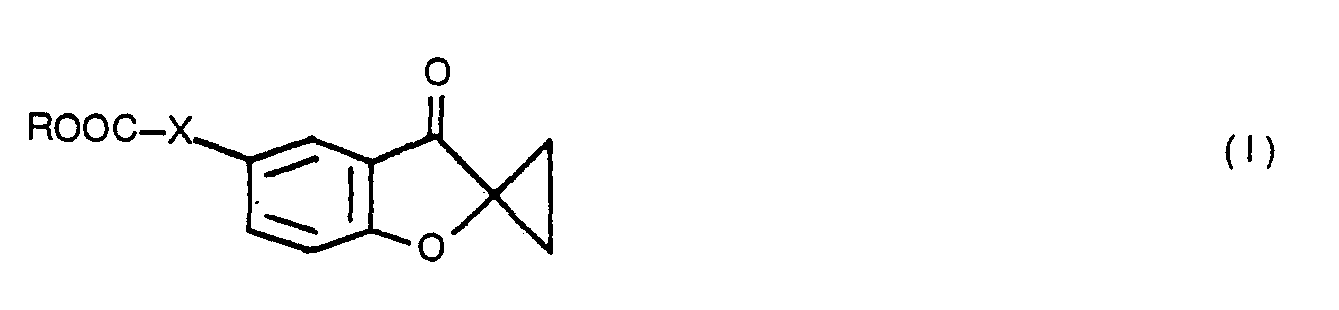
[0002] More particularly, this invention relates to a novel spirobenzofuranone compound of the formula I:
wherein R is a hydrogen atom or a C1-s lower alkyl and -XI is
and a phamaraceutically acceptable salt thereof, and its production.
[0003] Referring to the above formula I, R is a hydrogen atom or a C1-5 lower alkyl group which is a straight- chain or branched lower alkyl group of 1 to 5 carbon atoms, such as methyl, ethyl, n-propyl, n-butyl, isopropyl, tert-butyl, n-pentyl.
[0004] The spirobezonfuranone compound of the formula I wherein R is a C1-5 lower alkyl and -X- is
can be produced, for example, from the compound II described in U.S.P. No. 4,284,644 in the following manner:
[0005] In the above reaction formula, R' is a lower C1-5 alkyl group. Reacting the compound II with selenium dioxide or the like in a mixed solvent such as dioxane-water under reflux conditions gives rise to the a-ketoaldehyde III. This a-ketoaldehyde may, with or without purification, be subjected to the next reaction. Thus, the compound III is oxidized with, for example, manganese dioxide in a suitable alcoholic solvent (R'OH) in the presence of a catalyst such as sodium cyanide, potassium cyanide, whereby the contemplated spiro compound, i.e. a-ketoester is produced.
[0006] Referring, further, to the formula I, the compound I wherein R is a C1-5 lower alkyl and -X- is
i.e. a-hydroxyester can be produced by reducing the a-ketoester of the formula:
wherein R' is as defined hereinbefore.
[0007] The compound of the formula I wherein -X- is
and R is a hydrogen atom, i.e. a-hydroxyacid can be produced by hydrolyzing the a-hydroxyester of the formula:
wherein R' is as defined hereinbefore which is obtainable by the above-mentioned reduction of the a-ketoester of the formula:
[0008] The reduction may be carried out by a method using a metal borohydride as a reducing agent or a catalytic reduction method. The reduction reaction using a metal borohydride is conducted in a suitable solvent, and while the solvent may be any solvent only if it does not interfere with the reaction, ether, tetrahydrofuran, dioxane, dimethoxyethane, methylene, chloride, pyridine or isopropyl alcohol or a mixture of such solvents can be employed. As regards the reducing agent used for the above-mentioned reduction reaction, metal borohydrides such as sodium borohydride, potassium borohydride, are preferred. The reaction temperature is generally -70°C to +40°C and preferably -30°C to +20°C, although the reaction can be conducted at a still lower or a higher temperature so as to control the reaction rate and prevent the reduction of the 3-carbonyl group.
[0009] The catalytic reduction can be conducted in hydrogen gas streams using, for example, a palladium or Raney nickel catalyst in a suitable solvent such as methanol, ethanol, dioxane, methylene chloride or tetrahydrofuran of a mixture of such solvents. The hydrogen gas pressure may be atmospheric or superatmospheric, and the reaction temperature may range from -20°C to 100°C.
[0010] The hydrolysis reaction mentioned hereinbefore is conducted using, for example, a metal hydroxide such as sodium hydroxide, potassium hydroxide, barium hydroxide, or an alkali metal carbonate such as sodium carbonate, sodium hydrogen carbonate or potassium hydrogen carbonate in a suitable solvent such as water, tetrahydrofuran, dioxane, methanol, ethanol, acetonitrile or N,N-dimethylformamide or a mixture of such solvents. The reaction temperature is generally -10°C to +100°C and preferably 30°C to 80°C.
[0011] The spirobenzofuranone compound of the formula I wherein R is a hydrogen atom and -X- is
can also be produced by oxidizing the compound of the formula:
[0012] This oxidation reaction is carried out in a suitable solvent such as acetone, methylene chloride, dioxane, tetrahydrofuran or acetonitrile or a mixture of such solvents. The oxidizing agent may for example by chromic acid, chromium trioxide-sulfuric acid (Jones' reagent) or active manganese dioxide. The reaction temperature may range from -20°C to +50°C.
[0013] The desired compound I produced in the above manner can be isolated and purified by the conventional procedures (such as recrystallization, distillation, chromatography) from the reaction mixture. While the desired compound I may exist as optical isomers due to asymmetric carbon, these isomers also fall within the scope of this invention.
[0014] The product compound I may be isolated in the form of a pharmacologically acceptable salt such as salts of metals, e.g. sodium, potassium, calcium, aluminum, triethylamine salt, ammonium salt, quinine salt or cinchonine salt.
[0015] The spirobenzofuranone compound I accoding to this invention has gastric secretion inhibiting activity and antiulcer activity, and is of value as an antiulcer drug for the prevention and treatment of gastric or duodenal ulcers and acute and chronic cases of gastritis. In a test according to the method of Robert et al. (Gastroenterology 77,433,1979), this spiro compound I was found to strongly inhibit ulcerative damage to . the gastric mucosa at the dose level of 50 mg/kg and be low in toxicity. For use of the compound I as a drug for the above-mentioned diseases, it can be safely administered orally or non-orally, either as it is or as formulated with the known excipients or carriers, into suitable dosage forms such as tablets, powders, capsules, injections or suppositories. The dosage depends on the subject conditions and administration route, but for oral administration to adult humans in the treatment of gastric or duodenal ulcer or acute or chronic gastritis, the compound I can be advantageously administered in a dose of from 1 to 20 mg/kg body weight, once to 3 times a day.
[0016] The following test and working examples are further illustrative but not limitative of this invention.
Test Example
Antiulcer effect
[0017] The stress ulcer inhibiting effect of the drug was investigated in rats in accordance with the water immersion method described by K. Takagi and S. Okabe, Jap. J. Pharmacol. 18, 9, 1968.
[0018] When the above compound was once administered orally to ICR mice in a dose of 500 mg/kg, no death was found during an observation period of 7 days.
Example 1
[0019] In a mixture of 200 ml of dioxane and 20 ml of water is dissolved 20 g of 5-acetyl[benzofuran-2(3H),1'-cyclopropanl-3-one, and 20 g of selenium dioxide is added. The mixture is refluxed for 20 hours. After cooling, the precipitate is filtered off and the filtrate is concentrated under reduced pressure. The residue is dissolved in 300 ml of methanol and 1.0 g of potassium cyanide is added followed by portionwise addition of 30 g of active manganese dioxide with stirring at room temperature. After stirring for 30 minutes, the mixture is filtered and the filtrate is concentrated under reduced pressure. The residue is dissolved in ethyl acetate, washed with water and dried over anhydrous sodium sulfate. The solvent is then distilled off under reduced pressure and the residue is purified by silica gel column chromatography [eluent: hexane-ethyl acetate (3:1)]. Recrystallization from ether-hexane gives methyl 3-oxospiro[benzofuran-2(3),1'-cyclopropane]-5-oxalate as colorless prisms. Yield 13 g. M.p. 57-58°C.
Example 2
[0021] In 60 ml of tetrahydrofuran is dissolved 6.0 g of methy! 3-oxospiro[benzofuran-2(3H),1'-cyciopropane]-5-oxalate and, with stirring at -30°C to -20°C, 300 mg of sodium borohydride is added portionwise to the solution. After stirring for 30 minutes, 10 ml of acetone is added and the mixture is stirred at room temperature for 30 minutes and then concentrated under reduced pressure. To the residue is added ethyl acetate and the mixture is serially washed with water and dilute hydrochloric acid and dried over anhydrous sodium sulfate. The solvent is then distilled off under reduced pressure and the residue is recrystallized from ethyl acetate to give methyl 2-hydroxy-2-(3-oxospiro[benzofuran-2-(3H),1'-cycio- propane]-5)-acetate as colorless prisms. Yield 3.2 g. M.p. 112-113°C.
Example 3
[0023] In 30 ml of methanol is dissolved 2.0 g of methyl 3-oxospiro[benzofuran-2(3H),1'-cyclopropane)-5- oxalate, and catalytic reduction is carried out using 5% palladium-on-carbon at atmospheric temperature and pressure. The reaction is continued until the amount of hydrogen absorbed reaches one equivalent. The catalyst is then filtered off and the filtrate is concentrated under reduced pressure. The residue is recrystllized from ethyl acetate to give methyl 2-hydroxy-2-(3-oxospiro[benzofuran-2(3H),1'-cyclopropane]-5)-acetate as colorless prisms. Yield 1.6 g. M.p. 112-113°C.
Example 4
[0024] In a mixture of 30 ml of water, 30 ml of methanol and 60 ml tetrahydrofuran is dissolved 3.2 g of methyl 2-hydroxy-2-(3-oxospiro[benzofuran-2(3H),1'-cyclopropan]-5)-acetate, and 3.0 g of sodium hydrogen carbonate is added. The mixture is stirred at 60°C for 20 hours and then concentrated to 30 ml under reduced pressure and dried with ethyl acetate. The aqueous layer is acidified with 1 N hydrochloric acid with ice-cooling followed by extraction with ethyl acetate. The organic layer is washed with water and dried and the solvent distilled off under reduced pressure. The residue is recrystallized from hexane-ethyl acetate to give 2-hydroxy-2-(3-oxospiro[benzofuran-2(3H),1'-cyclopropane]-5)-acetic acid as colorless prisms. Yield 2.0 g. M.p. 138-129°C.
Example of preparation ready for administration
1. A spirobenzofuranone compound of the formula I:

wherein R is a hydrogen atom or a C1-5 lower alkyl and -X- is
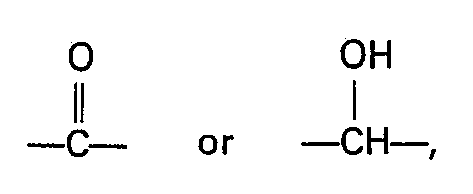
or a pharmaceutically acceptable salt thereof.
wherein R is a hydrogen atom or a C1-5 lower alkyl and -X- is
or a pharmaceutically acceptable salt thereof.
2. The compound according to Claim 1, which is methyl 3-oxospiro [benzofuran-2(3H),1'-cyclopropane]-5-oxalate.
3. The compound according to Claim 1, which is methyl 2-hydroxy-2-(3-oxospiro[benzofuran-2(3H),1'-cyclopropanel-5-acetate.
4. The compound according to Claim 1, which is 2-hydroxy-2-(3-oxospiro[benzofuran-2(3H),1'-cyclopropane]-5)-acetic
acid.
5. A pharmaceutical composition for treating peptic ulcer which comprises, as an active
ingredient, an effective amount of a compound or its salt as defined in Claim 1, and
a pharmaceutically acceptable carrier or diluent therefor.
6. A compound of the formula I:
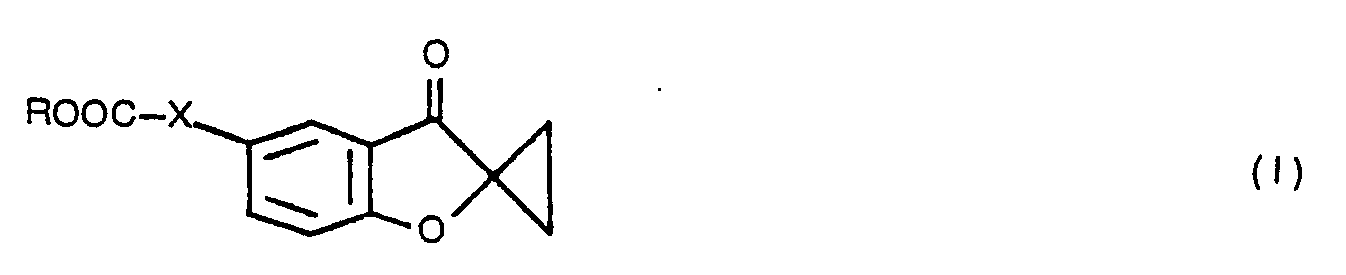
wherein R is a hydrogen atom or a C1-s lower alkyl and -X- is
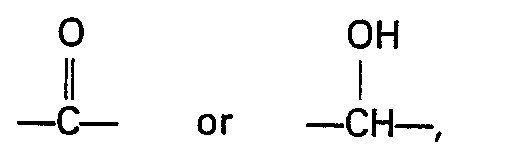
or a pharmaceutically acceptable salt thereof, for use in the preparation of a medicament for the treatment of peptic ulcers.
wherein R is a hydrogen atom or a C1-s lower alkyl and -X- is
or a pharmaceutically acceptable salt thereof, for use in the preparation of a medicament for the treatment of peptic ulcers.
7. A compound according to Claim 6, wherein the compound is 2-hydroxy-2-(3-oxospiro[benzofuran-2(3H),1'-cyclopropane]-5-acetic
acid.
1. Spirobenzofuranon-Verbindung der Formel I:
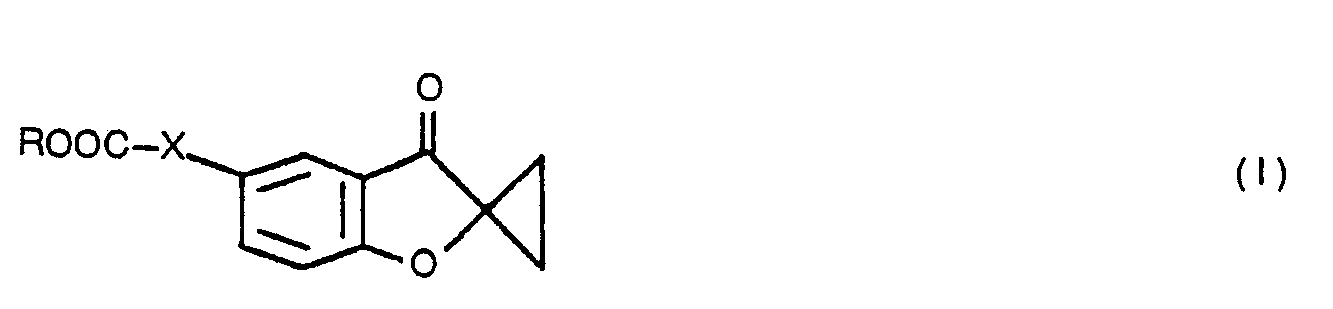
in der R ein Wasserstoff-Atom oder ein C1-5-Niederalkyl ist und -X-
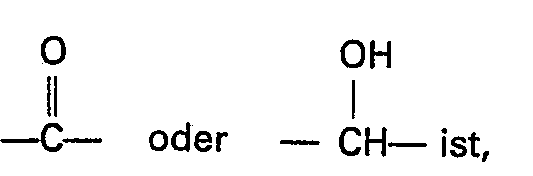
oder ein pharmazeutisch annehmbares Salz derselben.
in der R ein Wasserstoff-Atom oder ein C1-5-Niederalkyl ist und -X-
oder ein pharmazeutisch annehmbares Salz derselben.
2. Verbindung nach Anspruch 1, die Methyl-3-oxospiro[benzofuran-2(3H),1'-cyclopropan]-5-oxalat
ist.
3. Verbindung nach Anspruch 1, die Methyl-2-hydroxy-2-(3-oxospiro[benzofuran-2(3H),1'-cyclo-
propan]-5)-acetate ist.
4. Verbindung nach Anspruch 1, die 2-Hydroxy-2-(3-oxospiro[benzofuran-2(3H),1'-cyclopropan]-5)-essigsäure ist.
5. Pharmazeutische Zusammensetzung zur Behandlung eines peptischen Ulkus, die als
Wirkstoff eine wirksame Menge einer Verbindung oder ihres Salzes, wie sie in Anspruch
1 definiert sind, und ein pharmazeutisch annehmbares Trägermaterial oder Verdünnungsmittel
dafür umfaßt.
6. Verbindung der Formel I:

in der R ein Wasserstoff-Atom oder ein C1-5-Niederalkyl ist und -X-
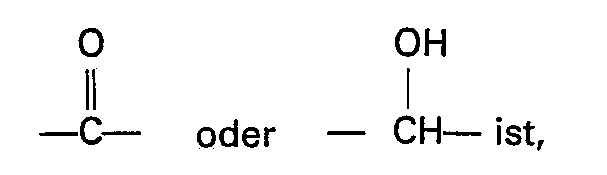
oder ein pharmazeutisch annehmbares Salz derselben zur Verwendung bei der Herstellung eines Medikaments zur Behandlung eines peptischen Ulkus.
in der R ein Wasserstoff-Atom oder ein C1-5-Niederalkyl ist und -X-
oder ein pharmazeutisch annehmbares Salz derselben zur Verwendung bei der Herstellung eines Medikaments zur Behandlung eines peptischen Ulkus.
7. Verbindung nach Anspruch 6, worin die Verbindung 2-Hydroxy-2-(3-oxospiro[benzofuran-2(3H),-1'cyclopropan]-5)-essigsäure
ist.
1. Dérivé de spirobenzofurannone der formule I:

dans laquelle R représente un atome d'hydrogène ou un alkyle inférieur en C1-5 et ―X― représente
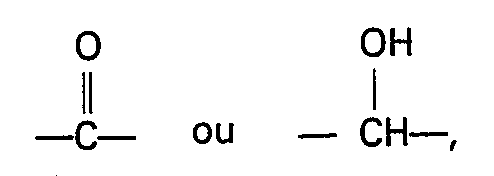
ou un sel pharmaceutiquement acceptable de ce dérivé.
dans laquelle R représente un atome d'hydrogène ou un alkyle inférieur en C1-5 et ―X― représente
ou un sel pharmaceutiquement acceptable de ce dérivé.
2. Composé selon la revendication 1, qui est le 3-oxospiro[benzofuranne-2(3H),1'-cyclopropane]-5-
oxalate de méthyle.
3. Composé selon la revendication 1, qui est le 2-hydroxy-2-(3-oxospiro[benzofuranne-2(3H),1'-cyclopropane]-5)-acétate
de méthyle.
4. Composé selon la revendication 1, qui est l'acide 2-hydroxy-2-(3-oxospiro[benzofuranne-2(3H),1'-cyclopropane]-5)-acétique.
5. Composition pharmaceutique pour le traitement de l'ulçère peptique, qui comprend
comme substance active une quantité efficace d'un composé ou d'un sel de celui-ci,
tels que défini à la revendication 1, et une matière de support ou un diluant pharmaceuiiquement
acceptables pour ceux-ci.
6. Composé de formule I:
dans laquelle R représente un atome d'hydrogène ou un alkyle interieur en C1-5 et―X― représente
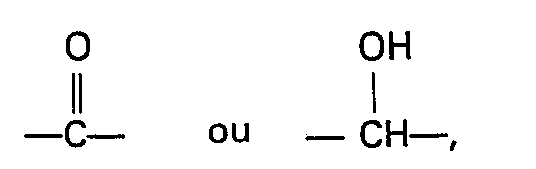
ou un sel pharmaceutiquement acceptable de ce dérivé pour leur utilisation à la préparation d'un médicament destiné au traitement de l'ulcère peptique.
dans laquelle R représente un atome d'hydrogène ou un alkyle interieur en C1-5 et―X― représente
ou un sel pharmaceutiquement acceptable de ce dérivé pour leur utilisation à la préparation d'un médicament destiné au traitement de l'ulcère peptique.
7. Composé selon la revendication 6, qui est l'acide 2-hydroxy-2-(3-oxospiro[benzofuranne-2(3H),1'-cyclopropane]-5-acétique.