| (19) |
 |
|
(11) |
EP 0 135 370 B1 |
| (12) |
EUROPEAN PATENT SPECIFICATION |
| (45) |
Mention of the grant of the patent: |
|
30.01.1991 Bulletin 1991/05 |
| (22) |
Date of filing: 17.08.1984 |
|
| (51) |
International Patent Classification (IPC)5: G11B 7/24 |
|
| (54) |
Information recording member
Aufzeichnungselement für eine Information
Elément pour enregistrer une information
|
| (84) |
Designated Contracting States: |
|
DE FR GB NL |
| (30) |
Priority: |
19.08.1983 JP 150148/83
|
| (43) |
Date of publication of application: |
|
27.03.1985 Bulletin 1985/13 |
| (73) |
Proprietor: HITACHI, LTD. |
|
Chiyoda-ku,
Tokyo 100 (JP) |
|
| (72) |
Inventors: |
|
- Terao, Motoyasu
Nishitama-gun
Tokyo (JP)
- Miyauchi, Yasushi
Hachioji-shi
Tokyo (JP)
- Shigematsu, Kazuo
Kita-katsushika-gun
Saitama-ken (JP)
- Horigome, Shinkichi
Tachikawa-shi
Tokyo (JP)
|
| (74) |
Representative: Paget, Hugh Charles Edward et al |
|
MEWBURN ELLIS
York House
23 Kingsway
London WC2B 6HP
London WC2B 6HP (GB) |
| (56) |
References cited: :
EP-A- 0 045 183
DE-A- 2 739 610
US-A- 3 530 441
|
EP-A- 0 050 047
DE-A- 3 023 134
|
|
| |
|
|
- PATENT ABSTRACTS OF JAPAN, unexamined applications, Section P, Vol. 4, No. 58, April
30, 1980 THE PATENT OFFICE JAPANESE GOVERNMENT pages 96 P 9
|
|
| |
|
|
|
Remarks: |
|
The file contains technical information submitted after the application was filed
and not included in this specification |
|
| Note: Within nine months from the publication of the mention of the grant of the European
patent, any person may give notice to the European Patent Office of opposition to
the European patent
granted. Notice of opposition shall be filed in a written reasoned statement. It shall
not be deemed to
have been filed until the opposition fee has been paid. (Art. 99(1) European Patent
Convention).
|
[0001] This invention relates to an information recording member for recording, on a real
time basis, frequency-modulated analog signals such as video and audio signals or
digital data such as computer data, facsimile signals, digital audio signals and the
like. The information is recorded in the member on an information recording film formed
on a substrate, using a recording beam such as laser light. The invention also extends
to the method of recording information.
[0002] Among the various principles which exist for recording information on a film using
laser light, the method based upon a change of atomic arrangement such as phase transition
(or phase change) of the film material, photodarkening and the like, has the advantage
that two discs can be directly bonded together to form a two-surface disc because
deformation of the film hardly occurs. Moreover, rewriting of the information can
be made possible by selection of a suitable composition. A large number of disclosures
of recording members of this kind are known, and the earliest of all is U.S. Patent
No. 3,530,441. This prior art reference discloses a large number of films such as
the Te-Ge type, the As-Te-Ge type, the Te-0 type, and so forth. Japanese Patent Laid-Open
No. 28530/1980 discloses Te-O-Se and Te-O-S type films. However, it is extremely difficult
to produce suitable films using these materials, and the stability of the amorphous
state is not sufficiently high.
[0003] It is therefore an object of the present invention to provide an information recording
member which can be produced by a process with high reproducibility and which can
remain stable for an extended period of time.
[0004] In the information recording member of the invention, the information recording film
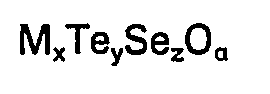
has an average composition in the direction of film thickness expressed by:
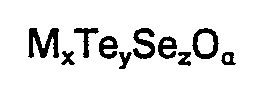
where x, y, z and a are values within the ranges 2≦x≦40, 30:5y:595, 3≤z≤45 and 0≤n≤20,
and M represents one of the following combinations of elements:
In and Sb
Sn and Ge
Pb and Sn
Sn and Bi
Sn and S
In and Pb
In and Bi
Sb and Bi
Sb and S
Sb and Pb
Sb and Sn
Sb and Ge
As and Sn
As and Sb
[0005] The combinations including Sn are preferred.
[0006] In its method aspect, the invention is set out in claim 11.
[0007] a may be zero, but preferably oxygen is present. In the manufacture of an information
recording member of the present invention, the oxygen-containing film is preferably
produced by first forming a film which does not contain oxygen having the formula
M
xTeySe
z, and then heat-treating this film in air of high humidity or subjecting the film
to ultraviolet radiation. In this case, the film is oxidized at least near its surface.
Accordingly, the average composition of the film in the direction of its thickness
is expressed by the general formula M
XTeySe
ZOa, where a is not zero but is not more than 20. If oxygen is introduced by such a
method, the composition can be controlled more easily then by evaporation of oxide
or by sputtering.
[0008] The distribution, in the direction of film thickness, of the contents of the elements
M may be freely chosen, but it is preferred that this content increases at either
one of the surface portions (which in some cases might be an interface with other
layers) rather than in the interior of the film, because spontaneous crystallization
from near the film surface, at which nuclei of micro-crystals are likely to develop,
can thus be prevented. For the same reason, the distribution in the direction of film
thickness of the Se content may be freely chosen, but preferably increases near the
film surface (interface). Incidentally, the film may contain trace amounts of elements
other than Te and Se and M.
[0009] The films, which contain relatively low amounts of oxygen, can be easily formed,
have high crystallization temperatures and provide high stability.
[0010] Preferably, at least one of the surfaces of the recording film in a member of the
present invention is protected by other material which is in close contact with that
surface. The protective layer may consist of an acrylic resin sheet or a polycarbonate
resin sheet which is the substrate, or at least one organic material such as an ultraviolet
light cured resin, an epoxy resin, an acrylic resin, a polyester resin or the like.
It may alternatively consist of at least one inorganic material such as an oxide,
a sulfide, a fluoride, a carbide, a nitride or carbon. The substrate, if it consists
of glass, quartz or sapphire can serve as an inorganic protective layer.
[0011] For heat resistance, the surface of the recording film is preferably in close contact
with the inorganic material. However, if the thickness of the inorganic layer is increased,
cracking and drop of transmissivity and sensitivity are likely to occur. It is therefore
preferable that a thick organic layer is disposed in close contact with the inorganic
layer on the opposite side thereof to the recording film. The organic layer may be
the substrate, and in such a case, the risk of deformation of the recording film is
reduced. Examples of the organic materials suitable for this purpose are polystyrene
resins, acrylic resins, polycarbonate resins, epoxy resins, ethylene-vinyl acetate
copolymers known as hot melt adhesives, binders and the like. Ultraviolet light cured
resins may alternatively be used.
[0012] The protective layer or layers consisting of inorganic materials can be formed in
their proper compositions directly, can be formed more easily by first making a film
made of at least one element of metals, semi-metals or semiconductors, and then making
this film react with at least one of O, S and N. Examples of suitable inorganic protective
layers include the following, and non-stoichiometric compounds having analogous compositions:
Ce0
2, La
20
3, SiO, Si0
2, In
20
3, AI
20
3, GeO, Ge0
2, PbO, SnO, Sn0
2, Bi
20
3, Te0
2, W0
2, W0
3, CdS, ZnS, CdSe, ZnSe, In
2S
3, In
2Se
3, Sb
2S
3, Sb
2Se
3, Ga
2S
3, Ga
2Se
3, MgF
2, CeF
3, CaF
2, GeS, GeSe, GeSe
2, SnS, SnSe, PbS, PbSe, Bi
2Se
3, Bi
2S
3, TaN and C. Among these, the compositions close to Ge0
2 or AI
20
3 are preferred because their vacuum evaporation is easy, surface reflectivity is not
too high and the film is stable. Next preferred are compositions which are close to
Si0
2.
[0013] When recording is effected by means of the phase transition, it is preferred that
the entire surface of the recording film is crystallized in advance. When organic
material is used for the substrate, however, the substrate cannot be heated to a high
temperature, so that the film surface must be crystallized by other methods. In such
a case, the combination of ultraviolet light radiation and heating, radiation of light
from a flash lamp, or the like, is preferred. The recording film may be crystallized
only on the recording track with the spacings between the tracks kept in amorphous
state. It is of course possible to make recording on a recording film in the amorphous
state by crystallization.
[0014] Generally, in the case of recording films which effect recording by means of a change
of atomic arrangement such as phase transition, the read signal intensity orthe degree
of modulation can be improved if a light reflection (absorption) layer is disposed
close to the recording film. If data rewriting is effected a large number of times
or if recording is made using a beam having excessively high power, however, mutual
diffusion and reaction may occur between the recording film and the light reflection
layer. For this reason, it is preferred to dispose an intermediate layer consisting
of at least one of a stable oxide, a sulfide, a fluoride and a nitride between the
light reflection layer and the recording film. The melting point and boiling (sublimation)
point of this layer are preferably higher than at least the melting point of the recording
film. Where light absorption by the recording film is less, and the light reflection
layer is chosen to absorb the light and the resulting heat is transmitted to the recording
film so as to effect recording, the intermediate layer described above is preferably
up to 100 nm (0.1 pm) thick, and particularly preferably from 1 nm to 50 nm thick,
in order to achieve good heat transfer efficiency. The inorganic materials such as
Ge0
2, AI
20
3 and the like that can be used as the protective layer can all be used as the intermediate
layer.
[0015] The preferred ranges of thickness of the layers described above are tabulated below:
recording film: 3 nm to 300 nm
inorganic protective layer: 1 nm to 5 pm (0.1 to 20 mm when protection is given by
the inorganic substrate itself)
organic protective layer: 10 nm to 10 mm light reflection layer: 5 nm to 300 nm.
[0016] Each of the layers described above can be formed by selecting a suitable method of
vacuum evaporation, evaporation inside gas, sputtering, ion beam evaporation, ion
plating, electron beam evaporation, injection molding, casting, spin coating and plasma
polymerization.
[0017] The recording member in accordance with the present invention can be not only in
the disc form but also in the form of a tape or in other forms.
1. An information recording member having an information recording film which is formed
on a substrate either directly or with the interposition of at least one inorganic
or organic protective layer and which undergoes change of atomic arrangement upon
being irradiated by a suitable recording .beam, characterised in that said recording
film has an average composition in the direction of a film thickness expressed by
the formula:
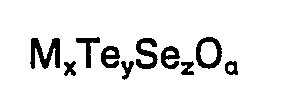
where 2≤x≤40, 30≤y≤95, 3≤z≤45 and 0≤α≤20, and M represents one of the following combinations
of elements:
In and Sb
Sn and Ge
Pb and Sn
Sn and Bi
Sn and S
In and Pb
In and Bi
Sb and Bi
Sb and S
Sb and Pb
Sb and Sn
Sb and Ge
As and Sn
As and Sb
2. An information recording member as defined in Claim 2 wherein a is zero.
3. An information recording member as defined in Claim 1 wherein a is not zero and
the oxygen in the recording film is introduced into the film by oxidisation of a film
having an average configuration in its thickness direction expressed by the formula
MxTeySez which has been formed previously.
4. An information recording member as defined in any one of Claims 1 to 3 wherein
the concentration of Se and/or the elements expressed by M is greater at a portion
adjacent at least one of the surfaces of the recording film than at the interior portion
thereof.
5. An information recording member as defined in any one of Claims 1 to 4 wherein
there is a protective film adjacent at least one side of said recording film, the
protective film having the composition Ge02 or A1203 or close to Ge02 or A1203.
6. An information recording member as defined in any one of Claims 1 to 5 wherein
at least one protective layer consisting of inorganic materials is disposed on at
least one side of said recording film adjacent to the surface of said recording film,
and an organic layer is disposed on the side of the inorganic protective layer remote
from the recording film.
7. An information recording member as defined in any one of Claims 1 to 6 wherein
a light reflection and absorption layer is disposed at one side of the recording film
with the interposition of an intermediate layer having a thickness in the range 1
nm to 50 nm.
8. An information recording member as defined in any one of Claims 1 to 7 wherein
the distance, in the track direction between adjacent pairs of recording locations
formed on the surface of said substrate and representing address locations is at least
half of the length of the erasing light spot in that direction.
9. An information recording member as defined in any one of Claims 1 to 8 wherein
the elements expressed by M include Sn.
10. An information recording member as defined in any one of Claims 1 to 9 wherein
the recording film has a thickness in the range 3 to 300 nm.
11. A method of recording information comprising
(i) providing an information recording member having an information recording film
which is formed on a substrate either directly or with the interposition of at least
one inorganic or oragnic protective layer and which has an average composition in
the direction of a film thickness expressed by the formula:
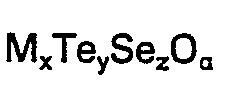
where 2≤x≤40, 30≤y≤95, 3:5z:545 and 0≤α≤20 and M represents one of the following combinations
of elements:
In and Sb
Sn and Ge
Pb and Sn
Sn and Bi
Sn and S
In and Pb
In and Bi
Sb and Bi
Sb and S
Sb and Pb
Sb and Sn
Sb and Ge
As and Sn
As and Sb
(ii) irradiating said recording film with a recording beam so as selectively to cause
a change of atomic arrangement of said film at locations thereof in accordance with
the information being recorded, so as to record said information.
12. A method as defined in Claim 11 wherein a is zero.
13. A method as defined in Claim 11 wherein a is not zero and the oxygen in the recording
film is introduced into the film by oxidisation of a film having an average configuration
in its thickness direction expressed by the formula MxTeySez which has been formed previously.
14. A method as defined in any one of Claims 11 to 13 wherein the concentration of
Se and/or the elements expressed by M is greater at a portion adjacent at least one
of the surfaces of the recording film than at the interior portion thereof.
15. A method as defined in any one of Claims 11 to 14 wherein there is a protective
film adjacent at least one side of said recording film, the protective film having
the composition Ge02 or A1203 or close to Ge02 or AI203.
16. A method as defined in any one of Claims 11 to 15 wherein at least one protective
layer consisting of inorganic materials is disposed on at least one side of said recording
film adjacent to the surface of said recording film, and an organic layer is disposed
on the side of the inorganic protective layer remote from the recording film.
17. A method as defined in any one of Claims 11 to 16 wherein a light reflection and
absorption layer is disposed at one side of the recording film with the interposition
of an intermediate layer having a thickness in the range 1 nm to 50 nm.
18. A method as defined in any one of Claims 11 to 17 wherein the distance, in the
track direction between adjacent pairs of recording locations formed on the surface
of said substrate and representing address locations is at least half of the length
of the erasing light spot in that direction.
19. A method as defined in any one of Claims 11 to 18 wherein the elements expressed
by M include Sn.
20. A method as defined in any one of Claims 11 to 19 comprising the further step
of
(iii) detecting the changes of atomic arrangement at said locations in order to reproduce
the information from the recording member.
21. A method according to any one of Claims 11 to 20 wherein the recording film has
a thickness in the range 3 to 300 nm.
1. Informations-Aufzeichungselement mit einem auf einem Substrat entweder direkt oder
unter Zwischenfügung mindestens einer anorganischen oder organischen Schutzschicht
ausgebildeten Informations-Aufzeichnungsfilm, der bei Bestrahlung mit einem geeigneten
Aufzeichnungsstrahl eine Änderung in der Atomanord-. nung durchläuft, dadurch gekennzeichnet,
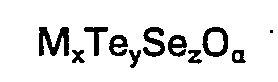
daß der Aufzeichnungsfilm in Richtung der Filmdicke eine mittlere Zusammensetzung
der folgenden Formel aufweist:
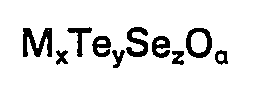
wobei 2≦x≦40, 30≦y≦95, 3≦z≦45 und O≦α≦20 ist und M eine der folgenden Kombinationen
von Elementen angibt:
In und Sb
Sn und Ge
Pb und Sn
Sn und Bi
Sn und S
In und Pb
In und Bi
Sb und Bi
Sb und S
Sb und Rb
Sb und Sn
Sb und Ge
As und Sn
As und Sb
2. Informations-Aufzeichungselement nach Anspruch 1, wobei a null ist.
3. Informations-Aufzeichungselement nach Anspruch 1, wobei a nicht null ist und der
in dem Aufzeichnungsfilm enthaltene Sauerstoff dadurch in diesen eingebracht wird,
daß ein vorher ausgebildeter Film oxidiert wird, der in Richtung seiner Dicke eine
mittlere Konfiguration der Formel MxTeySez aufweist.
4. Informations-Aufzeichnungselement nach einem der Ansprüche 1 bis 3, wobei die Konzentration
von Se und/oder den durch M ausgedrückten Elementen in einem Bereich nahe mindestens
einer der Oberflächen des Aufzeichnungsfilms größer ist als in dessen innerem Bereich.
5. Informations-Aufzeichnungselement nach einem derAnsprüche 1 bis 4, wobei an mindestens
einer Seite des Aufzeichnungsfilms ein Schutzfilm vorhanden ist, der die Zusammensetzung
Ge02 oder Al2O3 oder nahezu Ge02 oder A1203 aufweist.
6. Informations-Aufzeichnungselement nach einem der Ansprüche 1 bis 5, wobei an mindestens
einer der Oberfläche des Aufzeichnungsfilms benachbarten Seite dieses Films mindestens
eine aus anorganischen Materialien bestehende Schutzschicht und an der von dem Aufzeichnungsfilm
abgewandten Seite der anorganischen Schutzschicht eine organische Schicht angeordnet
ist.
7. Informations-Aufzeichnungselement nach einem der Ansprüche 1 bis 6, wobei an einer
Seite des Aufzeichnungsfilms unter Zwischenfügung einer Zwischenschicht mit einer
Dicke im Bereich von 1 nm bis 50 nm eine Lichtreflexions- und -absorptionsschicht
angeordnet ist.
8. Informations-Aufzeichnungselement nach einem der Ansprüche 1 bis 7, wobei der Abstand
in Spurrichtung zwischen benachbarten Paaren von Aufzeichnungsstellen, die auf der
Oberfläche des Substrats ausgebildet sind und Adressenplätze darstellen, mindestens
die Hälfte der Länge des Lösch-Lichtflecks in dieser Richtung beträgt.
9. Informations-Aufzeichnungselement nach einem der Ansprüche 1 bis 8, wobei die durch
M ausgedrückten Elemente Sn enthalten.
10. Informations-Aufzeichnungselement nach einem der Ansprüche 1 bis 9, wobei der
Aufzeichnungsfilm eine Dicke im Bereich von 3 bis 300 nm aufweist.
11. Informations-Aufzeichnungsverfahren, umfassend
(i) Vorbereiten eines Informations-Aufzeichnungselements mit einem auf einem Substrat
entweder direkt oder unter Zwischenfügung mindestens einer anorganischen oder organischen
Schutzschicht ausgebildeten Informations-Aufzeichnungsfilm, der in Richtung der Filmdicke
eine mittlere Zusammensetzung der folgenden Formel aufweist:
wobei 2≦x≦40, 30≦y≦95, 3≦z≦45 und O≦α≦20 ist und M eine der folgenden Kombinationen
von Elementen angibt:
In und Sb
Sn und Ge
Pb und Sn
Sn und Bi
Sn und S
In und Pb
In und Bi
Sb und Bi
Sb und S
Sb und Pb
Sb und Sn
Sb und Ge
As und Sn
As und Sb
(ii) Bestrahlen des Aufzeichnungsfilms mit einem Aufzeichnungsstrahl, um in dem Film
an Stellen entsprechend der aufzuzeichnenden Information selektiv eine Änderung der
Atomanordnung hervorzurufen, um die Information aufzuzeichnen.
12. Verfahren nach Anspruch 11, wobei a null ist.
13. Verfahren nach Anspruch 11, wobei a nicht null ist und der in dem Aufzeichnungsfilm
enthaltene Sauerstoff in diesen dadurch eingebracht wird, daß ein vorher ausgebildeter
Film oxidiert wird, der in Richtung seiner Dicke eine mittlere Konfiguration der Formel
MxTeySez aufweist.
14. Verfahren nach einem der Ansprüche 11 bis 13, wobei die Konzentration von Se und/oder
den durch M ausgedrückten Elementen in einem Bereich nahe mindestens einer der Oberflächen
des Aufzeichnungsfilms größer ist als in dessen innerem Bereich.
15. Verfahren nach einem der Ansprüche 11 bis 14, wobei an mindestens einer Seite
des Aufzeichnungsfilms ein Schutzfilm vorhanden ist, der die Zusammensetzung Ge02 oder A1203 oder nahezu Ge02 oder AI203 aufweist.
16. Verfahren nach einem der Ansprüche 11 bis 15, wobei an mindestens einer der Oberfläche
des Aufzeichnungsfilms benachbarten Seite dieses Films mindestens eine aus anorganischen
Materialien bestehende Schutzschicht und an der von dem Aufzeichnungsfilm abgewandten
Seite der anorganischen Schutzschicht eine organische Schicht angeordnet ist.
17. Verfahren nach einem der Ansprüche 11 bis 16, wobei an einer Seite des Aufzeichnungsfilms
unter Zwischenfügung einer Zwischenschicht mit einer Dicke im Bereich von 1 nm bis
50 nm eine Lichtreflexions- und -absorptionsschicht angeordnet ist.
18. Verfahren nach einem der Ansprüche 11 bis 17, wobei der Abstand in Spurrichtung
zwischen benachbarten Paaren von Aufzeichnungsstellen, die auf der Oberfläche des
Substrats ausgebildet sind und Adressenplätze darstellen, mindestens die Hälfte der
Länge des Lösch-Lichtflecks in dieser Richtung beträgt.
19. Verfahren nach einem der Ansprüche 11 bis 18, wobei die durch M ausgedrückten
Elemente Sn enthalten.
20. Verfahren nach einem der Ansprüche 11 bis 19, umfassend den weiteren Schritt:
(iii) Erfassen von Änderungen der Atomanordnung an den besagten Stellen zum Reproduzieren
der Information von dem Aufzeichnungselement.
21. Verfahren nach einem der Ansprüche 11 bis 20, wobei der Aufzeichnungsfilm eine
Dicke im Bereich von 3 bis 300 nm aufweist.
1. Elément d'enregistrement de l'information comportant une pellicule d'enregistrement
de l'information qui est formée sur un substrat, soit directement, soit avec interposition
d'au moins une couche protectrice inorganique ou organique et qui subit une modification
de disposition atomique lorsqu'elle est irradiée par un fasiceau d'enregistrement
approprié, caractérisé en ce que ladite pellicule d'enregistrement a une composition
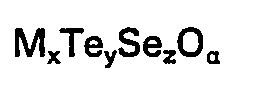
moyenne dans la direction de l'épaisseur de la pellicule exprimée par la formule:
où 2≦x≦40, 30≦y≦95, 3≦z≦45 et O≦α≦20, et M représente l'une des combinaisons d'éléments
suivantes:
In et Sb
Sn et Ge
Pb et Sn
Sn et Bi
SnetS
In et Pb
In et Bi
Sb et Bi
SbetS
Sb et Pb
Sb et Sn
Sb et Ge
As et Sn
As et Sb
2. Elément d'enregistrement de l'information tel que défini dans la revendication
1 dans lequel a vaut zéro.
3. Elément d'enregistrement de l'information tel que défini dans la revendication
1 dans lequel a est différent de zéro et l'oxygène dans la pellicule d'enregistrement
est introduit dans la pellicule par oxydation d'une pellicule ayant une configuration
moyenne dans la direction de son épaisseur exprimée par la formule MxTeySez qui a été formée auparavant.
4. Elément d'enregistrement de l'information tel que défini dans l'une quelconque
des revendications 1 à 3 dans lequel la concentration de Se et/ ou des éléments exprimés
par M est supérieure à une partie adjacente à au moins une des surfaces de la pellicule
d'enregistrement à ce qu'elle est dans sa partie intérieure.
5. Elément d'enregistrement de l'information tel que défini dans l'une quelconque
des revendications 1 à 4 dans lequel se trouve une pellicule protectrice adjacente
à au moins un côté de ladite pellicule d'enregistrement, la pellicule protectrice
ayant la composition Ge02 ou AI203 ou voisine de Ge02 ou AIz03.
6. Elément d'enregistrement de l'information tel que défini dans l'une quelconque
des revendications 1 à 5 dans lequel au moins une couche protectrice constituée de
matières inorganiques est disposée sur au moins un côté de ladite pellicule d'enregistrement
de manière adjacente à la surface de ladite pellicule d'enregistrement, et une couche
organique est disposée sur le côté de la couche protectrice inorganique à une distance
éloignée de la pellicule d'enregistrement.
7. Elément d'enregistrement de l'information tel que défini dans l'une quelconque
des revendications 1 à 6 dans lequel une couche de réflexion et d'absorption de la
lumière est disposée sur un côté de la pellicule d'enregistrement avec interposition
d'une couche intermédiaire ayant une épaisseur comprise dans un intervalle de 1 nm
à 50 nm.
8. Elément d'enregistrement de l'information tel que défini dans l'une quelconque
des revendications 1 à 7 dans lequel la distance, dans la direction de la piste entre
des paires adjacentes d'endroits d'enregistrement formés à la surface dudit substrat
et représentant des lieux d'adresse, est d'au moins la moitié de la longueur du point
lumineux d'effacement dans cette direction.
9. Elément d'enregistrement de l'information tel que défini dans l'une quelconque
des revendications 1 à 8 dans lequel les éléments exprimés par M incluent Sn.
10. Elément d'enregistrement de l'information tel que défini dans l'une quelconque
des revendications 1 à 9 dans lequel la pellicule d'enregistrement a une épaisseur
comprise dans un intervalle de 3 à 300 nm.
11. Procédé d'enregistrement de l'information dans lequel
(i) on fournit un élément d'enregistrement de l'information ayant une pellicule d'enregistrement
de l'information qui est formée sur un substrat soit directement, soit avec interposition
d'au moins une couche protectrice inorganique ou organique et qui a une composition
moyenne dans la direction de l'épaisseur de la pellicule exprimée par la formule:
où 2≦x≦40, 30≦y≦95, 3≦z≦45 et O≦α≦20 et M représente l'une des combinaisons d'éléments
suivantes:
In et Sb
Sn et Ge
Pb et Sn
Sn et Bi
Sn et S
ln et Pb
In et Bi
Sb et Bi
SbetS
Sb et Pb
Sb et Sn
Sb et Ge
As et Sn
As et Sb
(ii) on irradie ladite pellicule d'enregistrement avec un faisceau d'enregistrement
de manière à provoquer sélectivement une modification de la disposition de ladite
pellicule en des endroits de celle-ci selon l'information enregistrée, de manière
à enregistrer ladite information.
12. Procédé tel que défini dans la revendication 11 dans lequel a vaut zéro.
13. Procédé tel que défini dans la revendication 11 dans lequel a ne vaut pas zéro
et l'oxygène dans la pellicule d'enregistrement est introduit dans la pellicule par
oxydation d'une pellicule ayant une configuration moyenne dans le sens de son épaisseur
exprimée par la formule MxTeySez qui a été formée auparavant.
14. Procédétel que défini dans l'une quelconque des revendications 11 à 13 dans lequel
la concentration de Se et/ou des éléments exprimés par M est supérieure en une partie
adjacente à au moins une des surfaces de la pellicule d'enregistrement à ce qu'elle
est dans sa partie intérieure.
15. Procédé tel que défini dans l'une quelconque des revendications 11 à 14 dans lequel
se trouve une pellicule protectrice adjacente à au moins un côté de ladite pellicule
d'enregistrement, la pellicule protectrice ayant la composition Ge02 ou AI203 ou proche de Ge02 ou A1203.
16. Procédé tel que défini dans l'une quelconque des revendications 11 à 15 dans lequel
au moins une couche protectrice constituée de matières inorganiques est disposée sur
au moins un côté de ladite pellicule d'enregistrement de manière adjacente à la surface
de ladite pellicule d'enregistrement, et une couche organique est disposée sur le
côté de la couche protectrice inorganique éloigné de la pellicule d'enregistrement.
17. Procédétel que défini dans l'une quelconque des revendications 11 à 16 dans lequel
une couche de réflexion et d'absorption de la lumière est disposée sur un côté de
la pellicule d'enregistrement avec interposition d'une couche intermédiaire ayant
une épaisseur comprise dans un intervalle de 1 nm à 50 nm.
18. Procédétel que défini dans l'une quelconque des revendications 11 à 17 dans lequel
la distance, dans la direction de la piste entre des paires adjacentes d'endroits
d'enregistrement formés à la surface dudit substrat et représentant des lieux d'adresse,
est d'au moins la moitié de la longueur du point lumineux d'effacement dans cette
direction.
19. Procédé tel que défini dans l'une quelconque des revendications 11 à 18 dans lequel
les éléments exprimés par M incluent Sn.
20. Procédé tel que défini dans l'une quelconque des revendications 11 à 19 comprenant
l'étape supplémentaire de
(iii) détection des modifications de disposition atomique auxdits endroits afin de
reproduire l'information à partir de l'élément d'enregistrement.
21. Procédé selon l'une quelconque des revendications 11 à 20 dans lequel la pellicule
d'enregistrement a une épaisseur comprise dans un intervalle de 3 à 300 nm.