|
(11) | EP 0 135 392 B1 |

| (12) | EUROPEAN PATENT SPECIFICATION |
|
|
| (54) |
Rhodium-phosphine complexes Rhodium-Phosphinkomplexe Complexes rhodium-phosphine |
|
|
|||||||||||||||||||||||||||||||
| Note: Within nine months from the publication of the mention of the grant of the European patent, any person may give notice to the European Patent Office of opposition to the European patent granted. Notice of opposition shall be filed in a written reasoned statement. It shall not be deemed to have been filed until the opposition fee has been paid. (Art. 99(1) European Patent Convention). |
[0001] This invention relates to rhodium-phospine complexes and their preparation, which complexes are useful in preparing various organic compounds and also in asymmetric syntheses.
[0002] Catalysts for use in organic syntheses have long been studied, and a variety of catalysts have been prepared and used for various purposes. Development of separation techniques of optically active substances has stimulated investigations into asymmetric syntheses and the results of such investigations have been published. Simultaneously, extensive studies have been made in recent years on asymmetric catalysts for use in asymmetric syntheses such as asymmetric isomerization reactions and asymmetric hydrogenation reactions.
[0003] Many transition metal complexes have hitherto been used as catalysts for preparation of organic compounds, in particular noble metal complexes which are stable and are easy to handle although expensive. Accordingly, extensive investigations have been made into organic syntheses utilizing such noble metal complexes as catalysts. In recent years, organic synthesis reactions which are impossible to perform by other techniques have been reported.
[0004] In general,'rhodium, palladium and nickel catalysts with tert-phosphine as an optically active ligand coordinated thereto give good results. Japanese Patent Application (OPI) No. 61937/80, for example, discloses a rhodium/phosphine catalyst as an asymmetric hydrogenation catalyst, in which chiral phospine is coordinated to rhodium. The term "OPI" as used herein means a "published unexamined Japanese patent application".
[0005] Japanese Patent Application (OPI) No. 4748/83 discloses a method of preparing enamines or imines by isomerization of allylamine derivatives using as an asymmetric isomerization catalyst a rhodium complex represented by the formula (II):
wherein olefin represents ethylene, 1,3-butadiene, norbornadiene or cycloocta-1,5-diene; X represents CI04, BF4 or PF6: and L represents two triarylphosphines or a trivalent phospine compound represented by the formula (III):
wherein Y is
For example, neryldiethylamine is subjected to isomerization and the enamine thus prepared is hydrolyzed to obtain optically active citronellal.
[0006] Japanese Patent Application (OPI) No. 20294/84 describes a method of preparing a rhodium complex represented by the structural formula:
and "also a method of preparing (R)-3-methoxy-4-acetoxyphenylalanine in high yield by asymmetric hydrogenation of 3-methoxy-4-acetoxyacetamidecinnamic acid using the rhodium complex catalysts.
[0007] These catalysts, however, have various disadvantages. One of the disadvantages is that their production costs are high since they are prepared using expensive metals and, furthermore, they are difficult to prepare and require a series of steps in their preparation. This results in increasing the price of the desired compound. Another disadvantage is that although their catalytic activity is high, such a high activity cannot be maintained for long periods of time; or conversely, although their catalytic life or durability is long, activity is relatively low. Thus, they are not suitable for use in industrial applications.
[0008] Under such circumstances, it has been desired to develop catalysts which are inexpensive in use, have a high activity and can maintain such a high activity for long periods of time.
[0009] Accordingly, an aim of the present invention is to provide a novel rhodium-phosphine complex which can be used as a catalyst for various organic syntheses and also for asymmetric syntheses and, furthermore, which has a high activity and can maintain such a high activity for long periods of time.
[0010] A novel rhodium-phosphine complex useful as a catalyst according to the present invention is represented by the formula (I);
wherein BINAP represents 2,2'-bis(diphenylphosphino)-1,1'-binaphthyl; and Y represents CI04, PFs, BF4, PCl6 or B(CeHs)4.
[0011] The single figure of the accompanying drawings is a diagrammatic illustration of the structure of [Rh(BINAP)2]+ Cl04- as determined by X-ray analysis using a Model AFC C-4 Single Crystal Structure Analyzer and a rotor refractometer manufactured by Rigaku Denki Co., Ltd.
[0012] In the drawing, the symbols Ph and NP represent a phenyl group and a naphthyl group, respectively.
[0013] The rhodium-phosphine complex of the present invention can be prepared in high yields by reacting a rhodium complex represented by the formula (IV):
wherein olefin represents ethylene, 1,3-butadiene, cyclohexadiene, norbornadiene or cycloocta-1,5-diene, BINAP represents 2,2'-bis(diphenylphosphino)-1,1'-binapththyl, and y represents C104, PF6, BF4, PC16 or B(CsHs)4, with one mole of BINAP in a solvent such as tetrahydrofuran or acetone.
[0014] In one embodiment of the present invention, a rhodium complex of the formula (IV) is dissolved in a suitable solvent, an equimolar or excess amount of BINAP is added thereto, and the resulting uniform solution is then hydrogenated in an atmospheric pressure hydrogenating apparatus. This hydrogenation is carried out at a temperature of from 10° to 50°C. The time required for the hydrogenation process is from 1 to 10 hours. The reaction is determined to be completed when hydrogen absorption finishes. The pressure of hydrogen may be slightly superatmospheric pressure of 5 atmospheres or less. Thereafter, when hydrogen in the number of moles equal to that of rhodium is absorbed, the reaction is completed. The solvent is then distilled away from the reaction mixture, thereby obtaining the novel complex of the formula (I) of the present invention in crystal form. Industrially the reaction mixture can be directly used, i.e., without distilling away the solvent. Solvents which can be used include tetrahydrofuran, acetone and dichloromethane.
[0015] In another embodiment, the novel complex of the present invention can be prepared as follows:
[0016] A rhodium complex of the formula (IV) is dissolved in a solvent such as tetrahydrofuran or acetone, and an equimolar or excess amount of BINAP (based on the complex) is added thereto. The resulting mixture is heated to 50° to 60°C. After the reaction is completed, the solvent is distilled away. A fresh solvent is again added to prepare a uniform solution, and then the same reaction as above is repeated. The solvent is distilled away under reduced pressure. This operation is repeated two to four times, thereby obtaining the complex of the formula (I).
[0017] A racemic form and/or an optically active form of BINAP required to prepare the complex (I) of the present invention can be prepared by the method described in EP-A-118257. That is, bromine and 1,1'-bi-2-naphthol are reacted using triphenylphosphine as a reaction aid to prepare 2,2'-dibromo-1,1'-bi- naphthyl, and the resulting 2,2'-dibromo-1,1'-binaphthyl is then reacted with chlorodiphenylphosphine in the presence of tert-butyllithium, whereupon the desired BINAP is obtained. The optically active substance can be prepared by acting d- or 1-camphor-10-sulfonic acid or d- or 1-3-bromocamphor-10-sulfonic acid as an optical resolution agent onto the 2,2'-bis(diphenylphosphino)-1,1'-binaphthyldioxide which is obtained by oxidation of BINAP.
[0018] The rhodium complex of the formula (IV) can be prepared by the method described in JP-A- (OPI) No. 20294/84. That is, the rhodium complex can be easily prepared by reacting rhodium trichloride with an olefin such as cycloocta-1,5-diene in a solvent such as methanol or ethanol to prepare a rhodium/olefin complex, and then reacting the rhodium/olefin complex with BINAP as a trivalent phosphine compound.
[0019] The rhodium-phosphine complex of the present invention can be used as a catalyst for various organic syntheses and also for asymmetric syntheses such as asymmetric isomerization reactions and asymmetric hydrogenation reactions.
[0020] When the ligand does not have optical activity, the resulting rhodium-phosphine complex can be used as a catalyst for conventional organic synthesis. On the other hand, when it has optical activity, the resulting rhodium-phosphine complex can be used as an asymmetric synthesis catalyst.
[0021] One of the advantages of the present invention is that the rhodium-phosphine complex of the present invention has a high activity. That is, the activity of the rhodium-phosphine complex of the present invention is about 10 times those of conventionally used catalysts such as [Rh(cycloocta-1,5- diene)(BINAP)]+ ClO4- or [Rh(norbornadiene)(BINAP)+ ClO4- . This contributes greatly to a reduction in production costs. The rhodium-phosphine complex similarly prepared using an optically active ligand is useful as a catalyst in asymmetric syntheses.
[0022] The present invention is described in greater detail by reference to the following Examples and Application Examples.
[0023] Allylamine was isomerized using as a catalyst the rhodium-phosphine complex of the present invention, the molar ratio of allylamine to the complex being 4000:1 to 8000:1. In the subsequent reactions it was sufficient for the rhodium-phosphine complex to be supplemented in an amount of 1/10 of that added in the first reaction. On repeating this procedure, the allylamine in an amount of about 80,000 times that of the rhodium-phosphine complex could be isomerized into enamine.
[0024] The following Comparative Example (Application Example 2) is given to demonstrate the above- described significant effect, in which the rhodium-phospine complex of the present invention is used in an isomerization reaction of allylamine.
Example 1
[0025] 14.5 g of [Rh(cycloocta-1,5-diene)(BINAP)]+ClO4- was dissolved in 780 ml of tetrahydrofuran, and 9.68 g of BINAP was added thereto to prepare a uniform solution. This uniform solution was placed in an atmospheric pressure hydrogenating apparatus, and hydrogenation was carried out at 25° to 30°C. After 3 hours, absorption of hydrogen was not observable. Accordingly, the reaction was determined to be completed. The tetrahydrofuran was distilled away under reduced pressure to obtain 22.4 g of reddish brown crystals.
[0027] The structure of the complex was determined by X-ray analysis, and its structure is illustrated diagrammatically in the Figure.
Example 2
[0028] 9.5 g of [Rh(cyclohexa-1,3-diene)((-)BINAP)]+PF6- was dissolved in 1,000 ml of acetone, and 6.2 g of (-)BINAP was added thereto. The resulting mixture was stirred while heating at 50°C to 60°C for about 1 hour. The acetone was distilled away under reduced pressure. 500 ml of a fresh acetone was then added and the same procedure as above was repeated. The acetone was then distilled away. 500 ml of a fresh acetone was again added and the same procedure as above was repeated 14.9 g of the desired complex [Rh((-)BINAP)2]+PF6- , was obtained. The elemental analytical values of the complex were as follows:
Application Example 1
[0030] The air in a 1 liter pressure vessel was replaced by nitrogen. Under a nitrogen atmosphere, 10 ml (0.2 millimole) of a tetrahydrofuran solution of the complex [(Rh(BINAP)2]+CI04- prepared in Example 1, 200 ml of tetrahydrofuran and 330 g of N,N-diethylgeranylamine were placed in the vessel and reacted at 100°C for 15 hours. After the reaction was completed, the reaction mixture was transferred into a distillation column. After the tetrahydrofuran was distilled away, the resulting residue was further distilled under reduced pressure to obtain 328 g of the isomerized product, citronellaldiethylenamine (purity, 98.5%).
[0031] To the distillation residue was added 10 ml of n-heptane. The mixture was sufficiently stirred and a n-heptane soluble portion was removed by filtration. 10 ml of n-heptane was added and the same procedure as above was repeated. Thereafter, 200 ml of tetrahydrofuran was added to the distillation column and the remaining catalyst was dissolved therein to prepare a uniform solution. This uniform solution was returned to the 1 liter pressure vessel. 1 ml (0.02 millimole) of a fresh catalyst solution was added, and 330 g of N,N-diethylgeranylamine was added. The second reaction was carried out, whereby citronellaldiethylemaine of the same purity as in the first reaction was obtained in nearly the same amount as in the first reaction.
Application Example 2
(Comparative Example)
[0033] The reaction of Application Example 1 was repeated except that the catalyst was replaced by [Rh(cyclo- octa-1,5-diene)(BINAP)]+ClO4- .
[0034] The distillation residue was washed with n-heptane as in Application Example 1. 200 ml of tetrahydrofuran was added and the remaining catalyst was uniformly dissolved therein. Thereafter, 0.02 millimole (1/10 of the amount used in the first reaction) of the catalyst was added and, in addition, 330 g of N,N-diethyl- geranylamine was added. The second reaction was carried out in the same manner as in Application Example 1.
[0035] After the reaction was completed, the reaction mixture was examined by GLC analysis. This analysis showed that the conversion was 23%; that is, the reaction mixture was a mixture of 77% of unreacted N,N-diethylgeranylamine and 23% of citronellaldiethylenamine.
Application Example 3
[0036] 20 ml (0.2 millimole) of tetrahydrofuran solution of [Rh(BINAP)2]+PF6-, 200 ml tetrahydrofuran and 272 g of N,N-diethyl-7-hydroxynerylamine were placed in a pressure vessel in the same manner as in Application Example 1. The resulting mixture was reacted at 110°C for 16 hours. After the reaction was completed, the tetrahydrofuran was distilled away in the same manner as in Application Example 1 to obtain 269.5 g of 7-hydroxycitronellaldiethylenamine (purity, 96.5%).
Application Example 4
[0038] 10 ml (0.2 millimole) of a tetrahydrofuran solution of [Rh(BINAP)2]+BF4-, 200 ml of tetrahydrofuran and 167.2 g of N,N-diethylnerylamine were placed in a pressure vessel in the same manner as in Application Example 1. The resulting mixture was reacted at 100°C for 18 hours. Distillation was applied to yield 165 g of citronellaldiethylenamine (purity, 98%).
Application Example 5 -
[0041] 70 ml (0.2 millimole) of a tetrahydrofuran solution of [Rh(BINAP)2]+B(C6H5)4-, 160 ml of tetrahydrofuran and 113 g of N,N-diethylprenylamine were placed in a pressure vessel in the same manner as in Application Example 1. The resulting mixture was reacted at 90°C for 10 hours. Distillation was applied to yield 108 g of 3-methylbutylaldehydediethylenamine (purity, 97.3%).
Application Example 6
[0044] 10 ml (0.2 millimole) of a tetrahydrofuran solution of [Rh(BINAP)2]+PCl6-, 250 ml of tetrahydrofuran and 363 g of N,N-diethyl-7-hydroxygeranylamine were placed in a pressure vessel in the same manner as in Application Example 1. The resulting mixture was reacted at 100°C for 13 hours. Distillation was applied to yield 360 g of 7-hydroxycitronellalenamine (purity, 98%).
Application Example 7
[0047] 10 ml (0.2 millimole) of a tetrahydrofuran solution of [Rh(+)BINAP2]+ClO4-, 240 ml of tetrahydrofuran and 250 g of N,N-diethylnerylamine were placed in a pressure vessel in the same manner as in Application Example 1. The resulting mixture was reacted at 100°C for 16 hours. Distillation was applied to yield 247 g of d-citronellaldiethylamine (purity, 97%).
Application Example 8
[0050] 10 ml (0.2 millimole) of a tetrahydrofuran solution of [Rh((-)BINAP)2]+ClO4-, 200 ml of tetrahydrofuran and 330 g of N,N-diethylgeranylamine were placed in a pressure vessel in the same manner as in Application Example 1. The resulting mixture was reacted at 100°C for 16 hours. Distillation was applied to yield 327 g of d-citronellaldiethylenamine (purity: 98.5%; optical purity: 99%).
1. A rhodium-phosphine complex characterised by the following general formula (I):

wherein BINAP represents 2,2'-bis(diphenylphosphino)-1,1'-binaphthyl, and Y represents C104, PF6, BF4, PCl6 or B(C6H5)4.
wherein BINAP represents 2,2'-bis(diphenylphosphino)-1,1'-binaphthyl, and Y represents C104, PF6, BF4, PCl6 or B(C6H5)4.
2. A complex as claimed in Claim 1, wherein the 2,2'-bis(diphenylphosphino)-1,1'-binaphthyl
is present in optically active form.
3. A process for the preparation of a rhodium complex of the following general formula
(I):

wherein BINAP represents 2,2'-bis(diphenylphosphino)-1,1'-binaphthyl, and Y represents C104, PF6, BF4, PCl6 or B(C6H5)4 characterised in that a rhodium complex of the following general formula (IV):
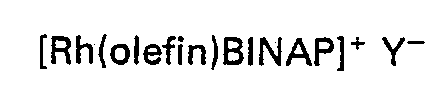
wherein olefin represents ethylene, 1,3-butadiene, cyclohexadiene, norbornadiene or cycloocta-1,5-diene, BINAP represents 2,2'-bis(diphenylphosphino)-1,1'-binapthyl, and Y represents C104, PFs, BF4, PCl6 or B(C6H5)4, is reacted with one mole of BINAP in an organic solvent.
wherein BINAP represents 2,2'-bis(diphenylphosphino)-1,1'-binaphthyl, and Y represents C104, PF6, BF4, PCl6 or B(C6H5)4 characterised in that a rhodium complex of the following general formula (IV):
wherein olefin represents ethylene, 1,3-butadiene, cyclohexadiene, norbornadiene or cycloocta-1,5-diene, BINAP represents 2,2'-bis(diphenylphosphino)-1,1'-binapthyl, and Y represents C104, PFs, BF4, PCl6 or B(C6H5)4, is reacted with one mole of BINAP in an organic solvent.
4. A process as claimed in Claim 3, wherein the complex of the formula (IV) is dissolved
in the solvent, an equimolar or excess amount of BINAP added thereto and the resultant
solution hydrogenated until hydrogen absorption is completed.
5. A process as claimed in Claim 3, wherein the complex of the formula (IV) is dissolved
in the solvent, an equimolar or excess amount of BINAP added thereto, the resultant
mixture heated, the solvent subsequently distilled away under reduced pressure, and
fresh solvent is added and subsequently distilled away under reduced pressure from
the uniform mixture so prepared, the last-mentioned solvent addition and distillation
steps being repeated.
1. Rhodium-Phosphin-Komplex, gekennzeichnet durch die folgende allgemeine Formel I

worin BINAP 2,2'-bis(Diphenylphosphino)-1,1'-binaphthyl darstellt und Y C104, PF6, BF4, PCI6 oder B(C6H5)4.
worin BINAP 2,2'-bis(Diphenylphosphino)-1,1'-binaphthyl darstellt und Y C104, PF6, BF4, PCI6 oder B(C6H5)4.
2. Komplex gemäss Anspruch 1, worin das 2,2'-bis(Diphenylphosphino)-1,1'-binaphthyl
in optisch aktiver Form vorhanden ist.
3. Verfahren zur Herstellung eines Rhodium-Komplexes der folgenden allgemeinen Formel
I

worin BINAP 2,2'-bis(Diphenylphosphino)-1,1'-binaphthyl darstellt und Y CI04, PF6, BF4, PCl6 oder B(C6H5)4 darstellt, dadurch gekennzeichnet, dass ein Rhodium-Komplex der folgenden allgemeinen Formel IV:

worin Olefin Ethylen, 1,3-Butadien, Cyclohexadien, Norbornadien oder Cycloocta-1,5-dien darstellt, BINAP 2,2'-bis(Diphenylphosphino)-1,1'-binaphthyl darstellt und Y C104, PF6, BF4, PCl6 oder B(CsHs)4 darstellt, mit einem Mol BINAP in einem organischen Lösungsmittel umgesetzt wird.
worin BINAP 2,2'-bis(Diphenylphosphino)-1,1'-binaphthyl darstellt und Y CI04, PF6, BF4, PCl6 oder B(C6H5)4 darstellt, dadurch gekennzeichnet, dass ein Rhodium-Komplex der folgenden allgemeinen Formel IV:
worin Olefin Ethylen, 1,3-Butadien, Cyclohexadien, Norbornadien oder Cycloocta-1,5-dien darstellt, BINAP 2,2'-bis(Diphenylphosphino)-1,1'-binaphthyl darstellt und Y C104, PF6, BF4, PCl6 oder B(CsHs)4 darstellt, mit einem Mol BINAP in einem organischen Lösungsmittel umgesetzt wird.
4. Verfahren gemäss Anspruch 3, worin der Komplex der Formel IV im Lösungsmittel aufgelöst
wird, ein äquimolarer oder ein überschüssiger Anteil BINAP dazugegeben wird und die
resultierende Lösung hydriert wird, bis die Wasserstoffabsorption beendet ist.
5. Verfahren gemäss Anspruch 3, worin der Komplex der Formel IV im Lösungsmittel aufgelöst,
ein äquimolarer oder überschüssiger Anteil BINAP zugegeben, die resultierende Mischung
erwärmt, das Lösungsmittel anschliessend unter reduziertem Druck abdestilliert und
frisches Lösungsmittel zugegeben und anschliessend unter reduziertem Druck von der
hergestellten einheitlichen Mischung abdestilliert wird, wobei die letztgenannten
Schritte der Lösungsmittelzugabe und Abdestillation wiederholt werden.
1. Complexe rhodium-phosphine caractérisé par la formule générale (1) suivante:

dans laquelle BINAP représente le 2,2'-bis(diphénylphosphino)-1,1'-binaphthyle et Y représente le ClO4, PF6, BF4, PCl6 ou B(C6H5)4.
dans laquelle BINAP représente le 2,2'-bis(diphénylphosphino)-1,1'-binaphthyle et Y représente le ClO4, PF6, BF4, PCl6 ou B(C6H5)4.
2. Complexe selon la revendication 1, dans lequel le 2,2'-bis(diphénylphosphino)-1,1'-binaphthyle
est présente sous forme optiquement active.
3. Procédé de préparation d'un complexe du rhodium de la formule générale (I) suivante:

dans laquelle BINAP représente le 2,2'-bis(diphénylphosphino)-1,1'-binaphthyle et Y représente le ClO4, PF6, BF4, CPl6 ou B(C6H5)4, caractérisé en ce qu'un complexe du rhodium de la formule générale (IV) suivante:
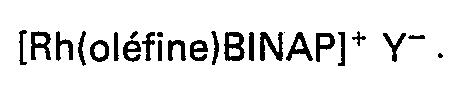
dans laquelle l'oléfine représente l'éthylène, le 1,3-butadiène, le cyclohexadiène, le norbornadiène ou le cycloocta-1,5-diène, BINAP représente le 2,2'-bis(diphénylphosphino)-1,1-binaphthyle et Y représente ClO4, PF6, BF4, PCl6 ou B(C6H5)4, est mis en réaction avec une mole de BINAP dans un solvant organique.
dans laquelle BINAP représente le 2,2'-bis(diphénylphosphino)-1,1'-binaphthyle et Y représente le ClO4, PF6, BF4, CPl6 ou B(C6H5)4, caractérisé en ce qu'un complexe du rhodium de la formule générale (IV) suivante:
dans laquelle l'oléfine représente l'éthylène, le 1,3-butadiène, le cyclohexadiène, le norbornadiène ou le cycloocta-1,5-diène, BINAP représente le 2,2'-bis(diphénylphosphino)-1,1-binaphthyle et Y représente ClO4, PF6, BF4, PCl6 ou B(C6H5)4, est mis en réaction avec une mole de BINAP dans un solvant organique.
4. Procédé selon la revendication 3, dans lequel le complexe de la formule (IV) est
dissous dans le solvant, une quantité équimoléculaire ou supérieure de BINAP y est
ajoutée et la solution qui en résulte est hydrogéné jusqu'à ce que l'absorption d'hydrogène
soit terminée.
5. Procédé selon la revendication 3, dans lequel le complexe de la formule (IV) est
dissous dans le solvant, une quantité équimoléculaire ou supérieure de BINAP y est
adjoutée, le mélange qui en résulte est chauffé, ensuite de quoi de le solvant est
chassé par distillation sous pression réduite, et du solvant frais est ajouté puis
chassé, par distillation, du mélange uniforme ainsi préparé, les dernières phases
susmentionnées d'adjonction de solvant et de distillation étant répétées.