|
(11) | EP 0 135 803 B1 |

| (12) | EUROPEAN PATENT SPECIFICATION |
|
|
| (54) |
Process for producing heterocyclic compounds having nitromethylene group as the side chain group Verfahren zur Herstellung einer heterocyclischen Verbindung mit einer Nitromethylengruppe als Seitenkette Procédé pour la préparation d'un composé hétérocyclique ayant un groupe nitrométhylène comme chaîne latérale |
|
|
|||||||||||||||||||||||||||||||
| Note: Within nine months from the publication of the mention of the grant of the European patent, any person may give notice to the European Patent Office of opposition to the European patent granted. Notice of opposition shall be filed in a written reasoned statement. It shall not be deemed to have been filed until the opposition fee has been paid. (Art. 99(1) European Patent Convention). |
Background of the Invention
[0001] This invention relates to a novel process for producing a heterocyclic compound having a nitromethylene group as the side chain group.
[0002] Heterocyclic compounds having a nitromethylene group as the side chain group find uses in agricultural chemicals, pharmaceuticals or perfumes. For example, Japanese Unexamined Patent Publication No. 151882/1975 proposes tetrahydro-2-(nitromethylene)-1,3-thiazines having excellent activities as agricultural chemicals such as pesticides and acaricides.
[0003] In the prior art, most of the processes for preparation of heterocyclic compounds having a nitromethylene group as the side chain employ as the starting material cyclic dithiocarbamic acid esters which can easily be synthesized and are also highly reactive.
[0004] For instance, the above Unexamined Patent Publication discloses the following process as the process for preparation of tetrahydro-2-(nitromethylene)-1,3-thiazines.
[0005] First, tetrahydro-1,3-thiazine-2-thion is methylated with a methyl halide, the resultant tetrahydro-2-(methylthio)-1 ,3-thiazine is allowed to react with an alkyl nitroacetate in the presence of zinc ions to give an alkyl nitro(tetrahydro-1,3-thiazine-2-ylidene)acetate, which is then hydrolyzed in the presence of a base, followed by decarboxylation to prepare a desired product of tetrahydro-2-(nitromethylene)-1,3-thiazine.
[0006] As can be seen from this example, the process for preparation of a heterocyclic compound having a nitromethylene group as the side chain group, using a cyclic dithiocarbamic acid ester as the starting material involves the reaction steps which are very lengthy and complicated, and methyl mercaptan which may cause offensive odor is generated in the step of reacting the methylated starting material with an alkyl nitroacetate. Thus, this process cannot necessarily be stated to be satisfactory in industrial application.
[0007] EP-A-0115323 discloses a process for producing tetrahydro-2-(nitromethylene)-1,3-thiazines and nitromethylene-1,3-thiazolidine derivatives by reacting a 2,2-dihalonitro-ethylene compound with a 1-aminoalkanethiol compound.
[0008] US-A-3993648, US-A-4065560 and US-A-4006156 disclose processes for preparing tetrahydro-2-(nitromethylene)-1,3-thiazines and nitromethylene-1,3-thiazolidenes by reacting a 1-aminoalkanethiol compound with a 1,1-bis-(methylthio)-nitroethene derivative.
[0009] DE-A-2514402 disclosesthe reaction of diamino alkanes with 1,1-bis-(methylthio)-nitroethene or 1,1- bis-halo-nitroethenes.
Summary of the Invention
[0010] The present inventors have made extensive studies in order to establish a process for producing industrially advantageously a heterocyclic compound having a nitromethylene group as the side chain group. As a result, it has now been found that a 2,2,2-trihaio-l-nitroethane compound of the formula (I):
wherein X', X2 and X3 may be the same or different and represent halogen atoms, and Y represents a hydrogen atom, a halogen atom or a lower alkyl group, can be allowed to react with a 1-aminoalkanethiol compound or a 1-N-substituted derivative thereof of the formula (II):
wherein R is a hydrogen atom, an alkyl group, a cycloalkyl group, an aralkyl group, an alkenyl group, an alkynyl group or an acyl group, and n represents an integer of 2, 3 or 4, in the presence of a base and in a solvent to produce industrially advantageously a heterocyclic compound having a nitromethylene group as the side chain group, of the formula (III):
wherein Y represents a hydrogen atom, a halogen atom or a lower alkyl group, R represents a hydrogen atom, an alkyl group, a cycloalkyl group, an aralkyl group, an alkenyl group, an alkynyl group or an acyl group, and n represents an integer of 2, 3 or 4, to accomplish the present invention.
[0011] This invention is extremely simplified in the reaction step, as compared with the process of the prior art as described above, without by-production of methyl mercaptan, which will cause troubles in industrial practice of the process, and the desired product can be also obtained at a high yield.
Description of the Preferred Embodiments
[0012] In the 2,2,2-trihalo-1-nitroethane compound represented by the above formula (1), which is the starting material to be used in this invention, the halogen atoms represented by X1, X2, X3 and Y may be either the same or different, and they may be any of chlorine, bromine, fluorine and iodine. The lower alkyl group represented by Y may include alkyl groups having 1 to 4 carbon atoms such as methyl, ethyl, propyl and butyl.
[0013] Examples of the compound (I) are 2,2,2-trihalo-1-nitroethanes such as 2,2,2-trichloro-1-nitroethane, 2-bromo-2,2,-dichloro-I-nitroethane, 2-chloro-2,2-dibromo-1-nitroethane, 2,2-dichloro-2-iodo-1-nitroethane, 2-chioro-2,2-diiodo-1-nitroethane, 2,2-dichloro-2-fluoro-1-nitroethane, 2-chloro-2,2-difluoro-1-nitroethane, 2,2-dibromo-2-iodo-1-nitroethane, 2-bromo-2,2-diiodo-1-nitroethane, 2,2-dibromo-2-fluoro-I-nitroethane, 2-bromo-2,2-difluoro-1-nitroethane, 2,2,2-tribromo-l-nitroethane, 2,2,2-triiodo-1-nitroethane, 2,2,2-trifluoro-1-nitroethane, 1-methyl-2,2,2-trichloro-1-nitroethane, 1-theyl-2,2,2-trichloro-1-nitroethane, 1-methyl-2-bromo-2,2-dichloro-1-nitroethane, and 1-ethyl-2-bromo-2,2-dichloro-1-nitroethane; and 1,2,2,2-tetrahalo-1-nitroethanes such as 1,2,2,2-tetrachloro-I-nitroethane, 1-bromo-2,2,2-trichloro-1-nitroethane, 2-bromo-1,2,2-trichloro-1-nitroethane, 1,2-dibromo-2,2-dichloro-1-nitroethane, 2,2-dibromo-1,2-dichloro-1-nitroethane, 1-chloro-2,2,2-tribromo-1-nitroethane, 2-chloro-1,2,2-tribromo-1-nitroethane and 1,2,2,2-tetrabromo-1-nitroethane.
[0014] Among them, in view of industrial availability, 2,2,2-trichloro-1-nitroethane, 2,2,2-tribromo-1-nitroethane and 1,2,2,2-tetrachloro-1-nitroethane are particularly useful.
[0015] These 2,2,2-triha)o-1-nitroethane compounds can be readily synthesized according to the process known in the art. For example, in the case of the above-mentioned 2,2,2-triha)o-1-nitroethane, it can be synthesized according to the reaction between a 2,2-dihaloethylene and a nitronium halide, while in the case of the above-mentioned 1,2,2,2-tetrahalo-I-nitroethane, according to the reaction between a 1,2,2- triohaloethylene, a dinitrogen tetraoxide and a halogen.
[0016] The 1-aminoalkanethiol or its 1-N-substituted derivative thereof represented by the above formula (II), which is the other starting material to be used in this invention, is a commercially available compound.
[0017] Examples of 1-aminoalkanethiol which is the compound (II) wherein R is a hydrogen atom, are 1-amino-2-ethanethiol, 1-amino-3-propanethiol and 1-amino-4-butanethiol.
[0018] The alkyl group represented by R may include alkyl groups having 1 to 12 carbon atoms such as methyl, ethyl, propyl, butyl, pentyl, hexyl, heptyl, octyl, nonyl, decyl, undecyl and dodecyl. As the cycloalkyl group, there may be included cycloalkyl groups having 5 to 12 carbon atoms such as cyclopentyl, cyclohexyl, cycloheptyl, cyclooctyl, cyclononyl, cyclodecyl, cycloundecyl and cyclododecyl. As the aralkyl group, there may be employed benzyl group and phenethyl group. Alkenyl groups may be, for example, those having 3 to 5 carbon atoms such as allyl, butenyl and pentenyl. Further, the alkynyl group may include those having 3 to 5 carbon atoms such as propargyl, butylyl and pentynyl. The acyl group may include formyl, acetyl, propionyl, butyryl, valeryl, palmitoyl, stearoyl, oleoyl, oxalyl, malonyl, succinyl, benzoyl, toluoil, salicyloyl, cinamoyl, naphthoyl, phthaloyl, furoyl, methoxycarbonyl, ethoxycarbonyl and propioxycarbonyl.
[0019] Typical examples of the 1-N-substituted derivatives of 1-aminoalkanethiol are 1-methylamino-2-ethanethiol, 1-methylamino-3-propanethiol, 1-methylamino-4-butane-thiol, 1-ethylamino-2-ethanethoil, 1-ethylamino-3-propanethiol, 1-ethylamino-4-butanethiol, 1-propylamino-2-ethanethiol, 1-propylamino-3-propanethiol, 1-propylamino-4-butanethiol, 1-isopropylamino-3-propanethiol, 1-butylamino-3-propanethiol, 1-pentylamino-3-propanethiol, 1-hexylamino-3-propanethiol, 1-octyl-amino-3-propanethiol, 1-decylamino-3-propanethiol, 1-dodecylamino-3-propanethiol, 1-cyclohexylamino-2-ethanethiol, 1-cyclohexylamino-3-propanethiol, 1-cyclohexylamino-4-butanethiol, 1-cyclooctylamino-3-propanethiol, 1-cyclododecylamino-3-propanethiol, 1-benzylamino-2-ethanethiol, 1-benzylamino-3-propanethiol, 1-benzylamino-4-butanethiol, 1-allylamino-2-ethanethiol, 1-allylamino-3-propanethiol, 1-allylamino-4-butanethiol, 1-propargylamino-2-ethanethiol, I-propargylamino-3-propanethiol, 1-N-formyl-2-ethanethiol, 1-N-formyl-3-propanethiol, 1-N-formyl-4-butanethiol, 1-N-acetyl-3-propanethiol, 1-N-acetyl-4-butanethiol, 1-N-propionyl-3-propanethiol, 1-N-butyryl-4-propanethiol, 1-N-oxalyl-3-propanethiol, 1-N-succinyl-3-propanethiol, 1-N-benzoyl-3-propanethiol, 1-N-malonyl-3-propanethiol, 1-N-methoxycarbonyl-3-propanethiol, 1-N-ethoxycarbonyl-3-propanethiol, 1-N-isopropoxycarbonyl-3-propanethiol.
[0020] These 1-aminoalkanethiol compounds or 1-N-substituted derivatives thereof may be used in an amount generally in the range of from 0.5 to 10 moles, preferably from 1 to 5 moles, per mole of the 2,2,2- trihato-1-nitroethane compound.
[0021] Useful bases to be used in this invention are alcoholates of alkali metals such as sodium methoxide, sodium ethoxide, potassium methoxide or potassium ethoxide; hydroxides of alkali metals such as sodium hydroxide or potassium hydroxide; hydroxides of alkaline earth metals such as calcium hydroxide, barium hydroxide or magnesium hydroxide. These bases can be used in amounts generally of 3 moles or more, preferably 3 to 6 moles, per mole of the 2,2,2-triha)o-1-nitroethane provided for use.
[0022] The reaction in this invention is carried out in a solvent. As the solvent to be provided for use, any solvent may be useful, so long as it can dissolve both starting materials and the base at the same time and is inert to the reaction. Typical examples of the solvent may include lower aliphatic alcohols such as methanol, ethanol, i-propanol, n-propanol, i-butanol or n-butanol, water, dimethyl sulfoxide, acetonitrile and dimethylformamide. Among them, it is particularly preferred for industrial practice to employ a lower aliphatic alcohol as the solvent.
[0023] In the present invention, it is not necessary to provide limitations with respect to the method by which a 2,2,2-trihalo-1-nitroethane compound is brought into contact with 1-aminoalkanethiol compound or its 1-N-substituted derivative.
[0024] For example, a base may be added into a solution in which both starting materials are dissolved in a solvent. Alternatively, a 1-aminoalkanethiol compound or its 1-N-substituted derivative may be beforehand reacted with a base in a solvent to convert the thiol compound to a thiolate compound, followed by addition of a 2,2,2-trihaio-l-nitroethane compound into the solution thereof. However, a desired compound can be obtained at still higher efficiency by employment of the method in which a 2,2,2-trihaio-l-nitroethane and a base dissolved in separate solvents are added gradually, sometimes in divided portions, into a solution of a 1-aminoalkanethiol compound or its 1-N-substituted derivative.
[0025] The reaction according to this invention may be carried out at a temperature generally of 100°C or lower, preferably of -10 to 50°C, for 0.5 to 10 hours, preferably 1 to 5 hours.
[0026] Thus, a heterocyclic compound having a nitromethylene group as the side chain can be obtained at a high yield. For example, when 1-amino-2-ethanethiol or 1-methylamino-2-ethanethiol is used as the 1-aminoalkanethiol compound or its 1-N-substituted derivative, there can be produced thiazolidines such as 2-(nitromethylene)-1,3-thiazolidine, 2-(nitrochloromethylene)-1,3-thiazolidine, 3-methyl-2-(nitromethylene)-1,3-thiazolidine, 3-methyl-2-(nitrochloromethylene)-1,3-thiazolidine and the like; and when 1-amino-3-propanethiol or 1-ethylamino-3-propanethiol is used, thiazines such as tetrahydro-2-(nitromethylene)-1,3-thiazine, tetrahydro-2-(nitrochloromethylene)-1 ,3-thiazine, tetrahydro-3-ethyi-2-(nitromethylene)-1,3-thiazine, tetrahydro-3-ethyl-2-(nitrochloromethylene)-1,3-thiazine and the like; and further when 1-amino-4-butanethiol or 1-cyclohexylamino-4-butanethiol is used, thiazepines such as hexahydro-2-(nitromethylene)-1,3-thiazepine, hexahydro-2-(nitrochloromethylene)-1,3-thiazepine, hexahydro-3-cyclohexyl-2-(nitromethylene)-1,3-thiazepine, hexahydro-3-cyclohexyl-2-(nitrochloromethylene)-1,3-thiazepine and the like; respectively.
[0027] After completion of the reaction, isolation and purification of the desired product can be done easily by employing suitably such an operation as filtration, concentration, extraction or recrystallization. To describe more specifically by way of example, first after completion of the reaction, the reaction mixture is neutralized with an aqueous solution of mineral acid and, after dilution of the neutralized solution with water, extracted with an organic solvent such as chloroform or diochloromethane. After removal of the solvent from the extract, the crude crystals obtained are recrystallized, whereby a purified desired product can be isolated.
[0028] Referring now to Examples, this invention is described in more detail. In each Example, the yield is based on the 2,2,2-triha!o-1-nitroethane compound provided for use.
Example 1
[0029] Into 50 ml of methanol were added 8.1 g of 1-amino-3-propanethiol and 5.0 g of caustic soda, followed by stirring, to be completely dissolved therein. Then, the mixture was cooled to 0°C. While stirring the solution, a solution of 5.4 g of 2,2,2-trichloro-1-nitroethane diluted in 20 ml of methanol was added dropwise slowly over 15 minutes, and the reaction was carried out for one hour. The reaction was exothermic and the liquid temperature was maintained at lower than 10°C (about 8°C). After the reaction, the reaction mixture was neutralized to pH 7 with 6 N aqueous hydrochloric acid, and then with addition of 50 ml of water, extraction with 100 ml of dichloromethane was repeated four times. The extracts were concentrated to give 2.91 g of tetrahydro-2-(nitromethylene)-1,3-thiazine (yield: 60.1 %).
Example 2
[0030] An experiment was conducted according to the same procedure as in Example 1 except for using 24.1 g of a 28 wt.% methanolic solution of sodium methoxide in place of 5.0 g of caustic soda. As a result, 3.19 g of tetrahydro-2-(nitromethylene)-1,3-thiazine was obtained (yield: 65.9%).
Example 3
[0031] An experiment was conducted according to the same procedure as in Example 1 except for using a 28 wt.% methanolic solution of sodium methoxide in place of 5.0 g of caustic soda and changing the amount of 1-amino-3-propanethiol employed to 5.5 g. As a result, 2.78 g of tetrahydro-2-(nitromethylene)-1,3-thiazine (yield: 57.4%) was obtained.
Example 4
[0032] An experiment was conducted according to the same procedure as in Example 1 except for using 29.2 g of a 30 wt.% methanolic solution of potassium ethoxide in place of 5.0 g of caustic soda. As a result, 3.21 g of tetrahydro-2-(nitromethylene)-1,3-thiazine was obtained (yield: 66.3%).
Example 5
[0033] Into 50 ml of methanol was added 8.1 g of 1-amino-3-propanethiol, followed by stirring, to be completely dissolved therein. Then, the mixture was cooled to 0°C. While stirring the solution, about 1/3- aliquot of a solution of 5.0 g of caustic soda dissolved in 40 ml of methanol was added dropwise thereinto, and the remainder of about2/3-aliquot of the solution and a solution of 5.4 g of 2,2,2-trichloro-1-nitroethane diluted in 20 ml of methanol were added dropwise slowly over 50 minutes, and the reaction was carried out for one hour. During the dropwise addition, the liquid temperature was maintained at lower than 10°C (about 8°C). After the reaction carried out for one hour, the procedure of the post-treatments as described in Example 1 was followed to obtain 4.20 g of tetrahydro-2-(nitromethylene)-1,3-thiazine (yield: 86.8%).
Example 6
[0034] An experiment was conducted according to the same procedure as in Example 5 except for using 24.1 g of a 28 wt.% methanolic solution of sodium methoxide in place of a solution of 5.0 g of caustic soda dissolved in 40 ml of methanol. As a result, 4.25 g of tetrahydro-2-(nitromethylene)-1,3-thiazine was obtained (yield: 87.8%).
Example 7
[0035] An experiment was conducted according to the same procedure as in Example 5 except for changing the amount of 1-amino-3-propanethiol employed to 4.1 g. As a result, 3.50 g of tetrahydro-2-(nitromethylene)-1,3-thiazine (yield: 72.3%) was obtained.
Example 8
[0036] An experiment was conducted according to the same procedure as in Example 5 except for using a solution of 7.0 g of caustic potash dissolved in 60 ml of methanol in place of a solution of 5.0 g of caustic soda dissolved in 40 ml of methanol. As a result, 4.18 g of tetrahydro-2-(nitromethylene)-1 ,3-thiazine was obtained (yield: 86.3%).
Example 9
[0037] An experiment was conducted according to the same procedure as in Example 5 except for using 9.5 g of 2,2,2-tribromo-1-nitroethane in place of 5.4 g of 2,2,2-trichloro-1-nitroethane. As a result, 4.15 g of tetrahydro-2-(nitromethylene)-1,3-thiazine was obtained (yield: 84.4%).
Example 10
[0038] An experiment was conducted according to the same procedure as in Example 5 except for using 6.5 g of 1,2,2,2-tetrachloro-1-nitroethylene in place of 2,2,2-trichloro-1-nitroethane. As a result, 4.0 g of tetrahydro-2-(nitrochloromethylene)-2,3-thiazine was obtained (yield: 81.0%).
Example 11
[0039] An experiment was conducted according to the same procedure as in Example 4 except for using 6.9 g of 1-amino-2-ethanethiol in place of 1-amino-3-propanethiol. As as result, 3.20 g of 2-(nitromethylene)-1,3-thiazolidine was obtained (yield: 72.4%).
Example 12
[0040] An experiment was conducted according to the same procedure as in Example 5 except for using 9.3 g of 1-amino-4-butanethiol in place of 1-amino-3-propanethiol. As a result, 4.47 g of hexahydro-2-(nitromethylene)-1,3-thiazepine was obtained (yield: 84.9%).
Example 13
[0041] Into 40 ml of methanol were added 5.0 g of 1-methylamino-3-propanethiol and 1.0 g of caustic soda, followed by stirring, to be completely dissolved therein. Then, the mixture was cooled to 0°C. While stirring the solution, a solution of 2.2 g of caustic soda dissolved in 25 ml of methanol and a solution of 3.5 g of 2,2,2-trichloro-1-nitroethane diluted in 20 ml of methanol were added at the same time dropwise slowly over 50 minutes, and the reaction was carried out for one hour. The reaction was exothermic and the liquid temperature was maintained at lower than 10°C (about 8°C). After the reaction, the reaction mixture was neutralized to pH 7 with 3 N aqueous hydrochloric acid, and then with addition of 60 ml of water, extraction with 50 ml of methylene chloride was repeated four times. The extracts were concentrated to give 3.27 g of tetrahydro-3-methyl-2-(nitromethylene)-1,3-thiazine (yield: 94%).
Example 14
[0042] An experiment was conducted according to the same procedure as in Example 13 except for using 15.4 g of 28 wt.% methanolic solution of sodium methoxide in place of caustic soda. As a result, 3.31 g of tetrahydro-3-methyl-2-(nitromethylene)-1,3-thiazine (yield: 95%) was obtained.
Example 15
[0043] An experiment was conducted according to the same procedure as in Example 13 except for using 5.6 g of 1-ethylamino-3-propanethiol in place of 1-methylamino-3-propanethiol. As a result, 3.53 of tetrahydro-3-ethyl-2-(nitromethylene)-1,3-thiazine was obtained (yield: 94%).
Example 16
[0044] An experiment was conducted according to the same procedure as in Example 15 except for using 4.4 g of caustic potash in place of caustic soda. As a result, 3.54 g of tetrahydro-3-ethyl-2-(nitromethylene)-1,3-thiazine (yield: 94%) was obtained.
Example 17
[0045] An experiment was conducted according to the same procedure as in Example 13 except for using 6.3 g of 1-isopropylamino-3-propanethiol in place of 1-methylamino-3-propanethiol. As a result, 3.80 g of tetrahydro-3-isopropyl-2-(nitromethylene)-1,3-thiazine was obtained (yield: 94%).
Example 18
[0046] An experiment was conducted according to the same procedure as in Example 13 except for using 8.3 g of 1-n-hexylamino-3-propanethiol in place of 1-methylamino-3-propanethiol. As a result, 4.54 g of tetrahydro-3-n-hexyl-2-(nitromethylene)-1,3-thiazine was obtained (yield: 93%).
Example 19
[0047] An experiment was conducted according to the same procedure as in Example 13 except for using 8.2 g of 1-cyclohexylamino-3-propanethiol in place of 1-methylamino-3-propanethiol. As a result, 4.55 g of tetrahydro-3-cyclohexyl-2-(nitromethylene)-1,3-thiazine was obtained (yield: 94%).
Example 20
[0048] Example 19 was repeated except that 18.7 g of a 30 wt.% methanolic solution of potassium methoxide was employed in place of caustic potash. As a result, 4.60 g of tetrahydro-3-cyclohexyl-2-(nitromethylene)-1,3-thiazine was obtained (yield: 95%).
Example 21
[0049] An experiment was conducted according to the same procedure as in Example 13 except for using 8.6 g of 1-benzylamino-3-propanethiol in place of 1-methylamino-3-propanethiol. As a result, 4.61 g of tetrahydro-3-benzyl-2-(nitromethylene)-1,3-thiazine was obtained (yield: 92%).
Example 22
[0050] An experiment was conducted according to the same procedure as in Example 13 except for using 6.2 g of 1-allylamino-3-propanethiol in place of 1-methylamino-3-propanethiol. As a result, 3.72 g of tetrahydro-3-allyl-2-(nitromethylene)-1,3-thiazine was obtained (yield: 93%).
Example 23
[0051] An experiment was conducted according to the same procedure as in Example 13 except for using 6.1 g of 1-propargylamino-3-propanethiol in place of 1-methylamino-3-propanethiol. As a result, 3.65 g of tetrahydro-3-propargyl-2-(nitromethylene)-1,3-thiazine was obtained (yield: 92%).
Example 24
[0052] An experiment was conducted according to the same procedure as in Example 13 except for using 4.3 g of 1-methylamino-2-ethanethiol in place of 1-methylamino-3-propanethiol. As a result, 2.82 g of 3-methyl-2-(nitromethylene)-1,3-thiazolidine was obtained (yield: 88%).
Example 25
[0053] An experiment was conducted according to the same procedure as in Example 13 except for using 5.6 g of 1-methylamino-2-butanethiol in place of 1-methylamino-3-propanethiol. As a result, 3.23 g of hexahydro-3-methyi-2-(nitromethyiene)-1,3-thiazepine was obtained (yield: 86%).
Example 26
1. A process for producing a heterocyclic compound having a nitromethylene group as
the side chain group, of the formula (III):
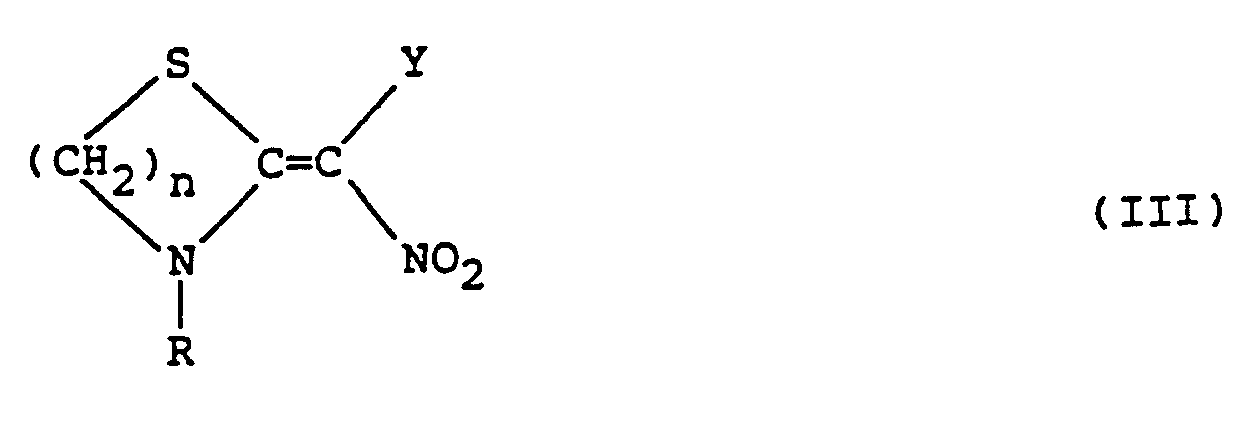
wherein Y represents a hydrogen atom, a halogen atom or a lower alkyl group, R represents a hydrogen atom, an alkyl group, a cycloalkyl group, an aralkyl group, an alkenyl group, an alkynyl group or an acyl group, and n represents an integer of 2, 3 or 4, which comprises reacting a 2,2,2-trihaI0-1-nitroethane compound of the formula (I):
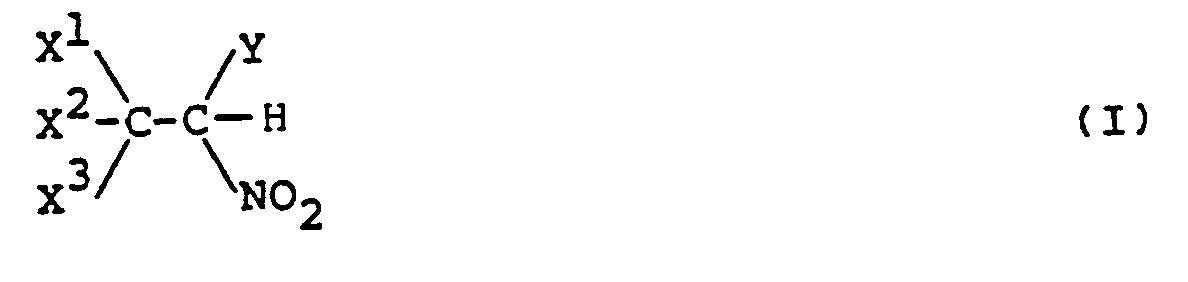
wherein X', X2 and X3 may be the same or different and represent halogen atoms, and Y is as defined above, with a 1-aminoalkanethiol compound or a 1-N-substituted derivative thereof, of the formula (II):

wherein R is as defined above, and n is as defined above, in the presence of a base and in a solvent.
wherein Y represents a hydrogen atom, a halogen atom or a lower alkyl group, R represents a hydrogen atom, an alkyl group, a cycloalkyl group, an aralkyl group, an alkenyl group, an alkynyl group or an acyl group, and n represents an integer of 2, 3 or 4, which comprises reacting a 2,2,2-trihaI0-1-nitroethane compound of the formula (I):
wherein X', X2 and X3 may be the same or different and represent halogen atoms, and Y is as defined above, with a 1-aminoalkanethiol compound or a 1-N-substituted derivative thereof, of the formula (II):
wherein R is as defined above, and n is as defined above, in the presence of a base and in a solvent.
2. The process according to Claim 1, wherein said halogen atoms represented by X',
X2, X3 and Y of the compound of the formula (I) are each selected from the group consisting
of chlorine, bromine, fluorine and iodine; and said alkyl group represented by Y is
an alkyl group having 1 to 4 carbon atoms.
3. The process according to Claim 1, wherein said alkyl group represented by R of
the compound of the formula (II) is an alkyl group having 1 to 12 carbon atoms; said
cycloalkyl group is a cycloalkyl group having 5 to 12 carbon atoms; said alkenyl group
is an alkenyl group having 3 to 5 carbon atoms; and said alkynyl group is an alkynyl
group having 3 to 5 carbon atoms.
4. The process according to Claim 1, wherein said compound of the formula (II) is
used in an amount of from 0.5 to 10 moles per mole of the compound of the formula
(I).
5. The process according to Claim 1, wherein said base is selected from the group
consisting of sodium methoxide, sodium ethoxide, potassium methoxide, potassium ethoxide,
sodium hydroxide, potassium hydroxide, calcium hydroxide, barium hydroxide, and magnesium
hydroxide.
6. The process according to Claim 5, wherein said base is used in an amount of 3 to
6 moles per mole of the compound of the formula (I).
7. The process according to Claim 1, wherein said solvent is selected from the group
consisting of methanol, ethanol, i-propanol, n-propanol, i-butanol, n-butanol, water,
dimethyl sulfoxide, acetonitrile and dimethylformamide.
8. The process according to Claim 1, wherein the reaction is carried out at a temperature
of from -10 to 50°C for 0.5 to 10 hours.
9. The process according to Claim 2, wherein the compound of the formula (I) is selected
from the group consisting of 2,2,2-trichloro-1-nitroethane, 2,2,2-tribromo-1-nitroethane
and 1,2,2,2-tetrachloro-1-nitroethane.
10. The process according to Claim 3, wherein the compound of the formula (II) is
selected from the group consisting of 1-amino-2-ethanethiol, 1-amino-3-propanethiol,
1-amino-4-butanethiol, 1-methylamino-3-propanethiol, 1-methylamino-4-butanethiol,
1-ethylamino-2-ethanethiol, 1-ethylamino-3-propanethiol, 1-isopropylamino-3-propanethiol,
1-hexylamino-3-propanethiol, 1-cyclohexylamino-3-propanethiol, 1-benzylamino-3-propanethiol,
1-allylamino-3-propanethiol and 1-propargylamino-3-propanethiol.
1. Verfahren zur Herstellung einer heterozyklischen Verbindung mit einer Nitromethylengruppe
als Seitenkette, der Formel (111):
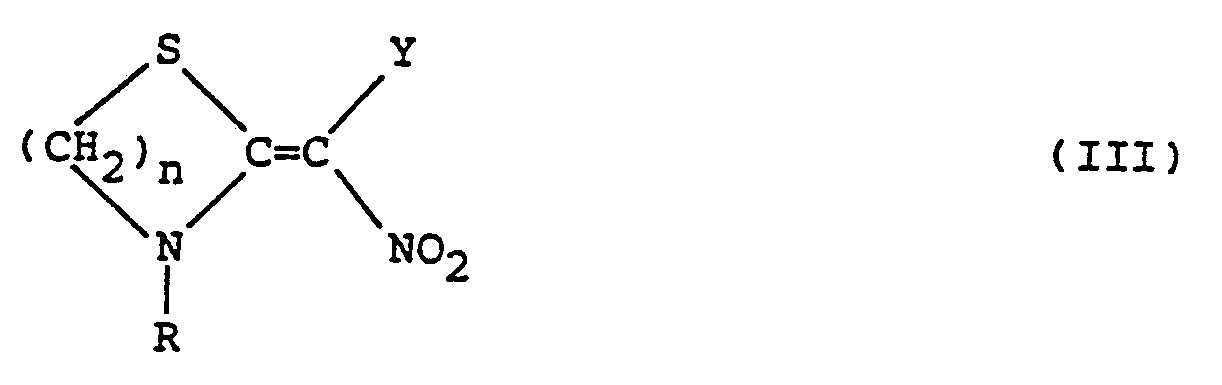
worin Y ein Wasserstoffatom, ein Halogenatom oder eine Niedrigalkylgruppe darstellt, R ein Wasserstoffatom, eine Alkylgruppe, eine Cycloalkylgruppe, eine Aralkylgruppe, eine Alkenylgruppe, eine Alkynylgruppe oder eine Acylgruppe darstellt, und n die Zahl 2, oder 4 ist, dadurch gekennzeichnet, dass eine 2,2,2-Trihalo-1-nitroethanverbindung der Formel (I)
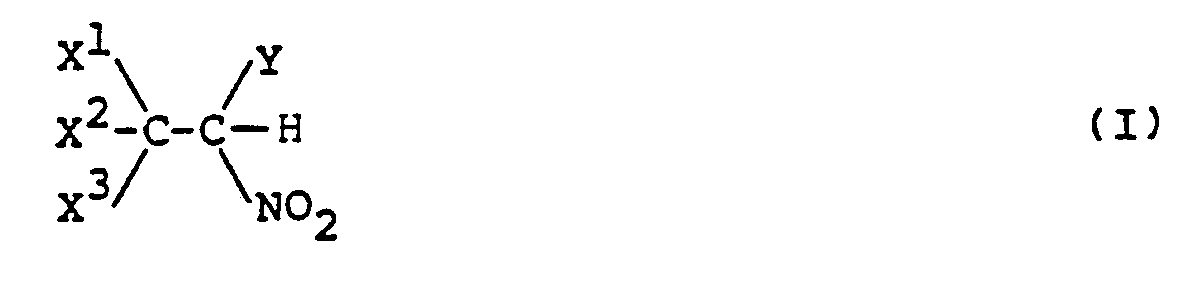
worin X1, X2 und X3 gleich oder verschieden sein können und Halogenatome darstellen und Y wie oben definiert ist, mit einer 1-Aminoalkanthiolverbindung oder seinem 1-N-substituierten Derivat der Formel (11)

worin R und n wie oben definiert sind, in Gegenwart einer Base und in einem Lösungsmittel umgesetzt wird.
worin Y ein Wasserstoffatom, ein Halogenatom oder eine Niedrigalkylgruppe darstellt, R ein Wasserstoffatom, eine Alkylgruppe, eine Cycloalkylgruppe, eine Aralkylgruppe, eine Alkenylgruppe, eine Alkynylgruppe oder eine Acylgruppe darstellt, und n die Zahl 2, oder 4 ist, dadurch gekennzeichnet, dass eine 2,2,2-Trihalo-1-nitroethanverbindung der Formel (I)
worin X1, X2 und X3 gleich oder verschieden sein können und Halogenatome darstellen und Y wie oben definiert ist, mit einer 1-Aminoalkanthiolverbindung oder seinem 1-N-substituierten Derivat der Formel (11)
worin R und n wie oben definiert sind, in Gegenwart einer Base und in einem Lösungsmittel umgesetzt wird.
2. Verfahren nach Anspruch 1, dadurch gekennzeichnet, dass die Halogenatome, dargestellt
durch X1, X2, X3 und Y, in der Verbindung der Formel (I) aus einer Gruppe, bestehend aus Chlor, Brom,
Fluor und Jod, ausgewählt werden; und die Alkylgruppe, dargestellt durch Y, eine Alkylgruppe
mit 1 bis 4 Kohlenstoffatomen ist.
3. Verfahren nach Anspruch 1, dadurch gekennzeichnet, dass die Alkylgruppe, dargestellt
durch R in der Verbindung der Formel (11), eine Alkylgruppe mit 1 bis 12 Kohlenstoffatomen
ist; die Cycloalkylgruppe ist eine Cycloalkylgruppe mit 5 bis 12 Kohlenstoffatomen;
die Alkenylgruppe ist eine Alkenylgruppe mit 3 bis 5 Kohlenstoffatomen; und die Alkynylgruppe
ist eine Alkynylgruppe mit 3 bis 5 Kohlenstoffatomen.
4. Verfahren nach Anspruch 1, dadurch gekennzeichnet, dass die Verbindung der Formel
(11) in einer Menge von 0,5 bis 10 Mol pro Mol der Verbindung der Formel (I) eingesetzt
wird.
5. Verfahren nach Anspruch 1, dadurch gekennzeichnet, dass die Base aus einer Gruppe,
bestehend aus Natriummethoxid, Natriumethoxid, Kaliummethoxid, Kaliumethoxid, Natriumhydroxid,
Kaliumhydroxid, Kalziumhydroxid, Bariumhydroxiod und Magnesiumhydroxid, ausgewählt
wird.
6. Verfahren nach Anspruch 5, dadurch gekennzeichnet, dass die Base in einer Menge
von 3 bis 6 Mol pro Mol der Verbindung der Formel (I) eingesetzt wird.
7. Verfahren nach Anspruch 1, dadurch gekennzeichnet, dass das Lösungsmittel aus der
Gruppe, bestehend aus Methanol, Ethanol, Isopropanol, n-Propanol, Isobutanol, n-Butanol,
Wasser, Dimethylsulfoxid, Acetonitril und Dimethylformamid, ausgewählt wird.
8. Verfahren nach Anspruch 1, dadurch gekennzeichnet, dass die Reaktion bei einer
Temperatur von -10 bis 50°C für 0,5 bis 10 Stunden ausgeführt wird.
9. Verfahren nach Anspruch 2, dadurch gekennzeichnet, dass die Verbindung der Formel
(I) aus der Gruppe, bestehend aus 2,2,2-Trichloro-1-nitroethan, 2,2,2-Tribromo-1-nitroethan
und 1,2,2,2-Tetrachloro-1-nitroethan, ausgewählt wird.
10. Verfahren nach Anspruch 3, dadurch gekennzeichnet, dass die Verbindung der Formel
(11) aus der Gruppe, bestehend aus 1-Amino-2-ethanthiol, 1-Amino-3-propanthiol, 1-Amino-4-butanthiol,
1-Methylamino-3-propanthiol, 1-Methylamino-4-butanthiol, 1-Ethylamino-2-ethanthiol,
1-Ethylamino-3-propanthiol, 1-Isopropylamino-3-propanthiol, 1-Hexylamino-3-propanthiol,
1-Cyclohexylamino-3-propanthiol, 1-Benzylamino-3-propanthiol, 1-Allylamino-3-propanthiol
und 1-Propargylamino-3-propanthiol, ausgewählt wird.
1. Procédé de préparation d'un composé hétérocyclique ayant un groupe nitrométhylène
en tant que groupe en chaîne latérale, de formule (III):
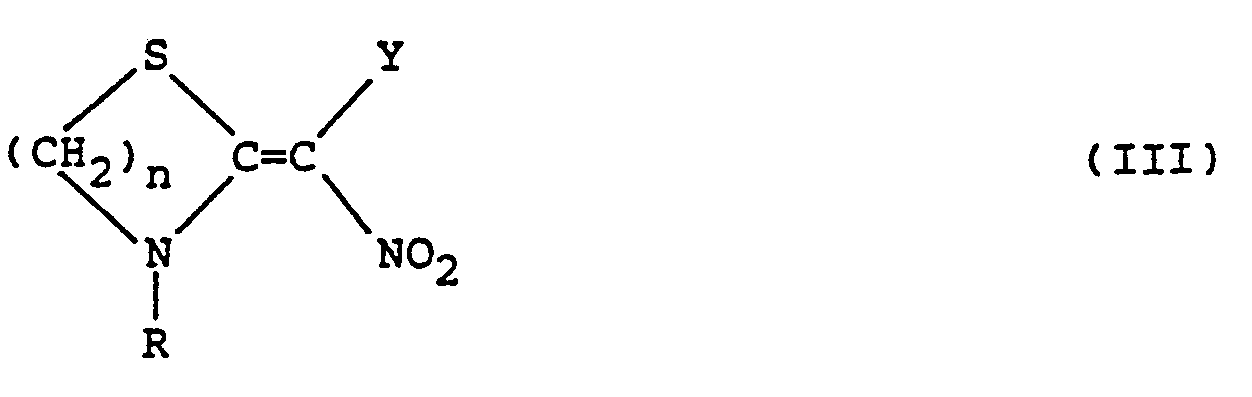
dans laquelle Y représente un atome d'hydrogène ou d'halogène ou un groupe alkyle inférieur, R représente un atome d'hydrogène, un groupe alkyle, un groupe cycloalkyle, un groupe aralkyle, un groupe alcényle, un groupe alcynyle ou un groupe acyle, et n représente un nombre entier égal à 2, 3 ou 4, qui comprend la réaction d'un composé 2,2,2-trihalogéno-1-nitroéthane de formule (I):
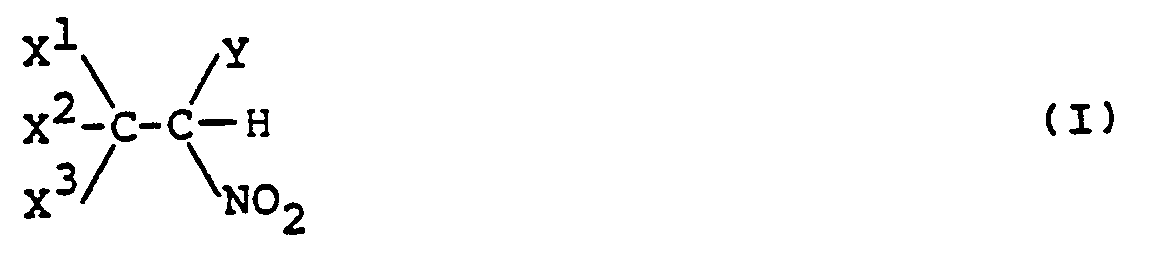
dans laquelle X', X2 et X3 peuvent être identiques ou différents et représentent des atomes d'halogène, et Y esttel que défini précédemment, avec un composé 1-aminoalcanethiol ou un dérivé substitué sur l'azote-de ce composé, de formule (II):

dans laquelle R est tel que défini précédemment et n est tel que défini précédemment, en présence d'une base et au sein d'un solvant.
dans laquelle Y représente un atome d'hydrogène ou d'halogène ou un groupe alkyle inférieur, R représente un atome d'hydrogène, un groupe alkyle, un groupe cycloalkyle, un groupe aralkyle, un groupe alcényle, un groupe alcynyle ou un groupe acyle, et n représente un nombre entier égal à 2, 3 ou 4, qui comprend la réaction d'un composé 2,2,2-trihalogéno-1-nitroéthane de formule (I):
dans laquelle X', X2 et X3 peuvent être identiques ou différents et représentent des atomes d'halogène, et Y esttel que défini précédemment, avec un composé 1-aminoalcanethiol ou un dérivé substitué sur l'azote-de ce composé, de formule (II):
dans laquelle R est tel que défini précédemment et n est tel que défini précédemment, en présence d'une base et au sein d'un solvant.
2. Procédé selon la revendication 1, dans lequel lesdits atomes d'halogène représentés
par X', X2, X3 et Y du composé de formule (1) sont choisis à chaque fois dans le groupe constitué
par chlore, brome, fluor et iode, et ledit groupe alkyle représenté par Y est un groupe
alkyle ayant 1 à 4 atomes de carbone.
3. Procédé selon la revendication, 1, dans lequel ledit groupe alkyle représenté par
R du composé de formule (II) est un groupe alkyle ayant 1 à 12 atomes de carbone,
ledit groupe cycloalkyle est un groupe cycloalkyle ayant 5 à 12 atomes de carbone,
ledit groupe alcényle est un groupe alcényle ayant 3 à 5 atomes de carbone, et ledit
groupe alcynyle est un groupe alcynyle ayant 3 à 5 atomes de carbone.
4. Procédé selon la revendication 1, dans lequel ledit composé de formule (II) est
utilisé en une proportion de 0,5 à 10 moles per mole du composé de formule (I).
5. Procédé selon la revendication 1, dans lequel ladite base est choisie dans le groupe
constitué par le méthylate de sodium, l'éthylate de sodium, le méthylate de potassium,
l'éthylate de potassium, l'hydroxyde de sodium, l'hydroxyde de potassium, l'hydroxyde
de calcium, l'hydroxyde de baryum et l'hydroxyde de magnésium.
6. Procédé selon la revendication 5, dans lequel ladite base est utilisé en une proportion
de 3 à 6 moles par mole du composé de formule (1).
7. Procédé selon la revendication 1, dans lequel ledit solvant est choisi dans le
groupe constitué par le méthanol, l'éthanol, l'isopropanol, le n-propanol, l'isobutanol,
le n-butanol, l'eau, le diméthylsulfoxyde, l'acétonitrile et le diméthylformamide.
8. Procédé selon la revendication 1, dans lequel la réaction est effectuée à une température
de -10 à 50°C, pendant une durée de 0,5 à 10 heures.
9. Procédé selon la revendication 2, dans lequel le composé de formule (1) est choisi
dans le groupe constitué par le 2,2,2-trichloro-1-nitroéthane, le 2,2,2-tribromo-1-nitroéthane
et le 1,2,2,2-tétrachloro-1-nitroéthane.
10. Procédé selon la revendication 3, dans lequel le composé de formule (II) est choisi
dans le groupe constitué par le 1-amino-2-éthanethiol, le 1-amino-3-propanethiol,
le 1-amino-4-butanethiol, le 1-méthylamino-3-propanethiol, le 1-méthylamino-4-butanethiol,
le 1-éthylamino-2-éthanethiol, le 1- éthylamino-3-propanethiol, le 1-isopropylamino-3-propanethiol,
le 1-hexylamino-3-propanethiol, le 1-cyclohexylamino-3-propanethiol, le 1-benzylamino-3-propanethiol,
le 1-allylamino-3-propanethiol et le 1-propargylamino-3-propane-thiol.