| (19) |
 |
|
(11) |
EP 0 136 627 B1 |
| (12) |
EUROPEAN PATENT SPECIFICATION |
| (45) |
Mention of the grant of the patent: |
|
02.05.1991 Bulletin 1991/18 |
| (22) |
Date of filing: 20.09.1984 |
|
|
| (54) |
Resonator transducer system with temperature compensation
Resonator-Wandlersystem mit Temperaturkompensation
Système transducteur de résonance avec compensation en température
|
| (84) |
Designated Contracting States: |
|
AT BE CH DE FR GB IT LI NL SE |
| (30) |
Priority: |
03.10.1983 US 538171
|
| (43) |
Date of publication of application: |
|
10.04.1985 Bulletin 1985/15 |
| (73) |
Proprietor: QUARTZTRONICS, INC. |
|
Salt Lake City
Utah 84107 (US) |
|
| (72) |
Inventors: |
|
- EerNisse, Errol P.
Sandy
Utah 84092 (US)
- Ward, Roger W.
Salt Lake City
Utah 84105 (US)
|
| (74) |
Representative: Grünecker, Kinkeldey,
Stockmair & Schwanhäusser
Anwaltssozietät |
|
Maximilianstrasse 58
80538 München
80538 München (DE) |
| (56) |
References cited: :
EP-A- 0 050 307
DE-B- 2 052 356
US-A- 3 879 992
US-A- 4 175 243
US-A- 4 311 053
|
DE-B- 1 648 711
LU-A- 83 598
US-A- 4 144 747
US-A- 4 297 872
|
|
| |
|
|
|
|
| |
|
| Note: Within nine months from the publication of the mention of the grant of the European
patent, any person may give notice to the European Patent Office of opposition to
the European patent
granted. Notice of opposition shall be filed in a written reasoned statement. It shall
not be deemed to
have been filed until the opposition fee has been paid. (Art. 99(1) European Patent
Convention).
|
[0001] The present invention relates to a resonator transducer system and to a corresponding
method according to the preambles of claims 1 and 24, respectively. This invention
particularly relates to a resonator transducer for simultaneously measuring force
or other parameter and temperature.
[0002] Resonator systems for measuring various force parameters such as pressure, acceleration,
weight, resonator surface film stress, etc., and other parameters such as density
of the medium in which the systems are placed are well known. Typically such systems
include a vibratory element whose frequency of resonation varies with variation in
the force parameter or other parameter to which the vibratory element is subjected,
an oscillator for causing the vibratory element to resonate, and processing circuitry
for determining the variation in frequency of resonation of the vibratory element
and thus the variation in the parameter to which the vibratory element is subjected.
[0003] It is also known that the frequency of resonation of most vibratory elements is affected
by the temperature to which the vibratory element is exposed. Thus, errors may be
introduced in the measurement of force or other parameters by resonator transducer
systems as a result of temperature variations. Such errors can be significant and
can seriously affect the accuracy of any measurements made.
[0004] There are a number of approaches for compensating for temperature variation when
making force parameter measurements with vibratory element resonator transducers.
One way is measuring temperature with a conventional analog temperature sensor and
then using analog to digital conversion to provide digital temperature information.
See for example G. R. Cucci, U.S. Patent No. 4,311,053. One disadvantage of this approach
is the need for both frequency and analog measurements and analog to digital conversion.
[0005] Document US-A-4 297 872, discloses a resonator transducer system designed so as not
to be influenced by a physical quantity other than the physical quantity to be measured.
This particular system takes the approach of utilising a circuit to perform mathematical
operations on the outputed frequency signals to try and eliminate the effect of one
parameter change on the measurement of another parameter. However, in the real world
this mathematical approach may not be very effective.
[0006] The most common approach for quartz crystal vibratory elements appears to be the
utilization of two quartz crystal resonators, both of which are exposed to the operating
environment (temperature), but only one of which is subjected to the force parameter
to be measured. The output of the resonator exposed only to temperature is used to
correct or compensate for temperature induced errors in the force parameter measurements
made by the other resonator. See, for example, E. P. EerNisse, "Vacuum Applications
of Quartz Resonators", Journal of Vacuum Science and Technology, Vol. 12, No. 1, Jan./Feb.,
1975, pages 564-568; and H. E. Karrer and J. Leach, U.S. Patent No. 3,561,832, issued
February 9, 1971. The disadvantage of this approach is that the two resonators cannot
be in precisely the same physical location and thus will not be exposed to precisely
the same temperature. Also, unless the resonators are exactly the same in dimension,
characteristics, etc., they will not respond in exactly the same way to temperature
variation, and yet such exactness in response is necessary to accurately compensate
for temperature variation.
[0007] Another proposed approach for compensating for, or at least determining, temperature
variations in quartz resonator transducers is that a single quartz crystal be used
in two different modes of oscillation. See J. A. Kusters and J. Leach, "Dual Mode
Operation of Temperature and Stress Compensated Crystals", Proc. 32nd Annual Symp.
on Frequency Control, 1978, pages 389-397. Here, a single crystal is driven by an
oscillator to resonate in the so-called fast-shear mode or "B" mode, and also in the
slow-shear mode or "C" mode. In the C mode, the frequency of oscillation of the crystal
is fairly temperature independent whereas in the B mode, the frequency of oscillation
varies with variation in temperature. The so-called dual mode oscillator arrangement
was proposed not for force parameter measurement with temperature compensation, but
rather for producing an output signal frequency which is temperature compensated.
Among the disadvantages of this arrangement are the difficulty in driving a crystal
in both the B and C modes simultaneously and the consequent requirement of a more
complicated oscillator driver, the problems created by the closeness of the frequencies
of the B and C modes and the attendant requirement of very precise filters to eliminate
cross talk, and the errors which can be introduced using the B mode of oscillation
which has what are termed "activity dips" (spurious frequency responses at certain
temperatures). The closeness of the frequencies of the B and C modes also causes phase
noise in the C mode frequency output when the B mode is resonating.
[0008] It is an object of the invention to provide a new and improved apparatus and method
for compensating for temperature variation in resonator transducers.
[0009] It is another object of the invention to provide a simple and yet accurate method
and apparatus for temperature correction in resonator transducers.
[0010] It is a further object of the invention to provide temperature compensation in a
single resonator transducer.
[0011] It is also an object of the invention to provide a single resonator transducer capable
of measuring both force or other parameters and temperature to thereby compensate
for either temperature introduced errors or force or other parameter introduced errors.
[0012] The above and other objects of the invention are achieved by a resonator transducer
system according to claim 1.
[0013] In accordance with the invention is a method of determining force or other parameter
and temperature according to claim 24.
[0014] Advantageously, the crystal is adapted to resonate in a mode which is free of significant
activity dips in both the selected frequencies. It has been found that this is the
case for the C mode of vibration for SC-cut quartz crystals and to a lesser extent
for the C mode of AT-cut quartz crystals and the B mode of BT-cut quartz crystals.
Other crystal configurations which have been found suitable for producing the two
desired frequencies f₁ and f₂ are a double-bar, double-ended arrangement resonating
in a flexure mode (see U.S. Patent No. 4,372,173) and a double-bar, single-ended arrangement
also resonating in the flexure mode for measuring fluid density of the surrounding
medium (see U.S. Patent No. 4 574 639, published 11,3,86)
[0015] In accordance with one aspect of the invention, a pair of filters are connected in
parallel with each other between the crystal and the oscillator, with one filter being
designed to pass signals having frequencies in a band generally centered about the
frequency f₁ and the other filter being designed to pass signals having frequencies
in a band centered about the frequency f₂. A similar pair of filters advantageously
are connected in parallel with each other between the oscillator and the frequency
detection apparatus.
[0016] Because a single crystal is used, the two modes of oscillation used--frequency f₁
and frequency f₂--are exposed to the same environment, thus removing any error which
may be introduced by using two crystals. Also, the oscillator driver for causing the
crystal to resonate in the two frequency modes is simple in construction and the two
modes of resonance are free of significant activity dips which could cause spurious
readings.
[0018] The above and other objects, features and advantages of the invention will become
apparent from a consideration of the following detailed description presented in connection
with the accompanying drawings in which:
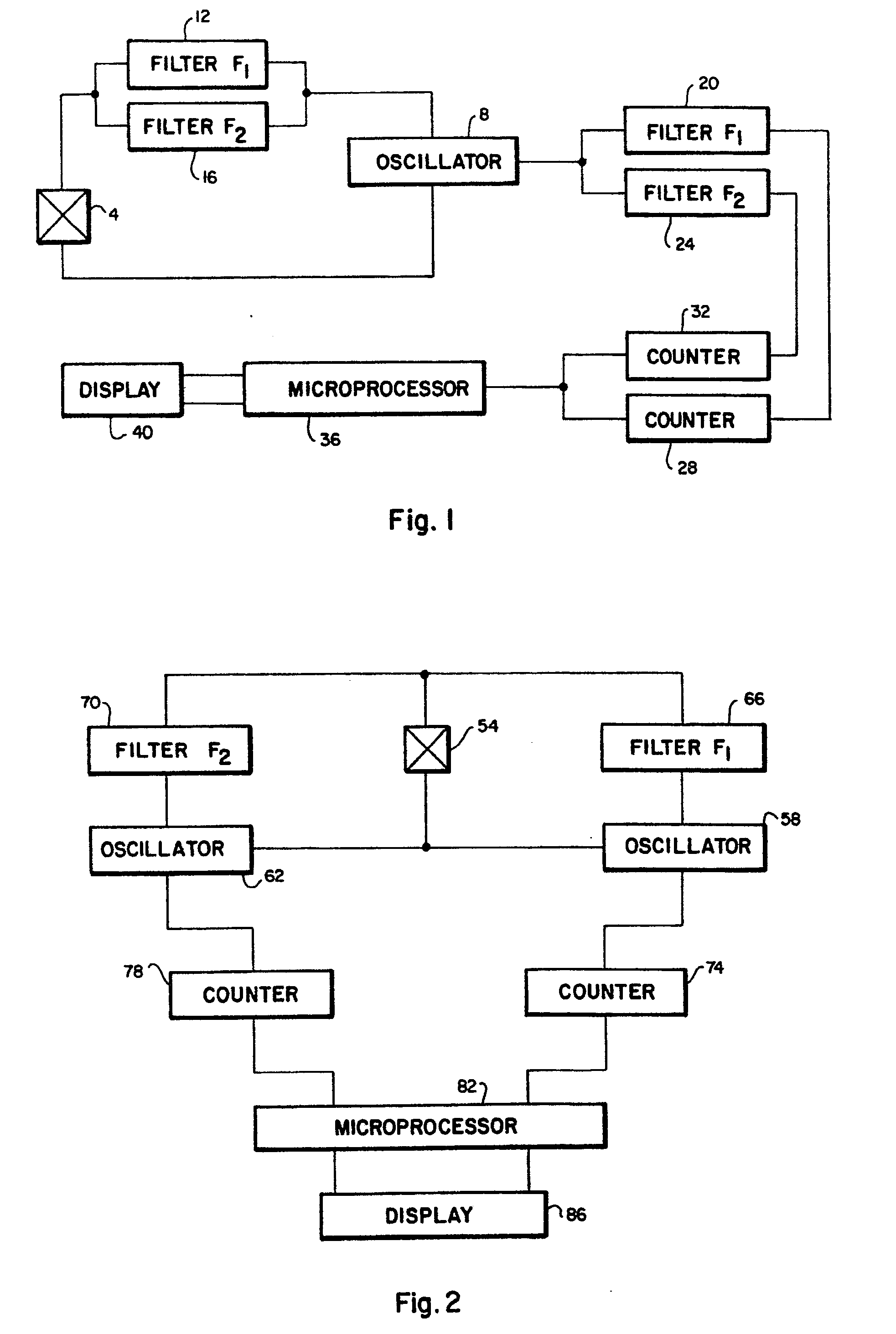
FIG. 1 is a schematic view of a resonator transducer system made in accordance with
the principles of the present invention and utilizing a single oscillator driver;
and
FIG. 2 is a schematic view of another embodiment of the invention which utilizes two
oscillator drivers.
[0019] Referring now to the drawings:
[0020] Referring to FIG. 1, there is shown a resonator transducer system capable of measuring
a force parameter (which will hereafter be referred to simply as "force") and temperature
in accordance with the present invention. The system includes a vibrating element
4 adapted to resonate free of significant activity dips. It has been found that for
the thickness shear mode of vibration, the SC-cut, AT-cut and BT-cut quartz crystals
meet this criterion, and that SC-cut quartz crystals are preferred because they are
more stable in transient temperature environments and have better short term frequency
stability. In addition, the flexure mode of vibration, among others, in both the double-bar,
double-ended resonator configuration (see U.S. Patent No. 4,372,173) and the double-bar,
single ended configuration (see U.S. Patent No. 4 574 639, published 11,3,86) have
been found to meet this criterion.
[0021] An oscillator 8 is coupled to the crystal 4 by way of a pair of filters 12 and 16
which are connected in parallel with each other. The oscillator 8 produces an oscillatory
signal which is supplied via the filters 12 and 16 to the crystal 4 to cause the crystal
to resonate at two (or more) frequencies f₁ and f₂ selected from the fundamental frequency
and its overtone frequencies. Filter 12 passes oscillatory signals whose frequencies
are within a band of frequencies centered about the first selected frequency f₁, whereas
filter 16 passes oscillatory signals having frequencies in a band centered about the
second selected frequency f₂. The frequencies at which the crystal 4 resonates are
dependent both upon the force (such as pressure) to which the crystal is subjected,
and the temperature to which the crystal is exposed. The crystal is selected and formed
so that the variation in the first selected frequency with a change in temperature
is by a different scale factor from that at which the second selected frequency varies
with variation in temperature. See, for example, A. R. Chi, Temperature Behavior of
AT-cut Quartz Resonators", Proc. 10th Annual Symp. on Frequency Control, 1956, pages
47-59. The same is also true for variations in force applied to the crystal 4. It
is this phenomenon which is utilized in a unique and yet simple fashion for producing
both force (or other parameter) and temperature measurements using a single crystal
resonator transducer, or alternatively for producing a force measurement which is
temperature corrected or a temperature measurement which is force corrected.
[0022] The oscillator 8 follows the frequency of oscillation of the crystal 4 and produces
a signal having the same two selected frequencies as the crystal and this signal is
supplied to a second pair of filters 20 and 24. Filter 20 passes signals having frequencies
in a band generally centered about the first selected frequency f₁ and filter 24 passes
signals having frequencies in a band generally centered about the second selected
frequency f₂. Filter 20 supplies its frequency signal to a counter 28 and filter 24
supplies its signal to a counter 32. Counter 20 produces a digital output signal representing
the first selected frequency of the received signal and counter 32 produces a digital
output signal representing the second selected frequency of the received signal. These
digital outputs are supplied to a microprocessor 36 which processes the signals to
determine the magnitude of the force applied to the crystal 4, and the temperature
to which the crystal is exposed. The force and temperature measurements are supplied
to a display unit 40 where the measurements are visually displayed. The oscillator
8, filters 12, 16, 20 and 24, counters 28 and 32, microprocessor 36 and display 40
are all conventional units.
[0023] The change in the two selected frequencies (preferably the fundamental and third
overtone frequencies or fundamental and fifth overtone frequencies) with force and
temperature can be characterized by algebraic equations as follows:
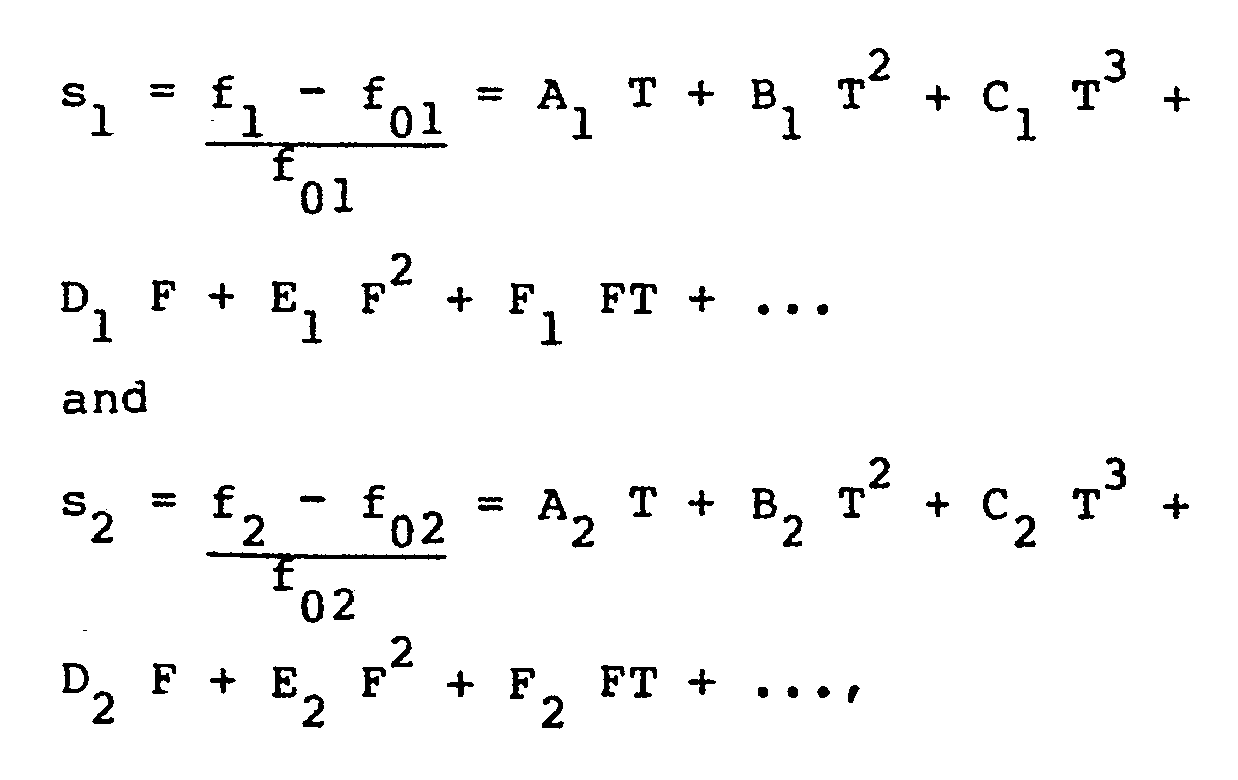
where f₀₁ and f₀₂ are the first and second selected frequencies at a predetermined
reference temperature T₀ and reference force F₀. Also, T is the change in temperature
from the reference temperature and F is the change in force (or other parameter) from
the reference force to which the crystal is subjected. The inverses of these equations
are:
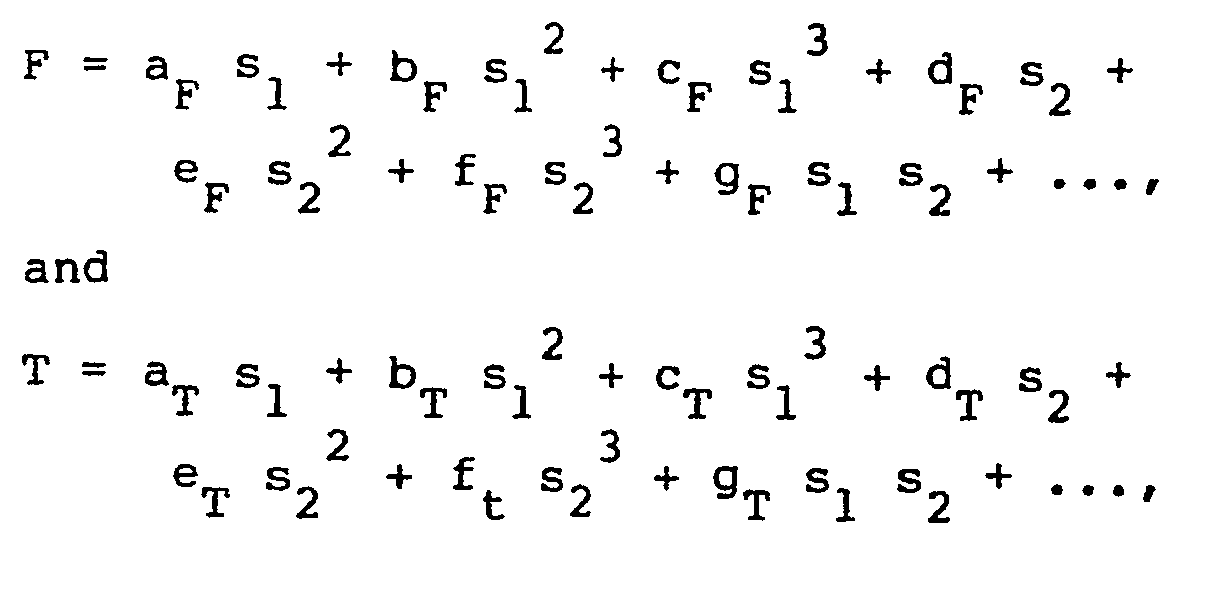
where a
F, b
F c
F, d
F, e
F, f
F and g
F are predetermined constant force coefficients, and where a
T, b
T, c
T, d
T, e
T, f
T and g
T are predetermined constant temperature coefficients.
[0024] The coefficients in the equations (3) and (4) are readily determined by applying
known forces and temperatures to the crystal and determining the constant coefficients
in the equations by curve fitting the equations to the known data. With the coefficients
being determined, and having two equations and two unknowns, the two unknowns can
be readily determined by conventional processing techniques. In effect, equations
(3) and (4) are solved by the microprocessor 36 to produce a measure of force F and
temperature T which are both self-compensated. Other parameters such as fluid density,
along with temperature, could be determined in a similar fashion.
[0025] FIG. 2 shows another embodiment of the invention which includes a single crystal
54 driven by two oscillators 58 and 62 to resonate at two selected frequencies f₁
and f₂. Filters 66 and 70 are coupled in series respectively to oscillators 58 and
62 to pass signal frequencies f₁ and f₂ to the crystal 54 to thereby cause the crystal
to resonate at these frequencies. The oscillators 58 and 62 follow respectively the
frequencies of oscillation f₁ and f₂ of the crystal 54 to produce and supply to counters
74 and 78 oscillatory signals having frequencies f₁ and f₂. The counters 74 and 78,
in turn, produce digital output signals representing frequencies f₁ and f₂ respectively,
and these signals are supplied to a microprocessor 82. The microprocessor 82 processes
the signals, as in the FIG. 1 embodiment, to determine the force (or other parameter
being measured) and temperature for visual display on display unit 86. The processing
is carried out in the same fashion as described for the FIG. 1 embodiment.
1. A resonator transducer system for determining force or other parameter and temperature
comprising a single vibratory element (4) which resonates at frequencies f₁ and f₂
selected from the group of frequencies consisting of the fundamental frequency and
overtone frequencies respectively of the vibratory element; an oscillator means (8)
for applying an oscillatory signal to the vibratory element and for producing a vibratory
signal having frequencies which follow the selected frequencies of the vibratory element;
and a processing means which processes said vibratory signal characterized in that said vibratory element being selected and formed such that the frequencies f₁ and
f₂ vary with variation in force or other parameter applied to the vibratory element
and with variation in temperature to which the vibratory element is exposed, and so
that the magnitude or scale factor of variation for frequency f₁ with respect to force
or other parameter and temperature is different from that for frequency f₂; and said
processing means produces a first signal representing the force or other parameter
applied to the vibratory element, and a second signal representing the temperature
to which the vibratory element is subjected.
2. A resonator transducer system as in claim 1, further comprising a detecting means
(28,32) having a first counting means (28) and a second counting means (32), which
detects the frequency f₁ and frequency f₂ of resonance of the vibratory element and
for producing a signal s₁ = f₁ - f₀₁, and a signal s₂ = f₂ -f₀₂, where f₀₁ is the
first selected frequency of vibration of the vibratory element at a predetermined
reference Force Fo or other parameter and reference temperature T₀, and where f₀₂ is the second selected
frequency of vibration of the vibratory element at the reference Force Fo or other parameter and reference temperature To; and said processing means is responsive to signals s₁ and s₂ to produce said first
and second signals.
3. A resonator transducer system as in Claim 1 or 2 wherein said vibratory element is
caused to resonate in modes substantially free of activity dips.
4. A resonator transducer system as in Claim 1 or 2 wherein the vibrating element is
a quartz crystal.
5. A resonator transducer system as in Claim 4 wherein said crystal is caused to resonate
in thickness shear modes.
6. A resonator transducer system as in Claim 5 wherein said crystal is a SC-cut quartz
crystal.
7. A resonator transducer system as in Claim 5 wherein said crystal is an AT-cut quartz
crystal.
8. A resonator transducer system as in Claim 5 wherein said crystal is a BT-cut quartz
crystal.
9. A resonator transducer system as in Claim 4 wherein said crystal is a double-bar,
double-ended resonator which vibrates in flexure modes.
10. A resonator transducer system as in Claim 4 wherein said crystal is double-bar, single-ended
resonator which vibrates in flexure modes.
11. A resonator transducer system as in Claim 1 or 2 further including a first filter
means (12) and second filter means (16) connected in parallel with each other between
the vibratory element (4) and the oscillator means (8), said first filter means being
adapted to pass oscillatory signals having frequencies in a band generally centered
about the frequency f₁, and said second filter means being adapted to pass oscillatory
signals having frequencies in a band generally centered about the frequency f₂.
12. A resonator transducer system as in Claim 11 wherein said frequency f₁ is the fundamental
frequency of vibration of the vibratory element and said frequency f₂ is the third
overtone of the fundamental frequency.
13. A resonator transducer system as in Claim 11 wherein said frequency f₁ is the fundamental
frequency of vibration of the vibratory element, and said frequency f₂ is the fifth
overtone of the fundamental frequency.
14. A resonator transducer system as in Claim 11 wherein said frequency f₁ is the third
overtone of the fundamental frequency of vibration of the vibratory element, and said
frequency f₂ is the fifth overtone of the fundamental frequency.
15. A resonator transducer system as in Claim 11 further including third filter means
(20) and fourth filter means (24) connected in parallel with each other between the
oscillator means (8) and the processing means (36), said third filter means being
adapted to pass oscillatory signals having frequencies in a band generally centered
about the frequency f₁, and said fourth filter means being adapted to pass oscillatory
signals having frequencies in a band generally centered about the frequency f₂.
16. A resonator transducer system as in claim 15 wherein said third filter means (20)
is connected to the processing means (36) via said first counting means (28) of said
detecting means, and said fourth filter means (24) is connected to the processing
means (36) via said second counting means (32) of said detecting means, and
said processing means includes means for producing signals
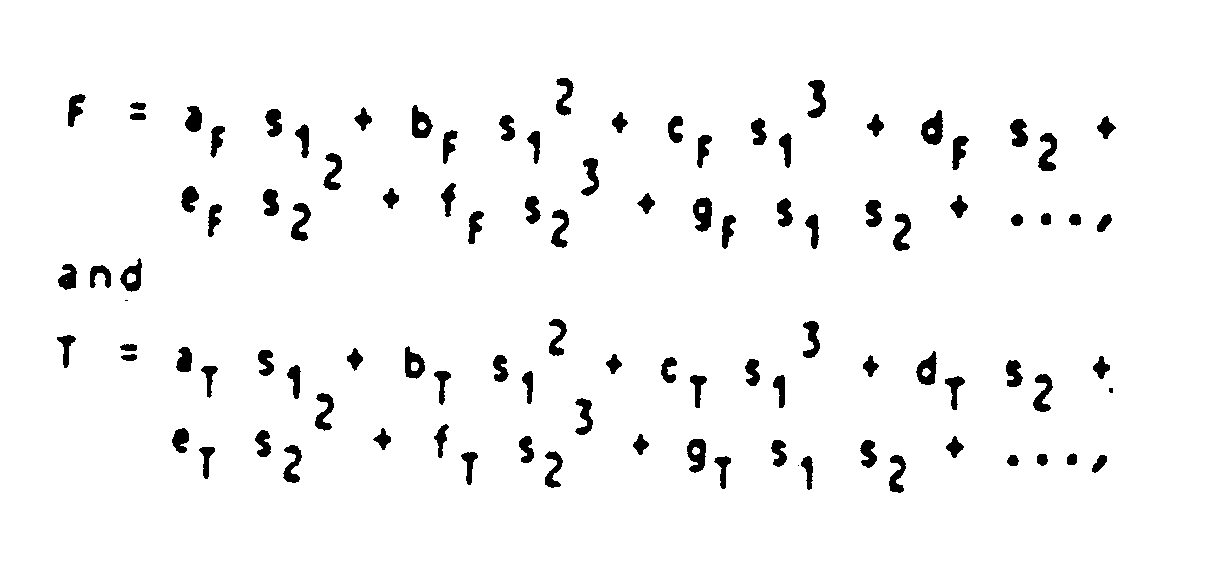
where a
F, b
F, c
F, d
F, e
F, f
F and g
F are predetermined constant force coefficients, and where a
T, b
T, c
T, d
T, e
T, f
T and g
T are predetermined constant temperature coefficients and where T is the change in
temperature from the reference temperature.
17. A resonator transducer system as in claim 4 wherein said oscillator means comprises
a first oscillator coupled to the crystal for causing the crystal to resonate at the
frequency f₁, and a second oscillator coupled to the crystal for causing the crystal
to resonate at the frequency f₂.
18. A resonator transducer system as in claim 17 further including a first filter means
coupled between said first oscillator and the crystal, said first filter means being
adapted to pass oscillatory signals having frequencies in a band generally centered
about the frequency f₁, and a second filter means coupled between the second oscillator
and the crystal, said second filter means being adapted to pass oscillatory signals
having frequencies in a band generally centered about the frequency f₂.
19. A resonator transducer system as in Claim 18 wherein said first and second oscillators
cause said crystal to oscillate in thickness shear modes.
20. A resonator transducer system as in Claim 19 wherein said crystal is selected from
a group consisting of SC-cut, AT-cut and BT-cut quartz crystals.
21. A resonator transducer system as in Claim 20 wherein said processing means includes
means for producing signals
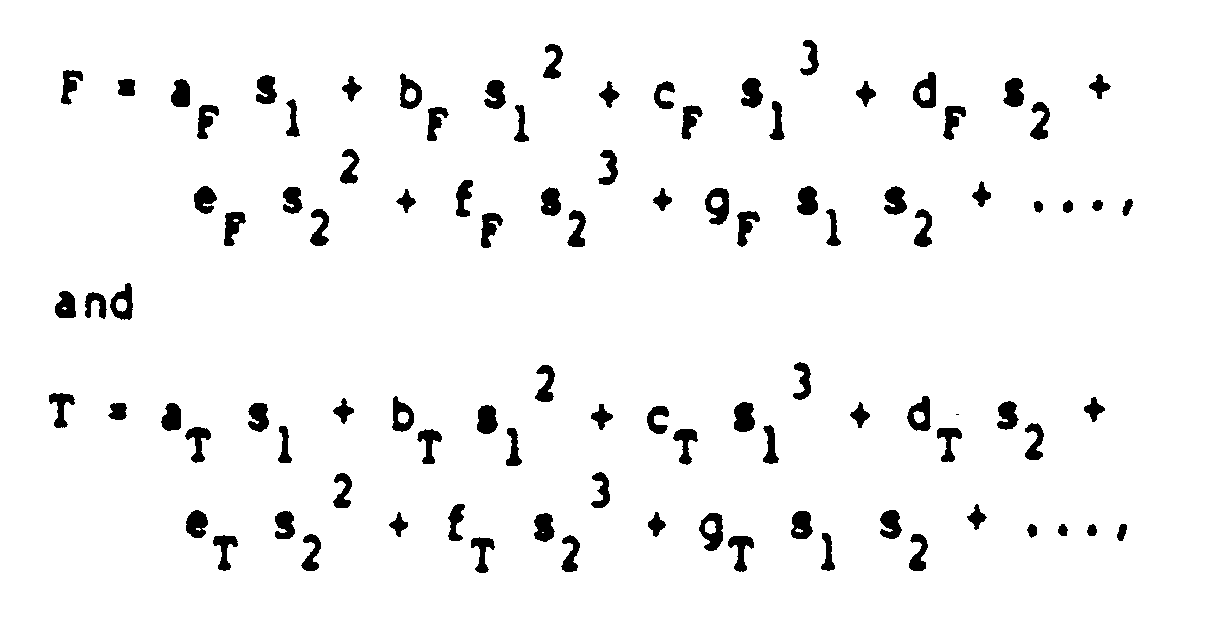
where a
F, b
F, c
F, d
F, e
F, f
F and g
F are predetermined constant force coefficients, and where a
T, b
T, C
T, d
T, e
T, f
T and g
T are predetermined constant temperature coefficients.
22. A resonator transducer system as in Claim 18 wherein said crystal is a double-bar,
double-ended resonator configuration, and wherein said first and second oscillators
cause said crystal to oscillate in flexure modes.
23. A resonator transducer system as in Claim 18 wherein said crystal is a double-bar,
single-ended resonator configuration, and wherein said first and second oscillators
cause said crystal to oscillate in flexure modes.
24. A method of determining force or other parameter and temperature comprising the steps
of:
causing a vibratory element to resonate at frequencies f₁ and f₂, with the frequencies
being selected from the group of frequencies consisting of the fundamental and overtone
frequencies of the vibratory element; and
producing a vibratory signal having frequencies f₁ and f₂ which follow the frequencies
of resonance of the vibratory element,
characterised in further comprising the steps of: Selecting and forming the vibratory
element such that the two frequencies vary with variation in force or other parameter
applied to the vibratory element and with variation in temperature to which the vibratory
element is exposed, with the magnitude of variation of frequency f₁ due to the change
in force or other parameter and the change in temperature being different from that
for frequency f₂; and
processing the vibratory signal to produce a first signal representing the force or
other parameter applied to the vibratory element, a second signal representing the
temperature to which the vibratory element is subjected.
25. A method as in Claim 24 wherein the vibratory element is caused to resonate in modes
substantially free of activity dips.
26. A method as in Claim 25 wherein the vibratory element is a quartz crystal.
27. A method as in Claim 26 wherein the crystal is caused to resonate in a thickness shear
mode and wherein the crystal is selected from the group of crystals consisting of
SC-cut, AT-cut and BT-cut crystals.
28. A method as in Claim 26 wherein the crystal is selected from the group consisting
of a double-bar, double-ended resonator configuration or a double-bar, single-ended
configuration, and wherein the crystal is caused to resonate in flexure modes.
1. Système transducteur à résonance pour déterminer une force ou un autre paramètre et
la température, comprenant un seul élément vibrant (4) qui résonne à des fréquences
f₁ et f₂ choisies dans le groupe de fréquences comprenant la fréquence fondamentale
et des fréquences harmoniques respectivement de l'élément vibrant, des moyens d'oscillateur
(8) pour appliquer un signal oscillant à l'élément vibrant et pour produire un signal
de vibration ayant des fréquences qui suivent les fréquences choisies de l'élément
vibrant, et un dispositif de traitement qui traite ce signal de vibration, caractérisé
en ce que l'élément vibrant est choisi et formé de telle sorte que les fréquences
f₁ et f₂ varient en fonction de variations dans la force ou d'un autre paramètre appliquée
à l'élément vibrant et en fonction de variations de la température à laquelle est
exposé l'élément vibrant, et de telle sorte que le facteur d'échelle de la variation
de la fréquence f₁ par rapport à la force ou à un autre paramètre et à la température
soit différent de celui pour la fréquence f₂ , et en ce que le dispositif de traitement
produit un premier signal représentant la force ou un autre paramètre appliquée à
l'élément vibrant, et un deuxième signal représentant la température à laquelle est
exposé l'élément vibrant.
2. Système transducteur à résonance selon la revendication 1, comprenant en outre des
moyens de détection (28,32) ayant un premier compteur (28) et un deuxième compteur
(32) qui détectent la fréquence f₁ et la fréquence f₂ de résonance de l'élément vibrant
et qui produisent un signal s₁=f₁-f₀₁ et un signal s₂=f₂-f₀₂ , f₀₁ étant la première
fréquence choisie de vibration de l'élément vibrant pour une force ou l'autre paramètre
de référence prédéterminée F₀ et pour une température de référence T₀ , et f₀₂ étant
la deuxième fréquence choisie de vibration de l'élément vibrant pour la force ou l'autre
paramètre de référence F₀ et pour la température de référence T₀ , le dispositif de
traitement répondant aux signaux s₁ et s₂ pour produire un premier et un deuxième
signal.
3. Système transducteur à résonance selon la revendication 1 ou la revendication 2, dans
lequel l'élément vibrant est amené à résonner en des modes pratiquement dépourvus
de creux d'activité.
4. Système transducteur à résonance selon la revendication 1 ou la revendication 2, dans
lequel l'élément vibrant est un cristal de quartz.
5. Système transducteur à résonance selon la revendication 4, dans lequel le cristal
est amené à résonner en des modes de cisaillement en épaisseur.
6. Système transducteur à résonance selon la revendication 5, dans lequel le cristal
est un cristal de quartz coupé en SC .
7. Système tranducteur à résonance selon la revendication 5, dans lequel le cristal est
un cristal de quartz coupé en AT .
8. Système transducteur à résonance selon la revendication 5, dans lequel le cristal
est un cristal de quartz coupé en BT .
9. Système transducteur à résonance selon la revendication 4, dans lequel le cristal
est un résonateur à deux barres et deux extrémités, qui vibre en des modes de flexion.
10. Système transducteur à résonance selon la revendication 4, dans lequel le cristal
est un résonateur à deux barres et une seule extrémité, qui vibre en des modes de
flexion.
11. Système transducteur à résonance selon la revendication 1 ou la revendication 2, comportant
en outre un premier filtre (12) et un deuxième filtre (16) reliés en parallèle l'un
à l'autre entre l'élément vibrant (4) et les moyens d'oscillateur (8), le premier
filtre étant adapté pour laisser passer des signaux oscillants ayant des fréquences
dans une bande centrée généralement autour de la fréquence f₁ et le deuxième filtre
étant adapté pour laisser passer des signaux oscillants ayant des fréquences dans
une bande centrée généralement autour de la fréquence f₂ .
12. Système transducteur à résonance selon la revendication 11, dans lequel la fréquence
f₁ est la fréquence fondamentale de vibration de l'élément vibrant et la fréquence
f₂ est la troisième harmonique de la fréquence fondamentale.
13. Système transducteur à résonance selon la revendication 11, dans lequel la fréquence
f₁ est la fréquence fondamentale de vibration de l'élément vibrant et la fréquence
f₂ est la cinquième harmonique de la fréquence fondamentale.
14. Système transducteur à résonance selon la revendication 11, dans lequel la fréquence
f₁ est la troisième harmonique de la fréquence fondamentale de vibration de l'élément
vibrant et la fréquence f₂ est la cinquième harmonique de la fréquence fondamentale.
15. Système transducteur à résonance selon la revendication 11, comprenant en outre un
troisième filtre (20) et un quatrième filtre (24) reliés en parallèle l'un avec l'autre
entre les moyens d'oscillateur(8) et le dispositif de traitement (36), ce troisième
filtre étant adapté pour laisser passer des signaux oscillants ayant des fréquences
dans une bande centrée généralement autour de la fréquence f₁ et le quatrième filtre
étant adapté pour laisser passer des signaux oscillants ayant des fréquences dans
une bande centrée généralement autour de la fréquence f₂ .
16. Système transducteur à résonance selon la revendication 15, dans lequel le troisième
filtre (20) est relié au dispositif de traitement (36) par l'intermédiaire d'un premier
compteur (28)des moyens de détection, et le quatrième filtre (24) est relié au dispositif
de traitement (36) par l'intermédiaire du deuxième compteur (32) des moyens de traitement,
et dans lequel le dispositif de traitement comporte des moyens pour produire des signaux
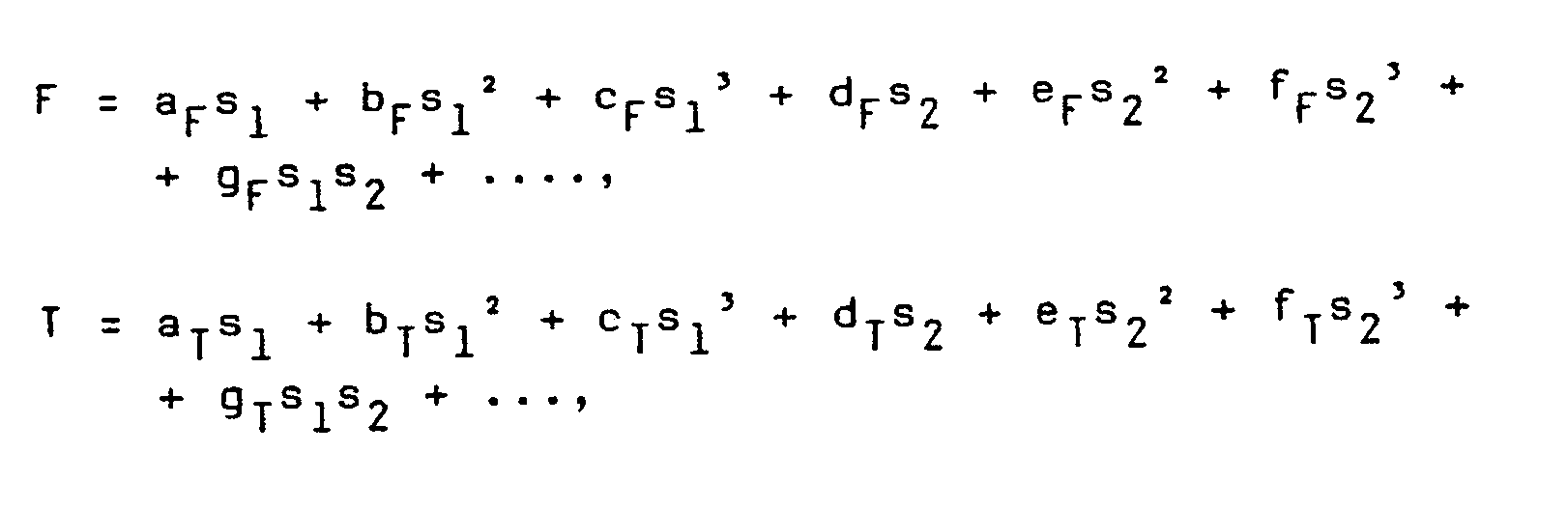
où a
F, b
F, c
F, d
F, e
F, f
F et g
F sont des coefficients de force constants prédéterminés et où a
T, b
T, c
T, d
T, e
T, f
T et g
T sont des coefficients de température constants prédéterminés, T étant le changement
de température par rapport à la température de référence.
17. Système transducteur à résonance selon la revendication 4, dans lequel les moyens
d'oscillateur comprennent un premier oscillateur couplé au cristal pour amener le
cristal à résonner à la fréquence f₁ et un deuxième oscillateur couplé au cristal
pour amener le cristal à résonner à la fréquence f₂ .
18. Système tranducteur à résonance selon la revendication 17, comprenant en outre un
premier filtre couplé entre le premier oscillateur et le cristal, ce premier filtre
étant adapté pour laisser passer des signaux oscillants ayant des fréquences dans
une bande centrée généralement autour de la fréquence f₁ , et un deuxième filtre couplé
entre le deuxième oscillateur et le cristal, ce deuxième filtre étant adapté pour
laisser passer des signaux oscillants ayant des fréquences dans une bande centrée
généralement autour de la fréquence f₂ .
19. Système transducteur à résonance selon la revendication 18, dans lequel le premier
oscillateur et le deuxième oscillateur amènent le cristal à osciller en des modes
de cisaillement en épaisseur.
20. Système transducteur à résonance selon la revendication 19, dans lequel le cristal
est choisi dans un groupe comprenant des cristaux de quartz coupés en SC , coupés
en AT et coupés en BT .
21. Système transducteur à résonance selon la revendication 20, dans lequel le dispositif
de traitement comporte des moyens pour produire des signaux

où a
F, b
F, c
F, d
F, e
F, f
F et g
F sont des coefficients de force constants prédéterminés et où a
T, b
T, c
T, d
T, e
T, f
T et g
T sont des coefficients de température constants prédéterminés.
22. Système transducteur à résonance selon la revendication 18, dans lequel le cristal
est une configuration de résonateurs à deux barres et deux extrémités et dans lequel
le premier et le deuxième oscillateur amènent ce cristal à osciller en des modes de
flexion.
23. Système transducteur à résonance selon la revendication 18, dans lequel le cristal
est une configuration de résonateurs à deux barres et une seule extrémité, et dans
lequel le premier et le deuxième oscillateurs amènent ce cristal à osciller en des
modes de flexion.
24. Procédé pour déterminer une force ou un autre paramètre et une température, comprenant
les stades suivants :
- amener un élément vibrant à résonner à des fréquences f₁ et f₂ , ces fréquences
étant choisies dans le groupe de fréquences comportant la fréquence fondamentale et
des fréquences harmoniques de l'élément vibrant; et
- produire un signal vibrant ayant des fréquences f₁ et f₂ , qui suivent les fréquences
de résonance de l'élément vibrant,
caractérisé en ce qu'il comporte en outre les stades suivants :
- choisir et former l'élément vibrant de telle sorte que les deux fréquences varient
lorsque varie la force ou l'autre paramètre appliquée à l'élément vibrant et lorsque
varie la température à laquelle est exposé l'élément vibrant, la grandeur de la variation
de la fréquence f₁ due au changement dans la force ou dans l'autre paramètre et au
changement dans la température étant différente de celle de la fréquence f₂ ; et
- traiter le signal vibrant pour produire un premier signal représentant la force
ou l'autre paramètre appliquée à l'élément vibrant, un deuxième signal représentant
la température à laquelle est exposé l'élément vibrant.
25. Procédé selon la revendication 24, dans lequel l'élément vibrant est amené à résonner
en des modes pratiquement dépourvus de creux d'activité.
26. Procédé selon la revendication 25, dans lequel l'élément vibrant est un cristal de
quartz.
27. Procédé selon la revendication 26, dans lequel le cristal est amené à résonner en
un mode de cisaillement en épaisseur et dans lequel le cristal est choisi dans le
groupe de cristaux constitués par des cristaux coupés en SC , coupés en AT et coupés
en BT .
28. Procédé selon la revendication 26, dans lequel le cristal est choisi dans le groupe
consistant en une configuration de résonateur à deux barres et deux extrémités ou
une configuration à deux barres et une seule extrémité, et dans lequel le cristal
est amené à résonner en des modes de flexion.
1. Resonator-Wandlersystem zur Bestimmung der Kraft oder eines anderen Parameters und
der Temperatur, mit einem einzigen Schwingungselement (4), das auf Frequenzen f₁ und
f₂ schwingt, die aus der Gruppe von Frequenzen ausgesucht sind, die die Fundamentalfrequenz
bzw. Obertonfrequenzen des Schwingungselements umfaßt; mit einer Oszillatorvorrichtung
(8) zum Anlegen eines Oszillatorsignals an das Schwingungselement und zur Erzeugung
eines Schwingungssignals, das Frequenzen aufweist, die den ausgewählten Frequenzen
des Schwingungselements folgen; und mit einer Verarbeitungseinrichtung, die das Schwingungssignal
verarbeitet, dadurch gekennzeichnet, daß das Schwingungselement derart ausgewählt und ausgebildet ist, daß sich die Frequenzen
f₁ und f₂ ändern mit der Änderung der Kraft oder eines anderen Parameters, die auf
das Schwingungselement ausgeübt werden, und mit der Änderung der Temperatur, der das
Schwingungselement ausgesetzt ist, so daß die Größe oder der Skalierungsfaktor der
Variation der Frequenz f₁ in bezug auf die Kraft oder einen anderen Parameter sich
von der bzw. dem für die Frequenz f₂ unterscheidet; und daß die Verarbeitungseinrichtung
ein erstes Signal erzeugt, das die Kraft oder den anderen Parameter repräsentiert,
die an das Schwingungselement angelegt werden, und ein zweites Signal, das die Temperatur
repräsentiert, der das Schwingungselement ausgesetzt ist.
2. Resonator-Wandlersystem nach Anspruch 1, welches weiterhin eine Nachweiseinrichtung
(28, 32) aufweist, die mit einer ersten Zähleinrichtung (28) und mit einer zweiten
Zähleinrichtung (32) versehen ist, welche die Frequenz f₁ und f₂ der Resonanz des
Schwingungselements nachweist, und zur Erzeugung eines Signals s₁ = f₁ - f₀₁, und
eines Signals S₂ = f₂ - f₀₂, wobei f₀₁ die erste ausgewählte Schwingungsfrequenz des
Schwingungselements bei einer vorbestimmten Referenzkraft F₀ oder einem anderen Parameter
und bei einer Referenztemperatur T₀ ist, und f₂ die zweite ausgewählte Schwingungsfrequenz
des Schwingungselements bei der Referenzkraft F₀ oder einem anderen Parameter und
bei der Referenztemperatur T₀ ist; und wobei die Verarbeitungseinrichtung auf Signale
s₁ und s₂ reagiert, um das erste und zweite Signal zu erzeugen.
3. Resonator-Wandlersystem nach Anspruch 1 oder 2, bei welchem das Schwingungssystem
zu einer Schwingung in Moden veranlaßt wird, die im wesentlichen frei von Einbuchtungen
sind.
4. Resonator-Wandlersystem nach Anspruch 1 oder 2, bei welchem das Schwingungselement
ein Quartzkristall ist.
5. Resonator-Wandlersystem nach Anspruch 4, bei welchem der Kristall zu einer Resonanz
in Dickenschermoden veranlaßt wird.
6. Resonator-Wandlersystem nach Anspruch 5, bei welchem der Kristall ein SC-geschnittener
Quartzkristall ist.
7. Resonator-Wandlersystem nach Anspruch 5, bei welchem der Krisall ein AT-geschnittener
Quartzkristall ist.
8. Resonator-Wandlersystem nach Anspruch 5, bei welchen der Kristall ein BT-geschnittener
Quartzkristall ist.
9. Resonator-Wandlersystem nach Anspruch 4, bei welchem der Kristall ein Doppelstangen-,
doppelendiger Resonator ist, der in Biegeschwingungsmoden schwingt.
10. Resonator-Wandlersystem nach Anspruch 4, bei welchem der Kristall ein Doppelstangen-,
einendiger Resonator ist, der in Biegeschwingungsmoden schwingt.
11. Resonator-Wandlersystem nach Anspruch 1 oder 2, welches weiterhin eine erste Filtereinrichtung
(12) und eine zweite Filtereinrichtung (16) aufweist, die parallel zueinander zwischen
das Schwingungselement (4) und die Oszillatoreinrichtung (8) geschaltet sind, wobei
die erste Filtereinrichtung angepaßt ist zum Durchlass von Oszillatorsignalen, die
Frequenzen aufweisen, die in einem allgemein um die Frequenz f₁ herum zentrierten
Band liegen, und die zweite Filtereinrichtung zum Durchlaß von Oszillatorsignalen
ausgebildet ist, die Frequenzen aufweisen, die in einem allgemein um die Frequenz
f₂ herum zentrierten Band liegen.
12. Resonator-Wandlersystem nach Anspruch 11, bei welchem die Frequenz f₁ die Fundamental-Schwingungsfrequenz
des Schwingungssystems ist und die Frequenz f₂ der dritte Oberton der Fundamentalfrequenz.
13. Resonator-Wandlersystem nach Anspruch 11, bei welchem die Frequenz f₁ die Fundamental-Schwingungsfrequenz
des Schwingungselements ist und die Frequenz f₂ der fünfte Oberton der Fundamentalfrequenz.
14. Resonator-Wandlersystem nach Abspruch 11, bei welchem die Frequenz f₁ der dritte Oberton
der Fundamental-Schwingungsfrequenz des Schwingungselements ist und die Frequenz f₂
der fünfte Oberton der Fundamentalfrequenz.
15. Resonator-Wandlersystem nach Anspruch 11, bei welchem weiterhin eine dritte Filtereinrichtung
(20) und eine vierte Filtereinrichtung (24) vorgesehen sind, die zueinander parallel
zwischen die Oszillatoreinrichtung (8) und die Verarbeitungseinrichtung (36) geschaltet
sind, wobei die dritte Filtereinrichtung angepaßt ist zum Durchlaß von Oszillatorsignalen
mit Frequenzen in einem Band, das allgemein um die Frequenz f₁ herum zentriert ist,
und die vierte Filtereinrichtung angepaßt ist zum Durchlaß von Oszillatorsignalen
mit Frequenzen in einem Band, das allgemein um die Frequenz f₂ herum zentriert ist.
16. Resonator-Wandlersystem nach Anspruch 15, bei welchem die dritte Filtereinrichtung
(20) mit der Verarbeitungseinrichtung (36) über die erste Zähleinrichtung (28) der
Nachweiseinrichtung verbunden ist, und die vierte Filtereinrichtung (24) mit der Verarbeitungseinrichtung
(36) über die zweite Zähleinrichtung (32) der Nachweiseinrichtung verbunden ist, und
wobei die Verarbeitungseinrichtung eine Einrichtung aufweist zur Erzeugung von Signalen
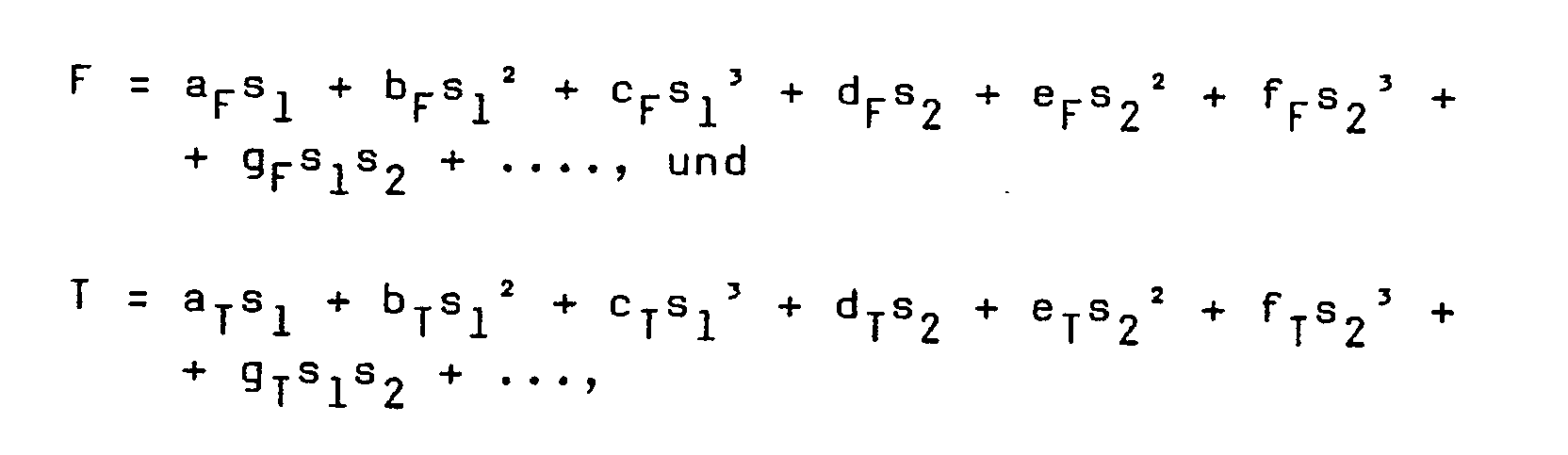
wobei a
F, b
F, c
F, d
F, e
F, f
F, g
F vorbestimmte konstante Kraftkoeffizienten sind, und a
T, b
T, c
T, d
T, e
T, f
T, g
T vorbestimmte konstante Temperaturkoeffizienten sind, und T die Temperaturänderung
bezüglich der Referenztemperatur bezeichnet.
17. Resonator-Wandlersystem nach Anspruch 4, bei welchem die Oszillatoreinrichtung einen
ersten Oszillator aufweist, der an den Kristall gekuppelt ist, um den Kristall zum
Schwingen bei der Frequenz f₁ zu veranlassen, und einen zweiten Oszillator, der an
den Kristall gekuppelt ist, um den Kristall zum Schwingen bei der Frequenz f₂ zu veranlassen.
18. Resonator-Wandlersystem nach Anspruch 17, bei welchem weiterhin eine erste Filtereinrichtung
vorgesehen ist, die zwischen den ersten Oszillator und den Kristall gekuppelt ist,
wobei die erste Filtereinrichtung angepaßt ist zum Durchlaß von Oszillatorsignalen
mit einer Frequenz in einem Band, das allgemein um die Frequenz f₁ herum zentriert
ist, sowie eine zweite Filtereinrichtung, die zwischen den zweiten Oszillator und
den Kristall gekuppelt ist, wobei die zweite Filtereinrichtung angepaßt ist zum Durchlaß
von Oszillatorsignalen mit Frequenzen in einem Band, das allgemein um die Frequenz
f₂ herum zentriert ist.
19. Resonator-Wandlersystem nach Anspruch 18, bei welchem der erste und der zweite Oszillator
den Kristall zum Schwingen in Dickenschermoden veranlassen.
20. Resonator-Wandlersystem nach Anspruch 19, bei welchem der Kristall aus einer Gruppe
ausgewählt ist, die SC-, AT-und BT-geschnittene Quarzkristalle umfaßt.
21. Resonator-Wandlersystem nach Anspruch 20, bei welchem die Verarbeitungseinrichtung
eine Einrichtung zur Erzeugung von Signalen umfaßt

wobei a
F, b
F, c
F, d
F, e
F, f
F, g
F vorbestimmte konstante Kraftkoeffizienten sind, und a
T, b
T, c
T, d
T, e
T, f
T, g
T vorbestimmte konstante Temperaturkoeffizienten.
22. Resonator-Wandlersystem nach Anspruch 18, bei welchem der Kristall eine Doppelstangen-,
doppelendige Resonatorform aufweist, und der erste und zweite Oszillator den Kristall
zum Schwingen in Biegeschwingungsmoden veranlassen.
23. Resonator-Wandlersystem nach Anspruch 18, bei welchem der Kristall eine Doppelstangen-,
einendige Resonatorform aufweist, und der erste und zweite Oszillator den Kristall
zum Schwingen in Biegeschwingungsmoden veranlassen.
24. Verfahren zur Bestimmung der Kraft oder eines anderen Parameters und der Temperatur
mit folgenden Schritten:
Veranlassen eines Schwingungselements zum Schwingen bei Frequenzen f₁ und f₂, die
aus der Gruppe von Frequenzen ausgewählt sind, die aus der Fundamentalschwingung und
den Obertonschwingungen des Schwingungselements besteht; und
Erzeugung eines Schwingungssignals, das Frequenzen f₁ und f₂ aufweist, die den Resonanzfrequenzen
des Schwingungselements folgen,
gekennzeichnet durch folgende weiteren Schritte:
Auswählen und Ausbilden des Schwingungselements auf solche Weise, daß sich die beiden
Frequenzen ändern mit einer Änderung der Kraft oder eines anderen an das Schwingungselement
angelegten Parameters und mit der Variation der Temperatur, der das Schwingungselement
ausgesetzt ist, wobei die Variationsgröße der Frequenz f₁ in folge der Änderung der
Kraft oder eines anderen Parameters und der Änderung der Temperatur sich von der für
die Frequenz f₂ unterscheidet; und
Verarbeiten des Schwingungssignals zur Erzeugung eines ersten Signals, welches die
Kraft oder einen anderen an das Schwingungselement angelegten Parameter repräsentiert,
und eines zweiten Signals, welches die Temperatur repräsentiert, der das Schwingungselement
ausgesetzt ist.
25. Verfahren nach Anspruch 24, bei welchem das Schwingungselement veranlaßt wird in Moden
zu schwingen, die im wesentlichen frei von Aktivitätseinbuchtungen sind.
26. Verfahren nach Anspruch 25, bei welchem das Schwingungselement ein Quartzkristall
ist.
27. Verfahren nach Anspruch 26, bei welchem der Kristall zum Schwingen in einem Dickenschermodus
veranlaßt wird und der Kristall aus der Gruppe von Kristallen ausgewählt ist, die
SC-, AT- und BT-geschnittene Kristalle umfaßt.
28. Verfahren nach Anspruch 26, bei welchem der Kristall aus der Gruppe ausgewählt ist,
die aus einer Doppelstangen-, doppelendigen Resonatorform oder einer Doppelstangen-,
einendigen Form besteht, und bei welchem der Kristall zum Schwingen in Biegeschwingungsmoden
veranlaßt wird.