|
(11) | EP 0 139 466 B1 |

| (12) | EUROPEAN PATENT SPECIFICATION |
|
|
| (54) |
A dithiolphosphoric acid ester as a soil pesticide Dithiolphosphorsäureester als Bodenpestizid Un ester d'acide dithiolphosphorique comme pesticide pour le sol |
|
|
|||||||||||||||||||||||||||||||
| Note: Within nine months from the publication of the mention of the grant of the European patent, any person may give notice to the European Patent Office of opposition to the European patent granted. Notice of opposition shall be filed in a written reasoned statement. It shall not be deemed to have been filed until the opposition fee has been paid. (Art. 99(1) European Patent Convention). |
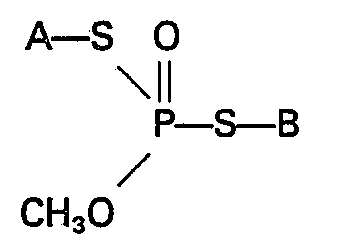
[0001] The present invention relates to a dithiophosphoric acid ester of the formula (I) (hereinafter referred to as the present compound),
wherein A is a sec-butyl or tert-butyl group, and B is an iso-propyl, iso-butyl, sec-butyl or tert-butyl group, its production and soil pesticidal compositions containing it as an active ingredient.
[0002] That some kinds of dithiophosphoric acid ester, for example, O-ethyl S,S-di-n-butyl dithiophosphate, etc., can be used as an active ingredient for insecticides, acaricides and nematocides, is described in Japanese Patent Publication No. 29847/1969, and also that, for example, O-ethyl S-sec-butyl S-tert-butyl dithiophosphate, etc., can be used as an active ingredient for nematocides and soil pesticides, is described in International Patent Publication No. WO 83/00870. But, it may not always be said that these compounds are always satisfactory as an active ingredient for soil pesticides.
[0003] However, the present compound, as compared with these compounds, has a high controlling activity against pests living in soil and doing damage to paddy rice, vegetables, flowers, lawn grasses, fruit trees, tea, mulberry and the like, and besides said compound gives no such phytotoxicity as to become a problem to these plants.
[0004] The present compound, therefore, can be used as an active ingredient for soil pesticidal compositions used for paddy fields, plowlands, orchards, pastures, tea gardens, mulberry farms and the like.
[0005] Soil pests include, for example, pests of Diabrotica genus such as western corn rootworm (Diabrotica virgifera Le Conte), northern corn rootworm (Diabrotica longicornis Say), southern corn rootworm (Diabrotica undecimpunctata howardi Barber), etc., pests of Anomala genus such as cupreous chafer (Anomala cuprea Hope), soybean beetle (Anomala rufocuprea Motschulsky), cherry chafer (Anomala daimiana, Harlod), striated chafer (Anomala testaceips Motschulsky), etc., pests of Popillia genus such as Japanese beetle (Popillia japonica Newman), etc., pests of Aulacophora genus such as cucurbit leaf beetle (Aulacophora femoralis Motschulsky), etc., pests of Phyllotreta genus such as striped cabbage flea beetle (Phyllotreta vittata Fabricius), etc., pests of Melanotus genus such as sweetpotato wireworm (Melanotus caudex Lewis), etc., pests of Agriotes genus such as barley wireworm (Agriotes fuscicollis Miwa), etc., pests of Hylemya genus such as onion maggot (Hylemya antiqua Meigen), turnip maggot (Hylemya floralis Fallén), seed-corn maggot (Hylemya platura Meigen), etc., pests of Agrotis genus such as common cutworm (Agrotis segetum Denis et Schiffermüller), black cutworm (Agrotis ipsilon Hufnagel), etc., pests of Gryllotalpa genus such as African mole cricket (Gryllotalpa africana Palisot de Beauvois), etc., pests of Lissorhoptrus genus such as ricewater weevil (Lissorhoptrus oryzophilus Kuschel), etc., pests of Pratylenchus genus such as Cobb root-lesion nematode (Pratylenchus penetrans Cobb), walnut root-lesion nematode (Pratylenchus vulnus Allen et Jensen), coffee root-lesion nematode (Pratylenchus coffeae Zimmermann), etc., pests of Heterodera genus such as soybean cyst nematode (Heterodera glycines Ichinohe), etc., pests of Meloidogyne genus such as northern root-knot nematode (Meloidogyne hapla Chitwood), cotton root-knot nematode (Meloidogyne incognita var. acrita Chitwood), Javanese root-knot nematode (Meloidogyne javanica Treub), peanut root-knot nematode (Meloidogyne arenaria Neal), etc., pests of Aphelenchoides genus such as rice white-tip nematode (Aphelenchoides besseyi Christie) and the like.
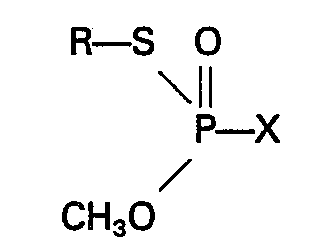
[0006] The present compound can be produced by reacting a halogenated thiophosphoric acid derivative of the formula (II),
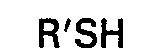
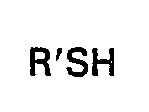
wherein R is an iso-propyl, iso-butyl, sec-butyl or tert-butyl group and X is a halogen atom, with ar alkylmercaptan of the formula (III),
wherein R' is B when R is A and is A when R is B (in which A and B are each as defined above).
[0007] The reaction is carried out in a solvent or without a solvent, preferably in the presence of a dehydrohalogenating agent and a phase transfer catalyst or copper catalyst.
[0008] As to the amount of the alkylmercaptan (III) and dehydrohalogenating agent which are reagents used in the reaction, the amount of the alkylmercaptan (III) is 1 to 5 equivalents based on 1 equivalent of the halogenated thiophosphoric acid derivative (11), and that of the latter is 1 to 1.5 equivalents based on 1 equivalent of the same.
[0009] The reaction temperature is about -10°C to about 50°C, and the reaction time is about 30 minutes to about 5 hours.
[0010] Suitable solvents include, for example, ketones (eg. acetone, methyl ethyl ketone, methyl isobutyl ketone, cyclohexanone), halogenated hydrocarbons (e.g. chloroform, carbon tetrachloride, dichloroethane, chlorobenzene, dichlorobenzene), aromatic hydrocarbons (e.g. benzene, toluene, xylene), aliphatic hydrocarbons (e.g. n-hexane, n-heptane, cyclohexane), nitriles (e.g. acetonitrile, isobutyronitrile), water and mixtures thereof.
[0011] Suitable dehydrohalogenating agents include, e.g., organic bases such as pyridine, triethylamine, N,N-diethylaniline, etc., and inorganic bases such as sodium hydroxide, potassium hydroxide, sodium carbonate, potassium carbonate, etc. Suitable phase transfer catalysts include, for example, tetraalkylammonium halides such as tetrabutylammonium bromide, triethylbenzylammonium chloride, etc., and suitable copper catalysts include, for example, copper powder, cuprous chloride, etc.
[0012] After completion of the reaction, after-treatment is carried out as usual, and if necessary, the product obtained is purified by chromatography, distillation and the like..
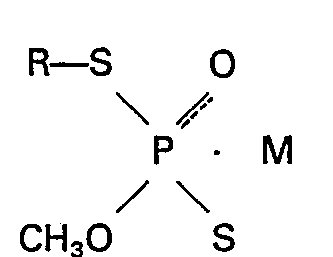
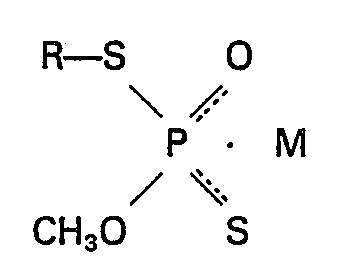
[0013] The present compound can also be produced by reacting a dithiophosphoric acid salt of the formula (IV),
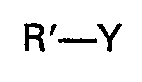
wherein R is an iso-propyl, iso-butyl, sec-butyl or tert-butyl group, and M is an alkali metal atom, with a halogenated alkyl of the formula (V),
wherein R' is B when R is A and is A when R is B (in which A and B are each as defined above), and Y is a halogen atom.
[0015] The amount of the halogenated alkyl (V) which is a reagent used for reaction, is 1 to 10 equivalents based on 1 equivalent of the dithiophosphoric acid salt (IV).
[0016] The reaction temperature is about 20°C to about 80°C, and the reaction time is about 30 minutes to about 3 hours.
[0017] Suitable solvents include, in addition to the foregoing ketones, halogenated hydrocarbons, aromatic hydrocarbons, aliphatic hydrocarbons, nitriles, water, etc., alcohols (e.g. methanol, ethanol, isopropanol, tert-butanol, methyl cellosolve) and mixtures thereof.
[0018] After completion of the reaction, after-treatment is carried out in the same manner as above, and the product obtained is purified if necessary.
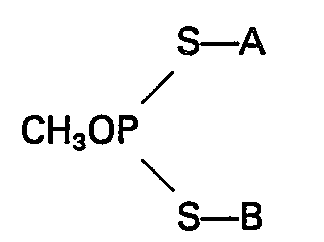
[0019] Further, the present compound can also be produced by reacting O-methyl S,S-dialkyl phosphite of the formula (VI),
wherein A and B are each as defined above, with an oxidizing agent.
[0021] The amount of the oxidizing agent (e.g. hydrogen peroxide) which is a reagent used for reaction, is 1 to 3 equivalents based on 1 equivalent of 0-methyl S,S-dialkyl phosphite (VI).
[0022] The reaction temperature is about 0°C to about 70°C, and the reaction time is about 30 minutes to about 3 hours.
[0023] Suitable solvents include the foregoing ketones, halogenated hydrocarbons, aromatic hydrocarbons and aliphatic hydrocarbons, water and mixtures thereof. After completion of the reaction, after-treatment is carried out in the same manner as described above, and the product obtained is purified if necessary.
[0024] O-methyl S,S-dialkyl phosphite of the formula (VI), which is a starting compound, can be produced by reacting S,S-dialkyl chlorophosphite of the formula (VII),
wherein A and B are each as defined above, with methanol in the presence of a dehydrochlorinating agent, and said S,S-dialkyl chlorophosphite can be produced, for example, by reacting phosphorus trichloride with an alkylmercaptan in a solvent that does not take part in this reaction and in the presence of a dehydrochlorinating agent.
[0025] Suitable solvent includes the foregoing halogenated hydrocarbons, aromatic hydrocarbons and aliphatic hydrocarbons, and the like. The dehydrochlorinating agent may be an organic base such as triethylamine, pyridine, N,N-dimethylaniline and the like.
Production Example 1 [Production of the present compound (1)]
[0027] To a solution of 9.0 g of O-methyl S-sec-butyl phosphorochloridothioate in 15 ml of toluene were added 4.0 g of iso-butylmercaptan and a catalytic amount of tetrabutylammonium bromide. Thereafter, 3.6 g of 50% aqueous sodium hydroxide solution was added dropwise over 1 hour with stirring while cooling the reaction mixture so that the inner temperature was 0° to 10°C, and then stirring was continued at room temperature for one further hour. After completion of the reaction, the reaction mixture was washed with 3% aqueous sodium hydroxide and then with water, and toluene was removed under reduced pressure. The oily product obtained as a residue was purified by column chromatography on silica gel to obtain 6.3 g of a pale yellow and oily O-methyl S-sec-butyl S-iso-butyl phosphorodithiolate.
Production Example 2 [Production of the present compound (6)]
[0028] To a solution of 7.0 g of O-methyl S,S-di-tert-butyl phosphite in 70 ml of n-hexane was added dropwise 6.5 g of 30% aqueous hydrogen peroxide at 25°C, and after stirring at 50°C for 1 hour, the mixture was cooled to room temperature. The hexane layer was washed with water, dried over anhydrous sodium sulfate and concentrated under reduced pressure to obtain 10 g of a pale brown and oily product as a residue. This product was purified by column chromatography on silica gel to obtain 6.3 g of a colorless and oily O-methyl S,S-di-tert-butyl phosphorodithioate.
[0029] Examples of the present compound which can be produced by these methods are shown in Table 1.
TABLE 1
[0031] When the present compound is used as an active ingredient for soil pesticidal compositions, it is generally formulated into oil sprays, emulsifiable concentrates, wettable powders, granules, dusts, aerosols, etc. by mixing with a solid, liquid or gaseous carrier and if necessary, adding auxiliaries for formulation such as surface active agents and others.
[0032] These compositions contain 0.1 to 99.9% by weight, preferably 1 to 80% by weight of the present compound as an active ingredient.
[0033] The solid carrier may be, for example, fine powders or granules of clays (e.g. kaolin clay, attapulgite clay, diatomaceous earth, synthetic hydrated silicon dioxide, Fubasami clay, bentonite, terra alba), talcs, other inorganic minerals (e.g. sericite, quartz powder, sulfur powder, activated carbon, calcium carbonate, hydrated silica), chemical fertilizers (e.g. ammonium sulfate, ammonium phosphate, ammonium nitrate, urea, ammonium chloride) and the like. The liquid carrier may be for example, water, alcohols (e.g. methanol, ethanol), ketones (e.g. acetone, methyl ethyl ketone), aromatic hydrocarbons (e.g. benzene, toluene, xylene, ethylbenzene, methylnaphthalene), aliphatic hydrocarbons (e.g. n-hexane, cyclohexanone, kerosene), esters (e.g. ethyl acetate, butyl acetate), nitriles (e.g. acetonitrile, isobutyronitrile), ethers (e.g. dioxane, diisopropyl ether), acid amides (e.g. dimethylformamide, dimethylacetamide), halogenated hydrocarbons (e.g. dichloroethane, trichloroethylene, carbon tetrachloride) and the like. The gaseous carrier, i.e. propellant, may be for example freon gas, butane gas, carbon dioxide gas and the like.
[0034] Suitable surface active agents include for example alkyl sulfates, alkylsulfonates, alkylarylsulfonates, alkyl aryl ethers and their polyoxyethylenized products, polyethylene glycol ethers, polyhydric alcohol esters, sugar alcohol derivatives and the like.
[0035] Suitable fixing agents and dispersing agents include for example casein, gelatin, polysaccharides (e.g. starch powder, gum arabic, cellulose derivatives, alginic acid), lignin derivatives, bentonite, saccharides, synthetic water-soluble high polymers (e.g. polyvinyl alcohol, polyvinyl pyrrolidone, polyacrylic acids) and the like. The stabilizer may be, for example PAP (isopropyl) acid phosphate), BHT (2,6 - di - tert - butyl - 4 - methylphenol), BHA (mixture of 2 - tert - butyl - 4 - methoxyphenol and 3 - tert - butyl - 4 - methoxyphenol), vegetable oils, mineral oils, the foregoing surface active agents, fatty acids and their esters and the like.
[0037] The present compound is shown by Compound No. in Table 1. Parts in the examples are by weight.
Formulation Example 1-Emulsifiable concentrate
[0038] To 40 parts of each of the present compounds (1) to (7) are added 50 parts of xylene and 10 parts of Sorpol* SM-200, an emulsifier (mixture of polyoxyethylene alkylaryl ether, etc. and dodecylbenzenesulfonic acid), and the mixture is well mixed by stirring to obtain a 40% emulsifiable concentrate of each compound.
Formulation Example 2-Wettable powder
[0039] To 40 parts of each of the present compounds (1) to (7) is added 75 parts of Sorpol SM-200, an emulsifier, and the mixture is well mixed. Thereafter, 20 parts of *Carplex #80 (synthetic hydrated silicon dioxide fine powder) and 35 parts of 300-mesh diatomaceous earth are added, and the mixture is well mixed by stirring on a juice mixer to obtain a 40% wettable powder of each compound.
Formulation Example 3-Granule
[0040] 15 Parts of each of the present compounds (1) to (7) is mixed with and dissolved in 10 parts of diethylene glycol. The resulting solution is well mixed with 75 parts of Attapulgus clay 25/50 mesh (attapulgite clay produced by Engelhard Co.) on the Nauta mixer while spraying the solution onto the clay. A 15% granule of each compound is thus obtained.
Formulation Example 4-Dust
[0041] To 5 parts of each of the present compounds (1) to (7) are added 20 parts of acetone, 3 parts of Carplex #80, 0.3 part of PAP and 91.7 parts of 300-mesh talc. The mixture is well mixed by stirring on a juice mixer and acetone is removed by evaporation to obtain a 5% dust of each compound.
Formulation Example 5-Oil spray
[0042] To 20 parts of each of the present compounds (1) to (7) is added 80 parts of kerosene, and the mixture is well mixed to obtain a 20% oil spray of each compound.
[0043] These compositions may be used, as such or as aqueous dilute liquors, by spraying or scattering onto the soil surface and if necessary, mixing with the soil after spraying or scattering, or drenching the soil. Sometimes, they may be used in foliar spraying. Also, they may be used in mixtures with other insecticides, acaricides, nematocides, fungicides, seed disinfectants, fertilizers or soil improvers, or may be used at the same time together with these chemicals without mixing.
* It is believed that Sorpol is a registered trademark in at least one of the designated states.
* It is believed that Carplex is a registered trademark in at least one of the designated states.
[0044] When the present compound is used as an active ingredient for soil pesticidal compositions, its dosage rate is generally 10 to 1000 g/10 ares, preferably 50 to 500 g/10 ares, and its application concentration is 0.01 to 30% when the emulsifiable concentrate or wettable powder is used as an aqueous dilute liquor.
[0045] These dosage rates and application concentrations vary with the form of composition, application time, application scene, application method, kind of soil pest, degree of damage and the like, so that they may be increased or decreased independently of the foregoing ranges.
[0046] The controlling activity on soil pests of the present compound will be shown with reference to the following test examples. Every test example was carried out according to a three-replication test method. Of the test compounds, the present compounds are shown by Compound No. in Table 1, and compounds used as control are shown by Compound symbol in Table 2.
Test Example 1
[0047] The emulsifiable concentrate of each test compound formulated according to Formulation Example 1 was diluted with water, and 5 ml of the resulting aqueous dilute liquor was mixed with 50 g of soil (16 mesh) to make the concentration of active ingredient in soil 1 ppm. The soil was then placed in a polyethylene cup of 5.6 cm in diameter and 5.8 cm high, and two pieces of corn having roots of 2 to 3 cm long were planted. At the same time, ten third instar larvae of southern corn rootworm (Diabrotica undecimpunctata howardi Barber) were liberated in the cup. Two days after liberation, the number of the dead and alive of the larvae was examined to obtain mortality (%).
[0049] The emulsifiable concentrate of each test compound formulated according to Formulation Example 1 was diluted with water, and 50 ml of the resulting aqueous dilute liquor was mixed with 500 g of soil (16 mesh) to make the concentrations of active ingredient in soil 0.5 and 0.25 ppm. The soil was then placed in a polyethylene cup of 12 cm in diameter and 8 cm high, and four pieces of corn having a bud of 5 to 6 cm long were planted. At the same time, twenty third instar larvae of southern corn rootworm (Diabrotica undecimpunctata howardi Barber) were liberated in the cup.
[0050] Two days after liberation, the number of the dead and alive of the larvae was examined to obtain mortality (%).
[0052] A polyethylene cup of 12 cm in diameter and 8 cm high was filled with soil infested with root-knot nematodes (Me%idogyne sp.), and three tomato seedlings at three- to four-leaf stage were planted. One day after planting, the emulsifiable concentrate of each test compound formulated according to Formulation Example 1 was diluted with water to make the concentration of active ingredient 500 ppm, and the soil was drenched with 30 ml of the resulting aqueous dilute liquor. Eighteen days after drenching, the degree of insertion of the root-knot was observed with the naked eye and evaluated in six grades, 5, 4, 3, 2, 1 and 0, described below. The result is shown in Table 5.
1. A dithiophosphoric acid ester of the formula,
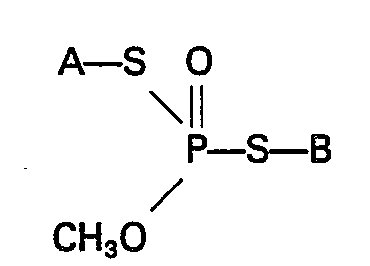
wherein A is sec-butyl or tert-butyl group, and B is iso-propyl, iso-butyl, sec-butyl or tert-butyl group.
wherein A is sec-butyl or tert-butyl group, and B is iso-propyl, iso-butyl, sec-butyl or tert-butyl group.
2. The dithiophosphoric acid ester according to claim 1, wherein both A and B are
tert-butyl group.
3. A method for producing a dithiophosphoric acid ester as defined in claim 1 or claim
2 which comprises reacting a halogenated thiophosphoric acid derivative of the formula,
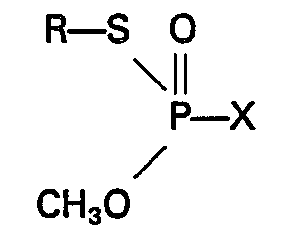
wherein R is iso-propyl, iso-butyl, sec-butyl or tert-butyl group and X is halogen atom, with an alkyl-mercaptan of the formula
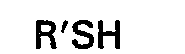
wherein R' is B when R is A and is A when R is B (in which A and B are each as defined above).
wherein R is iso-propyl, iso-butyl, sec-butyl or tert-butyl group and X is halogen atom, with an alkyl-mercaptan of the formula
wherein R' is B when R is A and is A when R is B (in which A and B are each as defined above).
4. A method for producing a dithiophosphoric acid ester as defined in claim 1 or claim
2 which comprises reacting a dithiophosphoric acid salt of the formula.
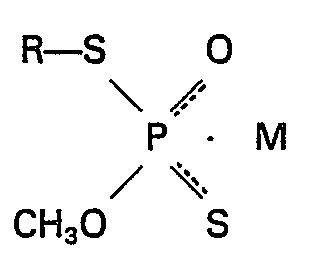
wherein R is iso-propyl, iso-butyl, sec-butyl or tert-butyl group, and M is alkali metal atom, with a halogenated alkyl of the formula,
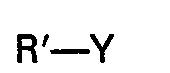
wherein R' is B when R is A and is A when R is B (in which A and B are each as defined above), and Y is halogen atom.
wherein R is iso-propyl, iso-butyl, sec-butyl or tert-butyl group, and M is alkali metal atom, with a halogenated alkyl of the formula,
wherein R' is B when R is A and is A when R is B (in which A and B are each as defined above), and Y is halogen atom.
5. A method for producing a dithiophosphoric acid ester as defined in claim 1 or claim
2 which comprises oxidizing O-methyl, S,S-dialkyl phosphite of the formula,
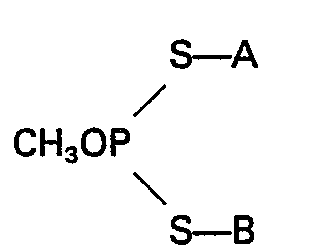
wherein A and B are each as defined above.
wherein A and B are each as defined above.
6. A soil pesticidal composition which comprises an inert carrier and a pesticidally
effective amount of dithiophosphoric acid ester according to Claim 1 or Claim 2 as
an active ingredient.
7. A composition according to claim 6 in the form of an oil spray, emulsifiable concentrate,
wettable powder, granules, dust or aerosol.
8. A method for controlling soil pests which comprises applying to the pest or to
an environment susceptible to pest infestation a pesticidally effective amount of
dithiophosphoric acid ester according to Claim 1 or Claim 2 or of a composition according
to Claim 6 or Claim 7.
9. Use of the dithiophosphoric acid ester according to Claim 1 or Claim 2 or a composition
according to Claim 6 or Claim 7 as a soil pesticide.
1. Dithiophosphorsäureester der Formel:
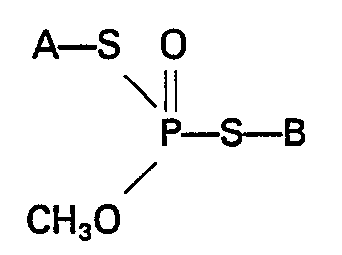
in der A eine sek.-Butyl- oder tert.-Butylgruppe und B eine Isopropyl-, Isobutyl-, sek.-Butyl- oder tert.-Butylgruppe ist.
in der A eine sek.-Butyl- oder tert.-Butylgruppe und B eine Isopropyl-, Isobutyl-, sek.-Butyl- oder tert.-Butylgruppe ist.
2. Dithiophosphorsäureester nach Anspruch 1, in dem beide Reste A und B tert.-Butylgruppen
sind.
3. Verfahren zur Herstellung eines Dithiophosphorsäureesters nach Anspruch 1 oder
Anspruch 2, umfassend die Umsetzung eines halogenierten Thiophosphorsäurederivats
der Formel:
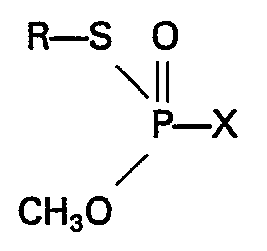
in der R eine Isopropyl-, Isobutyl-, sek.-Butyl- oder tert.-Butylgruppe und X ein Halogenatom ist, mit einem Alkylmercaptan der Formel:
in der R' die Bedeutung B hat, wenn R die Bedeutung A hat und die Bedeutung A, wenn R die Bedeutung B hat (wobei A und B jeweils die vorgenannten Bedeutungen haben).
in der R eine Isopropyl-, Isobutyl-, sek.-Butyl- oder tert.-Butylgruppe und X ein Halogenatom ist, mit einem Alkylmercaptan der Formel:
in der R' die Bedeutung B hat, wenn R die Bedeutung A hat und die Bedeutung A, wenn R die Bedeutung B hat (wobei A und B jeweils die vorgenannten Bedeutungen haben).
4. Verfahren zur Herstellung eines Dithiophosphorsäureesters nach Anspruch 1 oder
Anspruch 2, umfassend die Umsetzung eines Salzes einer Dithiophosphorsäure der Formel:
in der R eine Isopropyl-, Isobutyl-, sek.-Butyl- oder tert.-Butylgruppe und M ein Alkalimetallatom ist, mit einem halogenierten Alkyl der Formel:
in der R' die Bedeutung B hat, wenn R die Bedeutung A hat und die Bedeutung A, wenn R die Bedeutung B hat (wobei A und B jeweils die vorgenannten Bedeutungen haben), und Y ein Halogenatom ist.
in der R eine Isopropyl-, Isobutyl-, sek.-Butyl- oder tert.-Butylgruppe und M ein Alkalimetallatom ist, mit einem halogenierten Alkyl der Formel:
in der R' die Bedeutung B hat, wenn R die Bedeutung A hat und die Bedeutung A, wenn R die Bedeutung B hat (wobei A und B jeweils die vorgenannten Bedeutungen haben), und Y ein Halogenatom ist.
5. Verfahren zur Herstellung eines Dithiophosphorsäureesters nach Anspruch 1 oder
Anspruch 2, umfassend die Oxidierung von 0-Methyl-S,S-dialkylphosphit der Formel:
in der A und B jeweils die vorgenannten Bedeutungen haben.
in der A und B jeweils die vorgenannten Bedeutungen haben.
6. Bodenpestizides Mittel, umfassend einen inerten Träger und eine pestizid wirksame
Menge des Dithiophosphorsäureesters gemäß Anspruch 1 oder Anspruch 2 als wirksamen
Bestandteil.
7. Bodenpestizides Mittel nach Anspruch 6 in Form eines Öl-sprays, emulgierbaren Konzentrats,
benetzbaren Pulvers, Granulats, Staubs oder Aerosols.
8. Verfahren zur Bekämpfung von Bodenschädlingen, umfassend die Behandlung des Schädlungs
oder der für den Schädlingsbefall anfälligen Umgebung mit einer pestizid wirksamen
Menge des Dithiophosphorsäureesters nach Anspruch 1 oder Anspruch 2 oder einem Mittel
nach Anspruch 6 oder Anspruch 7.
9. Verwendung des Dithiophosphorsäureesters nach Anspruch 1 oder Anspruch 2 oder eines
Mittels nach Anspruch 6 oder Anspruch 7 als Bodenpestizid.
1. Ester d'acide dithiophosphorique de formule
dans laquelle A est un groupement sec-butyle ou tert-butyle et B est un groupement iso-propyle, iso-butyle, sec-butyle ou tert-butyle.
dans laquelle A est un groupement sec-butyle ou tert-butyle et B est un groupement iso-propyle, iso-butyle, sec-butyle ou tert-butyle.
2. Ester d'acide dithiophosphorique selon la revendication 1, dans lequel A et B sont
tous les deux un groupement tert-butyle.
3. Procédé de préparation d'un ester d'acide dithiophosphorique selon la revendication
1 ou 2, qui consiste à faire réagir un dérivé halogéné d'acide thiophosphorique de
formule
dans laquelle R est un groupement iso-propyle, iso-butyle, sec-butyle ou tert-butyle et X est un atome d'halogène, avec un alkylmercaptan de formule
dans laquelle R' est B quand R est A et est A quand R est B (A et B étant tels que définis précédemment).
dans laquelle R est un groupement iso-propyle, iso-butyle, sec-butyle ou tert-butyle et X est un atome d'halogène, avec un alkylmercaptan de formule
dans laquelle R' est B quand R est A et est A quand R est B (A et B étant tels que définis précédemment).
4. Procédé de production d'un ester d'acide dithiophosphorique selon la revendication
1 ou 2, qui consiste à faire réagir un sel d'acide dithiophosphorique de formule
dans laquelle R est un groupement iso-propyle, iso-butyle, sec-butyle ou tert-butyle et M est un atome de métal alcalin, avec un halogénure d'alkyle de formule
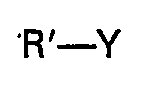
dans laquelle R' est B quand R est A et est A quand R est B (A et B étant tels que définis précédemment), et Y est un atome d'halogène.
dans laquelle R est un groupement iso-propyle, iso-butyle, sec-butyle ou tert-butyle et M est un atome de métal alcalin, avec un halogénure d'alkyle de formule
dans laquelle R' est B quand R est A et est A quand R est B (A et B étant tels que définis précédemment), et Y est un atome d'halogène.
5. Procédé de production d'un ester d'acide dithiophosphorique selon la revendication
1 ou 2, qui consiste à oxyder un phosphite de O-méthyle et de S,S-dialkyle de formule

dans laquelle A et B sont tels que définis precédemment.
dans laquelle A et B sont tels que définis precédemment.
6. Composition pesticide pour sol qui comprend un support inerte et une quantité efficace
sur le plan pesticide d'un ester d'acide dithiophosphorique selon la revendication
1 ou 2 en tant qu'ingredient actif.
7. Composition selon la revendication 6 sous forme d'une pulvérisation huileuse, un
concentre emulsifiable, une poudre mouillable, des granulés, une poudre fine ou un
aérosol.
8. Procédé de lutte contre les parasites du sol, qui consiste à appliquer au parasité
ou à un milieu susceptible d'une infestation parasitaire, une quantité efficace sur
le plan pesticide d'un ester d'acide dithiophosphorique selon la revendication 1 ou
2 ou d'une composition selon la revendication 6 ou 7.
9. Utilisation de l'ester d'acide dithiophosphorique selon la revendication 1 ou 2
ou d'une composition selon la revendication 6 ou 7 comme pesticide du sol.