| (19) |
 |
|
(11) |
EP 0 140 461 B1 |
| (12) |
EUROPEAN PATENT SPECIFICATION |
| (45) |
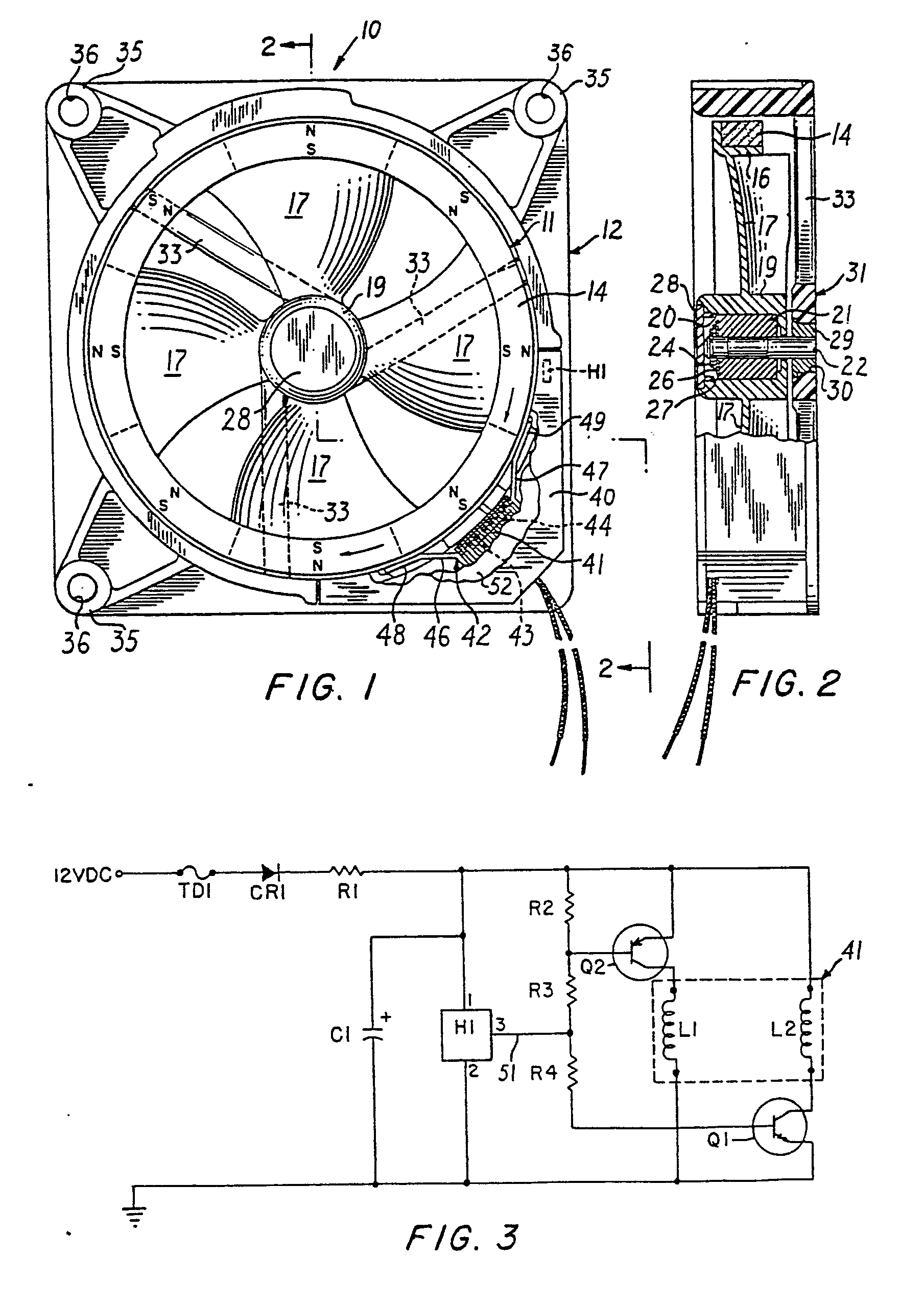
Mention of the grant of the patent: |
|
31.05.1989 Bulletin 1989/22 |
| (22) |
Date of filing: 10.02.1984 |
|
|
| (54) |
Simple brushless dc fan motor with reversing field
Einfacher bürstenloser Gleichstromlüftermotor mit Kommutierungsfeld
Moteur de ventilateur simple à courant continu, sans balai, avec champ de commutation
|
| (84) |
Designated Contracting States: |
|
DE FR GB |
| (30) |
Priority: |
04.08.1983 US 520154
|
| (43) |
Date of publication of application: |
|
08.05.1985 Bulletin 1985/19 |
| (73) |
Proprietor: Comair Rotron Inc |
|
Saugerties
New York 12477 (US) |
|
| (72) |
Inventors: |
|
- Brown, Fred A.
Woodstock
New York 12498 (US)
- Grouse, Alan F.
Woodstock
New York 12498 (US)
|
| (74) |
Representative: Cline, Roger Ledlie et al |
|
EDWARD EVANS & CO.
Chancery House
53-64 Chancery Lane
London WC2A 1SD
London WC2A 1SD (GB) |
| (56) |
References cited: :
DE-A- 2 031 141
|
FR-A- 2 478 896
|
|
| |
|
|
- ASR-DIGEST FÜR ANGEWANDTE ANTRIEBSTECHNIK, No. 1-2, 1977, St. Georgen; R. MÜLLER "Zweipulsige
kollektorlose Gleichstrommotoren", pages 27-31
- J.E.E. JOURNAL OF ELECTRONIC ENGINEERING, vol. 19, no. 192, December 1982, Tokyo,
Japan; R. MINEGISHI "Trends of DC brushless mini-motor fans", pages 53-56
|
|
| |
|
| Note: Within nine months from the publication of the mention of the grant of the European
patent, any person may give notice to the European Patent Office of opposition to
the European patent
granted. Notice of opposition shall be filed in a written reasoned statement. It shall
not be deemed to
have been filed until the opposition fee has been paid. (Art. 99(1) European Patent
Convention).
|
[0001] This invention relates to brushless DC motors electronically commutated and more
particularly to brushless DC fan motors that are of simple construction, inexpensive
to manufacture, and reliable.
[0002] A typical goal in the manufacture of fans is a motor that is very simple and consequently
has a low manufacturing cost. In AC motors for fans, the side armature AC motor comes
closest to achieving these goals. However, recently, DC motors for fans have become
more and more attractive, particularly for fans used to cool electronics where DC
power is available.
[0003] Brushless DC motors using Hall effect devices to sense the commutation points as
the rotor rotates are well known in the art. One or more stator coils are repeatedly
energized to have their energization reversed to effect relocation of the electromagnetic
field produced by poles of the stator core. A permanent magnet rotor is continuously
attracted to the new electromagnetic pole locations. For commutation, one or more
Hall effect devices sense the location of the poles of the rotor permanent magnet
to control the energization of the stator winding or windings, or a Hall device detects
the position of one or more commutation magnets mounted to rotate with the rotor and
provided especially to indicate, by changing the state of the Hall device, the commutation
points as the rotor turns.
[0004] Many brushless DC motors have been complex in both their structure and their commutation
circuitry. Where simple, low cost and reliable fan motors have been needed these brushless
DC motors, which might more appropriately have been used for, say, precise disc or
tape drives, have been too expensive for the simple purpose of fan rotation.
[0005] A DC motor is disclosed in JEE Journal of Electronic Engineering Volume 19 No. 192,
December 1982, Tokyo, Japan, in the article "Trends of DC Brushless Mini Motor Fans"
by Minegishi et pages 53-56. This article discloses a DC motor as set out in the introductory
portion of claim 1 of the present invention. US-A-1996195 discloses a fan structure
similar to the one described below which the motor of the present invention may drive.
[0006] According to the invention, the permanent magnet of the rotor is annular and constitutes
the rim of the rotor which is annular, said magnetic segments being oppositely polarized
in the radial outward direction wherein the rotor is free of encircling stator iron
in that the electromagnetic structure is located around a minor portion of the periphery
of the rotor, said coil means comprising a core having two electrically independent
windings wound thereon, said electromagnet structure further including a flux path
having a pair of arms in magnetic flux conducting relation with the windings and core
and extending to two pole pieces spaced apart along the circumference of the annular
magnet for establishing said magnetic fields of opposite polarities therein.
[0007] When the invention is applied to a fan, fan blades are located within and affixed
to the annular magnet of the motor described above. In one embodiment, the fan blades
are mounted for rotation at a central hub, the stator includes a housing and support
structure extending from proximate the magnet to the hub and supporting the rotor
hub for rotation, the housing encircles the annular magnet and the fan blades, the
support structure includes mounting means formed in the housing about the periphery
of the motor, and a small compartment in the housing houses the stator coil or windings,
the electromagnet structure, and all circuit elements of the relatively simple switching
circuitry, including the commutation-effecting Hall device. However, by virtue of
the features of the invention a significantly quieter fan results and still at low
cost.
[0008] The above and further features of the invention will be better understood with reference
to the attached drawings and the following detailed description of a preferred embodiment.
Figure 1 is a top plan view of a fan and motor according to the invention, and shows
the rotor's annular permanent magnet magnetized in segments about its periphery and
an external coil structure and electromagnet stator structure;
Figure 2 is a side elevational view of the fan and motor of Figure 1, partially in
section, along the line 2-2 of Figure 1, and illustrates the mounting of the rotor
and fan blades on a hub for rotation about a central support section of the stator
coil structure; and
Figure 3 is a schematic diagram of an energizing circuit for the stator coil structure.
[0009] As shown in Figure 1, a fan and motor combination 10 according to the invention includes
a rotor 11 and a stator 12. The rotor 11 has an annular permanent magnet 14, magnetized
in segments about its circumference. As illustrated, each succeeding segment about
the circumference is oppositely magnetized in the radial direction. The magnet 14
is secured on a ring 16 having an L-shaped cross-section as shown in Figure 2. Fan
blades 17 extend radially inwardly from the ring 16 to a central hub 19.
[0010] As shown in Figure 2, the hub 19 defines a bore 20 which receives a sleeve bearing
21 which in turn receives a shaft 22. The shaft 22 is retained in bearing 21 by means
of retaining C-ring 24 and thrust members 26 and 27. An end cap 28 covers the left
end of the shaft 22. The right end of the shaft 22 is securely mounted in a mounting
bushing 29, which is itself securely received in a mounting bore 30 of a stator housing
31. The particular mounting employed to locate the rotor assembly and fan blades rotatably
within the stator housing structure is exemplary only and should not be construed
as essential to the invention.
[0011] Three strut members 33 connect to and radiate outwardly from the center of stator
housing 31. Mounting bosses 35 (Figure 1) define holes 36 about the periphery of the
housing, enabling the entire motor and fan to be mounted by, e.g., bolts passed through
the holes 36.
[0012] As seen at the bottom of Figure 1, at one of its corners the stator housing 31 forms
a compartment 40 housing a stator coil 41, electromagnet structure 42, a Hall effect
device H1, and the remaining circuit elements of the commutation circuit, not shown
in Figure 1. The stator coil 41 comprises two electrically independent windings L1
and L2 concentrically wound on a bobbin 43 in bifilar fashion. A core 44 of magnetic
material extends through the bobbin from end to end and forms a part of the electromagnet
structure 42. Alternatively, the bobbin can be a part of the electromagnet structure.
The electromagnet structure also includes a pair of arms or shoes 46 and 47 secured
in flux conducting relation to the magnetic core 44 and terminating in respective
pole pieces 48 and 49 closely proximate the outer surface of the permanent magnet
14. As can be seen in Figure 1, the spacing of the pole pieces 48 and 49 is such that,
with the magnet located as shown, energization of the coil 41 to make pole piece 48
north and pole piece 49 south will effect clockwise rotation of the rotor structure
and the fan blades.
[0013] As start-up, the coil 41 is energized to apply, via the pole pieces 48 and 49, starting
torque to the annular magnet. The Hall effect device H1 controls energization of the
coil 41 such that the respective coil windings L1 and L2 are alternately energized
to attract approaching poles of the annular rotor magnet. When the Hall effect device
H1 detects changing of the magnetic field produced by the rotor 11 due to the arrival
of a new, oppositely magnetically polarized segment into proximity with the device
H1, the magnetic field of the electromagnet structure 42 is reversed by means of the
circuit of Figure 3 to attract the poles of the annular rotor magnet next approaching.
This sequence repeats itself until the rotor comes to an equilibrium speed where the
aerodynamic load balances the motor power.
[0014] No detent magnet is necessary to draw the rotor away from relatively large angular
ranges of positions of the rotor where the stator coil is not energized, as in the
motor of the above-referenced earlier application. Nevertheless, it may be desirable
to prevent cogging, the condition in which, at start up, the rotor is in a position
in which forces thereon are in equilibrium and starting will not occur. To this end,
a piece of magnetic metal (not shown), unmagnetized steel for example, may be located
on the stator proximate the path of travel of the rotor magnet, and at a position
easily empirically determined, to attract the rotor to an at-rest position angularly
removed from the motor-cogged position.
[0015] This operation allows use of a simplified commutation circuit. In Figure 3, the Hall
device H1, which can be a Hall switch, for example, is seen controlling transistors
Q1 and Q2, each of whose collector and emitter circuits is in series with a differnet
one of coil windings L1 and L2. One such Hall switch which may be used is the Hall
effect digital switch UGN-3013T of Spraque Electric Co., Worcester, Mass. Exposure
of the Hall effect device H1 to a magnetic field of one direction of polarity opens
(breaks) a conduction path from a line 51 (pin 3) to ground (pin 2), while exposure
of the device H1 to an opposite polarity closes (makes) a conduction path from line
51 to ground.
[0016] When the path is open, there is very little voltage drop across resistors R2, R3
and R4, and the Q-1 base-emitter voltage is sufficient to turn on Q1, which is an
NPN Darlington pair, commonly housed and sold as a single component. The Q1 Darlington
pair has a high gain so that the small base current through R2, R3 and R4 i adequate
to turn on Q1 and energize the winding L2. When the path through H1 is open, the Q2
base-emitter voltage is insufficient to turn on Q2, a PNP power transistor that requires
a greater base drive to conduct. So with Q2 off, no current flows through winding
L1. When the Hall effect device H1 experiences a magnetic field of opposite direction
or polarity, connecting line 51 to ground, a voltage drop nearly equal to the full
input voltage, for example about 12 volts, appears across resistors R2 and R3, creating
a Q2 base-emitter voltage sufficient to turn on Q2. Conduction by Q2 causes current
to flow through winding L1. However, the Q1 base-emitter voltage is insufficient to
turn Q1 on, so that no current flows through winding L2. Windings L1 and L2 are thus
alternately energized and deenergized in response to detection of different magnetic
fields by Hall device H1. Instead of providing two separate coil windings L1 and L2,
only one winding may be provided along with circuit means to alternately reverse the
current in the winding.
[0017] The remainder of the Figure 3 circuit comprises capacitor C1, which damps transients
that arise from the abrupt switching of the coil 41, a current limiting resistor R1,
appropriate protective fusing such as fuse TD1, and diode CR1, which prevents current
reversals back through the input leads to the supply. In a preferred embodiment, the
circuit elements are mounted on a printed circuit board 52 (Figure 1) of essentially
the same shape as the cavity that forms the compartment 40 in Figure 1. The circuit
board is supported above the cavity with the circuit elements projecting downward
and housed within the cavity so that the fan and motor have the compact shape seen
in Figure 1 and the narrow profile shown in Figure 2.
[0018] From the foregoing it will be seen that a novel arrangement of a motor and fan has
been provided. It will be readily apparent to those skilled in the art that many variations
in the foregoing exemplary embodiment can be made without departing from the spirit
and scope of the invention, as defined in the appended claims.
1. A DC motor comprising a rotor (11) with a permanent magnet (14) defining magnetic
segments oppositely polarized around its periphery, a stator (12) having an electro-magnetic
structure outside said permanent magnet, said structure including coil means (44,
L1, L2) for establishing magnetic fields of opposite polarities to attract the oppositely
polarized segments of the per- manant magnet towards the coil means (44, L1, L2) and
position detecting means (H1) for detecting the position of the rotor relative to
the stator and for commutating electrical current to the coil means repeatedly to
produce said opposite polarity fields and attract said segments in dependence on said
relative positioning, characterised in that said permanent magnet (14) is annular
and constitutes the rim of the rotor which is annular said magnetic segments being
oppositely polarized in the radial outward direction wherein the rotor (11) is free
of encircling stator iron in that the electromagnetic structure is located around
a minor portion of the periphery of the rotor, said coil means comprising a core (44)
having two electrically independent windings (L1, L2) wound thereon, said electromagnet
structure further including a flux path having a pair of arms (46), (47) in magnetic
flux conducting relation with the windings (L1, L2) and core (44) and extending to
two pole pieces (48, 49) spaced apart along the circumference of the annular magnet
(14) for establishing said magnetic fields of opposite polarities therein.
2. A motor as claimed in claim 1, further including commutation circuit means (R2-R4,
Q1, Q2) connected to said position detecting means (H1) and to said windings (L1,
L2) for reversing the field polarity at the approach of each oppositely polarized
magnet segment to the position detection means, whereby the windings (L1, L2) are
energized to produce the alternating field throughout substantially all of the 360°
of rotor movement.
3. A motor as claimed in claim 1 and claim 2 wherein the pole pieces (48, 49) are
spaced apart by such a distance as to attract respectively a separate magnetized segment
of the annular magnet (14) when a winding (L1, L2) is energized.
4. A motor as claimed in claim 3, wherein the pole pieces (48, 49) are located to
attract the adjacent, oppositely polarized segments when a winding (L1, L2) is energized.
5. A motor as claimed in any one of claims 1 to 4, wherein the two electrically independent
coil windings (L1, L2) produce magnetic fields of opposite polarities when energized,
the detecting means (H1) comprises means for commutating electrical current to a different
coil winding to produce said opposite polarity fields and attract said segments in
dependence on said relative positioning.
6. A motor as claimed in claim 5, wherein the means for commutating current includes
at least a first transistor means (Q2) connected in current conducting relation to
a first (L1) of suid windings and at least a second transistor means (Q1) in current
conducting relation to the second (L2) of said windings, resistance means (R2-R4)
for establishing biases to the first and second transistor means and said position
detecting means comrpising a Hall device (H1) responsive to a magnetic field of the
magnetic segments of one polarity for providing bias from the resistance means to
the first transistor means (Q2) to cause conduction therein while depriving the second
transistor means (Q1) of bias to prevent conduction therein, and responsive to the
absence of said field for providing bias from the resistance means (R2-R4) to the
second transistor means (Q1) to cause conduction therein while depriving the first
transistor means (Q2) of bias to prevent conduction thereof.
7. A motor as claimed in claim 6, wherein each transistor means is connected in series
with its associated winding across motor input voltage connections, the resistance
means comprises resistors (R2-R4) in series and connected with at least one of the
motor input voltage connections, and connected with terminals of the transistors to
bias the first or second transistor means into conduction upon establishment of appropriate
bias voltage across the resistors, and the Hall device comprises a Hall switch (H1)
connected between a junction of the resistors (R3, R4) and one of the motor input
voltage connections, said Hall switch (H1) being connected with the resistors to bypass
at least one resistor in the presence of said field of magnetic segments of one polarity
and to thereby alter the bias provided by the resistors to the transistor means.
8. A motor as claimed in claim 7, wherein the first transistor means (Q2) is a PNP
transistor connected between a high side of the motor input connections and the first
winding (L1), and the second transistor means (Q1) is an NPN Darlington transistor
pair connected between a low side of the motor input connections and the second winding
(L2), both of said transistor means having their bases connected to the resistance
means for control by the Hall switch (H1).
9. A motor as claimed in claim 7, wherein the first transistor means is a power transistor
means requiring a relatively high drive to cause conduction therein and the second
transistor means is a high gain transistor means requiring a relative low drive to
cause conduction therein, said resistors in series providing the relatively low drive
to the second transistor means when th Hall switch is open and the Hall switch being
connected to place a relatively large voltage drop across at least a portion of the
resistors in series when closed, thereby to substantially short the bias to the high
gain transistor means and supply the relatively high bias to the power transistor
means.
10. A motor as claimed in any one of claims 1 to 9, wherein the two coils are concentrically
wound on said core.
11. A motor as claimed in any one of claims 1 to 10, wherein the stator includes a
housing defining a compartment at one location on the periphery of the path of rotation
of the annular magnet, and wherein said coil means is located in said compartment.
12. A motor as claimed in claim 11, wherein said coil means has two windings (L1,
L2), wherein said compartment 40 houses the position detecting means (H1) for detecting
and commutating, and wherein the position detecting and commutating means includes
a Hall effect device (H1) located proximate the annular magnet (14) and switching
circuit means for energizing one coil winding (L1) when magnetized segments of a first
plarity are adjacent the Hall effect device, and for energizing the other coil winding
(L2) when magnetized segments having a second polarity opposite said first polarity
are adjacent the Hall effect device.
13. A motor as claimed in claim 11, wherein the stator housing encircles the annular
magnet (14).
14. A fan having a motor as claimed in any one of claims 1 to 13, the fan having blades
(17) located within the annular magnet (14).
15. A fan as claimed in claim 14, wherein the fan blades (17) extend from proximate
the inside surface of the annular magnet (14) to a central hub (19), said stator (12)
having a central member supporting, for rotation, the hub (19), the blades (17) and
the rotor members, including the annular magnet (14), the stator (12) further including
struts extending outwardly from the central stator member to a housing encircling
the fan blades (17), said housing supporting the coil means (L1, L2) proximate the
annular rotor magnet (14) and adjacent the outer surface thereon.
1. Gleichstrommotor, der folgendes umfasst: einen Rotor (11) mit einem Permanentmagneten
(14), der auf seiner Peripherie entgegengesetzt polarisierte Magnetsegmente definiert,
einen Stator (12), der eine elektromagnetische Struktur ausserhalb des besagten Permanentmagneten
aufweist, wobei besagte Struktur Spulmittel (44, L1, L2) zum Erstellen magnetischer
Felde mit entgegengesetzten Polaritäten umfasst, die dazu vorgesehen sind, die entgegengesetzt
polarisierten Magnetsegmente des Permanentmagnetes in Richtung auf die Spulmittel
(44, L1, L2) anzuziehen und Stellungserfassungsmittel (H1) zur Erfassung der Stellung
des Rotors in bezug auf den Stator und zur wiederholten Kommutierung von elektrischem
Strom auf die Spulmittel, um besagte entgegengesetzt polarisierte Felder zu bilden
und besagte Segmente in Abhängigkeit von besagter, relativer Stellung anzuziehen,
dadurch gekennzeichnet, dass besagter Permanentmagnet (14) ringförmig ist und die
Randzone des ringförmigen Rotors bildet, wobei besagte, magnetische Segmente in der
radialen, äusseren Richtung entgegengesetzt polarisiert sind, wobei der Rotor (11)
frei von umrandendem Statoreisen, indem sich die elektromagnetische Struktur auf einer
Seite des Rotors befindet, wobei besagte Spule einen Spulenkern (44) umfasst, der
zwei elektronisch unabhängige Windungen (L1, L2) darauf aufgewickelt aufweist, wobei
besagte elektromagnetische Struktur des weiteren einen Kraftlinienweg umfasst, der
ein Paar Arme (46), (47) aufweist, die in magnetischer Kraftflussverbindung mit den
Windungen (L1, L2) und dem Spulenkern (44) stehen und sich auf zwei Polteile (48,
49) hin erstrecken, die voneinander getrennt entlang des Umfangs des Ringmagneten
(14) angebracht sind, um besagte, magnetischen Felder mit entgegengesetzten Polaritäten
darin zu bilden.
2. Motor nach Anspruch 1, der das weiteren Kommutierungskreismittel (R2-R4, Q1, Q2)
umfasst, die mit besagtem Stellungserfassungsmittel (H1) und besagter Windungen (L1,
L2) verbunden sind, um die Feldpolarität beim Nähern jedes entgegengesetzt polarisierten
Magnetsegmentes auf das Stellungserfassungsmittel hin umkehrt wobei der Windunges
(L1, L2) Energie zugeführt wird um den wechselnden Feld durch im wesentlichen alle
360°-Bewegungen des Rotors herstellen zu können.
3. Motor nach Anspruche 1 und 2, bei dem die Polteile (48,49) in einem solchen Abstand
voneinander entfernt sind, dass sie entsprechend ein getrenntes, magnetisiertes Segment
des Ringmagnetes (14) anziehen können, wenn ein windung (L1 oder L2) Energie zugeführt
wird.
4. Motor nach Anspruch 3, bei dem die Polstücke (48, 49) so angebracht sind, dass
sie die naheliegenden, entgegengesetzt polarisierten Segmente anziehen, wenn ein windung
(L1 oder L2) Energie zugeführt wird.
5. Motor nach einem der Ansprüche 1 bis 4, bei dem die zwei elektrisch unabhängigen
Spulenwindungen (L1, L2) magnetische Felder mit entgegengesetzten Polaritäten herstellen,
wenn ihnen Energie zugeführt wird, wobei das Erfassungsmittel (H1) Mittel zum Kommutieren
von elektrischem Strom auf eine andere Spulenwindung umfasst, um besagte entgegengesetzt
polarisierte Felder zu bilden und besagte Segmente abhängig von besagter, relativer
Stellung anzuziehen.
6. Motor nach Anspruch 5, bei dem das Mittel zum Kommutieren von Strom wenigstens
ein erstes Transistormittel (Q2) umfasst, das in Stromleitungsverbindung mit einer
erste (L1) der besagten Windungen steht und wenigstens ein zweites Transistormittel
(Q1), das in Stromleitungsverbindungen mit dem zweiten (L2) der besagten Windungen
steht, wobei Widerstandsmittel (R2-R4) zum Erstellen der Vorspannung des ersten und
zweiten Transistormittels und besagtem Stellungserfassungsmittels eine Hallsche-Vorrichtung
(H1) umfasst, die auf das magnetische Feld der magnetischen Segmente einer Polarität
reagiert, um Vorspannung vom Widerstandsmittel zum ersten Transistormittel (Q2) vorzusehen,
um Leitung darin zu verursachen, während dem zweiten Transistormittel (Q1) Vorspannung
vorenthalten wird, um Leitung dorthin zu verhindern, und als Reaktion auf das Fehlen
des besagten Feldes zum Erstellen der Vorspannung von den Widerstandsmitteln (R2-R4)
zum zweiten Transistormittel (Q1), um Leitung darin zu verursachen, während dem ersten
Transistormittel (Q2) Vorspannung vorenthalten wird, um Leitung darin zu verhindern.
7. Motor nach Anspruch 6, bei dem jedes Transistormittel über Motoreingangsspannungsverbindungen
mit seiner dazugehörigen Windung in Serie geschaltet ist, wobei das Widerstandsmittel
Resistoren (R2-R4) in Serien umfasst und mit mindestens einem der Motoreingangsspannungsverbindung
verbunden ist, und mit den Klemmen der Transistoren verbunden ist, um das erste oder
zweite Transistormittel in Leitung vorzumagnetisieren, um angebrachte Vorspannung
über die Resistoren herzustellen, wobei die Hallsche-Vorrichtung einen Hallschen-Schalter
(H1) umfasst, der zwischen der Verbindung der Resistoren (R3, R4) und einer der Motoreingangsspannungsverbindungen
angebracht ist, wobei besagter Hall-Schalter (H1) mit den Resistoren verbunden ist,
um wenigstens einen der Resistoren in Gegenwart des besagten Feldes von magnetischen
Segmenten einer Polarität zu überbrücken und dadurch die Vorspannung von den Resistoren
zu den Transistormitteln zu verändern.
8. Motor nach Anspruch 7, bei dem das erste Transistormittel (Q2)-eine PNP-Transistor
ist, der zwischen einer hohen Seite der Motoreingangsverbindung und der ersten Windung
(L1) befestigt ist, wobei das zweite Transistormittel (Q1) ein NPN-Darlington-Transistorpaar
ist, das zwischen einer niederen Seite der Motoreingangsverbindungen und der zweiten
Windung (L2) befestigt ist, wobei die Böden der beiden, besagten Transistormittel
mit den Widerstandsmittel verbunden sind, um durch den Hall-Schalter (H1) gesteuert
zu werden.
9. Motor nach Anspruch 7, bei dem das erste Transistormittel ein Krafttransistormittel
ist, das einen relativ hohen Antrieb benötigt, um Leitung zu verursachen und das zweite
Transistormittel ein Transistormittel mit hoher Verstärkung ist, das einen relativ
niederen Antrieb benötigt, um Leitung dorthin zu verursachen, wobei besagte Resistoren
in Serie den relativ niederen Antrieb zum zweiten Transistormittel erstellen, wenn
der Hall-Schalter offen ist, und der Hall-Schalter ist so angeschlossen, dass er einen
relativ hohen Spannungsabfall über mindestens einen Teil der Resistoren in Serie abgibt,
wenn er geschlossen ist, wobei die Vorspannung zum Transistormittel mit hoher Verstärkung
im wesentlichen kurzgeschlossen wird, und so das Krafttransistormittel mit relativ
hoher Vorspannung vorsorgt wird.
10. Motor nach einem der Ansprüche 1 bis 9, bei dem zwei Spullen konzentrisch um besagten
Spulenkern gewunden sind.
11. Motor nach einem der Ansprüche 1 bis 10, bei dem der Stator ein Gehäuse umfasst,
dass an einer Stelle auf dem Umkreis des Rotationsweges des Ringmagnetes ein Fach
definiert, und bei dem besagte Spule in besagtem Fach untergebracht ist.
12. Motor nach Anspruch 11, bei dem besagte Spule zwei Windungen (L1, L2) aufweist,
wobei in besagtem Fach (40) das Stellungserfassungsmittel (H1) zum Erfassen und Kommutieren
untergebracht ist, und bei dem das Stellungserfassungs-und Kommutierungsmittel eine
Hall-Effekt-Vorrichtung (H1) umfasst, die in der Nähe des Ringmagneten (14) angebracht
ist und Schaltkreismittel, um die Spulenwindung (L1) Energie zuzuführen, wenn sich
magnetisierte Segmente einer ersten Polarität in der Nähe der Hall-Effekt-Vorrichtung
befinden, und um der anderen Spulenwindung (L2) Energie zuzuführen, wenn sich magnetisierte
Segmente mit einer zweiten, der ersten entgegengesetzten Polarität in der Nähe der
Hall-Effekt-Vorrichtung befinden.
13. Motor nach Anspruch 11, bei dem das Statorgehäuse den Ringmagnet (14) umringt.
14. Ein Lüfter mit einem Motor nach einem der Ansprüche 1 bis 13, wobei der Lüfter
Flügel (17) aufweist, die innerhalb des Ringmagnets (14) angebracht sind.
15. Lüfter nach Anspruch 14, bei dem sich die Lüfterflügel (17) von in der Nähe der
Innenfläche des Ringmagnets (14) bis zu einem zentralen Nabe (19) erstrecken, wobei
besagter Stator (12) ein zentrales Glied zur Stützung des Wickelkerns (19) bei der
Rotation, Flügel (17) und die Rotorglieder einschliesslich den Ringmagnet (14) umfasst,
wobei der Stator (12) des weiteren ein Gestänge umfasst, das sich nach aussen vom
zentralen Statorglied zu einem Gehäuse, das die Lüfterflügel (17) umgibt, erstreckt,
wobei besagtes Gehäuse die Spule (L1, L2) in der Nähe des ringförmigen Rotormagnetes
(14) stütz und in der Nähe von dessen Aussenfläche stützt.
1. Moteur à courant continu comprenant un rotor (11) à aimant permanent (14) définissant
à sa périphérie des segments magnétiques de polarités opposées, un stator (12) ayant
une structure électromagnétique à l'extérieur dudit aimant permanent, ladite structure
comportant des moyens à bobine (44, L1, L2) pour créer des champs magnétiques de polarité
opposées pour attirer les segments de polarités opposés de l'aimant permanent vers
lesdits moyens à bobine (44, L1, L2) et des moyens de détection de position (H1) pour
détecter la position du rotor par rapport au stator et pour commuter de manière répétitive
un courant électrique dans les moyens à bobine pour produire lesdits champs de polarités
opposées et attirer lesdits segments en fonction dudit positionnement relatif, caractérisé
en ce que l'aimant permanent (14) est annulaire et forme le bord du rotor qui est
aussi annulaire, lesdits segments aimantés étant polarisés dans des sens opposés dans
la direction radiale sortante dans laquelle le rotor n'entoure pas le fer ou noyau
du stator, et en ce que la structure électromagnétique est située d'un côté du rotor,
lesdits moyens à bobine comprenant un noyau (14) sur lequel sont bobinés deux enroulements
(L1, L2) électriquement indépendants, ladite structure électromagnétique comportant
en outre un chemin de flux ayant une paire de bras (46, 47) reliée aux enroulements
(L1, L2) et au noyau (44) de manière à conduire le flux magnétique et s'épanouissant
en deux pièces polaires (48, 49) éloignées l'une de l'autre le long de la circonférence
de l'aimant annulaire (14) pour y établir lesdits champs magnétiques de polarités
opposées.
2. Moteur selon la revendication 1, comprenant et outre des moyens de circuit de commutation
(R2-R4, Q1, Q2) relié auxdits moyens de détection de position (H1) et auxdits enroulements
(L1, L2) pour inverser la polarité du champ lorsque chaque segment d'aimant de polarité
opposée s'approche des moyens de détection de position, les enroulements (L1, L2)
étant ainsi excités pour produire le champ alternatif pendant sensiblement tous les
360°C du mouvement du rotor.
3. Moteur selon les revendications 1 et 2 dans lequel les pièces polaires (48, 49)
sont espacées d'une distance telle qu'elles attirent chacune un segment aimanté différent
de l'aimant annulaire (14) lorsque la bobine (L1 en L2) est excitée.
4. Moteur selon la revendication 3, dans lequel les pièces polaires (48, 49) sont
disposées pour attirer des segments de polarité opposée adjacents lorsque la bobine
(L1 en L2) est excitée.
5. Moteur selon l'une quelconque des revendications 1 à 4, dans lequel les deux enroulements
(L1, L2) électriquement indépendants produisent des champs magnétiques de polarités
opposées lorsqu'ils sont excités, les moyens de détection (H1) comprenant des moyens
pour commuter un courant électrique vers un enroulement différent pour produire lesdits
champs de polarités opposées et attirer lesdits segments en fonction dudit positionnement
relatif.
6. Moteur selon la revendication 5, dans lequel les moyens pour commuter un courant
comportent au moins un premier moyen à transistor (02) relié électriquement à un premier
desdits enroulements (L1) et au moins un second moyen à transistor (Q1) relié électriquement
au second desdits enroulements (L2), des moyens à résistances (R2-R4) pour polariser
lesdits premier et second moyens à transistor, et lesdits moyens de détection de position
comprenant un dispositif Hall (H1) répondant à un champ magnétique d'un segment aimanté
ayant une première polarité pour fournir une polarisation des moyens à résistances
au premier moyen à transistor (Q2) pour le rendre conducteur et priver de polarisation
le second moyen à transistor (Q1 ) pour empêcher sa conduction, et répondant à une
absence dudit champ pour fournir une polarisation des moyens à résistances (R2-R4)
au second moyen à transistor (Q1) pour le rendre conducteur et priver de polarisation
le premier moyen à transistor (Q2) pour empêcher sa conduction.
7. Moteur selon la revendication 6, dans lequel chaque moyen à transistor et son enroulement
associé sont reliés en série et disposés entre les bornes de tension d'entrée du moteur,
les moyens à résistances (R2-R4) sont en série et sont reliées à au moins l'une des
bornes de tension d'entrée du moteur, et sont reliées aux bornes des transistors pour
polariser le premier ou le second moyen à transistor afin de le rendre conducteur
en établissant une tension de polarisation adéquate aux bornes des moyens à résistances,
et le dispositif Hall comprend un commutateur Hall (H1) connecté entre un point commun
des moyens à résistances (R3, R4) et l'une des bornes de tension d'entrée du moteur,
ledit commutateur Hall (H1) étant relié aux moyens à résistances pour mettre hors
circuit au moins une résistance en présence dudit champ produit par des segments aimantés
ayant une première polarité et modifier ainsi la polarisation fournie par les résistances
aux moyens à transistors.
8. Moteur selon la revendication 7, dans lequel le premier moyen à transistor (Q2)
est un transistor PNP relié entre la borne de tension haute du moteur st le premier
enroulement (L1 et le second moyen à transistor (Q1) est une paire de transistors
NPN montés en Darlington reliée entre la borne de tension basse du moteur et le second
enroulement (L2), les bases des deux moyens à transistor étant reliées aux moyens
à résistances pour être commandées par le commutateur Hall (H1).
9. Moteur selon la revendication 7, dans lequel le premier moyen à transistor est
un transistor de puissance qui nécessite une tension de commande relativement élevée
pour être rendu conducteur et le second moyen à transistor est un transistor à gain
élevé qui nécessite une tension de commande relativement faible pour être rendu conducteur,
lesdites résistances en série délivrant la tension de commande relativement basse
au second moyen à transistor lorsque le commutateur Hall est ouvert et le commutateur
Hall étant connecté pour engendrer une chute de tension relativement importante aux
bornes d'au moins une partie des résistances en série lorsqu'il est fermé, pour pratiquement
éliminer la tension de polarisation du transistor à gain élevé et délivrer la tension
de polarisation relativement élevée au moyen à transistor de puissance.
10. Moteur selon l'une quelconque des revendications 1 à 9, dans lequel les deux enroulements
sont bobinés concentriquement sur ledit noyau.
11. Moteur selon l'une quelconque des revendications 1 à 10, dans lequel le stator
comporte un boîtier définissant un compartiment à un endroit situé à la périphérie
de la zone de rotation de l'aimant annulaire, et dans lequel la bobine est disposée
dans ce compartiment.
12. Moteur selon la revendication 11, dans lequel lesdits moyens à bobine ont deux
enroulements (L1, L2), le compartiment (40) contient les moyens de détection de position
(H1) ayant pour fonctions de détecter et commuter, et dans lequel des moyens de détection
de position et de commutation comporte un dispositif à effet Hall (H1) situé à proximité
de l'aimant annulaire (14) et des moyens de commutation pour exciter un enroulement
(L1) lorsque des segments aimantés selon une première polarité sont adjacents au dispositif
à effet Hall, et pour exciter l'autre enroulement lorsque des segments aimantés selon
une seconde polarité, opposée à la première polarité, sont adjacents au dispositif
à effet Hall.
13. Moteur selon la revendication 11, dans lequel le boîtier du stator entoure l'aimant
annulaire (14).
14. Ventilateur comportant un moteur selon l'une quelconque des revendications 1 à
13, et ayant des pales (17) disposées à l'intérieur de l'aimant annulaire (14).
15. Ventilateur selon la revendication 14, dans lequel les pales (17) du ventilateur
s'étendent depuis une position proche de la surface intérieure de l'aimant annulaire
(14) jusqu'à un moyeu central (19), ledit stator (12) comprenant un membre central
supportant en rotation le moyau (19), les pales (17) et les membres du rotor y compris
l'aimant annulaire (14), le stator (12) comportant en outre des cales s'étendant du
membre central du stator jusqu'à un boîtier entourant les pales (17) du ventilateur,
ledit boîtier supportant la bobine (L1, L2) à proximité de l'aimant annulaire du rotor
(14) et du côté de sa surface externe.