| (19) |
 |
|
(11) |
EP 0 142 541 B1 |
| (12) |
EUROPEAN PATENT SPECIFICATION |
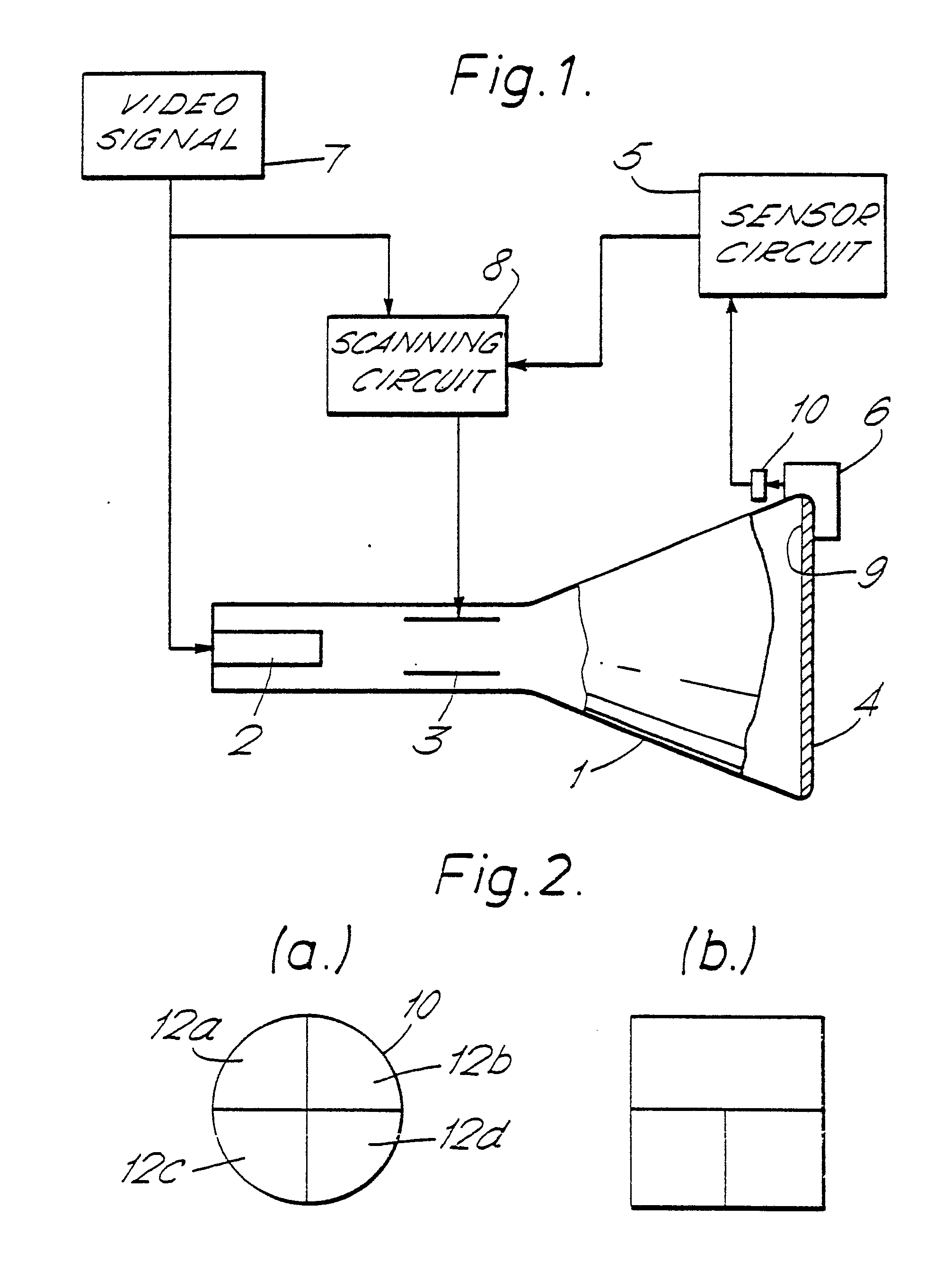
| (45) |
Mention of the grant of the patent: |
|
08.07.1987 Bulletin 1987/28 |
| (22) |
Date of filing: 09.05.1984 |
|
| (51) |
International Patent Classification (IPC)4: H04N 3/22 |
| (86) |
International application number: |
|
PCT/GB8400/156 |
| (87) |
International publication number: |
|
WO 8404/642 (22.11.1984 Gazette 1984/27) |
|
| (54) |
CATHODE RAY TUBE DISPLAY DEVICE
KATHODENSTRAHLRÖHRENANZEIGEVORRICHTUNG
DISPOSITIF D'AFFICHAGE PAR TUBE A RAYONS CATHODIQUES
|
| (84) |
Designated Contracting States: |
|
DE FR NL |
| (30) |
Priority: |
09.05.1983 GB 8312732
|
| (43) |
Date of publication of application: |
|
29.05.1985 Bulletin 1985/22 |
| (71) |
Applicant: THE GENERAL ELECTRIC COMPANY, p.l.c. |
|
London W1A 1EH (GB) |
|
| (72) |
Inventor: |
|
- HILSUM, Cyril
Middlesex HA5 3AN (GB)
|
| (74) |
Representative: Pope, Michael Bertram Wingate |
|
The General Electric Company, p.l.c.
GEC Patent Department
Waterhouse Lane
Chelmsford, Essex CM1 2QX
Chelmsford, Essex CM1 2QX (GB) |
|
| |
|
| Note: Within nine months from the publication of the mention of the grant of the European
patent, any person may give notice to the European Patent Office of opposition to
the European patent
granted. Notice of opposition shall be filed in a written reasoned statement. It shall
not be deemed to
have been filed until the opposition fee has been paid. (Art. 99(1) European Patent
Convention).
|
[0001] This invention relates to cathode ray tube display devices, more especially cathode
ray tube display devices suitable for operation under vibration, for example in an
aircraft or tank.
[0002] A cathode ray tube (CRT) comprises at least one electron gun for producing a beam
of electrons, a luminescent screen and means for deflecting the beam of electrons
across the screen. When such a tube is exposed to vibration, relative movement of
the component parts of the tube leads to image distortion. The remedy used at present
takes one of two forms. The tube can be especially strengthened to resist vibration,
e. g. so that the gun position always remains fixed with respect to the screen, or
the tube can be mounted in a vibration-proof mount. Both solutions are expensive and
they are not cures for all conditions.
[0003] Alternative solutions to this problem involving the electronic correction of the
position of the cathode ray tube electron beam to compensate for vibration of the
cathode ray tube display device are described in US-A-3 743 883, US-A-4 234 893 and
GB-A-2 102195.
[0004] US-A-3 743 883 discloses a display device comprising : a cathode ray tube including
electron gun means ; control means for periodically operating the CRT to direct a
beam of electrons produced by the electron gun means onto a target ; sensor means
for producing an output signal dependant on the deviation of the position of impact
of the beam on the target from a desired position on the target, said sensor means
including : sensing means responsive to the position of impact of the electron beam
on the target ; first circuit means responsive to the output of said sensing means
to produce a signal indicative of the direction of the deviation of said position
of impact from said desired position ; second circuit means responsive to the output
of said first circuit means to produce said sensor means output signal ; and correction
means for utilising sensor means output signal to reduce said deviation.
[0005] It is an object of the present invention to provide a more practical form of such
a display device.
[0006] The present invention provides such a display device wherein said sensing means comprises
: four sensing areas extending in different directions from a position defining said
desired position, each said area subtending an angle of substantially 90° at said
desired position ; said first circuit means comprises : comparator means responsive
to signals V
a, V
b, V
c, V
d respectively produced by said four sensing areas on impact of the electron beam to
produce output signals V
a - V
b, V
c - V
d, V
a - V
b, V
b - V
d ; and adder means for adding said comparator means output signals to produce outputs
(V
a - V
b) + (V
b - V
d) and (V
a - V
c) + (V
b - V
d) ; and said second circuit means comprises storage means for storing said adder means
output signals and circuit means for integrating said stored adder means output signals.
[0007] One cathode ray tube display device in accordance with the invention will now be
described by way of example with reference to the accompanying drawings in which :
Figure 1 is a schematic diagram of the device ;
Figures 2(a) and 2(b) show diagrammatically two possible forms of a sensing means
used in the device ;
Figures 3(a) and 3(b) illustrate two possible forms of an optical system associated
with the sensing means ; and
Figure 4 is a block schematic diagram of a sensor and correction circuit used in the
device.
Figure 1 shows a cathode ray tube 1 comprising an electron gun 2, deflection plates
3 and a luminescent screen 4. The synchronising part of a video signal 7 of raster-scan
format coming from, for example, a television broadcast receiver or a radar equipment
(not shown) is utilised to control the operation of the scanning circuit 8. The video
part of the signal 7 is fed to the electron gun 2 to modulate the intensity of the
beam.
[0008] At suitable intervals in the scanning sequence, as hereinafter further described,
the electron beam is directed, for a short period, onto an edge portion 9 of the screen
4 and the light spot produced on the portion 9 of the screen by the beam is directed
by means of an optical system 6 onto a light sensing means in the form of a photocell
10.
[0009] The output of the photocell 10 is utilised by a sensor circuit 5 to produce a deflection
correction signal to compensate for relative movement between the electron gun and
the screen of the CRT in operation.
[0010] The photocell 10 is divided into quadrants 12a, 12b, 12c and 12d, as shown in Figure
2(a), each of which is a photovoltaic detector with a transparent surface electrode
facing the incoming light. The boundaries between the four detectors are slightly
narrower than the diameter of the light spot so that the spot is always detectable
by at least one of the detectors 12a-d. The detectors 12a-d produce output voltages
V
a, V
b, V
c and V
d respectively which are either zero if the spot is not detected or positive if it
is detected. Hence the voltages can be used to indicate horizontal and vertical deviations
of the position of the spot.
[0011] An indication of vertical deviation of the spot can be obtained from the voltage
sum

which will be positive if the spot is above the centre line, zero if it is on the
centre line (since the upper and lower detectors will be detecting the spot) and negative
if it is below the centre line. An indication of horizontal deviation can be obtained
in a similar manner using the voltage sum

[0012] If the spot is on the exact centre of the photocell, all the detectors will have
an output and so the voltage sums V
v and V
h will be zero.
[0013] As shown in Figure 3(a), the optical system 6 consists of a 90° prism 13 which reflects
the light through 180° and a lens 14 to ensure that the light spot is focussed on
the photocell 10. The optical system 6 and the photocell 10 are located in such a
way that when the device is being used in a vibration free environment and voltages
V
xo and V
Y0 are being applied to the deflection plates, the light spot falls on the exact centre
of the photocell. In this case, of course, no correction is required.
[0014] When the device is being used in a vibrating environment, during each of the above
mentioned periods when the electron beam is directed onto the edge portion 9 of the
screen 4, the voltage sums V
v and V
h are sampled and utilised to produce appropriate deflection correction voltages if
the light spot is found to be displaced from the centre of the photocell.
[0015] Referring now to Figure 4, the sensor circuit 5 includes four comparators 19 to which
the photocell output voltages V
a, V
b, V
c and V
d are applied, and two adder circuits 20 arranged to produce signals corresponding
to the sum voltages V
v and V
h at their outputs respectively. Each of the adders produces an output of zero or V
volts of one polarity or the other so that the adder outputs are effectively digital
signals. The outputs of the adders 20 are sampled in sample and hold circuits 22 during
each period when the electron beam is directed onto the edge portion 9 of the CRT
screen 4, and the outputs of the circuits 22 are integrated by the integrators 23
to produce the required deflection correction signals. These correction voltages are
then combined in differential output amplifiers 24 with the normal deflection voltages
generated by scanning circuit 8 and applied to the CRT deflection plates 3.
[0016] It will be appreciated that the deflection voltages applied to the deflection plates
3 during each sampling period will thus be the voltages V
xo and Vy
O generated by the scanning circuit 8 combined with the correction voltages built up
over the preceding sampling periods at the outputs of the integrators 23 in the sensor
circuit 5.
[0017] In general, the frequency of vibration can be as high as 2 kHz and so the corrections
must be made at intervals of at most 500 microseconds in order to have at least one
correction per vibration cycle. Hence the beam is typically directed onto the edge
portion 9 of the screen at least once every 500 microseconds for a short period, e.
g. not more than 50 microseconds. In this way a series of unit small corrections is
applied, the sampling being so frequent that a large correction is never needed.
[0018] Where correction only for relative movement between the electron gun and the CRT
screen is required, the optical system 6 and the sensing means 10 will be secured
to the CRT envelope, as illustrated in Figure 3(a).
[0019] The invention may also be used, however, to correct in addition for relative movement
between the screen and the CRT mounting panel, or between the screen and the observer.
One arrangement suitable for use for additionally correcting for relative movement
between the screen and the mounting panel is shown in Figure 3(b) where a sensing
means 25 is mounted on the mounting panel 26 where it receives light from an optical
system 16 comprising a lens 27 and a prism 28 similarly to the system 6 described
above. Additional correction for observer motion relative to the screen can be achieved
with convenience by attaching the sensing means to the observer.
[0020] Of course the reflection of light by 180° is not necessary and in an alternative
arrangement a small plano-convexlens can be connected directly to the outer face of
the screen to focus the light spot onto a photocell fixed to the lens at an appropriate
distance. Alternatively, if the CRT has a fibre-optic face plate, the light may be
coupled to the sensing means through a small number of fibres, or a fibre optic bundle
may be cemented to the plate and connected to a sensing means attached to the appropriate
reference frame.
[0021] Further, the sensing means need not be divided into quadrants, but may, for example,
be divided into three portions as shown in Figure 2(b).
[0022] In further alternative arrangements in accordance with the invention, instead of
using a sensing means external of the CRT onto which an image of a light spot formed
on the CRT screen is directed to detect electron beam position, a sensing means integral
with the CRT may be used.
[0023] In one such arrangement the target comprises a patch of material on the internal
surface of a part of the CRT envelope which emits secondary electrons or whose conductivity
changes in response to impact of the electron beam, the sensing means then being responsive
to such secondary electron emission or conductivity changes as appropriate. Alternatively
the sensing means may be in the form of a photoconductive patch overlaying or underlying
a part of the phosphor screen.
[0024] Whilst in the device described by way of example small unit corrections of beam position
are applied, it will be appreciated that this is not necessarily the case in a device
according to the invention. Thus in one alternative arrangement in accordance with
the invention if the sensing means detects a deviation of the beam from the desired
position in a number of successive sampling periods the correction applied may be
increased e. g. to two or three times the usual unit correction. This could be useful
for quickly correcting large deviations of beam position such as may arise on first
switching on or when there is a sudden large shock.
[0025] It will further be understood that whilst in the device described above by way of
example a single electron gun cathode ray tube is used, the invention may also be
applied to devices using multi-gun cathode ray tubes. Where such a multi-gun tube
employs a multi-colour screen, information regarding beam position deviation may be
obtained by analysing the colour of the image produced by the beam as well as or in
addition to the position of the image.
[0026] It will be understood that a device according to the invention may be used to compensate
for deviations due to causes other than, or in addition to, vibration e. g. due to
stray magnetic fields.
1. A cathode ray tube display device (CRT) comprising : a cathode ray tube (1) including
electron gun means (2) ; control means (8) for periodically operating the CRT to direct
a beam of electrons produced by the electron gun means (2) onto a target (9) ; sensor
means (10, 5) for producing an output signal dependant on the deviation of the position
of impact of the beam on the target (9) from a desired position on the target (9),
said sensor means (10, 5) including : sensing means (10) responsive to the position
of impact of the electron beam on the target (9) ; first circuit means (5) responsive
to the output of said sensing means (10) to produce a signal indicative of the direction
of the deviation of said position of impact from said desired position ; and second
circuit means (5) responsive to the output of said first circuit means to produce
said sensor means output signal ; and correction means (24) for utilising said sensor
means output signal to reduce said deviation, characterised in that said sensing means
(10) comprises four sensing areas extending in different directions from a position
defining said desired position, each said area subtending an angle of substantially
90° at said desired position ; said first circuit means (5) comprises : comparator
means (19) responsive to signals Va, Vb, Vb, Vd respectively produced by said four sensing areas on impact of the electron beam to
produce output signals Va - Vb, Vc - Vd, Va - Vb, Vb - Vd ; and adder means (20) for adding said comparator means output signals to produce
outputs (Va - Vb) + (Vb - Vd) and (Va - Vc) + (Vb - Vd) ; and said second circuit means (5) comprises storage means (22) for storing said
adder means output signals and circuit means (23) for integrating said stored adder
means output signals.
2. A CRT display device according to Claim 1 wherein said correction means (24) comprises
differential output amplifier means for combining said output signal of the sensor
means with normal deflection signals for said electron beam.
3. A CRT display device according to Claim 1 or Claim 2 wherein said target (9) is
an area of luminescent material on the screen of the CRT and said sensing means (10)
comprises photo-electric material (12) and an optical system (6) is provided whereby
light produced by impact of the electron beam on said target is directed onto said
photo-electric material.
4. A CRT display device according to Claim 1 or Claim 2 or Claim 3 wherein said sensing
means (10) is mounted on the CRT.
5. A CRT display device according to Claim 1 or Claim 2 or Claim 3 wherein said sensing
means (10) is mounted on a part of a frame within which the CRT is positioned.
6. A CRT display device according to Claim 1 or Claim 2 or Claim 3 wherein said sensing
means (10) is mounted on an observer of the CRT display.
7. A CRT display device according to Claim 1 or Claim 2 wherein said target comprises
an area of secondary electron emitting material and said sensing means is responsive
to said secondary electrons.
8. A CRT display device according to Claim 1 or Claim 2 wherein said target is a material
whose conductivity changes in response to impact of the electron beam and said sensing
means is responsive to said changes in conductivity.
9. A CRT display device according to Claim 1 or Claim 2 wherein said target is an
area of luminescent material on the screen of the CRT and said sensing means comprises
a layer of photoconductive material overlying or underlying said luminescent material.
1. Kathodenstrahlröhrenanzeigevorrichtung (CRT), aufweisend : eine Kathodenstrahlröhre
(1), die eine Elektronenstrahlerzeugungsvorrichtung (2) enthält ; eine Steuervorrichtung
(8), die die CRT periodisch betätigt, um einen von der Elektronenstrahlerzeugungsvorrichtung
(2) erzeugten Elektronenstrahl auf ein Target (9) zu richten ; Sensorvorrichtungen
(10, 5), die ein von der Abweichung der Auftreffposition des Strahls auf dem Target
(9) von einer gewünschten Position auf dem Target (9) abhängendes Ausgangssignal erzeugen,
wobei diese Sensorvorrichtungen (10, 5) eine Sensoreinrichtung (10), die auf die Auftreffposition
des Elektronenstrahls auf dem Target (9) anspricht ; eine erste Schaltungseinrichtung
(5), die auf das Ausgangssignal der Sensoreinrichtung (10) anspricht, um ein die Richtung
der Abweichung dieser Auftreffposition von dieser gewünschten Position anzeigendes
Signal zu erzeugen ; und eine auf das Ausgangssignal dieser ersten Schaltungseinrichtung
ansprechende zweite Schaltungseinrichtung (5) aufweisen, die das Ausgangssignal der
Sensorvorrichtungen erzeugt ; und eine Korrekturvorrichtung (24), die zur Reduzierung
dieser Abweichung dieses Sensorvorrichtungsausgangssignal verwendet, dadurch gekennzeichnet,
daß die Sensoreinrichtung (10) vier Sensorbereiche aufweist, die sich von einer diese
gewünschte Position definierenden Position aus in verschiedene Richtungen erstrecken,
wobei jeder dieser Bereiche einen Winkel von im wesentlichen 90° an dieser gewünschten
Position begrenzt ; daß die erste Schaltungseinrichtung (5) aufweist : eine Vergleichseinrichtung
(19), die auf Signale Va, Vb, Vb, Vd anspricht, die jeweils bei Auftreffen des Elektronenstrahls von den vier Sensorbereichen
erzeugt werden, und die Ausgangssignale Va - Vb, Vc - Vd, Va - Vc, Vb - Vd erzeugt ; und eine Addiereinrichtung (20), die diese Ausgangssignale der Vergleichseinrichtung
zur Erzeugung von Ausgangssignalen (Va - Vb) + (Vb - Vd) und (Va - Vc) + (Vb - Vd) addiert ; und daß die zweite Schaltungseinrichtung (5) eine Speichereinrichtung
(22), die die Ausgangssignale der Addiereinrichtung speichert, und eine Schaltungsvorrichtung
(23) aufweist, die diese gespeicherten Addiereinrichtungsausgangssignale integriert.
2. Kathodenstrahlröhrenanzeigevorrichtung nach Anspruch 1, in welcher diese Korrekturvorrichtung
(24) eine Differentialausgangsverstärkereinrichtung aufweist, die dieses Ausgangssignal
der Sensorvorrichtungen mit normalen Ablenksignalen für diesen Elektronenstrahl kombiniert.
3. Kathodenstrahlröhrenanzeigevorrichtung nach Anspruch 1 oder 2, in welcher dieses
Target (9) ein Bereich lumineszierenden Materials auf dem Schirm der CRT ist und diese
Sensoreinrichtung (10) fotoelektrisches Material (12) aufweist, und in welcher eine
optische Anordnung (6) vorgesehen ist, durch welche beim Auftreffen des Elektronenstrahls
auf diesem Target erzeugtes Licht auf dieses fotoelektrische Material gerichtet wird.
4. Kathodenstrahlröhrenanzeigevorrichtung nach Anspruch 1 oder 2 oder 3, in welcher
diese Sensoreinrichtung (10) an der CRT angebracht ist.
5. Kathodenstrahlröhrenanzeigevorrichtung nach Anspruch 1 oder 2 oder 3, in welcher
diese Sensoreinrichtung (10) auf einem Teil eines Rahmens angebracht ist, innerhalb
dessen die CRT angeordnet ist.
6. Kathodenstrahlröhrenanzeigevorrichtung nach Anspruch 1 oder 2 oder 3, in welcher
diese Sensoreinrichtung (10) an einem Beobachter der CRT-Anzeige angebracht ist.
7. Kathodenstrahlröhrenanzeigevorrichtung nach Anspruch 1 oder 2, in welcher dieses
Target einen Bereich von Sekundärelektronen emittierenden Materials aufweist und diese
Sensoreinrichtung auf diese Sekundärelektronen anspricht.
8. Kathodenstrahlröhrenanzeigevorrichtung nach Anspruch 1 oder 2, in welcher dieses
Target ein Material ist, dessen Leitfähigkeit sich ansprechend auf das Auftreffen
des Elektronenstrahls ändert, und in welcher diese Sensoreinrichtung auf diese Änderungen
der Leitfähigkeit anspricht.
9. Kathodenstrahlröhrenanzeigevorrichtung nach Anspruch 1 oder 2, in welcher dieses
Target ein Bereich aus lumineszierendem Material auf dem Schirm der CRT ist und diese
Sensoreinrichtung eine Schicht aus lichtelektrisch leitendem Material aufweist, welche
über oder unter diesem lumineszierende Material liegt.
1. Dispositif d'affichage à tube à rayons cathodiques (TRC) comprenant un tube à rayons
cathodiques (1) contenant un dispositif à canon électronique (2), un dispositif de
commande (8) destiné à commander périodiquement le tube (TRC) afin qu'il dirige un
faisceau d'électrons produit par le dispositif à canon (2) sur une anticathode (9),
un dispositif capteur (10, 5) destiné à former un signal de sortie qui dépend de l'écart
de position de l'impact du faisceau sur l'anticathode (9) par rapport à une position
voulue sur l'anticathode (9), le dispositif à capteur (10, 5) comprenant un dispositif
de détection (10) sensible à la position d'impact du faisceau électronique sur l'anticathode
(9), un premier circuit (5) sensible au signal de sortie du dispositif de détection
(10) afin qu'il forme un signal représentatif du sens de l'écart de la position d'impact
par rapport à la position voulue, et un second circuit (5) commandé par le signal
de sortie du premier circuit et destiné à créer le signal de sortie du dispositif
capteur, et un dispositif de correction (24) destiné à utiliser le signal de sortie
du dispositif capteur afin qu'il réduise l'écart, caractérisé en ce que le dispositif
de détection (10) comporte quatre zones détectrices placées dans des directions différentes
à partir d'une position définissant la position voulue, chacune des zones sous-tendant
un angle de 90° pratiquement à la position voulue, le premier circuit (5) comporte
un comparateur (19) commandé par les signaux (Va, Vb, Vc, Vd) respectivement produits par les quatre zones détectrices lors de l'impact du faisceau
d'électrons, et formant des signaux de sortie Va - Vb, Vc ― Vd. Va ― Vc, Vb ― Vd ; et un dispositif additionneur (20) destiné à ajouter les signaux de sortie du comparateur
et à former des signaux de sortie (Va ― Vb) + (Vc ― Vd) et (Va ― Vc) + (Vb ― Vd), et le second circuit (5) comporte un dispositif (22) de mémorisation des signaux
de sortie du dispositif additionneur, et un circuit (23) d'intégration des signaux
mémorisés de sortie du dispositif additionneur.
2. Dispositif d'affichage à tube à rayons cathodiques selon la revendication 1. dans
lequel le dispositif de correction (24) comporte un dispositif amplificateur différentiel
de sortie destiné à combiner le signal de sortie du dispositif capteur aux signaux
normaux de déviation du faisceau d'électrons.
3. Dispositif d'affichage à tube à rayons cathodiques selon l'une des revendications
1 et 2, caractérisé en ce que l'anticathode (9) est une zone de matériau luminescent
placé sur l'écran du tube à rayons cathodiques et le dispositif de détection (10)
comporte une matière photoélectrique (12) et un système optique (6) est disposé de
manière que la lumière produite par le choc du faisceau d'électrons sur l'anticathode
soit dirigée sur la matière photoélectrique.
4. Dispositif d'affichage à tube à rayons cathodiques selon l'une quelconque des revendications
1 à 3, dans lequel le dispositif de détection (10) est monté sur le tube à rayons
cathodiques.
5. Dispositif d'affichage à tube à rayons cathodiques selon l'une quelconque des revendications
1 à 3, dans lequel le dispositif de détection (10) est monté sur une partie d'un châssis
dans lequel est placé le tube à rayons cathodiques.
6. Dispositif d'affichage à tube à rayons cathodiques selon l'une quelconque des revendications
1 à 3, dans lequel le dispositif de détection (10) est monté sur un observateur du
dispositif d'affichage à tube à rayons cathodiques.
7. Dispositif d'affichage à tube à rayons cathodiques selon l'une des revendications
1 et 2, dans lequel l'anticathode comporte une zone d'un matériau capable d'émettre
des électrons secondaires, et le dispositif de détection est sensible aux électrons
secondaires.
8. Dispositif d'affichage à tube à rayons cathodiques selon l'une des revendications
1 et 2, dans lequel l'anticathode est en un matériau dont la conductivité varie lors
de l'impact du faisceau d'électrons, et le dispositif de détection est sensible aux
variations de conductivité.
9. Dispositif d'affichage à tube à rayons cathodiques selon l'une des revendications
1 et 2, dans lequel l'anticathode est une zone d'un matériau luminescent placé sur
l'écran du tube à rayons cathodiques, et le dispositif de détection est une couche
d'un matériau photoconducteur placé au-dessus ou au-dessous du matériau luminescent.