|
(11) | EP 0 146 618 B1 |

| (12) | EUROPEAN PATENT SPECIFICATION |
|
|
| (54) |
BEVERAGE CLOUDING AGENT BASED ON CARNAUBA WAX TRÜBUNGSMITTEL FÜR GETRÄNKE AUF BASIS VON KARNAUBAWACHS AGENT DE TURBIDITE DE BOISSON A BASE DE CIRE DE CARNAUBA |
|
|
|||||||||||||||||||||||||||||||
| Note: Within nine months from the publication of the mention of the grant of the European patent, any person may give notice to the European Patent Office of opposition to the European patent granted. Notice of opposition shall be filed in a written reasoned statement. It shall not be deemed to have been filed until the opposition fee has been paid. (Art. 99(1) European Patent Convention). |
[0001] The present invention relates to an edible stable clouding agent to be used in a beverage. More specifically, the invention relates to a stable clouding agent to be used in a beverage. More specifically, the invention relates to a stable clouding agent comprised of a water soluble gum, carnauba wax, a polyhydric alcohol of two to six carbons, and an edible salt.
[0002] Many natural juices, including all freshly expressed citrus juices, have a characteristic turbidity or "cloudiness." It is desirable to maintain this cloudiness when processing natural juices, and to emulate it when preparing formulated beverages.
[0003] In a natural citrus juice, "cloud" is provided by minute, suspended or colloidal particles of citrus tissue and cell contents. In formulated beverages, however, various "clouding agents" have been utilized to stimulate a natural cloud. For example, one known clouding agent is based on brominated oils of specific gravity greater than 1.00 g/ml in combination with lower density flavor oils or vegetable oil, such as citrus oils which have a specific gravity of about 0.85; see U.S. Patent No. 3,353,961, issued November 21,1967 to Simon. Such a blend of oils is "balanced" so as to have a density close to that of the beverage in which it is to be suspended. (As an example, sugar sweetened drinks have a preferred specific gravity of about 1.03-1.06 while dietetic drinks have a specific gravity of about 1.0.).
[0004] By balancing the relatively low density flavor oil, such as citrus oils, with the high density brominated oil, it is possible to inhibit the highly insoluble citrus oils from floating to the top of the particular formulated beverage and from forming a "ring." Instead, the dispersion of the balanced oil in aqueous solutions has a desirable cloudy appearance.
[0005] However, brominated vegetable oils may now constitute only 15 ppm of a finished formulated beverage. This amount is about 10% of the concentration formerly used to prepare effective clouding agents. Consequently, brominated vegetable oils are now less effective as clouding agents.
[0006] As a substitute for brominated vegetable oils, the beverage industry generally turned to glyceryl abietate, or "Ester Gum", which is an F.D.A. approved oil-soluble material also of density greater than 1.00 g/ml; see U.S. Patent No. 3,959,510, issued May 25, 1976 to Felton and Kapp. Although glyceryl abietate, like brominated vegetable oils, can be effectively utilized to prepare an adequate clouding agent, it does have objectionable features. Since its specific gravity is 1.08 as compared to approximately 1.30 for brominated vegetable oils, about three times as much Ester Gum is required to achieve the same degree of balancing as is achieved by use of brominated oils. If too much Ester Gum were used, the taste of the finished beverage could possess a bitter character which is often undesirable. Another difficulty arises from the fact that although both glycerol and abietic acid are natural products. Ester Gum is nevertheless produced synthetically from abietic acid, which precludes its use in those beverages which the producer wishes to label as natural.
[0007] A desirable clouding agent for use in a formulated beverage will avoid the difficulties associated with the aforementioned known clouding agents, as well as possess various other advantages. Specifically such a clouding agent would be non-toxic, impart little or no taste to the final beverage, and be effective in producing a non-ringing, cloudy beverage. Also important to such a desirable agent would be its ability to produce a final cloudy beverage which is non-ringing for significant periods of time, specifically at least three months.
Disclosure of the invention
[0008] The clouding agent of the present invention is an emulsified composition of finely divided particles of carnauba wax, a water soluble gum, a polyhydric alcohol of two to six carbons, water, and an edible salt. An edible essential oil distillate such as orange oil distillate and additional resins such as gum elemi may also be incorporated. Important features of the invention include the size distribution of the carnauba wax particles, as well as the weight ratio of wax to alcohol and wax to salt. These features combine to produce the non-ringing stability of the final beverage cloud for periods of at least three months.
[0009] The wax particle size, as determined by Coulter Counter, is represented herein by specific interfacial area, which is the measured area in square meters of the oil/water interface per cubic centimeter of disperse phase. As the interfacial area increases, the particle size decreases. The wax particle size will range from an interfacial aera of 12.5 meter2/centimeter3 to 15.0 m2/cm3, and preferably from 13.0 to 13.6 m2/cm3.
[0010] The weight ratio of wax to salt will be from 1:2 to 2:3 with 2:3 being preferred. The weight ratio of carnauba wax to alcohol will be from 1:4 to 1:3, with 1:4 being preferred.
[0011] The carnauba wax will comprise 5.0 to 8.0, preferably about 6.0, percent by weight of the clouding agent. The water-soluble gum usually comprises 15.0 to 30.0, preferably 18.0 to 22.0, percent by weight of the emulsified clouding agent. The alcohol typically comprises 20.0 to 24.0, preferably about 22.0, percent by weight of the emulsion. The salt typically comprises 8.0 to 12.0, preferably about 9.0, percent by weight of the emulsion. If an essential oil distillate is used, it may comprise up to about 3.0, preferably 1.0 to 2.0, percent by weight of the emulsion. Also, if a purified gum elemi is used, it may comprise up to about 6.0, preferably up to about 4.0, percent by weight of said emulsion.
[0012] The water-soluble gum is preferably gum acacia. Other gums and suitable hydrocolloids may also be used. A preferred edible salt is sodium chloride. Another suitable salt is potassium chloride.
[0013] The polyhydric alcohol should have a chain length of two to six carbons, or alternatively, a molecular weight up to 360. A preferred alcohol is glycerol although other suitable alcohols include propylene glycol and sorbitol.
[0014] The clouding agent herein disclosed is an emulsion which is prepared by combining the wax with a heated solution of the other ingredients. If optional ingredients such as an essential oil distillate and/or purified gum elemi are used, they are first blended with the carnauba wax. To form such a blend, the wax plus optional oil distillate and/or elemi are combined by heating the mixture to a temperature sufficient to melt the carnauba wax; usually a temperature of about 85°C will be sufficient. The wax or wax blend is then emulsified with a solution of water, water-soluble gum, alcohol and an edible salt.
[0015] To perform the emulsification process, the homogeneous solution of water, a water-soluble gum, alcohol, and an edible salt is prepared, then the solution is heated to a temperature sufficient to permit the wax or wax blend to melt when it is stirred into the solution. A temperature of 95-100°C is preferred.
[0016] The resultant mixture of wax, water, alcohol, gum, and salt is subsequently emulsified by any conventional means capable of producing a final emulsion wherein the particle size of the carnauba wax is characterized by an interfacial area of 12.5 to 15.0 M2/CMI, preferably 13.0 to 13.6 m2/cm3. A preferred method of emulsification involves the use of a conventional heat jacketed, 2 stage pressure homogenizer, maintained at a temperature between 92-100°C, and a total pressure of 3000 to 7500 psig (2x 10⁷ to 5x 10⁷ Pa), preferably 4500 to 6000 psig (3x10⁷ to 4x10⁷ Pa).
[0017] The emulsified clouding agent thus obtained is capable of being used in a number of ways well known in the beverage industry art. One example is to prepare a beverage syrup by mixing the clouding agent with a sugar-in-water syrup and other conventional ingredients.
[0018] Such a beverage syrup may in turn be converted into a final, cloudy beverage by the addition of still or carbonated water. This final, cloudy beverage will be stable against ring formation or settling out for periods of at least three months.
Best modes for carrying out the invention
[0019] The clouding agent of the present invention provides several advantages over known clouding agents. For example, it imparts little or no taste a final beverage in which it is placed. Moreover, all of the ingredients of the agent are naturally-occurring and non-toxic.
[0020] The clouding agent of the present invention is intended for use in the preparation of still or carbonated aqueous beverages.
[0021] A clouding agent prepared in accordance with the present disclosure, comprises in part carnauba wax. It has been found that other edible waxes, e.g. candela and bees wax, do not perform in a manner equivalent to the carnauba wax. Carnauba wax is a natural, non-toxic wax having a specific gravity of about 0.995 and a melting point of about 82-86°C. Two types of carnauba wax are known-"raw" and "purified." Both function equally well in the invention.
[0022] The carnauba wax may optionally be blended with certain ingredients known in the art, such as an essential oil distillate, e.g. an orange distillate, and/or natural resins such as purified solid gum elemi, to produce a distillate-wax-resin blend having a density of 0.993 g/ml to 0.987 g/ml. If elemi is added, it is preferred that it be purified first so as to remove any volatile oils which would impart an undesirable taste to the final product.
[0023] The gum elemi which may be used in the present invention is derived from resins obtained from a tree of the Kanarium family. Although many kinds of elemi resins exist, they are all characterized by the constituent triterpene, amyline (C30H490H), which, it is speculated, contributes to emulsion stability. Elemi resins and their purified fractions are non-toxic.
[0024] The elemi may be purified by resort to any of a number of conventional means such as distillation, extraction, chromatography and precipitation. For example, it may be steam distilled or it may be purified by solubilizing the natural gum elemi with 1.6 parts by weight isopropyl alcohol, isolating the non-soluble portion by filtration, and finally evaporating any alcohol in the filtrate to produce a purified elemi with a density of 1.02 g/ml and a melting point of 130-142°C.
[0025] If the carnauba wax is blended with purified elemi and/or an essential oil distillate, it is not necessary to heat the distillate-wax-resin combination beyond 79-83°C in order to effect solution of the elemi and distillate into the carnauba wax. Upon cooling, such a blend will for a solid having a melting point of 68-75°C.
[0026] This distillate-wax-resin blend or the pure carnauba wax is then converted to a clouding agent emulsion by emulsification with water, a water-soluble gum, preferably a preservative, alcohol and salt. The salt will typically be sodium chloride, however, any edible inorganic salt of alkali or alkaline earth metals and halides, or sulfate may be used in the present invention. The halide salts of the alkali metals are preferred, especially sodium and potassium chlorides.
[0027] The emulsion is prepared by heating a homogeneous solution of the water, gum, alcohol and salt to a temperature high enough to melt the carnauba wax or wax blend when it is added, preferably between 95-100°C. The resultant mixture of wax and water, gum, alcohol and salt is then emulsified by any means sufficient to produce an emulsion in which the particle size of the carnauba wax is characterized by an interfacial area of 12.5 to 15.0 m2/cm3, preferably 13.0 to 13.6 m2/cm3. Methods of emulsification known in the art include simple stirring, aeration, propeller agitation, turbine agitation, use of a colloid mill, use of ultrasonics, and homogenization. For a more detailed description of those various emulsification methodologies, see Griffin, "Emulsions," in a 8 Kirk-Othmer Encyclopedia of Chemical Technology 900-930 (3d ed. 1979). One good emulsification technique is to employ a shear homogenizer. A preferred method involves the use of a conventional heat jacketed, 2 stage pressure homogenizer maintained at a temperature between 92-100°C (high enough to maintain the wax in its molten state) and a total pressure of 3000 to 7500 psig (2x10⁷ to 5x10⁷ Pa), preferably 4500 to 6000 psig (3X10⁷ to 4x1Q7 Pa).
[0028] Although the exact means by which the clouding agent functions is not known, it does not utilize the aforementioned "balancing" of a relatively low density oil with a heavier oil or gum in order to produce a blend having a density close to that of the beverage in which it is to be suspended. It is believed that the functioning of the clouding agent of the invention involves cooperation of the carnauba wax and salt plus alcohol to form a "micelle-like" structure wherein a microparticle of carnauba wax is suspended in water as a consequence of being surrounded by the salt ions and/or hydrogen bonded alcohol molecules. While true micelles are much smaller than the microparticles of the carnauba wax, the cooperative behavior of the wax particles, salt and alcohol may be similar to that of true miscelles. Moreover, it is believed that the salt ions and alcohol produce an electrostatic effect around the wax particles, rather than functioning merely as solution density modifiers. This is because the ability of the clouding agent to avoid ringing decreases rather sharply outside the range of disclosed weight ratios of wax-to-salt and wax-to-alcohol.
[0029] The clouding agent emulsion so produced may be used in a number of conventional ways. For example, it may be mixed with syrup (either sugar in water or artificial sweetener in water) and other conventional ingredients to prepare a beverage syrup, which beverage syrup may in turn be converted into the final cloudy beverage by addition of still or carbonated water. Suggested concentrations of the clouding agent emulsion in the finished beverage correspond to about 0.05-0.20% by weight of the emulsion, based on the total weight of the final beverage. Such a suggested usage concentration range is only related to anticipated commercial desirability and in no way should be deemed a limitation on the effective concentration of emulsion in an aqueous beverage.
[0030] It also is possible to dry the clouding agent emulsion by such conventional methods as spray, freeze drum, or foam-mat drying to form a dry mix having a moisture content no higher than about 5%. Such a dry mix may be optionally mixed with a solid edible acid, dry color, and/or sweetener to form a beverage powder, which may be converted to a final cloudy beverage by the addition of water.
[0031] The nature of the present invention may be further understood by the following examples of specific embodiment. Unless stated otherwise, all proportions here and elsewhere are in weight percent, based on the weight of the final clouding agent emulsion.
Example 1
A carnauba wax, sodium chloride glycerol gum acacia clouding agent
[0033] The carnauba wax was melted at a temperature of about 79-83°C. While the molten wax was kept at a temperature sufficient to maintain it in its molten state, the orange oil distillate was stirred into the molten wax in orderto solubilize it. The heat source was subsequently removed to allow the distillate-wax blend to solidify. The blend had a melting point of 68-75°C.
[0034] The final clouding agent emulsion was prepared by adding the water, preservative, salt, glycerol, and gum acacia together and stirring at room temperature to form a homogeneous solution. This solution, while continuously stirred, was heated to a temperature of between 95° to 100°C. While maintaining this temperature, the distillate-wax blend was stirred into said solution until the blend had melted, thereby forming a cloudifier premix.
[0035] This premix was then introduced into a conventional heat jacketed 2-stage pressure homogenizer maintained at a temperature of between 92 to 100°C, so that the cloudifier premix was a liquid during homogenization. The total homogenization pressure was 6000 psi (4x10' Pa). After homogenization, the cloudifier emulsion was cooled to room temperature. The resultant clouding agent had a specific gravity of about 1.20 at 25°C, as well as an interfacial area of 13.6 m2/cm3, created a stable long-lasting cloud when utilized as part of an aqueous beverage, and imparted no significant taste.
Example 2
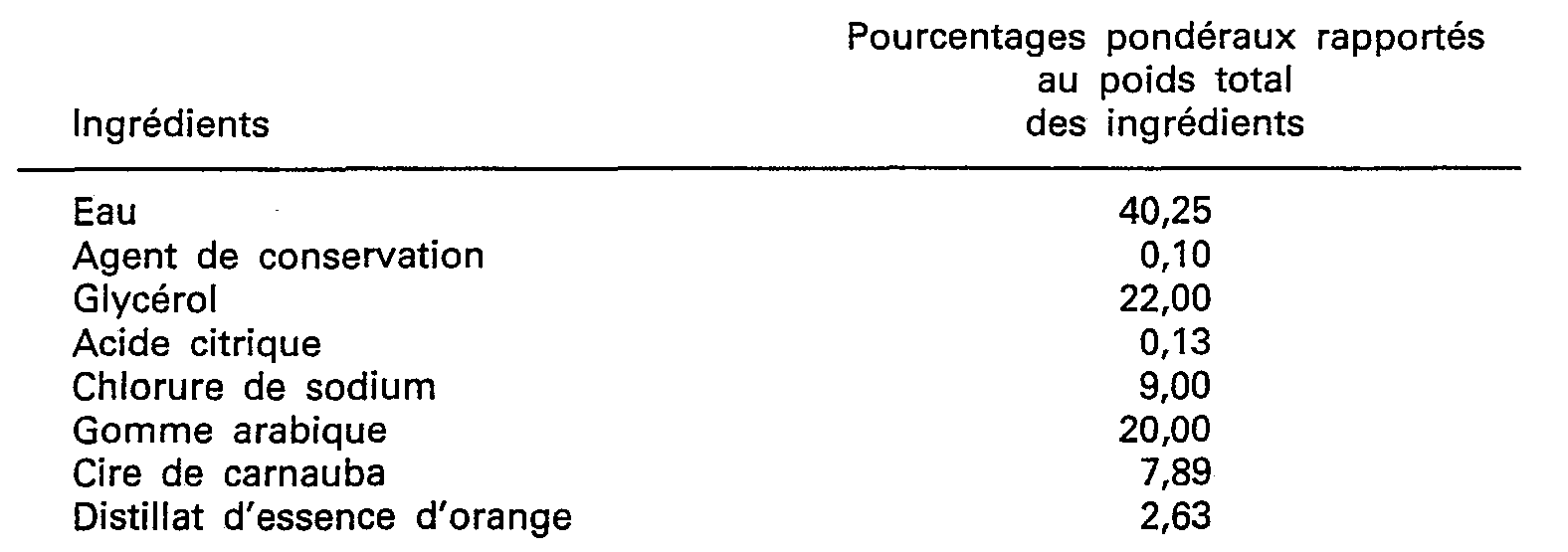
A carbnauba wax clouding agent containing citric acid
[0037] The carnauba wax and orange oil distillate were combined in the same fashion as in Example 1. The distillate-wax blend was then combined with the remaining ingredients also as in Example 1 to form a clouding agent having an interfacial area of 12.4 m2/cm' and showing good stability when used in an aqueous beverage.
Example 3
A carnauba wax clouding agent outside the invention
[0039] The ingredients were generally combined as in Example 1 to form an emulsion, however the homogenization parameters were adjusted so that the interfacial area of the final emulsion was only 11.4 m2/cm3, which is outside the scope of the present invention. This clouding agent, when utilized as part of an aqueous beverage, produced a cloud which was not long-lasting, but rather was stable only for about 5 days.
1. An edible clouding agent which comprises finely divided carnauba wax particles
in an emulsion base comprising water, a water-soluble gum, a polyhydric alcohol of
two to six carbons chosen from the group consisting of propylene glycol, sorbitol,
glycerol and combinations thereof and an edible salt, wherein the size of the wax
particles is characterized by an interfacial area of 12.5 m2/cm3 to 15.0 m2/cm3, wherein the weight ratio of wax to salt is 1:2 to 2:3, and the weight ratio of wax
to alcohol is 1:4 to 1:3.
2. An edible beverage clouding agent of claim 1, wherein the salt is an alkali metal
salt.
3. An edible beverage clouding agent of claim 1, wherein the salt is sodium chloride
and the polyhydric alcohol is glycerol.
4. An edible beverage clouding agent of claim 1, wherein the Carnauba wax is blended
with at least one of the group consisting of purified gum elemi and an essential oil
distillate.
5. An edible beverage clouding agent of claim 1 or 4 wherein the emulsion base further
comprises a preservative.
6. An edible beverage clouding agent of claim 4 wherein the essential oil distillate
is a natural orange oil distillate.
7. An edible beverage clouding agent of claim 5 wherein the preservative is sodium
benzoate.
8. An edible beverage clouding agent of claim 1 wherein the water-soluble gum is gum
acacia.
9. An edible beverage clouding agent of claim 1, comprising the following:
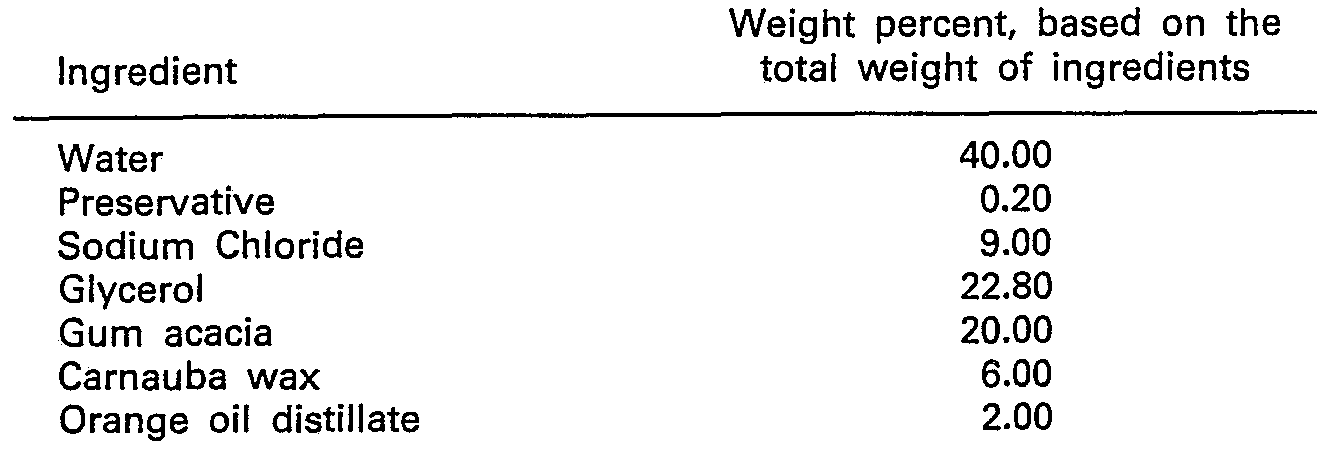
10. An edible beverage clouding agent comprising the following:
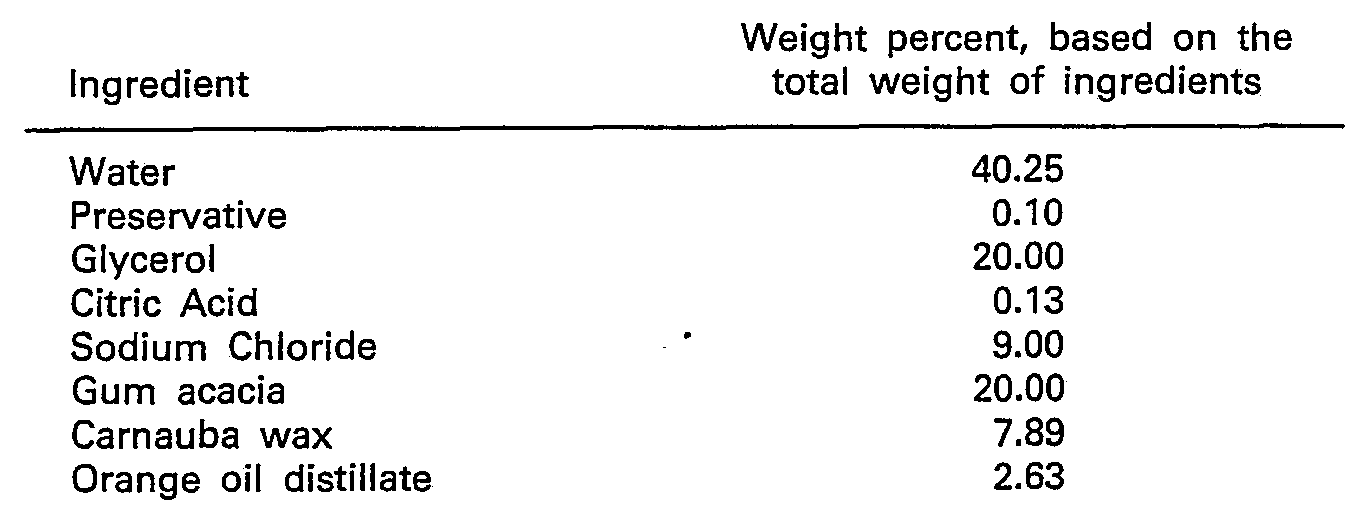
11. A beverage syrup comprising a beverage clouding agent of claims 1 and 10 comprising
0.05-0.20 percent by weight of the total weight of the beverage and flavored syrup.
12. A cloudy beverage, comprising a beverage syrup of claim 11 and still or carbonated
water.
13. A clouding agent of claim 1, wherein the agent has been dried to form a dry mix
having a moisture content no higher than about 5%.
14. A process of preparing a beverage clouding agent, comprising the steps of heating
a homogeneous solution of water, a water-soluble gum, a polyhydric alcohol of two
to six carbons chosen from the group consisting of propylen glycol, sorbitol, glycerol
and combinations thereof and an edible salt to a temperature sufficient to melt carnauba
wax, stirring in carnauba wax until melted, and finally emulsifying the entire mixture
to produce an emulsion having a wax interfacial area of 12.5 m2/cm3 to 15.0 m2/cm3.
15. A process of preparing a beverage clouding agent, comprising the steps of heating
a homogeneous solution of water, a water-soluble gum, a polyhydric alcohol of two
to six carbons chosen from the group consisting of propylen glycol, sorbitol, glycerol
and combinations thereof and an edible salt to a temperature of 92-100°C stirring
in carnauba wax until melted, and finally homogenizing the entire mixture in a heat
jacketed, 2 stage pressure homogenizer, maintained at a temperature between about
95-100°C, and also having a total pressure of between 3000-7500 psi (2X10⁷ to 5x10⁷ Pa).
16. A process of claim 15, wherein the weight ratio of wax to salt is 1:2 to 2:3 and
the weight ratio of wax to alcohol is 1:4 to 1:3.
17. A process of claim 15 wherein, prior to mixing with the other ingredients, the
Carnauba wax is blended with at least one compound selected from the group consisting
of an essential oil distillate and purified gum elemi.
18. A process of preparing a beverage syrup as defined in claim 11, comprising the
step of adding a clouding agent emulsion of claim 1 to a flavored syrup.
19. A process of preparing a cloudy beverage as defined in claim 12, comprising the
step of adding still or carbonated water to the beverage syrup of claim 11.
20. A process of preparing a cloudy beverage comprising the steps of drying a beverage
clouding agent of claims 1 and 10 to form a dry mix having a moisture content no higher
than about 5%, optionally mixing therewith a solid edible acid, dry color, and/or
sweetener to form a beverage powder, and finally converting said powder to a cloudy
beverage by the addition of water.
21. A dry beverage powder prepared by drying a beverage clouding agent of claims 1
and 10 to form a dry mix having a moisture content no higher than about 5%, and optionally
mixing therewith a solid edible acid, dry color and/or sweetener.
1. Geniessbares Trübungsmittel, enthaltend fein verteilte Carnaubawachs-Teilchen in
einer Emulsionsbasis, die Wasser, ein wasserlösliches Gummi, einen mehrwertigen Alkohol
mit zwei bis sechs Kohlenstoffen, ausgewählt aus der Gruppe, bestehend aus Propylenglykol,
Sorbit, Gycerin und Kombinationen davon, und ein geniessbares Salz enthält, worin
die Grösse der Wachsteilchen gekennzeichnet ist durch eine Grenzfläche von 12,5 m2/cm3 bis 15,0 m2/cm3, wobei das Gewichtsverhältnis von Wachs zu Salz etwa 1:2 bis 2:3 und das Gewichtsverhältnis
von Wachs zu Alkohol 1:4 bis 1:3 beträgt.
2. Geniessbares Trübungsmittel für Getränke nach Anspruch 1, in dem das Salz ein Alkalisalz
ist.
3. Geniessbares Trübungsmittel für Getränke nach Anspruch 1, in dem das Salz Natriumchlorid
ist und der mehrwertige Alkohol Glycerin ist.
4. Geniessbares Trübungsmittel für Getränke nach Anspruch 1, worin das Carnaubawachs
vermischt ist mit mindestens einem aus der Gruppe von gereinigtem Elemi-Gummi und
einem Destillat von etherischem Öl.
5. Geniessbares Trübungsmittel für Getränke nach Anspruch 1 oder 4, worin die Emulsionsbasis
darüber hinaus ein Konservierungsmittel enthält.
6. Geniessbares Trübungsmittel für Getränke nach Anspruch 4, worin das etherische
Öl-Destillat ein natürliches Orangenöl-Destillat ist.
7. Geniessbares Trübungsmittel für Getränke nach Anspruch 5, worin das Konservierungsmittel
Natriumbenzoat ist.
8. Geniessbares Trübungsmittel für Getränke nach Anspruch 1, worin das wasserlösliche
Gummi Gummi Arabikum ist.
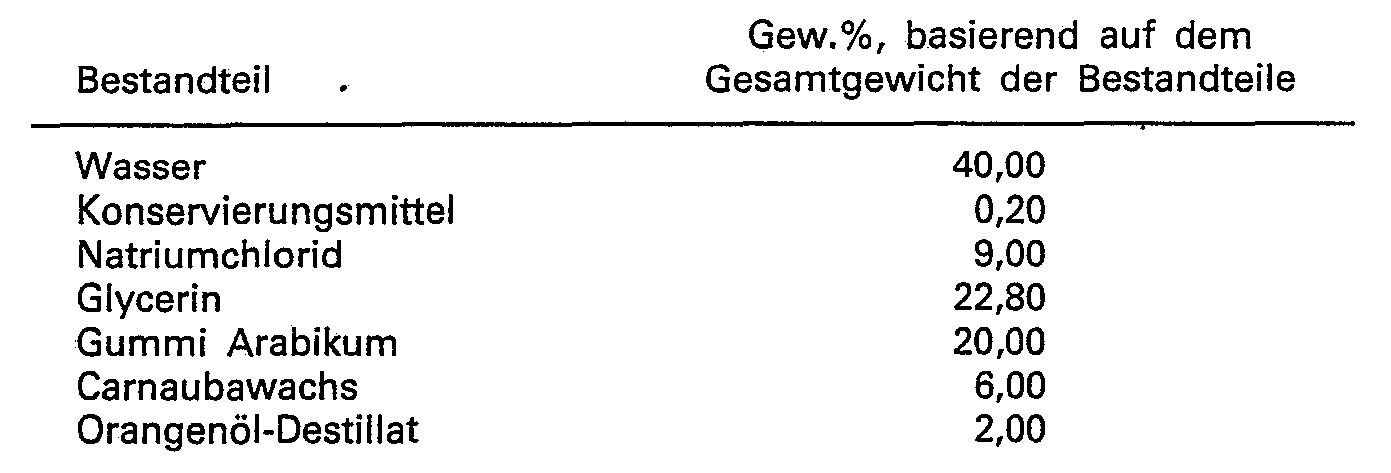
9. Geniessbares Trübungsmittel für Getränke nach Anspruch 1, umfassend das folgende:
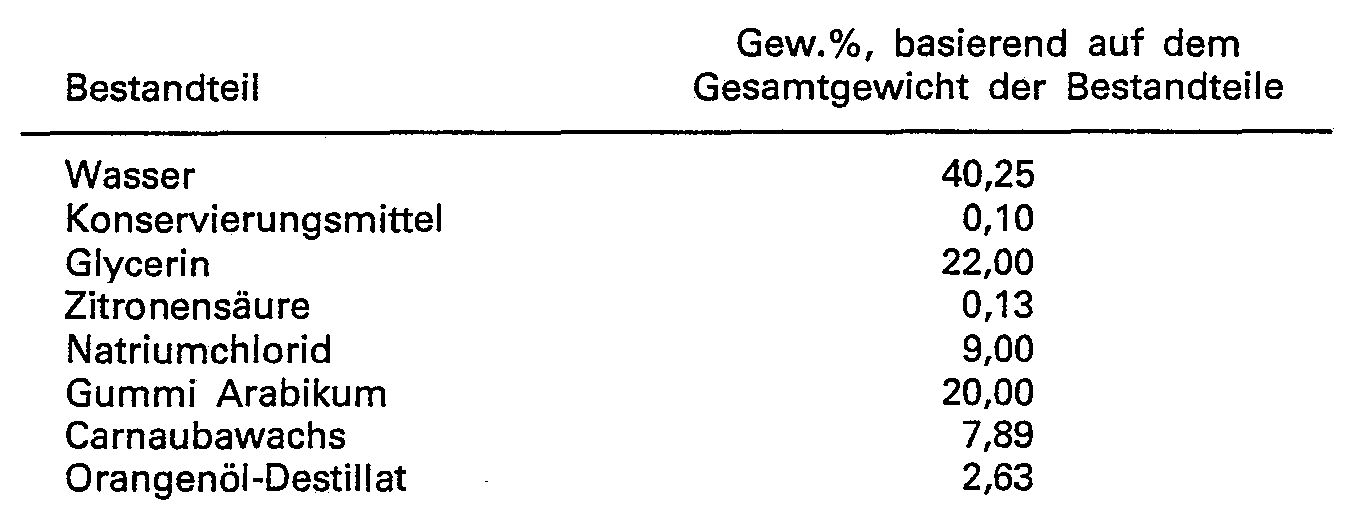
10. Geniessbares Trübungsmittel für Getränke, umfassend das folgende:
11. Getränkesirup, enthaltend ein Getränketrübungsmittel nach den Ansprüchen 1 und
10 in einer Menge von 0,05-0,20 Gew.% des Gesamtgewichts von Getränk und aromatisiertem
Sirup.
12. Trübes Getränk, umfassend einem Getränkesirup nach Anspruch 11 und stilles oder
kohlensäurehaltiges Wasser.
13. Trübungsmittel nach Anspruch 1, in dem das Mittel unter Bildung eines trockenen
Gemisches mit einem Feuchtigkeitsgehalt von nicht grösser als etwa 5% getrocknet wurde.
14. Verfahren zur Herstellung eines Trübungsmittels für Getränke, umfassend die Stufen
des Erwärmens einer homogenen Lösung von Wasser, einem wasserlöslichen Gummi, einem
mehrwertigen Alkohol mit zwei bis sechs Kohlenstoffen, ausgewählt aus der Gruppe,
bestehend aus Propylenglykol, Sorbit, Glycerin und Kombinationen davon, und einem
geniessbaren Salz, auf eine ausreichende Temperatur, um Carnaubawachs zu schmelzen,
Einrühren von Carnaubawachs, bis es geschmolzen ist, und schliesslich Emulgieren des
gesamten Gemischs, um eine Emulsion mit einer Wachsgrenzfläche von 12,5 m2/cm3 bis 15,0 m2/cm3 zu erzeugen.
15. Verfahren zur Herstellung eines Trübungsmittels für Getränke, umfassend die Stufen
des Erwärmens einer homogenen Lösung von Wasser, einem wasserlöslichen Gummi, einem
mehrwertigen Alkohol mit zwei bis sechs Kohlenstoffen, ausgewählt aus der Gruppe,
bestehend aus Propylenglykol, Sorbit, Glycerin und Kombinationen davon, und einem
geniessbaren Salz, auf eine Temperatur von 92100°C, Einrühren von Carnaubawachs,
bis es geschmolzen ist, und schliesslich Homogenisieren des gesamten Gemischs in einem
mit Wärmemantel versehenen 2-Stufen-Druckhomogenisator, der bei einer Temperatur zwischen
etwa 95-100°C gehalten wird und auch einem Gesamtdruck von zwischen 3000-7500 psi
(2x10' bis 5x10' Pa) hat.
16. Verfahren nach Anspruch 15, bei dem das Gewichtsverhälnis von Wachs zu Salz 1:2
bis 2:3 beträgt und das Gewichtsverhältnis von Wachs zu Alkohol 1:4 bis 1:3 beträgt.
17. Verfahren nach Anspruch 15, bei dem vor dem Vermischen mit den anderen Bestandteilen
das Carnaubawachs mit mindestens einer Verbindung vermischt wird, die ausgewählt ist
aus der Gruppe von einem etherischen Öl-Destillat und gereinigtem Elemi-Gummi.
18. Verfahren zur Herstellung eines Getränkesirups, wie in Anspruch 11 definiert,
umfassend die Stufe des Zusatzes einer Trübungsmittelemulision nach Anspruch 1 zu
einem aromatisierten Sirup.
19. Verfahren zur Herstellung eines trüben Getränks, wie in Anspruch 12 definiert,
umfassend die Stufe des Zusatzes von stillem oder kohlensäurehaltigen Wasser zu dem
Getränkesirup von Anspruch 11.
20. Verfahren zur Herstellung eines trüben Getränks, umfassend die Stufen des Trocknens
eines Trübungsmittels für Getränke nach den Ansprüchen 1 und 10, zur Bildung eines
trockenen Gemischs mit einem Feuchtigkeitsgehalt von nicht grösser als etwa 5%, gegebenenfalls
Vermischen damit von einer festen, geniessbaren Säure, trockener Farbe und/oder Süssungsmittel
zur Bildung eines Getränkepulvers, und schliesslich Umwandeln des Pulvers in ein trübes
Getränk, durch Zusatz von Wasser.
21. Trockenes Getränkepulver, hergestellt durch Trockenen eines Trübungsmittels für
Getränke nach den Ansprüchen 1 und 10 unter Bildung eines trockenen Gemischs mit einem
Feuchtigkeitsgehalt von nicht grösser als etwa 5% und gegebenenfalls Vermischen damit
von einer festen, geniessbaren Säure, trockener Farbe und/oder Süssungsmittel.
1. Un agent de trouble comestible pour boissons qui comprend de fines particules de
cire de carnauba dans une émulsion de base comprenant de l'eau, une gomme hydrosoluble,
un polyol ayant de deux à six atomes de carbone, pris parmi le propylène glycol, le
sorbitol, le glycérol et des mélanges de ces polyols, et un sel comestible, dans lequel
la dimension des particles de la cite est caractérisée par une surface interfaciale
de 12,5 m2/cm3 à 15,0 m2lcm3, le rapport pondéral de la cire au sel étant compris entre 1:2 et 2:3 et le rapport
pondéral de la cire à l'alcool entre 1:4 et 1:3.
2. Agent de trouble pour boissons selon la revendication 1, dans lequel le sel est
un sel de métal alcalin.
3. Agent de trouble selon la revendication 1 dans lequel le sel est de chlorure de
sodium et le polyol est le glycérol.
4. Agent de trouble selon la revendication 1 dans lequel la cire de carnauba est mélangée
avec de la gomme d'élémi purifiée ou un distillat d'huiles essentielles ou avec les
deux à la fois.
5. Agent de trouble selon la revendication 1 ou 4 dans lequel l'émulsion comprend
également un agent de conservation.
6. Agent de trouble selon la revendication 4 dans lequel le distillat d'huiles essentielles
est un distillat d'essence d'orange naturelle.
7. Agent de trouble selon la revendication 5 dans lequel l'agent de conservation est
du benzoate de sodium.
8. Agent de trouble selon la revendication 1 dans lequel la gomme hydrosoluble est
de la gomme arabique.
9. Agent de trouble selon la revendication 1, comprenant les ingrédients suivants:
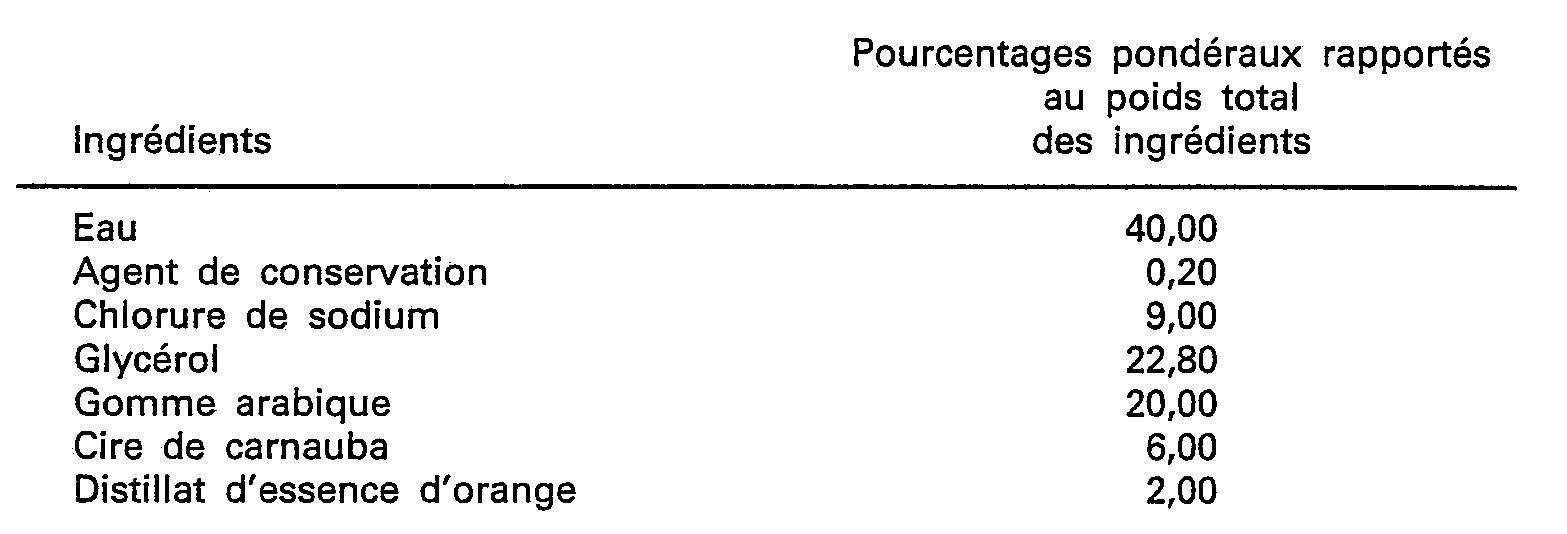
10. Agent de trouble comestible pour boissons, comprenant les ingrédients suivants:
11. Sirup pour boisson comprenant un agent de trouble des revendications 1 et 10,
et qui constitue de 0,05% à 0,20% du poids total de la boisson, et un sirup aromatisé.
12. Une boisson trouble comprenant un sirup selon la revendication 11 avec de l'eau
ordinaire ou de l'eau gazeuse.
13. Agent de trouble selon la revendication 1 qui a été séché de manière à donner
un mélange sec dont la teneur en humidité ne dépasse par 5% environ.
14. Un procédé de préparation d'un agent de trouble pour boissons selon lequel on
chauffe une solution homogène comprenant de l'eau, une gomme hydrosoluble, un polyol
ayant de 2 à 6 atomes de carbone pris parmi le propylène glycol, le sorbitol, le glycérol
et des mélanges de ces polyols, et un sel comestible, à une température suffisante
pour fondre de la cire de carnauba, on agite la solution dans de la cire de carnauba
jusqu'à ce que celle-ci soit fondue puis on émulsionne l'ensemble du mélange pour
en former une émulsion dans laquelle la surface interfaciale de la cire est comprise
entre 12,5 m2/cm3 et 15,0 m2/cm3.
15. Un procédé de préparation d'un agent de trouble pour boissons selon _lequel on
chauffe une solution homogène comprenant de l'eau, une gomme hydrosoluble, un polyol
ayant de 2 à 6 atomes de carbone, pris parmi le propylène glycol, le sorbitol, le
glycérol et des mélanges de ces polyols, et un sel comestible, à une température de
92 à 100°C, on agite ensuite la solution dans de la cire de carnauba jusqu'à ce que
celle-ci soit fondue puis on homogénéise l'ensemble du mélange dans un homogénéiseur
sous pression à deux temps équipé d'une chemise de chauffage, qui est maintenu à une
température d'environ 95-100°C, sous une pression totale de 2x10⁷ à 5x10⁷ Pa.
16. Procédé selon la revendication 15 dans lequel le rapport pondéral de la cite au
sel est compris entre 1:2 et 2:3 et le rapport pondéral de la cire à l'alcool entre
1:4 et 1:3.
17. Procédé selon la revendication 15 dans lequel, avant de mélanger la cire de carnauba
avec les autres ingrédients, on la mélange avec un distillat d'huiles essentielles
ou une gomme d'élémi purifiée ou avec les deux à la fois.
18. Un procédé de préparation d'un sirop de boisson selon la revendication 11 consistant
à ajouter une émulsion d'un agent de trouble selon la revendication 1 à un sirop aromatisé.
19. Un procédé de préparation d'une boisson trouble selon la revendication 12, consistant
à ajouter de l'eau ordinaire ou de l'eau gazeuse au sirop de boisson selon la revendication
11.
20. Un procédé de préparation d'une boisson trouble selon lequel on sèche un agent
de trouble pour boissons des revendications 1 et 10 de manière à avoir un mélange
sec dont la teneur en humidité ne dépasse pas 5% environ, avec lequel on mélange éventuellement
un acide comestible solide, un colorant sec et/ou un édulcorant pour obtenir une poudre
pour boisson, avec laquelle on prépare une boisson trouble en lui ajoutant de l'eau.
21. Une poudre sèche pour boissons qui a été obtenue par séchage d'un agent de trouble
des revendications 1 et 10 pour avoir un mélange sec dont la teneur en humidité ne
dépasse pas 5% environ, et mélange éventuel de celui-ci avec un acide comestible solide,
un colorant sec et/ou un édulcorant.