|
(11) | EP 0 148 122 A1 |

| (12) | EUROPEAN PATENT APPLICATION |
|
|
|
|
|||||||||||||||||||||||||||
| (54) | Coating for metallic substrates, method of production and use of the coating |
| (57) Transition metals of the groups IVB, VB and VIB or alloys thereof with Al are electrodeposited
in a system of an electrolyte based on an aromatic hydrocarbon. The electrolyte is
originally prepared by dissolving 0.02 to 0.2 moles of an inexpensive high ioxidation
state transition metal halides and 0.2 to 0.5 moles AlBr3 in 1.00 mole of the aromatic hydrocarbon. Additions of transition metal powders of
Mg of Al particles lead to the pre-reduction of the high oxidation state transition
metal ions to lower oxidation states. Alkali halides may be used to establish favourable
bath conditions. The electrolysis is carried out with dissolvable metal anodes, to
maintain the bath composition. The plating current density, bath composition and method
of preparation are chosen to obtain the desired composition of the coatings. |
Field of invention
[0001] The invention relates to a method of electroplating at least one or an alloy of several transition metals of the groups IVB, VB or VIB of the periodic table or an alloy of at least one of said transition metals with aluminum at near ambient temperature onto an electrically conductive substrate in a non-aqueous electrolyte. The invention further relates to an electroplated coating and to the use of this coating.
Background of the Invention
[0002] It is known to apply coatings of metals, alloys etc. onto conductive substrates by way of electroplating.
[0003] The canadian patent ≠ 945,935 discloses the electrodeposition of Al or alloys containing Al onto substrates in electrolytes based on a non-aqueous organic solvent like toluene, whereby the metal salts are added to the solvent in the form of bromides and/or chlorides.
[0004] However, this Canadian patent does not disclose the electrodeposition of transition metals of the groups IVB, VB or VIB, or of alloys thereof with Al from a non-aqueous electrolyte.
[0005] From the "Journal of Electrochemical Society", January 1957, page 21, it is known to electrodeposit Ti alloys from a nonaqueous bath, specially from ether containing A1 complexes. Deposits of maximum 6% Ti, rest Al, could be obtained. Deposits with higher contents of Ti could not be achieved. Moreover, because of the high flammability of ether and its low electrical conductivity the practical operating conditions are highly disadvantageous.
[0006] The French patent 2 494 726 discloses a process of a fused salt titanium electrowinning electrolysis, whereby the bath is heated to a temperature of 520oC. A process like this may in principle be used for electroplating, but it is highly desirable to perform the entire procedure at low temperatures.
Object of the invention
[0007] It is one object of the invention to provide a method which allows to electrodeposit transition metals or alloys thereof with Al onto a substrate at temperatures near ambient temperature under safe and economic operating conditions.
[0008] It is another object of the invention to provide a method for electroplating the above mentioned metals or alloys in a maximum wide range of compositions of the deposit, whereby the desired composition of the deposit may be obtained by suitable choice of additives and operating conditions such as plating current density, bath composition and method of bath preparation.
[0009] Still another object of the invention is the provision of a coating which has a good resistance against corrosion and which is applicable to complex as well as simple structures.
Summary of the Invention
[0010] The above objects are met by a method of electroplating as set out under the heading "Field of Invention" which is further characterized in that the electroplating is carried out in an electrolyte comprising an aromatic hydrocarbon and an aluminum halide, wherein said transition metal(s) is (are) dissolved in the form of halides of a high oxidation state, said transition metal(s) being pre-reduced to a lower oxidation state.
[0011] The pre-reduction of the transition metal ions from a high oxidation step to a lower one allows to use inexpensive high oxidation state-salts of the particular transition metal for the initial preparation of the plating bath, and it may be carried out by pre-electrolysis or by metallic reducing agents.
[0012] The pre-reduction by metallic reducing agents may be carried out by the addition of a powder of the same transition metal(s) as is (are) being plated. Other possible reducing agents are A1, Mg or alkali metals.
[0013] It was found that the use of Mg as a reducing agent lead to the formation of different complexes which yield high contents of the transition metal(s) in the deposit.
[0014] The aromatic hydrocarbon may be benzene or an alkyl benzene such as toluene, ethyl benzene , xylene or a mixture thereof. The transition metals to be electroplated may be dissolved therein in the form of bromides and/or chlorides. The plating bath may further comprise an alkali metal halide such as a bromide or a chloride of Li, Na, or K, the amount of which influences the acidity of the bath and thereby controls the composition of the deposit.
[0015] The molar concentration of the halide(s) of the transition metals : the Al halide the aromatic hydrocarbon may be in the range of 0.02 to 0.20 : 0.20 - 0.50 : 1.00, the cathodic plating current density being in the range of 5-100mA/cm2, a preferred range being from 15 to 40mA/cm .
[0016] The composition of the deposit may be determined by the appropriate choice of the plating current density, as well as by a specific bath composition or its preparation.
[0017] The reducing agent may have a molar concentration of 0.02-0.2 per 1 mole of the aromatic hydrocarbon.
[0018] The alkali metal halide may have a molar concentration of 0.01-0.3 per 1 mole of the aromatic hydrocarbon.
[0019] In the case of plating a Ti/Al alloy the electrolyte may comprise TiBr4, AlBr3, toluene, Mg and one of LiCl and KBr in a molar concentration of
[0020] The electroplating process may be carried out using feed anodes comprising the same metal(s) as the one (those) which is (are) electrodeposited onto a cathodically polarized substrate.
[0021] The application of the electroplating method according to the invention may be of special advantage in connection with substrates comprising nickel or an intermediate layer of nickel or a nickel alloy such as super alloys. The particular advantage thereof is the formation of coatings comprising intermetallic compounds of at least one component of the substrate and at least one component of the coating due to outwards diffusion of e.g. nickel into the coating during a suitable heat treatment e.g. at temperatures between 400-1200.C. In the case of a Ti/Al coating a nickel aluminide intermetallic compound is formed which has an enhanced stability in high temperature environments.
[0022] The invention further relates to a coating comprising at least one or an an alloy of several transition metals of the groups IVB, VB or VIB of the periodic table or an alloy thereof with aluminum, the coating being produced by electroplating in an electrolyte comprising an aromatic hydrocarbon and an aluminum halide, wherein said transition metal(s) is (are) dissolved in the form of halides of a high oxidation state, said transition metal(s) being pre-reduced to a lower oxidation state.
[0023] The composition of the coating may comrise 1-95w% of the transition metal(s) and 99-5w% aluminum.
[0024] The above coating may be used for corrosion protection of the coated substrates in aqueous solutions or high temperature gaseous environments.
Detailed Description of the Invention
1. Basic Principle
[0025] In a pure Al halide/aromatic hydrocarbon system which is considered to be one of the strongest acidic solvents at ambient temperatures the Al species is Al2X6. The dissolution of a metallic halide in this solvent system occurs according to the following acid-base interactions:
[0026] The identity of the predominant Al species (Al2X6, Al2X7, or AlX4-) depends on the molar ratio R = MXn : AlX3. For values of R being smaller, approximately equal or bigger than 0.5, Al2X6, Al2X7- or AIX; respectively is the predominant form. The reduction potential of these Al species gradually shift to more negative values in the above indicated sequence.
[0027] Thus in varying the value of R the reduction potential of the A1 species may be adjusted and therewith a desired content of M and Al in the deposit may be obtained.
[0028] However, the formation of Al2X7- and AlX4 species depends also on the basicity of the used metal halide MX , which in the case of transition metal n halides of the groups IVB, VB and VIB is rather weak, so that the inhibition of the A1 reduction by the transition metal halide is often incomplete, which leads to Al rich deposits.
[0029] To overcome this difficulty, a mixed system composed of a transition metal halide and an alkali metal halide is proposed according to a preferred embodiment of the invention.
2. Pre-Reduction Principle
[0030] Because of the strong oxidant character of the transition metal ions of the groups IVB, VB and VIB at high oxidation states (+6, +5, +4, +3) the pre-reduction of the latter to a lower oxidation state is necessary before the plating process.
[0031] For a plating process the chemical pre-reduction is certainly more advantageous than pre-electrolysis, which requires a specific cell, electrodes, etc.. Specially in the case where the high oxidation state compounds of the transition metals have a low solubility, the chemical pre-reduction to a lower oxidation state increases the ionic character of these compounds which increase their solubility by favouring the acid-base interaction with the Al halide.
[0032] To avoid problems of bath contamination it is preferable to use a reductant of which the final product is one of the elements of the original bath composition. For example in the case of Ti the following reductants may be used:
a) Transition metal to be plated:
b) Aluminum:
c) Alkali metal:
[0033] In these three cases the products of the pre-reduction are either a complex of the transition metal or the latter plus the supporting electrolyte complex.
3. Pre-reduction with magnesium
[0035] The Mg complex may be used as the supporting electrolyte instead of an alkali metal complex. However, it is known, that Mg(AlBr4)2 is practically insoluble in aromatic hydrocarbon, and therefore no specific effect of Mg should be expected.
[0036] It was found, however, by a composition analysis of the solution TiBr4/AlBr3/Toluene reduced by Mg that the above reaction does not occur, the atomic ratios of Ti:Mg, and Ti:Al in solution suggesting the formation of a new complex:
which is soluble in aromatic hydrocarbon.
[0037] By using this specific complex under appropriate conditions, deposits which are rich in transition metals (e.g. 64wt% Ti, or 95 wt% Mo) can be obtained.
[0038] The above described reactions prepare the electrolyte for the plating step which follows the reaction:
for the cathodic reaction, and
for the anodic reactions in the case that feed anodes are used, which replace the deposited ions at the same rate as they are removed from the bath.
4. Substrates
[0039] The above described method of electroplating may in principle be applied to any metallic substrates, however, it reveals special advantages in connection with certain specific metallic substrates.
[0040] Among those are in particular nickel, cobalt, iron and/or titanium containing substrates such as super alloys, or any basic substrate comprising an intermediate nickel containing layer. The specific advantages of the above substrate-coating combination becomes apparent after a suitable heat treatment of the coating and the substrate, which leads to a limited interdiffusion of the nickel into the coating. Thereby, an intermetallic compound of nickel and e.g. aluminum is formed, which is stable at high temperatures, thus providing an enhanced corrosion protection for the substrate at high temperatures up to more than 1300°C.
Examples
Example 1
[0041] In a glove-box with an Argon atmosphere containing less than 3 ppm of water, a solution of TiBr4 : AlBr3 : toluene was prepared by adding 0.080 mole of TiBr4 (Ventron - 99.6% pure), 0.330 mole of AlBr3 (Cerac - 99.5% pure) to 1.000 mole of toluene (Merck - pro analysis - 99.5% - distilled and stored over Na).
[0042] The solution was placed in a cylindrical glass cell, with a magnetic stirrer. A Cu cathode of dimensions 2.5 x 6.5 cm and the Ti anodes of the same dimensions were fixed to the cell top made of Teflon . The cathode-anode distances were about 1.0 cm. The solution temperature was maintained at 60°C.
[0043] The pre-electrolysis was made at a cathodic current density of 20mA/cm . After the passage of 19'200 Asec, traces of a "silver-white" deposit were observed at the cathode surface: the pre-electrolysis step was achieved and the totality of Ti4+ species was reduced to Ti2+ with a current efficiency of about 84%. The plating bath was now ready for the deposition of Ti/Al alloys.
[0044] New Cu substrates of dimensions 2.5 x 6.5 cm were etched in a solution 1 : 1 : 1 of HNO3 : H3PO4 : CH3COOH for 30 sec., rinsed with water, afterwards with acetone, dried in air, and introduced into the glove-box.
[0045] A Cu substrate was placed as a cathode in an electrolysis cell. The deposition of Ti/Al alloys was carried out at 60°C, and at different cathodic current densities within the range of 10 to 37mA/cm2 . The cell voltage was between 7 and 20 volts, depending on the applied current density. After the passage of 800Asec, the immersed surface of the Cu substrate was covered by a "silver-white" coating. The qualitative analysis of the deposit was made by x-ray diffraction, showing the presence of metallic phases of Ti and Al. The quantitative analysis was made by atomic absorption: the deposit was dissolved in a boiling solution of 10% HCl, the standard solutions of Ti and Al mixtures were used as the references. The composition of the deposit, as a function of the applied current density, is given in Table 1.
Example 2
[0047] A solution of TiBr4 : AlBr3 : toluene (molar composition 0.080 : 0.330 : 1.000) was prepared as in Example l. Afterwards a large excess of 0.21 gr.at. of Ti powder (Cerac - 99.5% - 150 + 325 mesh) was added to the solution, which was placed in a closed vessel. The mixture was heated to 60 - 80°C and strongly stirred for 4 to 6 hours. Afterwards, the solution, with the excess of Ti powder, was placed in an electrolysis cell as described in Example 1. The electrolyte temperature was maintained at 60°C, and the Ti powder was kept in suspension by a strong magnetic stirrer. The electrolysis was carried out at 30mA/cm2. The deposition of Ti/Al alloys occurred immediately, without any pre-electrolysis.
[0048] Twelve samples were produced under the above conditions for 6 days with the same plating bath with a charge of 800Asec per electrolysis. The quantitative analysis of the 12 resulting deposit samples gave a composition of 8 to 10wt% Ti and 90 to 92wt% Al. The average value of the current efficiency was about 50%.
Example 3
[0049] A solution of TiBr4 : AlBr3 : toluene (molar composition 0.080 : 0.330 : 1.000) was prepared as in Example 1. The pre-reduction of Ti4+ to Ti 2+ species was made with Ti powder as in Example 2.
[0050] The electrodeposition of Ti/Al alloys was carried out in an electrolysis cell described as in Example 1, at 60°C. A pulsed cathodic current was used. The peak current density (ipc) and the on:off time ratio of the pulsed current were calculated to obtain a constant effective cathodic current density of 20mA/cm . The cell voltage was about 12 to 14 volts. After the passage of 800Asec, the deposit was dissolved in HC1 10% and the composition, given in Table 2, was analyzed by atomic absorption.
Example 4
[0051] A solution of TiBr4 : AlBr3 : toluene (molar composition 0.080 : 0.330 : 1.000) was prepared as in Example 1. The pre-reduction of Ti4+ to Ti2+ was made with Ti powder as in Example 2. After the pre-reduction step, 0.032 mole of KBr (Merck - pro analysis 99.5%) was added to the plating bath.
[0052] The electrodeposition of Ti/Al alloys was carried out under similar conditions as described in Example 3. A pulsed cathodic current was used with an ipc of 40mA/cm2 and an on:off ratio of 1:1 (msec), giving an effective cathodic current density of 20mA/cm , and a cell voltage of about 5 volts.
[0053] After the passage of 800Asec, the grey metallic deposit obtained was analysed by atomic absorption and gave a composition of 2lwt% Ti and 79wt% A1. The current efficiency was 65.3%.
Example 5
[0054] A solution of TiBr4 : AlBr3 : toluene (molar composition 0.100 : 0.330 : 1.000) was prepared as in Example 1. Afterwards, the pre-reduction of Ti4+ to Ti2+ was made by addition of 0.130 gr.at. of Mg particles (Merck 99% for Grignard reagent) under the same conditions as in Example 2. After the pre-reduction step, 0.005 mole of KBr was added to the electrolyte.
[0055] The electrodeposition of Ti/Al alloys was carried out directly, without any pre-electrolysis step. The electrolysis conditions were similar to those described in Example 1. At a cathodic current density of 5mA/cm2, with a cell voltage of 4 to 6 volts, a grey metallic deposit was obtained onto a Cu substrate. A total of 800Asec of charge was passed.
[0056] The deposit was dissolved first in 10% HC1 at room temperature. After 30 minutes of dissolution, the Cu substrate, still covered by a thin, grey deposit layer was removed from the HC1 solution, washed with water, and the dissolution of the deposit was continued with a new solution of 10% HC1 at the boiling point. The atomic absorption analysis of the two dissolution solutions showed respectively a composition of 31.8wt% Ti and 68.2wt% Al for the first solution, and practically pure Ti for the second one.
Example 6
[0057] A solution of TiBr4 : AlBr3 : toluene (molar composition 0.025 : 0.100 : 1.000) was prepared as in Example 1. The pre-reduction of Ti4+ to Ti2+ was made by addition of 0.033 gr.at. of Mg particles under the same conditions as in Example 2. After the pre-reduction step, a mixture of 0.08 mole of KBr and 0.200 mole of AlBr3 was added to the electrolyte.
[0058] The electrolysis was carried out at 60°C, with a cylindrical rotating cathode, made of Cu tube of 10 mm diameter and 100 mm length. A cylindrical Ti anode of 40 mm diameter and 100 mm length was used. A separate compartment containing an Al wire immerged in the plating solution served as the reference electrode. The cathode rotation speed was about 5000 rpm. A pulsed cathode potential was used between the limits of -0.5 and -0.2 volts vs. the A1 reference electrode, with an on:off ratio of 0.5:2.0 (sec) The cathodic current density was stabilized between the two limit values of 0 and l2mA/cm2 after 5 minutes of electrolysis. After the passage of 850Asec, a grey metallic deposit obtained at the immersed surface of the Cu substrate was analysed. The x-ray diffraction analysis, at the surface deposit, showed the presence of TiAl intermetallic phase as the only crystallic phase (composition 64wt% Ti and 36wt% Al), no pure Ti, Al or Mg phase was observed. The global composition of the deposit was obtained by atomic absorption analysis. No Mg was detected, the total quantity of Ti and Al in the deposit corresponded to the composition of 53wt% Ti and 47wt% Al.
Example 7
[0059] Four solutions of TiBr4 : AlBr3 : toluene (molar composition 0.025 : 0.100 : 1.000) were prepared as in Example 1. The pre-reduction of Ti species was made with Mg particles as in Example 6. Afterwards, 0.200 mole of AlBr3 and respectively 0.080, 0.090, 0.100 and 0.110 mole of KBr were added into each of the four solutions of Ti 2+ complex.
[0060] The electrolysis were carried out under similar experimental conditions as in Example 6, with a cylindrical rotating Cu cathode. A pulsed cathodic current was used with an ipc of 10mA/cm2 and an on:off ratio of 1:4 (msec) After the passage of 850Asec the composition of deposits onto the four Cu substrates was analyzed by atomic absorption, the results are listed in Table 3.
Example 8
[0061] A solution of Ti2+ complex (initial molar ratio 0.025 TiBr4 : 0.100 AlBr3 : 1.000 toluene + 0.033 gr.at. Mg) was prepared as in Example 6. After the pre-reduction step a mixture of 0.090 mole of KBr and 0.200 mole of AlBr3 was added to the electrolyte.
[0062] The electrolysis were carried out under similar conditions as in Example 6, with a cylindrical rotating Cu cathode. A pulsed cathodic current was used, with different values for i pc and with an on:off ratio of 1:4 (msec) After the passage of 850Asec, the deposits were dissolved in a boiling solution of 10% HC1, and the composition was analyzed by atomic absorption. The deposit composition, as the function of the applied value of i pc is given in Table 4.
Example 9
[0063] A solution of TiBr4 : AlCl3 : toluene (composition 0.025 : 0.100 : 1.000) was prepared at room temperature. The pre-reduction of Ti4+ to Ti2+ was made by addition of 0.033 gr.at. of Mg particles, and by heating at 60°C for 6 hours. After the pre-reduction step, a mixture of 0.12 mole of LiCl and 0.300 mole of AlCl3 was added to the electrolyte.
[0064] The electrolysis were carried out under similar conditions as in Example 6, with a cylindrical rotating Cu cathode, and an Al anode of 40 mm diameter and 100 mm length. A pulsed cathodic current was used with different values of i and with and on:off ratio of 1:4 (msec) After the pc passage of 850Asec, the composition of the deposits obtained was determined by atomic absorbtion analysis. Within an ipc range of 5 to 25mA/cm2 the compositions of the deposits, obtained by atomic absorption analysis, were between 9 and llwt% Ti and between 89 and 91wt% Al, with a CE between 59 and 65%.
Example 10
[0065] Two solutions of TiBr4 : AlBr3 : toluene (molar ratio 0.055 : 0.330 : 1.00) were prepared as in Example 1. The pre-reduction of Ti4+ species was made by addition of 0.100 gr.at. of Ti powder, and by heating at 60°C for 6 hours. Afterwards a quantity of MgBr2 (Cerac - 99.8%) corresponding respectively to 0.090 mole and 0.130 mole was added to each of the two solutions. The deposition of Ti/Al alloys was made respectively from these two baths, under similar experimental conditions as in Example 6. The cathode potential was maintained constant respectively at -0.5 and -1.0 volts vs. Al reference electrode. After the passage of 800Asec, the grey metallic deposits were dissolved in a boiling solution of HC1 10% and the compositions were analyzed by atomic absorption. The results are listed in Table 5.
Example 11
[0066] A solution of MoBr3 : AlBr3 : toluene was prepared by adding 0.025 mole of MoBr3 (Cerac - 99.8%), 0.330 mole of AlBr3 and 1000 mole of toluene. The pre-reduction of Mo3+ species to the lower oxidation state (probably mixture of Ma2+ and Mo+) was made by addition of 0.030 gr.at. of Mg particles, and by beating at 60°C for 6 hours. Afterwards a 0.198 mole of KBr was added to the plating bath.
[0067] A glass electrolysis cell, with a rotating Cu cathode, and a cylindrical Al anode described as in Example 6 was used. The electrolysis was carried out at 60°C and the cathode potential was maintained constant at -0.2 volts vs. A1 reference electrode. The cathodic current density stabi- lized rapidly at about 5mA/cm2 . After the passage of 800Asec, a thin layer of about 1.2 micron of a "steel grey" deposit was obtained. This deposit was stable in a boiling solution of 10% NaOH. The deposit was dissolved in a hot solution of HNO3 concentration. The qualitative analyze of the resulting solution made with NH4SCN showed the presence of Mo. The x-ray diffraction analysis of the deposit showed the presence of about 5wt% of Al phase.
Example 12
[0068] A solution of MoBr3 : AlCl3 : toluene (molar ratio 0.025 : 0.330 : 1.000) was prepared as in Example 11. The pre-reduction of Mo3+ was made by addition of a large excess (about 5 g) of Al particles. Afterwards, 0.198 mole of LiCl was added to the electrolyte.
[0069] A glass cylindrical cell with a rotating cathode and a cylindrical Al anode described as in Example 6 was used. A tube of mild steel of 10 mm diameter and 100 mm length was used as the substrate, which was etched in 10% HCl for five minutes, rinsed with water and with acetone and dried in air. Before the cathodic deposition, the substrate was anodized at lOmA/cm2 for 5 minutes. Afterwards the polarity of the electrodes was reversed immediately and the deposition of Mo/Al alloys was carried out at different cathodic current densities within the range of 8 to 40mA/cm . Very dense and bright deposits were obtained after a short polishing step with Al203 powder. The adherence of the deposit onto steel substrates was proved by cutting and bending tests of the tube. The compositions of the deposits was analyzed by SEM method. Microhardness measurements were made, the results of which are listed in table 6.
Example 13
[0070] A Ti/Al plating bath was prepared as in Example 8 with the same composition. The electrolysis were carried out with the cell described as in Example 13. The mild steel substrates were etched in HC1 solution as above. Before the cathodic deposition of Ti/Al the substrate was anodized at 20mA/cm2 for 2 to 5 minutes. Afterwards the electrolysis circuit was opened and the substrate was allowed to stay in the electrolyte for about 30 minutes. During this rest period, a strong agitation is necessary.
[0071] After the surface treatment step, the deposition of Ti/Al alloys was carried out with a pulsed current at an ipc between 3 and 13mA/cm2 and an on:off ratio between 0.25 and 2.5(sec). Following the experimental conditions, three series of Ti/Al coatings of composition: a) 5 to 10% Ti; b) 16 to 20% Ti and c) 30 to 37% Ti were obtained onto the steel tube. The deposits were polished with a mixture of Al2O3 + water. The thickness of the deposit was between 30 and 40 micron. The adherence was proved by cutting and bending tests. The corrosion resistance of the coating was evaluated by a standard saline spray test, the results are listed in Table 7.
Example 14
[0073] A solution of LiCl:AlCl3 : Toluene (molar ratio 0.198:0.330:1) was prepared at room temperature. Afterwards 0.033 moles of CrCl3 (Ventron-puriss quality) and about 3g of Al particles were added to the electrolyte. The solution was heated up to 80°C in a closed vessel. CrCl3 which is practically insoluble was kept in suspension by a strong magnetic stirrer. The reduction of Cr 3+ to Cr 2+ was completed after about 10-12 hours, and a dark green final solution was obtained. The electrolyte was placed in an electrolysis cell as described in example 1. A Cu cathode of dimensions 2.5 x 6.5 cm and two Al anodes of the same dimensions were used.
[0074] The electrolysis was carried out at different current densities. The deposit compositions were analysed by atomic absorption, the results of which are listed in table 8.
Example 15
[0075] A quantity of TiBr4 corresponding to 0.010 moles was added to the electrolyte of example 14. The interaction between Ti4+ and Cr2+ occured immediately and led to the formation of a dark precipitate. Afterwards 2g of A1 particles were added to the mixture, and the solution was heated to 80°C for 4 hours. A final dark brown solution was obtained.
[0076] The electrolysis was carried out under similar conditions as described in example 14. The results of deposit composition analysis are listed in table 9.
Example 16
[0077] In a glove box with an inert atmosphere of nitrogen, a plating bath was prepared with the following molar composition:
TiBr4:AlCl3:LiCl:Toluene+0.033:0.330:0.198:1.00
[0078] The Ti (IV) species were reduced to Ti (II) by reaction with an excess of about 5g of Al particles, at 60-80°C during 24 hours.
[0079] The electrolyte was placed afterwards in a cylindrical glass electrolysis cell. Two plane Al anodes of dimensions 5.0 x 2.5 x 0.2 cms were used. The agitation was insured by a magnetic stirrer.
[0080] A sample of Ni base superalloy Inconel 738 of dimensions 3.5 x 6.0 x 0.5cms was sandblasted, degreased in hot acetone and dried. Afterwards, the sample was introduced into the electrolysis cell. Before the deposition step, the surface of the superalloy sample was cleaned by an anodisation step, in the same electrolyte, at 4 mA/cm2 with a charge corresponding to 5 Asec/cm2. Afterward the deposition of TiAl alloy was made with a pulse current with ip = 20mA/cm2 and on:off = 1:1 msec. After the passage of a charge of 160 Asec/cm2, a deposit thickness of about 40 µm of TiAl (20 w% Ti. 80w% Al) was obtained.
[0081] After washing with water and acetone to remove the traces of electrolyte, the coated Inconel 738 sample was introduced into a furnace heated at 1000°C, in air. The diffusion treatment lasted 24 hours.
[0082] After the thermal treatment, a coating layer of 55 - 60 µm was observed under the microscope. The thickenss of the coating was limited by a diffusion zone constituted by a chromium rich layer, resulting from the preferential diffusion of Ni from the Inconel 738 substrate. The composition of the coating, as shown in Table 10 below.
[0083] After diffusion the composition of different coating components showed that the coating layer was principally composed of a matrix of NiAl with high Ti content.
Example 17
[0084] A TiAl coated sample of Inconel 738 was prepared as in example 16. The TiAl deposit composition and thickness were in the range of 20% Ti - 80% Al and 35-40 µm.
[0085] The diffusion formation step of the aluminide coating from the TiAl deposit was performed directly under the test conditions.
[0086] The oxidation resistance of the coating was tested under thermal cycling conditions in static air. The thermal cycle was defined as follows: 23.5 hours at 1000°C followed by 0.5 hours at room temperature.
[0087] The oxidation resistance, and the stability towards diffusion of the coating were demonstrated by the evolution of the specific weight modification and the microstructure of the sample. The results after 2500 hours of exposure are listed in Table 11.
[0088] These results demonstrate the good oxidation resistance and adherence of the Al203 scale developed at the coating surface, and the excellent stability of the coatings towards excessive outward diffusion of Ni from the substrate.
Example 18
[0089] A TiAl coated sample of Nimonic 90 (dimensions 2.5x6.0x0.15 cms) was prepared as in example 16. The deposit thickness and composition were in the range of 35-40 µm and 20% Ti-80% Al.
[0090] The coated sample was submitted directly to the hot corrosion conditions simulated by spraying on the sample surface a solution of 0.9 mole/l of Na2SO4+ 0.1 mole/l K2SO4, in such a way that the dried salt load was in the range of 1.0 to 1.5 mg/cm2. The hot corrosion test conditions were as follows:
Temperature: 900oC
1. A method of electroplating at least one or an alloy of several transition metals
of the groups IVB, VB or VIB of the periodic table or an alloy of at least one of
said transition metals with aluminum at near ambient temperature onto an electrically
conductive substrate in a non-aqueous electrolyte, characterized by the electroplating
being carried out in an electrolyte comprising an aromatic hydrocarbon and an aluminum
halide, wherein said transition metal(s) is (are) dissolved in the form of halides
of a high oxidation state, said transition metal(s) being pre-reduced to a lower oxidation
state.
2. The method of claim 1, characterized by the pre-reduction of said transition metal(s)
being carried out by addition of a metallic reducing agent.
3. The method of claim 2, characterized by the reducing agent comprising one of the
transition metals being plated, A1 or an alkali metal.
4. The method of claim 2, characterized by the reducing agent being Mg.
5. The method of one of the claims 1-4, characterized by the aromatic hydrocarbon
being benzene, or an alkyl benzene of the group toluene, ethyl benzene, xylene or
mixtures thereof, the transition metals being dissolved therein in the form of bromides
and or chlorides, the electrolyte further comprising an alkali metal halide.
6. The method of claim 5, characterized by that the molar concentration of the halide(s)
of the transition metal(s) : the aluminum halide : the aromatic hydrocarbon is in
the range of 0.02-0.20 : 0.05-0.50 : 1, the cathodic plating current density being
in the range of 5-lOOmA/cm .
7. The method of claim 6, characterized by the reducing agent having a molar concentration
of 0.02-0.20 per 1.0 mole of the aromatic hydrocarbon.
8. The method of claim 6 or 7, characterized by the alkali metal halide having a molar
concentration of 0.01-0.3 per 1 mole of the aromatic hydrocarbon.
9. The method of claim 8, characterized by the alkali metal halide being a chloride
or a bromide of Li , Na or K.
10. The method of claim 9, characterized by the electrolyte comprising TiBr4, AlBr3, toluene, Mg and one of LiCl and KBr in the following compo- sition (expressed in
moles):
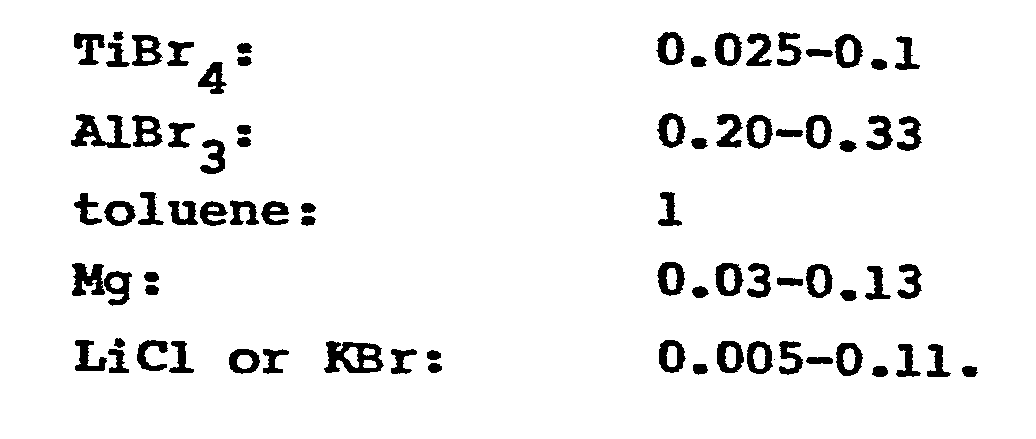
11. The method of claim 10, characterized by the electrolyte comprising 0.01-0.05
gr. at. of Mg particles, 0.05-0.15 moles KBr and an additional amount of 0.1-0.3 moles
of AlBr3 per mole toluene, the latter being added to the electrolyte after the initial pre-reduction
of the Ti 4+ ions to Ti2+ ions by the Mg.
12. The method of claim 9, characterized by the electrolyte comprising MoBr3, AlBr3, toluene, and Mg in a molar (gr. at.) concentration of 0.01-0.05 : 0.1-0.5 : 1 :
0.01-0.05, 0.1-0.3 moles KBr per mole toluene being added to the electrolyte after
pre-reduction of the Mo3+ ions to a lower oxidation state by the Mg.
13. The method of claim 9, characterized by the electrolyte comprising MoBr3, AlBr3, toluene, and A1 in a molar (gr. at.) concentration of 0.01-0.05 : 0.1-0.5 : 1 :
0.01-0.05, 0.1-0.3 moles LiC1 per mole toluene being added to the electrolyte after
pre-reduction of the Mo3 ions to a lower oxidation state by the Al.
14. The method of claim 9, characterized by the electrolyte comprising CrCl3, AlCl3, LiCl, toluene and Al in a molar concentration of 0.02-0.05 : 0.2-0.5 : 0.15-0.25
: 1 : 0.05-0.20.
15. The method of claim 14, characterized by the electrolyte further comprising 0.025-0.100
moles of TiBr4.
16. The method of one of the claims 1-15, characterized by the ions of the electroplated
metals being substantially continuously fed into the electrolyte by means of feed
anodes.
17. The method of one of claims 1-16, characterized by the substrate comprising nickel,
cobalt, iron and/or titanium.
18. The method of claim 17, characterized by the substrate encompassing an intermediate
layer comprising nickel.
19. The method of one of the claims 1-18, characterized by the coating and the substrate
being heat treated at temperatures between 400°C and 1200°C to allow interdiffusion
of substrate components with the coating.
20. A coating comprising at least one or an alloy of several transition metals of
the groups IVB, VB or VIB of the periodic table or an alloy of at least one of said
transition metals with aluminum, charactrized by the coating being produced by a method
of any of the preceeding claims.
21. The coating of claim 20, characterized by a composition of 1-95 wt% of the transition
metal(s) and 99-5 wt% of Al.
22. A coating produced according to the method of claim 19, characterized by the coating
comprising intermetallic compounds of at least one component of the substrate and
at least one component of the coating, the intermetallic compound being stable at
temperatures up to 1500°C.
23. A use of the coating of one of the claims 20-22 for corrosion and oxidation protection
in aqueous solutions or high temperature gaseous environments.