|
(11) | EP 0 149 000 B1 |

| (12) | EUROPEAN PATENT SPECIFICATION |
|
|
| (54) |
Process for preparing an aqueous dispersion of polytetrafluoroethylene Verfahren zur Herstellung einer wässrigen Polytetrafluorethylendispersion Procédé de préparation d'une dispersion aqueuse de polytétrafluoroéthylène |
|
|
|||||||||||||||||||||||||||||||
| Note: Within nine months from the publication of the mention of the grant of the European patent, any person may give notice to the European Patent Office of opposition to the European patent granted. Notice of opposition shall be filed in a written reasoned statement. It shall not be deemed to have been filed until the opposition fee has been paid. (Art. 99(1) European Patent Convention). |
[0001] The present invention relates to a process for preparing an aqueous dispersion of polytetrafluoroethylene (hereinafter referred to as "PTFE"). More particularly, it relates to a process for preparing an aqueous PTFE dispersion containing colloidal PTFE particles having a comparatively large average particle size.
[0002] PTFE fine powder prepared by coagulating and drying an aqueous PTFE dispersion is used as a coating of a wire and cable, a tube having a small or large diameter, a sealing tape, etc. In such applications of PTFE fine powder, relationship between characteristics of PTFE fine powder and its processability has been extensively studied and it has been found, for example, that PTFE fine powder having a larger average particle size is paste extruded at a lower extursion pressure.
[0003] Various processes for preparing an aqueous PTFE dispersion comprising colloidal PTFE particles having a comparatively large average particle size have been developed and described, for example, in Japanese Patent Publication Nos. 16154/1968, 39829/1970 and 14466/1971.
[0004] The process described in Japanese Patent Publication No. 16154/1968 is characterized in that, in polymerization of tetrafluoroethylene (hereinafter referred to as "TFE") in an aqueous medium, 1 x 10⁻⁵ tOt 1 x 10⁻⁴ mol/I of a water soluble compound selected from the group consisting of water soluble compounds of zinc, aluminum and alkaline earth metals which afford cations when dissolved in the aqueous medium is added to the aqueous medium. Thereby, the average particle size of the PTFE particle is controlled. The metal ion to be added in this process, however, finally constitutes a contaminant in the polymerization system and reduces interfacial potential of the colloidal particle resulting in deterioration of stability of the system.
[0005] The processes described in Japanese Patent Publication Nos. 39829/1970 and 14466/1971 are characterized in that the average particle size of PTFE is controlled by addition of a specific dispersant (i.e. a surfactant) at a specific time in the course of the polymerization. Although mono-dispersed collidal PTFE particles having a large average particle size are prepared by these processes, it is not convenient to add an aqueous concentrate of the dispersant in the course of the polymerization.
[0006] DE-A-2157170 discloses a dispersible PTFE powder produced by emulsion polymerisation of a monomer in the presence of octafluorcyclobutane and polyfluoroalkanoic acid. The powder consists of predominantly spherical particles having an average diameter of at least 0.35 IJm, a surface area of at least 9 m2/g and a narrow particle size distribution.
[0007] As a result of the extensive study to overcome the drawbacks of the conventional processes and to provide a convenient process for preparing PTFE particles having a comparatively large average particle size, it has now been found that when initial polymerization pressure is made lower for a specific period of time than polymerization pressure in the rest of polymerization period, colloidal PTFE particles having a comparatively large average particle size is prepared.
[0008] Accordingly, the present invention provides a process for preparing an aqueous PTFE dispersion containing colloidal PTFE prticles having a comparatively large average particle size, comprising polymerizing TFE in an aqueous medium at a temperature of from 10 to 100°C in the presence of a fluorine-containing dispersant and a water soluble polymerization initiator, in which, after the initiation of the polymerization and before consumption of 30% of TFE to be polymerized, TFE is polymerized at a pressure of not higher than 4 x 10⁵ Pa (4 Kg/cm2) for a period in which at least 1 g of TFE per liter of the aqueous medium is consumed, and then the rest of the TFE is polymerized at a pressure of from 6 x 10⁵ o 30 x 105 Pa (6 to 30 Kg/cm2).
[0009] Figs. 1, and 3 show the relationships between MP, and the average particle size, between P' and the average particle size, and between the average particle size and the extrusion pressure respectively.
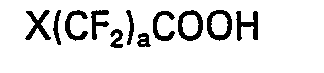
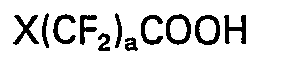
[0010] Specific examples of the fluorine-containing dispersant used in the process of the invention are a compound of the formula: t
wherein X is hydrogen, fluorine or chlorine and a is an integer of 6 to 12, a compound of the formula:
wherein b is an integer of 2 to 6 and a compound of the formula:
wherein Y is fluorine or lower perfluoroalkyl, c is an integer of 1 to 5 and d is an integer of 0 to 10, and salts of these compounds, for example, with ammonium, sodium and potassium. Usually, the amount of the dispersant to be added to the aqueous medium is from 0.01 to 0.5% by weight.
[0011] Specific examples of the water soluble polymerization initiator are water soluble persulfates (e.g ammonium persulfate and potassium persulfate), water soluble aliphatic dibasic carboxylic acid peroxides (e.g. disuccinic acid peroxide and diglutaric acid peroxide) and a mixture thereof. Usually, the amount of the initiator to be used is, in case of ammonium persulfate, from 0.0001 to 0.2% by weight, preferably from 0.001 to 0.1% by weight based on the weight of the aqueous medium and, in case of disuccinic acid peroxide, from 0.005 to 0.5% by weight, preferably from 0.01 to 0.2% bvy weight based on the weight of the aqueous medium. When the polymerization is carried out at a low temperature, a redox type initiating system comprising the above peroxide and a reducing agent (e.g. alkalimetal disulfite and bisulfite) may be used.
[0012] To the polymerization system, a dispersion stabilizer may be added and its specific examples are hydrocarbons having at least 12 carbon atoms which are liquid under the polymerization conditions (e.g. paraffins, mineral oils, etc.).
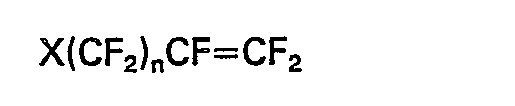
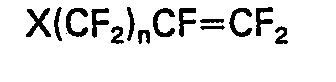
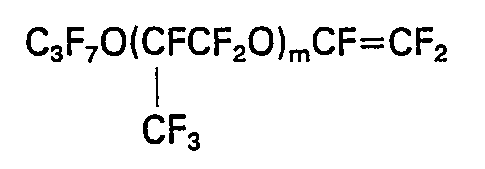
[0013] Further, as a modifier of PTFE, at least one monomer copolymerizable with TFE may be present in the polymerization system in such an amount that 0.001 to 2% by weight preferably from 0.002 to 0.5% by weight of the modifier is copolymerized. Specific examples of the modifier are compounds of the formulas:
and
wherein X is the same as defined above, n is an integer of 0 to 7 and m is 1 or 2.
[0014] Generally, in the conventional processes in which the polymerization is carried out at a pressure of from 6 x 10⁵ to 30 x 105 Pa (6 to 30 Kg/cm2) over the whole polymerization period, copolymerization of the modifier with TFE affords colloidal PTFE particles having a smaller average particle size. On the contrary, by the process of the invention, colloidal PTFE particles having a comparatively large average particle size are produced even when the modifier .is copolymerized. The addition mode of the modifier is not critical. Preferably, in the low pressure polymerization period, the modifier is also used in a reduced amount corresponding to the TFE partial pressure.
[0017] Control of the polymerization pressure is one of the characteristics of the invention. In a so-called nuclei forming period, namely a period after the initiation of the polymerization and before the consumption of 30%, preferably 10% of TFE to be polymerized, the polymerization presure is kept at a pressure of not higher than 4 x 10⁵ Pa (4 Kg/cm2) (herein referred to as "P,"). At such low polymerization pressure, the polymerization is carried out for a period in which at least 1 g, preferably at least 2 g of TFE per liter of the aqueous medium is consumed. The longer this period, the more satisfactorily the object of the invention achieved. However, if the low pressure period is too long, too large PTFE particles are formed and the polymerization system is rendered to be unstable. The higher P, is set, the further the low pressure period is extended. Otherwise, sufficiently large PTFE particles are not produced. However, too low P, makes the polymerization time too long, which deteriorates the producibility. The preferred P, is a sum of the TFE partial pressure of 0.2 x 10⁵ to 2 x 10⁵ Pa (0.2 to 2 Kg/cm2) and water-vapor pressure at a polymerization temperature. If P, is higher than 4 x 10⁵ Pa (4 Kg/cm2), the object of the invention is not achieved.
[0018] Influences of the consumed amount of TFE in the low pressure period (herein referred to as "MP,") and of P, on the particle size of PTFE (not including the modifier) are shown in Figs. 1 and 2. These data are obtained in below described Examples.
[0019] After the low pressure polymerization period, the polymerization pressure is raised to a pressure of from 6 x 10⁵ to 30 x 105 Pa (6 to 30 Kg/cm2) (hereinafter referred to a "P2") and the polymerization is continued to obtain the colloidal PTFE particle of the invention. During raising the polymerization pressure from P, to P2, the polymerization proceeds, but the present invention does not restrict the raising rate of the polymerization pressure. Usually, concentration of the thus prepared aqueous PTFE dispersion is from 20 to 40% by weight.
[0020] From the aqueous PTFE dispersion of the invention, the PTFE fine powder is obtained by a per se conventional method, for example, by coagulation, or co-coagulation. The aqueous PTFE dispersion of the invention may be used as a coating material. In this case, the dispersion may be used as such or together with an adhesive assistant, or the aqueous dispersion may be converted to organosol. With the dispersion of the invention, critical thickness for cracking, namely the maximum thickness of a coating with which the dispersion is coated at a time without cracking is improved.
[0021] Since the aqueous PTFE dispersion obtained by the process of the invention does not contain any metal ion that is inevitably contained in the dispersion of Japanese Patent Publication No. 16154/1968, the interfacial potential of the colloidal particle is not reduced and the system is stable. The workability of the present process is superior to the conventional methods in which the dispersant should be added in the course of the polymerization.
[0023] In Examples, the average particle sizes (1) and (2) of the colloidal PTFE particles and the paste extrusion pressure are measured as follows:
Average particle size (1)
[0024] With a lighttransmission type centrifugal sedimentation particle size distribution analyzer (CAPA-500, manufactured by Kabushikikaisha Horiba Seisakusho), 50% diameter based on area is measured under following conditions:
Average particle size (2)
[0025] A calibration curve is first prepared from transmittance of light having a wavelength of 500 nm through a unit length of an aqueous PTFE dispersion having a solid content of about 0.22% by weight and a number average particle size calculated from an electron microphotograph. Transmittance of each sample is measured and its average particle size is determined from the calibration curve.
Paste extrusion pressure
[0026] PTFE fine powder (50 g) and an extrusion assistant (10.8 g) (Trade name "IP 1620", manufactured by Idemitsu Petrochemical Co., Ltd.) are mixed in a glass bottle and aged at 25 ± 2°C for 1 hour. A cylinder (inner diameter of 25.4 mm) and an extrusion die (die angle of 30°, nozzle diameter of 2.54 mm, nozzle length of 7 mm) are filled with the mixture and load of 100 Kg is applied to a piston for 1 minute. Then, the mixture is extruded at a ram speed of 760 mm/min to obtain a strand. The extrusion pressure is calculated by dividing the extrusion pressure in the equilibrated latter half period by the cross sectional area of the cylinder.
Example 1
[0027] To a 1 liter glass made autoclave equipped with a paddle agitator, deionized deoxydized water (545 ml), liquid paraffin (first class grade reagent, 30 g) and ammonium perfluorooctanate (0.55 g) were charged. The interior space of the autoclave was replaced three times with nitrogen gas and two times with TFE at 70°C. TFE was injected to pressurize to 0.65 x 10⁵ Pa (0.65 Kg/cm2) (corresponding to P,) with TFE partial pressure being 0.34 x 10⁵ Pa (0.34 Kg/cm2). Thereafter, a solution of ammonium persulfate (5 mg) in water (5 ml) was added to the mixture contained in the autoclave with agitating it at 500 rpm. Polymerization very slowly proceeded. Till 5.5 g/I of TFE (corresponding to MP,) was consumed after 4.0 hours from the addition of the initiator, the internal pressure was kept at 0.65 x 10⁵ Pa (0.65 Kg/cm2). Then, TFE was injected to pressurize to 10 x 105 Pa (10 Kg/cm2) (corresponding to P2) and the polymerization was carried out at the same pressure. When 350 g/I of TFE (corresponding to MP2) was consumed in all, the agitator and the injection of TFE were stopped and the unreacted TFE was purged to germinate the polymerization. The polymerization time at 10 x 105 Pa (10 Kg/cm2) was 9.5 hours. The temperature was kept at 70°C over the whole polymerization period. The thus prepared aqueous PTFE dispersion was stable and very few PTFE particle was coagulated on the blades of the agitator and the inner wall of the autoclave.
[0028] The average particle size of the colloidal PTFE particle was 0.26 micrometers. The paste extrusion pressure of the PTFE fine powder obtained by coagulating, particulating and then drying at 130°C the colloidal PTFE particle was 128 x 105 Pa (128 Kg/cm2).
Comparative Example 1
[0029] In the same manner as in Example 1 but maintaining the pressure at 10 x 105 Pa (10 Kg/cm2) over the whole period, the polymerization was carried out for 6.3 hours. 350 g/I of TFE was consumed. The average particle size of the collidal particles was 0.18 micrometer and the paste extrusion pressure was 162 x 105 Pa (162 Kg/cm2).
Examples 2-4
[0030] In the same manner as in Example 1 but adjusting MP, to 1.4 g/I (Example 2), 2.5 g/I (Example 3) and 9.5 g/I (Example 4), the polymerization was carried out. The average particle size was 0.23, 0.24 and 0.28 micrometer respectively, and the paste extrusion pressure was 143 x 105, 138 x 105 and 122 x 105 Pa (143, 138 and 122 Kg/cm2) respectively.
Examples 5-7
[0031] In the same manner as in Example 1 but adjusting P, to 0.45 x 10⁵ Pa (0.45 Kg/cm2) (Example 5), 1.25 x 10⁵ Pa (1.25 Kg/cm2) (Example .6) and 3.25 x 10⁵ Pa (3.25 Kg/cm2)(Example 7), the polymerization was carried out. In Example 5, the low pressure polymerization period was very long. The results are shown in Table.
Comparative Example 2
[0032] In the same manner as in Example 1 but adjusting MP1 to 0.4 g/l; the polymerization was carried out. The results are shown in Table.
Comparative Example 3
[0033] In the same manner as in Example 1 but adjusting P1 to 5 x 10⁵ Pa (5.0 Kg/cm2), the polymerization was carried out. The average particle size of the colloidal particles was 0.20 micrometer and the paste extrusion pressure was 158 x 105 Pa (158 Kg/cm2). In comparison with Comparative Example 1, the increase of the particle size and the decrease of the extrusion pressure are small.
[0035] Further, the relationships between MP1 and the average particle size (P1 = 0.65 x 10⁵ Pa (0.65 Kg/cm2)), between P1 and the average particle size (MP1 = 5.5 g/I) and between the average particle size and the extrusion pressure are shown in Figs. 1, 2 and 3 respectively.
Example 8
[0036] To a 1 liter glass made autoclave equipped with a paddle agitator, deionized deoxydized water (545 ml), liquid paraffin (30 g) and ammonium perfluorooctanate (0.55 g) were charged. The interior space of the autoclave was replaced three times with nitrogen gas and two times with TFE at 70°C. Perfluoro(n-propyl vinyl ether) [n-C3F7OCF=CF2 (hereinafter referred to as "PPVE") 0.5 g, purity 98%] was added. Then, TFE was injected to pressurize to 5 x 10⁵Pa (5 Kg/cm2). Thereafter, a solution of ammonium persulfate (15 mg) in water (5 ml) was added to the mixture contained in the autoclave with agitating it at 500 rpm. As the polymerization proceeded, the pressure was gradually dropped to 3.5 x 10⁵ Pa (3.5 Kg/cm2) (corresponding to P,) after 35 minutes, during which about 7 g/I of TFE was consumed. The same pressure was kept till 9.5 g/I of TFE (corresponding to MP,) was consumed after 1 hour from the initiation of the polymerization. Then TFE was injected to pressurize to 10 x 105 Pa (10 Kg/cm2) (corresponding to P2) and the same pressure was kept by injecting TFE. When 350 g/I of TFE (corresponding to MP2) was consumed in all, the agitator and the injection of TFE were stopped and the unreacted TFE was purged to terminate the polymerization. Total polymerization time was 8.5 hours. The temperature was kept at 70°C over the whole polymerization period.
[0037] The average particle size of the colloidal PTFE particles was 0.17 micrometers. The content of the comonomer (modifier) in PTFE was found to be 0.085% by weight according to the infrared spectroscopic analysis described in Japanese Patent Publication No. 38159/1975 and U.S. Patent No. 3,819,594).
Example 9
[0038] To a 1 liter glass made autoclave equipped with a paddle agitator, deionized deoxydized water (545 ml), liquid paraffin (30 g) and ammonium perfluorooctanate (0.55 g) were charged. The interior space of the autoclave was replaced three times with nitrogen gas and two times with TFE at 70°C, and PPVE (0.1 g) was added. Then, TFE was injected to pressurize to 2 x 10⁵ Pa (2 Kg/cm2). Thereafter, a solution of ammonium persulfate (15 mg) in water (5 ml) was added to the mixture contained in the autoclave with agitating it at 500 rpm. By injecting TFE for about 50 minutes, the internal pressure was kept at 2.0 x 10⁵ to 1.5 x 10⁵ Pa (2.0 to 1.5 Kg/cm2), during which 8.0 g/I of TFE was consumed. Then, PPVE (0.4 g) was added and TFE was injected to pressurize to 10 x 105 Pa (10 Kg/cm2) (corresponding to P2) and the same pressure was kept by injecting TFE for 8.3 hours. When 350 g/I of TFE (corresponding to MP2) was consumed in all, the agitator and the injection of TFE were stopped and the unreacted TFE was purged to terminate the polymerization. The temperature was kept at 70°C over the whole polymerization period.
[0039] The average particle size of the colloidal PTFE particles was 0.19 micrometers. The content of the comonomer in PTFE was 0.082% by weight.
Comparative Example 4
[0040] In the same manner as in Example 8 but maintaining the pressure at 10 x 105 Pa (10 Kg/cm2) over the whole polymerization period, the polymerization was carried out for 7.2 hours. 350 g/I of TFE was consumed. The average particle size of the collidal particles was 0.12 micrometer and the comonomer content was 0.090% by weight.
Example 10
[0041] To a 6 liter glass made autoclave equipped with a paddle agitator, deionized deoxydized water (2,990 ml), solid paraffin having a melting point of 56°C (100 g) and ammonium perfluorooctanate (3.0 g) were charged. The interior space of the autoclave was replaced three times with nitrogen gas and two times with TFE at 70°C. PPVE (0.2 g) was added. Then, TFE was injected to pressurize to 2 x 10⁵ Pa (2 Kg/cm2). Thereafter, a solution of ammonium persulfate (30 mg) in water (10 ml) was added to the mixture contained in the autoclave with agitating it at 500 rpm. By injecting TFE for about 40 minutes, the internal pressure was kept at 2 x 10⁵ to 1.5 x 10⁵ Pa (2.0 to 1.5 Kg/cm2), during which about 20 g (6.7 g/I) of TFE was consumed. Then, PPVE (0.7 g) was added and TFE was injected to pressurize to 10 x 105 Pa (10 Kg/cm2) (corresponding to P2) and the same pressure was kept by injecting TFE in the rest of polymerization period. After pressurizing to 10 x 105 Pa (10 Kg/cm2), each 0.7 g of PPVE was added six times every consumption of 200 g of TFE. When 1,350 g (450 g/I) of TFE (corresponding to MP2) was consumed in all, the agitator and the injection of TFE were stopped and the unreacted TFE was purged to terminate the polymerization. The temperature was kept at 70 ± 1°C over the whole polymerization period. The polymerization time at 10 x 105 Pa (10 Kg/cm2) was 9.8 hours.
1. A process for preparing an aqueous PTFE dispersion containing colloidal PTFE particles
having a comparatively large average particle size, comprising polymerizing TFE in
an aqueous medium at a temperature of from 10 to 100°C in the presence of a fluorine-containing
dispersant and a water soluble polymerization initiator, in which, after the initiation
of the polymerization and before consumption of 30% of TFE to be polymerized, TFE
is polymerized at a pressure not higher than 4 x 10⁵ Pa (4 Kg/cm2) for a period in which at least 1 g of TFE per liter of the aqueous medium is consumed,
and then the rest of TFE is polymerized at a pressure of from 6 x 10⁵ to 30 x 105 Pa (6 to 30 Kg/cm2).
2. A process according to claim 1, wherein at least one modifier copolymerizable with
tetrafluoroethylene selected from the group consisting of compounds of the formulas:

and
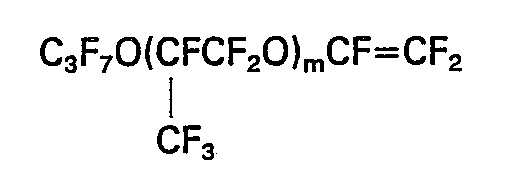
wherein X is hydrogen, fluorine or chlorine, n is an integer of 0 to 7 and m is 1 or 2 is present in the polymerization system.
and
wherein X is hydrogen, fluorine or chlorine, n is an integer of 0 to 7 and m is 1 or 2 is present in the polymerization system.
3. A process according to claim 1, wherein the low pressure polymerization period
is after the initiation of the polymerization and before consumption of 10% of tetrafluoroethylene
to be polymerized, and the partial pressure of tetrafluoroethylene in this period
from 0.2 x 10⁵ to 2 x 10⁵ Pa (0.2 to 2 Kg/cm2).
4. A process according to claim 1, wherein the fluorine-containing dispersant is one
selected from the group consisting of a compound of the formula:
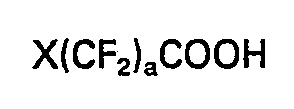
wherein X is hydrogen, fluorine or chlorine, and a is an integer of 6 to 12, a compound of the formula:

wherein b is an integer of 2 to 6 and a compound of the formula:

wherein Y is fluorine or lower perfluoroalkyl, c is an integer of 1 to 5 and d is an integer of 0 to 10, and salts of these compounds with ammonium, sodium and potassium.
wherein X is hydrogen, fluorine or chlorine, and a is an integer of 6 to 12, a compound of the formula:
wherein b is an integer of 2 to 6 and a compound of the formula:
wherein Y is fluorine or lower perfluoroalkyl, c is an integer of 1 to 5 and d is an integer of 0 to 10, and salts of these compounds with ammonium, sodium and potassium.
5. A process according to claim 1, wherein the polymerization initiator is one selected
from the group consisting of water soluble persulfates, water soluble aliphatic dibasic
acid peroxides and a mixture thereof.
6. A process according to claim 5, wherein the polymerization initiator is ammonium
persulfate.
7. A process according to claim 1, wherein the polymerization system comprises at
least one dispersion stabilizer selected from the group consisting of hydrocarbons
having at least 12 carbon atoms which are liquid under the polymerization conditions.
1. Verfahren zur Herstellung einer wässrigen PTFE-Dispersion mit kolloidalen PTFE-Teilchen,
die eine vergleichsweise große durchschnittliche Teilchengröße aufweisen, das die
Polymerisation von PFE in einem wässrigen Medium bei einer Temepratur von 10 bis 100°C
in Gegenwart eines fluorhaltigen Dispergiermittels und eines wasserlöslichen Polymerisationsinitiators
umfaßt, wobei nach der Initiierung der Polymerisation und vor dem Verbrauch von 30%
des zu polymerisierenden TFEs das TFE bei einem Druck von nicht mehr als 4 x 10⁵ Pa (4 kg/cm2) während einer Zeitspanne, in der mindestens 1 g TFE pro Liter des wässrigen Mediums
verbraucht wird, polymerisiert wird, und dann der Rest an TFE bei einem Druck von
6 x 10⁵ bis 30 x 105 Pa (6 bis 30 kg/cm2) polymerisiert wird.
2. Verfahren nach Anspruch 1, wobei mindestens ein mit Tetrafluorethylen copolymerisierbarer
Modifizierer, der aus der Gruppe bestehend aus den Verbindungen mit den Formeln:


und
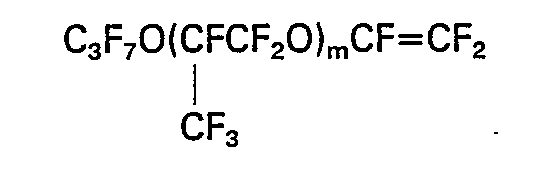
ausgewählt wird, wobei X Wasserstoff, Fluor oder Chlor, n eine Zahl von 0 bis 7 und m 1 oder 2 ist, in dem Polymerisationssystem vorliegt.
und
ausgewählt wird, wobei X Wasserstoff, Fluor oder Chlor, n eine Zahl von 0 bis 7 und m 1 oder 2 ist, in dem Polymerisationssystem vorliegt.
3. Verfahren nach Anspruch 1, wobei die Zeitspanne der Niedrigdruckpolymerisation
nach der Initiierung der Polymerisation und vor dem Verbrauch von 10% des zu polymerisierenden
Tetrafluorethylens liegt, und der Partialdruck des Tetrafluorethylens in dieser Zeitspanne
zwischen 0,2 x 10⁵ und 2 x 10⁵ Pa (0,2 bis 2 kg/cm2) beträgt.
4. Verfahren nach Anspruch 1, wobei das fluorhaltige Dispergiermittel aus der Gruppe
bestehend aus einer Verbinduna der Formel:
wobei X Wasserstoff, Fluor oder Chlor, und a eine Zahl von 6 bis 12 ist, einer Verbindung der Formel:

wobei b eine Zahl von 2 bis 6 ist, und einer Verbindung mit der Formel:

wobei Y Fluor oder ein Niedrigperfluoralkyl, c eine Zahl von 1 bis 5 und d eine Zahl von 0 bis 10 ist, und Salzen dieser Verbindungen mit Ammonium, Natrium und Kalium ausgewählt wird.
wobei X Wasserstoff, Fluor oder Chlor, und a eine Zahl von 6 bis 12 ist, einer Verbindung der Formel:
wobei b eine Zahl von 2 bis 6 ist, und einer Verbindung mit der Formel:
wobei Y Fluor oder ein Niedrigperfluoralkyl, c eine Zahl von 1 bis 5 und d eine Zahl von 0 bis 10 ist, und Salzen dieser Verbindungen mit Ammonium, Natrium und Kalium ausgewählt wird.
5. Verfahren nach Anspruch 1, wobei der Polymerisationsinitiator aus der Gruppe bestehend
aus wasserlöslichen Persulfaten, wasserloslichen, aliphatischen, zweibasigen Säureperoxiden
und einer Mischung daraus ausgewählt wird.
6. Verfahren nach Anspruch 5, wobei der Polymerisationsinitiator Ammoniumpersulfat
ist.
7. Verfahren nach Anspruch 1, wobei das Polymerisationssystem mindestens einen Dispergierstabilisator
enthält, der aus der Gruppe bestehend aus Kohlenwasserstoffen mit mindestens 12 Kohlenstoffatomen,
die unter den Polymerisationsbedingungen flüssig sind, ausgewählt wird.
1. Un procédé pour préparer une dispersion aqueuse de PTFE contenant des particules
colloïdales de PTFE ayant une dimension moyenne de particule relativement grande,
comprenant la polymérisation du TFE dans un milieu aqueux à une température de 10
à 100°C en présence d'un dispersant fluoré et d'un inducteur de polymérisation soluble
dans l'eau, procédé selon lequel, après le démarrage de la polymérisation et avant
consommation de 30% du TFE à polymériser, le TFE est polymérisé sous une pression
de pas plus de 4.105 Pa (4 kg/cm2) pendant une durée dans laquelle on consomme au moins 1 g de TFE par litre du milieu
aqueux, et ensuite le reste du TFE est polymérisé sous une pression de 6.105 à 30.105 Pa (6 à 30 kg/cm2).
2. Un procédé selon la revendication 1, selon lequel le système de polymérisation
contient au moins un agent modifiant copolymérisable avec le tétrafluoroéthylène,
choisi dans le groupe constitué par les composés de formules:

et
dans lesquelles X est l'hydrogène, le fluor ou le chlore, n est un entier de 0 à 7 et m est égal à 1 ou 2.
et
dans lesquelles X est l'hydrogène, le fluor ou le chlore, n est un entier de 0 à 7 et m est égal à 1 ou 2.
3. Un procédé selon la revendication 1, selon lequel la période de polymérisation
sous basse pression s'étend après le démarrage de la polymérisation et avant la consommation
de 10% du tétrafluoroéthylène à polymériser, et la pression partielle du tétrafluoroéthylène
dans cette période est de 0,2.105 à 2.105 Pa (0,2 à 2 kg/cm2).
4. Un procédé selon la revendication 1, selon lequel le dispersant fluoré est choisi
dans le groupe constitué par un composé de formule:
dans laquelle X est l'hydrogène, le fluor ou le chlore et a est un entier de 6 à 12, un composé de formule:

das laquelle b est un entier de 2 à 6 et un composé de formule:

dans laquelle Y est le fluor ou un groupe perfluoroalkyle inférieur, c est un entier de 1 à 5 et d est un entier de 0 à 10, et les sels d'ammonium, de sodium et de potassium de ces composés.
dans laquelle X est l'hydrogène, le fluor ou le chlore et a est un entier de 6 à 12, un composé de formule:
das laquelle b est un entier de 2 à 6 et un composé de formule:
dans laquelle Y est le fluor ou un groupe perfluoroalkyle inférieur, c est un entier de 1 à 5 et d est un entier de 0 à 10, et les sels d'ammonium, de sodium et de potassium de ces composés.
5. Un procédé selon la revendication 1, selon lequel l'inducteur de polymérisation
est choisi dans le groupe constitué par les persulfates solubles dans l'eau, les peroxydes
de diacides aliphatiques solubles dans l'eau, et leurs mélanges.
6. Un procédé selon la revendication 5, selon lequel l'inducteur de polymérisation
est le persulfate d'ammonium.
7. Un procédé selon la revendication 1, selon lequel le système de polymérisation
comprend au moins un stabilisant de dispersion choisi dans le groupe constitué par
les hydrocarbures en au moins C,2 qui sont liquides dans les conditions de polymérisation.