| (19) |
 |
|
(11) |
EP 0 156 064 B1 |
| (12) |
EUROPEAN PATENT SPECIFICATION |
| (45) |
Mention of the grant of the patent: |
|
16.03.1988 Bulletin 1988/11 |
| (22) |
Date of filing: 19.10.1984 |
|
| (51) |
International Patent Classification (IPC)4: F02N 11/10 |
|
| (54) |
Start switch mechanism
Anlassschaltervorrichtung
Dispositif pour commutateur de démarrage
|
| (84) |
Designated Contracting States: |
|
DE FR GB |
| (30) |
Priority: |
24.10.1983 US 544924
|
| (43) |
Date of publication of application: |
|
02.10.1985 Bulletin 1985/40 |
| (73) |
Proprietor: J. I. Case Company |
|
Racine, WI 53404 (US) |
|
| (72) |
Inventor: |
|
- Bellah, Glen R.
Bolingbrook
Illinois 60439 (US)
|
| (74) |
Representative: Geldard, David Guthrie et al |
|
Urquhart-Dykes & Lord
Tower House
Merrion Way
GB-Leeds LS2 8PB
GB-Leeds LS2 8PB (GB) |
| (56) |
References cited: :
DE-A- 2 426 319
US-A- 3 808 914
|
DE-A- 2 546 286
|
|
| |
|
|
|
|
| |
|
| Note: Within nine months from the publication of the mention of the grant of the European
patent, any person may give notice to the European Patent Office of opposition to
the European patent
granted. Notice of opposition shall be filed in a written reasoned statement. It shall
not be deemed to
have been filed until the opposition fee has been paid. (Art. 99(1) European Patent
Convention).
|
[0001] This invention pertains to start switch mechanisms and more particularly to a vehicle
start switch assembly permitting starting of an engine when a vehicle transmission
is in neutral gear.
[0002] DE-A-2546286, US―A―3808914 and DE-A-2426319 each disclose a switch incorporated into
a gear shift assembly and connected to a starter motor circuit in such a way that
the starter motor can not be operated unless the gear is in a neutral position.
[0003] Some vehicles, such as tractors, have a range transmission that incorporates a first
shaft controlling engagement of a first series of gears and a second shaft controlling
engagement of a second series of gears. These vehicles have a conventional start switch,
which is actuated by pressing a range clutch pedal to a disengaged position. This
allows the operator to turn the key switch to start the tractor. It was thus necessary
to hold the clutch pedal in the disengaged position in order to turn the ignition
key, so preventing an undesirable and accidential engagement of gears while actuating
the starting circuit. The prior art documents cited above do not suggest how to eliminate
the necessity of range clutch disengagement while actuating the starting circuit by
utilizing a single switch, and the invention seeks to solve this problem.
[0004] According to the present invention, a start switch mechanism for enabling a starting
circuit in a motor vehicle comprises a first shaft controlling engagement of a first
series of gears of a gear transmission; a second shaft controlling engagement of a
second series of gears of the gear transmission; a switch mounted to move with said
first shaft and connected with said vehicle starting circuit; an actuating means mounted
to move with said second shaft and engageable with said switch to operate said switch
to enable said starting circuit; said actuating means engaging said switch only when
said first and second shafts are in a predetermined relative position corresponding
to a neutral position of each of said shafts, which corresonds to the neutral zone
of the gear transmission. The fact that the predetermined relative position is a neutral
position of each of said shafts ensures that the starting circuit is enabled only
when the gear transmission is in neutral.
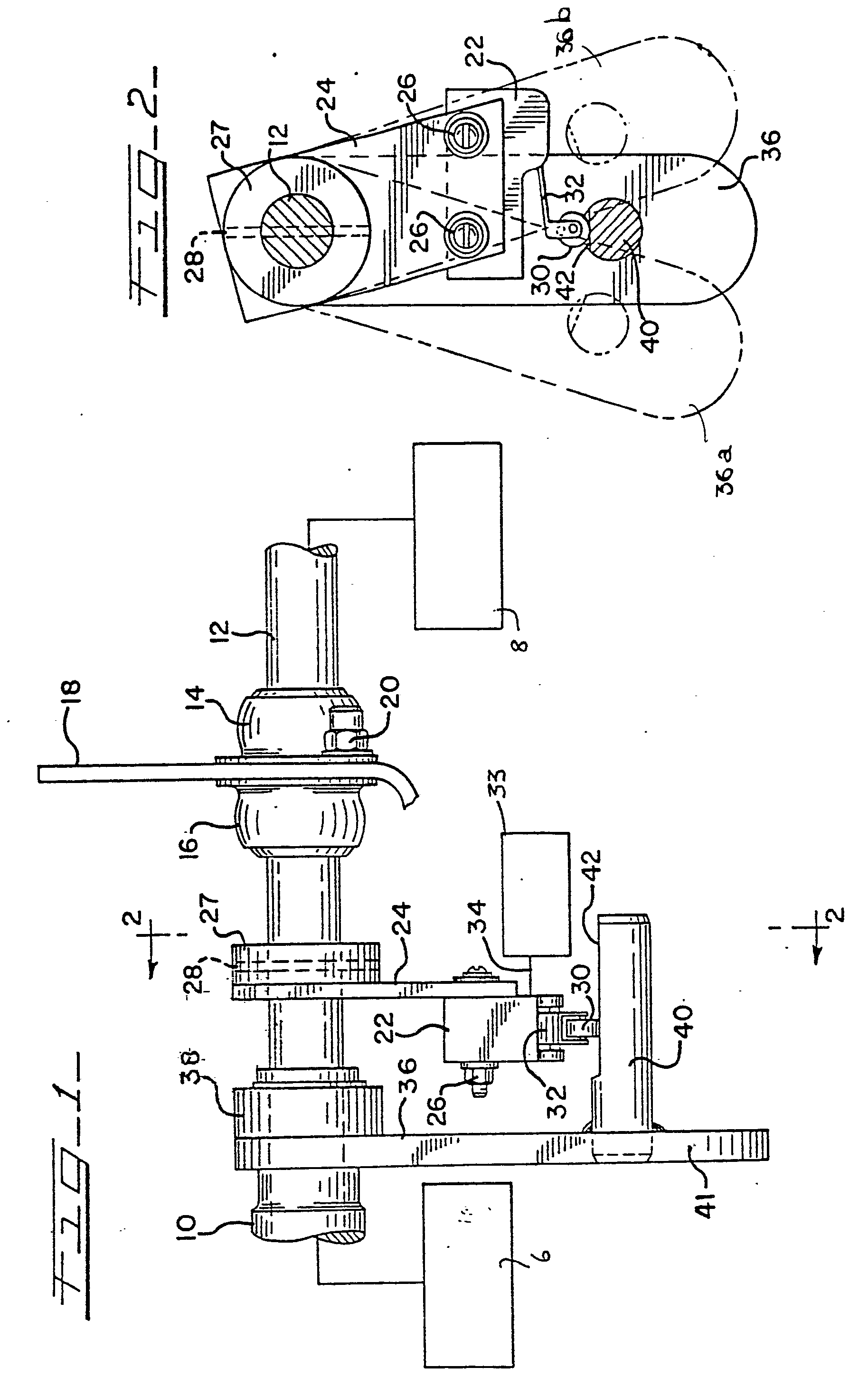
[0005] An embodiment of a mechanism according to the invention will now be described in
more detail by way of example only, with reference to the accompanying drawings in
which:-
Figure 1 is a partially schematic side view of a start switch mechanism; and
Figure 2 is a cross-sectional view taken substantially along the lines 2-2 in Figure
1.
[0006] Referring now to the drawings, there is shown part of a range transmission of a motor
vehicle, such as a tractor or the like. The range transmission includes "low" and
"reverse" range gears 6 engageable by controlled angular movement of an outer shaft
10 and "medium" and "high" range gears 8 engageable by controlled angular movement
of an inner shaft 12. The shaft 12 is coaxially disposed within the outer shaft 10,
and is supported by bearings 14 and 16, which are mounted on a support plate 18 by
bolts 20. The shafts 10 and 12 are shown in a neutral position in Figure 1 and in
solid lines in Figure 2. Engagement of low or reverse range gears entails angular
movement of shaft 10 from this neutral position, while engagement of medium or high
range gears entails angular movement of shaft 12 from the neutral position. Such movement
is effected by the vehicle operator by way of conventional controls as is well understood
in the art. A start switch 22, which can be a micro switch or any other tripping mechanism,
is attached to a lever 24 by bolts 26. The lever 24 is mounted on the shaft 12 by
a hub 27 extending along the shaft and is secured to the shaft 12 by a coil spring
pin 28 inside a cross-hole. This provides a releasable attachment of the lever 24
to the inner shaft 12.
[0007] The switch 22 includes a roller 30 supported by a pivoted operating lever 32, which
projects outwardly from the switch 22 and is biased downwardly. When the lever 32
is moved against the bias into its upper or actuating position it closes the switch
22, causing enabling of a starting circuit 33 by way of an electrical connection 34.
[0008] An arm 36 having an integral hub or ring portion 38 is secured to the outer shaft
10 and rotatable therewith. A switch actuation pin 40 is welded to the arm 36 to extend
outwardly from a free end 41 of the arm. The pin 40 has a platform 42 capable of contacting
the roller 30, to move the lever 32 against the bias into its upward position and
hold it in that position. Thus, the starting circuit is enabled and the engine can
be started by operating the starter key switch.
[0009] It will be noted that the circuit is only enabled when the two shafts are aligned
in. the neutral position. When either shaft is rotated into a gear range other than
neutral, the pin 40 lies out of contact with the roller 30 and the lever 32 is thus
biased to the switch open position, so disenabling the starting circuit. Figure 2
shows in broken lines the positions of arm 36 and pin 40 when the shaft 10 is moved
to the low range position (broken lines 36a) or the reverse range position (broken
lines 36b). If the shaft 12 is moved to engage medium or high range gears then the
lever 24 will move the switch 22 either clockwise or anticlockwise from the position
shown in Figure 2, the arm 36 lying in its neutral position as shown in solid lines
in that Figure. The pin 40 and roller 30 may, of course, be replaced by equivalent
members shaped to provide a smooth engagement and disengagement on relative angular
movement between the two shafts.
[0010] One of the main advantages of the mechanism is the synchronization of the starting
circuit actuation with the neutral zone of the transmission. This will allow the operator
to start the vehicle only when it is in neutral gear. Another advantage is that it
is only necessary to turn an ignition key to start the vehicle thereby eliminating
the need to keep the clutch pedal in the disengaged position or to use a clutch pedal
at all. A further advantage is that only a single switch is employed, responsive to
movement of either shaft.
1. A start switch mechanism for enabling a starting circuit in a motor vehicle comprising
a first shaft (12) controlling engagement of a first series of gears (8) of a gear
transmission; a second shaft (10) controlling engagement of a second series of gears
(6) of the gear transmission; a switch (22) mounted to move with said first shaft
and connected with said vehicle starting circuit; an actuating means (40) mounted
to move with said second shaft and engageable with said switch to operate said switch
to enable said starting circuit; said actuating means engaging said switch only when
said first and second shafts are in a predetermined relative position corresponding
to a neutral position of each of said shafts, which corresponds to the neutral zone
of the gear transmission.
2. A mechanism according to claim 1, in which the shafts are each rotatable to control
engagement of their respective series of gears, and said first shaft (12) is coaxially
disposed and rotatable within said second shaft (10).
3. A mechanism according to claim 1 or claim 2 in which said actuating means (40)
comprises a pin (40) protruding from an arm (36) secured to move with said second
shaft (10).
4. A mechanism according to any one of the preceding claims in which said switch (22)
is secured to a lever (24) attached to said first shaft (12).
1. Anlaßschalter-Vorrichtung zur Inbetriebnahme eines Anlasserschaltkreises in einem
Kraftfahrzeug, gekennzeichnet durch:
eine erste Welle (12) zur Steuerung der Eingriffsverhältnisse einer ersten Anzahl
von Zahnrädern (8) einer Getriebübersetzung; eine zweite Welle (10) zur Steuerung
der Eingriffsverhältnisse einer zweiten Anzahl von Zahnrädern (6) der Getriebübersetzung;
einen Schalter (22), der derart angeordnet ist, daß er sich mit der ersten Welle bewegt
und der mit dem Kraftfahrzeug-Anlasserschaltkreis verbunden ist; eine Betätigungsvorrichtung
(40), welche sich zusammen mit der zweiten Welle bewegt und mit dem Schalter in Eingriff
bringbar ist, um den Schalter zu betätigen und den Anlasserschaltkreis in Funktion
zu setzen, wobei die Betätigungsvorrichtung nur dann mit dem Schalter in Eingriff
gelangt, wenn die erste und zweite Welle in einer vorbestimmten relativen Stellung
zueinander entsprechend einer Neutrallage einer jeden der Welle sind, welche dem Neutralbereich
der Getriebeübersetzung entspricht.
2. Vorrichtung nach Anspruch 1, dadurch gekennzeichnet, daß die Wellen jeweils drehbar
sind, um die Eingriffsverhältnisse ihrer jeweiligen Anzahl von Zahnrädern steuern
zu können, und daß die erste Welle (12) koaxial zu und drehbar innerhalb der zweiten
Welle (10) ist.
3. Vorrichtung nach Anspruch 1 oder 2, dadurch gekennzeichnet, daß die Betätigungsvorrichtung
(40) einen Bolzen (40) aufweist, der sich von einem Arm (36) aus erstreckt, wobei
sich der Arm mit der zweiten Welle (10) bewegt.
4. Vorrichtung nach einem der vorhergehenden Ansprüche, dadurch gekennzeichnet, daß
der Schalter (22) an einem Hebel (24) befestigt ist, der seinerseits mit der ersten
Welle (12) verbunden ist.
1. Un mécanisme interrupteur de démarrage pour valider un circuit de démarrage d'un
véhicule à moteur, comportant un premier arbre (12) commandant la coopération d'une
première série d'engrenages (8) d'une transmission à engrenages; un second arbre (10)
commandant la coopération d'une seconde série d'engrenages (6) de la transmission
à engrenages; un interrupteur (22) monté pour se déplacer avec ledit premier arbre
et relié audit circuit de démarrage du véhicule; des moyens d'actionnement (40) montés
pour se déplacer avec ledit second arbre et pouvant coopérer avec ledit interrupteur
pour actionner ledit interrupteur pour valider ledit circuit de démarrage; lesdits
moyens d'actionnement coopérant avec ledit interrupteur seulement lorsque lesdits
premier et second arbres sont dans une position relative prédéterminée correspondant
à une position neutre de chacun desdits arbres qui correspond à la zone neutre de
la transmission à engrenages.
2. Un mécanisme selon la revendication 1, dans lequel les arbres sont chacun rotatifs
pour commander la coopération de leur série respective d'engrenages, et ledit premier
arbre (12) est disposé coaxialement et de manière tournante à l'intérieur dudit second
arbre (10).
3. Un mécanisme selon la revendication 1 ou la revendication 2, dans lequel lesdits
moyens d'actionnement (40) comportent une broche (40) qui fait saillie d'un arbre
(36) assujetti pour se déplacer avec ledit second arbre (10).
4. Un mécanisme selon l'une quelconque des revendications précédentes, dans lequel
ledit interrupteur (22) est assujetti à un levier (24) fixé audit premier arbre (12).