|
(11) | EP 0 156 232 B1 |

| (12) | EUROPEAN PATENT SPECIFICATION |
|
|
| (54) |
Multiwavelength spectrophotometer Spektrophotometer für mehrere Wellenlängen Spectrophotomètre pour plusieurs longueurs d'ondes |
|
|
|||||||||||||||||||||||||||||||
| Note: Within nine months from the publication of the mention of the grant of the European patent, any person may give notice to the European Patent Office of opposition to the European patent granted. Notice of opposition shall be filed in a written reasoned statement. It shall not be deemed to have been filed until the opposition fee has been paid. (Art. 99(1) European Patent Convention). |
[0001] The present invention relates to a multiwavelength spectrophotometer, particularly for liquid chromatography and more particularly to a multiwavelength spectrophotometer monitoring simultaneously wavelengths of a spectrum.
[0002] In multiwavelength spectrophotometers, the sensitivity or the signal to noise ratio (S/N ratio) is worse than that of a single wavelength spectrophotometer because the sensitivity of a multichannel light detector formed by a photodiode array used in the multiwavelength spectrophotometer is worse than that of a single channel light detector formed by a single photodiode or photomultiplier used in the single wavelength spectrophotometer due to interface defects between neighbouring photodiodes in the photodiode array of the multichannel light detector. The S/N ratio of the multiwavelength spectrophotometer is particularly very low in the wavelength range of low intensity of a light source. Some known multiwavelength spectrophotometer, described for example in Analytical Chemistry, Volume 55, No. 8, July 1983, pp. 836A, 838A and 842A, offer the following solutions for reducing this disadvantage.
[0003] One known spectrophotometer uses successively two kinds of light sources, for example a deuterium lamp (D₂ lamp) for the ultraviolet wavelength range and a tungsten lamp (W lamp) for the visible wavelength range, respectively. This spectrophotometer, however, is quite expensive and operates quite slowly because the different wavelengths cannot be measured simultaneously but only successively.
[0004] Another known spectrophotometer using a D₂ lamp reduces the S/N ratio in the visible wavelength range by a data processing, called "wavelength bunching" which is an integration of all signals between two preset wavelengths. Hereby, however, the wavelength resolution is deteriorated.
[0005] The object of the present invention is to eliminate the disadvantages of the known multiwavelength spectrophotometer and to provide a multiwavelength spectrophotometer with a high S/N ratio.
[0006] This object is solved according to the invention by a multiwavelength spectrophotometer as defined in claim 1.
[0007] The inventive spectrophotometer eliminates the additional expenses of a second light source, the low operation speed of a successively monotoring spectrophotometer and the low wavelength resolution of the known spectrophotometers as mentioned above and improves, that means increases the S/N ratio, especially in the wavelength range in which the light intensisity of the light source is low.
[0008] Advantageous embodiments of the present invention are described below in connection with the drawings wherein
- figure 1
- is a graph showing the intensity versus wavelength diagram of a light source consisting of a D₂ lamp,
- figure 2
- is a diagrammatic view of the optical system of an embodiment of the spectrophotometer according to the invention,
- figure 3
- is a block diagramm of an electrical circuit for processing the signals from the two light detectors of the spectrophotometer according to the invention,
- figure 4 and 5
- are graphs showing the absorption spectra of a sample measured by the first and second light detector of the spectrophotometer according to the invention,
- figure 6
- is a graph deducted from the graphs of figures 4 and 5 after the inventive averaging operation, and
- figure 7
- is a diagrammatic view of an optical system of another embodiment of the spectrophotometer according to the invention.
[0009] Figure 1 shows the intensity versus wavelength diagram of a D₂ lamp measured by using a silicon photodiode array as light detector. The light intensity of a D₂ lamp is quite low in the visible wavelength range, i.e. in the range above about 400 nm. As a result of this characteristic, the signals of a sample measured for example in a liquid chromatograph using such a D₂ lamp have generally a low S/N ratio in the visible wavelength range.
[0010] Figure 2 shows an optical system of the spectrophotometer comprising a light source 1, a condensor lens 2, a flow cell 3 and a monochromater formed by an entrance slit 4, a concave grating 5 and two multichannel light detectors consisting of two silicon photodiode arrays 6 and 7. The light beam is dispersed by the concave grating 5. Normally, the first order of interference in a first wavelength range is detected simultaneously by the silicon photodiode array 6. The array 7 detects simultaneously the second order of interference in a second wavelength range overlapping at least partly the first wavelength range.
[0011] As the second order of interference has a dispersion being the double of that of the first order of interference and as the photodiode array 7 detects half of the wavelength range of the wavelength range detected by the photodiode array 6, the identical photodiode array can be used for both photodiode array 6 and 7.
[0012] In figure 3, drivers 9 and 10 produce driving pulses ø₁ and ø₂ driving the photodiode arrays 6 and 7 respectively by corresponding command signals from a processor 8. The dirver 9 supplies further a start pulse SP to the photodiode array 6. A wavelength scan end pulse (End of Scan) EOS is supplied from the photodiode array 6 to the photodiode array 7 as a start pulse for the photodiode array 7 and from the photodiode array 7 to the processor 8. The output signals (Array Signal) AS of the photodiode array 6 and 7 are supplied to an A/D converter 15 through amplifiers 11 and 12 and sample and hold circuits 13 and 14. Command signals C are also supplied to the A/D converter 15. The output signals AS are converted to digital signals by the A/D converter 15 in response to the command signals C and read into the processor 8.
[0013] Figure 4 shows an example of the first order of interference of an absorption spectrum of a liquid sample which is measured in a chromatograph by the photodiode array 6 in the wavelength range from 200 to 600 nm. Large noises are indicated in the wavelength range of more than 400 nm in which the light intensity of the D₂ lamp is low.
[0014] Figure 5 shows an example of the second order of interference of an absorption spectrum of the same liquid sample which is measured by the photodiode array 7 in the wavelength range from 400 to 600 nm.
[0015] The processor 8 performs a smoothing or averaging operation for the output signals of the photodiode arrays 6 and 7 as shown in figures 4 and 5 in two steps as follows.
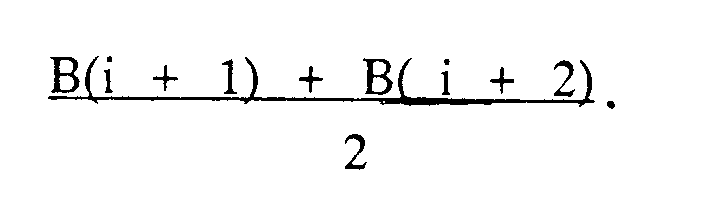
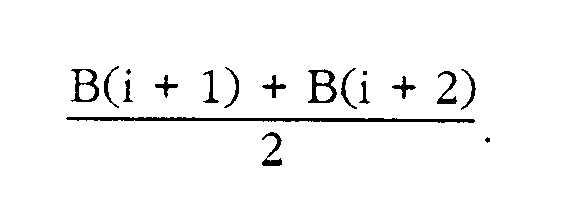
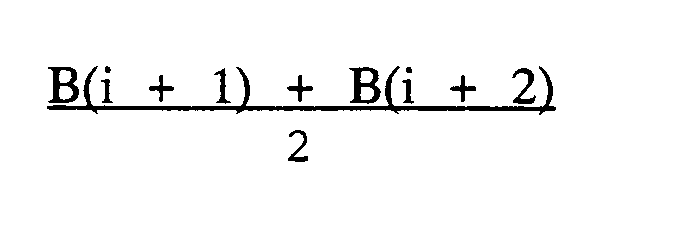
[0016] Let the output signals for the channels 1, 2, 3,...,60 of the photodiode array 7 be B(1), B(2), ...,B(60). The first step of the averaging operating is obtained by averaging the output signals of two neighbouring channels as
[0017] Those obtained signals have essentially the same wavelength resolution of 6 nm as the output signals of each channel of the photodiode array 6 as can be taken from the following.
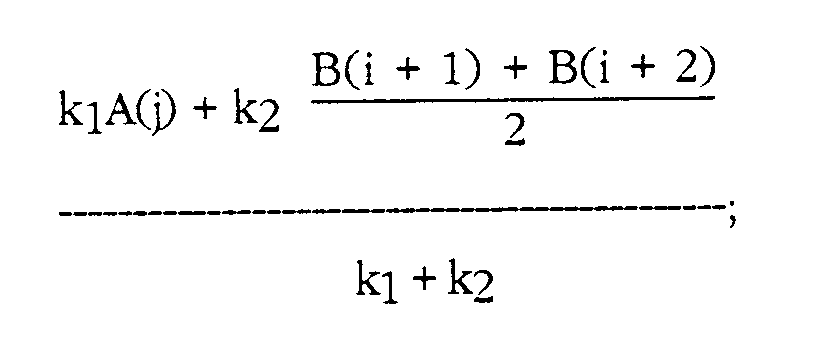
[0018] For the second step of the averaging operation, let the output signals of the channels 1, 2, 3 ...., 60 of the photodiode array 6 be A(1), A(2), A(3), ...., A(60). The output signals A(31), A(32), ...., A(60) indicate the spectrum signals of more than 400 nm. The average signals obtained by the second step of the averaging operation are
[0019] The spectrum including those signals is shown in figure 6. This spectrum indicates a high S/N ratio also in the visible wavelength range from 400 to 600 nm.
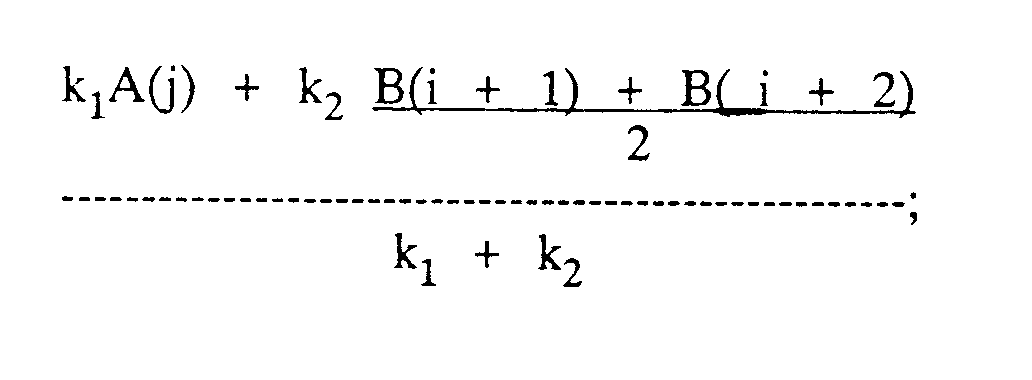
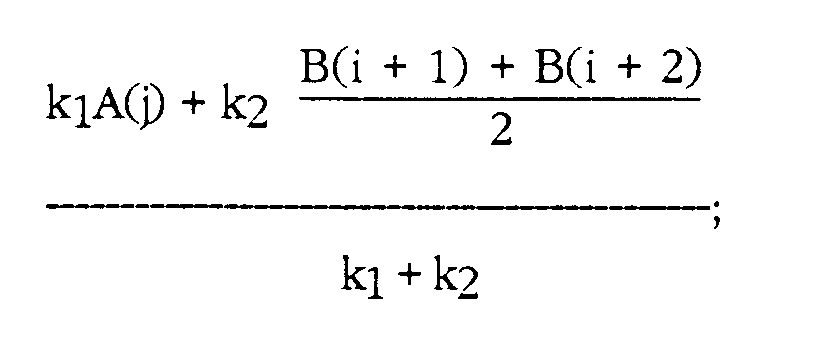
[0020] Depending on the S/N ratio of the spectra in figures 4 and 5, weighted averaging can be performed as
[0021] If the S/N ratio of the output signals of the photodiode array 6 (figure 4) is higher than the S/N ratio of the output signals of the photodiode array 7 (figure 5), a larger weight factor k₁ is taken compared to the weight factor k₂.
[0022] The above description is related to the spectrum data. In case for recording a chromatogram, a fixed wavelength is used for measurement.
[0023] Figure 7 shows another embodiment of the light detectors respectively photodiode arrays. The dispersed light is detected by a photodiode array 60 which has 150 channels. Channels 1 to 60 detect the first order of interference in the wavelength range from 200 to 600 nm. Channels 61 to 150 detect the second order of interference in the wavelength range of 303 to 600 nm. Due to the fact that only one photodiode array 60 is used, only one set of a photodiode array driver, an amplifier and a sample and hold circuit is necessary in the circuit of figure 3.
1. A multiwavelength spectrophotometer, particularly for liquid chromatography comprising
a light source (1), a sample cell (3), a grating (5) for dispersing a light beam from
said light source (1) and a multichannel light detector means (6, 7; 60) for detecting
light dispersed by said grating (5) in a first wavelength range
characterized in
that the multichannel light detector means (6, 7; 60) consist of a first part (6) arranged to detect the first order of interference of said first wavelength range, and of a second part (7) arranged to detect light dispersed by said grating (5) in a second wavelength range overlapping at least partly said first wavelength range, said light detected by said second part (7) having a different order of interference in comparison to the order of interference of said light detected by said first part (6), and in that a processor (8) is provided for averaging output signals in form of an absorption spectrum of each of said first and second part of said multichannel light detector means (6, 7; 60).
characterized in
that the multichannel light detector means (6, 7; 60) consist of a first part (6) arranged to detect the first order of interference of said first wavelength range, and of a second part (7) arranged to detect light dispersed by said grating (5) in a second wavelength range overlapping at least partly said first wavelength range, said light detected by said second part (7) having a different order of interference in comparison to the order of interference of said light detected by said first part (6), and in that a processor (8) is provided for averaging output signals in form of an absorption spectrum of each of said first and second part of said multichannel light detector means (6, 7; 60).
2. A spectrophotometer as claimed in claim 1, characterized in that said first part (6)
and said second part (7) of said multichannel light detector means (6, 7; 60) are
constructed integrally or separately.
3. A spectrophotometer as claimed in claim 1 or 2, characterized in that said second
part (7) of said multichannel light detector means is arranged for detecting the light
in a wavelength range in which the light intensity of said light source (1) is low.
4. A spectrophotometer as claimed in one of claims 1 to 3, characterized in that said
first part (6) of said multichannel light detector means detects the first order of
interference, and in that said second part (7) of said multichannel light detector
means detects the second order of interference.
5. A spectrophotometer as claimed in one of claims 1 to 4, characterized in that said
light source (1) is a deuterium lamp, said first part (6) of said multichannel light
detector means detects the first order of interference of the ultraviolet and visible
wavelength ranges, and said second part (7) of said multichannel light detector means
detects the second order of interference of the visible wavelength range.
6. A spectrophotometer as claimed in claim 5, characterized in that said first part (6)
of said multichannel light detector means detects the light in a wavelength range
from 200 to 600 nm, and said second part (7) of said multichannel light detector means
detects the light in a wavelength range from 400 to 600 nm.
7. A spectrophotometer as claimed in one of claims 1 to 6, characterized in that the
averaging of the output signals in form of the absorption spectrum of said two parts
(6, 7) of said multichannel light detector means follows the following formula
whereby
j is an integer; i = 0, 1, 2, ...; A(j) is the output signal of a photodiode of said first part (6) covering a predetermined wavelength range, B(i + 1) and B(i + 2) are the output signals of two neighbouring photodiodes of said second part (7) covering together the same predetermined wavelength range; and
k₁, k₂ are weight factors for the output signals A(j)
and
whereby
j is an integer; i = 0, 1, 2, ...; A(j) is the output signal of a photodiode of said first part (6) covering a predetermined wavelength range, B(i + 1) and B(i + 2) are the output signals of two neighbouring photodiodes of said second part (7) covering together the same predetermined wavelength range; and
k₁, k₂ are weight factors for the output signals A(j)
and
8. A spectrophotometer as claimed in one of claims 1 to 7, characterized in that each
of said two parts (6, 7) of said multichannel light detector means is an identical
photodiode array.
1. Spectrophotomètre pour plusieurs longueurs d'ondes, en particulier pour chromatographie
liquide comprenant une source lumineuse (1), une cellule échantillon (3), un réseau
de diffraction (5) pour disperser un faisceau lumineux de la source lumineuse (1)
et des moyens de détection de lumière à canaux multiples (6, 7; 60) servant à détecter
la lumière dispersée par ledit réseau de diffraction (5) dans une première gamme de
longueurs d'ondes.
caractérisé en ce que les moyens de détection de lumière à canaux multiples (6, 7; 60) sont composés d'une première partie (6) adaptée pour détecter le premier ordre d'interférence de ladite première gamme de longueurs d'ondes, et d'une deuxième partie (7) adaptée pour détecter la lumière dispersée par ledit réseau de diffraction (5) dans une seconde gamme de longueurs d'ondes chevauchant au moins partiellement ladite première gamme de longueurs d'ondes, ladite lumière détectée par ladite deuxième partie (7) ayant un ordre d'interférence différent, comparé à l'ordre d'interférence de ladite lumière détectée par la première partie (6), et en ce qu'il présente un processeur (8) pour établir une moyenne des signaux de sortie sous la forme d'un spectre d'absorption de chacune desdites première et deuxième parties desdits moyens de détection de lumière à canaux multiples (6, 7; 60).
caractérisé en ce que les moyens de détection de lumière à canaux multiples (6, 7; 60) sont composés d'une première partie (6) adaptée pour détecter le premier ordre d'interférence de ladite première gamme de longueurs d'ondes, et d'une deuxième partie (7) adaptée pour détecter la lumière dispersée par ledit réseau de diffraction (5) dans une seconde gamme de longueurs d'ondes chevauchant au moins partiellement ladite première gamme de longueurs d'ondes, ladite lumière détectée par ladite deuxième partie (7) ayant un ordre d'interférence différent, comparé à l'ordre d'interférence de ladite lumière détectée par la première partie (6), et en ce qu'il présente un processeur (8) pour établir une moyenne des signaux de sortie sous la forme d'un spectre d'absorption de chacune desdites première et deuxième parties desdits moyens de détection de lumière à canaux multiples (6, 7; 60).
2. Spectrophotomètre tel que revendiqué dans la revendication 1, caractérisé en ce que
ladite première partie (6) et ladite deuxième partie (7) desdits moyens de détection
de lumière à canaux multiples (6, 7; 60) sont fabriquées d'une seule pièce ou indépendamment.
3. Spectrophotomètre tel que revendiqué dans la revendication 1 ou 2, caractérisé en
ce que ladite deuxième partie (7) desdits moyens de détection de lumière à canaux
multiples (6, 7; 60) est adaptée pour détecter la lumière dans une gamme de longueurs
d'ondes dans laquelle l'intensité lumineuse de ladite source lumineuse (1) est basse.
4. Spectrophotomètre tel que revendiqué dans l'une des revendications 1 à 3, caractérisé
en ce que ladite première partie (6) desdits moyens de détection de lumière à canaux
multiples détecte le premier ordre d'interférence, et en ce que ladite deuxième partie
(7) desdits moyens de détection de lumière à canaux multiples détecte le deuxième
ordre d'interférence.
5. Spectrophotomètre tel que revendiqué dans l'une des revendications 1 à 4, caractérisé
en ce que ladite source lumineuse (1) est une lampe à deutérium, ladite première partie
(6) desdits moyens de détection de lumière à canaux multiples détectant le premier
ordre d'interférence des gammes de longueurs d'ondes ultraviolettes et visibles, et
ladite deuxième partie (7) desdits moyens de détection de lumière à canaux multiples
détectant le second ordre d'interférence de la gamme de longueurs d'ondes visibles.
6. Spectrophotomètre tel que revendiqué dans la revendication 5, caractérisé en ce que
ladite première partie (6) desdits moyens de détection de lumière à canaux multiples
détecte la lumière dans une gamme de longueurs d'ondes de 200 à 600 nanomètres, et
ladite seconde partie (7) desdits moyens de détection de lumière à canaux multiples
détecte la lumière dans une gamme de longueurs d'ondes de 400 à 600 nanomètres.
7. Spectrophotomètre tel que revendiqué dans l'une des revendications 1 à 6, caractérisé
en ce que la moyenne des signaux de sortie sous la forme du spectre d'absorption desdites
deux parties (6, 7) desdits moyens de détection de lumière à canaux multiples suit
la formule suivante
dans laquelle
j est un nombre entier; i = 0, 1, 2, ...; A(j) est le signal de sortie d'une photodiode de ladite première partie (6) couvrant une gamme de longueurs d'ondes prédéterminée, B(i + 1) et B(i + 2) sont les signaux de sortie des deux photodiodes voisines de ladite deuxième partie (7) couvrant ensemble la même gamme de longueurs d'ondes prédéterminée;
et
k₁, k₂ sont des rapports de pondération pour les signaux de sortie A(j)
et
dans laquelle
j est un nombre entier; i = 0, 1, 2, ...; A(j) est le signal de sortie d'une photodiode de ladite première partie (6) couvrant une gamme de longueurs d'ondes prédéterminée, B(i + 1) et B(i + 2) sont les signaux de sortie des deux photodiodes voisines de ladite deuxième partie (7) couvrant ensemble la même gamme de longueurs d'ondes prédéterminée;
et
k₁, k₂ sont des rapports de pondération pour les signaux de sortie A(j)
et
8. Spectrophotomètre tel que revendiqué dans l'une des revendications 1 à 7, caractérisé
en ce que chacune desdites deux parties (6, 7) desdits moyens de détection de lumière
à canaux multiples est une configuration identique de photodiode.
1. Mehrfachwellenlängen-Spektrophotometer, insbesondere für Flüssigchromatographie, das
aufweist: eine Lichtquelle (1), eine Probenzelle (3), ein Gitter (5) zum Dispergieren
eines Lichtstrahls von der Lichtquelle (1) und eine Mehrkanal-Lichtdetektor-Einrichtung
(6, 7; 60) zum Detektieren von Licht, das durch das Gitter (5) in einem ersten Wellenlängenbereich
dispergiert ist,
dadurch gekennzeichnet, daß
die Mehrkanal-Lichtdetektor-Einrichtung (6, 7; 60) aus einem ersten Teil (6) besteht, der angeordnet ist zum Detektieren einer Interferenz erster Ordnung des ersten Wellenlängenbereichs, und aus einem zweiten Teil (7), der angeordnet ist zum Detektieren von Licht, das durch das Gitter (5) in einem zweiten Wellenlängenbereich dispergiert ist, der zumindest teilweise den ersten Wellenlängenbereich überlappt, wobei das durch den zweiten Teil (7) detektierte Licht eine Interferenz aufweist, die im Vergleich zu der Ordnung der Interferenz des durch den ersten Teil (6) detektierten Lichts eine unterschiedliche Ordnung hat, und dadurch, daß ein Prozessor (8) vorgesehen ist zum Ermitteln des Durchschnitts von Ausgangssignalen in Form eines Absorptionsspektrums von sowohl dem ersten als auch dem zweiten Teil der Mehrkanal-Lichtdetektor-Einrichtung (6, 7; 60).
dadurch gekennzeichnet, daß
die Mehrkanal-Lichtdetektor-Einrichtung (6, 7; 60) aus einem ersten Teil (6) besteht, der angeordnet ist zum Detektieren einer Interferenz erster Ordnung des ersten Wellenlängenbereichs, und aus einem zweiten Teil (7), der angeordnet ist zum Detektieren von Licht, das durch das Gitter (5) in einem zweiten Wellenlängenbereich dispergiert ist, der zumindest teilweise den ersten Wellenlängenbereich überlappt, wobei das durch den zweiten Teil (7) detektierte Licht eine Interferenz aufweist, die im Vergleich zu der Ordnung der Interferenz des durch den ersten Teil (6) detektierten Lichts eine unterschiedliche Ordnung hat, und dadurch, daß ein Prozessor (8) vorgesehen ist zum Ermitteln des Durchschnitts von Ausgangssignalen in Form eines Absorptionsspektrums von sowohl dem ersten als auch dem zweiten Teil der Mehrkanal-Lichtdetektor-Einrichtung (6, 7; 60).
2. Spektrophotometer nach Anspruch 1, dadurch gekennzeichnet, daß der erste Teil (6)
und der zweite Teil (7) der Mehrkanal-Lichtdetektor-Einrichtung (6, 7; 60) einstückig
oder getrennt ausgebildet sind.
3. Spektrophotometer nach Anspruch 1 oder 2, dadurch gekennzeichnet, daß der zweite Teil
(7) der Mehrkanal-Lichtdetektor-Einrichtung angeordnet ist zum Detektieren des Lichts
in einem Wellerlängenbereich, in dem die Lichtintensität der Lichtquelle (1) gering
ist.
4. Spektrophotometer nach einem der Ansprüche 1 bis 3, dadurch gekennzeichnet, daß der
erste Teil (6) der Mehrkanal-Lichtdetektor-Einrichtung die Interferenz erster Ordnung
detektiert, und dadurch, daß der zweite Teil (7) der Mehrkanal-Lichtdetektor-Einrichtung
die Interferenz zweiter Ordnung detektiert.
5. Spektrophotometer nach einem der Ansprüche 1 bis 4, dadurch gekennzeichnet, daß die
Lichtquelle (1) eine Deuteriumlampe ist, der erste Teil (6) der Mehrkanal-Lichtdetektor-Einrichtung
die Interferenz erster Ordnung der ultravioletten und sichtbaren Wellenlängenbereiche
detektiert, und der zweite Teil (7) der Mehrkanal-Lichtdetektor-Einrichtung die Interferenz
des sichtbaren Wellenlängenbereichs detektiert.
6. Spektrophotometer nach Anspruch 5, dadurch gekennzeichnet, daß der erste Teil (6)
der Mehrkanal-Lichtdetektor-Einrichtung das Licht in einem Wellenlängenbereich von
200 - 600 nm detektiert und der zweite Teil (7) der Mehrkanal-Lichtdetektor-Einrichtung
das Licht in einem Wellenlängenbereich von 400 - 600 nm detektiert.
7. Spektrophotometer nach einem der Ansprüche 1 bis 6, dadurch gekennzeichnet, daß das
Bilden des Durchschnitts der Ausgangssignale in Form des Absorptionsspektrums der
zwei Teile (6, 7) der Mehrkanal-Lichtdetektor-Einrichtung gemäß folgender Formel erfolgt:
wobei j eine ganze Zahl ist; i = 0, 1, 2, ...; A(j) das Ausgangssignal einer Photodiode des ersten Teils (6), das einen vorbestimmten Wellenlängenbereich abdeckt, B(i + 1) und B(i + 2) Ausgangssignale zweier benachbarter Photodioden des zweiten Teils (7) sind, die zusammen den gleichen vorbestimmten Wellenlängenbereich abdecken; und k₁, k₂ Gewichtsfaktoren für die Ansgangssignale A(j) und
sind.
wobei j eine ganze Zahl ist; i = 0, 1, 2, ...; A(j) das Ausgangssignal einer Photodiode des ersten Teils (6), das einen vorbestimmten Wellenlängenbereich abdeckt, B(i + 1) und B(i + 2) Ausgangssignale zweier benachbarter Photodioden des zweiten Teils (7) sind, die zusammen den gleichen vorbestimmten Wellenlängenbereich abdecken; und k₁, k₂ Gewichtsfaktoren für die Ansgangssignale A(j) und
sind.
8. Spektrophotometer nach einem der Ansprüche 1 bis 7, dadurch gekennzeichnet, daß jeder
der zwei Teile (6, 7) der Mehrkanal-Lichtdetektor-Einrichtung eine identische Photodiodenanordnung
ist.