| (19) |
 |
|
(11) |
EP 0 157 471 B1 |
| (12) |
EUROPEAN PATENT SPECIFICATION |
| (45) |
Mention of the grant of the patent: |
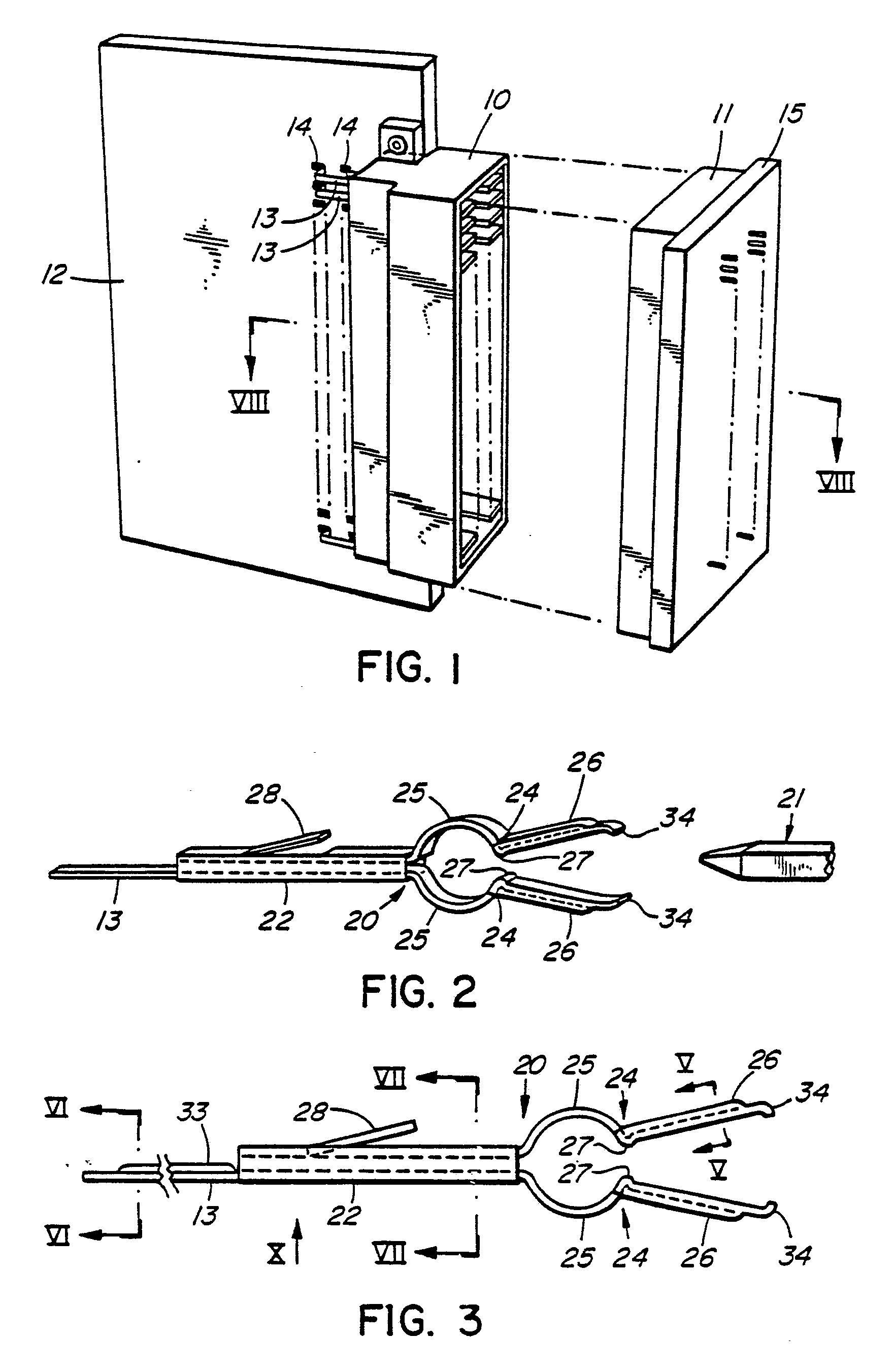
|
17.08.1988 Bulletin 1988/33 |
| (22) |
Date of filing: 29.01.1985 |
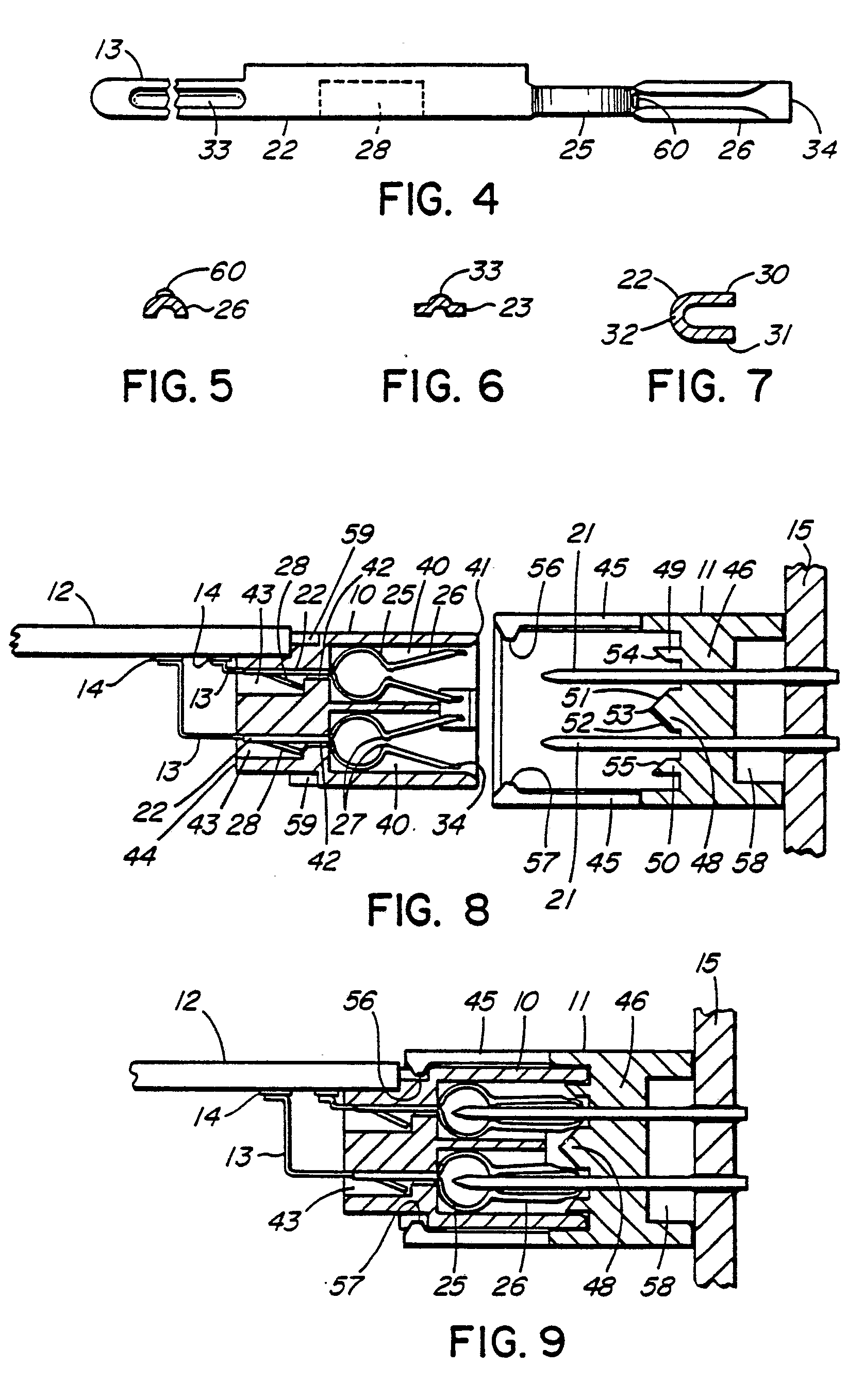
|
|
| (54) |
Socket-type terminal with minimum insertion force characteristics and a connector
embodying such a terminal
Buchsen-Anschlusskontakt mit minimaler nötiger Einsteckkraft und ein Steckverbinder,
der solch einen Anschlusskontakt enthält
Douille de jonction à force d'insertion minimum et un connecteur contenant celle-ci
|
| (84) |
Designated Contracting States: |
|
DE FR GB SE |
| (30) |
Priority: |
12.03.1984 CA 449391
|
| (43) |
Date of publication of application: |
|
09.10.1985 Bulletin 1985/41 |
| (73) |
Proprietor: NORTHERN TELECOM LIMITED |
|
Montreal
Quebec H3H 1R1 (CA) |
|
| (72) |
Inventor: |
|
- Aujla, Sharanjit Singh
Kanata
Ontario, K2L 2X7 (CA)
|
| (74) |
Representative: Crawford, Andrew Birkby et al |
|
A.A. THORNTON & CO.
Northumberland House
303-306 High Holborn
London WC1V 7LE
London WC1V 7LE (GB) |
| (56) |
References cited: :
EP-A- 0 083 862
DE-B- 2 644 612
|
WO-A-83/01867
|
|
| |
|
|
|
|
| |
|
| Note: Within nine months from the publication of the mention of the grant of the European
patent, any person may give notice to the European Patent Office of opposition to
the European patent
granted. Notice of opposition shall be filed in a written reasoned statement. It shall
not be deemed to
have been filed until the opposition fee has been paid. (Art. 99(1) European Patent
Convention).
|
[0001] This invention relates to socket-type terminals, which accept pin and similar type
terminals, particularly as are used in telecommunications systems to interconnect
circuit boards, connect circuit boards to backplanes, and similar arrangements.
[0002] The developments in silicon technology have resulted in an increase in the density
of integrated circuits, an increase in the speed of signal transmission, and an increase
in functionality of devices. This in turn has created stringent requirements in the
interconnection field to provide connectors with a small size, a high number of contacts
and a low mating or insertion force. However these requirements are contradictory
and connectors with more than two hundred terminals have been marginal in performance,
and in fact connectors with less than two hundred terminals often do not give adequate
or acceptable performance. This is because of various factors, such as:-
(i) the contact normal force required to provide and maintain a reliable connection
has been sacrificed in order to provide a low insertion force;
(ii) connectors providing zero, or very low, insertion forces have been very complex
and expensive;
(iii) the relatively large size has not been conducive to either dense packaging or
package size reduction.
[0003] By contact normal force is meant the force exerted between two contacting surfaces
in a direction normal to the contact plane.
[0004] It has been proposed, in WO 83/03323 to provide a connector- having a pin terminal,
and a socket terminal for receiving the pin terminal, the socket terminal having a
main body part, two arms extending from the front end of the main body part and arranged
to receive the pin terminal therebetween, each arm having a curved inner portion and
a substantially straight outer portion, the curved portions extending initially away
from each other and curving round and towards each other, and a contact position at
each junction of a curved inner portion with an outer straight portion for contacting
the pin terminal. However, such connector still requires a large initial insertion
force to force the arms of the socket terminal apart, against their natural inward
bias, during the early stages of insertion of the pin terminal.
[0005] According to the present invention there is provided a connector having first and
second housing parts, respectively provided with at least one pin terminal and at
least one socket terminal for receiving the pin terminal, the socket terminal having
a main body part, two arms extending from the front end of the main body part and
arranged to receive the pin terminal therebetween, each arm having a curved inner
portion and a substantially straight outer portion, the curved portions extending
initially away from each other and curving round and towards each other, and a contact
position at each junction of a curved inner portion with an outer straight portion
for contacting the pin terminal, characterised in that the connector further comprises
cam members provided on the first housing part for acting on the arms, wherein upon
assembly of the connector the cam members deform the arms in a direction to contact
the pin terminal.
[0006] There is thus provided a terminal which can be arranged to give a minimal insertion
force, down to as low as zero, but which is arranged to produce a high contact normal
force once a mating terminal has been inserted. The arms are preferably cantilever
arms with their inner portions extending in a curve having a convex outer surface
and a concave inner surface, and positioned such that the concave surfaces of the
inner portions of the two arms are in opposition. The two outer portions of the two
arms preferably normally incline away from each other at a slight angle. In use, after
the initial insertion of a male terminal into the socket terminal, with the male terminal
having entered past the contact areas or positions the arms are deformed inwards towards
each other by the cam members acting on the outer end of the cantilever arms. This
forces the contact areas or positions into contact with the male terminal.
[0007] The terminals of the invention can be mounted in connector members at a very small
pitch, and provide a high density low insertion force connector. In particular the
female terminals are mounted in one connector part and the male terminals mounted
in another connector part, and the cam members are formations on the connector part
having the male terminals.
[0008] The invention will be readily understood by the following description of one form
of terminal and a connector embodying the terminal, by way of example, in conjunction
with the accompanying drawings, in which:-
Figure 1 is an exploded perspective view of one form of connector;
Figure 2 is a perspective view of a socket terminal in accordance with the invention,
together with a square pin terminal prior to insertion;
Figures 3 and 4 are side and plan views respectively of the terminal of Figure 2,
Figure 4 being in the direction of arrow X in Figure 3;
Figures 5, 6 and 7 are cross-sections on the lines V-V, VI-VI and VII-VII respectively
of Figure 3;
Figure 8 is a cross-section, as on the line VIII-VIII of Figure 1, illustrating a
connector with terminals as in Figure 2 to 7; and
Figure 9 is a cross-section similar to that of Figure 8, with the connector parts
assembled.
[0009] Figure 1 illustrates a connector having a plug 10 containing socket terminals, not
seen, and a receptacle 11 containing pin terminals (also not seen). The plug and receptacle
are conveniently of molded plastic. The plug has, in the example, two rows of slots
or recesses in which are positioned the socket terminals. In the example, in Figure
1, a circuit board 12 is attached to the plug 10 and tail ends of the socket terminals,
indicated at 13 are connected, as by soldering to contact areas 14 on the circuit
board. The receptacle 11 is shown attached to a backplane or other circuit board 15.
The plug and receptacle will be described further with respect to Figures 8 and 9.
[0010] Figure 2 illustrates the combination of a socket terminal 20 and a square pin terminal
21. The socket terminal 20 has a main body part 22 with the tail portion 13 extending
from a rear end. From the front end of the body part 22 extend two arms 24. The two
arms each have an inner curved portion 25 and an outer substantially straight portion
26. At the junctions of the curved and straight portions are formed contact areas
or positions 27. A tab 28 on the body part 22 retains the socket terminal in the plug
once it is in position. The distance between the contact positions 27 is normally
made equal to or slightly greater than the dimension of the pin terminal 21 which
will be between the contact positions 27. While a square pin has been illustrated,
pins of other cross-sections can be used, for example, round, oval, flat and the like.
[0011] The socket terminal 20 is seen in more detail in Figures 3 to 7. The main body part
22 is of a U-shaped or channel shaped cross-section, as seen in Figure 7, having upper
and lower webs 30 and 31, joined by section 32, in the example, section 32 being arcuate.
At the outer end of the body part the webs 30 and 31 extend to form the arm 24. The
inner portions of the arms, at 25, are formed into arcs having a common center. The
portions 25 each extend for a substantial part of a semicircle, with the outer ends
of portions 25 connected to the inner ends of the outer portions 26. The cross-section
of the portions 25 is rectangular, being wider than its thickness, and is flexible.
The straight outer portions 26 are of arcuate cross-section, as seen in Figure 5,
to provide a high degree of stiffness. The tail portion 23 is also stiffened by forming
a longitudinally extending rib 33. At the outer ends the portions 26 are curved inwards,
at 34, to form entry ramps as will be discussed later.
[0012] The socket terminal is readily formed from strip material, first blanked and then
bent at the body part 22 to form the body part and the arms. One or more intermediate
forming stages may be necessary to form the arms 24 and the rib 33. The tab 28 can
also be formed by shearing out a section of the body part.
[0013] Figure 8 illustrates the two mating parts of a connector, in cross-section, prior
to assembly together. The plug 10 has two rows of slots or recesses 40 extending in
from a front face 41. Apertures 42 extend from the back surfaces of the slots or recesses
through the remainder of the plug, with an enlarged section or recess 43 extending
in from the rear face 44. A socket terminal is positioned in each slot or recess,
the slot or recess containing the curved portions 25 and straight portions 26 with
the body portions 22 extending through the apertures 42. The tabs 28 extend into the
recesses 43 and retain the socket terminals in position. The tail portions 13 are
bent down to be soldered to the contact areas 14. The tail portions can be made with
different lengths, or can be cropped after insertion of the terminals into the plug.
The terminals are inserted in from the front face 41, the tabs 28 being depressed
as they pass through the forward part of each aperture 42, snapping out into the recesses
43 when the terminals are fully inserted. Depending upon requirements, only a single
row of slots or recesses 40, or more than two rows of slots or recesses can be provided.
[0014] The receptacle 11 has two rows of pin terminals 21. In the example the pin terminals
are inserted through the back plane or circuit board 15, and soldered with their forward
ends projecting through the receptacle 11 attached to the board 15 and connected to
a circuit pattern. The receptacle has a hollow box-like formation with spaced top
and bottom walls 45 at the front portion. A transverse rear wall 46 holds the pins
in position. On the front surface of the wall 46 is a central rib 48 and two side
ribs 49 and 50. The central rib has two outwardly and rearwardly inclined cam surfaces
51 and 52 extending from an apex 53. The side ribs having their front surfaces inclined
rearward and inward towards the central rib, as illustrated at 54 and 55, to form
further cam surfaces. The forward ends of the top and bottom walls having inwardly
extending ribs 56 and 57 extending along each wall. The rear face of the wall 46 can
be recessed, as at 58. To ease insertion of the plug 10 into the receptacle 11, the
walls 45 can be subdivided into sections, for ease in deforming of the walls during
insertion.
[0015] The walls 45 are spaced apart to be a sliding fit over the plug 10. The ribs 56 and
57 are positioned such that on full assembly of plug and receptacle, the ribs snap
into recesses 59 towards the back of the plug 10. As the plug and receptacle are pushed
together, the forward ends of the pins 21 pass between the straight portions 26 of
the arms and eventually enter between the contact positions 27. Once the ends of the
pins have passed between the contact positions, the ramp surfaces 51, 52, 54 and 55
move into contact with the curved ends 34 of the arms. Continued movement of plug
and receptacle together causes the cam surfaces to push the straight portions of the
arms inward. This moves the contact positions into contact with the pin. Continued
pushing on the arms distorts the curved portions 25 and increases the contact force
between the contact positions 27 and the pins 21. A wiping action also occurs, to
give good contact conditions.
[0016] Thus, on initial insertion there is no insertion load arising from contact between
pin terminal and socket terminal. One of the major effects in a conventional terminal
arrangement is the pushing apart of spring contact members of the socket terminal
by the end of the pin terminal, on initial insertion. In the present invention this
is avoided. The design results in a relatively high contact normal force with a lower
force at the ramp surfaces. As an example, a contact normal force or load of 100 grams
at the contact positions can be obtained with a 37 gram force or load at the cam surfaces.
This proportion can be varied, and the actual values varied, by variation of the design.
As with the plug, the number of rows of pin terminals can be varied, from 1 row to
several rows.
[0017] The operation of the arms can be varied by variation in the design, such as the size,
shape and material thickness of various parts. While the curved portions 25 have been
illustrated and described as being arcs, the curved portions could be of other forms.
For example, instead of a circular appearance when two arms are opposed, as in Figure
3, this could be oval. The clearance between the curved portion outer surface and
the inner surfaces of the slots or recesses 40 will also modify operation, as once
contact occurs between the curved portions and the slot walls, the deformation characteristics
of the curved portions 25 will change. The length of the straight portions, and particularly
the relationship between the length of the straight portions and the chordal length
of the curved portions, will also affect the relationship between the loads or forces
at the ramp surfaces and the load or force on the pin at the contact position.
[0018] To improve contact conditions at the contact positions 27, the material can be dimpled,
as indicated at 60 in Figure 4, to give a more rounded form to the contact position.
Gold plating or other conventional contact treatment practices can be applied to the
contact positions.
[0019] The angles of the cam surfaces 51, 52, 54 and 55 can vary and can also be profiled,
for example curved instead of straight. It is possible to arrange that the ramps or
cam surfaces 51, 52, 54 and 55 do not contact all the curved ends 34 at the same time,
but provide some progressive inter-engagement.
[0020] Advantages over conventional socket terminals and differences in form are numerous
and include:-
utilization of curved flexible beams for optimum spring properties as opposed to straight
cantilever beams;
the pin terminals experience zero insertion force initially instead of having to overcome
a preload to enter the socket terminal;
the socket contacts can accept round, square and blade type pin terminals;
the small size of the socket terminal provides a high density connector;
a low insertion force is obtained while maintaining a high contact normal force contrary
to conventional terminals where a lower insertion force is obtained at the sacrifice
of contact normal force, affecting reliability;
contact wipe is obtained, achieving a high quality initial connection;
the self-actuating mechanism of cam surfaces on the receptacle avoids use of complex
cams and levers; and
a connector with a high number of contacts can readily be provided.
1. A connector having first (11) and second (10) housing parts, respectively provided
with at least one pin terminal (21) and at least one socket terminal (20) for receiving
the pin terminal (21), the socket terminal (20) having a main body part (22), two
arms (24) extending from the front end of the main body part and arranged to receive
the pin terminal (21) therebetween, each arm having a curved inner portion (25) and
a substantially straight outer portion (26), the curved portions (25) extending initially
away from each other and curving round and towards each other, and a contact position
(27) at each junction of a curved inner portion (25) with an outer straight portion
(26) for contacting the pin terminal (21), characterized in that the connector further
comprises cam members (48, 49, 50) provided on the first housing part (11) for acting
on the arms (24), wherein upon assembly of the connector the cams members (48, 49,
50) deform the arms (24) in a direction to contact the pin terminal (21).
2. A connector as claimed in claim 1 wherein said socket terminal (20) is provided
with means (13) for connecting a conductor thereto.
3. A connector as claimed in claim 2, wherein the means (13) for connecting a conductor
to said socket (20) is a tail (13) extending from the rear end of the main body part
(22) of said socket terminal (20).
4. A connector as claimed in claim 1, 2 or 3, wherein the main body (22) of said socket
terminal (20) is of hollow construction.
5. A connector as claimed in any one of the preceding claims, wherein the main body
part (22) of said socket terminal (20) has a channel shaped cross-section having upper
and lower webs (30, 31), and the arms (24) of said socket terminal (20) are extensions
of the webs.
6. A connector as claimed in any one of the preceding claims, wherein the straight
outer portions (26) of the arms (24) of said socket terminal (20) are of arcuate cross-section.
7. A connector as claimed in any one of the preceding claims, wherein the straight
outer portions (26) of the arms (24) of said socket terminal (20) have inwardly curved
ends (34).
8. A connector as claimed in any one of the preceding claims, wherein a tab (28) extends
outwardly and forwardly from the main body part (22) of said socket terminal (20),
at an intermediate position.
9. A connector as claimed in any one of the preceding claims, wherein the inner curved
portions (25) of the arms (24) of said socket terminal (20) extend in an arc.
10. A connector as claimed in any one of the preceding claims, wherein the outer portions
(26) of the arms (24) of said socket terminal (20) extend outwardly and forwardly,
away from each other.
11. A connector as claimed in any one of the preceding claims, wherein the contact
positions (27) at the junctions of the inner and outer portions of the arms of said
socket terminal (20) are dimpled to form a rounded contact position.
12. A connector as claimed in any one of the preceding claims, wherein the second
housing part (10) is provided with at least one row of slots (40), extending from
a front face (41) into the said housing part (10), spaced apart at predetermined positions
and extending parallel to each other, and an aperture (42) extending from an inner
end of each slot (40) to a rear face (44).
13. A connector as claimed in claim 12, wherein each slot (40) is provided with a
respective socket terminal (20).
14. A connector as claimed in claim 12 or 13, wherein the second housing part (10)
is provided with two rows of slots (40) extending from the front face (41).
15. A connector as claimed in any one of claims 12 to 14, wherein each of the apertures
(42) includes an enlarged portion (43) extending inwardly from the rear face of the
second housing part (10) to form a recess (43), and a tab (28) extends from the main
body part of each respective socket terminal (20) into the recesses (43) to retain
the terminals (20) in position in the slots (40).
16. A connector as claimed in any one of claims 12 to 15, wherein the connector is
mounted on a circuit board (12) with the tails (13) of the respective socket terminals
(20) extending from the second housing part (10) and being connected to a circuit
pattern (14) on the circuit board.
17. A connector as claimed in any one of claims 12 to 15, wherein the second housing
part (10) includes recesses (59) in the top and bottom surfaces, the recesses (59)
being positioned towards the rear face (44) of the housing part (10) to receive projections
(56) provided on the first connector part (11) when said first and second connector
parts (10, 11) are mated together.
18. A connector as claimed in any one of claims 12 to 17, wherein the first connector
part (11) comprises a hollow box-like form with top and bottom walls (45) spaced to
be a sliding fit over the second connector part (10), a transverse rear wall (46)
extending between the top and bottom walls, and a plurality of pin terminals (21)
mounted in at least one row in the transverse rear wall (46) and having their forward
ends positioned between the top and bottom walls, the pin terminals (21) being spaced
to be aligned with the socket terminals in the second connector part (10) wherein
the means (48, 49, 50) comprise forwardly extending cam members (48, 49, 50) of the
front face of the rear wall (46), a cam member being positioned on each side of a
row of pin terminals, the cam members (48, 49, 50) having inclined cam surfaces (51,
52, 54, 55) on their ends whereby on initial insertion of the second connector part
(10) into the first connector part (11) the ends of the pin terminals (21) pass between
the contact positions (27) on the arm (24), continued insertion of the second connector
part (10) moving the inclined cam surfaces (51, 52, 54, 55) into contact with the
front ends of the straight portions (26) of the arms to push the front ends of the
terminals (20) inward and to move the contact positions (27) into contact with the
pin terminals (21).
19. A connector as claimed in claim 18, wherein the first connector part (11) is mounted
on a circuit board (15) and the pin terminals (21) are connected to a circuit pattern
on the board (15).
20. A connector as claimed in claim 18 or 19, wherein the inner ends of the top and
bottom walls (45) of the first connector part (11) are provided with inwardly extending
projections (56) which, when the first and second connector parts (10, 11) are in
fully inserted condition, snap into recesses (59) provided in the second connector
part (10).
21. A connector as claimed in any one of claims 18 to 20, wherein the outer portions
(26) of the arms (24) of the socket terminal (20) extend outwardly and forwardly away
from each other, the contact positions (27) on each terminal being separated initially
by a distance at least equal to the corresponding dimension of a pin terminal (21).
1. Verbinder mit ersten (11) und zweiten (10) Gehäuseteilen, die jeweils mit mindestens
einer Stiftklemme (21) bzw. mindestens einer Buchsenklemme (20) zur Aufnahme der Stiftklemme
(21) versehen sind, wobei die Buchsenklemme (20) einen Hauptgehäuseteil (22) besitzt,
zwei Arme (24) von dem Vorderende des Hauptgehäuseteiles abstehen und so angeordnet
sind, daß die Stiftklemme (21) dazwischen aufgenommen wird, jeder Arm einen gekrümmten
Innenabschnitt (25) und einen im wesentlichen geradlinigen Außenabschnitt (26) besitzt,
die gekrümmten Abschnitte (25) anfangs voneinander abstehen und zu einander abgerundet
gebogen sind, und eine Kontaktstelle (27) an jeder Verbindung eines gekrümmten Innenabschnittes
(25) mit einem geradlinigen Außenabschnitt (26) zur Kontaktbildung mit der Stiftklemme
(21) vorgesehen ist, dadurch gekennzeichnet, daß der Verbinder weiter an dem ersten
Gehäuseteil (11) vorgesehene Nockenelemente (48, 49, 50) zur Einwirkung auf die Arme
(24) enthält, wobei bei dem Zusammenbau des Verbinders die Nockenelemente (48, 49,
50) die Arme (24) in Richtung zum Kontaktieren der Stiftklemme (21) verformen.
2. Verbinder nach Anspruch 1, bei dem die Buchsenklemme (20) mit Mitteln (13) zum
Anschließen eines Leiters daran versehen ist.
3. Verbinder nach Anspruch 2, bei dem das Mittel (13) zum Verbinden eines Leiters
mit der Buchse (20) ein von dem hinteren Ende des Hauptgehäuseteiles (22) der Buchsenklemme
(20) abstehende Anschlußfahne (13) ist.
4. Verbinder nach Anspruch 1, oder 3, bei dem das Hauptgehäuse (22) der Buchsenklemme
(20) hohl aufgebaut ist.
5. Verbinder nach einem der vorangehenden Ansprüche, bei dem der Hauptgehäuseteil
(22) der Buchsenklemme (20) einen kanalförmigen Querschnitt besitzt mit oberen und
unteren Stegen (30, 31) und die Arme (24) Weiterführungen der Stege sind.
6. Verbinder nach einem der vorangehenden Ansprüche, bei dem die geradlinigen Außenabschnitte
(26) der Arme (24) der Buchsenklemme (20) gekrümmten Querschnitt besitzen.
7. Verbinder nach einem der vorangehenden Ansprüche, bei dem die geradlinigen Außenabschnitte
(26) der Arme (24) der Buchsenklemme (20) nach innen gekrümmte Ende (34) besitzen.
8. Verbinder nach einem der vorangehenden Ansprüche, bei dem eine Fahne (28) nach
außen und vorne von dem Hauptgehäuseteil (22) der Buchsenklemme (20) an einer Zwischenstelle
absteht.
9. Verbinder nach einem der vorangehenden Ansprüche, bei dem die inneren gekrümmten
Abschnitte (25) der Arme (24) der Buchsenklemme (20) einen Kreisbogenabschnitt bilden.
10. Verbinder nach einem der vorangehenden Ansprüche, bei dem die Außenabschnitte
(26) der Arme (24) der Buchsenklemme (20) nach außen und vorne voneinander abstehen.
11. Verbinder nach einem der vorangehenden Ansprüche, bei dem die Kontaktstellen (27)
an den Verbindungen der inneren mit den äußeren Abschnitten der Arme der Buchsenklemme
(20) zur Bildung einer abgerundeten Kontaktstelle mit Eindrücken versehen sind.
12. Verbinder nach einem der vorangehenden Ansprüche, bei dem der zweite Gehäuseteil
(10) mit mindestens einer Reihe von Schlitzen (40) versehen ist, die sich von einer
Vorderfläche (41) in den Gehäuseteil (10) hinein erstrecken, an vorbestimmten Stellen
voneinander Abstand aufweisen und parallel zueinander verlaufen, und einen sich von
einem Innenende jedes Schlitzes (40) zu einer Rückfläche (44) erstreckenden Durchbruch
(42).
13. Verbinder nach Anspruch 12, bei dem jeder Schlitz (40) mit einer jeweiligen Buchsenklemme
(20) versehen ist.
14. Verbinder nach Anspruch 12 oder 13, bei dem der zweite Gehäuseteil (10) mit sich
von der Vorderfläche (41) erstreckenden zwei Reihen von Schlitzen (40) versehen ist.
15. Verbinder nach einem der Ansprüche 12 bis 14, bei dem jeder Durchbruch (42) einen
vergrößerten Abschnitt (43) enthält, der von der Rückfläche des zweiten Gehäuseteiles
(10) nach innen reicht, um eine Vertiefung (43) zu bilden, und wobei eine Fahne (28)
von dem Hauptgehäuseteil jeder jeweiligen Buchsenklemme (20) in die Vertiefung (30)
reicht, um die Klemmen (20) in den Schlitzen (40) in Stellung zu halten.
16. Verbinder nach einem der Ansprüche 12 bis 15, wobei der Verbinder an einer Schaltplatine
(12) angebracht ist und die Anschlußstücke (13) der jeweiligen Buchsenklemme (20)
von dem zweiten Gehäuseteil (10) abstehen und mit einem Schaltungsmuster (14) an der
Schaltplatine verbunden sind.
17. Verbinder nach einem der Ansprüche 12 bis 15, bei dem der zweite Gehäuseteil (10)
Vertiefungen (59) in den oberen und unteren Flächen enthält, welche Vertiefungen (49)
zu der Rückfläche (44) des Gehäuseteiles (10) hin angeordnet sind zur Aufnahme von
Fortsätzen (56), welche an dem ersten Verbinderteil (11) vorgesehen sind, wenn der
erste und der zweite Verbinderteil (10, 11) zusammengesteckt werden.
18. Verbinder nach einem der Ansprüche 12 bis 17, bei dem der erste Verbinderteil
(11) eine hohle kastenartige Form mit Deck- und Bodenwänden (45) umfaßt, die solchen
Abstand haben, daß sie mit Gleichpassung über den zweiten Verbinderteil (10) gehen,
eine Quer-Rückwand (46), die sich zwischen der Deck- und der Bodenwand erstreckt,
und eine Vielzahl von Stiftklemmen (21), die in mindestens einer Reihe in der Quer-Rückwand
(46) befestigt sind und deren vordere Enden zwischen den Deck- und Bodenwänden liegen,
wobei die Stiftklemmen (21) solchen Abstand haben, daß sie mit den Buchsenklemmen
in dem zweiten Verbinderteil (10) ausgerichtet sind, wobei die Mittel (48, 49, 50)
sich nach vorne erstreckende Nockenelemente (48, 49, 50) an der vorderen Fläche der
Rückwand (46) umfassen, jeweils ein Nockenelement an jeder Seite einer Reihe von Stiftklemmen
angeordnet ist, die Nokkenelemente (48, 49, 50) schräg verlaufende Nokkenflächen (51,
52, 54, 55) an ihren Enden besitzen, wodurch beim anfänglichen Einsetzen des zweiten
Verbinderteiles (10) in den ersten Verbinderteil (11) die Enden der Stiftklemmen (21)
zwischen den Kontaktstellen (27) an dem Arm (24) durchgehen, eine forgesetzte Einführung
des zweiten Verbinderteiles (10) die geneigten Nokkenflächen (51, 52, 54, 55) in Berührung
mit den vorderen Enden der geradlinigen Abschnitte (26) der Arme bewegen, um die vorderen
Enden der Klemmen (20) nach innen zu stoßen und die Kontaktstellen (27) in Kontakt
mit den Stiftklemmen (21) zu bewegen.
19. Verbinder nach Anspruch 18, bei dem der erste Verbinderteil (11) an einer Schaltplatine
(15) angebracht ist und die Stiftklemmen (21) mit einem Schaltungsmuster an der Platine
(15) verbinden sind.
20. Verbinder nach Anspruch 18 oder 19, bei dem die inneren Enden der Deck- und Bodenwände
(45) des ersten Verbinderteiles (11) mit nach innen abstehenden Fortsätzen (56) versehen
sind, die bei vollständig eingesetzten ersten und zweiten Verbinderteilen (10, 11)
in Vertiefungen (59) einschnappen, die in dem zweiten Verbinderteil (10) vorgesehen
sind.
21. Verbinder nach einem der Ansprüche 18 bis 20, bei dem die Außenabschnitte (26)
der Arme (24) der Buchsenklemmen (20) nach außen und vorne voneinander abstehen, wobei
die Kontaktstellen (27) an jeder Klemme anfangs mit einem Abstand voneinander getrennt
sind, der mindestens gleich der entsprechenden Abmessung einer Stiftklemme (21) ist.
1. Connecteur comportant des première (11) et seconde (10) parties de logement, munies
respectivement d'au moins une borne à broche (21) et d'au moins une borne à douille
(20) pour recevoir la borne à broche (21), la borne à douille (20) ayant un corps
principal (22), deux bras (24) s'étendant à partir de l'extrémité avant du corps principal
et disposés de manière à recevoir entre eux la borne à broche (21), chaque bras présentant
une partie intérieure incurvée (25) et une partie extérieure sensiblement rectiligne
(26), les parties incurvées (25) s'étendant initialement en s'écartant l'une de l'autre
et s'incurvant en étant rondes et en se dirigeant l'une vers l'autre, et une position
de contact (27) à chaque jonction d'une partie intérieure incurvée (25) avec une partie
extérieure rectiligne (26) pour venir en contact avec la borne à broche (21 caractérisé
en ce que le connecteur comprend en outre des éléments de came (48, 49, 50) prévus
sur la première partie (11) du logement pour agir sur les bras (24), à la suite de
quoi, lors de l'assemblage du connecteur les éléments de came (48, 49, 50) déforment
les bras (24) dans une certaine direction pour venir en contact avec la borne à broche
(21).
2. Connecteur selon la revendication 1, caractérisé en ce que la borne à douille (20)
comporte un moyen (13) pour y connecter un conducteur.
3. Connecteur selon la revendication 2, caractérisé en ce que le moyen (13) pour connecter
un conducteur à la douille (20) est une queue (13) s'étendant à partir de l'extrémité
arrière du corps principal (22) de la borne à douille (20).
4. Connecteur selon la revendication 1, la revendication 2 ou la revendication 3,
caractérisé en ce que le corps principal (22) de la borne à douille (20) a une construction
creuse.
5. Connecteur selon l'une quelconque des revendications précédentes, dans lequel le
corps principal (22) de la borne à douille (20) présente une section en forme de canal
ayant des parois supérieure et inférieure (30, 31) et les bras (24) de la borne à
douille (20) sont des prolongements des parois.
6. Connecteur selon l'une quelconque des revendications précédentes, dans lequel les
parties extérieures rectilignes (26) des bras (24) de la borne à douille (20) ont
la forme d'un arc dans une section en coupe.
7. Connecteur selon l'une quelconque des revendications précédentes, dans lequel les
parties extérieures rectilignes (26) des bras (24) de la borne à douille (20) comportent
des extrémités incurvées vers l'intérieur (34).
8. Connecteur selon l'une quelconque des revendications précédentes, dans lequel une
partie (28) s'étend vers l'extérieur et vers' l'avant à partir du corps principal (22) de la borne à douille (20) à une position
intermédiaire.
9. Connecteur selon l'une quelconque des revendications précédentes, dans lequel les
parties intérieures incurvées (25) des bras (24) de la borne à douille (20) s'étendent
suivant un arc.
10. Connecteur selon l'une quelconque des revendications précédentes, dans lequel
les parties extérieures (26) des bras (24) de la borne à douille (20) s'étendent vers
l'extérieur et vers l'avant, en s'éloignant l'une de l'autre.
11. Connecteur selon l'une quelconque des revendications précédentes, dans lequel
les positions de contact (27) aux jonctions des parties intérieure et extérieure des
bras de la borne à douille (20) sont en fossette de manière à former une position
de contact arrondie.
12. Connecteur selon l'une quelconque des revendications précédentes, dans lequel
la seconde partie (10) du logement comporte au moins une rangée de fentes (40), s'étendant
à partir d'une face avant jusque dans la partie (10) du logement, espacées à des positions
prédéterminées et s'étendant parallèlement les unes aux autres, et une ouverture (42)
s'étendant entre une extrémité intérieure de chaque fente (40) et une face arrière
(44).
13. Connecteur selon la revendication 12, caractérisé en ce que chaque fente (40)
comporte une borne respective à douille (20).
14. Connecteur selon la revendication 12 ou la revendication 13, caractérisé en ce
que la seconde partie (10) du logement comporte deux rangées de fentes (40) s'étendant
à partir de la face avant (41
15. Connecteur selon l'une quelconque des revendications 12 à 14, dans lequel chacune
des ouvertures (42) comporte une partie agrandie (43) s'étendant vers l'intérieur
à partir de la face arrière de la seconde partie (10) du logement afin de former un
évidement (43), et une pattie (28) s'étend à partir du corps principal de chaque borne
respective à douille (20) jusque dans les évidements (43) afin de maintenir les bornes
(20) en position dans les fentes (40).
16. Connecteur selon l'une quelconque des revendications 12 à 15, dans lequel le connecteur
est monté sur une plaquette à circuits (12) avec les queues (13) des bornes respectives
à douille (20) s'étendant à partir de la seconde partie (10) du logement et étant
connectées à un motif de circuit (14) de la plaquette à circuits.
17. Connecteur selon l'une quelconque des revendications 12 à 15, dans lequel la seconde
partie (10) du logement comporte des évidements (59) dans les surfaces supérieure
et inférieure, les évidements (59) étant positionnés dans la direction de la face
arrière (44) de la partie (10) du logement afin de recevoir des saillies (56) montées
sur le première partie (11) du connecteur, lorsque les première et seconde parties
(10, 11) du connecteur sont accouplées.
18. Connecteur selon l'une quelconque des revendications 12 à 17, dans lequel la première
partie (11) du connecteur présente une forme ressemblant à une boîte creuse avec des
parois supérieure et inférieure (45) estpacées pour être à ajustement glissant sur
la seconde partie (10) du connecteur, une paroi arrière transversale (46) s'étendant
entre les parois supérieure et inférieure, une multitude de bornes à douille (21)
montées dans au moins une rangée dans la paroi arrière transversale (46) et ayant
leurs extrémités avant placées entre les parois supérieure et inférieure, les bornes
à broche (21) étant espacées de manière à être en alignement avec les bornes à douille
dans la seconde partie (10) du connecteur, où le moyen (48, 49, 50) comprend des éléments
de came s'étendant vers l'avant (48, 49, 50) sur la face avant de la paroi arrière
(46), un élément de came étant placé de chaque côté d'une rangée de bornes à broche,
les éléments de came (48, 49, 50) ayant des surfaces à came inclinées (51, 52, 54,
55) sur leurs extrémités, d'où il résulte que lors de l'insertion initiale de la seconde
partie (10) du connecteur dans la première partie (11) du connecteur, les extrémités
des bornes à broche (21) passent entre les positions de contact (27) du bras (24),
la poursuite de l'insertion de la seconde partie (10) du connecteur déplaçant les
surfaces à came inclinées (51, 52, 54, 55) pour les amener en contact avec les extrémités
avant des parties rectilignes (26) des bras afin de pousser les extrémités avant des
bornes (20) dans la direction de l'intérieur et de déplacer les positions de contact
(27) pour les amener en contact avec les bornes à broche (21).
19. Connecteur selon la revendication 18, dans lequel la première partie (11) du connecteur
est montée sur une plaquette à circuits (15) et les bornes à broches (21) sont connectées
à un motif de circuits de la plaquette (15).
20. Connecteur selon la revendication 18 ou la revendication 19, dans lequel les extrémités
intérieures des parois supérieure et inférieure (45) de la première partie (11) du
connecteur comportent des saillies s'étendant vers l'intérieur (56) qui, lorsque les
première et seconde parties (10, 11) de connecteur sont à l'état d'insertion totale,
s'én- clenchent dans des évidements (59) ménagés dans la seconde partie (10) du connecteur.
21. Connecteur selon l'une quelconque des revendications 18 à 20, dans lequel les
parties extérieures (26) des bras (24) de la borne à douille (20) s'étendant vers
l'extérieur et vers l'avant en s'éloignant les unes des autres, les positions de contact
(27) de chaque borne étant séparées initialement d'une distance au moins égale à la
cote correspondante d'une borne à broche (21).