| (19) |
 |
|
(11) |
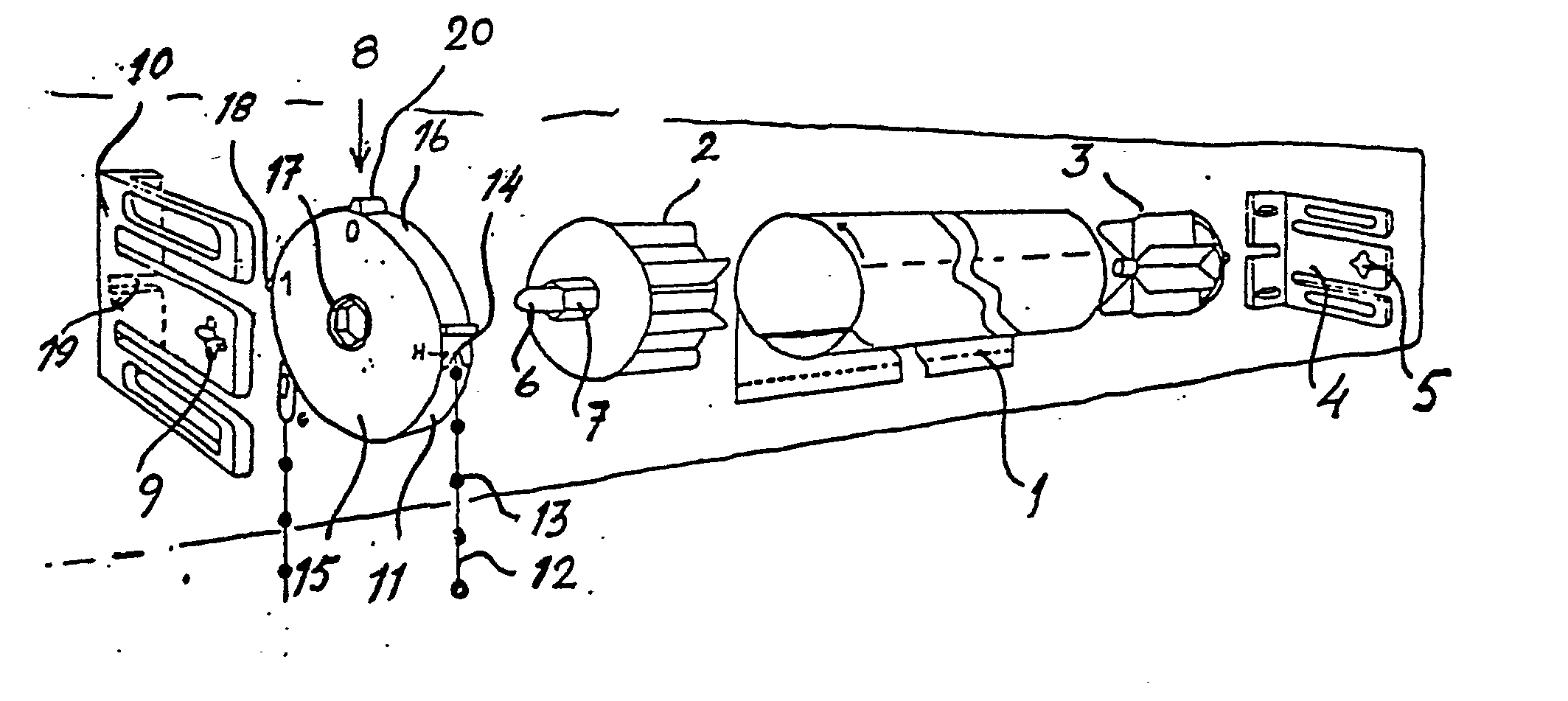
EP 0 157 998 B1 |
| (12) |
EUROPEAN PATENT SPECIFICATION |
| (45) |
Mention of the grant of the patent: |
|
26.04.1989 Bulletin 1989/17 |
| (22) |
Date of filing: 21.12.1984 |
|
| (51) |
International Patent Classification (IPC)4: E06B 9/206 |
|
| (54) |
Device at roller blind
Anordnung für Rollo
Dispositif pour store enroulable
|
| (84) |
Designated Contracting States: |
|
AT DE GB NL |
| (30) |
Priority: |
28.12.1983 SE 8307183
|
| (43) |
Date of publication of application: |
|
16.10.1985 Bulletin 1985/42 |
| (73) |
Proprietor: SEGERLJUNG & CO AB |
|
S-18600 Vallentuna (SE) |
|
| (72) |
Inventor: |
|
- Segerljung, Bo
S-186 00 Vallentuna (SE)
|
| (74) |
Representative: Billberg, Hans et al |
|
Axel Ehrners Patentbyra AB
Box 10 316
100 55 Stockholm
100 55 Stockholm (SE) |
| (56) |
References cited: :
WO-A-81/02911
FR-A- 2 428 730
|
FR-A- 2 398 172
|
|
| |
|
|
|
|
| |
|
| Note: Within nine months from the publication of the mention of the grant of the European
patent, any person may give notice to the European Patent Office of opposition to
the European patent
granted. Notice of opposition shall be filed in a written reasoned statement. It shall
not be deemed to
have been filed until the opposition fee has been paid. (Art. 99(1) European Patent
Convention).
|
[0001] This invention relates to a device at a roller blind of the kind disclosed in WO-A-8
102 911 comprising a blind to be reeled on a rod, which at one end is supported freely
rotatable in a fitting and at its other end is provided with a pin, which extends
through a cog-like wheel, which is rigidly attached to said pin and driven rotary
by a ball cord, which wheel is enclosed by and supported rotatably in a hub provided
with a stop notch for receiving the cord and a ball, which notch is located approximately
in the horizontal diameter when the hub is mounted in a fitting for supporting the
other end of the rod.
[0002] The present invention has the object to facilitate the mounting of the parts at the
setting-up of the roller blind and to ensure correct position of the hub, irrespective
of whether the fittings for supporting the roller blind are mounted on a wall or against
a ceiling.
[0003] The invention, therefore, is characterized in that the hub comprises two circular
discs, which at the centre carry the wheel on both sides thereof and have a greater
diameter than the wheel, which discs along the circumference are connected by means
of a cylindric wall, which extends from the stop notch to a point located substantially
diametrically to said notch, in such a way, that one half of the space between the
discs is open for inserting the wheel, and a pin is located on the circumference of
the hub for co-operation with a recess in the fitting for rigidly fixing the hub therein,
so that the stop notch is located in an imaginary substantially horizontal diameter
to the hub.
[0004] The invention is described in the following with reference to the accompanying drawing
showing the invention in a schematic way.
[0005] In the Figure the roller blind is designated by 1. The blind can be reeled on a rod
comprising two end wall pieces 2 and, respectively, 3, which are connected by a connecting
rod (not shown). In the Figure, thus, the roller blind with its parts and fittings
is shown exploded, for the sake of clearness. The right-hand end 3 of the roller blind
rod is provided with a pin (not shown), which is inserted freely into the right-hand
fitting 4. The fitting includes a mounting hole 5 rendering it possible for the roller
blind rod to rotate freely relative to the fitting 4. The left-hand portion 2 of the
rod is provided with a pin 6 and an external polygonal member 7. The pin 6 is passed
through a hub casing 8 into a hole 9 of a left-hand fitting 10. The polygonal member
7 passes non-rotary into a wheel 11 located rotatably in the hub casing 8. The wheel
11 has a circumferential surface of cogged design (not shown), so that a cord 12 with
balls 13 can engage with the circumference of the wheel 11 and rotate the wheel. A
stop notch 14 is located in the circumference of the hub casing and a desired one
of the balls 13 can be caused to engage with the stop notch whe6?t4e blind has assumed
the desired unwound position. The principle of the location of the notch and operation
of the ball cord relative to the notch is known art and not described here in greater
detail.
[0006] The hub casing is designed to comprise two circular discs, of which only the forward
one 15 is shown in the drawing. The two discs are held together by a cylindric wall
16, which extends from the stop notch 14 through about half a turn of the circumference.
The hub casing downwardly is open about half a turn, and due to the fact that the
hub casing is made of plastic, which is slightly elastic, the wheel 11 can be introduced
into the hub casing and positioned in the centre for rotation in the hub casing. It
is, thus, very simple to mount the wheel 11 in the hub casing 8. The wheel is so supported
in the hub casing that the wheel 11 has an annular surface on both sides which fit
in holes 17 in the circular disc 15 and the disc not shown.
[0007] It is important that the hub casing assumes correct position relative to the fitting
10. The stop notch, thus, shall be located slightly beneath an imagined horizontal
diameter through the hub casing 8. In order to effect correct mounting of the hub
casing and to attach it non-rotary relative to the roller blind rod, a pin 18 is located
on the circumferential edge of the hub casing substantially diametrically directly
in front of the stop notch 14. The pin 18 drops into a groove 19 in the fitting 10
when the fitting 10 is mounted on a vertical wall.
[0008] In order to ensure correct mounting of the hub casing 8 even when the fitting 10
is mounted against a ceiling, a second pin 20 is provided so, that when the groove
19 is located up against a ceiling, the pin 20 shall fit in the groove for mounting
the hub casing correctly. A correctly mounted position of the hub casing, thus, is
the position when the stop notch 14 is located slightly beneath the imagined horizontal
diameter through the hub casing. This position, namely, renders it possible that a
ball 13 on the ball cord 12 readily is caught in the notch and retains the roller
blind safe against rotation and at the same time permits the ball to easily leave
the notch, so that the cord can continue to run in that the cord is moved slightly
inward to the imagined vertical plane through the central axis of the roller blind
rod.
A device at a roller blind comprising a roller blind (1) to be reeled on a rod (2,
3), which at one end is supported freely rotatably in a fitting (4) and at the other
end is provided with a pin (6, 7), which extends through a cog-like wheel (11) rotary
driven at the pin in rigid connection with a ball cord (12, 13), which wheel is enclosed
by and rotatably supported in a hub (8), which is pro- .vided with a stop notch (14)
for receiving said cord (12, 13) and a ball, which notch approxi- mately is located in the horizontal diameter at the mounting of the hub in a
fitting (10) for supporting the other end (2) of said rod (2, 3), characterized in
that the hub (8) comprises two circular discs (15), which at the centre support the
wheel (11) on both sides thereof and have a greater radius than the wheel, which discs
(15) along the circumference are connected by means of a cylindric wall (16), which
extends from the stop notch (14) to a point substantially diametrically to the notch,
in such a manner, that one half of the space between the discs (15) is open for inserting
the wheel (11), and a pin (18; 20) is located on the circumference of the hub (8)
for co-operation with a recess (19) in the fitting (10) for rigidly fixing the hub
therein, so that the stop notch (14) will be located in an imagined substantially
horizontal diameter to the hub.
Vorrichtung an einem Rollo, die aufweist einen Rollo (1) zum Aufrollen auf eine Stange
(2, 3), die an einem Ende frei drehbar in einem Lager (4) gelagert ist und an dem
anderen Ende mit einem Stift (6, 7) versehen ist, der sich durch ein zahnradähnliches
Rad (11) erstreckt, das drehend am Stift in starrer Verbindung mit einer Kugelschnur
(12, 13) angetrieben wird, wobei das Rad umschlossen ist und drehbar gelagert ist
in einer Nabe (8), die mit einer Arretierkerbe (14) zum Aufnehmen der Schnur (12,
13) und einer Kugel versehen ist, wobei die Kerbe ungefähr im horizontalen Durchmesser
an der Nabenbefestigung in einem Lager (10) zum Lagern des anderen Endes (2) der Stange
(2, 3) angeordnet ist, dadurch gekennzeichnet, daß die Nabe (8) zwie kreisförmige
Scheiben (15) aufweist, die in der Mitte das Rad (11) auf dessen beiden Seiten lagern
und einen größeren Radius als das Rad haben, wobei die Scheiben (15) entlang des Umfangs
mittels einer zylindrischen Wand (16) verbunden sind, die sich von der Arretierkerbe
(14) zu einem Punkt erstreckt, der im wesentlichen diametral zur Kerbe ist, und zwar
in solch einer Weise, daß eine Hälfte des Raumes zwischen den Scheiben (15) zum Einsetzen
des Rades (11) geöffnet ist, und wobei ein Stift (18; 20) auf dem Umfang der Nabe
(8) zum Zusammenwirken mit einer Aussparung (19) im Lager (10) zum darin starren Fixieren
der Nabe angeordnet ist, sodaß die Arretierkerbe (14) in einem gedachten, im wesentlichen
horizontalen Durchmesser zu der Nabe angeordnet sein wird.
Dispositif pour store enroulable, comprenant un store enroulable (1) à enrouler sur
une tige (2, 3) qui est supportée à une extrémité de façon à tourner librement dans
une monture (4) et qui est pourvue, à l'autre extrémité, d'une broche (6, 7) qui traverse
une roue à empreintes (11) reliée rigidement à la broche et entraînée en rotation
au moyen d'un cordon à billes (12, 13), ladite roue étant entourée et supportée de
façon tournante par un boîtier (8) qui comporte une encoche d'arrêt (14) pour recevoir
ledit cordon (12, 13) et une bille, cette encoche étant située sensiblement sur le
diamètre horizontal lorsque le boîtier est fixé dans une monture (10) pour supporter
l'autre extrémité (2) de ladite tige (2, 3), caractérisé en ce que le boîtier (8)
comprend deux disques circulaires (15) qui supportent la roue (11), en leur centre,
de chaque côté de la roue, et qui ont un diamètre plus grand que celui de la roue,
ces disques (15) étant reliés le long de la circonférence par une paroi cylindrique
(16) qui s'étend de l'encoche d'arrêt (14) jusqu'à un point sensiblement diamétralement
opposé à l'encoche, d'une manière telle qu'une moitié de l'espace entre les disques
(15) est ouverte pour permettre l'insertion de la roue (11), et un ergot (18, 20)
est prévu sur la circonférence du boîtier (8), pour coopérer avec un logement (19)
prévu dans la monture (10) afin de fixer rigidement le boîtier dans la monture de
sorte que l'encoche d'arrêt (14) se trouve sur un diamètre imaginaire sensiblement
horizontal du boîtier.