|
(11) | EP 0 158 369 B2 |

| (12) | NEW EUROPEAN PATENT SPECIFICATION |
|
|
| (54) |
A method of stabilizing a light-sensitive silver halide color photographic material Methode zur Stabilisierung eines lichtempfindlichen farbphotographischen Silberhalogenidmaterials Méthode de stabilisation d'un matériau photographique couleur à l'halogénure d'argent sensible à la lumière |
|
|
|||||||||||||||||||||||||||||||||||
|
||||||||||||||||||||||||||||||||||||
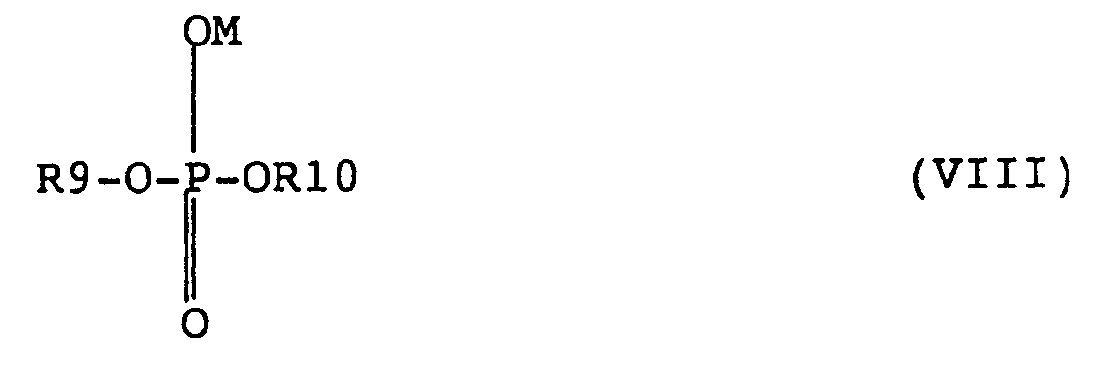
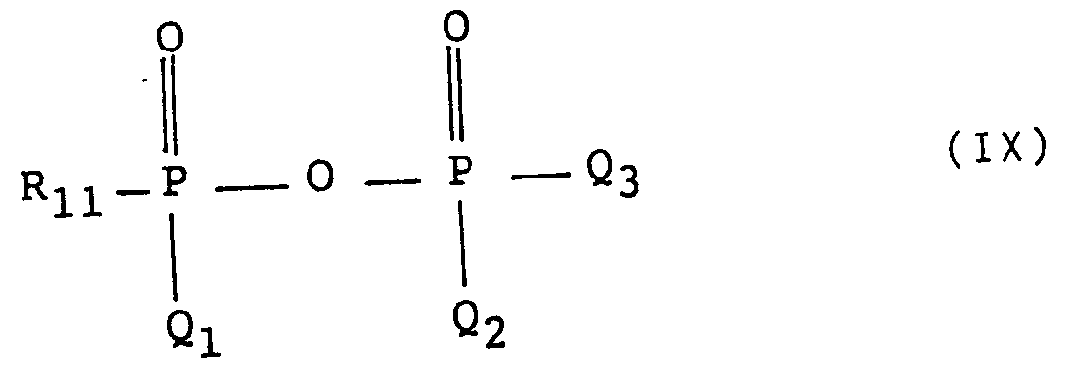
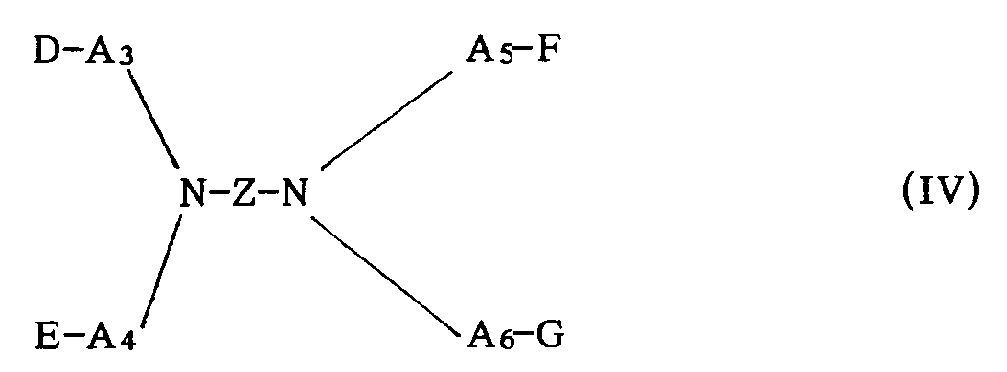
[0001] The present invention relates to a method of stabilizing a dye image formed in a light-sensitive silver halide color photographic material.
[0002] It is well known that a light-sensitive silver halide color photographic material produces azomethine and indoaniline dyes by color development to form the color image.
[0003] It is also well known that these dyes discolor under ultraviolet or visible light. Further, their discoloration also occurs even when they are kept in the dark. Particularly, this discoloration is accelerated by high temperature and humidity. This phenomenon of discoloration of the developed color image is a significant weakness in color photography and an improvement is much needed.
[0004] Various preventive measures have been disclosed for preventing the discoloration of a developed color image in a silver halide color photographic material in the dark or in the light. For example, US Patent No 2 788 274 discloses a process using a zinc salt solution; US Patent No 2 913 338 a process making use of a calcium, magnesium or cadmium salt; and British Patent Nos 909 824 and 1 001 446 a process using a solution containing a monosaccharide, disaccharide or hexitol and a process using a solution containing formaldehyde and polycarboxylic acid, respectively.
[0005] However, some of these preventive measures give only a slight improvement and others, though effective in preventing discoloration, make use of compounds which soften the gelatin film thus weakening considerably its mechanical strength. To prevent softening of the gelatin layer, formaldehyde has been used in some cases notwithstanding that this compound has a tendency to soil the white border of the print.
[0006] To prevent the discoloration of the dye picture, chemicals with which the photographic material has been loaded in processing baths must be removed in a washing step which lasts as long as possible using as large a volume of water as possible. For faster processing and labor saving, therefore, such a stabilizing process has only a minor or insignificant effect and is therefore omitted in some cases. Further, for the same purpose and also for the alleviation of environmental pollution and a reduction in processing costs, it is general practice to perform processes in individual processing solutions at high temperature, reduced washing time, and/or use a reduced volume of water for washing, which makes the stabilization of dye images less effective.
[0007] A stabilizing process that includes no washing step is disclosed in, for example, US Patent No 3 335 004. This is a silver stabilizing process making use of a thiocyanate salt whose stabilizing bath contains a large quantity of sulfite salts, so that image dyes are readily reduced to their leuco form, influencing the color photographic image significantly as regards its deterioration. Further, at the low pH which is used for such a stabilizing bath, there is a danger of generating sulfurous acid gas. Accordingly, this process is not satisfactory.
[0008] A conventional stabilizing process of a color image thus fails to achieve the stabilization of a photographic image for a long period of time while simultaneously speeding up the process time, labor saving, alleviating environmental pollution and reducing the volume of washing water.
[0009] After a variety of investigations to prevent the discoloration of a developed color image in the dark or in the light, we have found a solution. According to the present invention there is provided a method of processing a light-sensitive silver halide color photographic material involving bleaching and fixing wherein an iron complex salt is used as a blending agent characterised in that to stabilise the material against dye image fading in the dark, it is treated with a solution of a chelating agent (hereinafter referred to as the "stabilising solution") directly following bleaching and fixing or bleach-fixing as the final stage of the method prior to drying without intermediate washing such that the iron complex salt is present in the solution in an amount which does not exceed 1 × 10⁻¹ mols per litre and, when a multi-tank stabilising bath is used for the said solution, the iron complex salt is present in the last tank in an amount which does not exceed 1 × 10⁻¹ mols per litre.
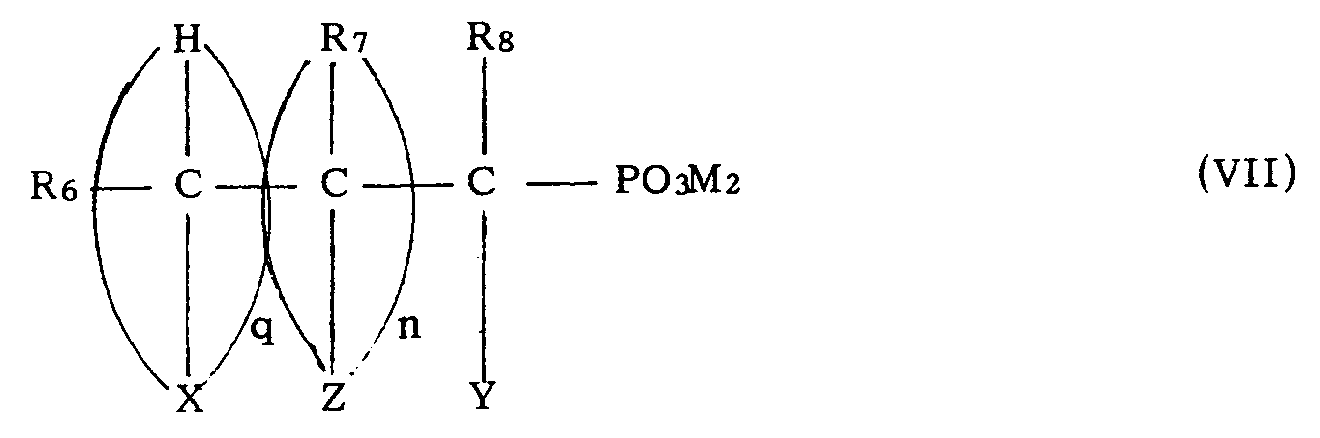
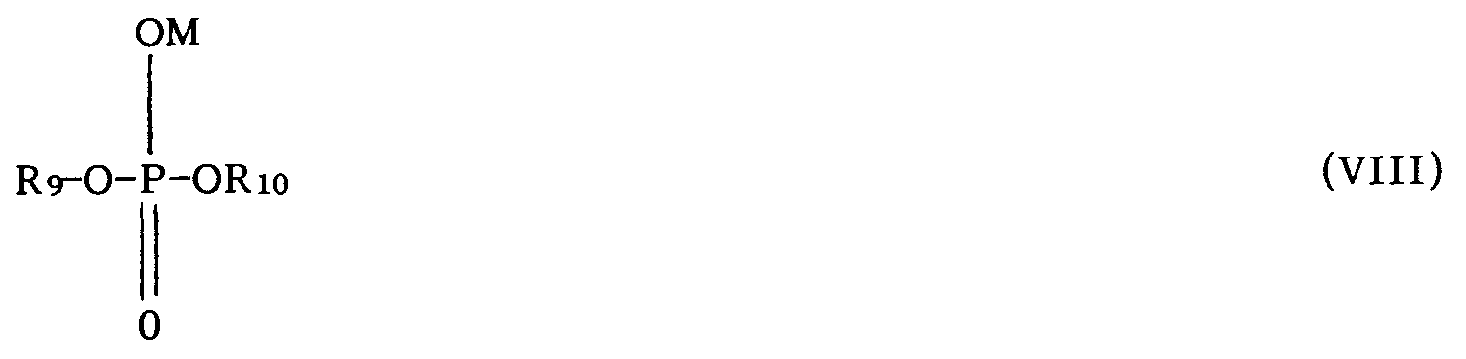
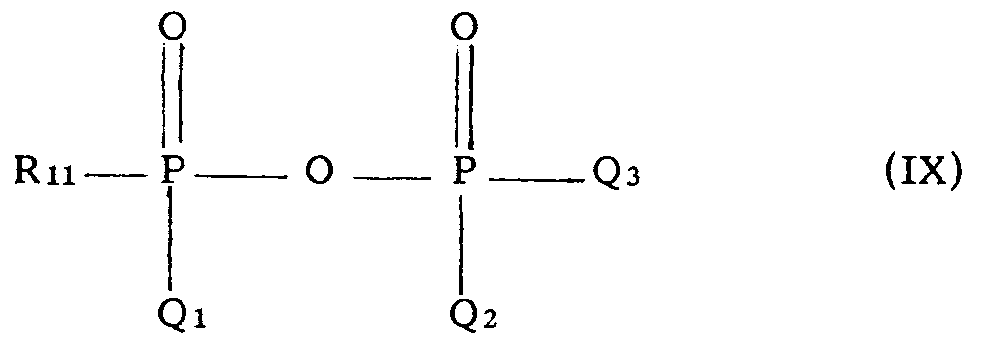
[0010] The soluble iron salts to be used in the present invention are various complex salts of divalent or trivalent iron ions. Compounds supplying these iron ions are, for example, ferric chloride, ferric sulfate, ferric nitrate, ferrous chloride, ferrous sulfate and ferrous nitrate, carboxylic acid iron salts including ferric acetate and ferric citrate, and various iron complex salts. Examples of the compounds that can react with these iron ions to form complex salts are expressed by the following general formulae [I] through [XI].
MmPmO3m Formula [I]
Mn+2PnO3n+1 Formula [II]
[0011] In the formulae [I] [II],
M: Hydrogen, alkali metal, or ammonium;
m: Integer from 3 to 6
n: Integer from 2 to 20
B-A₁-Z-A₂-C Formula [III]
[0012] In the formulas [III] and [IV], A₁ to A₆ individually represent substituted or unsubstituted alkylene groups, Z an alkylene group, a cyclo alkylene group, a phenylene group, -R-O-R, -ROROR- (R = alkyl group), or >N-A₇ [A₇ = hydrogen, hydrocarbon (preferably C₁-C₁₂ alkyl group), C₁-C₄ aliphatic carboxylate, C₁-C₄ hydroxyalkyl], and B, C, D, E, F, and G individually an -OH group, -COOM group, or -PO₃M₂ (M = hydrogen, alkali metal, or ammonium).
where
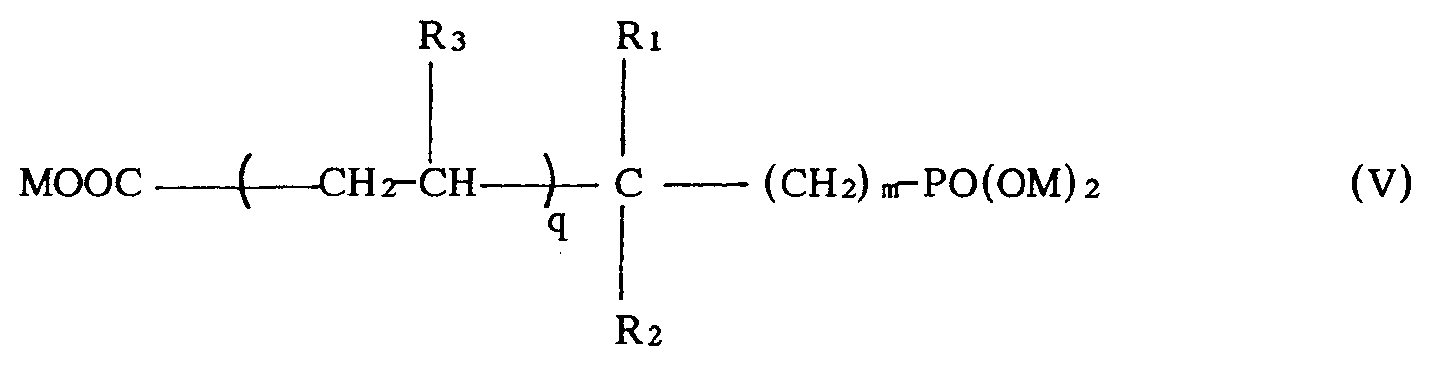
R₁: -COOM, -PO(OM)₂;
R₂: Hydrogen, alkyl group (preferably C₁ to C₄ alkyl group), -(CH₂)nCOOM, or phenyl group;
R3: Hydrogen, -COOM;
M: Hydrogen, alkali metal, or ammonium;
m: 0 or 1; and n: from 1 to 4
q: 0 or 1
R₄N(CH₂PO₃M₂)₂ Formula [VI]
where
R₄: an alkyl, preferably lower alkyl, group, aryl group, aralkyl group, or nitrogen-containing 6-membered heterocyclic group [optionally substituted by, e.g., -OH, -OR₅ (R₅ = alkyl group of C₁ to C₄), -PO₃M₂, -CH₂PO₃M₂, -N(CH₂PO₃M₂)₂, -COOM, and/or -N(CH₂COOM)₂]; and
M: Hydrogen, alkali metal or ammonium
where
R₆, R₇, R₈ independently represent: Hydrogen, an alkyl, preferably lower alkyl, group, -OH, a hydroxyalkyl group, PO₃M₂ or -NJ₂ (J = H, OH, alkyl group (preferably C₁-C₄), or -C₂H₄OH, -PO₃M₂);
X, Y, and Z independently represent: -OH, -COOM, -PO₃M₂, or H;
M: Hydrogen, alkali metal, or ammonium; and
n, q independently represent: 0 or 1
where
M, R₉, R₁₀ independently represent: Hydrogen, alkali metal, ammonium, an alkyl group, preferably C₁ to C₁₂, an alkenyl group, or alicyclic group
where
R₁₁: Alkyl group, preferably C₁ to C₁₂, alkoxy group, preferably C₁ to C₁₂, monoalkylamino group, preferably C₁ to C₁₂, dialkylamino group, preferably C₂ to C₁₂, amino group, aryloxy group, preferably C₆ to C24, allylamino group or amyloxy group, preferably C₆ to C₂₄; and
Q₁ to Q₃ independently represent: -OH, alkoxy group, preferably C₁ to C₂₄, aralkyloxy group, aryloxy group, -OM₃ (M₃ = a cation such as alkali metal or ammonium), amino group, cyclic amino group, e.g. a morpholino group, alkylamino group, dialkylamino group, allylamino group, or alkyloxy group.
[0013] Beside compounds expressed by the general formulas [I] to [XI], citric acid and glycine, for example, may be cited though the former compounds are generally superior.
[0014] Specific examples of the compounds as expressed by the formulas [I] through [XI] are:
(1) Na₄P₄O₁₂ (2) Na₃P₃O₉ (3) H₄P₂O₇
(4) H₅P₃O₁₀ (5) Na₆P₄O₁₃
(15) (HOC₂H₄)₂NCH₂COOH
[0015] The concentration of iron salt in the stabilizing bath should not exceed 1 × 10⁻¹ mol/l. For a continuous stabilizing process using a stabilizing bath comprising a number of successive tanks for treatment in countercurrent with a replenishing solution added to the last tank, the maximum amount of the above soluble iron salt is determined with reference to the concentration of the last tank.
[0016] The stabilizing solution (or stabilizing bath) of the present invention has a pH.of 3.0 to 9.0. Below pH 3.0 or above 9.0, the effect in preventing the discoloration of dyes is reduced. In the present invention, therefore, the pH is preferably adjusted to 4.5 to 8.5 and more preferably to 6.0 to 8.0. To the stabilizing solution are preferably added buffer agents for a buffering action. For such buffer agents, acetic acid, sodium acetate, boric acid, phosphoric acid or sodium hydroxide, for example, are preferably used, though such iron complex forming agents as mentioned above may be used in excess of the iron ions for a buffering action.
[0017] According to the present invention, the discoloration of the color picture can be avoided without softening the gelatin film. Further, in the present invention, the stabilizing treatment improves the stability of the dye picture substantially even when a foreign chemical or chemicals are retained in trace amounts in the photographic material. In the prior art, a compound such as ethylenediaminetetraacetic acid ferric complex salt used as a bleaching agent in color processing has to be thoroughly washed out in the washing step but we have found, rather unexpectedly, that the presence of soluble iron ions with the chelating agent contributes to the stabilization of the dye picture.
[0018] It will be appreciated that the soluble iron salt present in the bleach-fix or fix bath is automatically brought in by the photographic material to the stabilizing solution. It has been found that in the presence of a soluble iron salt other chemical ingredients, for example thiosulfate and sulfite salts, are effectively neutral in the discoloration of the dye picture provided their concentration is below a certain critical level, resulting in higher stability of the dye picture. To reduce the concentration of these chemical ingredients down to a desirable level, it is preferable to perform the stabilisation in a stabilizing bath comprising a plurality of tanks using a replenishing solution in countercurrent.
[0019] The stabilizing process of the present invention is performed at the final stage of the color processing. The stabilizing bath may comprise a single tank. For the reasons mentioned above, however, the stabilizing bath of the present invention preferably comprises a plurality of tanks for a multi-bath process. Further, the number of tanks used to achieve the desired results is closely dependent on the relation between the amount brought in with the photographic material from the processing bath containing the organic acid ferric complex salt and the volume of replenishing solution added. Namely, the smaller the ratio of the volume of replenishing solution added to the amount brought in, the larger the number of tanks required, and vice versa.
[0020] Though, generally, the number of tanks also depends on the concentration of the bath containing the organic acid ferric complex salt, if the volume of replenishing solution used is about three to five times as great as the volume brought in, two to eight tanks are preferably used for the stabilization; if, however, the volume ratio is fifty, preferably two to four tanks are used for the stabilization to achieve the desired results.
[0021] For the stabilizing bath of the present invention, a generally buffered solution whose pH is 3.0 to 9.0 is used; various buffer agents can be used. Specific examples of such buffer agents are borate, metaborate, borax, monocarboxylate, dicarboxylate, polycarboxylate, hydroxycarboxylate, amino acid, aminocarboxylate, monobasic, dibasic and tribasic phosphate, sodium hydroxide and potassium hydroxide.
[0022] Various chelating agents can be added. Examples of such chelating agents are aminopolycarboxylate, aminopolyphosphonic acid, phosphonocarboxylic acid, alkylidenediphosphonic acid, polyphosphate, pyrophosphoric acid, metaphosphoric acid, and gluconate. The use of 1-hydroxyethylidene-1,1-diphosphonic acid is particularly preferred.
[0023] Commonly known additives can be included in the stabilizing bath, for example fluorescent whitening dye, surfactant, bactericide, antiseptic, organic sulfur compound, onium salt, formalin, hardening agent such as aluminium or chromium, and various metal salts. These materials can be added in any combination and quantities provided the pH of the stabilizing bath can be maintained in the specified range; the stability of the photographic picture during storage is generally not affected adversely, and there is no precipitation in the bath.
[0024] Beside the chelating agent, compounds preferably added to the stabilizing bath of the present invention are buffer agents such as acetic acid and sodium acetate, bactericides such as 5-chloro-2-methyl-4-isothiazolin-3-on, 1-2-benzisothiazolin-3-on and thiabenzazole, a trace of formaldehyde, hardening agents such as aluminium salt and magnesium salt, fluorescent whitening dye etc. However, since the processing method of the present invention can achieve efficient stabilization of the dye picture and save the washing step, the above additive compounds are preferably added at a more dilute concentration to avoid environmental pollution and to reduce processing costs, provided they are added in an amount to endow the solution with a satisfactory buffering capacity.
[0025] The temperature for the stabilization is suitably 15 to 60°C, and preferably 20 to 45°C. The stabilization time is preferably set short from the viewpoint of quick processing, which is normally from 20 s to 10 min, and most preferably 1 to 5 min. In the case of a multi-tank stabilization system, preferably the earlier the position of a tank, the shorter the treatment time therein and vice versa. Specifically, it is preferred for the treatment time in successive tanks to increase 20 to 50% as compared to the previous tank.
[0026] In this way, the processing method of the present invention can also be applied to color paper, color reversal paper, color positive film, color negative film, color reversal film and color X-ray film, for example.
[0027] If the stabilizing bath of the present invention contains soluble silver salts, silver can be recovered from the bath by the technique of ion exchange, metal substitution, electrolysis or silver sulfide precipitation, for example.
Example 1
[0029] After picture printing, a roll of Sakura color paper (manufacturer: Konishiroku Photo Industry Co., Ltd.) was processed by an automatic developing machine for color processing with continuous replenishment. The processes and the formulation of the processing solutions used were as follows:
Standard processes:
Formulation of processing solution:
[Color development tank's solution]
[Color development replenishing solution]
[Bleach-fix tank's solution]
[Bleach-fix replenishing solution A]
[Bleach-fix replenishing solution B]
[0036] The automatic developing machine was filled with the color development tank's solution and bleach-fix tank's solution as formulated above, and a stabilizing solution as formulated below. While processing the color paper, the above color development replenishing solution and bleach-fix replenishing solutions A and B, and stabilizing replenishing solution were added at intervals of 3 min using a measuring cup, to conduct a running test. The color development tank was replenished at a rate of 324 ml of replenishing solution/m² of color paper, and the bleach-fix tank at a rate of 25 ml of each replenishing solution/m² of color paper.
[0037] For stabilization, the stabilizing bath of the automatic developing machine was modified so it might comprise either a single tank or three or six tanks for a continuous process. When the stabilizing bath of the automatic developing machine comprised a plurality of tanks, the first through, say, sixth tanks, in the direction of movement of the photographic material and a multi-tank countercurrent system in which the loss of solution was made up for at the last tank with the overflow from one tank added to the tank before it was used.
[0038] Stabilization in the solution formulated below was continued after the continuous processing until the volume of bleach-fix replenishing solutions A and B added totalled three times (taken together) the volume of the bleach-fix bath.
[0039] The first tank of the stabilizing bath was checked for any sign of precipitation, while the red mid-density (D = 1.5) was measured for the test samples obtained by the running processing. The samples were left to stand at 80°C and 80 RH% for sixty days and the measurements for the red mid-density were repeated.
[0041] It is noted that 50 ml of bleach-fix solution was brought into the stabilizing bath with each square meter of color paper. Stabilizing solution (and stabilizing solution replenisher)
[0042] As can be seen from the above table, in washing of the control sample (1), a slight precipitation in the first tank was detected with the appearance of algae at the tank walls, in spite of the very large volume of water used for replenishment, resulting in significant contamination of the color paper in some cases. Further, in the sample storage test, a large drop in red mid-density was detected in this case. By contrast, with the samples (2) through (9) that were stabilized according to the present invention, there was no precipitation in the stabilizing tank and the red mid-density showed a smaller drop in the storage test. Even in the stabilization of the present invention, however, if the volume of replenishing solution used is less than hundred times the volume of bleach-fixing solution brought in with the photographic material, the effect in preventing the red discoloration is limited, to some extent, when using a single tank stabilizing bath bath; this is probably because there is not enough dilution of the ingredients other than the ferric complex salt brought in from the bleach-fix solution. Thus, it is found that when the method of stabilizing the dye picture in the stabilizing solution of the present invention is used and the fixing or bleach-fixing process is directly followed by the stabilizing process, a more remarkable effect in preventing the discoloration of the dye picture can be achieved by using a stabilizing bath comprising a plurality of tanks and by making the solution overflow one tank to the next countercurrent, with the loss of solution made up at the last tank stage in the direction of the photosensitive material.
[0043] It is noted that for the three tank bath used for the stabilization of samples (7) and (8) of present example, the dip time was set at 20, 40 s and 2 min for the first, second and third tank, respectively, while for the six tank bath used for the stabilization of samples (9) and (10), the time was set to 10 s for the first two tanks, and 20, 30 50 s and 1 min for the third, fourth, fifth and sixth tank, respectively.
1. A method of processing a light-sensitive silver halide color photographic material
involving bleaching and fixing, wherein an iron complex salt is used as a bleaching
agent characterised in that, to stabilise the material against dye image fading in
the dark, it is treated with a solution of a chelating agent directly following bleaching
and fixing, or bleach-fixing, as the final stage of the method prior to drying without
intermediate washing such that the iron complex salt is present in the solution in
an amount which does not exceed 1 x 10⁻¹ mols per litre and, when a multi-tank stabilising
bath is used for the said solution, the iron complex salt is present in the last tank
in an amount which does not exceed 1 x 10⁻¹ mols per litre.
2. A method according to claim 1 which is carried out continuously and in which following
bleaching and fixing, or bleach-fixing, the developed silver halide color photographic
material is brought into contact with a stabilizing solution, the chelating agent
being added to said solution with replenisher therefor.
3. A method according to claim 1 or 2 in which the soluble iron complex salt is a complex
salt of an iron ion and a compound represented by the formula:
MmPmO3m (I)
or
Mn+2PnO3n+1 (II)
wherein
M represents a hydrogen atom, an alkali metal or an ammonium ion;
m represents an integer from 3 to 6; and
n represents an integer from 2 to 20.
MmPmO3m (I)
or
Mn+2PnO3n+1 (II)
wherein
M represents a hydrogen atom, an alkali metal or an ammonium ion;
m represents an integer from 3 to 6; and
n represents an integer from 2 to 20.
4. A method according to claim 1 or 2 in which the soluble iron complex salt is a complex
salt of an iron ion and a compound represented by the formulae:
B-A₁-Z-A₂-C (III)
or
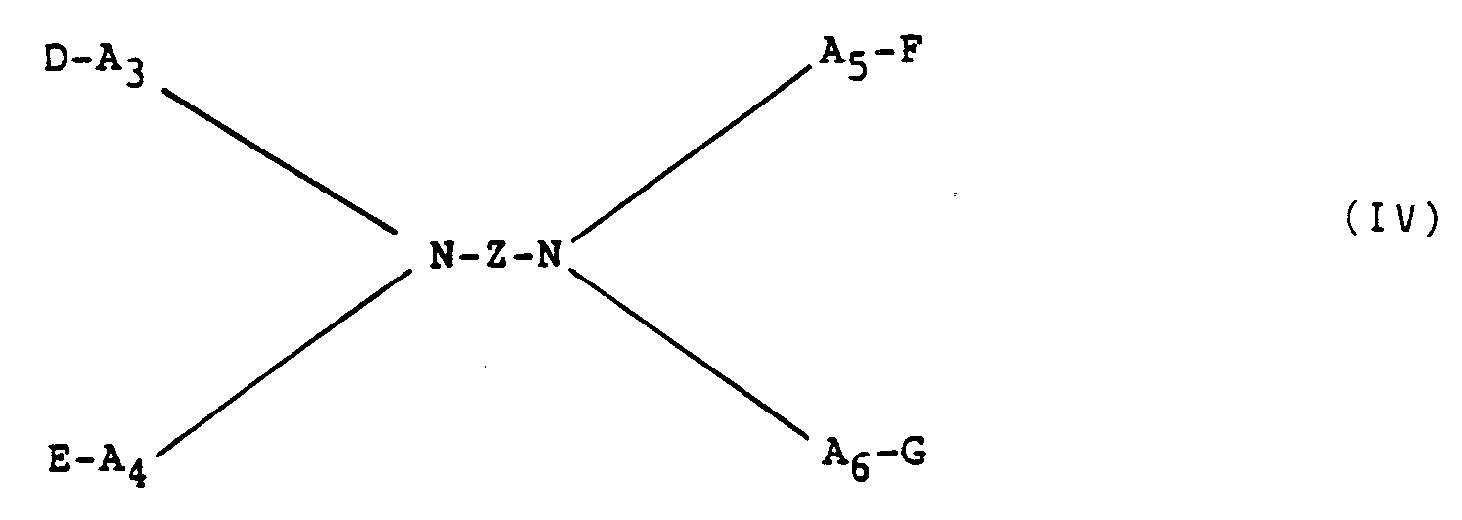
wherein
A₁ to A₆ each independently represent a substituted or unsubstituted alkyl group;
Z represents an alkylene group, a cycloalkylene group or phenylene group, -R-O-R or -ROROR- (wherein R represents an alkyl group) or >N-A₇ (wherein A₇ represents a hydrogen atom or a hydrocarbon, carboxy C₁-C₄ aliphatic or C₁-C₄ hydroxy alkyl radical); and
B, C, D, E, F and G each independently represents an -OH group, -COOM group, or -PO₃M₂ (wherein M represents a hydrogen atom, an alkali metal or an ammonium ion).
B-A₁-Z-A₂-C (III)
or
wherein
A₁ to A₆ each independently represent a substituted or unsubstituted alkyl group;
Z represents an alkylene group, a cycloalkylene group or phenylene group, -R-O-R or -ROROR- (wherein R represents an alkyl group) or >N-A₇ (wherein A₇ represents a hydrogen atom or a hydrocarbon, carboxy C₁-C₄ aliphatic or C₁-C₄ hydroxy alkyl radical); and
B, C, D, E, F and G each independently represents an -OH group, -COOM group, or -PO₃M₂ (wherein M represents a hydrogen atom, an alkali metal or an ammonium ion).
5. A method according to claim 1 or 2 in which the soluble iron complex salt is a complex
salt of an iron ion and a compound represented by the formula:
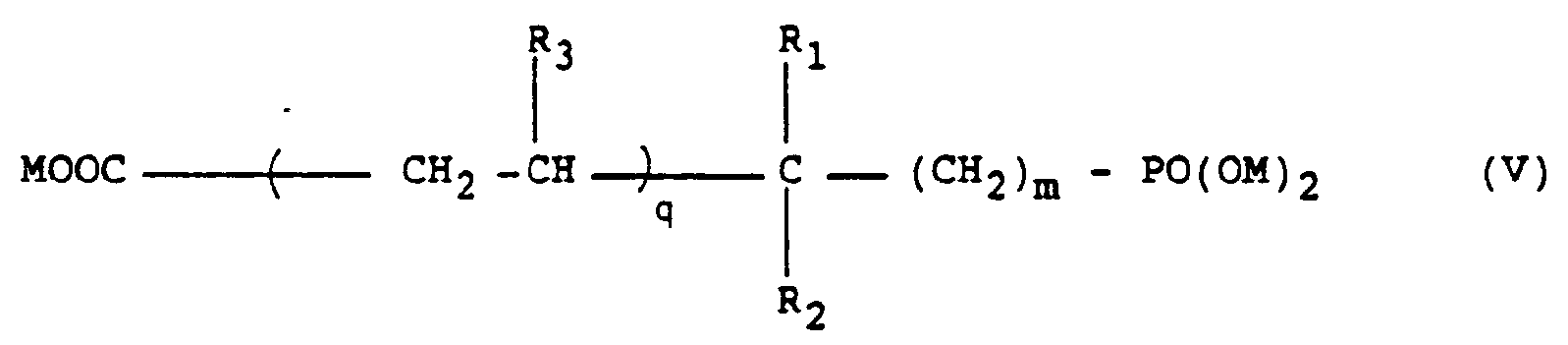
wherein
R₁ represents -COOM or -PO(OM)₂;
R₂ represents a hydrogen atom, an alkyl group, -(CH₂)nCOOM or a phenyl group;
R₃ represents a hydrogen atom or -COOM;
M represents a hydrogen atom, an alkali metal, or an ammonium ion;
m and q are independently 0 or 1; and
n represents an integer from 1 to 4.
wherein
R₁ represents -COOM or -PO(OM)₂;
R₂ represents a hydrogen atom, an alkyl group, -(CH₂)nCOOM or a phenyl group;
R₃ represents a hydrogen atom or -COOM;
M represents a hydrogen atom, an alkali metal, or an ammonium ion;
m and q are independently 0 or 1; and
n represents an integer from 1 to 4.
6. A method according to claim 1 or 2 in which the soluble iron salt is a complex salt
of an iron ion and a compound represented by the formula:
R₄N(CH₂PO₃M₂)₂ (VI)
wherein
R₄ represents an alkyl group, an aryl group, an aralkyl group or a nitrogen-containing 6-membered heterocyclic group optionally substituted by -OH, -OR₅, -PO₃M₂, -CH₂PO₃M₂, -N(CH₂PO₃M₂)₂, -COOM and/or -N(CH₂COOM)₂ wherein R₅ is a C₁-C₄ alkyl group; and
M represents a hydrogen atom, an alkali metal or an ammonium ion.
R₄N(CH₂PO₃M₂)₂ (VI)
wherein
R₄ represents an alkyl group, an aryl group, an aralkyl group or a nitrogen-containing 6-membered heterocyclic group optionally substituted by -OH, -OR₅, -PO₃M₂, -CH₂PO₃M₂, -N(CH₂PO₃M₂)₂, -COOM and/or -N(CH₂COOM)₂ wherein R₅ is a C₁-C₄ alkyl group; and
M represents a hydrogen atom, an alkali metal or an ammonium ion.
7. A method according to claim 1 or 2 in which the soluble iron complex salt is a complex
salt of an iron ion and a compound represented by the formula:
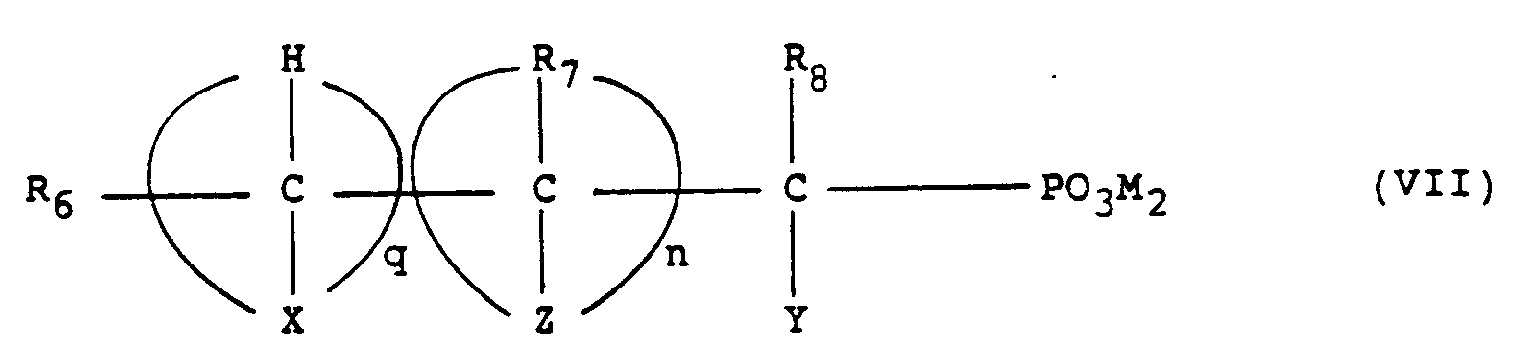
wherein
R₆, R₇ and R₈ each independently represents a hydrogen atom, an alkyl group, -OH, a hydroxyalkyl group, PO₃M₂, -NJ₂ (wherein J represents a hydrogen atom, -OH, an alkyl group,-C₂H₄OH or -PO₃M₂);
X, Y and Z each independently represents -OH, -COOM, -PO₃M₂ or a hydrogen atom;
M represents a hydrogen atom, an alkali metal or an ammonium ion; and
n and q are independently 0 or 1.
wherein
R₆, R₇ and R₈ each independently represents a hydrogen atom, an alkyl group, -OH, a hydroxyalkyl group, PO₃M₂, -NJ₂ (wherein J represents a hydrogen atom, -OH, an alkyl group,-C₂H₄OH or -PO₃M₂);
X, Y and Z each independently represents -OH, -COOM, -PO₃M₂ or a hydrogen atom;
M represents a hydrogen atom, an alkali metal or an ammonium ion; and
n and q are independently 0 or 1.
8. A method according to claim 1 or 2 in which the soluble iron complex salt is a complex
salt of an iron ion and a compound represented by the formula:
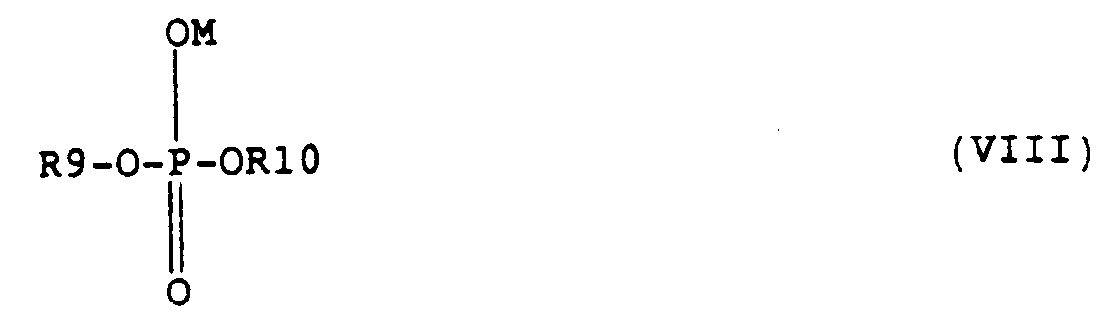
wherein
M, R₉ and R₁₀ each independently represents a hydrogen atom, an alkali metal, an ammonium ion, an alkyl group, an alkenyl group, or an alicyclic group.
wherein
M, R₉ and R₁₀ each independently represents a hydrogen atom, an alkali metal, an ammonium ion, an alkyl group, an alkenyl group, or an alicyclic group.
9. A method according to claim 1 or 2 in which the soluble iron complex salt is a complex
salt of an iron ion and a compound represented by the formula:
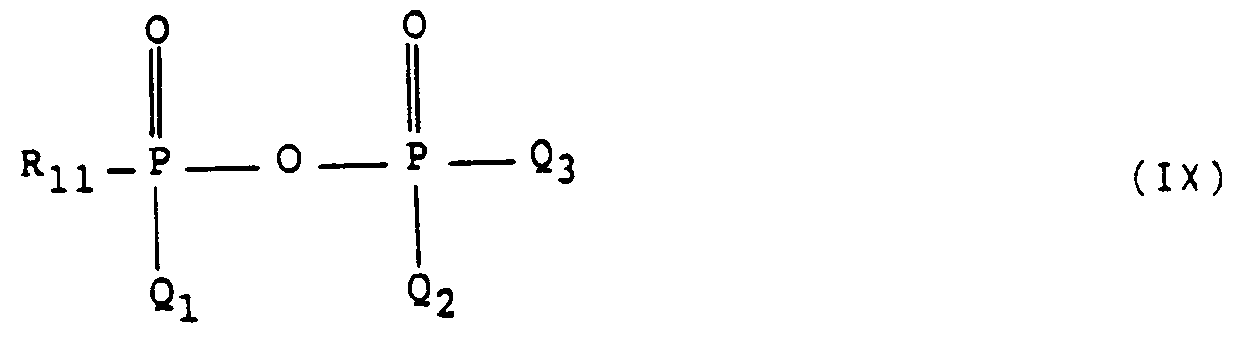
wherein
R₁₁ represents an alkyl group, an alkoxy group, a monoalkylamino group, a dialkylamino group, an amino group, an aryloxy group, an allylamino group or an amyloxy group; and
Q₁ through Q₃ each independently represents -OH, an alkoxy group, an aralkyloxy group, an aryloxy group, -OM₃ wherein M₃ represents a cation, an amino group, a cyclic amino group, an alkylamino group, a dialkylamino group, an allylamino group or an alkoxy group.
wherein
R₁₁ represents an alkyl group, an alkoxy group, a monoalkylamino group, a dialkylamino group, an amino group, an aryloxy group, an allylamino group or an amyloxy group; and
Q₁ through Q₃ each independently represents -OH, an alkoxy group, an aralkyloxy group, an aryloxy group, -OM₃ wherein M₃ represents a cation, an amino group, a cyclic amino group, an alkylamino group, a dialkylamino group, an allylamino group or an alkoxy group.
10. A method according to any one of the preceding claims in which the chelating agent
is an aminopoly carboxylate, aminopoly phosphonic acid, phosphono carboxylic acid,
alkylidenediphosphonic acid, polyphosphate, pyrophosphoric acid, metaphosphoric acid
or gluconate.
11. A method according to claim 10 in which the chelating agent is 1-hydroxyethylidene-1,1-diphosphonic
acid.
12. A method according to any one of the preceding claims in which the iron complex salt
is present in a bleach fix bath.
13. A method according to any one of the preceding claims in which thiosulfate is also
present in the said solution.
1. Verfahren zur Behandlung eines lichtempfindlichen Silberhalogenid-farbphotographischen
Materials, das Bleichen und Fixieren einschließt, wobei ein Eisen-Komplexsalz als
Bleichmittel verwendet wird,
dadurch gekennzeichnet,
daß zur Stabilisierung des Materials gegen Verblassen des Farbbildes im Dunkeln es mit einer Lösung eines Chelatbildners unmittelbar im Anschluß an das Bleichen und Fixieren, oder Bleich-Fixieren, als letzte Stufe des Verfahrens vor dem Trocknen ohne intermediäres Waschen so behandelt wird, daß das Eisen-Komplexsalz in der Lösung in einer Menge vorhanden ist, die 1 x 10⁻¹ mol pro Liter nicht überschreitet und, falls ein Mehrfachtank-Stabilisierungsbad für die genannte Lösung verwendet wird, das Eisen-Komplexsalz im letzten Tank in einer Menge vorliegt, die 1 x 10⁻¹ mol pro Liter nicht überschreitet.
dadurch gekennzeichnet,
daß zur Stabilisierung des Materials gegen Verblassen des Farbbildes im Dunkeln es mit einer Lösung eines Chelatbildners unmittelbar im Anschluß an das Bleichen und Fixieren, oder Bleich-Fixieren, als letzte Stufe des Verfahrens vor dem Trocknen ohne intermediäres Waschen so behandelt wird, daß das Eisen-Komplexsalz in der Lösung in einer Menge vorhanden ist, die 1 x 10⁻¹ mol pro Liter nicht überschreitet und, falls ein Mehrfachtank-Stabilisierungsbad für die genannte Lösung verwendet wird, das Eisen-Komplexsalz im letzten Tank in einer Menge vorliegt, die 1 x 10⁻¹ mol pro Liter nicht überschreitet.
2. Verfahren nach Anspruch 1, das kontunierlich durchgeführt und bei dem nach dem Bleichen
und Fixieren, oder Bleich-Fixieren, das entwickelte Silberhalogenid-farbphotographische
Material mit einer Stabilisierungslösung in Kontakt gebracht wird, wobei der Chelatbildner
der erwähnten Lösung mit einem Auffrischer hierfür zugesetzt wird.
3. Verfahren nach Anspruch 1 oder 2, bei dem das lösliche Eisen-Komplexsalz ein Komplexsalz
eines Eisenions und einer Verbindung gemäß der Formeln:
MmPmO3m (I)
oder
Mn+2PnO3n+1 (II)
darstellt, wobei
M ein Wasserstoffatom, ein Alkalimetall oder ein Ammoniumion ist;
m eine ganze Zahl von 3 - 6 bedeutet; und
n eine ganze Zahl von 2 - 20 bedeutet.
MmPmO3m (I)
oder
Mn+2PnO3n+1 (II)
darstellt, wobei
M ein Wasserstoffatom, ein Alkalimetall oder ein Ammoniumion ist;
m eine ganze Zahl von 3 - 6 bedeutet; und
n eine ganze Zahl von 2 - 20 bedeutet.
4. Verfahren nach Anspruch 1 oder 2, bei dem das lösliche Eisen-Komplexsalz ein Komplexsalz
eines Eisenions und einer Verbindung gemäß der Formeln:
B-A₁-Z-A₂-C (III)
oder
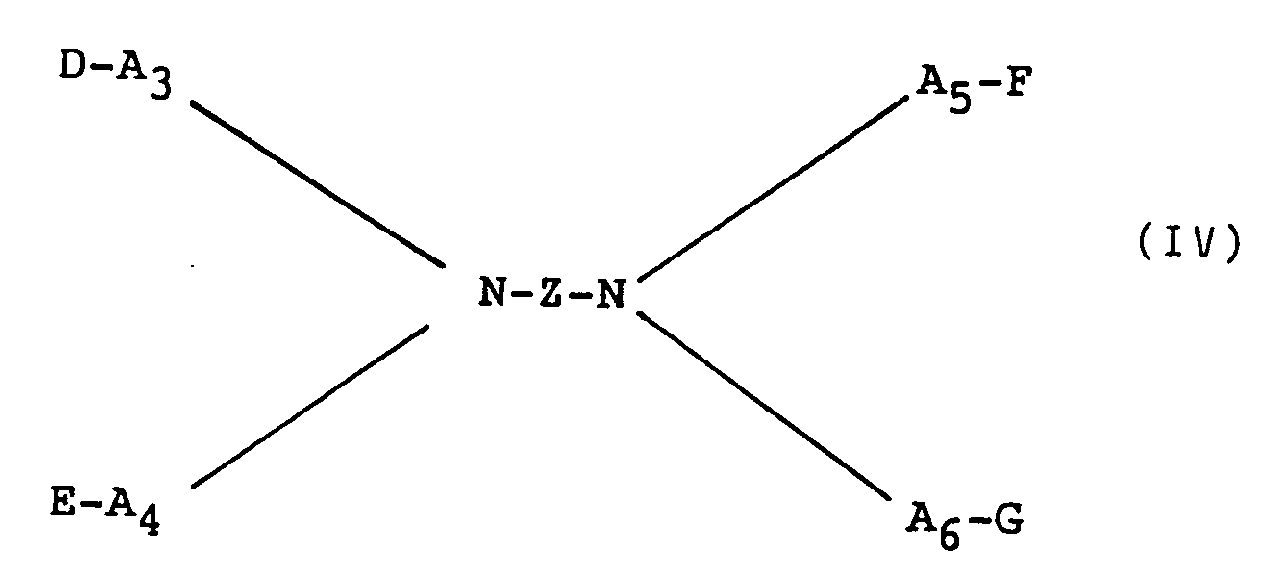
darstellt, wobei
A₁ bis A₆ jeweils unabhängig voneinander eine substituierte oder unsubstitutierte Alkylgruppe ist;
Z eine Alkylengruppe, eine Cycloalkylengruppe oder Phenylengruppe, -R-O-R oder - ROROR- (worin R eine Alkylgruppe ist ) oder >N-A₇ (worin A₇ ein Wasserstoffatom oder ein Kohlenwasserstoff-, aliphatisches Carboxy C₁-C₄ - oder C₁-C₄ Hydroxyalkylradikal ist ) darstellt; und
B, C, D, E, F und G jeweils unabhängig voneinander eine -OH Gruppe, -COOM Gruppe oder -PO₃M₂ Gruppe (worin M ein Wasserstoffatom, ein Alkalimetall oder Ammoniumion ist ) darstellt.
B-A₁-Z-A₂-C (III)
oder
darstellt, wobei
A₁ bis A₆ jeweils unabhängig voneinander eine substituierte oder unsubstitutierte Alkylgruppe ist;
Z eine Alkylengruppe, eine Cycloalkylengruppe oder Phenylengruppe, -R-O-R oder - ROROR- (worin R eine Alkylgruppe ist ) oder >N-A₇ (worin A₇ ein Wasserstoffatom oder ein Kohlenwasserstoff-, aliphatisches Carboxy C₁-C₄ - oder C₁-C₄ Hydroxyalkylradikal ist ) darstellt; und
B, C, D, E, F und G jeweils unabhängig voneinander eine -OH Gruppe, -COOM Gruppe oder -PO₃M₂ Gruppe (worin M ein Wasserstoffatom, ein Alkalimetall oder Ammoniumion ist ) darstellt.
5. Verfahren nach Anspruch 1 oder 2, bei dem das lösliche Eisen-Komplexsalz ein Komplexsalz
eines Eisenions und einer Verbindung gemäß der Formel:
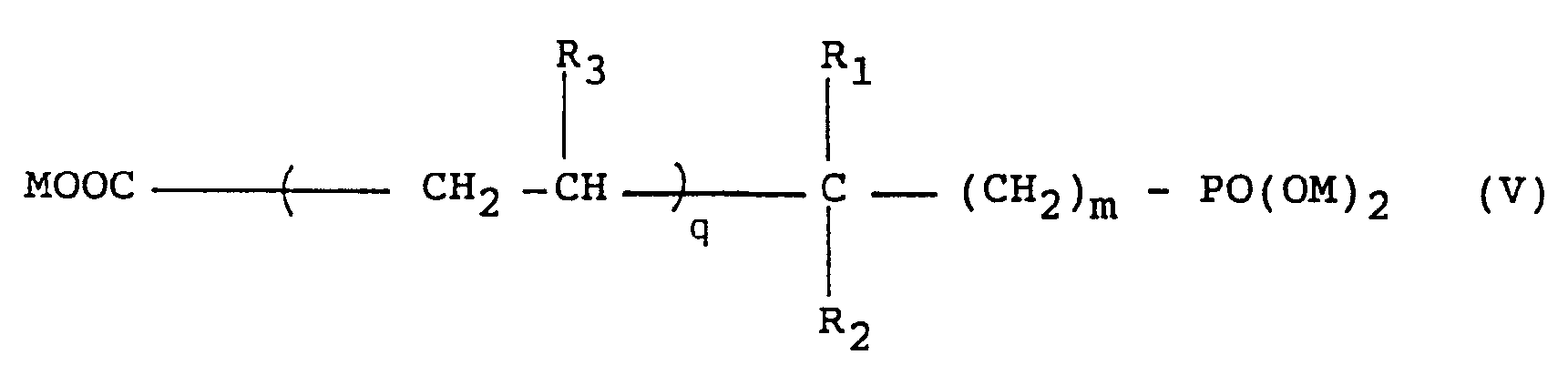
darstellt, worin
R₁ -COOM oder -PO(OM)₂ bedeutet;
R₂ ein Wasserstoffatom, eine Alkylgruppe, -(CH₂)n COOM oder eine Phenylgruppe bedeutet;
R₃ ein Wasserstoffatom oder -COOM bedeutet;
M ein Wasserstoffatom, ein Alkalimetall oder ein Ammoniumion bedeutet;
m und q unabhängig voneinander 0 oder 1 ist;
und
n eine ganze Zahl von 1 bis 4 bedeutet.
darstellt, worin
R₁ -COOM oder -PO(OM)₂ bedeutet;
R₂ ein Wasserstoffatom, eine Alkylgruppe, -(CH₂)n COOM oder eine Phenylgruppe bedeutet;
R₃ ein Wasserstoffatom oder -COOM bedeutet;
M ein Wasserstoffatom, ein Alkalimetall oder ein Ammoniumion bedeutet;
m und q unabhängig voneinander 0 oder 1 ist;
und
n eine ganze Zahl von 1 bis 4 bedeutet.
6. Verfahren nach Anspruch 1 oder 2, bei dem das lösliche Eisensalz ein Komplexsalz eines
Eisenions und einer Verbindung gemäß der Formel:
R₄N (CH₂PO₃M₂)₂ (VI)
bedeutet, worin
R₄ eine Alkylgruppe, eine Arylgruppe, eine Aralkylgruppe oder eine Stickstoff enthaltende 6-gliedrige heterozyklische Gruppe darstellt, die gegebenenfalls durch -OH, -OR₅, -PO₃M₂, -CH₂PO₃M₂,-N(CH₂PO₃M₂)₂, -COOM und/oder -N(CH₂COOM)₂ substituiert ist, wobei R₅ eine C₁-C₄ Alkylgruppe ist; und
M ein Wasserstoffatom, ein Alkalimetall oder ein Ammoniumion darstellt.
R₄N (CH₂PO₃M₂)₂ (VI)
bedeutet, worin
R₄ eine Alkylgruppe, eine Arylgruppe, eine Aralkylgruppe oder eine Stickstoff enthaltende 6-gliedrige heterozyklische Gruppe darstellt, die gegebenenfalls durch -OH, -OR₅, -PO₃M₂, -CH₂PO₃M₂,-N(CH₂PO₃M₂)₂, -COOM und/oder -N(CH₂COOM)₂ substituiert ist, wobei R₅ eine C₁-C₄ Alkylgruppe ist; und
M ein Wasserstoffatom, ein Alkalimetall oder ein Ammoniumion darstellt.
7. Verfahren nach Anspruch 1 oder 2, bei dem das lösliche Eisen-Komplexsalz ein Komplexsalz
eines Eisenions und einer Verbindung gemäß der Formel:
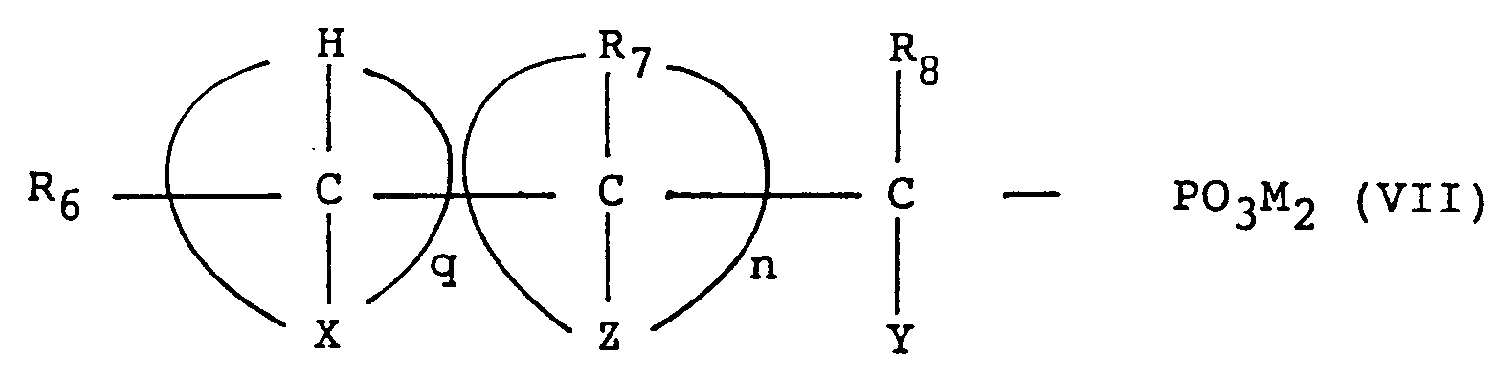
darstellt, worin
R₆, R₇ und R8 jeweils unabhängig ein Wasserstoffatom, eine Alkylgruppe, -OH, eine Hydroxylalkylgruppe, PO₃M₂, -NJ₂ (worin J ein Wasserstoffatom, - OH, eine Alkylgruppe, -C₂H₄OH oder -PO₃M₂ ist) darstellt;
X, Y und Z jeweils unabhängig -OH, -COOM, -PO₃M₂ oder ein Wasserstoffatom bedeuten;
M ein Wasserstoffatom, ein Alkalimetall oder ein Ammoniumion bedeutet; und
n und q unabhängig 0 oder 1 bedeuten.
darstellt, worin
R₆, R₇ und R8 jeweils unabhängig ein Wasserstoffatom, eine Alkylgruppe, -OH, eine Hydroxylalkylgruppe, PO₃M₂, -NJ₂ (worin J ein Wasserstoffatom, - OH, eine Alkylgruppe, -C₂H₄OH oder -PO₃M₂ ist) darstellt;
X, Y und Z jeweils unabhängig -OH, -COOM, -PO₃M₂ oder ein Wasserstoffatom bedeuten;
M ein Wasserstoffatom, ein Alkalimetall oder ein Ammoniumion bedeutet; und
n und q unabhängig 0 oder 1 bedeuten.
8. Verfahren nach Anspruch 1 oder 2, bei dem das lösliche Eisen-Komplexsalz ein Komplexsalz
eines Eisenions und einer Verbindung gemäß der Formel:
bedeuten, worin
M, R₉ und R₁₀ jeweils unabhängig ein Wasserstoffatom, ein Alkalimetall, ein Ammoniumion, eine Alkylgruppe, eine Alkenylgruppe oder eine alizyklische Gruppe darstellen.
bedeuten, worin
M, R₉ und R₁₀ jeweils unabhängig ein Wasserstoffatom, ein Alkalimetall, ein Ammoniumion, eine Alkylgruppe, eine Alkenylgruppe oder eine alizyklische Gruppe darstellen.
9. Verfahren nach Anspruch 1 oder 2, bei dem das lösliche Eisen-Komplexsalz ein Komplexsalz
eines Eisenions und einer Verbindung gemäß der Formel:
darstellt, worin
R₁₁ eine Alkylgruppe, eine Alkoxygruppe, eine Monoalkylaminogruppe, eine Dialkylaminogruppe, eine Aminogruppe, eine Aryloxygruppe, eine Allylaminogruppe oder eine Amyloxygruppe bedeutet; und
Q₁ bis Q₃ jeweils unabhängig -OH, eine Alkoxygruppe, eine Aralkyloxygruppe, eine Aryloxygruppe, -OM₃, worin M₃ für ein Kation steht, eine Aminogruppe, eine zyklische Aminogruppe, eine Alkylaminogruppe, eine Dialkylaminogruppe, eine Allylaminogruppe oder eine Alkoxygruppe darstellen.
darstellt, worin
R₁₁ eine Alkylgruppe, eine Alkoxygruppe, eine Monoalkylaminogruppe, eine Dialkylaminogruppe, eine Aminogruppe, eine Aryloxygruppe, eine Allylaminogruppe oder eine Amyloxygruppe bedeutet; und
Q₁ bis Q₃ jeweils unabhängig -OH, eine Alkoxygruppe, eine Aralkyloxygruppe, eine Aryloxygruppe, -OM₃, worin M₃ für ein Kation steht, eine Aminogruppe, eine zyklische Aminogruppe, eine Alkylaminogruppe, eine Dialkylaminogruppe, eine Allylaminogruppe oder eine Alkoxygruppe darstellen.
10. Verfahren nach einem der vorhergehenden Ansprüche, wobei der Chelatbildner ein Aminopolycarboxylat,
eine Aminopolyphosphonsäure, eine Phosphoncarboxylsäure, eine Alkylidendiphosphonsäure,
ein Polyphosphat, Pyrophosphorsäure, Metaphosphorsäure oder ein Gluconat ist.
11. Verfahren nach Anspruch 10, bei dem der Chelatbildner 1-Hydroxyethyliden-1,1-diphosphonsäure
ist.
12. Verfahren nach einem der vorhergehenden Ansprüche, bei dem das Eisen-Komplexsalz in
einem Bleich-Fixierbad vorhanden ist.
13. Verfahren nach einem der vorhergehenden Ansprüche, bei dem in der erwähnten Lösung
ebenfalls Thiosulfat vorhanden ist.
1. Méthode de traitement d'un matériau photosensible à l'halogénure d'argent pour la
photographie en couleur, comprenant des étapes de décoloration et de fixage, dans
laquelle on utilise un sel complexe de fer comme agent de décoloration, caractérisée
par le fait que, pour stabiliser le matériau contre la dégradation de l'image couleur
à l'obscurité, on le traite avec une solution d'un agent chélatant directement à la
suite de la décoloration et du fixage, ou du blanchiment-fixage, en étape finale du
traitement avant le séchage, sans lavage intermédiaire, de façon telle que le sel
complexe de fer est présent dans la solution dans une proportion n'excédant pas 1
x 10⁻¹ mole par litre et, lorsqu'on utilise un bain de stabilisation à cuves multiples,
pour ladite solution, le sel complexe de fer est présent dans la dernière cuve à une
concentration n'excédant pas 1 x 10⁻¹ mole par litre.
2. Méthode selon la revendication 1, qui est effectuée en continu et dans laquelle, après
la décoloration et le fixage, ou le blanchiment-fixage, le matériau photographique
à l'halogénure d'argent développé est mis en contact avec une solution de stabilisation,
l'agent chélatant étant ajouté à ladite solution avec sa solution de recharge.
3. Méthode selon la revendication 1 ou 2, dans laquelle le sel complexe de fer soluble
est un sel complexe d'un ion fer et d'un composé représenté par la formule :
MmPm03m (I)
ou
Mn+2Pn03n+1 (II)
où
M représente un atome d'hydrogène, un métal alcalin ou un ion ammonium ;
m représente un nombre entier de 3 à 6 ; et
n représente un nombre entier 2 à 20.
MmPm03m (I)
ou
Mn+2Pn03n+1 (II)
où
M représente un atome d'hydrogène, un métal alcalin ou un ion ammonium ;
m représente un nombre entier de 3 à 6 ; et
n représente un nombre entier 2 à 20.
4. Méthode selon la revendication 1 ou 2, dans laquelle le sel complexe de fer soluble
est un sel complexe d'un ion fer et d'un composé représenté par les formules :
B-A₁-Z-A₂-C (III)
ou
où
A₁ à A₆ représentent chacun indépendamment un groupe alkyle substitué ou non substitué ;
Z représente un groupe alkylène, un groupe cylcoalkylène ou un groupe phénylène, -R-O-R- ou -ROROR- (où R représente un groupe alkyle) ou >N-A₇ (où A₇ représente un atome d'hydrogène ou un groupe hydrocarboné, un groupe carboxylé aliphatique en C₁-C₄ ou hydroxyalkyle en C₁-C₄) ; et
B, C, D, E, F et G représentent chacun indépendamment un groupe -OH, un groupe COOM, ou -PO₃M₂ (où M représente un atome d'hydrogène, un métal alcalin ou un ion ammonium).
B-A₁-Z-A₂-C (III)
ou
où
A₁ à A₆ représentent chacun indépendamment un groupe alkyle substitué ou non substitué ;
Z représente un groupe alkylène, un groupe cylcoalkylène ou un groupe phénylène, -R-O-R- ou -ROROR- (où R représente un groupe alkyle) ou >N-A₇ (où A₇ représente un atome d'hydrogène ou un groupe hydrocarboné, un groupe carboxylé aliphatique en C₁-C₄ ou hydroxyalkyle en C₁-C₄) ; et
B, C, D, E, F et G représentent chacun indépendamment un groupe -OH, un groupe COOM, ou -PO₃M₂ (où M représente un atome d'hydrogène, un métal alcalin ou un ion ammonium).
5. Méthode selon la revendication 1 ou 2, dans laquelle le sel complexe de fer soluble
est un sel complexe d'un ion fer et d'un composé représenté par la formule :
où
R₁ représente -COOM ou -PO(OM)₂ ;
R₂ représente un atome d'hydrogène, un groupe alkyle, un groupe -(CH₂)nCOOM ou un groupe phényle ;
R₃ représente un atome d'hydrogène ou -COOM ;
M représente un atome d'hydrogène, un métal alcalin ou un ion ammonium ;
m et q représentent chacun indépendamment 0 ou 1; et
n représente un nombre entier de 0 à 4.
où
R₁ représente -COOM ou -PO(OM)₂ ;
R₂ représente un atome d'hydrogène, un groupe alkyle, un groupe -(CH₂)nCOOM ou un groupe phényle ;
R₃ représente un atome d'hydrogène ou -COOM ;
M représente un atome d'hydrogène, un métal alcalin ou un ion ammonium ;
m et q représentent chacun indépendamment 0 ou 1; et
n représente un nombre entier de 0 à 4.
6. Méthode selon la revendication 1 ou 2, dans laquelle le sel complexe de fer soluble
est un sel complexe d'un ion fer et d'un composé représenté par la formule :
R₄N(CH₂PO₃M₂)₂ (VI)
où
R₄ représente un groupe alkyle, un groupe aryle, un groupe aralkyle ou un groupe hétérocyclique azoté à six chaînons éventuellement substitué par -OH, -OR₅ , -PO₃M₂, -CH₂PO₃M₂, - N(CH₂PO₃M₂)₂, -COOM et/ou -N(CH₂COOM)₂ où R₅ est un groupe alkyle en C₁-C₄ ; et
M représente un atome d'hydrogène, un métal alcalin ou un ion ammonium.
R₄N(CH₂PO₃M₂)₂ (VI)
où
R₄ représente un groupe alkyle, un groupe aryle, un groupe aralkyle ou un groupe hétérocyclique azoté à six chaînons éventuellement substitué par -OH, -OR₅ , -PO₃M₂, -CH₂PO₃M₂, - N(CH₂PO₃M₂)₂, -COOM et/ou -N(CH₂COOM)₂ où R₅ est un groupe alkyle en C₁-C₄ ; et
M représente un atome d'hydrogène, un métal alcalin ou un ion ammonium.
7. Méthode selon la revendication 1 ou 2, dans laquelle le sel complexe de fer soluble
est un sel complexe d'un ion fer et d'un composé représenté par la formule :
où
R₆, R₇ et R₈ représentent chacun indépendamment un atome d'hydrogène, un groupe alkyle, un groupe -OH, un groupe hydroxyalkyle, -PO₃M₂, -NJ₂ (où J représente un atome d'hydrogène, -OH, un groupe alkyle, -C₂H₄OH ou -PO₃M₂) ;
X, Y, Z représentent chacun indépendamment -OH, -COOM, -PO₃M₂ ou un atome d'hydrogène ;
M représente un atome d'hydrogène, un métal alcalin ou un ion ammonium ;
n et q valent indépendamment 0 ou 1.
où
R₆, R₇ et R₈ représentent chacun indépendamment un atome d'hydrogène, un groupe alkyle, un groupe -OH, un groupe hydroxyalkyle, -PO₃M₂, -NJ₂ (où J représente un atome d'hydrogène, -OH, un groupe alkyle, -C₂H₄OH ou -PO₃M₂) ;
X, Y, Z représentent chacun indépendamment -OH, -COOM, -PO₃M₂ ou un atome d'hydrogène ;
M représente un atome d'hydrogène, un métal alcalin ou un ion ammonium ;
n et q valent indépendamment 0 ou 1.
8. Méthode selon la revendication 1 ou 2, dans laquelle le sel complexe de fer soluble
est un sel complexe d'un ion fer et d'un composé représenté par la formule :
où
M, R₉ et R₁₀ représentent chacun indépendamment un atome d'hydrogène, un métal alcalin, un ion ammonium, un groupe alkyle, un groupe alcényle ou un groupe alicyclique.
où
M, R₉ et R₁₀ représentent chacun indépendamment un atome d'hydrogène, un métal alcalin, un ion ammonium, un groupe alkyle, un groupe alcényle ou un groupe alicyclique.
9. Méthode selon la revendication 1 ou 2, dans laquelle le sel complexe de fer soluble
est un sel complexe d'un ion de fer et d'un composé représenté par la formule :
où
R₁₁ représente un groupe alkyle, un groupe alcoxy, un groupe monoalkylamino, un groupe dialkylamino, un groupe amino, un groupe aryloxy, un groupe allylamino ou un groupe amyloxy ; et
Q₁ à Q₃ représentent chacun indépendamment -OH, un groupe alcoxy, un groupe aralcoxy, un groupe aryloxy, -OM₃ où M₃ représente un cation, un groupe amino, un groupe amino cyclique, un groupe alkylamino, un groupe dialkylamino, un groupe allylamino ou un groupe alcoxy.
où
R₁₁ représente un groupe alkyle, un groupe alcoxy, un groupe monoalkylamino, un groupe dialkylamino, un groupe amino, un groupe aryloxy, un groupe allylamino ou un groupe amyloxy ; et
Q₁ à Q₃ représentent chacun indépendamment -OH, un groupe alcoxy, un groupe aralcoxy, un groupe aryloxy, -OM₃ où M₃ représente un cation, un groupe amino, un groupe amino cyclique, un groupe alkylamino, un groupe dialkylamino, un groupe allylamino ou un groupe alcoxy.
10. Méthode selon l'une quelconque des revendications précédentes, dans laquelle l'agent
chélatant est un aminopolycarboxylate, un acide aminopolyphosphonique, un acide phosphonocarboxylique,
un acide alkylidène diphosphonique, un polyphosphate, l'acides pyrophosphorique, l'acide
métaphosphorique ou un gluconate.
11. Méthode selon la revendication 10, dans laquelle l'agent chélatant est l'acide 1-hydroxyéthylidène-1,1-diphosphonique.
12. Méthode selon l'une quelconque des revendications précédentes, dans laquelle le sel
complexe de fer est présent dans un bain de décoloration-fixage.
13. Méthode selon l'une quelconque des revendications précédentes, dans laquelle un thiosulfate
est également présent dans ladite solution.