|
(11) | EP 0 161 665 A2 |

| (12) | EUROPEAN PATENT APPLICATION |
|
|
|
|
|||||||||||||||||||||||||||
| (54) | Yellow disperse dyestuff mixtures and dyeing process |
| (57) C.I. Disperse Yellow 54 and 64 are important yellow dyestuffs of the quinophthalone
type used in coloring synthetic fibers, particulairly polyamide, polyester, acrylic
and acetate fibers at boiling temperature conditions. Yellow azo dyestuffs of the
hydroxypyridone type, e.g., C.l. Disperse Yellow 114, 180, 227 and 230, have found
widespread application in the high-temperature dyeing of such synthetic fibers. It
has now been found that improved tinctorial results on these synthetic fiber materials
can be obtained by applying a dyestuff composition derived from these yellow coloring
means and comprising a mixture of 70 - 90 parts by weight of one or more dyestuffs
of the C.I. Disperse Yellow 54 and 64 type with 5 to 30 parts by weight of one or
more azo dyestuffs of the hydroxypyridone type. These novel dyestuff compositions
exhibit superior leveling, high tinctorial strength or color build-up, high dyebath
exhaustion and deep shade dyeing over the individual components. In addition, the
dyestuff compositions of the invention are not phototropic. |
BACKGROUND OF THE INVENTION
[0001] Synthetic fibers, e.g. polyester (PES), polyamide, acrylic and acetate fibers, can be exhaust-dyed with disperse dyestuffs by the high-temperature method at a tenperature of about 105°C to about 140°C, preferably about 130°C, or by the boiling temperature method at a temperature of about 95°C to about 100°C in the presence of carriers.
[0002] However, only a few selected disperse dyestuffs can produce all depths of shade when dyeing at the boil, which is carried out in open-type dyeing machines under atmospheric pressure. Despite the use of a carrier, many disperse dyestuffs only produce pale to medium depths of shade by this method.
[0003] In the field of coloring yellow hues an PES fibers under boiling temperature conditions, C.I. Disperse Yellow 54 and 64 have become established in industry as the most important yellow dyestuffs derived from quinophthalones for the self-shade and combination-shade dyeing. Disperse Yellow 54 and 64 produce bright reddish yellow dyeings having a high lightfastness level; though these dyestuffs are, in principle, suitable for all depths of shade both in dyeing at the boil and in high-tenperature dyeing, they have, nevertheless, a number of disadvantages: Thus, the tinctorial strength is, as is typical for quinophthalone dyestuffs, relatively low. As a consequence thereof, dyestuff consumption and hence costs, are high, particularly in the case of deeper shades. Further, in the dyeing of wound packages (cheese, muff or beam dyeing), of yarn in hank form and of piece goods there is always a great danger, in particular with modern rapid-dyeing methods, that the dyeing will turn out unlevel, both for self-shade and combination-shade colorations. Disperse Yellow 54 and 64 are among the particularly poor-leveling dyestuffs, unless an excessively long dyeing time is used for the subsequent leveling-out of the dyeing. Finally, when the concentration of the dyestuff used relative to the weight of the PES fiber material is increased, the hue becomes undesirably more and more reddish, and consequently deep, neutral yellow dyeings are no longer obtainable.
[0004] As far as the field of yellow colorations of PES fibers under high-tenperature dyeing conditions is concerned, azo dyestuffs of the hydroxypyridone type ( e.g. C.I.Disperse Yellow 114, 180, 227 and 230) have become established in industry as important yellow dyestuffs for the self-shade and combination-shade dyeing. These dyestuffs produce bright greenish yellow dyeings having a high lightfastness level. They are suitable for dyeing all depths of shade under high-tenperature dyeing conditions and are characterized by high tinctorial strength and consequently by low dyestuff consumption and low costs. However, these dyestuffs also have disadvantages: The distribution equilibrium at the end of the dyeing process (i.e. the dyestuff level in the fiber relative to the dyestuff level in the dyeing liquor) is so unfavorable that, depending on the depth of shade being dyed, an appreciable amount of dyestuff does not exhaust onto the PES fiber. Moreover, a number of these dyestuffs are phototropic, so that it can be very difficult, depending on the optical conditions, to compare a sample of a completed dyeing with that of the shade to be matched. Further, a number of these dyestuffs are pH-sensitive, i.e. at a dyeing pH above 5 a considerable portion of the tinctorial strength is lost. Ultimately, no dyestuff of the hydroxypyridone type is suitable for dyeing at the boil, even in the presence of carriers; this means that the color build-up achieved under these dyeing conditions is low or at most of medium depth, which results in a high portion of non-exhausting dyestuff residue remaining in the dyebath. Consequently, dyestuffs costs are extrenely high because of low dyestuff utilization, and it is impossible to obtain deep self-shade or combination-shade dyeings with this type of dyestuff.
[0005] The object of the present invention is to avoid the above-described disadvantages of the disperse-type yellow dyestuffs already known for use in the exhaust dyeing of synthetic fibers, such as polyamide, PES, acrylic and acetate fibers, in particular PES fibers, and their mixtures with other fibers.
SUMMARY OF THE INVENTION
[0006] It has now been found, surprisingly, that the before described disadvantages of the known yellow individual dyestuffs in exhaust-dyeing of synthetic fibers such as polyamide, polyester, acrylic and triacetates, particularly polyester fibers, and their mixtures with natural fibers such as wool or cotton, or with regenerated cellulose fibers, can be avoided by using a mixture comprising 70-95, preferably 80 - 90 parts by weight of one or more yellow disperse dyestuffs of the general Formula I type, and 5 - 30, preferably 10 - 20 parts by weight of one or more yellow disperse dyestuffs of the general Formula II type. Dyestuff compositions of such characteristics are, in the first place, the principal object of this invention. These dyestuff mixtures applied in the form of a fine dispersion resulting, for example, from grinding with dispersant(s) are highly suitable for exhausting synthetic fibers at the boil (95°C - 100°C) or under high temperature conditions (105°C - 140°C) in the presence or absence of a customary carrier, and with or without the concomitant use of other disperse dyestuffs of different structure, to yield yellow self-shade or combination-shade colorations. The ingredient amounts of the underlying individual dyestuffs specified above are each time expressed relative to a total weight of said dyestuff composition of 100 parts by weight of the Formula I type and Formula II type dyestuffs, and referring (in the case of commercial products) to the content of the respective pure dyestuff; the general formulae for the dyestuff types of the mixture ingredients are as follows: Fonnula I type
where R1 is a hydrogen or bramine atom;
Formula II type
[0007]
where n = 0, 1, 2, 3, 4 or 5; R2 is a hydrogen atom when n = 0 or is a substituent independently selected fran a halogen atom, e.g. chlorine, fluorine or bromine, the cyano group, the nitro group, the trifluoromethyl group, an alkyl group of 1 to 4 carbon atoms, an alkoxy group of 1 or 4 carbon atoms, any aliphatic carboxylate group, any aromatic sulfonate group, any aliphatic or aromatic keto group, unsubstituted carboxyamide, any aliphatic carboxyamide group, unsubstituted sulfonamide, any aliphatic sulfonamide group or any aliphatic or aromatic sulfone group when n = an integer of from 1 - 5, preferably 1 - 3, (it being understood that when n = 0 the number of hydrogens on the above identified phenyl ring is 5, and when n = 5, the number of hydrogens is 0); and R3 is a hydrogen atom, a straight-chain or branched alkyl group of 1 to 6 carbon atoms optionally interrupted in the chain by one or more ethereal oxygen atoms, or is a benzyl group or a phenethyl group.
[0008] It should be noted that although R1 is depicted in the above Formula I type structure as being located on the left-hand nitrogen substituted ring, it may be optionally located on the right-hand ring portion. Both positions are intended to be within the scope of this invention and the claims hereof.
[0009] Preferred Formula II type components of the mixtures are disperse dyestuffs having molecular structures as set forth below:
where R4 is a hydrogen atom when n = 0 or is a substituent independently selected from methyl, ethyl, chlorine, nitro, cyano, methoxy and ethoxy when n = an integer of from 1 to 5; R5 is amino, an alkylamino of 1 to 4 carbon atoms, a dialkylamino of 1 to 4 carbon atoms per each alkyl, methyl, ethyl, phenyl or optionally a substituted phenoxy; R6 is an alkyl of 1 to 4 carbon atoms which can also be interrupted in the chain by ethereal oxygen, or is phenyl-sulfo; R7 is an alkyl of 1 to 4 carbon atoms, an alkoxy of 1 to 4 carbon atoms, amino, an alkylamino of 1 - 4 carbon atoms, a dialkylamino of 1 - 4 carbon atoms per each alkyl, or a phenyl which can also be substituted by an alkyl of 1 to 4 carbon atoms; and in these preferred Formula II type compounds, the meaning of the "R4" subscript "n" index is the same with regard to hydrogen replacement as was previously explained for the moiety R2.
[0010] Particularly preferred Formula II type conponents of the mixtures are disperse dyestuffs having the following molecular structures:
wherein: n = 0 or 1;
where R4 is defined as indicated above; R8 is hydrogen, methoxy, methyl, chlorine or nitro; R9 is hydrogen, methyl or ethyl; and R10 is hydrogen or an alkyl of 1 to 4 carbon atoms.
[0011] It is indeed already known to apply for thermo-transfer printing of synthetic fiber materials dyestuff mixtures of the following general Formulae I' and II' (European Patent Application No: 00 83,553 correspondin to U.S. Patent 4,427,413) with the dyestuff of Formula II' being used in excess:
[0012] This use in a heat transfer printing, however, has no bearing whatsoever on the use of these products in exhaust dyeing.
[0013] The individual disperse dyestuffs representing the mixing conponents of the foregoing disclosed compositions are known as such and available applying manufacturing techniques usual in this field.
[0014] The preparation of the novel yellow dyestuff compositions according to this invention consisting essentially of dyestuffs of Formulae I and II type can be effected by mixing together ready-finished (i.e. highly water-dispersible) formulations of the individual base dyestuffs, or by mutually finishing the individual base dyestuffs in admixture, i.e. by jointly wet-grinding of mixtures of the individual dyestuffs in the presence of customary nonionic or anionic dispersants (for example a ligninsulfonate) in a conventional bead mill, optionally under conditions whereby the formation of mixed crystals derived from the individual base dyestuffs may occur. Likewise one or more additional disperse dyestuff of different structure may be mixed with the yellow dyestuffs of this invention to produce a different shade.
DErAILED DESCRIPTION OF THE PREFERRED EMBODIMENTS
[0015] Synthetic fibers which may be dyed with the compositions of this invention are polyamide, acrylic, triacetate and polyester (PES) fibers. The PES fibers include those based on polyethylene terephthalate, polybutylene terephthalate or polycyclohexylene terephthalate; PES fibers modified by copolymerization with polyethylene glycol, isophthalic acid or polymerizable phosphorus compounds; and mixtures of such PES fibers with fiber materials of natural origin such as wool or cotton, or with regenerated cellulose, the PES weight proportion in said fiber blends may be present in an amount of 10 - 90%, preferably 30 - 70%. Polyamide fibers include those fibers made from nylon-6, nylon-6,6 and their various modified forms and copolymers. This invention is applicable to the dyeing of such fibers in a variety of forms, for example in the form of loose flock, slubbing, yarn or piece goods.
[0016] The dyeing of the synthetic fibers or their mixtures with the dyestuff compositions of this invention is carried out by the standard exhaust method. Special mention is made employing this technique for exhaust dyeing at the boil, where the dyeing is done in open-type dyeing machines at atmospheric pressure (e.g. reel becks), preferably in the presence of usual carriers, such as those based on orthophenylphenol, dichlorobenzenes, trichlorobenzenes, methylnaphthalenes, chloronaphthalenes, alkyl benzoates or kresotates, or diphenyl and the like. The dye bath may further contain one or more of the customary dispersants and/or leveling agents. In addition, dyeing may also be effected according to a conventional high-tenperature (HT) exhaust method at temperatures approximately of 105°C to about 140°C. The actual dyeing operation is advantageously followed by a reduction clear or a dispersant-assisted after-treatment for removing unfixed dyestuff.
[0017] If mixtures of PES fibers with wool, cotton, other natural fibers, or regenerated cellulose are used, the accompanying fiber portion of the blend can be dyed with suitable dyestuffs in the same or different shades (two-tone effects or woven designs) before or after the PES dyeing.
[0018] The dyestuff compositions of the invention can be applied by themselves in the yellow region to produce bright, deep yellow dyeings, or combined with other commercial disperse dyestuffs of a different structural type resulting also in yellow shades or even with such disperse dyes yielding hues other than yellow, for example, red and blue dyestuffs (trichromatic dyeing), with the proviso that under the prevailing conditions all dyestuffs have similar absorbing properties; the achievable lightfastness of these dyeings is very good for the yellow self-shade, as well as the trichromatics. These other disperse dyestuffs can already be present in the ready-made dyestuff composition or are first added when the dyeing procedure is carried out in the sense of a combination-shade dyeing.
[0019] One particularly surprising aspect of the dyestuff mixtures representing the compositions of this invention is their improved dyebath exhaustion over that of the respective individual dyestuffs. As the following comparison shows, dyeing PES fibers at the boil (at 96° - 98°C for 60 minutes) in conjunction with a conventional addition of carrier and with the starting levels (liquor concentration) of the individual dyestuffs or mixtures given hereinafter in percent by weight (expressed as pure dyestuff) on weight of polyester fiber leads to the dyebath exhaustions as set forth below:
[0021] The dyestuff mixtures according to the invention have a very high tinctorial strength, favorable economics and can produce extraordinarily deep shades. The leveling behaviour of the dyestuff compositions of the invention is markedly better than that of C.I. Disperse Yellow 54 and 64, and the hues which can be obtained on synthetic fiber materials by the way of these dyestuff mixtures remain virtually constant from pale shades to very deep shades, i.e., there is no red shift with increasing level of the dyestuff composition.
[0022] When used in amounts that are conventional on a practical scale, relative to the fiber material to be dyed, the application of the compositions representing the present invention does not result in leaving behind in the exhausted dyebath, at the end of the dyeing process, i.e., after the distribution equilibrium has became established, any noticeable remainder of dyestuff not having been fixed by the fiber. The dyestuff mixtures of the invention have no marked phototropy in any case and are not pci sensitive between pH 3 and 6, under standard dyeing conditions for the foregoing disclosed fiber substances.
[0023] The following examples serve to illustrate the invention. Parts and percentages are by weight, unless stated otherwise:
EXAMPLE I
[0025] 20 parts of a Formula II type disperse dyestuff having the following structure:
and 150 parts of a ligninsulfonate dispersant were mixed by water-wet bead-milling and thus converted into a fine dyestuff dispersion, which was spray dried.
[0026] For dyeing at the boil, 100 parts of a polyethylene terephthalate-type PES fiber in yarn form were treated in a dyeing beaker which contained 2,000 parts of water at 60°C, 2 parts of crystallized sodium acetate, 3 parts of a 30% strength acetic acid, 5 parts of a commercial carrier on diphenyl basis and 1 part of the dyeing formulation mentioned above. The dyebath temperature was then raised in the course of 30 minutes to 98°C - 100°C and held there for 60 minutes. Thereupon, the dyebath was cooled and the yarn so dyed was rinsed, dried, and after-cured at 150°C for 30 seconds under dry conditions. The tinctorial result was a bright yellow dyeing of high lightfastness, whilst only very little non-absorbed dyestuff remained in the exhausted dyebath.
[0027] The same dyeing result was obtained if a different type of a customary dispersant was used in preparing the dyeing formulation.
EXAMPLE II
[0028] Dyeing formulations were prepared in the manner described in Example I, but using this time the following ratios of the same Formulae I and II type disperse dvestuffs:
and applying these batches to PES fibers in accordance with the procedure of Example I. The dyeing results obtained in this case were equivalent to those of Example I.
[0029] Dyeing in the presence of a different type of a conventional carrier likewise gives very high dyebath exhaustion.
EXAMPLE III
[0030] 100 parts of a PES fiber of the polyethylene terephthalate type but modified to a minor proportion with butylene glycol comonomers were used for the dyeing operation corresponding to a procedure which is otherwise the same as that described in Example I, except that no carrier was present in the dyeing liquor. The result achieved was likewise a very high dyebath exhaustion and a deep shade on the modified PES material
[0031] The same good result was obtained when a modified polyethylene terephthalate PES fiber containing incorporated polyethylene glycol portions was dyed in the above manner.
EXAMPLE IV
[0032] 85 parts of a disperse dyestuff of the Formula I type having the structure:
15 parts of a disperse dyestuff of the Formula II type having the structure:
and 180 parts of a conventional dispersant comprising a sulfonated formaldehyde/naphthalene condensation product were converted into a finely divided dyestuff dispersion by aqueous bead-milling, and the said formulation was dried.
[0033] Two parts of this formulation were used for dyeing, at the boil and in the presence of 12 parts of an usual carrier based on a mixture of ortho-phenylphenol and methyl salicylate, 150 parts of a PES fiber of the polycyclohexylene terephthalate type. The tinctorial result was a deep yellow dyeing without appreciable amounts of non-absorbed dyestuffs have been left in the exhausted dyebath.
[0034] If the same dyeing had been carried out under HT-dyeing conditions at a temperature of 130°C in the absence of a carrier, the tinctorial result was equally good.
EXAMPLE V
[0035] If the dyeing procedure at boiling temperature of the liquor specified in Example IV was repeated at 98°C - 100°C for the coloration of a blend composed of 170 parts of PES fibers based on polyethylene terephthalate and 30 parts of cotton in the presence of the carrier mentioned, this gave the PES fiber component dyed deeply yellow side by side a well-reserved cotton portion.
EXAMPLE VI
[0036] Separate, finely divided and spray-dried dispersions were prepared by bead-milling in the presence of a dispersant, each of a Formula I disperse dyestuff having the following structure:
and of a Fornula II disperse dyestuff having the following structure:
These respective dispersions of the above individual dyestuffs were then mixed in a ratio of 80 parts of the Formula I type and 20 parts of the Formula II type.
[0037] Ten parts of a PES fiber material in the form of a wound yarn package were then treated at 95°C - 98°C for 90 minutes and assisted by the effect of a commercial carrier based on methylnaphthalene with an aqueous liquor which contained - for producing a combination-shade dyeing - , 0.1 part of the above described dispersion of the yellow type dyestuffs, 0.05 part of a commercial dyestuff of the type C.I. Disperse Blue 56 and 0.1 part of a commercial dyestuff of the type C.I. Disperse Red 73. This dyeing procedure gave a deep brown dyeing and very high exhaustion of the dyebath.
[0038] An equally good tinctorial result was obtained in the dyeing if, for carrying out the foregoing Exanple, a formulation was prepared from the individual dyestuffs by finishing them together, or by mixing the individually finished dyestuffs.
EXAMPLE VII - XXXI
[0039] Example I was repeated, except that the disperse dyestuff referred to therein as a Formula II type had been replaced by one of the disperse dyestuffs listed below wherein said Formula II type disperse dyestuff had the following general structural fomula:
and wherein R11 and R12 are set forth respectively in the following table. The mixed dyestuff compositions of these Exanples VII - XXXI showed a better color build-up than the individual dyestuffs.
EXAMPLE XXXII
[0040] If, for dyeing according to Example I as the textile material, a commercially available cellulose triacetate fiber was dyed in place of the polyester fiber used in Example I, then an equally good dyeing resulted.
EXAMPLE XXXIII
[0041] If, for dyeing according to Example I as the textile material, a commercially available cellulose 2½ - acetate fiber or a commercially available polyamide fiber were dyed in place of the polyester fiber of Example I, and if the dyeing was done without using the carrier mentioned in Example I, then in each case deep yellow dyeings were obtained, which left behind very highly exhausted dyebaths.
[0042] The dyestuff compositions of this invention as has previously been described (see e.g. Example VI), may be used in shade combination dyeings with other disperse dyestuffs of different structure, e.g. the dyestuff compositions of this invention may be used in shade-combination dyeings with disperse dyes such as C.I. Disperse Yellow 23, Disperse Orange 25, Disperse Red 60, Disperse Red 65, Disperse Red 91, Disperse Blue 56, Disperse Blue 60, Disperse Blue 91, or with disperse dyes of other structural types.
1. A dyestuff composition comprising a mixture of: (1) 70 - 95 parts by weight of
at least one yellow disperse dyestuff, designated as a Formula I type dyestuff, having
the formula:
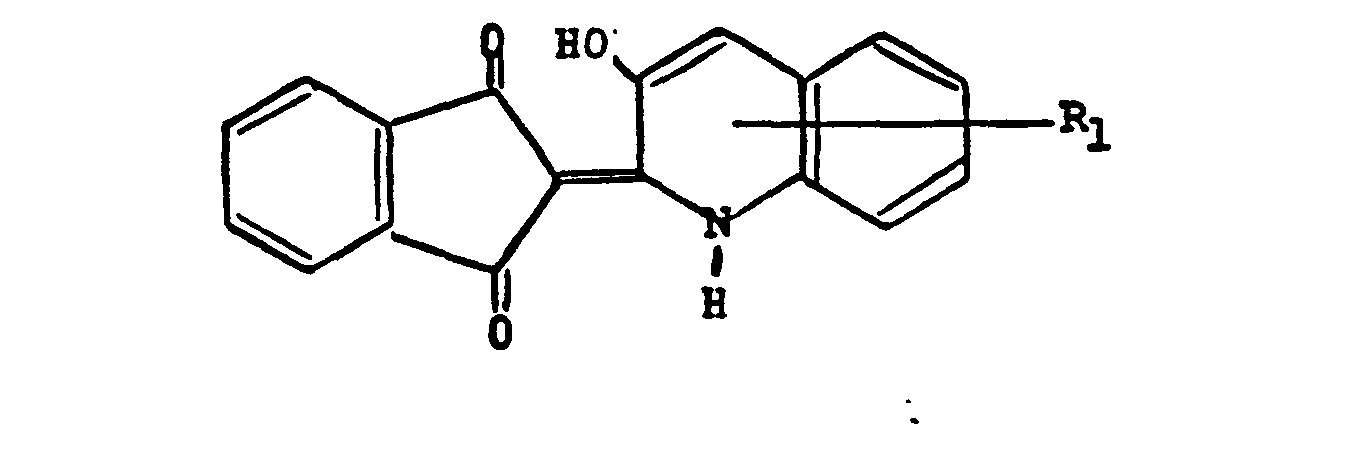
where R1 is hydrogen or bromine; and (2) 5 - 30 parts by weight of at least one yellow disperse dyestuff, designated as Formula II type dyestuff, having the fornula:
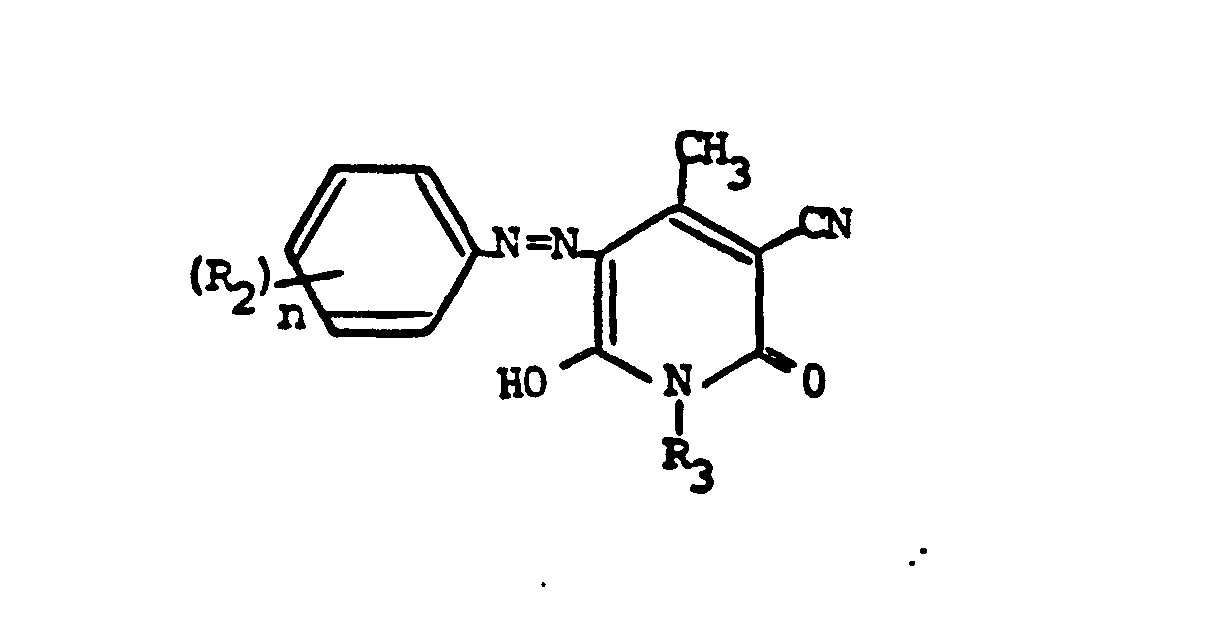
where: n = 0, 1, 2, 3, 4 or 5; R2 is hydrogen when n = 0 or is a substitutent independently selected from halogen, cyano, nitro, trifluoromethyl, alkyl of 1 to 4 carbon atoms, alkoxy of 1 to 4 carbon atoms, aliphatic carboxylate, aromatic sulfonate, aliphatic Keto, aromatic keto, unsubstituted carboxyamide, aliphatic carboxyamide, unsubstituted sulfonamide, aliphatic sulfonamide, aliphatic sulfone or aromatic sulfone, when n = an integer of from 1 to 5; and R3 is hydrogen, alkyl of 1 to 6 carbons, alkyl of 1 to 6 carbons containing ethereal oxygen, or is benzyl or phenethyl, wherein the ingredient amounts of the underlying individual dyestuffs are each calculated on 100 parts by weight of the Formula I type and Formula II type dyestuffs.
where R1 is hydrogen or bromine; and (2) 5 - 30 parts by weight of at least one yellow disperse dyestuff, designated as Formula II type dyestuff, having the fornula:
where: n = 0, 1, 2, 3, 4 or 5; R2 is hydrogen when n = 0 or is a substitutent independently selected from halogen, cyano, nitro, trifluoromethyl, alkyl of 1 to 4 carbon atoms, alkoxy of 1 to 4 carbon atoms, aliphatic carboxylate, aromatic sulfonate, aliphatic Keto, aromatic keto, unsubstituted carboxyamide, aliphatic carboxyamide, unsubstituted sulfonamide, aliphatic sulfonamide, aliphatic sulfone or aromatic sulfone, when n = an integer of from 1 to 5; and R3 is hydrogen, alkyl of 1 to 6 carbons, alkyl of 1 to 6 carbons containing ethereal oxygen, or is benzyl or phenethyl, wherein the ingredient amounts of the underlying individual dyestuffs are each calculated on 100 parts by weight of the Formula I type and Formula II type dyestuffs.
2. A dyestuff composition according to Claim 1, wherein the Formula II type dyestuff
has the following formula:
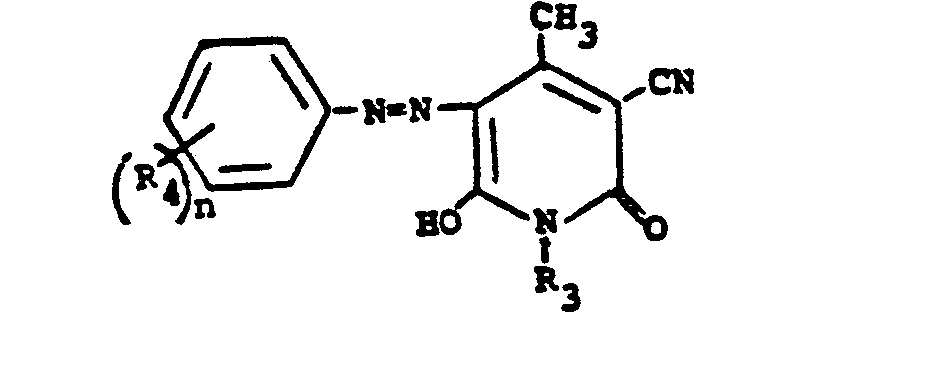
wherein n= 0, 1, 2, 3, 4 or 5; R3 is defined as in Claim 1; and R4 is hydrogen when n = 0 or is a substituent independently selected from methyl, ethyl, chlorine, nitro, cyano, methoxy and ethoxy when n = an integer of fran 1 to 5.
wherein n= 0, 1, 2, 3, 4 or 5; R3 is defined as in Claim 1; and R4 is hydrogen when n = 0 or is a substituent independently selected from methyl, ethyl, chlorine, nitro, cyano, methoxy and ethoxy when n = an integer of fran 1 to 5.
3. A dyestuff composition according to Claim 2, wherein said Formula II type dyestuff
has the following formula:
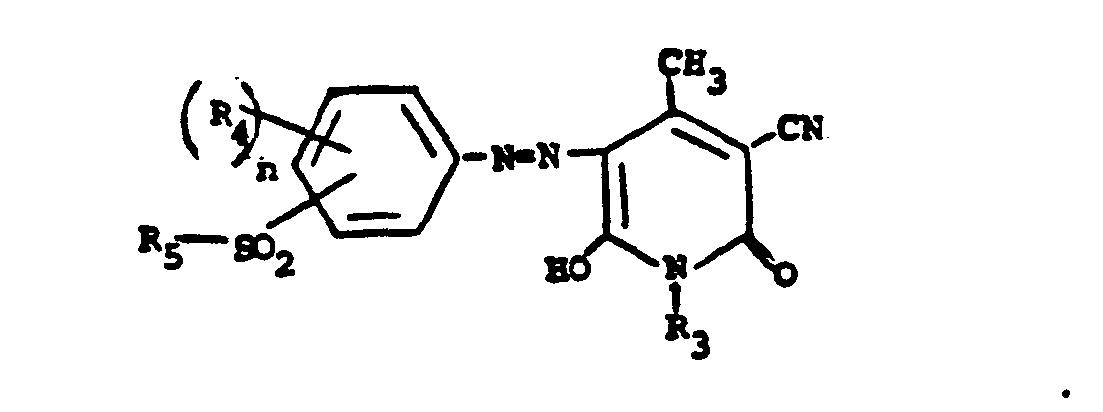
where n=0 or 1; R3 is defined as in claim 1; R4 is defined as in claim 2; and R5 is amino, alkylamino of 1 to 4 carbons, dialkylamino of 1 to 4 carbons per each alkyl, methyl, ethyl, phenyl or substituted phenoxy.
where n=0 or 1; R3 is defined as in claim 1; R4 is defined as in claim 2; and R5 is amino, alkylamino of 1 to 4 carbons, dialkylamino of 1 to 4 carbons per each alkyl, methyl, ethyl, phenyl or substituted phenoxy.
4. A dyestuff conposition according to Claim 2, wherein said Formula II type dyestuff
has the formula:
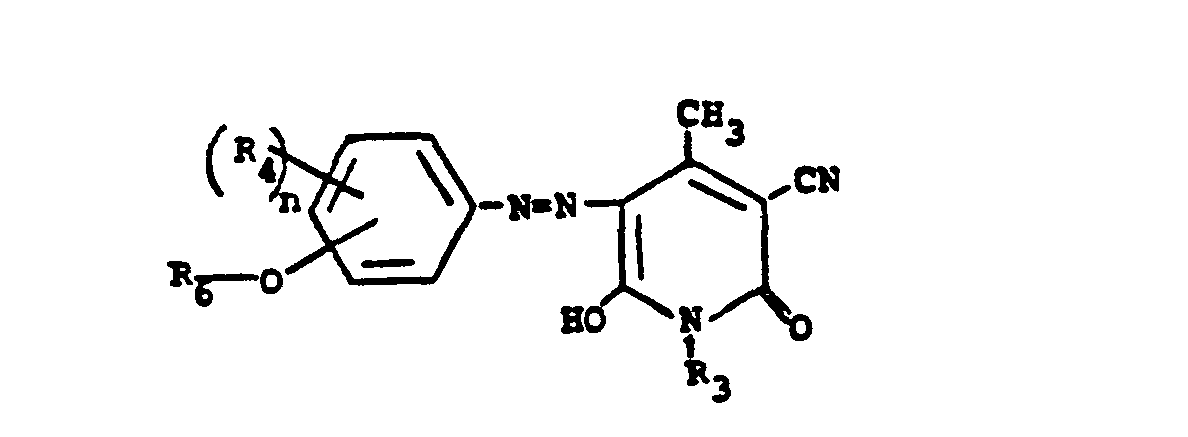
where n = 0 or 1; R3 is defined as in Claim 1; R4 is defined as in Claim 2; and R6 is alkyl of 1 to 4 carbons, or alkyl of 1 to 4 carbons containing ethereal oxygen, or is phenyl-sulfo.
where n = 0 or 1; R3 is defined as in Claim 1; R4 is defined as in Claim 2; and R6 is alkyl of 1 to 4 carbons, or alkyl of 1 to 4 carbons containing ethereal oxygen, or is phenyl-sulfo.
5. A dyestuff composition according to Claim 2, wherein said Formula II type dyestuff
has the formula:
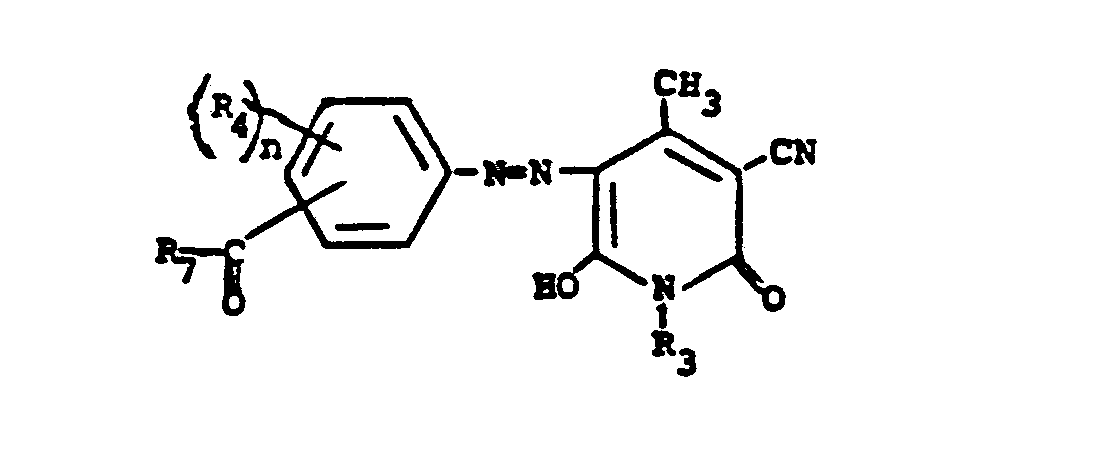
where n = 0 or 1; R3 is defined as in Claim 1; R4 is defined as in Claim 2; and R7 is alkyl of 1 to 4 carbons, alkoxy of 1 to 4 carbons, amino, alkylamino, phenyl or phenyl substituted by alkyl of 1 to 4 carbons.
where n = 0 or 1; R3 is defined as in Claim 1; R4 is defined as in Claim 2; and R7 is alkyl of 1 to 4 carbons, alkoxy of 1 to 4 carbons, amino, alkylamino, phenyl or phenyl substituted by alkyl of 1 to 4 carbons.
6. A dyestuff carposition according to Claim 2, wherein said Formula II type dyestuff
has the formula:
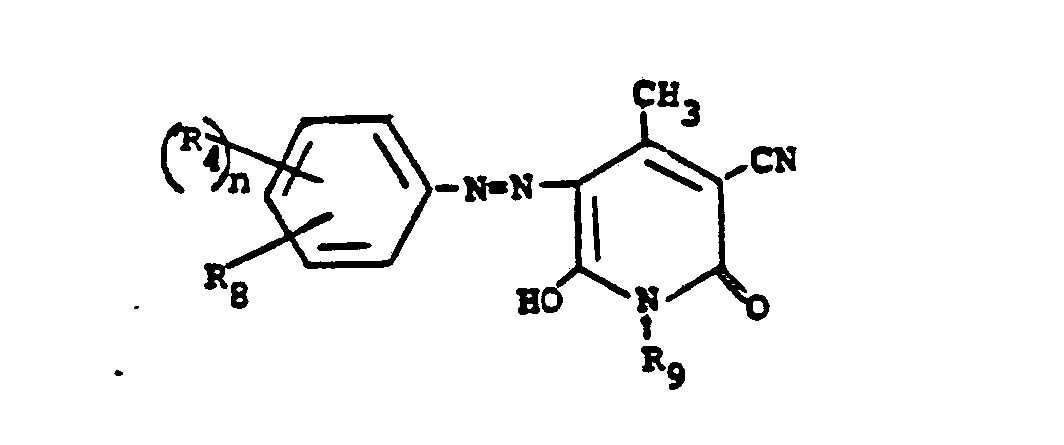
where n = 0 or 1; R4 is defined as in Claim 2; R8 is hydrogen, methoxy, methyl, chlorine or nitro; and R9 is hydrogen, methyl or ethyl.
where n = 0 or 1; R4 is defined as in Claim 2; R8 is hydrogen, methoxy, methyl, chlorine or nitro; and R9 is hydrogen, methyl or ethyl.
7. A dyestuff composition according to Claim 2, wherein said Formula II type dyestuff
has the formula:
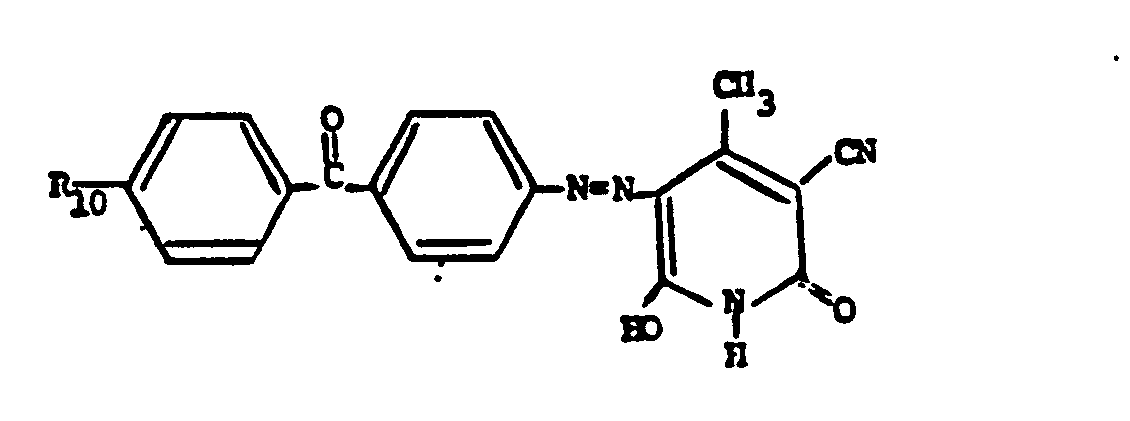
where R10 is hydrogen or alkyl of 1 to 4 carbons.
where R10 is hydrogen or alkyl of 1 to 4 carbons.
8. A dyestuff composition according to any one of Claims 1 to 7, wherein said dyestuff
designated as Formula I type is present in an amount of fran 80 - 90 parts by weight,
and said dyestuff designated as Formula II type is present in an amount of 10 - 20
parts by weight, calculated on 100 parts by weight of the Formula I type and Formula
II type dyestuffs.
9. A dyestuff composition according to any one of claims 1 to 8, containing in addition
at least one further disperse dyestuff having a chemical structure different from
that of said Formula I and Formula II type dyestuffs and which likewise produces a
yellow shade by itself.
10. A dyestuff composition according to any one of claims 1 to 8, and if appropriate
claim 9, containing in addition at least one further disperse dyestuff having a chemical
structure different from that of said Formula I and Formula II type dyestuffs and
which by itself produces a shade other than yellow.
11. A dyestuff composition according to any one of claims 1 to 7, wherein the mixture
or mix-crystal of said Formula I and Formula II type dyestuffs with or without at
least one further dyestuff mixing component in accordance with claims 9 or 10 is present
in the ready-to-use state of a fine dispersion resulting from grinding with dispersant(s).
12. A dyestuff composition according to claim 11 of said Formula I and Formula II
type dyestuffs which has been prepared by
- mixing fully-finished dyestuff preparations of the underlying individual dyestuffs or
- jointly finishing the underlying individual dyestuffs in the form of a mixture, if appropriate under conditions where the formation of a mix-crystal of the individual components can occur, with or without at least a further dyestuff mixing component in accordance with claims 9 or 10.
13. Use of a dyestuff composition according to any one of claims 1 to 8 as a disperse
yellow dyestuff for obtaining self-or combination shades on synthetic fibers by themselves
or mixtures containing such synthetic fibers.
14. Use of a dyestuff composition according to any one of claims 1 to 8 in combination
with at least one further dyestuff mixing component in accordance with claims 9 or
10 for obtaining a shade other than yellow.
15. A process for exhaust-dyeing textile material in synthetic fibers by themselves
or as component of mixtures containing these synthetic fibers with natural fibers
or regenerated fibers, which comprises using as a disperse yellow dyestuff for self-shade
and combination-shade dyeings a dyestuff composition in accordance with any one of
claims 1 to 8.
16. The process according to claim 15, wherein said synthetic fiber material comprises
polyester, polyamide or cellulose acetate fibers.
17. The process according to claim 16 wherein said polyester fiber material is a copolymer
of the underlying ester monomer with a polyethylene glycol, isophthalic acid or polymerizable
phosphorus compound.
18. The process according to claim 15, wherein the dyeing operation is carried out
as an exhaust-dyeing under high-temperature (HT) conditions.
19. The process according to claim 15, wherein the dyeing operation is carried out
as an exhaust-dyeing under atmospheric conditions at the boil of the aqueous dyeing
medium in the absence or presence of a carrier.
20. The process according to claim 15, wherein the dyestuff can- position in accordance
with any one of claims 1 to 8 is used for dyeing in combination with at least one
further dyestuff mixing component in accordance with claims 9 and 10.
21. Textile material in synthetic fibers by themselves or as a component of mixtures
containing these synthetic fibers which has been dyed with a dyestuff composition
in accordance with any one of claims 1 to 8.
22. Textile material in synthetic fibers by themselves or as a component of mixtures
containing these synthetic fibers which has been dyed using a process in accordance
with any one of claims 15 to 20.