|
(11) | EP 0 161 796 B1 |

| (12) | EUROPEAN PATENT SPECIFICATION |
|
|
| (54) |
Process for producing N-acylphenylalanines Verfahren zur Herstellung von N-Acylphenylalaninen Procédé pour la préparation de N-acylphénylalanines |
|
|
|||||||||||||||||||||||||||||||
| Note: Within nine months from the publication of the mention of the grant of the European patent, any person may give notice to the European Patent Office of opposition to the European patent granted. Notice of opposition shall be filed in a written reasoned statement. It shall not be deemed to have been filed until the opposition fee has been paid. (Art. 99(1) European Patent Convention). |
[0001] This invention relates to a process for producing substituted or unsubstituted N-acylphenylalanines.
[0002] N-acylphenylalanines are important compounds as precursors of phenylalanines. In particular, unsubstituted N-acylphenylalanines are categorized as essential amino acids and are important compounds as precursors of L-phenylalanine which has come to be rapidly used as a starting material of an artificial sweetner "Aspartame". For example, N-acetylphenylalanine readily undergoes asymmetric hydrolysis by the action of an enzyme acylase to form L-phenylalanine.
[0003] Conventionally, N-acrylphenylalanines have generally been produced by the reduction of either 2- substituted-4-(substituted) benzylidene-5-oxazolones, which are produced relatively easily by a condensation reaction of an N-acylglycine and a benzaldehyde, or a-acylaminocinnamic acids which are hydrolysis products of said oxazolones.
[0004] Although various processes have hitherto been proposed for effecting the reduction, it is practical in an industrial sense to carry out the reduction catalytically in the presence of a heterogeneous reducing catalyst. For example, in accordance with the method of T. Okuda and Y. Fugii (Bull. Chem. Soc. (Japan), 30, 698 (1957)), a substituted or unsubstituted 2-methyl-4-benzylidene-5-oxazolone is reduced catalytically in an alkaline solution under a pressure of 40-70 kg/cm2 using Raney nickel as a catalyst to produce an N-acetylphenylalanine. As an example of using a heterogeneous catalyst of noble metal, there is disclosed a method by R. M. Herbst and D. Shemin (Organic Synthesis, Coll. Vol. 2, p491) wherein a-acetylamino- cinriamic acid is reduced catalytically in acetic acid under atmospheric pressure using platinum oxide as a catalyst to produce N-acetylphenylalanine.
[0005] However, since the former method carries out the reduction under a high pressure, restrictions are imposed on the apparatus that is used in effecting the method industrially. Moreover, the Raney nickel is used in a relatively large amount and thus raises environmental problems in its disposal. The prior method which uses acetic acid as a solvent is accompanied by drawbacks, e.g. that its operation is complicated because the solvent has to be concentrated or distilled upon isolation of the product after the reduction.
[0006] Recently, noble metals such as palladium or platinum have also come to be used frequently on an industrial scale as catalysts for use in catalytic reduction. This is because these catalysts are effective in relatively small amounts, are recovered easily because they are heterogeneous to various solvents, and eliminate environmental problems caused by disposal because they are regenerative. They are extremely expensive, however. These expensive noble metal catalysts are generally used repeatedly in industry by way of their recovery after completion of reaction.
[0007] The present inventors have hydrolyzed 2-methyl-4-benzylidene-5-oxazolone with alkali in water and reduced catalytically the resultant a-acetylaminocinnamic acid, without isolating it from the reaction solution, by adding a palladium or platinum reducing catalyst thereto to prepare N-acetylphenylalanine. It was then found that the catalyst recovered by filtration after the reduction was lowered in catalytic activity through use, thus requiring considerably longer times in effecting subsequent reductions compared with reductions performed with fresh catalyst. Finally, the noble metal catalyst lost its activity almost completely after several repeated uses thereof. The same situation occurred when other 2-substituted-4-(substituted) benzylidene-5-oxazolones were used. Further, it was also found that a catalyst whose activity had been lowered or lost could not be restored as to its catalytic activity even by washing it with an organic solvent, such as alcohol, or with an acid such as dilute hydrochloric acid and thus its catalytic activity was irreversibly degraded.
[0008] On the basis of these experimental facts, the present inventors have made an intensive effort to establish a process for the preparation of N-acylphenylalanines from 2-substituted-4-(substituted) benzylidene-5-oxazolones wherein a reduction catalyst could be used efficiently and repeatedly without its catalytic activity being lowered or lost during the reduction. As a result of their work, it was found that the pH of the reaction solution during the reduction was closely related to the activity of the catalyst and was responsible for the irreversible decrease in activity of the recovered catalyst, thus leading to the completion of the present invention.
[0009] Accordingly, the present invention provides a process for producing N-acylphenylalanines represented by the general formula (II):
wherein R4 and R5 independently of one another are a hydrogen atom, an alkyl group having 1-4 carbon atoms, an alkoxy group having 1-4 carbon atoms, a halogen atom, a hydroxyl group or an aryloxy group, or in combination are the methylenedioxy group, and R3 is a methyl or phenyl group, which process comprises hydrolyzing, with alkali, 2-substituted-4-(substituted) benzylidene-5-oxazolones represented by the general formula (I):
wherein each R1 and R2 independently of one another are a hydrogen atom, an alkyl group having 1-4 carbon atoms, an alkoxy group having 1-4 carbon atoms, a halogen atom, an acyloxy group or an aryloxy group, or adjoiningly to each other and together are a methylenedioxy group, and R3 is a methyl or phenyl group, adjusting the pH of the reaction solution containing the hydrolysis product to 5-9 with acid and subjecting the resultant reaction solution to catalytic reduction in the presence of a palladium or platinum reduction catalyst.
[0010] In performing the process of the present invention, the time period required for the reduction can be remarkably shortened compared with the time required for reduction in an aqueous, strong alkaline solution. Moreover, there is such a great advantage in the present process that the catalyst recovered through filtration after the reduction can be used repeatedly without any additional treatment and without any observed decrease in its catalytic activity. A reduction using the catalyst recovered from a previous reduction may proceed at practically the same rate as in the case of a reduction performed using fresh catalyst. Further, in the process of the present invention, the starting material, 2-substituted-4-(substituted) benzylidene-5-oxazolone, is hydrolyzed with alkali to produce a substituted or unsubstituted N-acylaminocinnamic acid which is subsequently and continuously subjected to the reduction, that is to say without being isolated from the reaction mixture. Accordingly, the present process has advantages over a process wherein a N-acylaminocinnamic acid is reduced after it has been isolated from the reaction system; the advantages include the benefit of process simplification and surprisingly improved overall yield.
[0011] If R1 and R2 (and correspondingly R3 and R4) are univalent, they can be attached to any unoccupied position on the benzylidene ring. If R1 and R2 (and R3 and R4) are combined as the divalent methylenedioxy group, however, this group attaches to two adjoining positions of the benzylidene ring.
[0012] The invention is now explained in more detail in the following non-limitative description of a preferred mode of carrying out the process.
[0013] The process of the present invention comprises two steps consisting of (A) treating a 2-substituted-4-(substituted) benzylidene-5-oxazolone represented by the general formula (I) with alkali to form a substituted or unsubstituted a-acylaminocinnamic acid and (B) reducing catalytically the resultant a-acylaminocinnamic acid without isolating it from the reaction system.
[0014] Specific examples of the 2 - substituted - 4 - (substituted)benzylidene - 5 - oxazolone of the general formula (I) used as the starting material in the present process include 2 - methyl - 4 - benzylidene - 5 - oxazolone, 2 - phenyl - 4 - benzylidene - 5 - oxazolone, 2 - methyl - 4 - (p - methylbenzylidene) - 5 - oxazolone, 2 - phenyl - 4 - (p - methylbenzylidene) - 5 - oxazolone, 2 - methyl - 4 - (p - ethyl- benzylidene) - 5 - oxazolone, 2 - phenyl - 4 - (p - iso - propylbenzylidene) - 5 - oxazolone, 2 - methyl - 4 - (p - n - butylbenzylidene) - 5 - oxazolone, 2 - methyl - 4 - (p - methoxybenzylidene) - 5 - oxazolone, 2 - phenyl - 4 - (p - methoxybenzylidene) - 5 - oxazolone, 2 - methyl - 4 - (3,4 - dimethoxybenzylidene) - 5 - oxazolone, 2 - methyl - 4 - (2,3 - dimethoxybenzylidene) - 5 - oxazolone, 2 - phenyl - 4 - (2,4 - dimethoxybenzylidene) - 5 - oxazolone, 2 - methyl - 4 - (3,5 - dimethoxybenzylidene) - 5 - oxazolone, 2 - methyl - 4 - (p - ethoxybenzylidene) - 5 - oxazolone, 2 - methyl - 4 - (3,4 - diethoxy- benzylidene) - 5 - oxazolone, 2 - phenyl - 4 - (p - n - propoxybenzylidene) - 5 - oxazolone, 2 - methyl - 4 - (p - n - butoxybenzylidene) - 5 - oxazolone, 2 - methyl - 4 - (p - chlorobenzylidene) - 5 - oxazolone, 2 - phenyl 4 - (p - chlorobenzylidene) - 5 - oxazolone, 2 - methyl - 4 - (3,4 - dichlorobenzylidene) - 5 - oxazolone, 2 - phenyl - 4 - (3,4 - dichlorobenzylidene) - 5 - oxazolone, 2 - methyl - 4 - (m - phenoxybenzylidene) - 5 - oxazolone, 2 - phenyl - 4 - (m - phenoxybenzylidene) - 5 - oxazolone, 2 - methyl - 4 - (p - acetoxybenzylidene) - 5 - oxazolone, 2 - phenyl - 4 - (p - acetoxybenzylidene) - 5 - oxazolone, 2 - methyl - 4 - (3,4 - diacetoxybenzylidene) - 5 - oxazolone, 2 - phenyl - 4 - (3,4 - diacetoxybenzylidene) - 5 - oxazolone, 2 - methyl - 4 - (3,4 - methylenedioxybenzylidene) - 5 - oxazolone or 2 - phenyl - 4 - (3,4 - methylenedioxybenzylidene) - 5 - oxazolone. These starting materials can easily be produced by the Elrenmeyer method in which N-acetylglycine or N-benzoylglycine (hippuric acid) is condensed with a substituted or unsubstituted benzaldehyde in acetic anhydride in the presence of anhydrous sodium acetate. Another method involves treating a β-phenylserine in acetic anhydride in the presence of a base (Japanese Patent Application Laid-Open No. 32753/1985).
[0015] The first step of the process of the present invention, in which an a-acylaminocinnamic acid is produced through hydrolysis of a 2-substituted-4-(substituted)-benzylidene)-5-oxazolone, comprises treating this starting material present in an aqueous medium in a state of suspension or solution by adding thereto an alkali such as the hydroxide, oxide or carbonate of an alkali or alkaline earth metal in amount in excess of its stoichiometric requirement, thereby producing a corresponding a-acylaminocinnamic acid easily. The amount of water used is one part by weight or more, or preferably two parts by weight or more from an operational standpoint, per one part by weight of the 2-substituted-4-(substituted) benzylidene-5-oxazolone starting material. The temperature and time duration applied in the hydrolysis are 0-100°C and 0.5-20 hours, or preferably 20-80°C and 1-15 hours, respectively. An aqueous solution of an alkali or alkaline earth metal salt of an a-acylaminocinnamic acid is obtained in the above manner. However, in a case where an acyloxy group-substituted oxazolone is used as the starting material, the acyloxy group will also be hydrolyzed to form a hydroxyl group-substituted a-acylaminocinnamic acid. In the hydrolysis of 2- substituted-4-(substituted) benzylidene-5-oxazolones, various water-miscible organic solvents, for example, methanol, ethanol, isopropanol, acetone, dioxane, tetrahydrofuran or the like, may be used jointly without raising any especial problems. However, the hydrolysis reaction proceeds under mild conditions even in an aqueous medium. It may sometimes be necessary to distill or remove such an organic solvent in the isolation of the intended compound of N-acrylphenylalanine after completion of the subsequent catalytic reduction, so that the post-reaction treatment is made complicated. From this point of view, it is not usually preferred to employ an organic solvent in the aqueous medium.
[0016] In the second step of the process of the present invention, the reaction solution containing an alkaline salt of an a-acylaminocinnamic acid resulting from the foregoing first step is adjusted in pH to 5-9 and thereafter it is subjected to catalytic reduction in the presence of a palladium or platinum reducing catalyst to produce an N-acylphenylalanine.
[0017] For effecting the catalytic reduction of this step, the said reaction solution is neutralized with an acid to adjust its pH in the range of 5-9 or preferably 5.5-8.5 and subsequently exposed to a reducing catalyst so as to be subjected to catalytic reduction. Although hydrochloric and sulfuric acids are frequently used for the pH adjustment, there may also be used, as a matter of course, other mineral acids or organic acids such as acetic acid and p-toluenesulfonic acid. If the pH of the reaction solution should exceed 9 during the reduction period, the catalytic activity of the recovered catalyst will, as pointed out previously, be lowered or lost through its repeated use, and even in the case of using a fresh catalyst, the reaction time duration will tend to be prolonged as opposed to the reduction carried out in the pH range of 5 to 9. Further, if the pH should be below 5, the solubility of the N-acylaminocinnamic acid will be decreased and the reduction will have to be carried out in a state of suspension so that the time taken for completion of the reaction will be prolonged unfavourably.
[0018] Any type of noble metal catalyst of the palladium or platinum series can be used as the reducing catalyst so long as it makes up a heterogenous catalytic system to the reaction solution. Specific examples of such catalysts may include palladium-carbon, palladium black, colloidal palladium, palladium-barium sulfate, palladium-alumina, platinum oxide, platinum-carbon or platinum-silica gel. The catalyst used in practising the present invention is not limited to these particular, exemplary catalyst, however. The amount of the catalyst to be used is generally 0.1 % by weight or more based on the weight of the starting material, 2-substituted-4-(substituted)benzylidene-5-oxazolone. The more catalyst used, the shorter will be the time required for the reduction. However, from economical and operational points of view, it is preferred to use the catalyst in an amount of 30% by weight or less. More favourably, it is recommended to use it in an amount in the range of 0.5-10% by weight.
[0019] The temperature and the duration of the reduction depend more or less on the amount of the catalyst used but generally lie in the ranges of 0-100°C and 0.5-30 hours, respectively. The reduction may be effected either at atmospheric pressure or under pressure.
[0020] Since N-acylphenylalanines are generally dissolved in the reaction solution after completion of the reaction, it is possible, as required, to isolate the N-acylphenylalanines from the reaction solution by filtering and removing the catalyst while the reaction solution is hot and thereafter acidifying the filtrate with an acid such as hydrochloric acid. The catalyst thus-recovered can be used repeatedly, maintaining its original activity to effect the reduction without any further treatment and without any observed lowering in its catalytic activity.
[0021] The present invention will be described more specifically with reference to the following non-limiting examples.
Example 1
[0022] In a 100-ml tightly-sealed glass vessel were charged 9.36 g of 2-methyl-4-benzylidene-5-oxazolone and 30 ml of water. Thereafter, 5.3 g of 45% sodium hydroxide solution was added thereto and the resulting mixture was stirred at 40-45°C for 2 hours. The 2-methyl-4-benzylidene-5-oxazolone was hydrolyzed to form an aqueous homogeneous solution of sodium a-acetylaminocinnamate. Then, concentrated hydrochloric acid was added to the solution to adjust its pH to 7.2, and subsequently 0.2 g of 5%-palladium-carbon was added thereto. The gas phase in the vessel was purged with nitrogen and then with hydrogen and thereafter the vessel's contents were subjected to catalytic reduction at 40―45°C under atmospheric pressure. The reaction time was approximately 90 minutes until hydrogen absorption was completed. During this time period, it was observed that one mole of hydrogen was absorbed to one mole of 2-methyl-4-benzylidene-5-oxazolone.
[0023] The gas phase in the vessel was purged with nitrogen after completion of the reaction and thereafter the catalyst was filtered and washed with a small amount of water. The filtrate and the washinqs were combined and concentrated hydrochloric acid was added thereto at 30-35°C to adjust pH of the resultant mixture to 1. The mixture was then cooled to 0-5°C. The resulting crystals were separated by filtering, were washed with cold water and dried to obtain 9.96 g of N-acetylphenylalanine as a white crystal. Its yield was 96.1% based on the 2-methyl-4-benzylidene-5-oxazolone, and its melting point was 150.5-151°C.
Example 2
[0024] In the same manner as in Example 1, 2-methyl-4-benzylidene-5-oxazolone was treated with alkali to obtain an aqueous solution of sodium N-acetylaminocinnamate which was then subjected to reduction, after adjusting its pH with concentrated hydrochloric acid to 7.2, using the palladium-carbon catalyst recovered in Example 1 without any further treatment. The catalyst was used repeatedly five times for effecting the reduction. Results are shown in Table 1. In each of the repeated experiments, the reduction was completed in 95-105 minutes. This signifies in comparison with Example 1 that each reduction time was not, in practical terms, affected by the repeated use of catalyst.
Comparative Example 1
[0025] In a 100-mi tightly-sealed glass vessel were charged 9.36 g of 2-methyl-4-benzylidene-5-oxazolone and 30 ml of water. Then, 5.3 g of 45% sodium hydroxide solution was added thereto and the resulting mixture was stirred at 40-45°C for two hours. The 2-methyl-4-benzylidene-5-oxazolone was hydrolyzed to form an aqueous homogeneous solution of sodium a-acetylaminocinnamate. The solution had a pH in excess of 12. 0.2 g of 5%-palladium-carbon was then added to the solution. Afterthe gas phase in the vessel was purged with nitrogen and then with hydrogen, the reaction mixture in the vessel was subjected to catalytic reduction at 40-45°C under atmospheric pressure. The time required for the reduction was approximately four hours. After completion of the reduction, the reaction mixture was treated in the same manner as in Example 1 to recover the catalyst and obtain 9.91 g of N-acetylphenylalanine as a white crystal. Its melting point was 149.5-150.5°C.
Comparative Example 2
[0026] Procedures of Comparative Example 1 were repeated to effect the reaction except for the repeated use of the catalyst recovered in Comparative Example 1. The time durations required for the reduction were 6.5 hours and 10 hours for the first and second repeated uses, respectively. In the third repeated use, hydrogen absorption was interrupted during the reduction.
Examples 3 and 4
[0027] Each example was effected in the same manner as in Example 1 except that the pH of the solution during the reduction was changed. Results are shown in Table 2. Each catalyst recovered in these two experiments was used repeatedly three times under the same respective conditions. The time durations required for the reduction of these repetitions were practically the same as that resulted when a fresh catalyst was used.
Example 5
[0028] In 100-ml tightly-sealed glass vessel were charged 9.36 g of 2-methyl-4-benzylidene-5-oxazolone and 40 ml of water. 4.15 g of potassium carbonate was then added thereto and the resulting mixture was stirred at 40-45°C for two hours. Concentrated hydrochloric acid was added to the resulting solution to adjust its pH to 6.8 and 0.2 g of 5%-palladium-carbon was added thereto. The gas phase in the vessel was purged with nitrogen and then with hydrogen, and thereafter the reaction mixture in the vessel was subjected to catalytic reduction at 40―45°C under atmospheric pressure. The reaction time during which hydrogen absorption was completed was 100 minutes. It was observed that one mole of hydrogen was absorbed to one mole of 2-methyl-4-benzylidene-5-oxazolone during this period. After the gas phase in the vessel was purged with nitrogen upon completion of the reaction, the catalyst was filtered and washed with a small amount of water. The filtrate and the washings were combined, and concentrated hydrochloric acid was added at a temperature lower than 30°C to adjust the pH of the resulting mixture to 1. The mixture was cooled to 0-5°C. Crystals formed and were separated by filtration, were washed with cold water and dried to obtain 9.81 g of N-acetylphenylalanine having a melting point of 150-151°C as a white crystal. The yield was 94.7%.
[0029] Using the recovered catalyst repeatedly, experiments were carried out three times under the same conditions as described above. In each of the experiments, the time duration required for the reduction was in the range of 95-110 minutes which was practically the same as in the case of using a fresh catalyst.
Examples 6 to 12
[0030] 0.05 mole of each of various 2-substituted-4-(substituted) benzylidene-5-oxazolones was suspended in 40-100 ml of water and 5.3 g of 45% sodium hydroxide solution was added thereto to hydrolyze it at 40-80°C for 1-3 hours, thereby forming a corresponding a-acylaminocinnamic acid. Then concentrated hydrochloric acid was added to the resultant aqueous solution to adjust its pH to 5.5-8.5. The resultant solution was charged into a tightly-sealed glass vessel. 5%-palladium-carbon was added thereto and the gas phase in the vessel was purged with nitrogen and with hydrogen. Thereafter, the reaction mixture was subjected to catalytic reduction under atmospheric pressure. Procedures of Example 1 were repeated in the isolation of each of N-acylphenylalanines resulted from the reduction. Results are shown in Table 3.
1. A process for producing an N-acylphenylalanine represented by the general formula
(II):
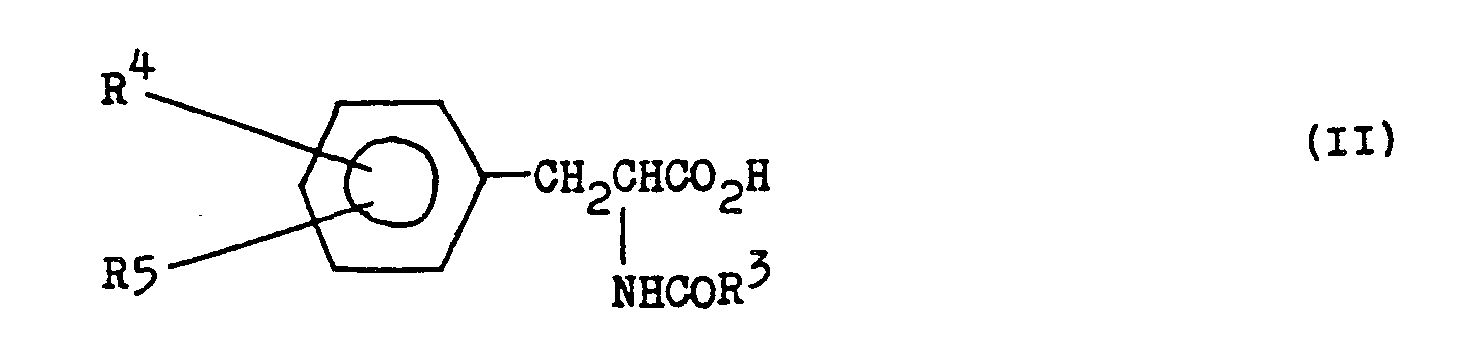
wherein R4 and R5 independently of one another are a hydrogen atom, an alkyl group having 1-4 carbon atoms, an alkoxy group having 1-4 carbon atoms, a halogen atom, a hydroxyl group or an aryloxy group, or in combination are the methylenedioxy group, and R3 is a methyl or phenyl group, the process comprising hydrolyzing with alkali a 2-substituted-4-(substituted)benzylidene-5-oxazolone represented by the general formula (I):
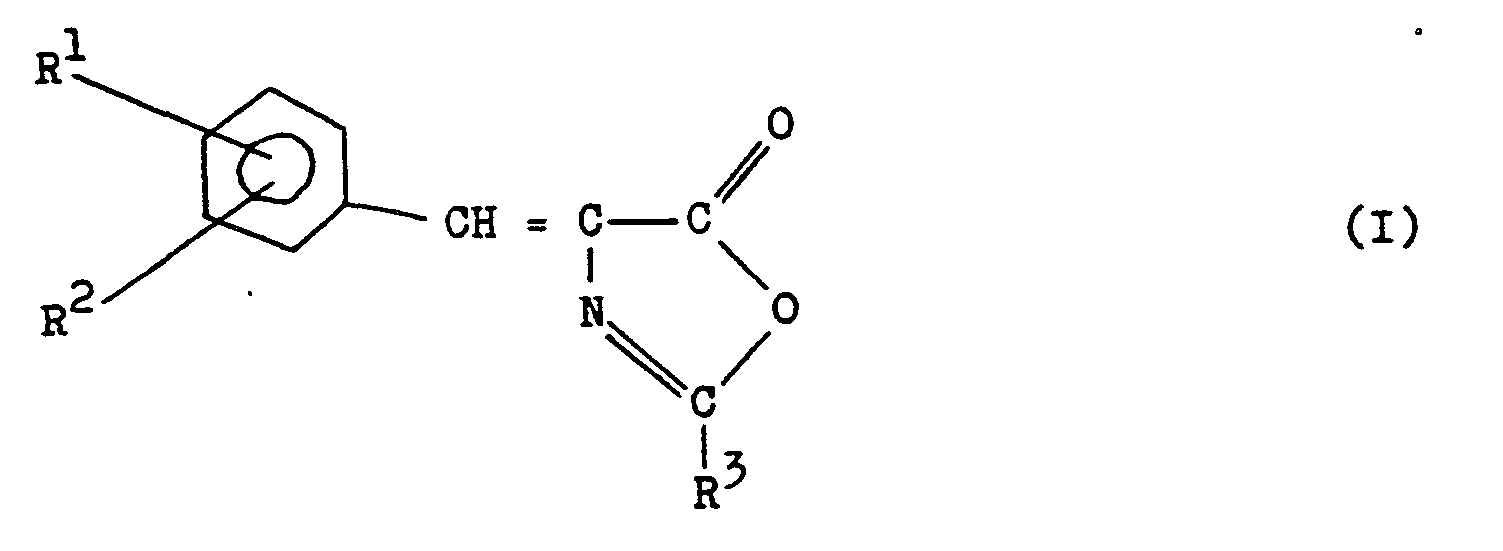
wherein R1 and R2 independently of one another are a hydrogen atom, an alkyl group having 1-4 carbon atoms, an alkoxy group having 1-4 carbon atoms, a halogen atom, an acyloxy group or an aryloxy group, or in combination are the methylenedioxy group, and R3 is a methyl or phenyl group, adjusting the pH of the reaction solution containing the hydrolysis product to 5-9 with acid, and subjecting the resultant reaction solution to catalytic reduction in the presence of a palladium or a platinum reduction catalyst.
wherein R4 and R5 independently of one another are a hydrogen atom, an alkyl group having 1-4 carbon atoms, an alkoxy group having 1-4 carbon atoms, a halogen atom, a hydroxyl group or an aryloxy group, or in combination are the methylenedioxy group, and R3 is a methyl or phenyl group, the process comprising hydrolyzing with alkali a 2-substituted-4-(substituted)benzylidene-5-oxazolone represented by the general formula (I):
wherein R1 and R2 independently of one another are a hydrogen atom, an alkyl group having 1-4 carbon atoms, an alkoxy group having 1-4 carbon atoms, a halogen atom, an acyloxy group or an aryloxy group, or in combination are the methylenedioxy group, and R3 is a methyl or phenyl group, adjusting the pH of the reaction solution containing the hydrolysis product to 5-9 with acid, and subjecting the resultant reaction solution to catalytic reduction in the presence of a palladium or a platinum reduction catalyst.
2. A process according to claim 1, wherein the alkali is a hydroxide, oxide or carbonate
of an alkali metal or an alkaline earth metal.
3. A process according to claim 1 or claim 2, wherein the hydrolysis reaction is carried
out at a temperature in the range 20-80°C.
4. A process according to claim 1, 2 or 3, wherein one part by weight of the starting
substance comprising the 2-substituted-4-(substituted)benzylidene-5-oxazolone is dissolved
or suspended in 2 or more parts by weight of water for the hydrolysis reaction.
5. A process according to claim 1, 2, 3 or 4, wherein the reaction solution containing
the hydrolysis product is adjusted to a pH in the range 5.5 to 8.5.
6. A process according to any of claims 1 to 5, wherein the catalyst is selected from
palladium-carbon, palladium black, colloidal palladium, palladium-barium sulfate,
palladium-alumina, platinum oxide, platinum-carbon and platinum-silica gel.
7. A process according to any of claims 1 to 6, wherein the catalyst is used in an
amount of 0.1 to 30% by weight, based on the weight of the starting substance comprising
the 2-substituted-4-(substituted)-benzylidene-5-oxazolone, and preferably in an amount
of 0.5 to 10% by weight on the same basis.
8. A process for the manufacture of L-phenylalanines, comprising preparing an N-acylphenylalanine
by the process according to any of claims 1 to 7, and then subjecting the N-acylphenylalanine
to asymmetric hydrolysis by the action of an enzyme acylase.
1. Verfahren zur Herstellung eines N-Acylphenylalanins, welches durch die allgemeine
Formel (11) dargestellt wird:
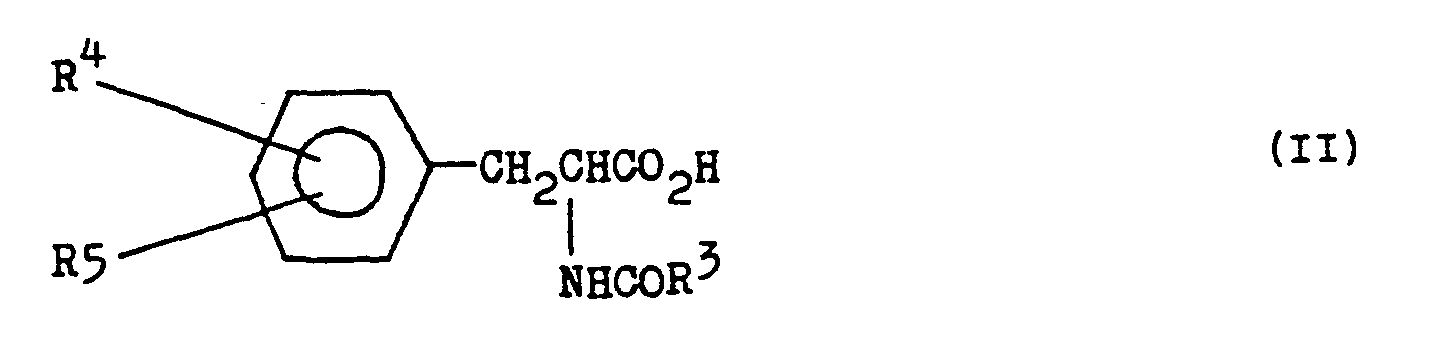
worin R4 und R5 unabhängig voneinander ein Wasserstoffatom, eine Alkylgruppe mit 1 bis 4 Kohlenstoffatomen, eine Alkoxygruppe mit 1 bis 4 Kohlenstoffatomen, ein Halogenatom, eine Hydroxylgruppe oder eine Aryloxygruppe darstellen oder in Kombination die Methylendioxygruppe sind und R3 eine Methyl- oder Phenylgruppe ist, wobei das Verfahren das Hydrolysieren mit Alkali eines 2- substituierten-4-(substituierten)Benzyliden-5-oxazolons, das durch die allgemeine Formel (I) dargestellt wird:
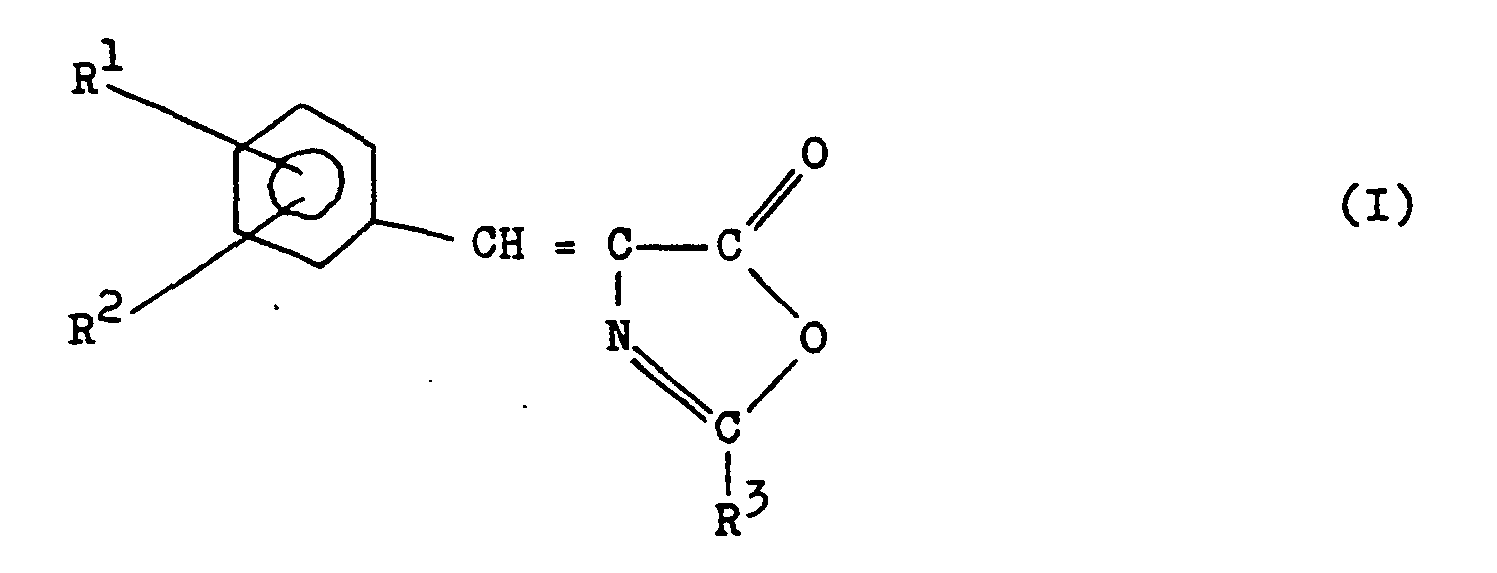
worin R1 und R2 unabhängig voneinander ein Wasserstoffatom, eine Alkylgruppe mit 1 bis 4 Kohlenstoffatomen, eine Alkoxygruppe mit 1 bis 4 Kohlenstoffatomen, ein Halogenatom, eine Acyloxygruppe oder eine Aryloxygruppe sind oder in Kombination die Methylendioxygruppe sind und R3 eine Methyl- oder Phenylgruppe ist, Einstellen des pH der Reaktionslösung, die das Hydrolyseprodukt enthält, auf 5 bis 9 mit Säure und Unterwerfen der entstehenden Reaktionslösung. einer katalytischen Reduktion in Anwesenheit eines Palladium- oder eines Platin-Reduktionskatalysators umfaßt.
worin R4 und R5 unabhängig voneinander ein Wasserstoffatom, eine Alkylgruppe mit 1 bis 4 Kohlenstoffatomen, eine Alkoxygruppe mit 1 bis 4 Kohlenstoffatomen, ein Halogenatom, eine Hydroxylgruppe oder eine Aryloxygruppe darstellen oder in Kombination die Methylendioxygruppe sind und R3 eine Methyl- oder Phenylgruppe ist, wobei das Verfahren das Hydrolysieren mit Alkali eines 2- substituierten-4-(substituierten)Benzyliden-5-oxazolons, das durch die allgemeine Formel (I) dargestellt wird:
worin R1 und R2 unabhängig voneinander ein Wasserstoffatom, eine Alkylgruppe mit 1 bis 4 Kohlenstoffatomen, eine Alkoxygruppe mit 1 bis 4 Kohlenstoffatomen, ein Halogenatom, eine Acyloxygruppe oder eine Aryloxygruppe sind oder in Kombination die Methylendioxygruppe sind und R3 eine Methyl- oder Phenylgruppe ist, Einstellen des pH der Reaktionslösung, die das Hydrolyseprodukt enthält, auf 5 bis 9 mit Säure und Unterwerfen der entstehenden Reaktionslösung. einer katalytischen Reduktion in Anwesenheit eines Palladium- oder eines Platin-Reduktionskatalysators umfaßt.
2. Verfahren nach Anspruch 1, bei dem das Alkali ein Hydroxid, Oxid oder Carbonat
eines Alkalimetalles oder eines Erdalkalimetalles ist.
3. Verfahren nach Anspruch 1 oder Anspruch 2, bei dem die Hydrolyse-Reaktion bei einer
Temperatur in dem Bereich von 20 bis 80°C durchgeführt wird.
4. Verfahren nach Anspruch 1, 2 oder 3, bei dem ein Gewichtsteil der Ausgangssubstanz,
die das 2- substituierte-4-(substituierte)Benzyliden-5-oxazolon umfaßt, in zwei oder
mehr Gewichtsteilen Wasser für die Hydrolyse-Reaktion gelöst oder suspendiert wird.
5. Verfahren nach Anspruch 1, 2, 3 oder 4, bei dem die Reaktionslösung, die das Hydrolyseprodukt
enthält, auf einen pH in dem Bereich von 5,5 bis 8,5 eingestellt wird.
6. Verfahren nach einem der Ansprüche 1 bis 5, bei dem der Katalysator aus Palladium-Kohlenstoff,
Palladium-Ruß, kolloidalem Palladium, Palladium-Bariumsulfat, Palladium-Aluminiumoxid,
Platinoxid, Platin-Kohlenstoff und Platin-Silicagel ausgewählt wird.
7. Verfahren nach einem der Ansprüche 1 bis 6, bei dem der Katalysator in einer Menge
von 0,1 bis 30 Gew.-%, bezogen auf das Gewicht der Ausgangssubstanz, die das 2-substituierte-4-(substituierte)Benzyliden-5-oxazolon
umfaßt, und vorzugsweise in einer Menge von 0,5 bis 10 Gew.-% auf der gleichen Basis,
verwendet wird.
8. Verfahren für die Herstellung von L-Phenylalaninen, das das Herstellen eines N-Acylphenylalanins
durch das Verfahren gemäß einem der Ansprüche 1 bis 7 und das nachfolgende Unterwerfen
des N-Acylphenylalanins einer asymmetrischen Hydrolyse durch die Wirkung einer Enzym-Acylase
umfaßt.
1. Un procédé pour la préparation d'une N-acylphénylalanine représentée par la formule
générale (II):
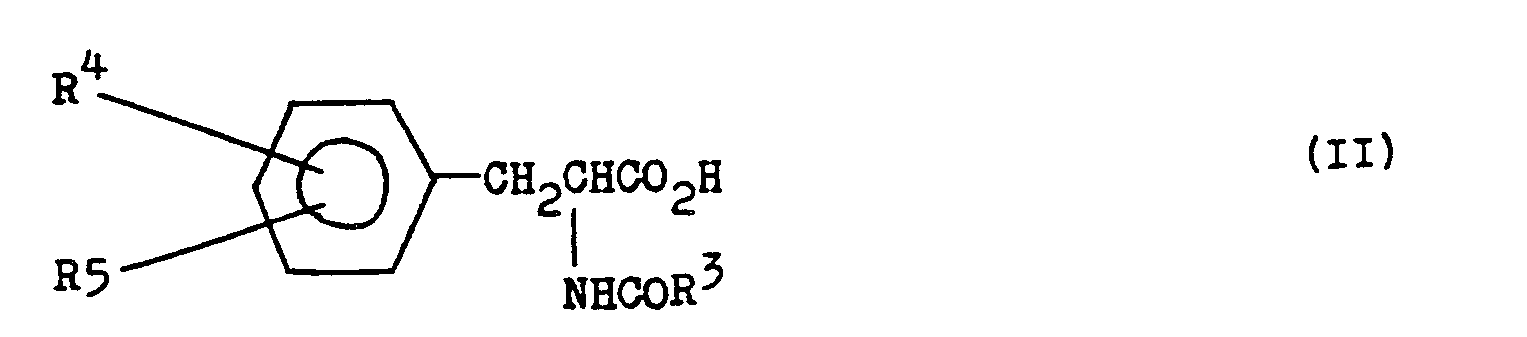
dans laquelle R4 et R5 indépendamment l'un de l'autre sont un atome d'hydrogène, un groupe alcoyle ayant 1 à 4 atomes de carbone, un groupe alcoxy ayant 1 à 4 atomes de carbone, un atome d'halogène, un groupe hydroxyle ou un groupe aryloxy ou, en combinaison, sont le groupe méthylènedioxy, et R3 est un groupe méthyle ou phényle, le procédé comprenant l'hydrolyse avec un alcali d'une 4-benzylidène (substitué)-5-oxazolone 2-substituée représentée par la formule générale (I):
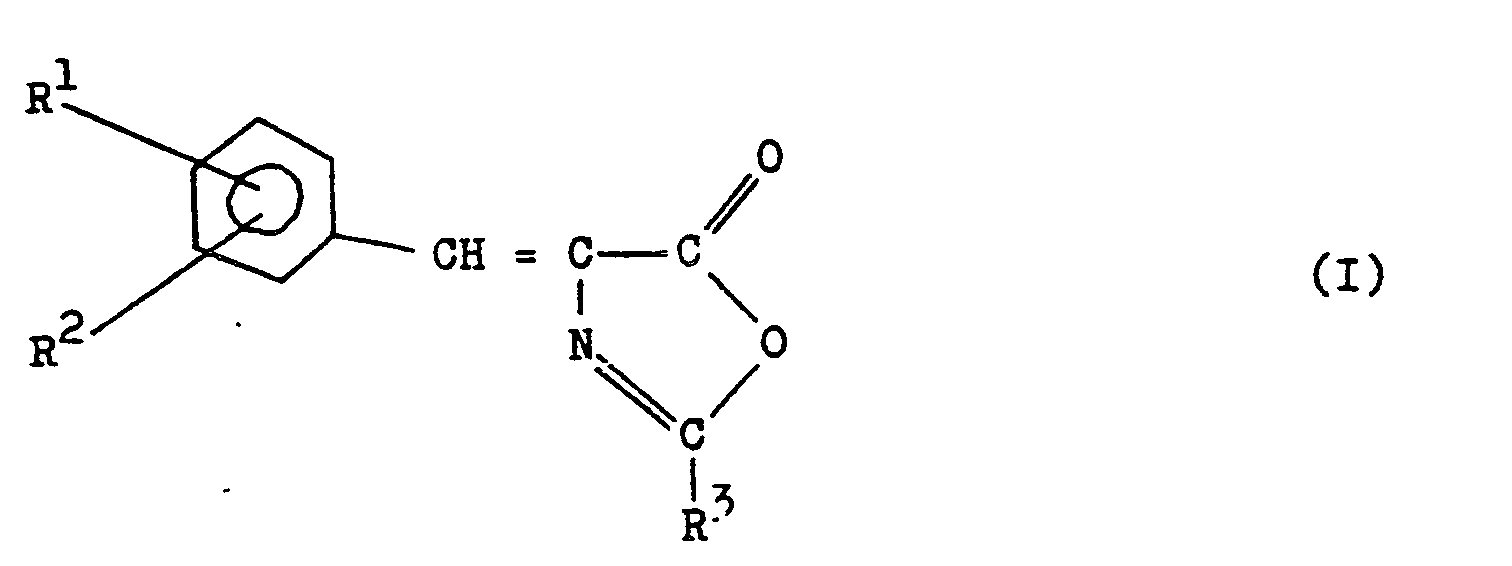
dans laquelle R1 et R2 indépendamment l'un de l'autre sont un atome d'hydrogène, un groupe alcoyle ayant 1 à 4 atomes de carbone, un groupe alcoxy ayant 1 à 4 atomes de carbone, un atome d'halogène, un groupe acyloxy ou un groupe aryloxy ou, en combinaison, sont le groupe méthylènedioxy, et R3 est un groupe méthyle ou phényle, l'ajustement du.pH de la solution réactionnelle contenant le produit d'hydrolyse à 5-9 avec un acide et la réduction catalytique de la solution réactionnelle obtenue en présence d'un catalyseur de réduction au palladium ou au platine.
dans laquelle R4 et R5 indépendamment l'un de l'autre sont un atome d'hydrogène, un groupe alcoyle ayant 1 à 4 atomes de carbone, un groupe alcoxy ayant 1 à 4 atomes de carbone, un atome d'halogène, un groupe hydroxyle ou un groupe aryloxy ou, en combinaison, sont le groupe méthylènedioxy, et R3 est un groupe méthyle ou phényle, le procédé comprenant l'hydrolyse avec un alcali d'une 4-benzylidène (substitué)-5-oxazolone 2-substituée représentée par la formule générale (I):
dans laquelle R1 et R2 indépendamment l'un de l'autre sont un atome d'hydrogène, un groupe alcoyle ayant 1 à 4 atomes de carbone, un groupe alcoxy ayant 1 à 4 atomes de carbone, un atome d'halogène, un groupe acyloxy ou un groupe aryloxy ou, en combinaison, sont le groupe méthylènedioxy, et R3 est un groupe méthyle ou phényle, l'ajustement du.pH de la solution réactionnelle contenant le produit d'hydrolyse à 5-9 avec un acide et la réduction catalytique de la solution réactionnelle obtenue en présence d'un catalyseur de réduction au palladium ou au platine.
2. Un procédé selon la revendication 1, dans lequel l'alcali est un hydroxyde, oxyde
ou carbonate d'un métal alcalin ou d'un métal alcalino-terreux.
3. Un procédé selon la revendication 1, ou la revendication 2, dans lequel la réaction
d'hydrolyse est effectuée à une température dans la gamme de de 20 à 80°C.
4. Un procédé selon la revendication 1, ou 3, dans lequel on dissout ou met en suspension
une partie en poids de la substance de départ comprenant la 4-benzylidène(substitué)-5-oxazolone
2-substituée dans 2 ou plus de 2 parties en poids d'eau pour la réaction d'hydrolyse.
5. Un procédé selon la revendication 1, 2, 3 ou 4, dans lequel la solution réactionnelle
contenant le produit d'hydrolyse est ajustée à un pH dans la gamme de 5,5 à 8,5.
6. Un procédé selon l'une quelconque des revendications 1 à 5, dans lequel le catalyseur
est choisi parmi le charbon palladié, le noir de palladium, le palladium colloidal,
le sulfate de baryum palladié, l'alumine palladiée, l'oxyde de platine, le charbon
platiné et un gel de silice platiné.
7. Un procède selon l'une quelconque des revendications 1 à 6, dans lequel le catalyseur
est utilisé en une quantité de 0,1 à 30% en poids relativement au poids de la substance
de départ comprenant la 4-benzylidène(substitué)-5-oxazolone 2-substituée et de préférence
en une quantité de 0,5 à 10% en poids sur la même base.
8. Un procédé pour la préparation de L-phénylalanines comprenant la préparation d'une
N-acylphénylalanine selon le procédé de l'une quelconque des revendications 1 à 7,
puis l'hydrolyse asymétrique de la N-acylphénylalaline par action d'une enzyme acylase.