| (19) |
 |
|
(11) |
EP 0 165 730 B1 |
| (12) |
EUROPEAN PATENT SPECIFICATION |
| (45) |
Mention of the grant of the patent: |
|
10.05.1989 Bulletin 1989/19 |
| (22) |
Date of filing: 30.05.1985 |
|
| (51) |
International Patent Classification (IPC)4: B01D 53/00 |
|
| (54) |
Process and biological contact gas scrubber for waste gas purification
Verfahren und biologischer Kontakt-Gas-Wäscher zur Abgasreinigung
Procédé et laveur de gaz à contact biologique pour purification de gaz d'échappement
|
| (84) |
Designated Contracting States: |
|
BE DE FR GB IT NL |
| (30) |
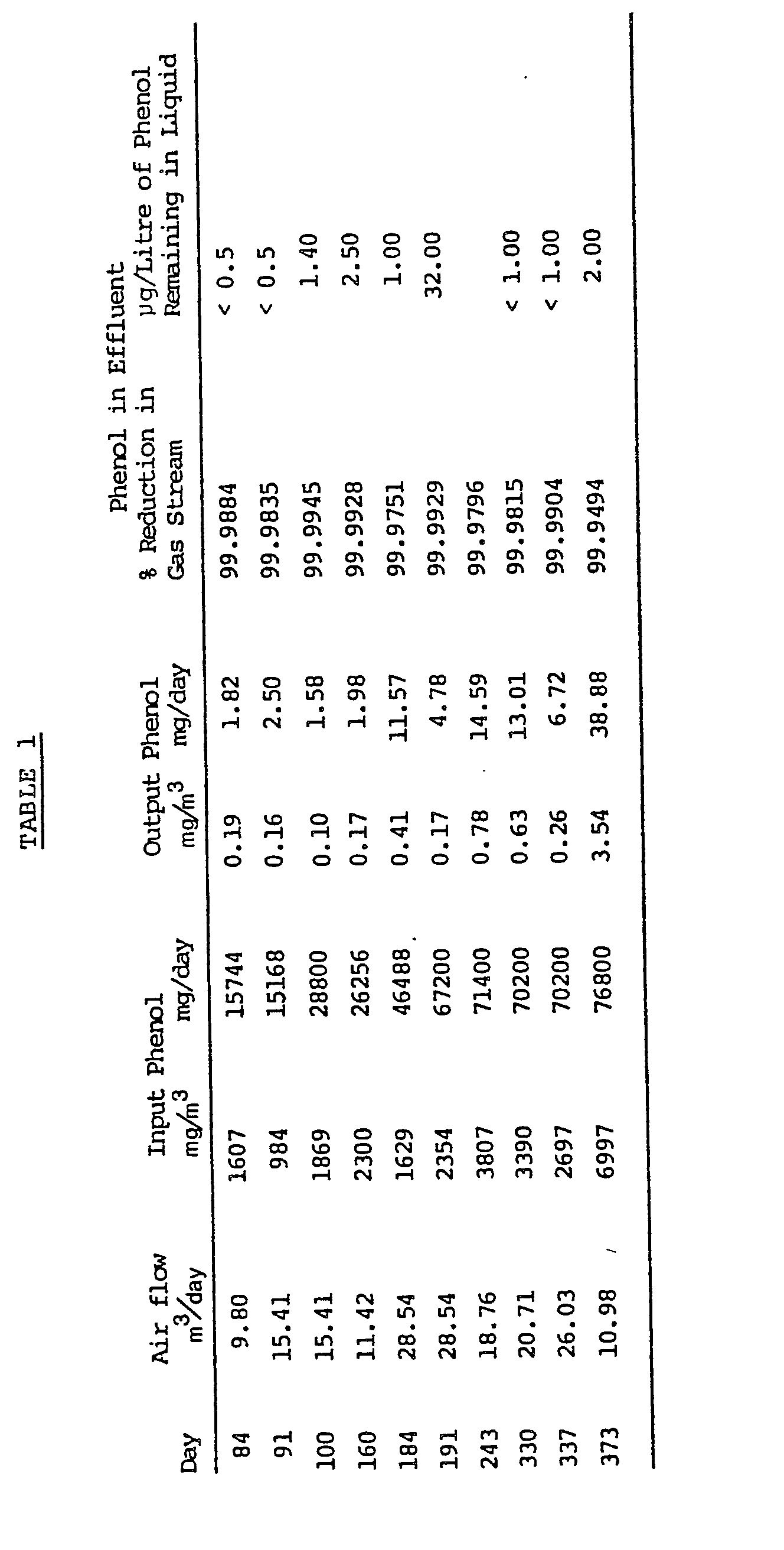
Priority: |
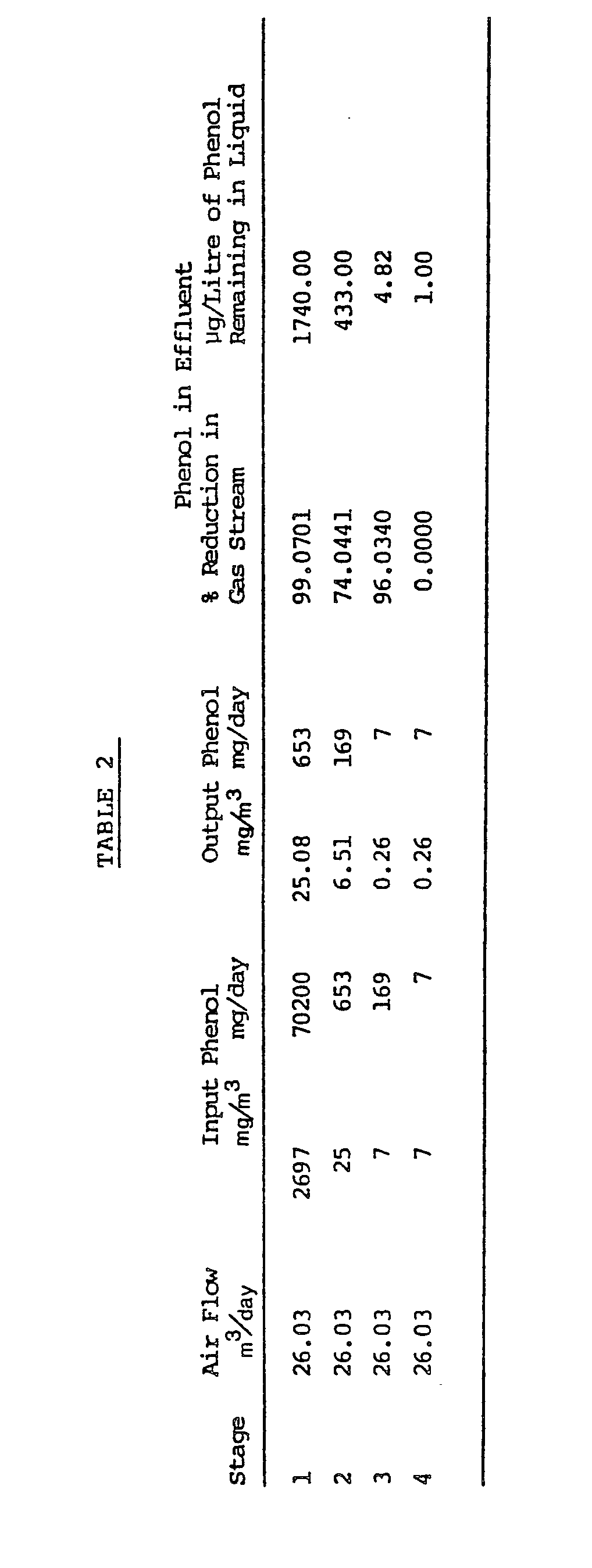
30.05.1984 GB 8413751
|
| (43) |
Date of publication of application: |
|
27.12.1985 Bulletin 1985/52 |
| (73) |
Proprietor: ORTECH CORPORATION |
|
Mississauga
Ontario L5K 1B3 (CA) |
|
| (72) |
Inventors: |
|
- Kahler, Brett D.
Brampton
Ontario (CA)
- McKim, Matthew P.
Oakville
Ontario (CA)
|
| (74) |
Representative: Abbie, Andrew Kenneth (GB) et al |
|
R.G.C. Jenkins & Co.
26 Caxton Street
GB-London SW1H ORJ
GB-London SW1H ORJ (GB) |
|
| |
|
| Note: Within nine months from the publication of the mention of the grant of the European
patent, any person may give notice to the European Patent Office of opposition to
the European patent
granted. Notice of opposition shall be filed in a written reasoned statement. It shall
not be deemed to
have been filed until the opposition fee has been paid. (Art. 99(1) European Patent
Convention).
|
[0001] This invention relates to the continuous removal of pollutants from waste gas streams
by use of a microbiological system.
[0002] Waste gases are the by-products of various manufacturing processes. Environmental
legislation requires, for example, that these wastes be removed from the air before
it is released into the atmosphere. Presently, companies employ a system of wet scrubbers
to cleanse their manufacturing exhaust of these wastes. The exhaust, for example,
is passed up through a wet scrubber consisting of a water tower packed with ceramic
rings. Water flows down through the scrubber and absorbs the water soluble gases due
to a concentration gradient that favours the absorption of the gases from the exhaust
into the water.
[0003] The contaminated water is then disposed into the water sewage system and treated
usually before being released into the water systems. A rotary biocontactor is one
of the devices used to process waste water in the treatment plants. This device requires
passing water through a wheel consisting of multiple mesh discs on which a biomass
is growing. The biomass converts the carbon waste products into C0
2 for instance.
[0004] United States patent 3,335,081 discloses an example of this type of rotary biocontactor
for treating sewage. A plurality of rotating discs supporting the growth of biomass
rotates through the sludge circulated through the apparatus while the upper portion
of the discs are exposed to air to thereby provide the necessary oxygen in maintaining
the viability of the biological system in degrading the contaminants in the liquid
sludge stream.
[0005] Other processes involving rotating discs in biological systems are disclosed in United
States patents 3,594,277 and 4,446,236. Neither of these systems are directed to the
removal of pollutants from a gas stream by the use of rotary biocontactor systems.
[0006] It is known to purify gases using microoganisms by techniques such as disclosed in
United States patents 1,701,825, 2,200,581, 2,793,096 and 3,216,905. These systems
involve in one form or another contacting a biomass with the waste gas stream to be
purified. The waste gases are brought into contact with fine sprays of medium containing
the bacteria as disclosed in United States patent 1,701,825. Other techniques of contacting
the waste gases with the bacteria include growing the bacteria on supporting media,
such as disclosed in United States patent 2,200,581. Soil microoganisms may be used
in purifying gases, such as disclosed in United States patents 2,793,096 and 3,216,905.
[0007] Rotating biocontactors are also used in the production of vaccines such as disclosed
in United States patents 3,839,155, 3,933,585 and 4,080,258. The systems function
in a manner similar to other forms of rotary biocontactors where air or other oxygen
containing gas passes over top of the contactor discs to provide the necessary oxygen
needed during the metabollic growth of the microoganisms in producing the desired
vaccines.
[0008] The method and apparatus, according to this invention, removes waste gases from a
waste gas stream directly by the use of a viable biomass. The method and apparatus
is more compact, more efficient, costs less to operate and is readily assembled.
[0009] An apparatus to convert pollutants in waste gases into harmless substances is disclosed
in DE-A-2 722 013. This apparatus comprises a tank having partitions extending downwardly
to just below the water level. These partitions define a number of chambers in each
of which are arranged rotating hollow bodies, moving into and out of the water. The
water is however free to circulate within the tank and thus any microoganisms present
in the hollow bodies are exposed to equal conditions along the tank, which is the
pathway for the waste gases from inlet to outlet. Obviously in the case of water-soluble
waste gases, the water will be a solution of the waste gases.
[0010] According to one aspect of the present invention, there is provided a process for
removing pollutants from a waste gas stream comprising culturing in a rotary biocontactor
a biomass capable of assimilating said pollutants and producing harmless metabolites
by contacting said waste gas stream with said biomass. The process is characterised
by culturing said biomass in said biocontactor having a chamber enclosing a plurality
of discs mounted for rotation about an axis, providing said biomass in a bottom portion
of said biocontactor and rotating said discs through said biomass, growing said biomass
on said discs, introducing to said chamber said waste gas stream and passing said
waste gas stream through said chamber above said biomass and over exposed portions
of said rotating discs having said biomass growing thereon, removing said pollutants
from said waste gas stream by said biomass on said exposed portions of said discs
absorbing said pollutants, assimilating said pollutants and producing harmless metabolites,
exhausting from said chamber said gas stream with a substantial percentage of pollutants
removed therefrom and containing any gaseous metabolites at a location in said chamber
downstream of where said waste gas stream is introduced to said chamber.
[0011] According to another aspect of the present invention, there is provided an apparatus
for removing pollutants from a waste gas stream by use of a rotary biocontactor having
a chamber defined within a housing, a plurality of partitions provided within said
housing for defining a plurality of serially arranged sub-chambers, means for introducing
a waste gas stream to a first of said sub-chambers and means for exhausting a gas
stream from a last of said sub-chambers, rotor means extending through all of said
sub- chambers on which a plurality of devices are mounted in each sub-chamber, means
for rotating said rotary means to rotate said devices within each sub-chamber, each
of said sub-chambers containing a biomass through which said devices are rotated.
The apparatus ot the invention is characterised in that each ot said partitions isolates
one of said sub-chambers from an adjacent one of said sub-chambers, a lower aperture
is provided in each of said partitions for determining liquid biomass level in a respective
one of said sub- chambers, said lower apertures providing for liquid flow from one
sub-chamber to the next, means for withdrawing biomass liquid from said last sub-chamber
and means for introducing to said first sub- chamber a liquid containing nutrients
for the biomass in the sub-chambers being provided, in that an upper aperture is provided
in each of said partitions through which said waste gas flows in passing over said
devices as they are exposed above the liquid biomass, and in that said plurality of
devices are in the form of discs mounted on said rotor means.
[0012] Preferred embodiments of the invention will now be more particularly described by
way of example and with reference to the accompanying drawings, wherein:
Figure 1 is a perspective view of the rotary biocontactor apparatus according to this
invention;
Figure 2 is an exploded view in perspective of the biocontactor apparatus of Figure
1;
Figure 3 is a top plan view of the apparatus of Figure 1 with the cover removed;
Figure 4 is a section of the biocontactor disc showing the assembly thereof;
Figure 5 is a section through Figure 1 at the position indicated by lines 5-5 in Figure
3;
Figure 6 is a section through the apparatus of Figure 1 at the position indicated
by lines 6-6 in Figure 3; and
Figures 7, 8, 9 and 10 are photographs of the biomass at four distinct stages zones
along the biocontactor apparatus.
[0013] As shown in Figure 1, the biocontactor apparatus 10 has a chamber consisting of a
hemi-cylindrical upper shell or housing 12 and a corresponding hemi-cylindrical bottom
shell or housing 14. These shells may be made of various corrosion resistant materials,
preferably rigid molded fiberglass resin material. The shells define a chamber enclosing
the rotary biocontactor 16 as shown in Figure 2. The phenol laden waste gas stream
to be treated by the apparatus 10 is introduced to the biocontactor via conduit 18
in the direction of arrow 20 and is exhausted from the system via outlet 22 in the
direction of arrow 24 at a location in said chamber downstream of said inlet 18. The
biocontactor device 16 is rotated within the apparatus 10 by motor 26 which belt drives
axle 28 having pulley 30 mounted thereon and connected by drive belt 32 to pulley
34 of the motor. The rotary biocontactor device is partially immersed in the biomass
medium contained in the lower shell 14. The medium is circulated through an external
solid separating device (not shown) where the biomass liquid is removed from the lower
shell 14 through outlet 36 in the direction of arrow 38 and returned to the liquid
inlet 40 in the direction of arrow 42.
[0014] Turning to Figure 2, further details of the interior of the special rotary biocontactor
apparatus are shown. The lower shell 14 has three interior baffles or partitions 44,
46 and 48 which define for the biomass medium four discrete liquid sub-chambers or
zones 50, 52, 54 and 56. The biomass medium is allowed to circulate through the sub-chambers
as induced by removing the biomass through outlet 36. The circulation along the shell
14 amongst the sub-chambers or zones is effected by apertures 58, 60 and 62 in the
baffles 44, 46 and 48. The apertures provide for a criss-crossing flow of the biomass
liquid through the chambers 50, 52, 54 and 56, whereby channelling of the biomass
liquid from the inlet to the outlet is avoided to ensure steady state for the biomass
medium in each of the discrete chambers 50, 52, 54 and 56.
[0015] The cover 12 is provided with flanges 64 and 66 which are secured to opposing corresponding
flanges 68 and 70 to provide a gas tight seal about these portions of the apparatus.
Gasket material (not shown) is also provided along opposing edges 72, 74, 76 and 78
of the cover and bottom to seal the end portions. Also not shown, appropriate seals
are provided about the axle 28 of the biocontactor unit 16 at both ends to seal about
the opposing recessed portions 80 and 81 of the upper and lower shell end walls 85
and 87; and to seal about the opposing recessed portions 82 and 83 of the upper and
lower shell end walls 89 and 91. This arrangement provides a completely gas tight
environment in the apparatus 10.
[0016] The phenol laden gas stream under pressure is introduced to the inlet 18 of the biocontactor
apparatus and is then allowed to flow through the upper discrete chambers defined
by baffles 84, 86 and 88. These baffles in turn define the individual gaseous sub-chambers
or zones 90, 92, 94 and 96 which overlie the lower liquid sub-chambers 50, 52, 54
and 56. To avoid channelling of the gas flow through the respective gas contact sub-chambers,
apertures 98, 100 and 102 ensure that the air flow criss-crosses through the chambers
and over the biocontactors before exhausting through outlet 22.
[0017] The biocontactor unit 16 consists of four discrete units 104, 106, 108 and 110 which
are individually located in the corresponding liquid/gas sub-chambers 50/90, 52/92,
54/94 and 56/96. This relationship is shown more clearly in Figure 3 where each biocontactor
unit 104, 106, 108 and 110 is concentrically mounted on the axle 28 which rotates
in the direction of arrow 112. Each biocontactor unit, such as 104, includes a number
of spaced-apart circular discs 114 which are concentric with the axle 112. Each end
of biocontactor unit 104 is provided with opposing rigid frames 116 and 118. As shown
in Figure 2, the frames are in the form of a cross with aligned leg portions through
which fasteners 120 extend. As shown in more detail in Figure 4, each leg 122 of frame
116 and 124 of frame 118 have a fastener 120 extending through aperture 126 and a
corresponding aperture (not shown) in leg 124. Each disc 114 has a corresponding aperture
128 through which the fastener 120 extends. Between each disc is a spacer 130 which
defines the space between each disc. Upon insertion of the fastener through the apertures
126, 128 and spacers 130, nut 132 is used to complete the assembly at the four extremities
of the legs of each frame 116 and 118. According to a preferred embodiment of the
invention, these frames 116, 118 and fasteners and spacers may all be made of stainless
steel. The discs 114 are perforated and flexible and may be made of a suitable plastic
material which acts as an inert support for the growth of the biomass.
[0018] Turning to Figure 5, the liquid level 134 is shown in the lower portion 14 of the
biocontactor. One leg is rotated in the direction 112 as shown in Figure 3, where
the biomass growing on each disc 114 is continuously passed through the biomass liquid
134 to maintain a continuous growth of the biomass on the discs. The discs 114 may
be of open mesh construction to facilitate attachment of the growing biomass to the
discs. As shown in Figure 6, the liquid level is above the aperture 62 to provide
for a liquid flow therethrough as it is removed through outlet 36. Correspondingly
the gas stream flow is above the biomass and over and around the biocontactor discs
104,106,108 and 110 as it criss-crosses through the respective chambers predetermined
by the tortuous path defined by the apertures in the baffles.
[0019] The apparatus, in accordance with this invention, provides for a readily manufactured,
enclosed rotary biocontactor system. The shells and partitions or baffles may be formed
by molding a combination of fiberglass with polyester resins in accordance with well
known techniques. Appropriate bearings may be provided in each respective end wall
of the opposing lower and upper shells to support rotation of the rotor 28 in the
biocontactor. The system is readily assembled by clamping the opposing shells 12 and
14 together with the rotor and disc arrangement located within the assembled channels.
Standard types of split bearings may be used to support the rotor at the end walls
of the assembled shells and optionally at locations along the respective partitions
44, 46, and 48. The chamber within the assembled shells may be gas tight to ensure
that an anaerobic environment may be provided within the rotary biocontactor to digest
particular pollutants under anaerobic conditions. Clamps or the like, which are used
to assemble the shell halves, may be removed to provide for ready disassembly of the
biocontactor for purposes of service and clean-out if required.
[0020] The biomass composition varies in each of the chambers 50, 52, 54 and 56 of the lower
half of the apparatus. The chamber 50, which is the first in the series and is exposed
to the highest concentration of phenol in the waste stream has, as shown in Figure
7, the highest proportion of phenol digesting bacteria. The proportion of higher lifeforms
increases along the length of the reactor in remaining chambers 52, 54 and 56. At
each stage the phenol concentration becomes less, thereby permitting growth of the
more vulnerable higher lifeforms. This is exemplified in Figures 8, 9 and 10 showing
in the second, third and fourth chambers an increasing occurrence of the higher, more
complex lifeforms such as worms.
[0021] The waste stream to be treated by the biomass is introduced to inlet 18. The waste
stream travels through each chamber 90, 92, 94 and 96 as it passes over, around and
possibly through the discs of each contactor unit 104, 106, 108 and 110. The biomass
grows on each of the discs. The pollutants in the waste stream diffuse into the liquid
containing the biological system of biomass, whereby the biomass assimilates the pollutants,
grows and forms metabolites which are harmless to the atmosphere. According to this
preferred aspect of the invention in treating phenol laden gases, the biological system
in the chambers is acclimated to the phenol carbon source. In accordance with standard
procedures, the biological system could be acclimated to any other nutrient source,
such as, carbon which is to be treated in a gaseous stream. The removal of ketones
from a gas stream and sulphides from a gas stream are other examples of aerobic systems.
It is appreciated that there is an application in an anaerobic system.
[0022] The air flow follows the tortuous path over and through the discs and through the
chambers and in so doing, allows the phenol to diffuse by mass transfer into the water
of the biological system growing on the disc. The phenol is immediately absorbed because
the continuous digestion of phenol by the biological system maintains a high concentration
gradient of phenol between the water of the biomass medium and the gas stream passing
through the upper chambers. Thus by the biological system continuously removing phenol
from the liquid medium, this maintains a high rate of mass transfer of the phenol
from the gas stream into the biomass liquid which cannot be accomplished in standard
wet scrubbing systems. In order for wet scrubbing systems to achieve a comparable
situation, there would be a need to continuously replace water which is limited due
to flooding of a packed tower or the like. The conversion of the phenol in the water
by the biomass permits this water medium to be reused on a continuous basis. The biomass
in the lower chamber and on the rotary biocontactors is kept in a steady state by
the circulation of the water medium. When water is removed from the lower chamber,
it is flushed of the excess biomass in accordance with standard techniques of separating
biological solids from the liquid. Nutrients, such as nitrogen and phosphorous, are
added to the recirculating water. The fortified water is returned into the lower chamber
of the apparatus to replenish the biomass with the necessary nutrients. As the biomass
liguid is circulated from sub-chamber to sub-chamber, the nutrients are adequately
distributed where steady state is eventually established amongst the intercommunicating
sub-chambers. The separation of biological solids from liquids removed from the apparatus
prevents an excess build-up of biomass in the system to provide for its continued
operation.
Example 1
[0023] Numerous test runs were conducted to measure the effectiveness of the system. The
tests were set up so that a certain level of phenol in a gas stream was fed through
the system during a measured period of time. The gas flow rate was varied with each
trial. The gas stream leaving the system was passed through an impinger consisting
of 10 g of sodium hydroxide in 100 ml of water. This impinger absorbed any phenol
gas that was left in the gas stream after it passed through the system because sodium
hydroxide reacts with phenolic compounds. After the test run was completed, the level
of phenol in the liquid in each of the four subchambers of the system and the impinger
was measured. These measurements indicated the effectiveness of the system as any
phenol from the gas stream that was not degraded by the biomass should have been found
in either the aqueous medium or the impinger.
[0024] Given this experimental framework, 10.5 g of phenol was fed through the system in
a gas stream flowing at a rate of 6.8 I/min. over the course of 16 hours. After this
test run, the level of phenol in the liquid phase in each of the four subchambers
was less than 0.0005 mg/I. The amount of phenol that reacted with the sodium hydroxide
solution was 0.122 mg. The efficiency of the system is 99.99% as 0.122 mg of phenol
was found, after 10.5 g of phenol has passed by means of the gas stream through the
system.
[0025] The next trial run involved passing 11.7 g of phenol in a gas stream flowing at a
rate of 10.6 I/min over the course of 18.5 hours. After this test run, the level of
phenol in the liquid phase in each of the subchambers was in the range of less than
.002 mg/I to .0005 mg/I. It was discovered that 0.193 mg of phenol reacted with the
sodium hydroxide solution. Thus the system is 99.99% efficient as 0.193 mg of phenol
compound was found, after 11.7 g of phenol was passed through the system.
[0026] In the last experimental run, 3.0 g of phenol passed through the system at a rate
of 10.7 I/min over the course of 3.5 hours. The level of phenol found in the liquid
phase was in the range of .0106 mg/I to .0005 mg/I. It was discovered that 0.165 mg
of phenol had reacted with the sodium hydroxide solution. Again, the system is 99.99%
efficient as 0.165 mg of phenol compound was found after 3.0 g was passed through
the system.
Example 2
[0027] In accordance with the procedures used in Example 1 for analyzing the phenol removal
percentages by the rotary biocontactor, the system was then operated for a total of
373 days where, from time to time, the efficiency in phenol removal based on varying
input rates of phenol in the waste gas stream were determined. The results of the
373 day run are set out in the following Table 1.
Example 3
[0028] On day 337 of the run set out in Table 1 of Example 2, the efficiencies of each zone
or sub-chamber in phenol reduction was evaluated. The results of this evaluation are
set out in Table 2.
[0029] Based on the above results of the extended run evaluated in Examples 2 and 3, the
rotary biocontactor, according to this invention, over more than a year's operation
for a variety of inputs of phenol maintained a percent reduction of phenol well in
excess of 99%. Furthermore, the phenol removal in each zone of the rotary biocontactor,
according to this invention, provides a significant reduction in phenol in the first
stage or zone of the biocontactor at a percent reduction rate of 99%. In the second
and third stages, the remainder of the phenol within the efficiencies of the unit
is removed. According to Table 2, there is no significant amount of phenol removed
from stage 4 to thereby indicate that additional stages are not required in the operation
of this apparatus for purposes of phenol removal from waste gas streams.
[0030] These tests conclusively show that the biomass converts the phenol from the gas stream
into carbon by-products. Negligible phenol remains in the liquid medium in the subchambers
and in the gas leaving the system.
1. A process for removing pollutants from a waste gas stream comprising culturing
in a rotary biocontactor a biomass capable of assimilating said pollutants and producing
harmless metabolites by contacting said waste gas stream with said biomass, characterised
by culturing said biomass in said biocontactor having a chamber enclosing a plurality
of discs mounted for rotation about an axis, providing said biomass in a bottom portion
of said biocontactor and rotating said discs through said biomass, growing said biomass
on said discs, introducing to said chamber said waste gas stream and passing said
waste gas stream through said chamber above said biomass and over exposed portions
of said rotating discs having said biomass growing thereon, removing said pollutants
from said waste gas stream by said biomass on said exposed portions of said discs
absorbing said pollutants, assimilating said pollutants and producing harmless metabolites,
exhausting from said chamber said gas stream with a substantial percentage of pollutants
removed therefrom and containing any gaseous metabolites at a location in said chamber
downstream of where said waste gas stream is introduced to said chamber.
2. A process as claimed in claim 1, characterised in that said chamber is divided
into a plurality of serially arranged sub-chambers which are serially in fluid communication,
circulating said waste gas stream along said sub-chambers, providing a plurality of
said discs in each of said sub-chambers, introducing said waste gas stream to a first
of said serially arranged sub-chambers and exhausting said gas stream from a last
of said serially arranged sub-chambers.
3. A process as claimed in claim 2, characterised in that limited amounts of liquid
of said biomass are circulated from one sub-chamber to the next in the direction of
flow of said waste gas stream.
4. A process as claimed in either claim 2 or claim 3, characterised in that said waste
gas stream and liquid of said biomass are circulated from one end of said chamber
to the other along a tortuous path through said sub-chambers.
5. A process as claimed in any one of claims 2 to 4, characterised in that said biomass
comprises various microorganism colonies, the population distribution of species in
said various colonies changing from sub-chamber to sub-chamber as determined by the
concentration of said one or more pollutants decreasing as said gas stream is circulated
towards said exhaust location of said chamber.
6. A process as claimed in any one of the preceding claims, and adapted for removing
phenols from a waste gas stream containing oxygen characterised in that said biomass
is acclimated to said phenols as a source of carbon nutrient for supporting the growth
of said biomass on said discs.
7. A process as claimed in any one of the preceding claims, characterised in that
said circulating of said biomass includes withdrawing a portion of said biomass in
a liquid, removing biological solids from said biomass liquid, adding biological nutrients
to said biomass liquid to fortify said biomass liquid and returning said fortified
biomass liquid to said chamber.
8. A process as claimed in any one of the preceding claims, further characterised
by sealing said chamber from the surrounding environment, passing an oxygen free waste
gas stream containing pollutants to provide for the anaerobic biological growth of
said biomass culture in assimilating said pollutants to provide a gas stream free
of said pollutants.
9. A process as claimed in any one of claims 1 to 7, further characterised by sealing
said chamber from the surrounding environment, passing an oxygen containing waste
gas stream with pollutants to provide for the aerobic biological growth of said biomass
culture in assimilating said pollutants to provide a gas stream free of said pollutants.
10. Apparatus for removing pollutants from a waste gas stream by use of a rotary biocontactor
having a chamber defined within a housing (12,14), a plurality of partitions (44,
46, 48, 84, 86, 88) provided within said housing for defining a plurality of serially
arranged sub-chambers (50, 52, 54, 56), means (18) for introducing a waste gas stream
to a first of said sub-chambers (50) and means (22) for exhausting a gas stream from
a last of said subchambers (56), rotor means (28) extending through all of said sub-chambers
on which a plurality of devices (104, 106, 108, 110) are mounted in each sub-chamber,
means for rotating said rotary means to rotate said devices within each sub-chamber,
each of said sub-chambers containing a biomass through which said devices are rotated,
said apparatus being characterised in that each of said partitions isolates one of
said sub-chambers from an adjacent one of said sub-chambers, a lower aperture (58,
60, 62) is provided in each of said partitions for determining liquid biomass level
in a respective one of said sub-chambers, said lower apertures (58, 60, 62) providing
for liquid flow from one sub-chamber to the next, means (36) for withdrawing biomass
liquid from said last sub-chamber (56) and means (40) for introducing to said first
sub-chamber (50) a liquid containing nutrients for the biomass in the sub-chambers
being provided, in that an upper aperture (98,100,102) is provided in each of said
partitions through which said waste gas flows in passing over said devices as they
are exposed above the liquid biomass, and in that said plurality of devices (104,106,108,110)
are in the form of discs (114) mounted on said rotor means (28).
11. An apparatus as claimed in claim 10, characterised in that said discs (114) are
of open mesh on which a biomass grows when cultured in a corresponding subchamber.
12. An apparatus as claimed in either claim 10 or claim 11, characterised in that
said chamber housing (12, 14) comprises opposing hemi-cylindrical shells with end
walls, means for connecting said shells together to define therewithin a cylindrical
chamber, each of said shells having semi-circular shaped spaced-apart partitions (44,
46, 48, 84, 86, 88) to define a portion of each sub-chamber in said chamber, each
of said partitions in one of said shells being in register with a corresponding partition
of the other shell when said shells are connected together by said connecting means,
said partition means in each shell which are in register contacting each other to
seal the sub-chamber, said apertures being the sole form of communication between
adjacent sub-chambers.
13. An apparatus as claimed in any one of claims 10 to 12, characterised in that said
upper apertures° (98, 100, 102) in said partitions are arranged to define a tortuous
flow path from a waste gas stream as it passes over said biomass and around said discs.
14. An apparatus as claimed in any one of claims 10 to 13, further characterised by
means for separating solids from biomass liquid obtained from said withdrawal means
(36), means for introducing nutrients to remaining liquid emerging from said solids
separator, means for returning said remaining liquid with nutrients to said means
(40) for introducing liquid to said first sub-chamber.
15. An apparatus as claimed in any one of claims 12 to 14, characterised in that each
of said opposing shells and related partition means are formed of a rigid fiberglass
polyester resin composition.
1. Verfahren zur Entfernung von Verunreinigungen aus einem Abgasstrom, umfassend das
Kultivieren in einem Rotationsbiokontaktor einer Biomasse, die in der Lage ist, die
Verunreinigungen zu assimilieren und unschädliche Metabolite zu produzieren, durch
Kontaktieren des Abgasstroms mit der Biomasse, gekennzeichnet durch das Kultivieren
der Biomasse in dem Biokontaktor, der eine Kammer besitzt, die eine Vielzahl von zur
Rotation um eine Achse montierte Scheiben einschließt, Vorsehen der Biomasse in einem
Bodenbereich des Biokontaktors und Rotieren der Scheiben durch die Biomasse hindurch,
Wachsenlassen der Biomasse auf den Scheiben, Einführen in die Kammer des Abgasstroms
und Hindurchleiten des Abgasstroms durch die Kammer oberhalb der Biomasse und über
freiliegende Bereiche der rotierenden Scheiben, auf denen die Biomasse wächst, Entfernen
der Verunreinigungen aus dem Abgasstrom durch die Biomasse auf den freiliegenden Bereichen
der Scheiben, die die Verunreinigungen absorbiert, die Verunreinigungen assimiliert
und unschädliche Metabolite produziert, Absaugen aus der Kammer des Gasstroms, aus
dem ein wesentlicher Prozentsatz an Verunreinigungen entfernt ist und der irgendwelche
gasförmige Metabolite enthält, an einer Stelle in der Kammer stromabwärts der Stelle,
an der der Abgasstrom in die Kammer eingeführt wird.
2. Verfahren nach Anspruch 1, dadurch gekennzeichnet, daß die Kammer in eine Vielzahl
in Reihe angeordneter Unterkammern unterteilt ist, die reihenweise in Fluid-Verbindung
stehen, der Abgasstrom entlang der Unterkammern zirkuliert wird, eine Vielzahl der
Scheiben in jeder der Unterkammern vorgesehen ist, der Abgasstrom in eine erste der
in Reihe angeordneten Unterkammern eingeführt wird und der Gasstrom aus einer letzten
der in Reihe angeordneten Unterkammern abgesaugt wird.
3. Verfahren nach Anspruch 2, dadurch gekennzeichnet, daß limitierte Mengen an Flüssigkeit
aus der Biomasse von einer Unterkammer zu der nächsten in Strömungsrichtung des Abgasstroms
zirkuliert werden.
4. Verfahren nach Anspruch 2 oder 3, dadurch gekennzeichnet, daß der Abgasstrom und
die Flüssigkeit aus der Biomasse von einem Ende der Kammer zu dem anderen entlang
einer gewundenen Bahn durch die Unterkammern zirkuliert werden.
5. Verfahren nach einem der Ansprüche 2 bis 4, dadurch gekennzeichnet, daß die Biomasse
zahlreiche Mikroorganismenkolonien umfaßt, wobei die Populationsverteilung der Spezien
in den zahlreichen Kolonien sich von Unterkammer zu Unterkammer ändert, wie es durch
die Konzentration der einen oder mehreren Verunreinigungen, die in dem Maße abnimmt,
wie der Gasstrom in Richtung der Absaugstelle der Kammer zirkuliert wird, bestimmt
wird.
6. Verfahren nach einem der vorangehenden Ansprüche, das zur Entfernung von Phenolen
aus einem Abgasstrom, der Sauerstoff enthält, adaptiert ist, dadurch gekennzeichnet,
daß die Biomasse an die Phenole angepaßt ist als eine Kohlenstoffnährstoffquelle zur
Unterstützung des Wachstums der Biomasse auf den Scheiben.
7. Verfahren nach einem der vorangehenden Ansprüche, dadurch gekennzeichnet, daß das
Zirkulieren der Biomasse das Abziehen eines Teils der Biomasse in eine Flüssigkeit,
Entfernen biologischer Feststoffe aus der Biomassenflüssigkeit, Zugeben biologischer
Nährstoffe zu der Biomassenflüssigkeit, um die Biomassenflüssigkeit zu verstärken,
und das Rückführen der verstärkten Biomassenflüssigkeit zu der Kammer beinhaltet.
8. Verfahren nach einem der vorangehenden Ansprüche, dadurch gekennzeichnet, daß man
weiterhin die Kammer von der anschließenden Umgebung abdichtet, einen sauerstoffreien
Abgasstrom, der Verunreinigungen enthält, hindurchführt, um für das anaerobe biologische
Wachstum der Biomassenkultur durch Assimilierung der Verunreinigungen zu sorgen, um
einen Gasstrom vorzusehen, der die Verunreinigungen nicht enthält.
9. Verfahren nach einem der Ansprüche 1 bis 7, dadurch gekennzeichnet, daß man weiterhin
die Kammer von der anschließenden Umgebung abdichtet, einen sauerstoffhaltigen Abgasstrom
mit Verunreinigungen durchführt, um für das aerobe biologische Wachstum der Biomassenkultur
durch Assimilierung der Verunreinigungen zu sorgen, um einen Gasstrom vorzusehen,
der die Verunreinigungen nicht enthält.
10. Vorrichtung zur Entfernung von Verunreinigungen aus einem Abgasstrom durch Verwendung
eines Rotationsbiokontaktors mit einer Kammer, die innerhalb eines Gehäuses (12, 14)
definiert ist, einer Vielzahl von Unterteilungen (44, 46, 48, 84, 86, 88), die innerhalb
des Gehäuses vorgesehen sind, um eine Vielzahl in Reihe angeordneter Unterkammern
(50, 52, 54, 56) zu definieren, einer Einrichtung (18) zur Einführung eines Abgasstroms
in eine erste der Unterkammern (50) und einer Einrichtung (22) zum Absaugen eines
Gasstroms von einer letzten der Unterkammern (56), einer Rotationseinrichtung (28),
die sich durch sämtliche der Unterkammern erstreckt, auf der eine Vielzahl von Vorrichtungen
(104, 106, 108, 110) in jeder Unterkammer montiert sind, einer Einrichtung zur Rotation
der Rotationseinrichtung, um die Vorrichtungen innerhalb jeder Unterkammer zu rotieren,
wobei jede der Unterkammern eine Biomasse enthält, durch welche die Vorrichtungen
rotiert werden, wobei die Vorrichtung dadurch gekennzeichnet ist, daß jede der Unterteilungen
eine der Unterkammern von einer benachbarten der Unterkammern isoliert, eine untere
öffnung (58, 60, 62) in jeder der Unterteilungen zur Festlegung eines Flüssigkeits-Biomassenspiegels
in der entsprechenden Unterkammer vorgesehen ist, wobei die unteren öffnungen (58,
60, 62) für die Flüssigkeitsströmung von einer Unterkammer zu der nächsten sorgen,
wobei eine Einrichtung (36) zum Abziehen von Biomassenflüssigkeit aus der letzten
Unterkammer (56) und eine Einrichtung (40) zur Einführung in die erste Unterkammer
(50) einer Flüssigkeit, die Nährstoffe für die Biomasse in den Unterkammern enthält,
vorgesehen sind, daß eine obere öffnung (98, 100, 102) in jeder der Unterteilungen
vorgesehen ist, durch die das Abgas strömt, wenn es über die Vorrichtungen, so wie
sie oberhalb der flüssigen Biomasse freiliegen, geführt wird, und daß die Vielzahl
von Vorrichtungen (104,106, 108, 110) in Form von Scheiben (114) vorliegt, die auf
der Rotationseinrichtung (28) montiert sind.
11. Vorrichtung nach Anspruch 10, dadurch gekennzeichnet, daß die Scheiben (114) aus
einem offenen Gitter bestehen, auf dem die Biomasse wächst, wenn sie in einer entsprechenden
Unterkammer kultiviert wird.
12. Vorrichtung nach Anspruch 10 oder 11, dadurch gekennzeichnet, daß das Kammergehäuse
(12, 14) umfaßt sich gegenüberstehende halbzylindrische Schalen mit Endwänden, eine
Einrichtung zum Verbinden der Schalen miteinander, um darin eine zylindrische Kammer
zu definieren, wobei jede der Schalen halbkreisförmige, voneinander getrennt angeordnete
Unterteilungen (44, 46, 48, 84, 86, 88) aufweist, um einen Bereich jeder Unterkammer
in der Kammer zu definieren, wobei jede der Unterteilungen in einer der Schalen sich
in Paßstellung befindet mit einer korrespondierenden Unterteilung der anderen Schale,
wenn die Schalen durch die Verbindungseinrichtung miteinander verbunden werden, wobei
die Unterteilungseinrichtungen in jeder Schale, die in Paßstellung sind, einander
berühren, um die Unterkammer abzudichten, wobei die öffnungen die einzige Form von
Verbindung zwischen benachbarten Unterkammern darstellen.
13. Vorrichtung nach einem der Ansprüche 10 bis 12, dadurch gekennzeichnet, daß die
oberen öffnungen (98, 100, 102) in den Unterteilungen so angeordnet sind, daß sie
eine gewundene Strömungsbahn aus einem Abgasstrom definieren, wie dieser über die
Biomasse und um die Scheiben passiert.
14. Vorrichtung nach einem der Ansprüche 10 bis 13, weiterhin gekennzeichnet durch
eine Einrichtung zur Abtrennung von Feststoffen aus der Biomassenflüssigkeit, die
aus der Abzugseinrichtung (36) erhalten wird, eine Einrichtung zur Einführung von
Nährstoffen in die restliche Flüssigkeit, die aus der Feststoffabtrennvorrichtung
austritt, eine Einrichtung zur Rückführung der restlichen Flüssigkeit mit Nährstoffen
zu der Einrichtung (40) zur Einführung von Flüssigkeit in die erste Unterkammer.
15. Vorrichtung nach einem der Ansprüche 12 bis 14, dadurch gekennzeichnet, daß jede
der gegenüberliegenden Schalen und der diesbezüglichen Unterteilungseinrichtungen
aus einer steifen Fiberglas-Polyesterharzzusammensetzung gebildet sind.
1. Procédé d'extraction de polluants d'un courant de gaz usés, comprenant la culture,
dans un appareil rotatif de contact biologique, d'une biomasse capable d'assimiler
les polluants et de former des métabolites inoffensifs par contact entre le courant
de gaz usés et la biomasse, caractérisé par la culture de la biomasse dans l'appareil
de contact biologique qui a une chambre entourant plusieurs disques montés afin qu'ils
tournent autour d'un axe, par la disposition de la biomasse dans une partie inférieure
de l'appareil de contact biologique et par la rotation des disques dans la biomasse,
par croissance de la biomasse sur les disques, par introduction du courant de gaz
usés dans la chambre et par circulation de ce courant dans la chambre au-dessus de
la biomasse et sur les parties exposées des disques rotatifs sur lesquelles s'effectue
la croissance de la biomasse, par extraction des polluants du courant de gaz usés
par la biomasse disposée sur les parties exposées des disques et absorbant les polluants,
par assimilation des polluants et formation de métabolites inoffensifs, par évacuation
du courant gazeux de la chambre après extraction d'un pourcentage important des polluants,
et par confinement des métabolites gazeux à un emplacement de la chambre qui se trouve
en aval de l'emplacement d'introduction du courant de gaz usés dans la chambre.
2. Procédé selon la revendication 1, caractérisé en ce que la chambre est divisée
en plusieurs chambres secondaires disposées en série qui permettent la communication
du fluide en série, et le procédé comprend la circulation du courant de gaz usés le
long des chambres secondaires, la disposition de plusieurs disques dans chacune des
chambres secondaires, l'introduction du courant de gaz usés dans une première des
chambres secondaires disposées en série, et l'évacuation du courant gazeux de la dernière
des chambres secondaires disposées en série.
3. Appareil selon la revendication 2, caractérisé en ce que des quantités limitées
du liquide de la biomasse circulent d'une chambre secondaire à la suivante. dans le
sens d'écoulement du courant de gaz usés.
4. Procédé selon la revendication 2 ou 3, caractérisé en ce que le courant de gaz
usés et le liquide de la biomasse circulent d'une première extrémité de la chambre
à l'autre suivant un trajet sinueux formé dans les chambres secondaires.
5. Procédé selon l'une quelconque des revendications 2 à 4. caractérisé en ce que
la biomasse comporte diverses colonies de microorganismes, la distribution des populations
des espèces dans les diverses colonies variant d'une chambre secondaire à la suivante
en fonction de la concentration d'un ou plusieurs polluants qui diminuent lorsque
le courant gazeux circule vers l'emplacement d'évacuation de la chambre.
6. Procédé selon l'une quelconque des revendications précédentes, destiné à l'extraction
des phénols d'un courant de gaz usés contenant de l'oxygène, caractérisé en ce que
la biomasse est acclimatée aux phénols comme source nutritive de carbone entretenant
la croissance de la biomasse sur les disques.
7. Procédé selon l'une quelconque des revendications précédentes, caractérisé en ce
que la circulation de la biomasse comprend l'extraction d'une partie de la biomasse
dans un liquide, l'extraction des matières solides biologiques du liquide de la biomasse,
l'addition de matières nutritives biologiques au liquide de la biomasse afin que ce
liquide soit enrichi, et le renvoi du liquide enrichi de la biomasse dans la chambre.
8. Procédé selon l'une quelconque des revendications précédentes, caractérisé en outre
par la fermeture étanche de la chambre par rapport au milieu environnant, et par la
circulation d'un courant de gaz usés dépourvu d'oxygène et contenant des polluants
afin que la croissance biologique anaérobie de la culture de la biomasse soit assurée
par assimilation des polluants avec formation d'un courant gazeux débarrassé des polluants.
9. Procédé selon l'une quelconque des revendications 1 à 7, caractérisé en ce qu'il
comprend la fermeture étanche de la chambre par rapport à l'atmosphère environnante,
et la circulation d'un courant de gaz usés contenant de l'oxygène et des polluants
afin qu'une croissance biologique aérobie de la culture de la biomasse soit assurée
par assimilation des polluants avec formation d'un courant de gaz débarrassé de polluants.
10. Appareil d'extraction de polluants d'un courant de gaz usés par utilisation d'un
élément rotatif de contact biologique ayant une chambre délimitée dans un boîtier
(12,14), plusieurs cloisons (44, 46, 48, 84, 86,88) disposées dans le boîtier et destinées
à délimiter plusieurs chambres secondaires montées en série (50, 52, 54, 56), un dispositif
(18) d'introduction d'un courant de gaz usés dans une première des chambres secondaires
(50) et un dispositif (22) d'évacuation d'un courant de gaz d'une dernière des chambres
secondaires (56), un dispositif à rotor (28) passant dans toutes les chambres secondaires
et sur lequel sont montés plusieurs éléments (104, 106, 108, 110) dans chaque chambre
secondaire, un dispositif destiné à faire tourner le dispositif rotatif afin que les
éléments tournent dans chaque chambre secondaire, chacune des chambres secondaires
contenant une biomasse dans laquelle tournent les éléments, l'appareil étant caractérisé
en ce que chacune des cloisons isole l'une des chambres secondaires d'une chambre
secondaire adjacente, une ouverture inférieure (58, 60, 62) est formée dans chacune
des cloisons afin qu'elle détermine le niveau de biomasse liquide dans une chambre
secondaire respective, les ouvertures inférieures (58, 60, 62) assurant l'écoulement
du liquide d'une chambre secondaire à la suivante, par un dispositif (36) d'extraction
de liquide de la biomasse de la dernière chambre secondaire (56), et par un dispositif
(40) d'introduction, dans la première chambre secondaire (50), d'un liquide contenant
des matières nutritives pour la biomasse disposée dans les chambres secondaires, en
ce qu'une ouverture supérieure (98, 100, 102) est formée dans chacune des cloisons
afin que les gaz usés circulent en passant sur les éléments lorsqu'ils sont exposés
au-dessus de la biomasse liquide, et en ce que les éléments (104, 106, 108, 110) sont
sous forme de disques (114) montés sur le dispositif à rotor (28).
11. Appareil selon la revendication 10, caractérisé en ce que les disques (114) sont
formés par une toile à mailles ouvertes sur laquelle la biomasse présente une croissance
lorsqu'elle est cultivée dans une chambre secondaire correspondante.
12. Appareil selon la revendication 10 ou 11, caractérisé en ce que le boîtier de
la chambre (12, 14) comporte des enveloppes hémicylindriques opposées ayant des parois
d'extrémités, un dispositif de raccordement des enveloppes l'une à l'autre afin qu'une
chambre cylindrique soit délimitée entre elles, chacune des enveloppes ayant des cloisons
semi-circulaires espacées (44, 46, 48, 84, 86, 88) destinées à délimiter une partie
de chaque chambre secondaire dans la chambre, chacune des cloisons de l'une des enveloppes
étant en position de coopération avec une cloison correspondante de l'autre enveloppe
lorsque les enveloppes sont raccordées l'une à l'autre par le dispositif de raccordement,
les cloisons de chaque enveloppe qui sont disposées en face étant au contact d'autres
cloisons afin que la chambre secondaire soit fermée de manière étanche, les ouvertures
assurant la seule forme de communication entre les chambres secondaires adjacentes.
13. Appareil selon l'une quelconque des revendications 10 à 12, caractérisé en ce
que les ouvertures supérieures (98, 100, 102) formées dans les cloisons sont disposées
afin qu'elles délimitent un trajet sinueux de circulation d'un courant de gaz usés
lorsque celui-ci circule sur la biomasse et autour des disques.
14. Appareil selon l'une quelconque des revendications 10 à 13, caractérisé en outre
par un dispositif de séparation des matières solides du liquide de la biomasse obtenue
par le dispositif d'extraction (36), un dispositif d'introduction de matières nutritives
dans le liquide restant qui quitte le séparateur de matières solides, et un dispositif
de renvoi du liquide restant ayant les matières nutritives dans le dispositif (40)
d'introduction du liquide dans la première chambre secondaire.
15. Appareil selon l'une quelconque des revendications 12 à 14, caractérisé en ce
que chacune des enveloppes en regard et des cloisons associées est formée par une
composition rigide à base d'une résine polyester armée de fibres de verre.