| (19) |
 |
|
(11) |
EP 0 166 702 B1 |
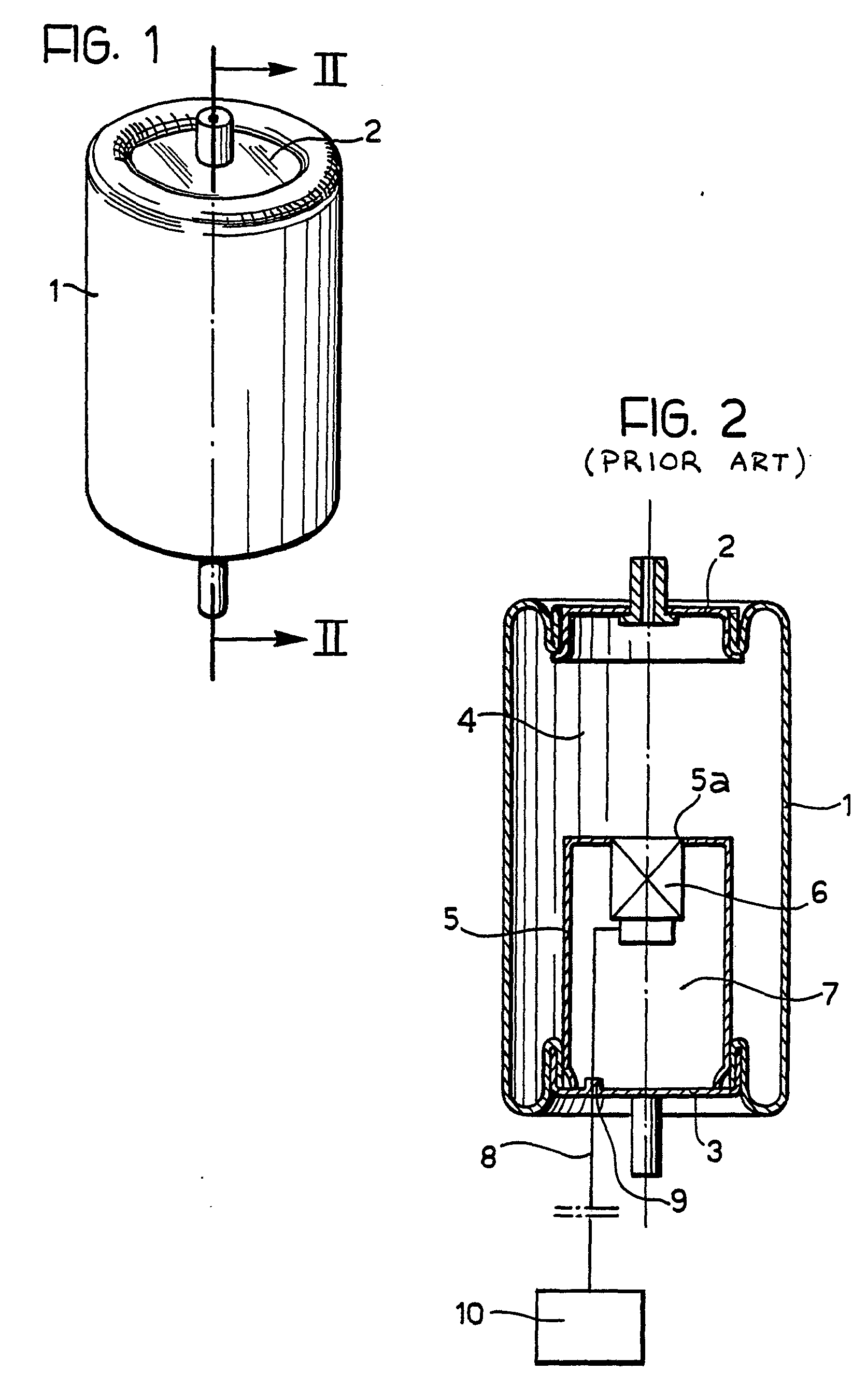
| (12) |
EUROPEAN PATENT SPECIFICATION |
| (45) |
Mention of the grant of the patent: |
|
20.12.1989 Bulletin 1989/51 |
| (22) |
Date of filing: 25.06.1985 |
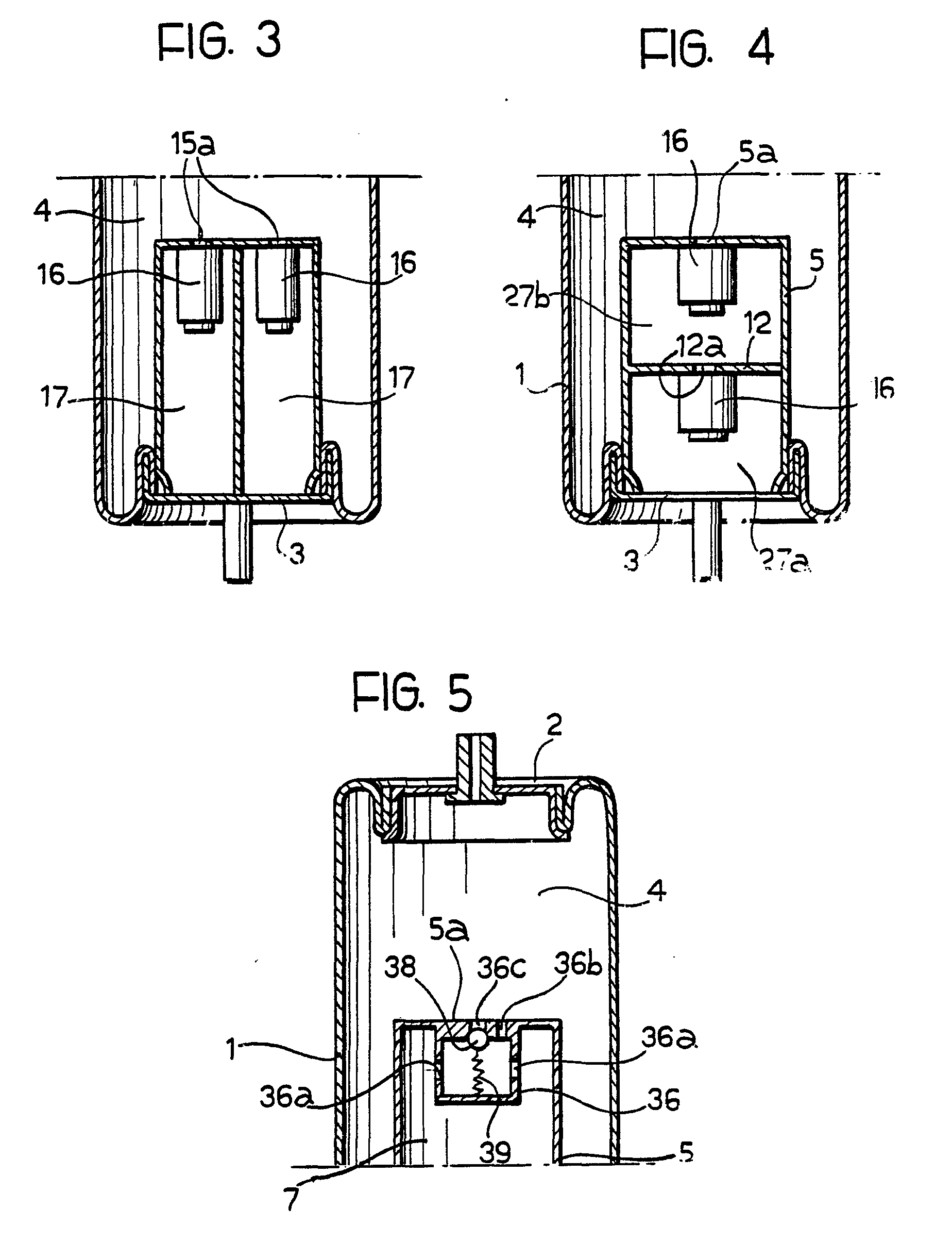
|
|
| (54) |
Variable-stiffnes air spring, particularly for motor vehicle suspensions
Luftfeder mit veränderlicher Steifheit, insbesondere für Kraftfahrzeugaufhängungen
Ressort pneumatique à rigidité variable, en particulier pour suspensions de véhicule
à moteur
|
| (84) |
Designated Contracting States: |
|
DE FR GB |
| (30) |
Priority: |
27.06.1984 IT 6765884
|
| (43) |
Date of publication of application: |
|
02.01.1986 Bulletin 1986/01 |
| (73) |
Proprietor: FIAT AUTO S.p.A. |
|
10135 Torino (IT) |
|
| (72) |
Inventors: |
|
- Trebbi, Giorgio
I-10025 Pino Torinese (Torino) (IT)
- Di Giusto, Nevio
I-10078 Venaria (Torino) (IT)
- Visconti, Amedeo
I-10137 Torino (IT)
- Mannina, Antonino
I-10135 Torino (IT)
|
| (74) |
Representative: Quinterno, Giuseppe et al |
|
c/o JACOBACCI & PERANI S.p.A.
Corso Regio Parco, 27
10152 Torino
10152 Torino (IT) |
| (56) |
References cited: :
EP-A- 0 089 794
FR-A- 1 339 321
|
DE-A- 2 406 835
FR-A- 1 377 961
|
|
| |
|
|
- PATENTS ABSTRACTS OF JAPAN, vol. 8, no. 224 (M-331)[1661], 13th October 1984; & JP-A-59
106 308 (ISUZU JIDOSHA K.K.) 20-6-1984
|
|
| |
|
| Note: Within nine months from the publication of the mention of the grant of the European
patent, any person may give notice to the European Patent Office of opposition to
the European patent
granted. Notice of opposition shall be filed in a written reasoned statement. It shall
not be deemed to
have been filed until the opposition fee has been paid. (Art. 99(1) European Patent
Convention).
|
[0001] The present invention relates to an air spring, particularly for vehicle suspensions,
of the type defined in the preamble of the appended Claim 1.
[0002] An air spring of this kind is disclosed in FR-A-1 339 321. That known air spring
includes a single auxiliary chamber, which is external to the main variable volume
chamber.
[0003] The object of the present invention is to provide an improved air spring of the aforesaid
type, which has a simple and robust structure and has a stiffness that is more gradually
variable.
[0004] This object is achieved according to the invention by an air spring of the type specified
above, the features of which are defined in the characterizing portion of the appended
Claim 1.
[0005] Further characteristics and advantages of the air spring according to the invention
will become apparent from the detailed description which follows with reference to
the appended drawings provided purely by way of non-limiting example, in which:
Figure 1 is a perspective view of an air spring.
Figure 2 is a sectional view taken along the line II-II of Figure 1, showing an embodiment
of the prior art.
Figures 3 and 4 are partially-sectioned views of two embodiments according to the
invention of the spring shown in Figure 1, and
Figure 5 is a sectional view of a variant of the valve for a spring according to the
invention.
Figure 1 shows an air spring comprising a flexible tubular casing 1, for example of
rubberized canvas, with rigid caps 2, 3 connected to its ends in known manner.
[0006] The casing 1 and the caps 2, 3 define in their entirety an air-filled chamber 4 of
variable volume.
[0007] Referring to Figure 2, a rigid body 5 in the form of an inverted beaker is welded
to the lower cap 3 within the chamber 4. The axial dimension of this rigid body 5
is considerably less than the distance between the caps 2, 3.
[0008] The lower cap 3 and the wall of the body 5 define in their entirety an auxiliary
chamber 7 of fixed volume.
[0009] The wall of the rigid body 5 facing the upper cap 2 has an opening 5a within which
is fixed a known type of solenoid valve 6 which controls the communication between
the chambers 4 and 7. The solenoid valve 6 is controlled through a connection cable
8 which emerges from the air spring, for example through a sealing connector 9 fixed
in a corresponding ready-made hole in the lower cap 3.
[0010] The solenoid valve 6 is normally kept in a state in which it allows communication
between the chambers 4 and 7. In this condition, the volume of compressible air consists
in practice of all the air in the casing 1 and thus includes the volume of air within
the chamber 7.
[0011] The spring described above can be used for vehicle suspensions. In this application,
when the vehicle meets a bend at high speed, the solenoid valve is closed in order
to limit rolling. In this condition, only the volume of air outside the rigid casing
5 is "working" and the stiffness of the air spring is increased.
[0012] The solenoid valve 6, which can be of the on-off type or the variable-throughput
type, is appropriately piloted by a sensor 10, for example a sensor of the transverse
acceleration of the vehicle, an inertial sensor, or some other.
[0013] Figures 3 and 4 show two embodiments according to the invention in each of which
is provided a plurality of auxiliary chambers, indicated 17 in Figure 3 and 27a and
27b in Figure 4.
[0014] In the embodiment illustrated in Figure 3, the region within the rigid body 5 is
divided into two chambers 17 which do not communicate with one another but communicate
with the variable-volume chamber 4 through respective openings 15a controlled by respective
solenoid valves 16. In this variant, it is possible to achieve progressive stiffening
of the air spring by the successive closure of the two solenoid valves 16. It is therefore
possible to achieve a progressive stiffening with the use of very simple and cheap
solenoid valves of the on-off type.
[0015] In the embodiment shown in Figure 4, the region within the rigid body 5 is divided
into two chambers 27a and 27b by an internal transverse partition 12 with an opening
12a.
[0016] The lower chamber 27a can be put into communication with the upper chamber 27b through
an opening 12a in the partition 12, controlled by a solenoid valve 16. The upper chamber
27b communicates in its turn with the variable-volume chamber 4 through the opening
5a in the rigid body 5, which is also controlled by a solenoid valve 16. In this variant,
the progressive stiffening of the air spring can be achieved firstly by the closure
of the solenoid valve associated with the opening 12a and then by the subsequent closure
of the solenoid valve associated with the opening 5a.
[0017] In the case of the embodiments shown in Figures 3 and 4 also, the solenoid valves
can be piloted by the sensors able to detect, for example, the transverse acceleration
of a motor vehicle.
[0018] Figure 5 illustrates a variant of the valve employed on a spring according to the
invention, which can also act as a damper and has a stiffness in compression stages
different from the stiffness in extension stages. In this drawing, the parts already
described above with reference to the other variants have been given the same reference
numerals.
[0019] In the variant of Figure 5, the rigid body 5 has a central opening 5a at its upper
end, to the edge of which a hollow rigid body 36 is sealingly connected. This hollow
body has, for example, a cylindrical shape and has through-holes 36a in its side wall
which put the interior of the hollow body into communication with the region or chamber
7 defined by the casing 5 and the lower cap 3. The wall of the hollow body 36 facing
the upper cap 2 has a pair of holes 36b, 36c the second of which has a larger diameter.
[0020] A ball 38 biassed by a spring 39 into engagement with the lower edge of the hole
36c is located within the hollow body 36. The ball 39 acts as a shutter while the
lower edge of the hole 36c acts as a valve seat. The spring 39 reacts at its lower
end against the lower wall of the hollow body 36.
[0021] The variable-volume chamber 4 is in permanent communication with the fixed-volume
chamber 7 through the holes 36b and 36a of the hollow body 36.
[0022] When the spring is compressed during use, the increase of air pressure in the variable-volume
chamber 4 pushes the ball 38 downwards against the action of the biassing spring 39
and opens the hole 36c. In this manner, the resistance to the flow of air from the
chamber 4 to the chamber 7 will be reduced considerably.
[0023] When the air spring extends again, the spring 39 urges the ball 38 back into engagement
with the hole 36c, and the flow cross-section of the communication between the chambers
7 and 4 is reduced to the section of the one hole 36b. The resistance to the drawing
of air from the chamber 7 to the chamber 4 will therefore be greater than for the
drawing under compression.
[0024] Preferably, the cross-section of the hole 36b is much smaller than the hole 36c.
[0025] By the appropriate selection of the diameters of the holes 36b and 36c, as well as
the stiffness of the biassing spring 39, it is possible to produce air springs with
stiffnesses and damping characteristics which are different under compression and
extension over a wide range of values.
[0026] The air spring described above can also be used as a damper.
1. Air spring, particularly for motor vehicle suspensions, comprising a flexible tubular
casing (1) to the ends of which are connected rigid caps (2, 3) defining therewith
a main air chamber (4) of variable volume, which is associated with an auxiliary chamber
(7; 17; 27a, 27b) which has an opening (5a, 15a) for communication with the main chamber
(4) and which defines a supplementary volume, valve means (16) being provided for
controlling the communication between the said main and auxiliary chambers (4; 7,
17, 27a, 27b), characterized in that within the main chamber (4) there is formed a
plurality of auxiliary chambers (27a, 27b) which communicate with each other through
openings (12a) controlled by respective valve means (16) so as to define a plurality
of supplementary volumes addable to that of said main chamber (4).
2. Variable-stiffness air spring according to Claim 1, characterized in that the auxiliary
chambers (27a, 27b) are adjacent one of the end caps (2,3).
3. Variable-stiffness air spring according to Claim 2, characterized in that the auxiliary
chambers (27a, 27b) are constituted by rigid casings (5) connected to one of the end
caps (3).
4. Variable-stiffness air spring according to any one of the preceding claims, characterized
in that the valve means comprise at least one solenoid valve (16).
5. Variable stiffness air spring according to Claim 4, characterized in that the said
at least one solenoid valve (16) is of the on-off type.
6. Variable-stiffness air spring according to Claim 4, characterized in that the said
at least one solenoid valve (16) is of the variable-throughput type.
7. Variable-stiffness air spring according to any one of the preceding claims, characterized
in that the valve means are controlled in dependence on signals output by means (10)
for sensing the transverse acceleration of the vehicle.
8. Variable-stiffness air spring according to any one of the preceding Claims, characterized
in that it further includes further valve means (38, 29) for automatically varying
the section of the communication passage (36b, 36c, 36a) between one auxiliary chamber
(7) and the main chamber (4) in such a way that the section of the passage is automatically
increased when the air spring is compressed and reduced when the air spring is extended.
9. Variable-stiffness air spring according to Claim 8, charcterized in that the said
communication passage comprises a first hole (36b) which is permanently open and a
second hole (36c) with which the further valve means (38, 39) are associated.
10. Variable-stiffness air spring according to Claim 9, characterized in that the
first hole (36b) has a smaller diameter than the second hole (36c).
11. Variable-stiffness air spring according to Claim 9 or 10, characterized in that
the said further valve means comprise a shutter valve (38) movable under the action
of a spring (39).
1. Luftfeder, insbesondere für Kraftfahrzeug-Aufhängungen,
mit einem flexiblen rohrförmigen Gehäuse (1), an dessen Stirnseiten starre Kappen
(2, 3) angebracht sind, die mit dem Gehäuse eine Hauptluftkammer (4) mit variablem
Volumen begrenzen, die mit einer Hilfskammer (7; 17; 27a, 27b) verbunden ist, wobei
die Hilfskammer eine Öffnung (5a; 15a) für die Verbindung mit der Haupfluftkammer
(4) aufweist und ein Zusatzvolumen begrenzt,
sowie mit Ventilmitteln (16), die die Verbindung zwischen der Hauptluftkammer (4)
und den Hilfskammern (7; 17; 27a, 27b) steuern,
dadurch gekennzeichnet,
daß innerhalb der Hauptluftkammer (4) eine Mehrzahl von Hilfskammern (27a, 27b) ausgebildet
sind, die über durch entsprechende Ventilmittel (16) gesteuerte Öffnungen (12a) so
miteinander in Verbindung stehen, daß sie mehrere Zusatzvolumina begrenzen, die zu
dem Volumen der Hauptluftkammer (4) hinzufügbar sind.
2. Luftfeder mit variabler Steifigkeit nach Anspruch 1, dadurch gekennzeichnet, daß
die Hilfskammern (27a, 27b) in der Nähe einer der stirnseitigen Kappen (2; 3) angeordnet
sind.
3. Luftfeder mit variabler Steifigkeit nach Anspruch 2, dadurch gekennzeichnet, daß
die Hilfskammern (27a, 27b) von starren Gehäusen (5) gebildet sind, die mit einer
der stirnseitigen Kappen (3) verbunden sind.
4. Luftfeder mit variabler Steifigkeit nach einer der vorhergehenden Ansprüche, dadurch
gekennzeichnet, daß die Ventilimittel wenigstens ein Magnetventil (10) umfassen.
5. Luftfeder mit variabler Steifigkeit nach Anspruch 4, dadurch gekennzeichnet, daß
das wenigstens eine Magnetventil (16) ein Ein-Aus-Ventil ist.
6. Luftfeder mit variabler Steifigkeit nach Anspruch 4, dadurch gekennzeichnet, daß
das wenigstens eine Magnetventil (16) ein Ventil mit variablem Durchsatz ist.
7. Luftfeder mit variabler Steifigkeit nach einer der vorhergehenden Ansprüche, dadurch
gekennzeichnet, daß die Ventilmittel in Abhängigkeit von Signalen gesteuert werden,
die von Mitteln (10) zur Erfassung der Querbeschleunigung des Fahrzeugs ausgegeben
werden.
8. Luftfeder mit variabler Steifigkeit nach einer der vorhergehenden Ansprüche, dadurch
gekennzeichnet, daß ferner Ventilmittel (38, 39) vorgesehen sind, mit denen der Querschnitt
der Verbindungsdurchgangs (36b, 36c, 36a) zwischen einer Hilfskammer (7) und der Hauptluftkammer
(4) so veränderbar ist, daß der.Durchgangsquerschnitt bei Kompression der Luftfeder
automatisch vergrößert und bei Expandierung der Luftfeder automatisch verkleinert
wird.
9. Luftfeder mit variabler Steifigkeit nach Anspruch 8, dadurch gekennzeichnet, daß
der Verbindungsdurchgang eine erste Öffnung (36b) aufweist, die permanent offen ist,
und eine zweite Öffnung (36c), der die weiteren Ventilmittel (38, 39) zugeordnet sind.
10. Luftfeder mit variabler Steifigkeit nach Anspruch 9, dadurch gekennzeichnet, daß
die erste Öffnung (36b) einen kleineren Durchmesser hat als die zweite Öffnung (36c).
11. Luftfeder mit variabler Steifigkeit nach Anspruch 9 oder 10, dadurch gekennzeichnet,
daß die weiteren Ventilmittel ein unter der Wirkung einer Feder (39) bewegbares Schließventil
(38) umfassen.
1. Ressort pneumatique, en particulier pour suspensions de véhicules automobiles,
comprenant une enveloppe tubulaire flexible (1) aux extrémités de laquelle sont fixés
des fonds rigides (2, 3) qui définissent avec cette enveloppe une chambre à air principale
(4) à volume variable qui est associée à une chambre auxiliaire (7; 17; 27a, 27b),
laquelle possède une ouverture (5a; 15a) servant à établir la communiction avec la
chambre principale (4) et définit un volume supplémentaire, des moyens obturateurs
(16) étant prévus pour commander la communication entre lesdites chambres principale
et auxiliaire (4; 7, 17, 27a, 27b), caractérisé en ce qu'à l'intérieur de la chambre
principale (4), sont formées plusieurs chambres auxiliaires (27a, 27b) qui communiquent
entre elles à travers des ouvertures (12a) commandées par des valves respectives (16)
de manière à définir plusieurs volumes supplémentaires qui peuvent être ajoutés à
celui de ladite chambre principale (4).
2. Ressort pneumatique à raideur variable selon la revendication 1, caractérisé en
ce que les chambres auxiliaires (27a, 27b) sont adjacentes à l'un des fonds d'extrémités
(2; 3).
3. Ressort pneumatique à raideur variable selon la revendication 2, caractérisé en
ce que les chambres auxiliaires (27a, 27b) sont constituées par des boîtiers rigides
(5) reliés à l'un des fonds (3).
4. Ressort penumatique à raideur variable selon une quelconque des revendications
précédentes, caractérisé en ce que les moyens obturateurs comprennent au moins une
électrovalve (16).
5. Ressort pneumatique à raideur variable selon la revendication 4, caractérisé en
ce que l'électrovalve on chaque électrovalve (16) est du type tout ou rien.
6. Ressort pneumatique à raideur variable selon la revendication 4, caractérisé en
ce que l'électrovalve ou chaque électrovalve (16) est du type à section de passage
variable.
7. Ressort pneumatique à raideur variable selon une quelconque des revendications
précédentes, caractérisé en ce que les moyens obturateurs sont commandés en fonction
de signaux émis par des moyens (10) servant à capter l'accélération transversale du
véhicule.
8. Ressort pneumatique à raideur variable selon une quelconque des revendications
précédentes, caractérisé en ce qu'il comprend en outre d'autres moyens obturateurs
(38, 29) servant à faire varier automatiquement la section du passage de communication
(36b, 36c, 36a) entre une chambre auxiliaire (7) et la chambre principale (4) de telle
manière que la section du passage soit automatiquement augmentée lorsque le ressort
pneumatique se comprise et qu'elle soit automatiquement réduite lorsque le ressort
pneumatique s'allonge.
9. Ressort pneumatique à raideur variable selon la revendication 8, caractérisé en
ce que ledit passage de communication comprend un premier trou (36b) qui est ouvert
en permance et un deuxième trou (36c) auquel sont associés les moyens obturateurs
additionnels (38, 39).
10. Ressort pneumatique à raideur variable selon la revendication 9, caractérisé en
ce que le premier trou (36b) possède un plus petit diamètre que le second trou (36c).
11. Ressort pneumatique à raideur variable selon la revendication 9 ou 10, caractérisé
en ce que lesdits moyens obturateurs additionnels comprennent un élément mobile de
soupape (38) qui peut se déplacer sous l'action d'un ressort (39).