|
(11) | EP 0 168 373 B1 |

| (12) | EUROPEAN PATENT SPECIFICATION |
|
|
| (54) |
Detergent compositions Detergenszusammensetzungen Compositions détergentes |
|
|
|||||||||||||||||||||||||||||||
| Note: Within nine months from the publication of the mention of the grant of the European patent, any person may give notice to the European Patent Office of opposition to the European patent granted. Notice of opposition shall be filed in a written reasoned statement. It shall not be deemed to have been filed until the opposition fee has been paid. (Art. 99(1) European Patent Convention). |
[0001] This invention relates to detergent compositions for washing fabrics and to combinations of components for use therein.
[0002] For many years, phosphates such as sodium tripolyphosphate have been used as components of laundry detergent compositions because of their beneficial effect on the cleaning efficiency of the surfactant component. Recently however, there have been moves to reduce the amounts of phosphates included in detergent compositions because of indications that soluble phosphates were reaching natural water systems in quantities which excessively promoted the growth of algae to the detriment of other aquatic life.
[0003] Much effort has been devoted to the search for alternative so-called 'builder' materials which could at least partially replace the phosphates while maintaining the performance of detergent compositions, and without adding significantly to costs, and which would be environmentally acceptable.
[0004] Aluminosilicate materials having ion-exchange capability have been proposed for this purpose, and the prior art also disclosed various aminopoly-(methylenephosphonates) as components of such detergent formulations, as in EP-A-0001 853.
[0005] We have now discovered that aluminosilicates in conjunction with mixtures of certain aminopoly-(methylenephosphonates) can be used as effective detergent builders meeting the above criteria at surprisingly low levels of addition.
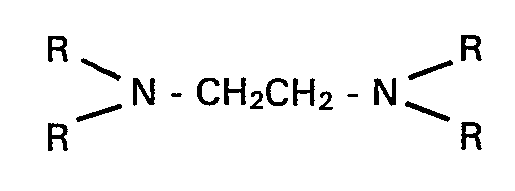
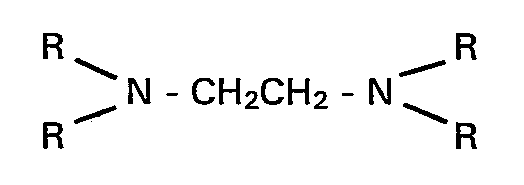
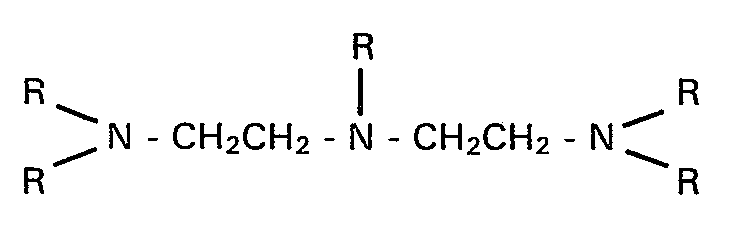
[0006] The detergent compositions of the invention contain a surfactant and usually other conventional additives, and are characterised in that they contain, on a dry weight basis, from 1 to 40% of a water-insoluble aluminosilicate and from 0.5 to 5% of a aminopoly(methylenephosphonate) component which is a mixture of an ethylenediamine derivative of the formula
and a diethylenetriamine derivative of the formula
where in each formula at least three R's represent -CH2P03M2, with M representing hydrogen or an alkali metal and the remaining R's represent hydrogen, -CH3 oτ -CH2PD3M2, in which mixture the ratio by weight of the ethylenediamine derivative to the diethylenetriamine derivative is from 3:1 to 1:5, and the combined weight of the aluminosilicate material and the aminopoly(methylenephosphonate) component is at least 5% of the dry weight of the composition.
[0007] Preferred aluminosilicate materials are those of the zeolite-type, particularly those of the general formula:
wherein b and c are integers of at least 6, the molar ratio of b to c is in the range from 1.0 to 0.5 and d is a number such that the moisture content of the aluminosilicate is from about 10% to about 35% by weight. Preferred aluminosilicates of this type belong to the faujasite group and include faujasite itself and the synthetic zeolites A, X and Y conventionally represented by the following formulae:
[0008] Preferred synthetic zeolites are prepared from metakaolin by heating with alkali alone (in the case of zeolites having a 1:1 A1O2:SiO2 ratio such as Zeolite A) or with mixtures of alkali and additional silica provided, for instance, in the form of sodium silicate or colloidal silica (in the case of zeolites having A102:SiO2 ratios of less than 1, e.g. Zeolite X).
[0009] The preferred aluminosilicates have an average particle size of less than about 4 micrometres, especially less than about 1 micrometre, and surface area greater than about 5 m2/g, for example greater than about 10 m2/g.
[0010] In the compositions of the present invention, the aminopoly(methylenephosphonates) are preferably used in the form of their sodium salts. The commercially available sodium aminopoly(methylene- phosphonates) are themselves usually mixtures, the major component of the ethylenediamine derivative being the compound in which the four R groups in the above formula are all -CH2?03Na2 or -CH2P03HNa, but the compounds in which three or two R groups are -CH2P03Na2 or -CH2P03HNa, the other(s) being hydrogen or -CH3 are also present. Preferably at least 80% of the R groups in the mixture are -CH2-P03Na2 or -CH2P03HNa groups. Similarly, in the diethylenetriamine derivatives, the penta(methylenephosphonate) usually accounts for from 60 to 80% of the total weight of the derivative, the remainder being mostly the tri(methylenephosphonate) with a small amount of the tetra(methylenephosphonate). Preferably at least 65% of the R groups in the mixture are -CH2P03Na2 or -CH2P03HNa groups.
[0011] The compositions of the invention contain at least 1 % by weight of the aluminosilicate as anhydrous material. Washing performance improves as the amount of aluminosilicate is increased, and generally it is preferred to include at least 4% of aluminosilicate. A preferred upper limit is about 15%, and often the optimum quantity of aluminosilicate is in the range 5 to 10%.
[0012] Preferably a composition of the invention contains at least 0.7% of the aminopoly(methylenephosphonate) component, and although, as indicated above, up to 5% may be present, it is generally not cost-effective to include more than about 2%.
[0013] Preferred ranges for the ratios of ethylenediamine derivative to the diethylenetriamine derivative in the aminopoly(methylenephosphonate) component are from 2:1 to 1:4, more especially from 1:1 to 1:3. Mixtures in which the ratio is from 1:1.5 5 to 1:2.5, for example approximately 1:2, are particularly effective.
[0014] The surfactant component of the compositions of the present invention usually comprises one or more anionic surfactants, or a mixture of one or more anionic surfactants with one or more nonionic surfactants. Examples of suitable anionic surfactants include soaps such as the salts of fatty acids containing about 9 to 20 carbon atoms, e.g., salts of fatty acids derived from coconut oil and tallow; alkyl benzene sulphonates, particularly linear alkyl benzene sulphonates; alkyl sulphates and sulphonates; monoglyceride sulphates, and acid condensates of fatty acid chlorides with hydroxy alkyl sulphonates.
[0015] Examples of suitable nonionic surfactants include condensates of alkylene oxides (e.g., ethylene oxide), with mono- or polyhydroxy alcohols, alkyl phenols, fatty acid amides or with fatty amines; sugar derivatives such as sucrose monopalmitate; or fatty acid amides.
[0016] In certain instances, the surfactant may include compounds having at least one tertiary amine oxide group, for example dimethyl dodecylamine oxide.
[0017] Preferably the surfactant component contains (Cio-16 alkyl)benzene sulphonate, in an amount exceeding that of any other surfactant, and particularly good detergency performance has been obtained with surfactant components which are blends containing 40-60% by weight of one or more (ClO-16 alkyl)benzene sulphonates, 15-30% of condensates of fatty alcohols with 10-18 ethylene oxide units, and 15-30% of soaps.
[0018] It will be understood that many more examples of surfactants are known to those skilled in the art, and the compositions of the invention may contain other compounds having surfactant activity, for example zwitterionic and amphoteric surfactants.
[0019] The quantity of surfactant in a composition of the invention will depend on its particular ingredients, but normally the composition will contain at least 5%, for example from 5 to 50% by weight. In most instances, the optimum amount is within the range 10 to 30% by weight.
[0020] The composition of the invention preferably include a peroxygen bleaching compound, i.e. a compound capable of yielding hydrogen peroxide in aqueous solution. Such compounds are well known in the art, and include organic peroxide bleaching compounds, for example alpha-omega C2-12 alkane- diperoxycarboxylic acids and their salts, aromatic diperoxycarboxylic acids and their salts, aromatic monoperoxydioic acids and their salts, for example monoperoxyphthalic acid and its salts, and inorganic persalt bleaching compounds, such as the alkali metal perborates, percarbonates and per- phosphates. Mixtures of two or more such bleaching compounds can also be used, if desired.
[0021] Preferred peroxygen bleaching compounds include sodium perborate commercially available in the form of mono- and tetrahydrate, sodium carbonate peroxyhydrate, sodium pyrophosphate peroxyhydrate, urea peroxyhydrate, and sodium peroxide. Particularly preferred are sodium perborate tetrahydratEt and sodium perborate monohydrate.
[0022] The level at which the peroxygen bleaching compounds is present in a composition of the invention depends on the particular compound or compounds selected, but is usually within the range 2 to 50% by weight of the composition. For the particularly preferred sodium perborates, the optimum amount is normally within the range 1 to 40% for the tetrahydrate, with a correspondingly lower range for the monohydrate.
[0023] From the functional point of view, it is usually advantageous to include additional builders, for example phosphates, nitrilotriacetates or polycarboxylates, in the compositions of the present invention, but considerably lower amounts are required than would be required for equivalent washing performance in the absence of the combination of aluminosilicate and aminopoly(methylenephosphonate) components which characterises the present invention. Sodium tripolyphosphate or mixtures of sodium tripolyphosphate with pyrophosphates or orthophosphates, at a level of, for example, from 5 to 20% by weight of the composition, may be used. Alternatively, or additionally, a composition of the invention may contain, for example, from 2 to 10% by weight of sodium nitrilotriacetate.
Example 1
[0025] Examples of compositions of the present invention were evaluated using various standard commercial soil/stain swatches of the same size sewn on to 1 m x 1 m cotton cloths and washed with various other items, giving a total load of 2 kg for washes at 40°C and a total load of 4 kg for washes at 60°C. The washing machine was a Miele - Model 753 taking 20 I of water for the wash. An IEC (International Commission Geneva) type test detergent was used, but with some variations in proportions.
[0027] In the present evaluations, the detergent contained sodium tripolyphosphate 18%, other builders, and sodium perborate tetrahydrate 30%. Other components of the IEC formulation were present, but not magnesium silicate nor EDTA. Balance to 100% was achieved with sodium sulphate.
[0028] The builder component characteristic of the present invention was made up of various amounts of zeolite, Dequest° 2046 phosphonate, a neutral solution containing approximately 35% by weight of the sodium salts of ethylenediamine poly-(methylenephosphonic acids), the major component being the tetrasodium salt of ethylenediamine tetra-(methylenephosphonic acid) and Dequest° 2066 phosphonate, a neutral solution containing approximately 35% by weight of the sodium salts of diethylenetriamine poly(methylenephosphonic acids), the major component being the pentasodium salt of diethylenetriaminepenta(methylenephosphonic acid), were added.
[0029] The dosage of the complete detergent composition was 7.5 g/I. The water had a «German hardness» of 21 °, equivalent to 384 mg/I calcium carbonate, with a Ca:Mg mole ratio of 3:1.
[0030] After the washing cycle was completed, the cloths carrying the swatches were dried and lightly ironed. Washing efficiency was assessed by brightness measurements on the swatches defined as the reflectance of stimulus Z («blue» light) relative to a standard white reference with an IEC three stimulus colorimeter. The reflectance of both sides of the swatches was measured and the reflectance values averaged.
[0031] In washes at 40°C and at 60°C, a composition (A) containing 5% of zeolite (3.25% dry weight aluminosilicate), 1.67% of Dequest° 2066 phosphonate (0.58% sodium salt on an anhydrous basis) and 0.83% of Dequest° 2046 phosphonate (0.29% sodium salt on an anhydrous basis) showed better detergency performance on WFK (Waschereiforschung Krefeld) soiled cotton, polyester-cotton and WFK cocoa-oil watches than a composition (B) containing 5% of zeolite, 0.83% of Dequest 2066 phosphonate and 1.67% of Dequest 2046 phosphonate. (Percentages are parts by weight per 100 parts by weight of spray dried base formulation.) In the 40°C wash, compositions (A) and (B) generally gave superior performance to a formulation (C) containing 15% of zeolite and no phosphonates, and to a formulation (D) containing 1.25% of Dequest 2066 phosphonate and 2.5% of Dequest 2046 phosphonate but no zeolite. In the 60°C wash, composition (A) was significantly better than the others.
[0032] In a 60°C wash, composition (A) was markedly superior to the other compositions in removing stains of blood, cocoa, coffee and tea.
Example 2
[0034] Compositions having the following ingredients in parts by weight were evaluated for detergency effectiveness by the method described in Example 1 in a machine wash at 60°C. A detergent base similar to that of the IEC Test Detergent formulation shown above, except that the sodium triphosphate was omitted, was used. Composition No. 4 is an example of a composition of the invention. Compositions 1, 2 and 3 are comparative.
1. A detergent composition containing a surfactant, a water-insoluble aluminosilicate
and an aminopoly(methylenephosphonate), characterised in that it contains, on a dry
weight basis, from 1 to 40% of water-insoluble aluminosilicate and from 0.5 to 5%
of an aminopoly(methylenephosphonate) component which is a mixture of an ethylenediamine
derivative of the formula
and a diethylenetriamine derivative of the formula
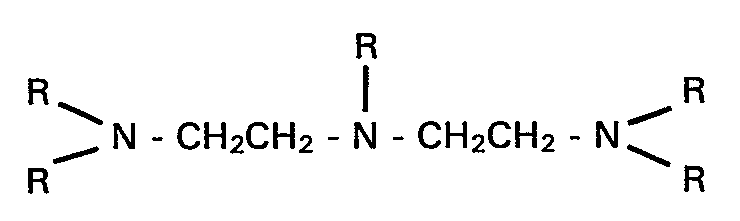
where in each formula at least three R's represent -CH2P03M2, with M representing hydrogen or an alkali metal and the remaining R's represent hydrogen, -CH3 or -CH2P03M2, in which mixture the ratio by weight of the ethylenediamine derivative to the diethylenetriamine derivative is from 3:1 to 1:5, and the combined weight of the aluminosilicate material and the aminopoly(methylenephosphonate) component is at least 5% of the dry weight of the composition.
and a diethylenetriamine derivative of the formula
where in each formula at least three R's represent -CH2P03M2, with M representing hydrogen or an alkali metal and the remaining R's represent hydrogen, -CH3 or -CH2P03M2, in which mixture the ratio by weight of the ethylenediamine derivative to the diethylenetriamine derivative is from 3:1 to 1:5, and the combined weight of the aluminosilicate material and the aminopoly(methylenephosphonate) component is at least 5% of the dry weight of the composition.
2. A composition according to Claim 1 in which the amount of the water-insoluble aluminosilicate
is from 4 to 15% of the dry weight of the composition and the water-insoluble aluminosilicate
is a zeolite having an average particle size less than 1 micrometre.
3. A composition according to either of Claims 1 and 2 which contains from 0.75% to
2% of the aminopoly(methylenephosphonate) component, that component being a mixture
of an ethylenediamine derivative in which at least 3, or an average of at least 3,
of the R groups represent -CH2P03Na2 or -CH2P03HNa and a diethylenetriamine derivative in which at least 3, or an average of at least
3, of the groups represent -CH2P03Na2 or -CH2P03HNa and the weight ratio of the ethylenediamine derivative to the diethylenetriamine
derivative is from 1:1 to 1:3.
4. A composition according to any of Claims 1 to 3 which further contains sodium tripolyphosphate
or a mixture of sodium tripolyphosphate with pyrophosphates or orthophosphates, said
sodium tripolyphosphate or mixture being present in an amount of from 5 to 20% by
weight of the composition.
5. A composition according to any of Claims 1 to 4 which further contains from 2 to
10% by weight of sodium nitrilotriacetate.
6. A composition according to any of Claims 1 to 5 which further contains a peroxygen
bleaching compound in an amount of from 2 to 50% by weight of the composition.
1. Composition détergente contenant un agent tensio-actif, un aluminosilicate insoluble
dans l'eau et un amino-poly(méthylène-phosphonate), caractérisée en ce qu'elle contient,
en poids à l'état sec, de 1 à 40% d'aluminosilicate insoluble dans l'eau et de 0,5
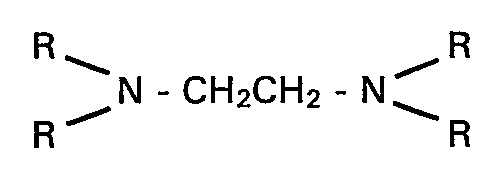
à 5% d'un constituant amino-poly(méthylène- phosphonate) qui est un mélange d'un dérivé
éthylènediamine de formule
et d'un dérivé diéthylènetriamine de formule
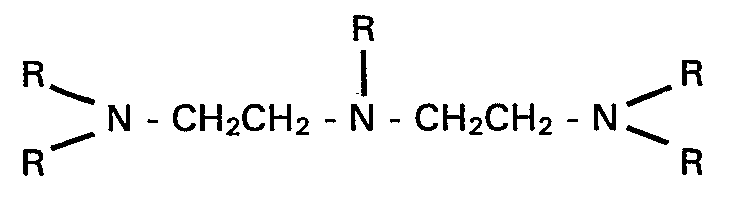
où, dans chaque formule, au moins trois R représentent -CH2P03M2, M représentant un atome d'hydrogène ou un métal alcalin et les R restants représentent un atome d'hydrogène, -CH3 ou -CH2P03M2, mélange dans lequel le rapport en poids du dérivé éthylènediamine au dérivé diéthylènetriamine vaut de 3:1 à 1:5, le poids combiné du matériau aluminosilicate et du constituant amino-poly(méthylène- phosphonate) étant d'au moins 5% du poids de la composition à l'état sec.
et d'un dérivé diéthylènetriamine de formule
où, dans chaque formule, au moins trois R représentent -CH2P03M2, M représentant un atome d'hydrogène ou un métal alcalin et les R restants représentent un atome d'hydrogène, -CH3 ou -CH2P03M2, mélange dans lequel le rapport en poids du dérivé éthylènediamine au dérivé diéthylènetriamine vaut de 3:1 à 1:5, le poids combiné du matériau aluminosilicate et du constituant amino-poly(méthylène- phosphonate) étant d'au moins 5% du poids de la composition à l'état sec.
2. Composition selon la revendication 1, dans laquelle la quantité de l'aluminosilicate
insoluble dans l'eau va de 4 à 15% du poids de la composition à l'état sec et dans
laquelle l'aluminosilicate insoluble dans l'eau est une zéolite ayant une grosseur
moyenne de particules inférieure à 1 micromètre.
3. Composition selon la revendication 1 ou 2, qui contient de 0,75% à 2% du constituant
amino- poly(méthylène-phosphonate), ce constituant étant un mélange d'un dérivé éthylènediamine
dans lequel au moins 3, ou une moyenne d'au moins trois, des groupes R représentent
-CH2PO3Na2 ou -CH2P03HNa et d'un dérivé diéthylènetriamine dans lequel au moins trois, ou une moyenne d'au
moins trois, des groupes R représentent -CH2P03Na2 ou -CH2P03HNa, et le rapport pondéral du dérivé éthylènediamine au dérivé diéthylènetriamine
valant de 1:1 à 1:3.
4. Composition selon l'une quelconque des revendications 1 à 3, qui contient en outre
du triphosphate de sodium ou un mélange de triphosphate de sodium avec des pyrophosphates
ou des orthophosphates, ledit triphosphate de sodium ou ledit mélange étant présent
en une quantité allant de 5 à 20% en poids de la composition.
5. Composition selon l'une quelconque des revendications 1 à 4, qui contient en outre
de 2 à 10% en poids de nitrilotriacétate de sodium.
6. Composition selon l'une quelconque des revendications 1 à 5, qui contient en outre
un composé peroxygène de blanchiment en une quantité allant de 2 à 50% en poids de
la composition.
1. Reinigungsmittelzusammensetzung enthaltend ein Tensid, ein wasserunlösliches Aluminiumsilikat
und ein Aminopoly-(methylenphosphonat), dadurch gekennzeichnet, dass sie, auf Trockengewichtsbasis,
1 bis 40% wasserunlösliches Aluminiumsilikatund 0,5 bis 5% eines Aminopoly-(methy-
lenphosphonat)-bestandteiles, der eine Mischung eines Äthylendiaminderivats der Formel
und eines Diäthylentriaminderivats der Formel
ist, wobei in jeder Formel zumindest drei R die Bedeutung -CH2P03M2 haben, worin M Wasserstoff oder ein Alkalimetall ist, und die übrigen R Wasserstoff, -CH3 oder -CH2P03M2 darstellen, in welcher Mischung das Gewichtsverhältnis des Äthylendiaminderivats zum Diäthylentriaminderivat 3:1 bis 1: 5 beträgt und das vereinigte Gewicht des Aluminiumsilikatmaterials und des Aminopoly-(methylenphos- phonat)-bestandteiles zumindest 5%, bezogen auf das Trockengewicht der Zusammensetzung, beträgt, enthält.
und eines Diäthylentriaminderivats der Formel
ist, wobei in jeder Formel zumindest drei R die Bedeutung -CH2P03M2 haben, worin M Wasserstoff oder ein Alkalimetall ist, und die übrigen R Wasserstoff, -CH3 oder -CH2P03M2 darstellen, in welcher Mischung das Gewichtsverhältnis des Äthylendiaminderivats zum Diäthylentriaminderivat 3:1 bis 1: 5 beträgt und das vereinigte Gewicht des Aluminiumsilikatmaterials und des Aminopoly-(methylenphos- phonat)-bestandteiles zumindest 5%, bezogen auf das Trockengewicht der Zusammensetzung, beträgt, enthält.
2. Zusammensetzung nach Anspruch 1, in der der Anteil des wasserunlöslichen Aluminiumsilikats
4 bis 15% des Trockengewichtes der Zusammensetzung beträgt und das wasserunlösliche
Aluminiumsilikat ein Zeolith mit einer mittleren Teilchengrösse von weniger als 1
µm ist.
3. Zusammensetzung nach einem der Ansprüche 1 und 2, die 0,75 bis 2% des Aminopoly-(methylen-
phosphonat)-bestandteiles enthält, wobei dieser Bestandteil eine Mischung eines Äthylendiaminderivats,
worin zumindest 3 oder ein Durchschnitt von zumindest 3 der Gruppen R -CH2P03Na2 oder -CH2PO3HNa sind, und eines Diäthylentriaminderivats, worin zumindest 3 oder ein Durchschnitt
von zumindest 3 der Gruppen R -CH2P03Na2 oder -CH2P03HNa sind, ist und das Gewichtsverhältnis des Äthylendiaminderivats zum Diäthylentriaminderivat
1:1 bis 1:3 beträgt.
4. Zusammensetzung nach einem der Ansprüche 1 bis 3, die weiters Natriumtripolyphosphat
oder eine Mischung von Natriumtripolyphosphat mit Pyrophosphaten oder Orthophosphaten
enthält, wobei das Natriumtripolyphosphat oder die Mischung in einem Anteil von 5
bis 20 Gew.-% der Zusammensetzung vorhanden ist.
5. Zusammensetzung nach einem der Ansprüche 1 bis 4, die weiters 2 bis 10 Gew.-% Natriumnitrilotriacetat
enthält.
6. Zusammensetzung nach einem der Ansprüche 1 bis 5, die weiters eine bleichende Persauerstoffverbindung
in einem Anteil von 2 bis 50 Gew.-% der Zusammensetzung enthält.