|
(11) | EP 0 168 889 B1 |

| (12) | EUROPEAN PATENT SPECIFICATION |
|
|
| (54) |
Dispersible fabric softeners Dispergierbare Wäscheweichmacher Adoucisseurs dispersables pour textiles |
|
|
|||||||||||||||||||||||||||||||
| Note: Within nine months from the publication of the mention of the grant of the European patent, any person may give notice to the European Patent Office of opposition to the European patent granted. Notice of opposition shall be filed in a written reasoned statement. It shall not be deemed to have been filed until the opposition fee has been paid. (Art. 99(1) European Patent Convention). |
Technical field
[0001] The present invention relates to means of treating fibers and fabrics, wherein a sub-stoichiometric complex of amines and phosphate esters is used to provide softness and anti-static benefits. Detergent compositions containing said amine-phosphwze ester softeners are disclosed. The compositions herein can be used to soften fabrics.
Background
[0002] The use of softeners to treat fabrics after a washing operation is a well-known laundering practice. Fabric softeners are, in the main, water-insoluble cationic materials that are incompatible with anionic detersive surfactants used in most fabric washing compositions. For that reason, the softening operation is generally carried out in the laundry rinse bath after the surfactant has been removed from the washing machine. This entails additional work for the user.
[0003] Formulators of fabric laundering compositions have long sought means whereby fabric washing and softening could be done concurrently. Laundering methods employing clay softeners, mixtures of clays and various amine materials and the like, are described in the DE-A-29 64 114, 28 57 163, 24 39 541, 23 34 899 and EP-A-23367 26528 and 28432. The use of mixtures of amines and soaps (salt of fatty acids) as through-the-wash softeners is disclosed in U.K. Patent 1,514,276.
[0004] The prior art also describes the use of various cationic materials in sheet form. See U.S. Patent 4,220,562.
[0005] The prior art also teaches the softener use of alkyl phosphonate and quaternary ammonium compounds. EP-A-0 006 268, filed June 11, 1979.
[0006] The prior art also teaches various mixtures of phosphate esters in detergents with fabric softening action BE-A-802,679.
[0007] The present invention employs amine-phosphate ester softeners in laundry compositions to provide cleaning and softening concurrently. The softeners herein provide softening and anti-static benefits, especially when used with clay softeners. Importantly, the use of phosphate esters in sub-stoichiometric quantities with the amines in the manner disclosed herein advantageously enhances deposition of the amines on fabrics by as much as 1.5- or 2-fold, as compared with prior art amine fabric softening compositions.
Summary of the invention
[0008] The present invention encompasses a method for softening fabrics by contacting same with sub-stoichiometric, water-insoluble, water-dispersible complexes of amine and phosphate ester (as described more fully, hereinafter) in the presence of water. The method can be carried out, for example, by tumbling damp fabrics with said complexes in a hot air clothes dryer. In another mode, said complexes can be used in an aqueous rinse bath, for example in a laundry rinse. In still another mode, the method can be carried out concurrently with a fabric cleansing treatment, for example in a detergent-containing laundry liquor, to soften fabrics.
[0009] The invention also encompasses detergent compositions (preferably granular) which may be described succinctly as containing conventional detergent ingredients such as detersive surfactants (including anionics), detergency builders, optical brighteners, detersive enzymes, fabric bleaches, and the like, all at rather conventional levels, as well as clay fabric softeners (preferably, smectite clays), said compositions being characterized in that they contain at least 0.1% (preferably 1.0% to 15%) of the aforesaid sub-stoichiometric, water-insoluble, water-dispersible amine-phosphate ester softeners. The most preferred compositions with clay are formulated to contain not more than 5% (preferably not more than 1%-2%) of a nonionic detersive surfactant.
[0010] The invention also encompasses an article for use in a laundry bath or rinse bath, or in a laundry dryer, comprising the aforesaid sub-stoichiometric amine-phosphate ester softeners releasably affixed to a non-particulate water-insoluble carrier, for example, a sheet of paper or fabric. Such compositions are optionally formulated to contain a bleach activator and such activator-containing compositions are especially useful in laundry baths.
[0011] The ingredients and means for preparing the compositions are disclosed more fully hereinafter. All weights and proportions are by weight, unless otherwise specified.
Detailed description of the invention
[0012] As noted hereinafter, the compositions of this invention comprise, in major part, conventional ingredients that are quite familiar to formulators of laundry compositions. One of the major advantages of the amine-phosphate softeners used herein is that they are entirely compatible with such conventional laundry ingredients, used at conventional concentrations.
Amines
[0013] The amines employed herein are of the formula R, R2R3N where R1 is C6 to C20 alkyl, R2 is C1 to C20 alkyl or hydrogen, and R3 is C1 to C10 alkyl or hydrogen.
[0014] Preferably, the amines have both R1 and R2 as C6―C20 alkyl, with C16-C18 alkyl, being most preferred, and with R3 as C,-C3 alkyl. Mixed amines, such as dicoconutalkyl- and ditallowalkyl-methyl amines can be used. Such materials are commercially available under Trade Marks such as "Armeen"8.
Phosphate ester
[0015] The phosphate esters which are critical to the practice of this invention are commercially available materials of the general formulae:
wherein R and R' are C,-C2o alkyl or (preferably) ethoxylated alkyl groups of the general formulae: alkyl-(OCH2CH2)y, wherein the alkyl substituent is C1-C20, preferably CS-C16 and Y is an integer of 1 to 15, preferably 2-10, most preferably 2-5. Such compounds are prepared by known methods from phosphorus pentoxide, phosphoric acid or phosphorus oxy halide and alcohols or ethoxylated alcohols.
[0016] It will be appreciated that the formulae depicted represent mono- and di-esters, and commercial phosphate esters will general comprise mixtures of the mono- and di-esters, together with some proportion of tri-ester. Typical commercial esters are available under the Trade Marks "Phospholan@" PDB3 (Diamond Shamrock) and "Servoxyl®" VPAZ (Servo).
Amine-phosphate ester softeners
[0017] The prior art describes various phosphate ester-amine compounds―see U.S. Patent 3,364,192-some of which have been disclosed for use as fiber-finishing agents-see U.S. Patents 3,434,874; 3,428,481; and 3,560,382. However, the prior art compositions generally involve 1:1 (mole basis) compounds or complexes, i.e., compounds or complexes from stoichiometric mixtures. Surprisingly, such stoichiometric complexes are of no use in the present invention, apparently because they form unstable dispersions prone to aggregation. In contrast, the sub-stoichiometric mixtures herein are extremely well dispersed in water, but are not water-soluble.
[0018] While not intending to be limited by theory, it is instructive to consider the physico-chemical behaviour of the amine-phosphate ester softeners herein, inasmuch as this can be of assistance to the formulator.
[0019] It will be appreciated that the amines used herein and in art-disclosed compositions exist in aqueous solutions as fairly coarse particles, or oily globules, having a spectrum of sizes. It appears that attachment of such particles to fabrics to provide the desired softening action can be considerably enhanced by reduction of their average size; coarser material being rinsed away by mechanical action. On the other hand, complete solubilization or micellization is to be avoided since this also leads to inadequate attachment of the amine to fabrics.
[0020] In addition to size of the dispersed amine particles, their phase structure is of importance since this will influence their effective spreading after attachment to fiber or fabric surfaces. Phase structure influences also the stability of amine dispersions.
[0021] Consideration of these factors apparently explains why, on one hand, amines untreated with phosphate ester and on the other hand, stoichiometric amine-ester complexes are of very low effectiveness relative to the sub-stoichiometric mixtures of amine-phosphate ester now disclosed.
[0022] It has now been discovered that sub-stoichiometric mixtures of amine-phosphate ester exist as aqueous dispersions whose particles readily deposit on, spread on, and soften, fibers and fabrics.
[0023] By "sub-stoichiometric" herein is meant that there is an excess of amine relative to phosphate ester. In general, there are at least about two parts amine (on a weight basis) per one part (weight) of phosphate ester, but this will, of course, vary with the molecular weights of the amine and ester, respectively. The objective is to have a readily-dispersible (in water) mixture, but not one that is water-soluble.
[0024] Useful amine-phosphate esters can easily be observed by a simple test. The amines herein, suspended in water, form a generally greasy-appearing, non-homogeneous mixture. By contrast, the sub-stoichiometric amine-phosphate ester mixtures used in this invention form stable "milky" suspensions in water. Laboratory estimates of the particle sizes of these suspensions indicate that 60% to 80% of the particles fall within the size range of 0.1 to 8 micrometers; 20% to 40% within the range 8 to 20 micrometers; and essentially all the particles are below 40 micrometers in diameter.
[0025] For the preferred sub-stoichiometric amine-phosphate ester softeners herein, the weight ratio of amine:phosphate ester is above 5:1, generally 7:1 to 15:1, most preferably 10:1. Again, such softeners are selected to be water-dispersible, not water-soluble.
[0026] In general terms, the amine-phosphate ester softeners are prepared separately from the balance of the compositions, and are preferably then added to the other, conventional ingredients to provide the final formulations. This can most conveniently be done by preparing a melt of the phosphate ester and the amine and maintaining the melt stage for a few minutes. The melt can then be layered onto a sheet substrate to prepare, for example, a dryer-added fabric softener. To prepare a detergent, the melt can be solidified and comminuted to the desired particles size (e.g., in an extruder), and dry-mixed with a granular detergent composition. The melt may also be sprayed onto detergent granules. The melt may also be dispersed into a stirred, aqueous crutcher mix comprising the balance of the detersive ingredients, and spray-dried in standard fashion. This crutcher-addition is less preferred, as it leads to some decomposition of the complex. Simply adding the amine and phosphate ester, individually, to a detergent crutcher mix does not secure the intended benefits of this invention.
[0027] An especially preferred softener herein is prepared by melting together ten parts by weight of di-C12-C14 alkyl monomethyl amine and one part by weight of a mono-[C12-C14 alkyl (EO)1-51 ester of phosphoric acid, sold under the Trade Mark "Servoxyl VPAZ(&".
[0028] The amine-phosphate ester softeners will generally be used at levels of at least 0.1 %, preferably 1 % to 15%, in detergent compositions; at levels of at least 1%, preferably 1% to 25% in rinse-added fabric softeners; and at levels of 2% to 60% in dryer- and wash machine- added sheets (where the balance of the composition mainly comprises the weight of the sheet substrate).
Softener clay
[0029] The above-disclosed amine-phosphate ester softeners are preferably used in granular detergent compositions, where they are most preferably used in combination with a detergent-compatible clay fabric softener. Such clay softeners are well-known in the detergency patent literature and are in broad commercial use, both in Europe and in the United States. Included among such clay softeners are various heat-treated kaolins and various multi-layer smectites. Preferred clay softeners are smectite softener clays that are described in German patent document 23 34 899 and in U.K. Patent 1,400,898 which can be referred to for details. Softener clays are used in the preferred compositions at levels of at least 1%, generally 1-20%, preferably 2-7%.
Detersive surfactants
[0030] The detergent compositions of this invention will contain organic surface-active agents ("surfactants") to provide the usual cleaning benefits associated with the use of such materials.
[0031] Detersive surfactant useful herein include well-known synthetic anionic, amphoteric and zwitterionic surfactants. Typical of these are the alkyl benzene sulfonates, alkyl- and alkylether sulfates, paraffin sulfonates, olefin sulfonates, amine oxides, a-sulfonates of fatty acids and of fatty acid esters, and the like, which are well-known from the detergency art. In general, such detersive surfactants contain an alkyl group in the C9―C18 range; the anionic detersive surfactants can be used in the form of their sodium, potassium or triethanolammonium salts. U.S. Patent 4,111,855 contains detailed listings of such typical detersive surfactants. C11-C18 alkyl benzene sulfonates, C12―C18 paraffin-sulfonates and alkyl sulfates are especially preferred in the compositions of the present type.
[0032] Also useful herein as the surfactant are the water-soluble soaps, e.g. the common sodium and potassium coconut or tallow soaps well-known in the art.
[0033] It is to be understood that the use of typical alkoxylated nonionic surfactants (e.g. the C9-C18 alkyl) alcohols and alkyl phenols with 5 to 20 ethoxyl groups) are preferably limited in the practice of this invention to levels of not more than 5%, preferably not more than 2%, most preferably 0-1%, of the compositions when clay is present as a co-softener, since alkoxylates can interfere with the softening proporties of clay. In clay-free compositions, the alkoxylated nonionics can be used at any desired level.
[0034] The surfactant component can comprise as little as 1% of the laundry detergent compositions herein, but generally the compositions will contain 5% to 40%, preferably 6% to 30%, of surfactant. Mixtures of the anionics, such as the alkyl benzene sulfonates, alkyl sulfates and paraffin sulfonates are preferred for through-the-wash cleansing of a broad spectrum of soils and stains from fabric.
Detersive adjuncts
[0035] The compositions herein can contain other ingredients which aid in their cleaning performance. For example, it is highly preferred that through-the-wash detergent compositions contain a detergent builder and/or metal ion sequestrant. Compounds classifiable and well-known in the art as detergent builders include the nitrilotriaceates, polycarboxylates, citrates, water-soluble phosphates such as tripolyphosphate and sodium ortho- and pyro-phosphates, silicates, and mixtures thereof. Metal ion sequestrants include all of the above, plus materials like ethylene diaminetetraacetate, the amino- polyphosphonates and phosphates (Dequest0') and a wide variety of other poly-functional organic acids: and salts too numerous to mention in detail here. See U.S. Patent 3,579,454 for typical examples of the use of such materials in various cleaning compositions. In general, the builder/sequestrant will comprise 0.5% to 45% of the composition. The 1-10 micrometer size zeolite (e.g. zeolite A) builders disclosed in German Patent 24 22 655 are especially preferred for use in low-phosphate compositions which contain the softeners described herein.
[0036] The laundry compositions herein also preferably contain enzymes to enhance their through-the-wash cleaning performance on a variety of soils and stains. Amylase and protease enzymes suitable for use in detergents are well-known in the art and in commercially available liquid and granular detergents. Commercial detersive enzymes (preferably a mixture of amylase and protease) are typically used at levels of 0.001% 2o 2%, and higher, in the present compositions.
[0037] Moreover, the compositions herein can contain, in addition to ingredients already mentioned, various other optional ingredients typically used in commercial products to provide aesthetic or additional product performance benefits. Typical ingredients include pH regulants, perfumes, dyes, bleaches, optical brighteners, soil suspending agents, hydrotopes and gel-control agents, freeze-thaw stabilizers, bactericides, preservatives, suds control agents, bleach activators and the like.
[0038] The compositions can further contain a peroxygen bleach activator, particularly tetraacetyl ethylenediamine (TAED), typicallly from 0.1 % to 5%, preferably from 0.5% to 2.5%. Other highly desirable detergent ingredients for use in the detergent compositions of the present invention are quaternary ammonium compounds of the formula R4R5R6R7N+X-, wherein R4 is alkyl having from 10 to 20, preferably from 12-18 carbon atoms, and Rs, R6 and R7 are each C, to C4 alkyl preferably methyl; X- is an anion, e.g. chloride. Examples of such quaternary ammonium compounds include monotallowalkyl trimethyl ammonium chloride and mono(cocoalkyl) trimethyl ammonium methosulfate. The quaternary ammonium compounds can be used at levels from 0.5% to 5%, preferably from 1% to 3%. Detergent compositions containing both TAED and the mono(long chain alkyl) tri(short chain alkyl) ammonium compound are highly preferred.
[0039] In a through-the-wash laundry mode, the compositions are typically used at a concentration of at least 500 ppm, preferably 0.10% to 2.5%, in an aqueous laundry bath at pH 7-11 to launder fabrics. The laundering can be carried out over the range from 5°C to the boil, with excellent results.
[0040] In an alternate mode, the amine-phosphate ester softeners herein may be releasably adsorbed or releasably coated onto a non-particulate water-insoluble substrate such as a non-woven or paper sheet or flexible sponge mat, or the like. Such sheet-form objects may be added to the laundry or rinse bath, or to the laundry dryer, where the softener is released to provide fabric softening. In an alternate, and highly preferred, mode the amine-phosphate ester softener is used in sheet form in combination with a bleach activator (such as tetraacetyl ethylene diamine or a straight- or branched-chain CS-C1o oxybenzene sulfonate) as a combined perborate-activator and softener in a laundry liquor. See, for example U.S. Patent 4,220,562.
[0041] Such sheet-form products will generally employ 1-20 grams of the amine-phosphate ester softener and 1-20 grams of the bleach activator.
[0042] It is to be understood that the compositions and processes of this invention are carried out in a manner that will, typically, deposit at least a few milligrams (generally, at least 1-1000 mg) of the sub-stoichiometric amine-phosphate ester softener per square meter on the fabric being treated, as will be seen in the following examples.
Industrial application
[0043] The following examples are typical of the preferred compositions of this invention, but are not intended to limit the scope of the invention.
Example I
[0044] A mix of ditallow methyl amine (total 3.8% of complete formulation after spray-drying) and monococonutalkyl(ethoxy)1-5 phosphoric acid ester (0.38% of complete formulation) are admixed, melted in a jacketed bath, and maintained as a melt for about ten minutes. Stirring assures homogeneity.
[0045] A standard aqueous crutcher mix comprising the following ingredients is prepared (percentages listed relate to percent ingredients in the complete formulation after spray-drying).
[0046] The crutcher mix is handled in entirely standard fashion, and spray-dried to form a granular composition.
[0047] The amine-phosphate ester softener is added to the spray-dried granules as particles or "prills".
[0048] The composition of Example I is free-flowing and provides excellent cleaning and through-the-wash ' fabric softening when used at laundry concentration of 0.1% and above.
[0049] In an alternate mode, the amine-phosphate ester softener can be sprayed onto the spray-dried granules.
[0050] The composition of Example I may be modified by adding 1.0% tetraacetyl ethylenediamine (TAED) as a perborate bleach activator. It is preferred that materials such as bleach activators and enzymes be 0 dry-mixed with the balance of the composition, after spray-drying.
[0051] The composition may be modified further by adding, in addition to TAED, 2.4% monotallowalkyl trimethyl ammonium chloride.
Example II
[0053] The composition of Example II is prepared by spray-drying an aqueous crutcher mix, in the manner described for Example I. In use, the composition gives excellent cleaning and through-the-wash fabric softening performance.
Example III
[0054] A clay-free composition is prepared by removing the clay from Example I and substituting therefor an additional softener comprising monotallowalkyl trimethyl ammonium chloride as 2.4% of the total composition.
Example IV
[0055] A laundry additive product is prepared by warming 6.5 g of bis(tetradecyl)methyl amine and 0.8 g of tetradecylphosphate to form a melt, and spreading the melt onto an ordinary disposable paper hand-towel (20x20 cm). 4 grams of TAED powder (1-10 micrometers) are sprinkled onto, and pressed into, the melt before it has the chance to solidify.
[0056] The article of Example IV is added to a laundry liquor containing a commercial perborate/clay detergent composition (DASH®-3; Trade Mark) to enhance through-the-wash softening and bleaching performance.
Example V
[0057] The article of Example IV is modified by deleting the TAED and replacing the Example IV softener with 3.5 g of the amine-phosphate ester softener of Examples I and II. The resulting article is tumbled with damp fabrics in a standard hot air clothes dryer, whereby the softener is transferred to the fabrics to impart softness.
Example VI
1. A method of softening fibers or fabrics which comprises contacting said fibers
or fabrics with an aqueous laundry liquor comprising a water-dispersible complex of
an amine of the formula R1R2R3N where R, is C6 to C2o, alkyl R2 is C1 to C20 alkyl or hydrogen, and R3 is C1 to C10 alkyl or hydrogen, and a phosphate ester of the formula
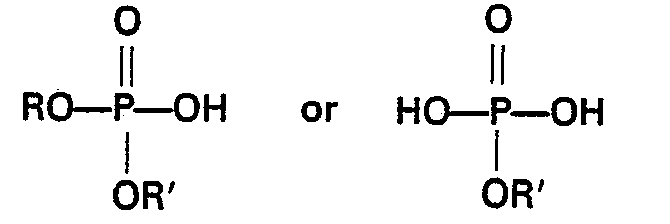
wherein R and R' are C1―C20 alkyl or (preferably) ethoxylated alkyl groups of the general formulae: alkyl―(OCH2CH2)y, wherein the alkyl substituent is C1―C20, preferably C8―C16 and Y is an integer of 1 to 15, preferably 2-10, most preferably 2-5, characterized in that said complex contains a stoichiometric excess of amine relative to phosphate ester.
wherein R and R' are C1―C20 alkyl or (preferably) ethoxylated alkyl groups of the general formulae: alkyl―(OCH2CH2)y, wherein the alkyl substituent is C1―C20, preferably C8―C16 and Y is an integer of 1 to 15, preferably 2-10, most preferably 2-5, characterized in that said complex contains a stoichiometric excess of amine relative to phosphate ester.
2. A method of softening fabrics which is carried out by tumbling damp fabrics in
a hot air clothes dryer while contacting said fabrics with the complex of Claim 1.
3. A laundry detergent composition comprising conventional detersive ingredients,
characterized in that it contains at least 0.1% by weight of the complex of Claim
1.
4. A composition according to Claim 3 which contains from 1% to 15% by weight of said
complex.
5. A composition according to Claim 3 or 4 which also contains at least 1% by weight
of a clay fabric softener.
6. A composition according to Claim 5 which contains not more than 5% by weight of
an alkoxylated nonionic detersive surfactant.
7. A composition according to any of Claims 3 through 6 which contains a detergency
builder selected from phosphate, nitrilotriacetate, polycarboxylate, citrate and zeolite
builders, or mixtures thereof.
8. A composition according to any of the Claims 3 through 7 which contains from 0.1
% to 5% by weight of tetraacetyl ethylenediamine and from 0.5% to 5% by weight of
a quaternary ammonium compound of the formula R4R5R6R7N+X-, wherein R4 is alkyl having from 10 to 20 carbon atoms, R5, R6 and R7 are each alkyl having from 1 to 4 carbon atoms, and X- is an anion.
9. An article for use in a laundry or rinse bath, or in a laundry dryer, comprising
a non-particulate water-insoluble substrate, preferably a flexible sheet, having releasably
affixed thereto a fabric softener which comprises the complex of Claim 1.
10. An article according to Claim 9 which additionally has affixed thereto a bleach
activator.
1. Ein Verfahren zum Weichmachen von Fasern oder Textilien, welches das Inberührungbringen
der genannten Fasern oder Textilien mit einer wässerigen Wäschewaschflüssigkeit umfaßt,
die einen wasserdispergierbaren Komplex eines Amins der Formel R,R2R3N, worin R1 C6―C20-Alkyl ist, R2 C1―C20-Alkyl oder Wasserstoff ist, und R3 C1―C10-Alkyl oder Wasserstoff ist, und eines Phosphatesters der Formel
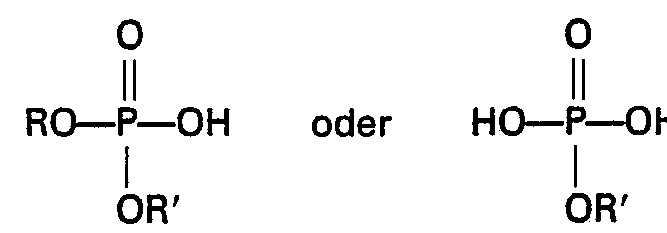
enthalt, worin R und R' C1―C20-Alkyl- oder (vorzugsweise) ethoxylierte Alkylgruppen der allgemeinen Formel: Alkyl-(OCH2CH2), sind, wobei der Alkylsubstituent C1―C20, vorzugsweise CS-C16, ist, und y eine ganze Zahl von 1 bis 15, vorzugsweise 2 bis 10, und in am höchsten bevorzugter Weise 2 bis 5, ist, dadurch gekennzeichnet, daß der genannte Komplex, bezogen auf Phosphatester, einen stöchiometrischen Überschuß von Amin enthält.
enthalt, worin R und R' C1―C20-Alkyl- oder (vorzugsweise) ethoxylierte Alkylgruppen der allgemeinen Formel: Alkyl-(OCH2CH2), sind, wobei der Alkylsubstituent C1―C20, vorzugsweise CS-C16, ist, und y eine ganze Zahl von 1 bis 15, vorzugsweise 2 bis 10, und in am höchsten bevorzugter Weise 2 bis 5, ist, dadurch gekennzeichnet, daß der genannte Komplex, bezogen auf Phosphatester, einen stöchiometrischen Überschuß von Amin enthält.
2. Ein Verfahren zum Weichmachen von Textilien, welches durch Umwälzen von feuchten
Textilien in einem Heißluftwäschetrockner ausgeführt wird, während die genannten Textilien
mit dem Komplex von Anspruch 1 in Berührung sind.
3. Eine Wäschewaschdetergenszusammensetzung, enthaltend herkömmliche, detersive Bestandteile,
dadurch gekennzeichnet, daß sie wenigstens 0,1 Gew.-% des Komplexes von Anspruch 1
enthält.
4. Eine Zusammensetzung nach Anspruch 3, welche 1 Gew.-% bis 15 Gew.-% des genannten
Komplexes enthält.
5. Eine Zusammensetzung nach Anspruch 3 oder 4, welche auch wenigstens 1 Gew.-% eines
Textilweichmachers auf Tonbasis enthält.
6. Eine Zusammensetzung nach Anspruch 5, welche nicht mehr als 5 Gew.-% eines alkoxylierten
nichtionishcen, detersiven grenzflächenaktiven Mittels enthält.
7. Eine Zusammensetzung nach einem der Ansprüche 3 bis 6, welche einen Detergensgerüststoff
enthält, der aus Phosphat-, Nitrilotriacetat-, Polycarboxylat-, Citrat- und Zeolith-Gerüststoffen
oder Gemischen davon, ausgewählt ist.
8. Eine Zusammensetzung nach einem der Ansprüche 3 bis 7, welche 0,1 Gew.-% bis 5
Gew.-% Tetraacetylethylendiamin und 0,5 Gew.-% bis 5 Gew.-% einer quaternären Ammoniumverbindung
der Formel R4R5R6R7N+X- enthält, worin R4 Alkyl mit 10 bis 20 Kohlenstoffatomen bedeutet, Rs, R6 und R7 jeweils Alkyl mit 1 bis 4 Kohlenstoffatomen sind, und X- ein Anion ist.
9. Ein erzeugnis zur Verwendung in einem Wäschewasch- oder Spülbad, oder in einem
Wäschetrockner, enthaltend ein nicht-teilchenförmiges, wasserunlösliches Substrat,
vorzugsweise ein biegsames Blatt, das darauf einen Textilweichmacher, welcher den
Komplex von Anspruch 1 enthält, freisetzbar angebracht aufweist.
10. Ein Erzeugnis nach Anspruch 9, welche zusätzlich darauf einen Bleichmittelaktivator
angebracht aufweist.
1. Procède d'adoucissement de fibres ou de tissus, qui comprend la mise en contact
des fibres ou des tissus avec une liqueur de blanchissage aqueuse comprenant un complexe
dispersable dans l'eau d'une amine de formule RlR2R3N, dans laquelle R1 est un groupe alkyle en C6―C20, R2 est un groupe alkyle en C1―C20 ou un hydrogène, et R3 est un groupe alkyle en C1―C10 ou un hydrogène et d'un ester phosphate de formule
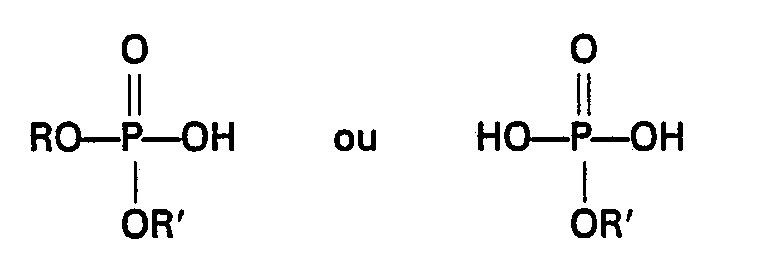
formules dans lesquelles R et R' sont des groupes alkyle ou (de préférence) alkyle éthoxylé en C1―C20, de formules générales: alkyle-(OCH2CH2)y, dans lesquelles le substituant alkyle possède 1 à 20 atomes de carbone, de préférence 8 à 16 atomes de carbone, et y est un nombre entier de 1 à 15, de préférence de 2 à 10, mieux encore de 2 à 5, caractérisé en ce que le complexe contient un excès stoechiométrique de l'amine par rapport à l'ester phosphate.
formules dans lesquelles R et R' sont des groupes alkyle ou (de préférence) alkyle éthoxylé en C1―C20, de formules générales: alkyle-(OCH2CH2)y, dans lesquelles le substituant alkyle possède 1 à 20 atomes de carbone, de préférence 8 à 16 atomes de carbone, et y est un nombre entier de 1 à 15, de préférence de 2 à 10, mieux encore de 2 à 5, caractérisé en ce que le complexe contient un excès stoechiométrique de l'amine par rapport à l'ester phosphate.
2. Procédé d'adoucissement de tissus, réalisé par passage au tambour des tissus humides,
dans un sécheur pour vêtements à air chaud, ces tissus étant au contact du complexe
de la revendication 1.
3. Composition détergente de blanchissage comprenant des ingrédients détersifs classiques,
caractérisée en ce qu'elle contient au moins 0,1% en poids du complexe de la revendication
1.
4. Composition selon la revendication 3, qui contient de 1% à 15% en poids du complexe.
5. Composition selon la revendication 3 ou 4, qui contient aussi au moins 1% en poids
d'un adoucissant pour tissus à base d'argile.
6. Composition selon la revendication 5, qui ne contient pas plus de 5% en poids d'un
tensioactif détersif non ionique alcoxylé.
7. Composition selon l'une quelconque des revendications 3 à 6, qui contient un adjuvant
de détergence choisi parmi les adjuvants phosphate, nitrilotriacétate, polycarboxylate,
citrate et zéolite, ou des mélanges de ceux-ci.
8. Composition selon l'une quelconque des revendications 3 à 7, qui contient de 0,1
% à 5% en poids de tétraacétyléthylène-diamine et de 0,5% à 5% en poids d'un composé
d'ammonium quaternaire de formule R4R5R6R7N+X-, dans laquelle R4 est un groupe alkyle comportant 10 à 20 atomes de carbone, Rs, R6 et R7 sont chacun des groupes alkyle comportant 1 à 4 atomes de carbone, et X- est un anion.
9. Article utilisable dans un bain de blanchissage ou de rinçage, ou dans un sécheur
à linge, comprenant un substrat insoluble dans l'eau non particulaire, de préférence
une feuille flexible, à laquelle est fixée, de façon libérable, un adoucissant pour
textiles qui comprend le complexe de la revendication 1.
10. Article selon la revendication 9, auquel est fixé en outre un activateur de blanchiment.