|
(11) | EP 0 169 077 B1 |

| (12) | EUROPEAN PATENT SPECIFICATION |
|
|
| (54) |
Dielectric porcelain material Dielektrischer Porzellanwerkstoff Matériau diélectrique en porcelaine |
|
|
|||||||||||||||||||||||||||||||
| Note: Within nine months from the publication of the mention of the grant of the European patent, any person may give notice to the European Patent Office of opposition to the European patent granted. Notice of opposition shall be filed in a written reasoned statement. It shall not be deemed to have been filed until the opposition fee has been paid. (Art. 99(1) European Patent Convention). |
[0001] The present invention relates to a dielectric porcelain material used in the micro-wave frequency region. More particularly, the invention relates to such a material used in frequencies higher than X-band, and which effectively demonstrates high no-load Q and stable thermal properties.
[0002] ZrO2―SnO2―TiO2 and BaO-Ti02 systems, and those systems partially substituted with other elements, or composite materials having a controlled thermal coefficient obtained by combining positive dielectric porcelains or glass with negative Ti02, are heretofore well-known. However, their dielectric constants are as high as from 30 to 40. On the other hand, with the increasing use of high frequency regions and from the viewpoint of workability, materials with dielectric constants of about 10, rather than those with high constants as above described, have become of interest in the manufacture of porcelain substrates for dielectric resonators.
[0003] Alumina procelains are known to have small dielectric constants. However, the thermal coefficients of alumina porcelains which are as high as ±60 ppm/°C have inhibited their practical applications.
[0004] In Japanese Patent Application No. 32113/84, materials are disclosed having compositions falling in the quadrilateral area defined in the Al2O3―CaO―TiO2 ternary composition diagram in the application by connecting the following points:
[0005] The materials are manufactured by combining alumina sinterings of thermal coefficients (hereinafter denoted Tf) which have negative large-absolute values such as -60 ppm/°C, high no-load Q, small dielectric loss at high frequencies and excellent thermal conductivity, mechanical strength and chemical stability properties, with CaO+TiO2-derived calcium-titanate materials of large positive Tf values. It has been desired, however, to further improve the τf and no-load Q of the materials which are the invention of Japanese Patent Application No. 32113/84.
[0006] The principal object of the present invention is, therefore, to provide a dielectric porcelain material for use in the micro-wave frequency region that has improved τf and no-load Q, and in particular, τf and no-load Q which are improved over those of the materials of Japanese Patent Application No. 32113/84.
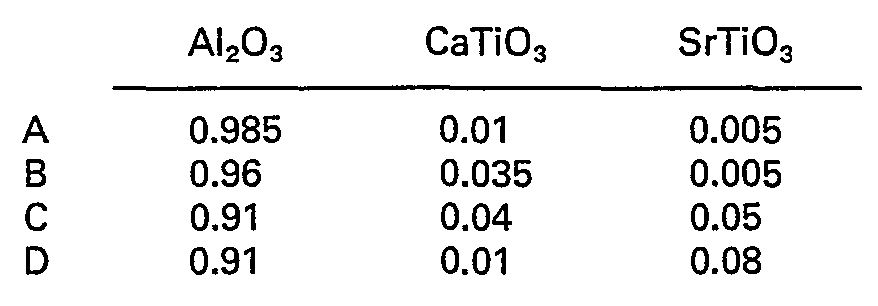
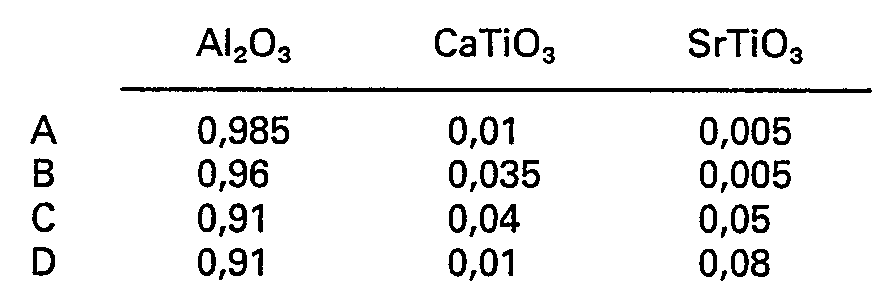
[0007] In order to achieve this and other objects of the invention, the CaO and Ti02 components mixed in the alumina porcelain of the material of Japanese Patent Application No. 32113/84 have been substituted by CaTiO3 and SrTiO3, respectively. The composition range of the Al2O3―CaTiO3―SrTiO3 material of the present invention is restricted to the quadrilateral area defined by the points A, B, C and D in the ternary composition diagram shown in the accompanying drawings, wherein the points A, B, C and D are represented in mol % as follows:-.
[0008] The sintered porcelain of the present invention may contain such minerals as AI203, CaTi03, SrTi03, 6AI203 - CaO, 16AI203 - SrO, 6Al3O3 · SrO, etc. The Al2O3 contributes toward maintaining high no-load Q, whereas the CaTiO3, SrTiO3, and especially stable CaTi03, contribute toward the improvement of Tf.
[0009] There is disclosed in Silikattechnik, Vol. 34, (1983, No. 12), pages 370 to 373, an alumina ceramic obtained by sintering a mixture of alumina and small amounts of either but not both, of calcium and strontium titanate.
[0010] The single figure is a ternary component diagram in which the compositional ranges of AI203, CaTiO3 and SrTi03 in the porcelain material according to the present invention are defined.
Example 1
Synthesis of calcium titanate (CaTi03)
[0012] 278 g of calcium carbonate, (commercially available CaC03; reagent grade), 222 g of titanium dioxide (commercially available Ti02; reagent grade), and 800 ml of water were mixed with 2 kg of alumina balls (99.99% pure 20 mm diameter) in a polyethylene container having a volume of 2 liters under the condition of 84 RPM for 15 hours. The mixture was dried and the product which passed a 60-mesh sieve was calcinated in a 99.99% pure alumina crucible for one hour at 1300°C using an electric furnace to obtain CaTi03. The calcined CaTi03 was re-crushed, dried and sieved under the same conditions as described above to contain CaTi03 powder of grains which passed the 60-mesh sieve.
Example 2
Synthesis of strontium titanate (SrTiO3)
[0013] 324 g of strontium carbonate (commercially available SrC03; reagent grade), 176 g of titanium dioxide (the same as that used in Example 1) and 800 ml of water were mixed and treated under the same conditions used in the synthesis of CaTi03 in Example 1.
Example 3
Mixing of the components
[0014] The CaTi03 and SrTi03 powders synthesized in Examples 1 and 2 were appropriately mixed with 1000 kg of commercially available 99.99% pure alumina (average particle size of 0.5 µm) to obtain products (Samples 1-22) having compositions as shown in the following Table 1 and in the drawing. The products of Samples 2-12 are indicated at points 2-12 in the drawing. These compositions fall within the quadrilateral area (margins included) defined by points A, B, C and D in the ternary composition diagram shown in the drawing. The products of Samples 1 and 13-22 are indicated at points 1 and 13-22 in the drawing and these compositions fall outside the said defined quadrilateral area. The compositions represented by points 2, 3, and 4 correspond to the compositions represented by points B, C and D, respectively.
[0015] Test pieces were prepared in the following manner: For each of Samples 1-22, 1500 ml of water and 5 g of PVA (polyvinyl alcohol) caking agent were added to the appropriate mixture of Al2O3, CaTiO3 and, when used, SrTiO3 and the mixture was then mixed with 3 kg of 20 mm diameter 99.99% pure alumina balls in a polyethylene container having a volume of 3 liters under the condition of 84 RPM for 24 hours. The slurried product was pelletized by spray-drying using a 110 mm diameter atomizer at 170°C and 7200 RPM. The granulated powder was press-formed to obtain cylinders 18.6 mm in diameter and 10.2 mm in length using a metal-mould press with a capacity of 1500 kg/cm2. Sinterings 15.5 mm in diameter and 8.5 mm in length were obtained after burning at a temperature of from 1400° to 1500°C for one hour in an electric furnace. The properties of test pieces 15 mm in diameter and 7 mm in length, obtained after the sinterings were finished by 0.1-s and 0.5-s polishing of the ends and outer surfaces, are shown in the following Table 1.
[0016] Also shown in the Table, for reference purposes, are the dielectric constants s, the thermal coefficient τf and the no-load Q for each of AI203, CaTi03 and SrTiO3.
[0017] For the values shown in Table 1, the measurements of the dielectric constant e were obtained by the dielectric cylinder resonance method (resonance frequency: 8-9 GHz). The thermal coefficients τf were measured in the temperature range of from 25° to 85°C and calculated using the following equation:
wherein τε represents the thermal coefficient of the relative dielectric constant, and a represents the coefficient of linear thermal expansion of the porcelain material.
1. A dielectric porcelain material having a composition falling in the quadrilateral
area defined by connecting points A, B, C and D in the ternary diagram of components
AI203, CaTi03 and SrTi03 in the accompanying drawing, wherein the points A, B, C and D are represented in
mol % as follows:-
2. A dielectric porcelain material according to claim 1, containing minerals selected
from AI203, CaTiO3, 6Al3O3· CaO, 16Al2O3· SrO and 6Al2O3· SrO.
3. A dielectric porcelain material according to claim 1 or claim 2, having a thermal
coefficient Tf between -15 and +15.
4. A dielectric porcelain material according to claim 3, wherein the thermal coefficient
rf is measured in the temperature range of from 25° to 85° and is calculated using
the equation:
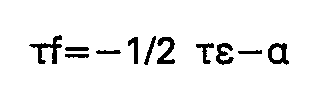
wherein Te represents the thermal coefficient of the relative dielectric constant and a represents the coefficient of linear thermal expansion of the porcelain material.
wherein Te represents the thermal coefficient of the relative dielectric constant and a represents the coefficient of linear thermal expansion of the porcelain material.
5. A dielectric porcelain material according to any of claims 1 to 4, having a no-load
Q not less than 4000.
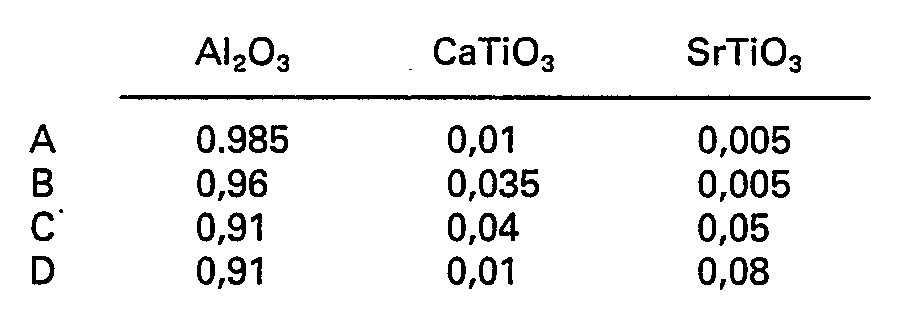
1. Dielektrisches Porzellanmaterial einer Zusammensetzung, die in die durch Verbinden
der Punkte A, B, C und D in dem aus der beigefügten Zeichnung ersichtlichen ternären
Diagramm der Komponenten AI203, CaTi03 und SrTi03 festgelegte viereckige Fläche fällt, wobei den Punkten A, B, C und D folgende Molprozente
zukommen:
2. Dielektrisches Porzellanmaterial nach Anspruch 1, enthaltend Mineralien, ausgewählt
aus AI203, CaTi03, 6Al2O3· CaO, 16Al2O3 · SrO und 6Al2O3 · SrO.
3. Dielektrisches Porzellanmaterial nach Ansprüchen 1 oder 2 mit einem Wärmekoeffizienten
Tf zwischen -15 und +15.
4. Dielektrisches Porzellanmaterial nach Anspruch 3, dadurch gekennzeichnet, daß der
Wärmekoeffizient Tf im Temperaturbereich von 25°C bis 85°C gemessen wird und sich aus der Gleichung:
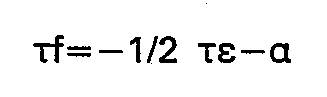
worin bedeuten:
worin bedeuten:
τε den Wärmekoeffizienten der relativen Dielektrizitätskonstante und
a den Koeffizienten der linearen Wärmeausdehnung des Porzellanmaterials errechnet.
5. Dielektrisches Porzellanmaterial nach einem der Ansprüche 1 bis 4 mit einem Leerlauf
Q von nicht weniger als 4000.
1. Un matériau diélectrique en porcelaine ayant une composition tombant dans la surface
du quadrilatère défini par les points de connexion A, B, C et D dans le diagramme
ternaire des composants A1203, CaTi03 et SrTi03 sur le dessin ci-joint, dans lequel les points A, B, C et D sont représentés en %
molaire comme suit:
2. Un matériau diélectrique en porcelaine selon la revendication 1, contenant des
composés minéraux choisis parmi les suivants: AI203, CaTiO3, 6Al2O3 · CaO, 16Al2O3 · SrO et 6Al2O3 · SrO.
3. Un matériau diélectrique en porcelaine selon la revendication 1 ou 2, ayant un
coefficient thermique τf compris entre -15 et +15.
4. Un matériau diélectrique en porcelaine selon la revendication 3, selon lequel le
coefficient thermique τf est mesuré dans l'intervalle de températures de 25° à 85°
et est calculé en utilisant l'équation:
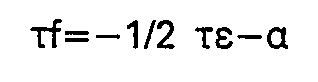
dans laquelle τε représente la coefficient thermique de la constante diélectrique relative et a représente le coefficient de dilatation thermique linéaire du matériau en porcelaine.
dans laquelle τε représente la coefficient thermique de la constante diélectrique relative et a représente le coefficient de dilatation thermique linéaire du matériau en porcelaine.
5. Un matériau diélectrique en porcelaine selon l'une quelconque des revendications
1 à 4 ayant un facteur Q sans charge non inférieur à 4000.