|
(11) | EP 0 169 101 B1 |

| (12) | EUROPEAN PATENT SPECIFICATION |
|
|
| (54) |
Process for preparing (hydrocarbylthio)cyclic amines Verfahren zur Herstellung von (hydrocarbylthio)-cyclischen Aminen Procédé de préparation d'hydrocarbylthio-cycliques amines |
|
|
|||||||||||||||||||||||||||||||
| Note: Within nine months from the publication of the mention of the grant of the European patent, any person may give notice to the European Patent Office of opposition to the European patent granted. Notice of opposition shall be filed in a written reasoned statement. It shall not be deemed to have been filed until the opposition fee has been paid. (Art. 99(1) European Patent Convention). |
[0001] This invention relates to (hydrocarbylthio)cyclic amines and more particularly to a process for preparing them.
[0002] As indicated in U. S. Patents 3, 272, 814 (Cutler et al.), 3, 920, 444 (Harrington et al.), and 4, 146, 688 (Schwindt et al.), it is known that various (hydrocarbylthio)aromatic amines are useful as intermediates in the preparation of biologically-active materials, polyurethanes, etc., and that they can be prepared by various techniques involving multi-step reactions. It is also known from U. S. Patent 4 324 920 (McKinnie et al. I) and RE-31771, issued 18 December 1984 (McKinnie et al. II), S. N. 484, 338 (McKinnie et al. III), and S. N. 551, 336 (McKinnie et al. IV), filed April 12,1983, and November 14,1983, respectively, that (hydrocarbylthio) phenols can be prepared by reacting phenols with hydrocarbyl disulfides in the presence of an aluminum phenoxide catalyst.
[0003] The present invention provides a novel process for preparing (hydrocarbylthio)cyclic amines by reacting a cyclic amine with a hydrocarbyl disulfide so as to form a (hydrocarbylthio)cyclic amine.
[0004] Cyclic amines utilizable in the practice of the invention include (1) aromatic compounds having at least one amino group attached to a carbocyclic or heterocyclic ring of an aromatic compound containing one or more simple and/or fused rings, such as benzene, naphthalene, anthracene, pyrrole, pyridine, indole, etc., rings and (2) reactive heterocyclic amines, such as pyrrole, indole, imidazole. The compounds may bear no substituents other than the required amino group, or they may bear substituents inert to the reaction conditions, such as one or more additional amino groups or substituents such as chloro, fluoro, alkyl, aryl, alkaryl, or aralkyl groups an any positions other than those to be substituted by hydrocarbylthio groups. In the case of coupled aromatic rings, the rings may be directly attached to one another or may be coupled through a bridge such as an oxygen, sulfur, sulfoxide, sulfone, alkyl, or other hydrocarbon link. Useful compouds include, e.g., 4,4'-methylenedianiline, 4-(phenylthio)aniline, 1,3-dimethylpyrrole, 1-methylpyrrole. 2-aminobiphenyl, 4-phenoxyaniline 7-methylindole, aminobenzenes containing one or two amino groups, such as aniline, 4-butylaniline, 4-methylaniline, 4-chloroaniline, 2-ethylaniline, N-methylaniline, 2,4-and 2,6-diaminotoluenes, 2,6-diamino-1-ethylbenzene.
[0005] Hydrocarbyl disulfides which may be reacted with the cyclic amines include saturated and unsaturated aliphatic, in particular alkyl, cycloaliphatic, and aromatic disulfides in which the hydrocarbyl groups optionally bear inert, such as chloro, substituents. Exemplary of such compounds are methyl, ethyl, propyl, n-butyl, sec- butyl, t-butyl, 2-chloropentyl, cyclopentyl, cyclohexyl, phenyl, benzyl, p-tolyl, and p-chlorphenyl disulfides. This component of the reaction mixture is generally employed in at least the stoichiometric amount required to yield the disired (hydrocarbylthio)cyclic amine, i.e., at least an equimolar amount being used when a mono)hydrocarbylthio)cyclic amine is desired, at least two molar equivalents being utilized when a di(hydrocarbylthio)cyclic amine is desired.
[0006] The reaction of the cyclic amine with the hydrocarbyl disulfide is generally conducted at a temperature in the range of 20-300 °C. and at a pressure of atmospheric up to 70 x 105Pa (1000 psi) in the presence of a catalyst. Suitable catalysts are Lewis acid catalysts, such as metal halides, e.g., aluminium chloride, boron trifluoride, ferric chloride, zinc chloride, etc.; metal alkyls, e.g., triethyl- aluminum, diethylaluminum chloride, ethyl aluminum dichloride; and the organometallic compounds derived from the reaction of the cyclic amine with the metal halides, metal alkyls, and reactive metals such as aluminum. The preferred catalysts are the metal halides, such as aluminum chloride, boron trifluoride, and boron trichloride. Aluminum chloride is especially preferred. The catalyst is employed in catalytic amounts, generally in a catalyst/cyclic amine mol ratio of 0.01-0.5/1, preferably 0.01-0.2/1. When the catalyst is one of the more active catalysts and/or is used in a relatively large amount, the temperature and pressure conditions required are milder than when a less active catalyst and/or a lesser amount of catalyst is utilized. Thus, e.g., when 0.01-0.1 molar proportion of aluminum chloride is employed, particularly satisfactory results are obtained when the reaction is conducted at 100-150 °C. and atmospheric pressure, whereas highter temperatures and/or elevated pressures are required for comparable results when aluminum is used instead of aluminum chloride.
[0007] In conducting the process of the invention, it is generally preferred to (1) heat a mixture of the catalyst and the cyclic amine at a suitable temperature, usually a temperature highter than the boiling point of the disulfide to be added, e.g., 100-150 °C., until all of the catalyst has reacted and then (2) heat the reaction mixture at reflux temperature after the disulfide has been added to effect a hydrocarbylthiolation process while removing evolved hydrocarbyl thiol by-product from the reaction vessel. However, it is also satisfactory to conduct the process by simply mixing the catalyst and the reactants together and heating them to the reflux temperature. An inert solvent may be employed if desired but is unnecessary.
[0008] The process of the invention results in the formation of (hydrocarbylthioiciclic amines wich are useful as intermediates in the preparation of biologically-active materials, polyurethanes, etc. Some of these amines are novel compounds, e.g., those corresponding to the formula:
wherein R is a hydrocarbyl group; Y is a hydrocarbylthio group, Z is an inert substituent, selected from chloro, alkyl, aryl, alkaryl and aralkyl groups and m has a value of 0-3. The hydrocarbyl groups are preferably alkyl, e.g., methyl, ethyl, etc; groups.
[0009] The following examples are given to illustrate the invention and are not intended as a limitation thereof.
Example 1
[0010] A yellow solution of 0.66 mol af aniline and 0.0445 mol of aluminium chloride was stirred at 150 °C. for one hour under nitrogen to form a dark solution, which was cooled to 100 °C. Then 2.66 mols of methyl disulfide were added, and the reaction mixture was stirred at reflux to a pot temperature of 135 °C. The reaction time was 4-5 days. Gas chromatography (GC) analysis of an acid-quenched sample showed 31 area % of methyl disulfide, 6 area % of di(methylthio)aniline, 61 area % of tri(methylthio) aniline, and 2 area % of tetra(methylthio)aniline. The assignments were confirmed by Gas chromatography/Mass spectroscopy (GS/MS).
[0011] The reaction mixture was cooled to ambient temperature, and 50.9 g of methyl disulfide were collected by distillation under reduced pressure (40 mm) to a pot temperature of 90 °C. The dark blue reaction mixture was diluted with 200 ml of ether, extracted with 100 ml of IN NaOH, and then two times with 100 ml of saturated aqueous NaCI. The solvent was removed with a rotary evaporator, and the dark blue residue was distilled using a short path still to give 131.6 g (87% yield) of an amber liquid having a boiling point of 120-185 °C. at 0.2-0.3 mm. The bulk of the material distilled at 173 °C. GC and Nuclear magnetic Resonance (NMR) analyses indicated that the product was a 74/15/11 mixture of isomeric tri-(methylthio)anilines, with 2, 4, 6-tri (methylthio) aniline being the predominant isomer.
Example I I
[0012] A stirred yellow solution of 0.11 mol of distilled aniline and 0.0075 mol of aluminum chloride was heated in a nitrogen atmosphere to 130°C., at which point a nearly black solution was formed The solution was cooled to 100°C., 0.11 mol of methyl disulfide was added, and the reaction was stirred at reflux to a pot temperature of 150 °C. in about 18 hours. The cooled reaction mixture was diluted with 30 ml of ether, extracted sequentially with 20 ml of IN NaOH and 20 ml of saturated aqueous NaCI, dried over sodium sulfate, and filtered. The solvent was removed with a rotary evaporator. Distillation at 0.5 mm using a short path still gave a forerun of 3.9 g of aniline (37% recovery) and 6.3 g of a yellow liquid having a boiling point of 60-110°C. which, analyzed by gas chromatography, showed 86% 4-(methylthio) aniline, 11% 2-(methylthio)aniline, and 3% di-(methylthio)aniline.
Example II I
[0013] A mixture of 0.2 mol of 2,4-diaminotoluene and 0.013 mol of aluminum chloride was stirred at 150 °C. in a nitrogen atmosphere for 30 minutes and cooled to 100 °C. Then 0.3 mol of methyl disulfide was added, and the reaction mixture was stirred at reflux to a pot temperature of 160 °C. in about 20 hours. The reaction mixture was cooled, diluted with 100 ml of ether, and treated with 50 ml of IN NaOH and then with 50 ml of saturated aqueous NaCI. The combined aqueous portions were treated with 25 ml of ether, and the solvent was removed from the combined organic portions under reduced pressure (40 mm) with a rotary evaporator to give 32.6 g of crude product. Analysis by gas chromatography showed 13 area % 2,4-diaminotoluene,12 area % 3-(methylthio)-2,4-diaminotoluene, 45 area % 5-(methylthio)-2,4-diaminotoluene, and 31 area % 3,5-di(me- thyltio)-2,4-diaminotoluene.
Example IV
[0014] A mixture of 0.1 mol of 4-chloroaniline and 0.0067 mol of aluminum chloride was stirred in a nitrogen atmosphere at 150 °C. for 30 minutes and cooled to 100 °C., and 0.15 mol of methyl disulfide was added. The reaction mixture was then stirred at reflux until a pot temperature of 165 °C. was obtained. The reaction mixture was cooled, and 2.66 g of residual methyl disulfide were removed under reduced pressure (40 mm) by distillation to a pot temperature of 90 °C. The residue was diluted with 50 ml of ether, treated with 50 ml of IN NaOH, and then with 50 ml of saturated aqueous NaCI. The ether was removed under reduced pressure with a rotary evaporator to give 17.12 g of crude product. Analysis by gas chromatography showed 2 area % of methyl disulfide, 15 area % 4-chloroaniline, 60 area % 4-chloro-2-(methylthio)aniline, and 19 area % 4-chloro- 2,6-di(methylthio)aniline. Distillation through a 152 mm (6") Vigreux column gave 1.9 g of a forerun of 4-chloroaniline (54%) and 4-chloro-2-(methylthio)aniline (b.p. of 44-80 °C. at 0.05 mm), followed by 8.7 g of 4-chloro-2-(methylthio)aniline (93% purity, b.p. of 76-92 °C. at 0.075 mm) and 2.77 g of 4-chloro-2,6-di(methylthio)aniline (79% purity, b.p. of 106-110°C. at 0.15 mm).
Example V
[0015] A mixture of 0.1 mol of 4-methylaniline and 0.0067 mol of aluminum chloride was stirred in a nitrogen atmosphere at 150 °C. for 30 minutes and cooled to 100 °C., and 0.15 mol of methyl disulfide was added. The reaction mixture was then stirred at reflux until a pot temperature of 165 °C. was obtained. The residue was diluted with 50 ml of ether, treated with 50 ml of IN NaOH and then with 50 ml saturated aqueous NaCl. The ether was removed under reduced pressure with a rotary evaporator to give 17.12 g of crude product. Analysis by gas chromatography showed 14 area % methyl disulfide, 9 area % 4-methylaniline, 56 area % 4-methyl-2-(methylthio)aniline,17 area % 4-methyl-2,6-di(methylthio)aniline, and 3 % others. Distillation through a 152mm (6") Vigreux column gave 1.4 g of a forerun of 4-methylaniline (47%) and 4-methyl-2-(methylthio) aniline (53%) having a boiling point of 32-68 °C. at 0.2 mm, followed by 8.4 g of 4-methyl-2(methylthio)aniline (97% purity, b.p. of 64-69 °C. at 0.15 mm) and 2.8 g of 4-methyl-2,6-di(methylthio)aniline (83% purity, b.p. of 88-100 °C. at 0.15 mm).
Example VI
[0016] A mixture of 0.093 mol of aniline and 0.007 g-atom of aluminum was stirred at reflux under nitrogen until all of the metal dissolved. The resultant black solution was cooled to 100 °C., and 0.1 mol of phenyl disulfide was added. The mixture was heated to 220-230 °C., and 7,76 g of a distillate determined to be a mixture of aniline and thiophenol e was collected over five hours. The reaction was cooled, diluted with 15 ml of water, and extracted with 60 ml of ether. The ethereal layer was dried over sodium sulfate and filtered, and the solvent was removed with a rotary evaporator to give 18 g of a dark liquid which solidified upon cooling. GC/MS analysis indicated the composition to be 1 area % of thiophenol, 3 area %of aniline, 13 area % of diphenyl sulfide, 70 area % of diphenyl disulfide, and 13 area % of isomeric (phenylthio)anilines. The isomeric (phenylthio) anilines were isolated by chromatography on silica gel with hexane and then methylene chloride to give a dark liquid analyzing for 11 area % of diphenyl disulfide and 89 area % of a 74/2/13 mixture of 2-, 3-, and 4-(phenylthio)anilines.
Example VI I
[0017] A stirred solution of 0.112 mol of aniline and 0.007 mol of boron trifluoride etherate was heated to 100 °C. in a nitrogen atmosphere, and 0.111 mol of methyl disulfide was then added. The reaction mixture was stirred at reflux to a reaction temperature of 133 °C. in about five days. The reaction mixture was cooled, and 4.3 g of methyl disulfide were recovered by distillation under reduced pressure (40 mm). The residue was diluted with 50 ml of ether, hydrolyzed with 50 ml of IN NaOH, and washed with 50 ml of saturated aqueous sodium chloride. Removal of the solvent under reduced pressure gave 11.3 g of a cherry red liquid which was analyzed by gas chromatography and mass spectroscopy to show 68 area % aniline, 7 area % 2-(methylthio)aniline, and 8 area % 4-(methylthio)aniline.
Example Vlll
[0018] A stirred mixture of 0.1 mol of freshly-distilled N-methylaniline and 0.0067 mol of aluminum chloride was heated at 150 °C. in a nitrogen atmosphere for 30 minutes. The reaction mixture was cooled to 100 °C., 0.15 mol of methyl disulfide was added, and the mixture was heated at reflux to a reaction temperature of 165 °C. in about 18 hours. GC analysis showed that 30% of the starting material remained, An additional 0.056 mol of methyl disulfide was added, and the reaction mixture was heated to a reaction temperature of 165 °C. in about one hour. The reaction mixture was cooled, and 1.4 g of methyl disulfide was. recovered by distillation under reduce pressure (40 mm) to a pot temperature of 80 °C. The dark blue residue was diluted with 100 ml of ether, hydrolyzed with 50 ml of IN NaOH, and the organics then treated with 50 ml of saturated aqueous sodium chloride. Removal of the solvent under reduced pressure with a rotary evaporator gave 14.7 g of crude product which GC/MS analysis showed to contain 13 area % N-methylaniline, 22 area % 2-(methylthio)-N-methylaniline, 33 area % 4-(methylthio)-N-methylaniline, and 24 area % 2,4.di(methylthio)-N-methylaniline.
Example IX
[0019] A stirred mixture of 0.1 mol of 2-ethylaniline and 0.0067 mol of aluminum chloride was heated at 150 °C. in a nitrogen atmosphere for 30 minutes and cooled to 100 °C., and 0.15 mol of methyl disulfide was then added. The mixture was heated at reflux until a reaction temperature of 165 °C. was achieved, The reaction mixture was cooled to ambient temperature, and 1.65 g of methyl disulfide was recovered by distillation under reduced pressure (40 mm) to a pot temperature of 80 °C. The residue was diluted with 50 ml of ether, hydrolyzed with 50 ml of IN NaOH, and the organics treated with 50 ml of saturated aqueous NaCI. Removal of the solvent with a rotary evaporator under reduced pressure gave 17.4 g of crude product. Distillation through a Vigreux column at 0,15 mm afforded the following:
Example X
[0021] A stirred mixture of 0.2 mol of 1-methylpyrrole, 0.03 mol of methyl disulfide, and 0.0134 mol of aluminum chloride was heated at reflux temperature in a nitrogen atmosphere for 3.5 hours until a reaction temperature of 135 °C. was obtained. The reaction mixture was cooled, and excess methyl disulfide and unreacted 1-methylpyrrole were removed under reduced pressure (40 mm) to a pot temperature of 60 °C. The residue was treated with 50 ml of IN NaOH, diluted with 50 ml of ether, and separated; and the organic layer was extracted with 50 ml of aqueous saturated NaCI. Removal of the solvent with a rotary evaporator gave 21.3 g of product. Analysis by gas chromatography and mass spectroscopy showed 28% of a 20/8 isomeric mixture of (methylthio)-1-methyl- pyrroles, 40% of a 15/19/5/1 isomeric mixture od di(methylthio)-1-methylpyrroles, and 10% of an 8/2 isomeric mixture of tri(methy)thio)-1-methy!- pyrroles. Distillation through a Vigreux column at 0.1-0.2 mm afforded the following:
1. A process for preparing (hyrdocarbylthio) cyclic amines characterized in that it
comprises reacting a cyclic amine, which may be (1) an aromatic compound having at
least one amino group attached to a carbocyclic or heterocyclic ring of an aromatic
compound or (2) a reactive heterocyclic amine which may be pyrrole, indole or imidazole,
with a hydrocarbyl disulfide wherein the hydrocarbyl group may be a saturated or unsaturated
aliphatic group, in particular an alkyl group, a cycloaliphatic group or an aromatic
group, in the presence of a catalytic amount of a Lewis acid.
2. The process as claimed in Claim 1 wherein the cyclic amine is selected from an
aminobenzene, such as for instance aniline, or diaminobenzene, or heterocyclic amine,
auch as for instance 1-methylpyrrole.
3. The process as claimed in Claim 1 wherein the hydrocarbyl disulfide is an alkyl
disulfide, which is methyl disulfide, or an aryl disulfide, which is phenyl disulfide.
4. The process as claimed in Claim 1 wherein the Lewis acid is aluminum chloride.
5. A compound corresponding to the formula:
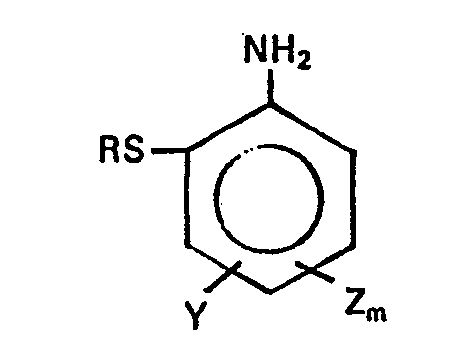
wherein R is a hydrocarbyl group, which is preferably an alkyl group such as a methyl or ethyl group, Y is a hydrocarbylthio group, which is preferably an alkylthio group such as a methylthio group or an ethylthio group, Z is an inert substituent selected from alkyl, aryl, alkaryl groups, and m has a value of 0-3.
wherein R is a hydrocarbyl group, which is preferably an alkyl group such as a methyl or ethyl group, Y is a hydrocarbylthio group, which is preferably an alkylthio group such as a methylthio group or an ethylthio group, Z is an inert substituent selected from alkyl, aryl, alkaryl groups, and m has a value of 0-3.
6. The compound as claimed in claim 5 which is selected from 4-methyl-2,6-di-(methylthio)
aniline, or 2-ethyl-4,6-(dimethylthio)aniline.
7. The compound 2, 4, 6-tri (methylthio) aniline.
8. The compound 3, 5-di(methylthio)-2,4-diaminotoluene.
1. Verfahren zur Herstellung von (hydrocarbylthio)-cyclischen Aminen, dadurch gekennzeichnet,
dass es umfasst das Umsetzten eines cyciischen Amins, das (1 ) eine aromatische Verbindung
mit zumindest einer Aminogruppe, gebunden an einen carbocylischen oder heterocyclischen
Ring einer aromatischen Verbindung oder (2) ein reaktionsfähiges heterocyclisches
Amin, das Pyrrol, Indol oder Imidazol sein kann, bedeuten kann, mit einem Hydrocarbyldisulfid,
worin die Hydrocarbylgruppe eine gesättigte oder ungesättigte aliphatische Gruppe,
insbesondere eine Alkylgruppe, eine cycloaliphatische Gruppe oder eine aromatische
Gruppe sein kann, in Gegenwart einer katalytischen Menge einer Lewis-Säure.
2. Verfahren nach Anspruch 1, worin das cyclische Amin aus einem Aminobezol, wie beispielsweise
aus Anilin oder Diaminobenzol, oder heterocyclischem Amin, wie beispielsweise 1-Methylpyrrol,
ausgewählt ist.
3. Verfahren nach Anspruch 1, worin das Hydrocarbyldisulfid ein Alkyldisulfid, welches
Methyldisulfid ist, oder ein Aryldisulfid, welches Phenyldisulfid ist, bedeutet.
4. Verfahren nach Anspruch 1, dadurch gekennzeichnet, dass die Lewis-Säure Aluminiumchlorid
ist.
5. Verbindung der nachfolgenden Formel:
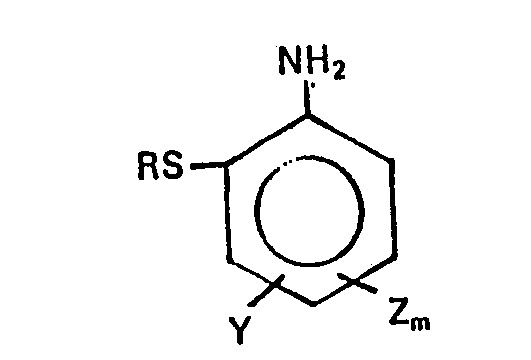
in welcher R einer Hydrocarbylgruppe bedeutet, die bevorzugterweise eine Alkylgruppe, wie beispielsweise eine Methyl- oder Ethylgruppe ist, Y eine Hydrocarbylthiogruppe bedeutet, die bevorzugterweise eine Alkylthiogruppe, wie beispielsweise eine Methylgruppe, wie beispielsweise eine Methylthiogruppe oder eine Ethylthiogruppe ist, Z ein inerter Substituent, ausgewählt aus Alkyl-, Aryl-, Alkaryl- und Aralkylgruppen, ist und der Index m einen Wert von 0 bis 3 besitzt.
in welcher R einer Hydrocarbylgruppe bedeutet, die bevorzugterweise eine Alkylgruppe, wie beispielsweise eine Methyl- oder Ethylgruppe ist, Y eine Hydrocarbylthiogruppe bedeutet, die bevorzugterweise eine Alkylthiogruppe, wie beispielsweise eine Methylgruppe, wie beispielsweise eine Methylthiogruppe oder eine Ethylthiogruppe ist, Z ein inerter Substituent, ausgewählt aus Alkyl-, Aryl-, Alkaryl- und Aralkylgruppen, ist und der Index m einen Wert von 0 bis 3 besitzt.
6. Verbindung nach Anspruch 5, die aus 4-Methyl-2,6-di(methylthio)-anilin oder 2-Ethyl-4,6-(dimethylthio)anilin
ausgewählt ist.
7. Die Verbindung 2, 4, 6-Tri(methylthio)-anilin.
8. Die Verbindung 3, 5-Di(methylthio)-2,4-diaminotoluol.
1. Procédé de préparation d'(hydrocarbylthio)amines cycliques, caractérisé en ce qu'il
consiste à faire réagir une amine cyclique, qui peut être (1 ) un composé aromatique
ayant au moins un groupe amino fixé à un noyau carbocyclique ou hétérocyclique d'un
composé aromatique ou (2) une amine hétérocyclique réactive qui peut être le pyrrole,
l'indole ou l'imidazole, avec un disulfure d'hydrocarbyle dans lequel le groupe hydrocarbyle
peut être un groupe aliphatique saturé ou insaturé, en particulier un group alkyle,
un groupe cycloaliphatique ou un groupe aromatique, en présence d'une quantité catalytique
d'un acide de Lewis.
2. Procédé suivant la revendication 1, dans lequel l'amine cyclique est choisie entre
un amino- benzène, tel que par exemple l'aniline, ou un di- aminobenzène, ou une amine
hétérocyclique telle que par exemple le 1-méthylpyrrole.
3. Procédé suivant la revendication 1, dans lequel le disulfure d'hydrocarbyle est
un disulfure d'alkyle, qui est le disulfure de méthyle, ou un disulfure d'aryle, qui
est le disulfure de phényle.
4. Procédé suivant la revendication 1, dans lequel l'acide de Lewis est le chlorure
d'aluminium.
5. Composé répondant à la formule:
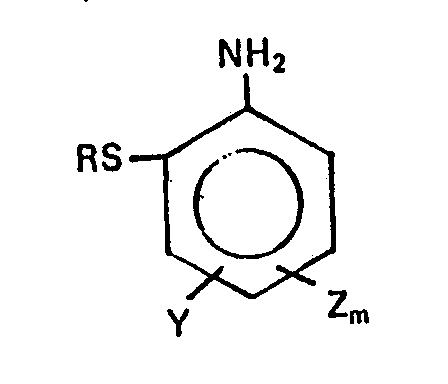
dans laquelle R est un groupe hydrocarbyle, qui est de préférence un groupe alkyle, tel quel le groupe méthyle ou éthyle, Y est un groupe hydrocarbylthio, qui est de préférence un groupe alkylthio tel qu'un groupe méthylthio ou un groupe éthylthio, Z est un substituant inerte choisi entre des groupes alkyle, aryle, alkaryle et aralkyle, et m a une valeur de 0 à 3.
dans laquelle R est un groupe hydrocarbyle, qui est de préférence un groupe alkyle, tel quel le groupe méthyle ou éthyle, Y est un groupe hydrocarbylthio, qui est de préférence un groupe alkylthio tel qu'un groupe méthylthio ou un groupe éthylthio, Z est un substituant inerte choisi entre des groupes alkyle, aryle, alkaryle et aralkyle, et m a une valeur de 0 à 3.
6. Composé suivant la revendication 5, qui est choisi entre la 4-méthyl-2,6-di(méthylthio)aniline
et la 2-éthyle-4,6- (diméthylthio)aniline.
7. Composé appelé 2, 4, 6-tri(méthylthio) aniline.
8. Composé appelé 3, 5-di(méthylthio)-2,4-diaminotoluène.