|
(11) | EP 0 172 297 B1 |

| (12) | EUROPEAN PATENT SPECIFICATION |
|
|
| (54) |
Chromium-nickel-manganese-iron alloy with austenitic structure for use in sulphurous environment at high temperature Chrom-Nickel-Mangan-Eisen-Legierung mit austenitischem Gefüge zur Anwendung in schwefeliger Umgebung bei hoher Temperatur Alliage de chrome, nickel, manganèse, fer, présentant une structure austénitique pour utilisation en atmosphère sulfureuse à haute température |
|
|
||||||||||||||||||||||||||||
| Note: Within nine months from the publication of the mention of the grant of the European patent, any person may give notice to the European Patent Office of opposition to the European patent granted. Notice of opposition shall be filed in a written reasoned statement. It shall not be deemed to have been filed until the opposition fee has been paid. (Art. 99(1) European Patent Convention). |
[0001] The present invention relates to an austenitic manganese-alloyed construction material for use at high temperatures and in sulphurous environments. The material is characterized of an improved corrosion resistance in sulphidizing environments, excellent mechanical properties at high temperature, such as good creep strength and creep ductility, and small tendency of embrittlement.
[0002] The development towards a better utilization of fossil fuels of lower qualities having high contents of the impurity elements sulphur, vanadium and chlorine, has given rise to an increasing need of construction materials being resistant to corrosion attacks caused by said impurities. Furthermore, the development goes towards energy systems working at higher temperatures which involves greater demands upon the construction materials.
[0003] Besides resistance to corrosion in flue gas environments, it is demanded that the materials for these plants or establishments have sufficiently good creep properties at temperature of uses. The materials must also have a stable structure without tendency towards precipitation of phases which make he material brittle at shut-down of the establishment or which impairs the creep properties after ng operating times. It is also important that the material has good weldability and bendability in order to facilitate the construction and repair of plants utilizing fossil fuels.
[0004] The present invention is based on the discovery of alloying compositions which fulfil the demands being raised upon construction materials in sulphurous environments concerning corrosion resistance, creep strength, structure stability, weldability, ductility, etc. Earlier used high temperature steels have, in some respect, not met these demands satisfactorily. In such cases where corrosion has been regarded as the most important factor, ferritic chromium steels have often been used because nickel is unfavourable for the corrosion resistance. In order to increase the resistance to sulphidation and oxidation these steels can be alloyed with aluminium. Ferritic chromium steels have, however, considerable drawbacks. They have low creep strength. If the contents of chromium, and in particular the contents of aluminium, are high, they will also be brittle and difficult to weld and bend. The low creep strength means that they can only be used in systems not being under pressure or as a coating on creep resistant austenitic steels or on nickel base alloys.
[0005] Another corrosion resistant, often used type of alloy has the basic composition 50Cr, 50Ni. Also this kind of alloy has, however, several disadvantages. It is difficult to work in hot as well as in cold condition, it has low creep strength and it is expensive because of its high content of nickel.
[0006] Austenitic materials offer many advantages. They have high creep strength and are easy to weld and bend because they are more ductile.
[0007] Austenitic materials have, however, the great disadvantage that they are generally less resistant to sulphidation, mainly because they contain nickel. As a consequence it is attempted to eliminate the corrosion problems in sulphurous environments by reducing the amount of sulphur, i.e. using more pure fuels or by lowering the temperature of the material. But decreased material temperatures will also lead to decreased efficiencies.
[0008] One main aim with the present invention is to avoid the drawbacks of present steei grades and to reach good resistance to sulphur corrosion without renouncing the mechanical and the manufacturing properties. Characteristic of the alloy according to the invention is above all the optimal addition of manganese. Manganese favours the resistance in sulphurous environment because it influences the composition of the protecting oxide layer and because it forms stable sulphides which prevent continuous sulphidation/oxidation attacks.
[0009] In iron base alloys which form protecting oxide layers by help of Cr at high temperatures, the composition of the oxide will vary in the layer. Innermost there is a chromium rich oxide layer essentially consisting of Cr203, through which Mn, Cr, Fe or other anions are transported out towards the surface and contact with the gaseous phase, where iron- and manganese spinels M203XMO (in which M represents an arbitrary metal) are formed. The transport through the tight, chromium-rich Cr203 is determining the speed of the oxidation. Because manganese usually is present only in small amounts in iron based high temperature alloys the iron content of the spinel increases inasmuch as the diffusion rate of metal ions in Cr203 decreases in the order Mn, Fe, Ni and Cr.
[0010] In environments where sulphur is present at the same time as oxygen there are risks of rapid attacks of sulphur, sulphidation, or rather rapid simultaneous sulphidation/oxidation attacks. In order to obtain acceptably low corrosion rates it is trusted on alloys which form protecting oxide layers, similarly to pure oxidation. Sulphur can, however, be transported through protecting oxide layers and form sulphides in the boundary surface oxide/metal. These sulphides can then be oxidized, at which sulphur is made free and goes further into the metal. The process is repeated and rapid attacks may take place.
[0011] An addition of manganese to chromium oxide forming alloys neutralizes said attacks because manganese-rich spinel is more stable than iron or nickel-rich spinel and reduces the transport of sulphur through the oxide layer. Furthermore, if sulphur penetrates the oxide layer there are formed stable manganese sulphides in the matrix, which sulphides do not tend to be oxidized. In this way sulphidation/ oxidation attacks are prevented.
[0012] The invention relates to a chromium-nickel-manganese-iron alloy with austenitic structure said alloy being defined in the appended claims.
[0013] A known alloy of this kind is disclosed in DE-A-19 21 790. The alloy contains, in percentages by weight:
C up to 0.08
Si up to 0.7
Mn 3.5-7
Cr 20-25
Ni 6-17
N 0.15-0.50
at least one of Mo, Nb, V, at which
Mo 0.5-4
V 0.05-0.5
Nb 0.1-0.7
the balance being iron and usual impurities.
[0014] In comparison with said known alloy the alloy or steel according to the invention has a considerably higher content of Ni and/or different contents of N and C.
[0015] The alloy of the invention is used at high temperatures such as at the lowest 300°C and usually at the lowest 450°C. The sulphurous environment generally consists of flue gases or similar being formed by combustion, gasification or similar operations of fuels and similar with a sulphur content of at the lowest 0.2%. Often the content of sulphur is hither than 0.5%.
[0016] Manganese is an often used alloying element in stainless steels and nickel base alloys. In valve steel for Diesel and petrol engines manganese is an important alloying element.
[0017] Thereby, the most important function of manganese is to increase the solubility of carbon and nitrogen in order to give high contents of said elements meaning an improved hot hardness. In for example the U.S. patent 2, 495, 731, so called 21-4N and 21-2N steels and modifications thereof are described. The basic composition is 0.5% carbon, 9.0% manganese, 21% chromium, 3.35% nickel, 0.45% nitrogen, the rest being iron. These steels are optimized regarding strength, hot hardness and resistance to lead-induced corrosion. On the other hand, they are not suited to sulphurous environments, in systems set under pressure where great demands are put upon mechanical properties such as structure stability and ductility at high as well as low temperature. From this point of view they have too high contents of carbon and nitrogen.
[0018] Another manganese alloyed steel is described by the U.S. patent 3, 552, 920. Manganese is added in contents between 4-20% and chromium between 12-40% to alloys with 34-70% Ni. The alloy is optimized mainly with respect to corrosion because of lead oxide. Manganese as well as nickel are said to have favourable effects in this respect. The disadvantage of this alloy is among other things the high content of titanium, 1.5-3% in the preferred range. So high contents give deteriorated resistance in sulphurous environment.
[0019] The composition of the alloy according to the invention is carefully balanced. The content of manganese should be in the range of 3-8%. The lower limit is determined by the content needed to reach an improved resistance to sulphidation. At too high contents, on the other hand, the structure stability and the oxidation resistance in air are impaired too much. Manganese has a slight sigma phase promoting effect. At high contents of nickel, higher contents of manganese can well be used in order to neutralize the negative effects of nickel on the resistance to sulphidation. The influence of manganese upon the structure stability has also smaller importance at high contents of nickel.
[0020] The chromium content is of great importance for the resistance to sulphidation as well as oxidation and it should be at least 18%. Above 25% Cr, depending upon the content of nickel, there will be problems with the structure stability because chromium is a ferrite stabilizer and favours sigma phase precipitation. The higher chromium content, the more Ni or N have to be added in order to reach the necessary, stabile austenite structure. Because the solubility of N is limited and nickel is unfavourable for the resistance to sulphidation, the content of chromium should not be greater than what needed to obtain a satisfactory resistance, meaning that a suitable chromium range usually is 20-25%.
[0021] The nickel content should be as low as possible with respect to corrosion resistance in sulphurous environments, while it should usually be high with respect to mechanical properties. In order to obtain an austenitic structure with small tendency to sigma phase formation the nickel content must be sufficiently high in relation to the chromium content. The necessary Ni content for structure stability can be decreased, however, if nitrogen is added. The amount of nitrogen which can be dissolved is influenced by manganese and the ratio Cr/Ni. From this fact follows that the contents of Mn, Ni, Cr and N have to be carefully balanced.
[0022] The nitrogen content is of importance in said balancing. A high content of nitrogen improves the austenite stability and counteracts sigma phase embrittlement. Nitrogen is also favourable for the resistance to low cycle fatigue by promoting planar slip. High contents of nitrogen also increase the yield and creep strength. If nitrogen is added, however, additions of elements with strong affinity to nitrogen, such as Al, Zr, Nb, Ti and other, have to be avoided. But the nitrogen content must not be too high because high contents decrease the creep ductility and impact strength at room temperature after use.
[0023] In order to improve the resistance in sulphurous environment, niobium is added, whose favourable effect is additive to the earlier described, favourable effect of manganese. Nb influences the protecting ability of the oxide layer. Addition of Nb also improves the creep strength. In order to obtain marked effects, the content of niobium should exceed 0.3%. A too high Nb content impairs the hot ductility and makes the hot wbrking" more difficult. Nb is also an expensive alloying element. More than 1.5% should therefore not be added. When Nb is added, the nitrogen content should be below 0.10% in order to avoid difficulties in the hot working. The above-mentioned niobium contents are also optimized with respect to creep strength. Nb leads to precipitation of niobium carbides and biobium nitrides, which give a particle hardening. At too high Nb contents, however, the structure stability is impaired, which is negative for the creep strength.
[0024] A niobium containing alloy with a relatively high content of nickel and very good structure stability, and which has favourably been used for the special purpose of the invention, has shown the following composition (in % by weight):
[0025] Depending upon the balance of Cr, Ni, N, Mn and Nb, the nickel content can be varied within the wide interval 20-35%. If niobium is added together with manganese in order to increase the resistance to sulphidation, nitrogen can not be added why nickel alone will stand for the structure stability. A content of 27% is then necessary for good stability of the structure. A greater content than 31 % will, however, give a deteriorated resistance to sulphidation, but is sometimes necessary for the mechanical properties.
[0026] The nickel content can, however, be chosen lower also at niobium additions, if, instead, the chromium content is lower and the demands upon structure stability are lower.
[0027] An alloy according to the present invention with good resistance to sulphidation has shown the following composition (in% by weight):
[0028] Carbon contributes to an improved creep strength by precipitating carbides during creep. In wrought alloys the carbon content should not be too high, however, at the most 0.15%, because problems otherwise are found in the hot working. But also the creep ductility is impaired at higher contents of carbon. Too small carbon contents, below 0.03%, give insignificant contribution to the creep strength.
[0029] If the product is used in cast condition, a higher carbon content can be allowed. In this way an improved creep strength is obtained. An optimal interval is 0.2-0.5%. If the carbon content is above 0.5%, the creep ductility will be too low, however. Too high contents of carbon are also unfavourable because chromium will be bound in carbides, which deteriorates the resistance to oxidaion and sulphidation.
[0030] A cast alloy according to the invention with improved resistance to sulphidation has shown the following composition (in % by weight):
[0031] Silicon is harmful for the corrosion resistance in sulphurous environment. Silicon also increases the tendency to sigma phase precipitation very much. For these reasons the content of silicon should be as low as possible. For manufacturing reasons, such as smelt metallurgical, i.e. desoxidation, a content of at least 0.1 % is demanded, however, in cast material a higher content. In wrought material, a higher content than 0.5% should not be allowed with respect to the properties of uses.
[0032] A well optimized addition of rare earth metals in the form of "Mischmetall' is preferably added to the alloy according to the invention in order to give an improved oxidation resistance and hot workability. The effect of increased hot workability is particularly important when niobium is an alloying'element. The total content of rare earth metal should not be less than 0.05% in order to make sufficient improvements but should not be above 0.15%, because the structure in such case would be too rich in inclusions.
[0033] Optimal amounts of substitutionally dissolved elements and strong carbide formers such as W, Mo, Ta, V, Ti may be added to increase the strength. Aluminium in combination with titanium may be added in order to give a hardening gamma-prim-precipitation at higher contents of nickel.
[0034] in alloys with high nickel contents, it is favourable for the resistance to sulphidation, however, to avoid strengthening titanium and aluminium additions. A well balance composition according to the invention with good resistance to sulphidation has shown to be:
[0036] Alloy compositions according to the present invention have shown good properties at sulphidation and oxidation tests. Examples of compositions of an alloy according to the present invention are given in Table 1. Tables 2 and 3 show total corrosion, including scaling, formation of oxide layers and internal oxidation and sulphidation, after testing in CaS04+10%C mixture at 900°C for 10 x 24h with a change of mixture after each cycle. This type of test gives sulphidation in the form of sulphide formation below an oxide layer. The result of the corrosion test shows that the alloy according to the invention has a considerably better resistance than the alloy "Alloy 800H" having relatively high contents of Cr and Ni but a conventional content of Mn.
[0037] Cyclic oxidation testing at 1000°C, with 3000 cycles using 15 min at high temperature and 5 min cooling at room temperature show that alloy according to the present invention can reach the same oxidation resistance as "Alloy 800H", which has, however, as been mentioned earlier, considerably lower resistance to sulphidation, see Table 2.
1. Chromium-nickel-manganese-iron-alloy with austenitic structure consisting of in
percentages by weight:
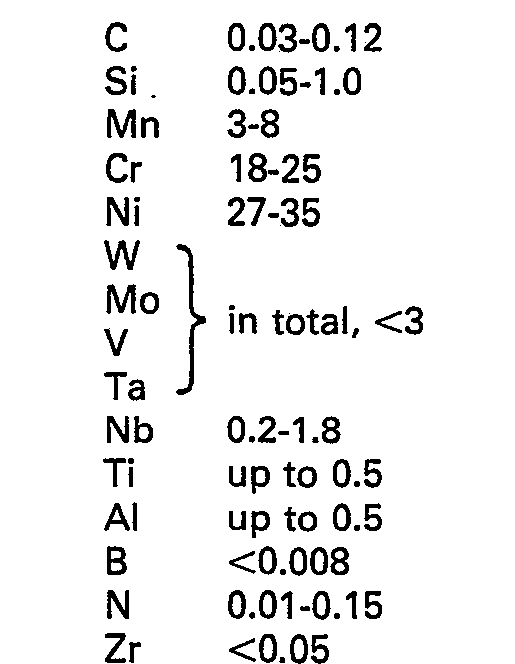
the balance iron and unavoidable impurities. 2. Chromium-nickel-manganese-iron-alloy with austenitic structure consisting of in percentages by weight:
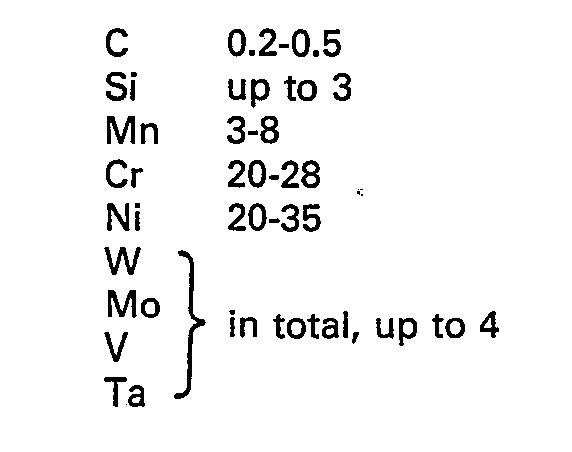
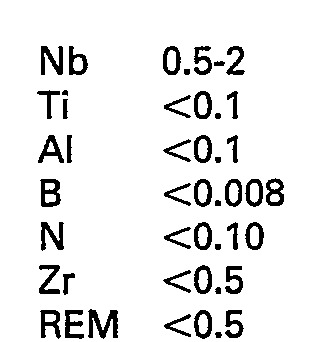
the balance iron and unavoidable impurities.
the balance iron and unavoidable impurities. 2. Chromium-nickel-manganese-iron-alloy with austenitic structure consisting of in percentages by weight:
the balance iron and unavoidable impurities.
3. Use of the steel according to claims 1 or 2 in a sulphurous environment at high
temperature, such as 300°C, in which the sulphurous environment consists of flue gases
or similar media being formed by combustion or equivalent operations of fuels or the
like having a sulphur content of at the lowest 0.2%.
1. Chrom-Nickel-Mangan-Eisen-Legierung mit austenitischem Gefüge, in Gewichtsprozenten
bestehend aus:
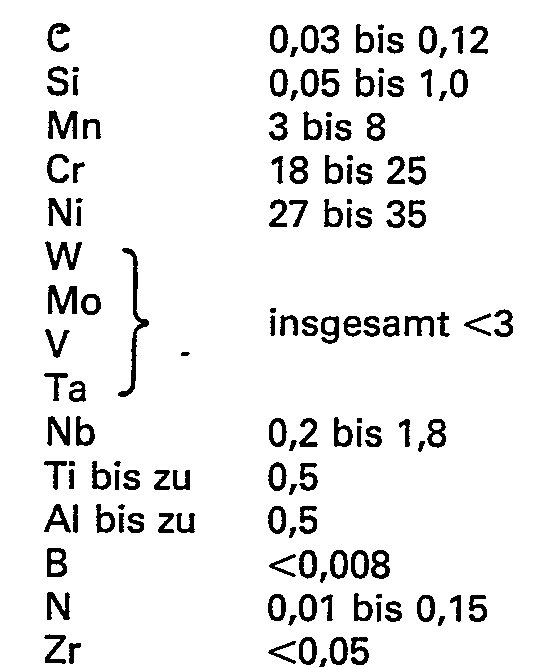
Fe Rest (neben üblichen Verunreinigungen)
Fe Rest (neben üblichen Verunreinigungen)
2. Chrom-Nickel-Mangan-Eisen-Legierung mit austenitischem Gefüge, in Gewichtsprozenten
bestehend aus:
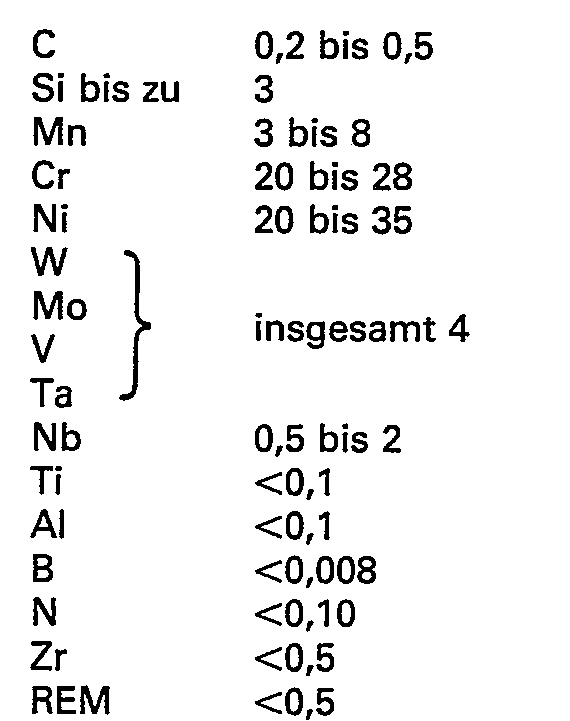
Rest Eisen und unvermeidbare Verunreinigungen.
Rest Eisen und unvermeidbare Verunreinigungen.
3. Verwendung des Stahls nach Anspruch 1 oder 2 in einer schwefelhaltigen Umgebung
bei hoher Temperatur, wie 300°C, wobei die schwefelhaltige Umgebung aus Rauchgasen
oder ähnlichen Medien besteht, die bei der Verbrennung oder äquivalenten Operationen
mit Brennstoffen oder dergleichen mit einem Schwefelgehalt von mindestens 0,2% gebildet
werden.
1. Un alliage de chrome, nickel, manganèse etfer présentant une structure austénitique
et comportant, en pourcentaqes en poids:
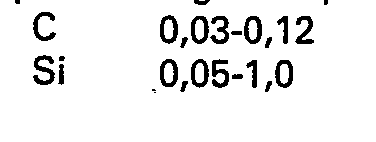
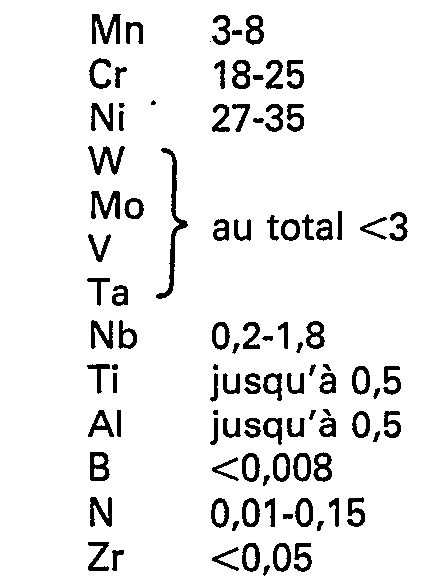
le reste étant du fer et des impuretés inévitables.
le reste étant du fer et des impuretés inévitables.
2. Un alliage de chrome, nickel, manganèse et fer présentant une structure austénitique
et comportant, en pourcentages en poids:
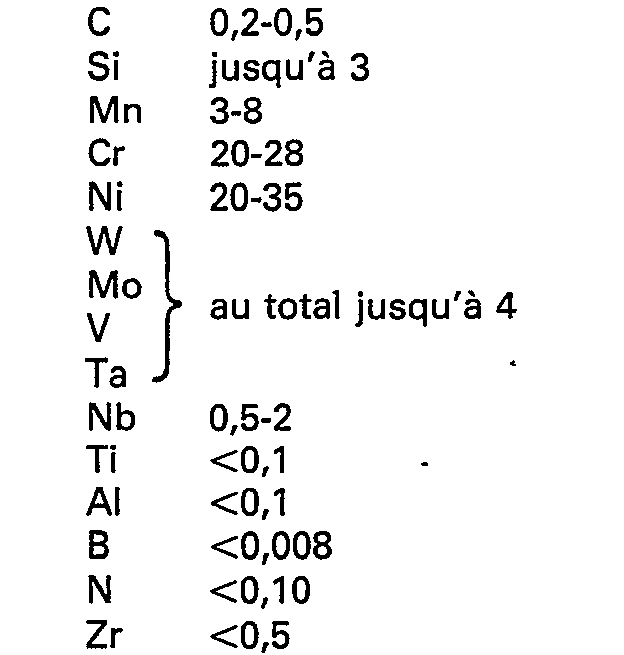
Métaux des terres rares <0,5 le reste étant du fer et des impuretés inévitables.
Métaux des terres rares <0,5 le reste étant du fer et des impuretés inévitables.
3. Utilisation de l'acier selon la revendication 1 ou 2 en atmosphère sulfureuse à
haute température, telle que 300°C, dans laquelle l'atmosphère sulfureuse consiste
en des gaz de combustion ou agents similaires formés par combustion ou opérations
équivalentes sur des carburants ou analogues comportant une teneur en soufre d'au
moins 0,2%.