|
(11) | EP 0 172 306 B1 |

| (12) | EUROPEAN PATENT SPECIFICATION |
|
|
| (54) |
Tetrahydrophthalimide compounds, their production and use Tetrahydrophthalimidverbindungen, Herstellung und Anwendung Composés de la tétrahydrophtalimide, préparation et utilisation |
|
|
|||||||||||||||||||||||||||||||||||
| Note: Within nine months from the publication of the mention of the grant of the European patent, any person may give notice to the European Patent Office of opposition to the European patent granted. Notice of opposition shall be filed in a written reasoned statement. It shall not be deemed to have been filed until the opposition fee has been paid. (Art. 99(1) European Patent Convention). |
[0002] The said tetrahydrophthalimide compounds (hereinafter referred to as "tetrahydronaphthalimide(s)") are representable by the formula:
wherein R1 is hydrogen, C1―C12 alkyl, C3-Cs cycloalkyl, C1―C8 alkyl(C3―C8)cycloalkyl, C3―C8 cycloalkyl(Cl-Cs)alkyl, C1―C8 alkoxy(C1―C8)alkyl, C2―C8 alkenyl, C3―C8 cycloalkenyl, C3―C8 cycloalkenyl(C1―C8)alkyl, phenyl, cyano(Cl-C8)alkyl, C2―C8 alkynyl, C1―C8 alkylideneamino, C1―C8 alkylthio(C1―C8)alkyl, benzyl, halo(C1―C8)alkyl or C3-Cs cycloalkylideneamino, X is chlorine or bromine and Z is oxygen or sulfur.
[0003] The alkyl residues are preferably intended to have 3 to 7 carbon atoms for a cyclic moiety and not more than 6 carbon atoms for a non-cyclic moiety. Preferred numbers of carbon atoms for alkyl, cycloalkyl, alkenyl, cycloalkenyl and alkynyl residues are respectively from 1 to 6, from 3 to 7, from 2 to 6, from 5 to 6 and from 2 to 6. Preferable numbers of carbon atoms for alkoxy, alkylthio, alkylideneamino and cycloalkylideneamino are respectively from 1 to 6, from 1 to 6, from 1 to 6 and from 3 to 7.
[0004] Preferred are the compounds of formula I, wherein R1 is hydrogen, C1―C6 alkyl, C3-C7 cycloalkyl, C1―C6 alkyl(C3-C,) cycloalkyl, C3-C7 cycloalkyl(C1―C6)alkyl, C1―C6 alkoxy(Cl-C6)alkyl, C2―C6 alkenyl, C5―C6 cycloalkenyl, C5―C6 cycloalkenyl(C1―C6)alkyl, phenyl, cyano (C1―C6) alkyl, C2―C6 alkynyl, C1―C6 alkylideneamino, C1―C6 alkylthio(C1―C6)alkyl, benzyl, chloro(C1―C6) alkyl, bromo (C1―C6) alkyl or C3―C7 cycloalkylideneamino, X is chlorine or bromine and Z is oxygen or sulphur.
[0005] More preferably R1 is C3-C7 cycloalkyl, Cl-C2 alkyl(C3―C6)cycloalky), C3―C6 cycloalkyl(C1―C2)alkyl, C1―C4 alkoxy(C,-C4)alkyl, C2―C4 alkenyl, C5―C6 cycloalkenyl, CS-C6 cycloalkenyl(C1―C2)alkyl, cyano(C1―C3)alkyl, C3-C4 alkynyl, C1―C4 alkylideneamino, C1―C4 alkylthio(C1―C4)alkyl, halo(C1―C4)alkyl and C4―C6 cycloalkylideneamino.
[0006] It is known that some tetrahydrophthalimide compounds exhibit a herbicidal activity. For instance, U.S. patent 3,984,435, EP 0049508A, U.S. patent 4,032,326, etc. disclose that 2-(4-chlorophenyl)-4,5,6,7-tetrahydro-2H-isoindole-1,3-dione, 2-[4-chloro-3-(1-propylthiocarbonylbutoxy)phenyl]-4,5,6,7-tetrahydro-2H-isoindole-1,3-dione, 2-(4-chloro-2-fluoro-phenyl)-4,5,6,7-tetrahydro-2H-isoindole-1,3-dione, etc. are useful as herbicides. However, their herbicidal effect is not always satisfactory.
[0007] It has now been found that the tetrahydrophthalimides (I) show a strong herbicidal activity against a wide variety of weeds by foliar or soil treatment in plowed fields. Advantageously, some of them do not produce any material phytotoxicity on agricultural crops (e.g. corn, soybean, cotton). Their herbicidal activity is particularly notable on post-emergence foliar treatment of broad-leafed weeds such as common purslane (Portulaca oleracea), common lambsquarters (Chenopodium album), redroot pigweed (Amaranthus retroflexus), hemp sesbania (Sesbania exaltata), velvetleaf (Abutilon theophrasti), prickly sida (Sida spinosa), ivyleaf morningglory (Ipomoea hederacea), tall morningglory (Ipomoea purpurea), field bindweed (Convolvulus arvensis), jimsonweed (Datura stramonium), black nightshade (Solanum nigrum), cocklebur (Xanthium pensylvanicum), sunflower (Helianthus annus), common ragweed (Ambrosia artemisiifolia) in corn or soybean fields as they do not afford any toxicity to corn or soybean. Likewise, they exhibit a good herbicidal activity against Graminaceous weeds such as barnyardgrass (Echinochloa crus- galli), broad-leafed weeds such as false pimpernel (Lindernia procumbens), toothcup (Rotala indica) and waterwort (Elatine triandra) and paddy field weeds such as nutsedge (Cyperus serotinus), monochoria (Monochoria vaginalis) and arrowhead (Sagittaria pygmaea) in paddy rice fields, while exerting no significant damage to rice plants. Accordingly, they can be used as herbicides applicable to paddy fields as well as agricultural plowed fields. They are also useful as herbicides to be employed for orchards, pastures, lawns, forests, non-agricultural fields, etc.
[0008] The tetrahydrophthalimides (I) can be produced by reacting a H2N-phenyltetrahydrophthalimide of the formula:
wherein X is as defined above with an a-halocarboxylic acid ester of the formula:
wherein A is chlorine or bromine and R, and Z are each as defined above in a solvent in the presence or absence of a dehydrohalogenating agent, usually at a temperature of 0 to 200°C for 1 to 240 hours. The amounts of the a-halocarboxylic acid ester (III) and the dehydrohalogenating agent may be respectively 1.0 to 10 equivalents and 0.5 to 1.5 equivalents to the H2N-phenyltetrahydrophthalimide (II). When desired, a phase transfer catalyst such as tetrabutylammonium bromide or benzyltributylammonium chloride may be employed.
[0009] As the solvent, there may be used an aliphatic hydrocarbon (e.g. hexane, heptane, ligroin, petroleum ether), an aromatic hydrocarbon (e.g. benzene, toluene, xylene), a halogenated hydrocarbon (e.g. chloroform, carbon tetrachloride, dichloroethane, chlorobenzene, dichlorobenzene), an ether (e.g. diethyl ether, diisopropyl ether, dioxane, tetrahydrofuran, diethylene glycol dimethyl ether), a ketone (e.g. acetone, methylethylketone, methylisobutylketone, isophorone, cyclohexanone), an alcohol (e.g. methanol, ethanol, isopropanol, t-butanol, octanol, cyclohexanol, methylcelosolve, diethylene glycol, glycerol), a nitrile (e.g. acetonitrile, isobutyronitrile), an acid amide (e.g. formamide, N,N-dimethylformamide, acetamide), a sulfur compound (e.g. dimethylsulfoxide, sulfolane), water. They may be employed alone or in combination.
[0010] Examples of the dehydrohalogenating agent are an organic base (e.g. pyridine, triethylamine, N,N-diethylaniline), an inorganic base (e.g. sodium hydroxide, potassium hydroxide, sodium carbonate, potassium carbonate, sodium hydride), an alkali metal alkoxide (e.g. sodium methoxide, sodium ethoxide).
[0011] The produced tetrahydrophthalimide (I) is, when desired, purified by a per se conventional procedure such as chromatography or recrystallization.
[0012] The starting H2N-phenyltetrahydrophthalimide can be produced by treating a nitrophenyltetrahydrophthalimide of the formula:
wherein X is as defined above with 2.0 to 10 equivalents of an iron in the presence of an acid in a solvent (e.g. acetic acid, water, methanol, ethanol, tetrahydrofuran) at a temperature of 20 to 100°C.
[0013] The production of the nitrophenyltetrahydrophthalimide (IV) is summarized in the following scheme:
wherein X is as defined above.
[0014] Namely, the haloaniline (V) is treated with 1.0 to 1.5 equivalents of conc. nitric acid in conc. sulfuric acid at a temperature of 10 to -10°C to give the nitroaniline (VI), which is then reacted with 3,4,5,6-tetrahydrophthalic anhydride in a solvent (e.g. toluene, xylene, acetic acid, propionic acid, water, dioxane) at a temperature of 0 to 200°C, whereby the nitrophenyltetrahydrophthalimide (IV) is obtained.
[0015] The thus obtained compound (IV) may be subjected to usual work-up or, if necessary, to purification by chromatography or recrystallization.
[0016] Practical and presently preferred embodiments for production of the tetrahydrophthalimides (I) as well as the intermediary compounds are illustratively shown in the following Examples.
Example 1
[0017] 2-(3-Amino-4-bromo-6-fluorophenyl)-4,5,6,7-tetrahydro-2H-isoindole-1 ,3-dione (0.85 g) was dissolved in 1,4-dioxane (5 ml), and ethyl bromoacetate (3.3 g) was added thereto. The resultant mixture was refluxed for 6 hours. Triethylamine (0.2 g) was added thereto, and the mixture was refluxed for 1 hour. After allowed to cool, water and toluene were added to the mixture, which was then extracted with toluene. The toluene layer was dried and concentrated. The residue was purified by silica gel column chromatography to give 1.0 g of 2-(4-bromo-2-fluoro-5-ethoxycarbonylmethyliminophenyl)-4,5,6,7-tetrahydro-2H-isoindole-1,3-dione (Compound No. 11). n
1.5281.
[0018] Examples of the tetrahydrophthalimides (I) produced by the same procedure as above are shown in Table 1.
Example 2
[0020] A solution of N-(4-chloro-2-fluoro-5-nitrophenyl)-3,4,5,6-tetrahydrophthalimide (16.2 g) in acetic acid (200 ml) was dropwise added to a suspension of iron powder (14 g) in a 5% aqueous acetic acid (30 ml) at 90-100°C and refluxed for 1 hour. After allowed to cool, chloroform was added to the resultant mixture, followed by filtration. The organic layer was separated from the filtrate, washed with a saturated sodium hydrogen carbonate solution, dried and concentrated. The residue was recrystallized from a mixture of ether and petroleum ether to give 7.5 g of N-(3-amino-4-chloro-6-fluorophenyl)-3,4,5,6-tetrahydrophthalimide. M.P., 144.5-146.50C.
Example 3
[0022] In the same manner as in Example 2 but using N-(4-bromo-2-fluoro-5-nitrophenyl)-3,4,5,6-tetrahydrophthalimide in place of N-(4-chloro-2-fluoro-5-nitrophenyl)-3,4,5,6-tetrahydrophthalimide, there was produced N-(3-amino-4-bromo-6-fluorophenyl)-3,4,5,6-tetrahydrophthalimide. M.P., 163-164.5°C.
Example 4
[0024] 4-Chloro-2-fluoro-5-nitroaniline (19 g) and 3,4,5,6-tetrahydrophthalic anhydride (15.2 g) were dissolved in acetic acid (50 ml) and refluxed for 6 hours. After allowed to cool, the resultant mixture was poured into water and extracted with toluene. The toluene layer was washed with water, an aqueous sodium hydrogen carbonate solution and water in order, dried and concentrated. The residue was crystallized from ethanol to give 20 g of N-(4-chloro-2-fluoro-5-nitrophenyl)-3,4,5,6-tetrahydrophthalimide. M.P., 157-157.5°C.
Example 5
[0026] In the same manner as in Example 4 but using 4-bromo-2-fluoro-5-nitroaniline in place of 4-chloro-2-fluoro-5-nitroaniline, there was produced N-(4-bromo-2-fluoro-5-nitrophenyl)-3,4,5,6-tetrahydrophthalimide. M.P., 155-156°C.
Example 6
[0028] To a solution of 4-bromo-2-fluoroaniline (58.6 g) in conc. sulfuric acid (100 ml), there was dropwise added a mixture of conc. nitric acid (25.3 g) and conc. sulfuric and (15 ml) at a temperature of 0 to -10°C. The resultant mixture was stirred at 0-5°C for 1 hour, poured into ice-water and extracted with toluene. The toluene layer was washed with water and an aqueous sodium hydrogen carbonate solution and concentrated. The residue was purified by silica gel chromatography to give 16.4 g of 4-bromo-2-fluoro-5-nitroaniline. M.P., 90-920C.
Example 7
[0030] In the same manner as in Example 6 but using 4-chloro-2-fluoroaniline in place of 4-bromo-2-fluoroaniline, there was produced 4-chloro-2-fluoro-5-nitroaniline. M.P., 83-84.5°C.
[0031] In the practical usage of the tetrahydrophthalimides (I), they may be applied in any composition such as emulsifiable concentrates, wettable powders, suspensions, granules or dusts.
[0032] The concentration of the active ingredient in such composition is usually within a range of 0.1 to 95% by weight, preferably of 1 to 80% by weight.
[0033] In formulation of those compositions, a solid or liquid carrier or diluent may be used. As the solid carrier or diluent, there may be employed fine dust or granules of kaolin clay, attapulgite clay, bentonite, terra abla, pyrophyllite, talc, diatomaceous earth, calcite, walnut powder, urea, ammonium sulfate, synthetic hydrated silicon dioxide. As the liquid carrier or diluent, there may be employed aromatic hydrocarbons (e.g. xylene, methyl naphthalene), alcohols (e.g. isopropanol, ethylene glycol, celosolve), ketones (e.g. acetone, cycylohexanone, isophorone), plant oils (e.g. soybean oil, cotton seed oil), dimethylsulfoxide, acetonitrile, water.
[0034] A surface active agent used for emulsification, dispersion or spreading may be any of the non-ionic, anionic, cationic and amphoteric type of agents. Examples of the surface active agent include alkylsulfates, alkylaryl sulfonates, dialkylsuccinates, polyoxyethylene alkylaryl phosphates, polyoxyethylene alkyl ethers, polyoxyethylene alkylaryl ethers, polyoxyethylene-polyoxypropylene blocked polymers, sorbitan fatty acid esters, polyoxyethylene sorbitan fatty acid esters, polyoxyethylene resin acid esters, abietic acid, dinaphthylmethanedisulfonates and paraffin. If necessary, ligninsulfonates, alginates, polyvinyl alcohol, gum arabic, CMC (carboxymethylcellulose), PAP (isopropyl acid phosphate) or the like may be used as an auxiliary agent.
[0035] Practical embodiments of the herbicidal composition according to the invention are illustratively shown in the following examples wherein part(s) and % are by weight. The compound number of the active ingredient correponds to the one in Table 1.
Formulation Example 1
[0036] Fifty parts of Compound No. 7,3 3 parts of calcium ligninsulfonate, 2 parts of sodium laurylsulfate and 45 parts of synthetic hydrated silicon dioxide are well mixed while being powdered to obtain a wettable powder.
Formulation Example 2
[0037] Ten parts of Compound No. 4, 14 parts of polyoxyethylene styrylphenyl ether, 6 parts of calcium dodecylbenzenesulfonate, 30 parts of xylene and 40 parts of cyclohexanone are well mixed while being powdered to obtain an emulsifiable concentrate.
Formulation Example 3
[0038] Two part of Compound No. 8, 1 part of synthetic hydrated silicon dioxide, 2 parts of calcium ligninsulfonate, 30 parts of bentonite and 65 parts of kaolin clay are well mixed while being powdered. The mixture is then kneaded with water, granulated and dried to obtain a granule.
Formulation Example 4
[0039] Twenty-five parts of Compound No. 7, 3 parts of polyoxyethylene sorbitan monooleate, 3 parts of carboxymethyl cellulose and 69 parts of water are well mixed and pulverized until the particle size of the active ingredient becomes less than 5 microns to obtain a granule.
[0040] These compositions comprising the tetrahydrophthalimides (I) may be applied as such, or after dilution with water, to the weeds in suitable application modes such as spraying, perfusion. For instance, they may be spread over, perfused into or admixed with soil. Further, for instance, they may be applied for foliar treatment. If necessary, they may be used together with other herbicides to improve their activity as herbicides, and in some cases, a synergistic effect can be expected. They may be also applied in combination with insecticides, acaricides, nematocides, fungicides, plant growth regulators, fertilizers, soil controlling agent, etc.
[0041] A dosage rate of the tetrahydrophthalimide (I) as the active ingredient may be generally from 0.01 to 100 grams, preferably from 0.1 to 50 grams, per are. In the practical usage of the tetrahydrophthalimide (I) as emulsifiable concentrates, wettable powders or suspensions, it may be diluted with 1 to 10 liters of water (optionally including an auxiliary agent such as a spreading agent) per are. When formulated into granules or dust, it may be used as such without dilution.
[0042] The application of the tetrahydrophthalimides (I) as herbicides will be illustratively shown in the following Examples wherein the phytotoxicity to cultivated plants and the herbicidal activity on weeds were evaluated as follows: the aerial parts of the test plants were cut off and weighed (fresh weight); the percentage of the fresh weight of the treated plant to that of the untreated plant was calculated with the latter fresh weight taken as 100; and the phytotoxicity and the herbicidal activity were evaluated by the standard given in the table below.
Test Example 1
[0044] Trays (33 x 23 cm2) were filled with upland field soil, and the seeds of soybean, tall morningglory, velvetleaf, black nightshade, cocklebur and hemp sesbania were sowed therein and grown for 18 days in a greenhouse. A designed amount of the test compound formulated into an emulsifiable concentrate and diluted with water was sprayed to the foliage of the test plants over the top by means of a small hand sprayer at a spray volume of 10 liters per are. At the time of application, the test plants were generally at the 2 to 4 leaf stage and had a height of 2 to 12 cm. Twenty days thereafter, herbicidal activity and phytotoxicity were examined. The results are shown in Table 2.
Test Example 2
[0045] Plastic pots (diameter, 10 cm; height, 10 cm) were filled with upland field soil, and the seeds of soybean, cotton, tall morningglory and velvetleaf were sowed therein and covered with soil. A designed amount of the test compound formulated into an emulsifiable concentrate and diluted with water was sprayed to the soil at a spray volume of 10 liters per are and then the soil was well mixed to the depth of 4 cm. The test plants were further grown for 20 days in a greenhouse, and herbicidal activity and phytotoxicity were examined. The results are shown in Table 3.
Test Example 3
[0047] Plastic pots (diameter, 8 cm; height, 12 cm) filled with paddy field soil, and the seeds of barnyardgrass and broad-leafed weeds (e.g. false pimpernel, toothcup, waterwort) were sowed therein to a depth of 1 to 2 cm. The pots were placed under a flooded condition, and the tubers of arrowhead and the rice seedlings of the 2-leaf stage were transplanted therein at a depth of 1 to 2 cm and grown for 6 days in a greenhouse. A designed amount of the test compound formulated into an emulsifiable concentrate and diluted with water was perfused into the pots at a perfusion volume of 5 ml per pot. The test plants were further grown for 20 days in the greenhouse, and phytotoxicity and herbicidal activity were examined. The results are shown in Table 4.
1. A compound of the formula:
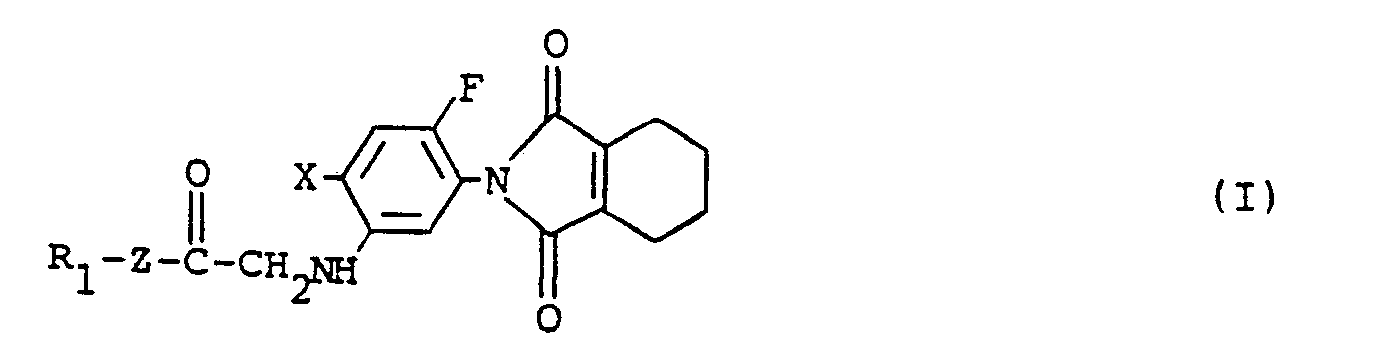
wherein R, is hydrogen, C1―C12 alkyl, C3―C8 cycloalkyl, C1―C8 alkyl(C3―C8)cycloalkyl, C3―C8 cycloalkyl(C1―C8)alkyl, C1―C8 alkoxy(Cl-Cs)alkyl, C2―C8 alkenyl, C3-Ce cycloalkenyl, C3―C8 cycloalkenyl(C1―C8)alkyl, phenyl, cyano(C1―C8)alkyl, C2―C8 alkynyl, C1―C8 alkylideneamino, C1―C8 alkylthio(C1―C8)alkyl, benzyl, halo(C1―C8)alkyl or C3―C8 cycloalkylideneamino, X is chlorine or bromine and Z is oxygen or sulfur.
wherein R, is hydrogen, C1―C12 alkyl, C3―C8 cycloalkyl, C1―C8 alkyl(C3―C8)cycloalkyl, C3―C8 cycloalkyl(C1―C8)alkyl, C1―C8 alkoxy(Cl-Cs)alkyl, C2―C8 alkenyl, C3-Ce cycloalkenyl, C3―C8 cycloalkenyl(C1―C8)alkyl, phenyl, cyano(C1―C8)alkyl, C2―C8 alkynyl, C1―C8 alkylideneamino, C1―C8 alkylthio(C1―C8)alkyl, benzyl, halo(C1―C8)alkyl or C3―C8 cycloalkylideneamino, X is chlorine or bromine and Z is oxygen or sulfur.
2. The compound according to claim 1, wherein R, is hydrogen, C1―C3 alkyl, C2―C7 cycloalkyl, C1―C6 alkyl(C3―C7) cycloalkyl, C3-C7 cycloalkyl(C1―C6)alkyl, C1―C6 alkoxy(C1―C6)alkyl, C2-C6 alkenyl, C5―C6 cycloalkenyl, C5―C6 cycloalkenyl(C1―C6)alkyl, phenyl, cyano (C1―C6) alkyl, C2―C6 alkynyl, C1―C6 alkylideneamino, C1―C6 alkylthio(C1―C6alkyl, benzyl, chloro(C1―C6) alkyl, bromo (C1―C6) alkyl or C3―C7 cycloalkylideneamino, X is chlorine or bromine and Z is oxygen or sulphur.
3. 2-(4-Chloro-2-fluoro-5-cyclopentylmethoxycarbonylmethyl-iminophenyl)-4,5,6,7-tetrahydro-2H-indole-1,3-dione.
4. A process for producing the compound according to claim 1, which comprises reacting
a H2N-phenyltetrahydrophthalimide of the formula:
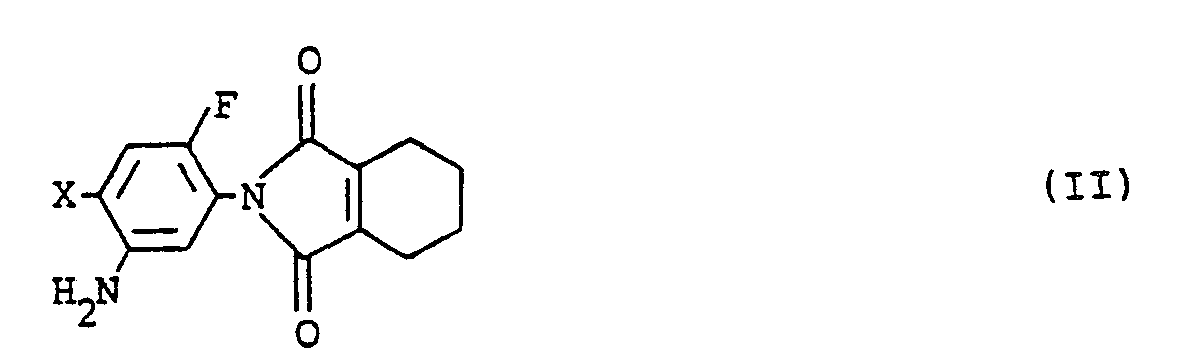
wherein X is as defined in claim 1 with an a-halocarboxylic acid ester of the formula:
wherein A is chlorine or bromine and R, and Z are each as defined in claim 1 in a solvent in the presence or absence of a dehydrohalogenating agent at a temperature of 0 to 200°C for 1 to 240 hours.
wherein X is as defined in claim 1 with an a-halocarboxylic acid ester of the formula:
0 II A―CH2―C―Z―R, (III)
wherein A is chlorine or bromine and R, and Z are each as defined in claim 1 in a solvent in the presence or absence of a dehydrohalogenating agent at a temperature of 0 to 200°C for 1 to 240 hours.
5. A process according to claim 4 wherein the H2N-phenyltetrahydrophthalimide of the formula:
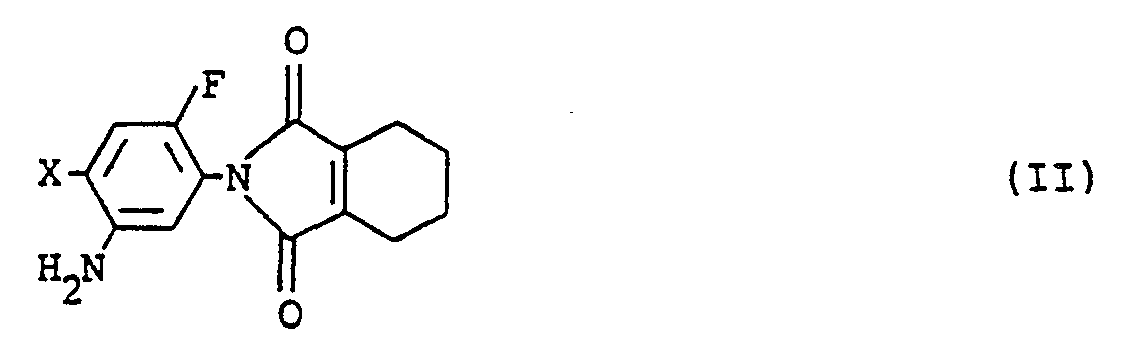
wherein X is as defined in claim 1, is prepared by treating a nitrophenyltetrahydrophthalimide of the formula:
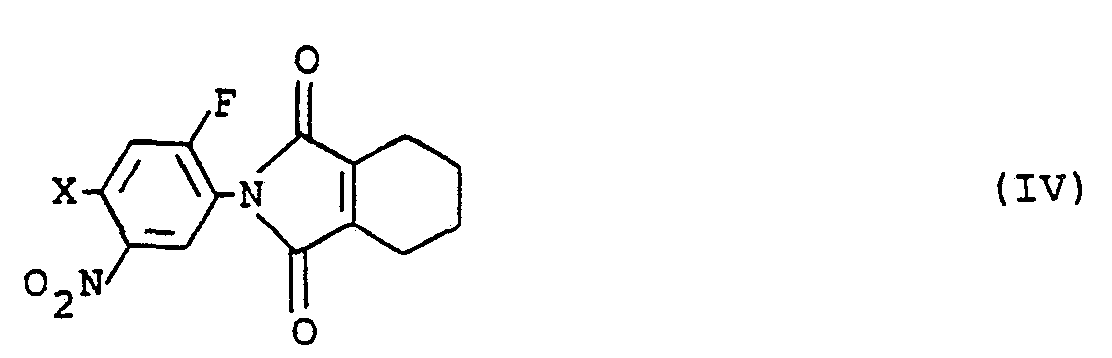
wherein X is as defined above with iron in the presence of an acid in a solvent at a temperature of 20 to 100°C.
wherein X is as defined in claim 1, is prepared by treating a nitrophenyltetrahydrophthalimide of the formula:
wherein X is as defined above with iron in the presence of an acid in a solvent at a temperature of 20 to 100°C.
6. A herbicidal composition which comprises as an active ingredient a herbicidally
effective amount of the compound according to claim 1 and an inert carrier.
7. A method for controlling or exterminating weeds in a plowed field which comprises
applying a herbicidally effective amount of the compound according to claim 1 to the
area where the weeds grow or will grow.
8. The method according to claim 7, wherein the plowed field is a corn or soybean
field.
9. Use of the compound according to claim 1 as a herbicide.
1. Eine Verbindung der Formel
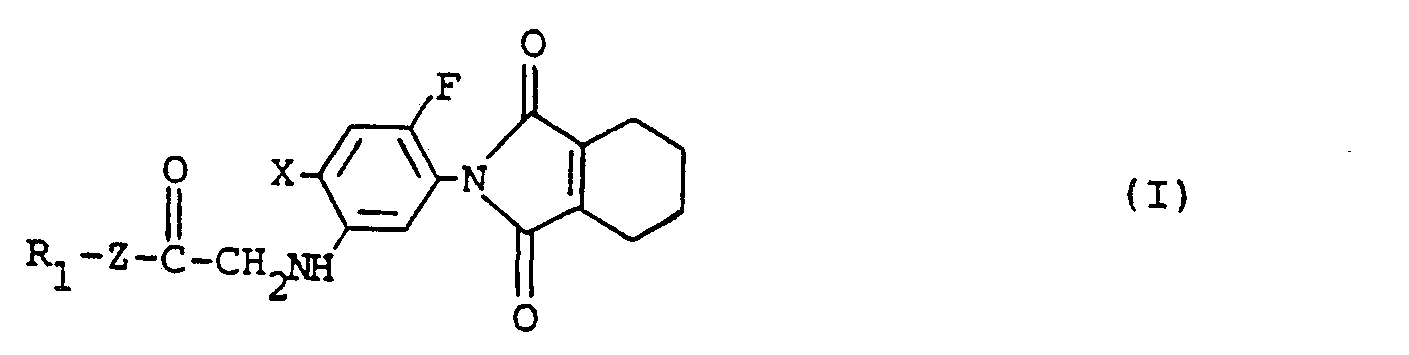
in der R, ein Wasserstoffatom, einen C1―C12-Alkyl-, C3―C8-Cycloalkyl-, C1―C8-Alkyl-(C3―C8)-cycloalkyl-, C3―C8-Cycloalkyl-(C1―C8)-alkyl-, C1―C8-Alkoxy-, C1―C8-Alkyl-, C2―C8-Alkenyl-, C3―C8-Cycloalkenyl-, C3―C8-Cycloalkenyl-(C1―C8)-alkyl-, Phenyl-, Cyano-(C1-C8)-alkyl-, C2―C8-Alkinyl-, C1―C8-Alkylideneamino-, C1―C8-Alkylthio-(C1―C8)-alkyl-, Benzyl-, Halogen-(C1―C8)-alkyl- oder C3―C8-Cycloalkylidenaminorest bedeutet, X ein Chlor- oder Bromatom ist und Z ein Sauerstoff- oder Schwefelatom darstellt.
in der R, ein Wasserstoffatom, einen C1―C12-Alkyl-, C3―C8-Cycloalkyl-, C1―C8-Alkyl-(C3―C8)-cycloalkyl-, C3―C8-Cycloalkyl-(C1―C8)-alkyl-, C1―C8-Alkoxy-, C1―C8-Alkyl-, C2―C8-Alkenyl-, C3―C8-Cycloalkenyl-, C3―C8-Cycloalkenyl-(C1―C8)-alkyl-, Phenyl-, Cyano-(C1-C8)-alkyl-, C2―C8-Alkinyl-, C1―C8-Alkylideneamino-, C1―C8-Alkylthio-(C1―C8)-alkyl-, Benzyl-, Halogen-(C1―C8)-alkyl- oder C3―C8-Cycloalkylidenaminorest bedeutet, X ein Chlor- oder Bromatom ist und Z ein Sauerstoff- oder Schwefelatom darstellt.
2. Verbindung nach Anspruch 1, in der R1 ein Wasserstoffatom, einen C1―C6-Alkyl-, C3-C7-Cycloalkyl-, C1―C6-Alkyl-(C3―C7)-cycloalkyl-, C3-C7-Cycloalkyl-(C1-C6)-alkyl-, C1―C6-Alkoxy-(C1―C6)-alkyl-, C2―C6-Alkenyl-, C5―C6-Cycloalkenyl-, C5―C6-Cycloalkenyl-(C1―C6)-alkyl-, Phenyl-, Cyanon-(C1-C6)-alkyl-, C2―C6-Alkinyl-, C1―C6-Alkylidenamino-, C1―C6-Alkylthio-(C1―C6)-alkyl-, Benzyl-, Chlor-(C1―C6)-alkyl-, Brom-(C1―C6)-alkyl- oder C3―C7-Cycloalkylideneaminorest bedeutet, X ein Chlor- oder Bromatom ist und Z ein Sauerstoff-
oder Schwefel atom darstellt.
3. 2-(4-Chlor-2-fluor-5-cyclopentylmethoxy-carbonylmethyliminophenyl)-4,5,6,7-tetrahydro-2H-indol-1,3-dion.
4. Verfahren zur Herstellung der Verbindung nach Anspruch 1, das Umsetzung eines H2N-Phenyltetrahydrophthalimides der Formel
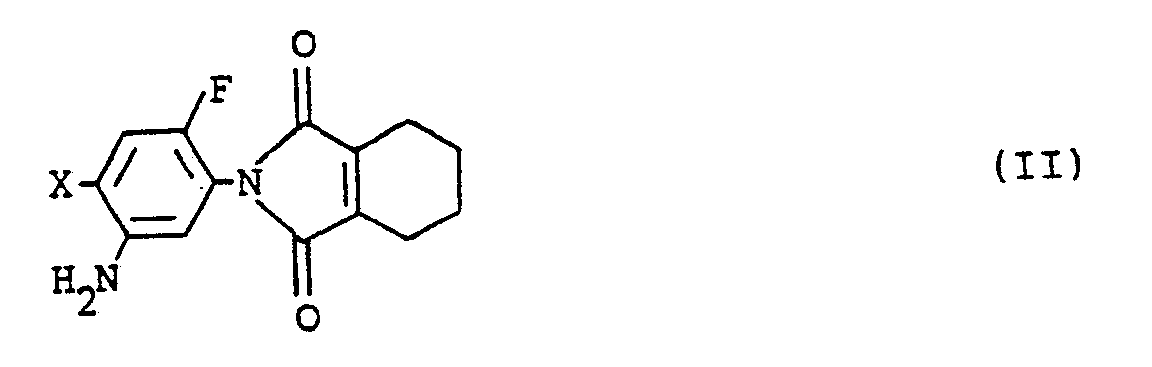
in der X wie in Anspruch 1 definiert ist, mit einem a-Halogencarbonsäureester der Formel

in der A ein Chlor- oder Bromatom ist und R, und Z wie in Anspruch 1 definiert sind, in einem Lösungsmittel in Gegenwart oder Abwesenheit eines Dehydrohalogenierungsmittels bei einer Temperatur von 0 bis 200°C für 1 bis 240 Stunden umfaßt.
in der X wie in Anspruch 1 definiert ist, mit einem a-Halogencarbonsäureester der Formel
in der A ein Chlor- oder Bromatom ist und R, und Z wie in Anspruch 1 definiert sind, in einem Lösungsmittel in Gegenwart oder Abwesenheit eines Dehydrohalogenierungsmittels bei einer Temperatur von 0 bis 200°C für 1 bis 240 Stunden umfaßt.
5. Verfahren nach Anspruch 4, wobei das H2N-Phenyltetrahydrophthalimid der Formel
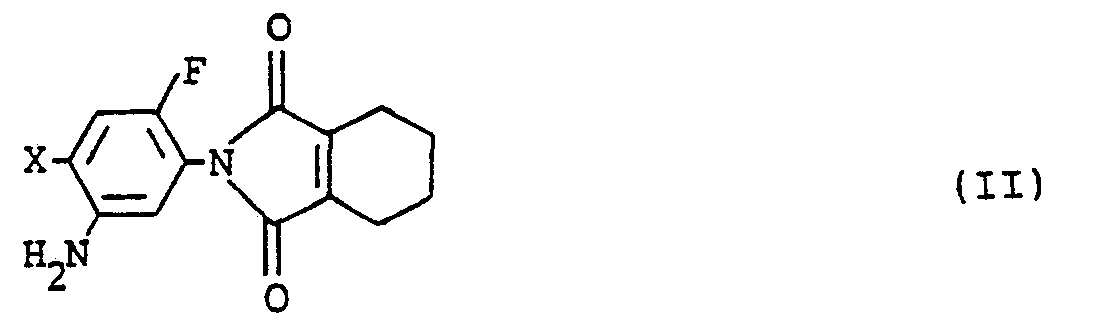
in der X wie im Anspruch 1 definiert ist, durch Behandlung eines Nitrophenyltetrahydrophthalimids der Formel
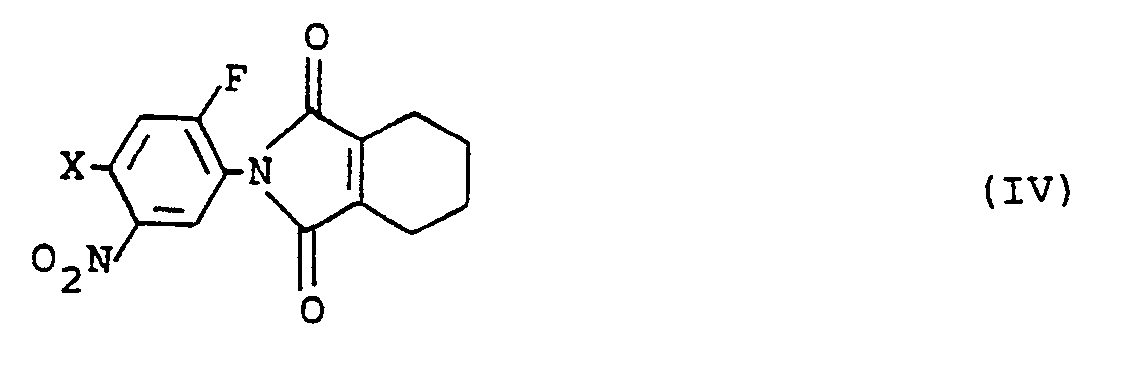
in der X die vorstehend definiert ist, mit Eisen in Gegenwart einer Säure in einem Lösungsmittel bei einer Temperatur von 20 bis 100°C hergestellt worden ist.
in der X wie im Anspruch 1 definiert ist, durch Behandlung eines Nitrophenyltetrahydrophthalimids der Formel
in der X die vorstehend definiert ist, mit Eisen in Gegenwart einer Säure in einem Lösungsmittel bei einer Temperatur von 20 bis 100°C hergestellt worden ist.
6. Herbizides Mittel, umfassend als aktiven Bestandteil eine herbizid wirksame Menge
der Verbindung nach Anspruch 1 und einen inerten Träger.
7. Verfahren zur Bekämpfung oder Vertilgung von Unkraütern in einem gepflügten Feld,
das Aufbringen einer herbizid wirksamen Menge der Verbindung nach Anspruch 1 auf die
Fläche, auf der die Unkräuter wachsen oder wachsen werden, umfaßt.
8. Verfahren nach Anspruch 7, wobei das gepflügte Feld ein Mais-, Getreide- oder Sojabohnenfeld
ist.
9. Verwendung der Verbindung nach Anspruch 1 als Herbizid.
1. Composé de formule:
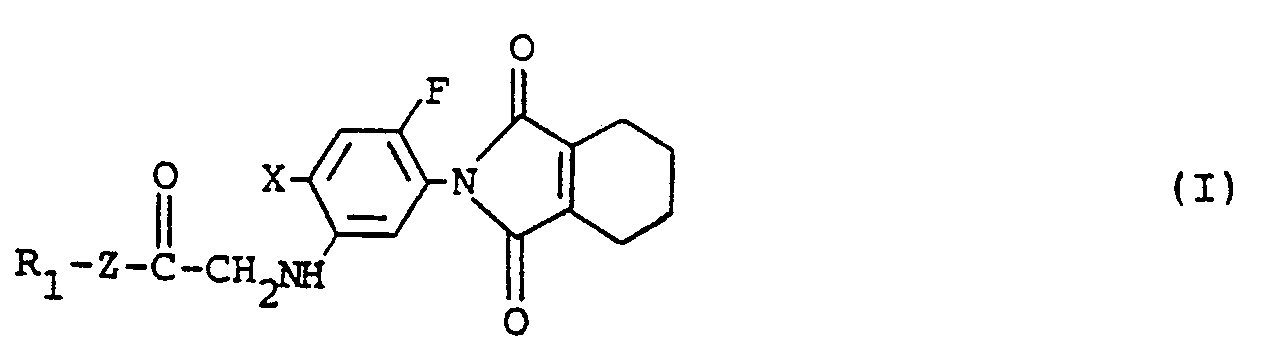
dans laquelle R1 représente un atome d'hydrogène, un groupe alkyle (en C1 à C12), un groupe cycloalkyle (en C3 à C8), un groupe alkyl (en C1 à C8)-cycloalkyle (en C3 à C8), un groupe cycloalkylen (en C3 à C8)-alkyle (en C1 à C8), un groupe alcoxy (en C1 à C8)-alkyle (en C1 à C8), un groupe alcényle (en C2 à C8), un groupe cycloalcényle (en C3 à C8), un groupe cycloalcényl (en C3 à C8)-alkyle (en C1 à C8), un groupe phényle, un groupe cyanoalkyle (en C1 à C8), un groupe alcynyle (en C2 à C8), un groupe alkylidèneamino (en Ci à C8), un groupe alkylthio (en C1 à Ca)-alkyle (en C1 à C8), un groupe benzyle, un groupe halogénoalkyle (en C1 à C8) ou un groupe cycloalkylidèneamino (en C3 à C8); X représente un atome de chlore ou de brome et Z représente un atome d'oxygène ou de soufre.
dans laquelle R1 représente un atome d'hydrogène, un groupe alkyle (en C1 à C12), un groupe cycloalkyle (en C3 à C8), un groupe alkyl (en C1 à C8)-cycloalkyle (en C3 à C8), un groupe cycloalkylen (en C3 à C8)-alkyle (en C1 à C8), un groupe alcoxy (en C1 à C8)-alkyle (en C1 à C8), un groupe alcényle (en C2 à C8), un groupe cycloalcényle (en C3 à C8), un groupe cycloalcényl (en C3 à C8)-alkyle (en C1 à C8), un groupe phényle, un groupe cyanoalkyle (en C1 à C8), un groupe alcynyle (en C2 à C8), un groupe alkylidèneamino (en Ci à C8), un groupe alkylthio (en C1 à Ca)-alkyle (en C1 à C8), un groupe benzyle, un groupe halogénoalkyle (en C1 à C8) ou un groupe cycloalkylidèneamino (en C3 à C8); X représente un atome de chlore ou de brome et Z représente un atome d'oxygène ou de soufre.
2. Composé selon la revendication 1, dans lequel R1 représente un atome d'hydrogène, un groupe alkyle en (C1 à C6), un groupe cycloalkyle (en C3 à C7), un groupe alkyl (en C1 à C6)-cycloalkyle (en C3 à C7), un groupe cycloalkyl (en C3 à C7)-alkyle (en C1 à C6), un groupe alcoxy (en Ci à C6)-alkyle (en C1 à C6) un groupe alcényle (en C2 à C6), un groupe cycloalcényle (en C5 ou Cs), un groupe cycloalcényl (en C5 ou C6)-alkyle (en C1 à C6), un groupe phényle, un groupe cyanoalkyle (en C1 à C6), un groupe alcynyle en (C2 à C6), un groupe alkylidèneamino (en C1 à C6), un groupe alkylthio (en C1 à C6)-alkyle (en C1 à C6), un groupe benzyle, un groupe chloroalkyle (C1 à C6), un groupe bromoalkyle (en C1 à C6) ou un groupe cycloalkylidèneamino (en C3 à C7), X représente un atome de chlore ou de brome, et Z représente un atome d'oxygène
ou de soufre.
3. La 2-(4-chloro-2-fluoro-5-cyclopentylméthoxycarbonylméthyl-iminophényl)-4,5,6,7-tétrahydro-2H-indole-1,3-dione.
4. Procédé pour produire le composé selon la revendication 1, qui comprend la réaction
d'un amino- phényltétrahydrophtalimide de formule:
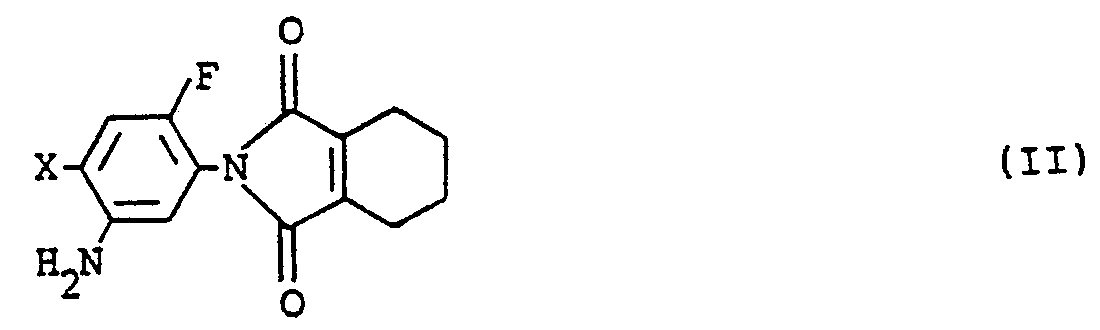
(dans laquelle X est tel que défini à la revendication 1), avec un ester d'acide a-halogénocarboxylique de formule:

(dans laquelle A représente le chlore ou le brome, et R1 et Z sont chacun tel que défini à la revendication 1), dans un solvant en présence ou en l'absence d'un agent de déshydrogénation, à une température de 0 à 200°C durant 1 à 240 h.
(dans laquelle X est tel que défini à la revendication 1), avec un ester d'acide a-halogénocarboxylique de formule:
(dans laquelle A représente le chlore ou le brome, et R1 et Z sont chacun tel que défini à la revendication 1), dans un solvant en présence ou en l'absence d'un agent de déshydrogénation, à une température de 0 à 200°C durant 1 à 240 h.
5. Procédé selon la revendication 4, dans lequel on prépare l'aminophényltétrahydrophtalimide
de formule:
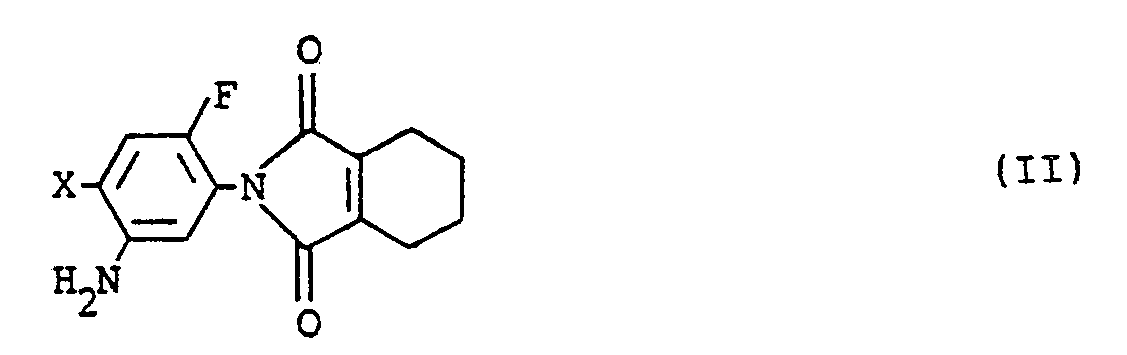
(dans laquelle X est tel que défini à la revendication 1), en traitant un nitrophényltétrahydrophtalimide de formule:
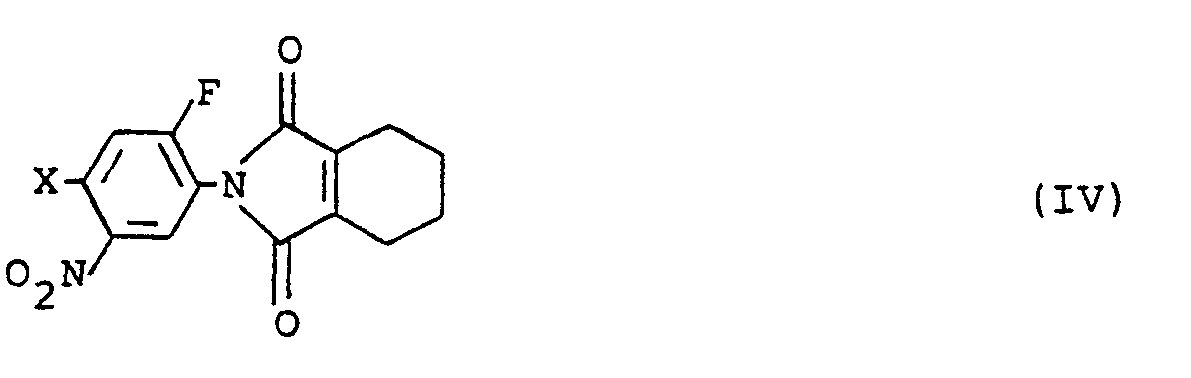
(dans laquelle X est tel que défini ci-dessus) par du fer en présence d'un acide dans un solvant à une température de 20 à 100°C.
(dans laquelle X est tel que défini à la revendication 1), en traitant un nitrophényltétrahydrophtalimide de formule:
(dans laquelle X est tel que défini ci-dessus) par du fer en présence d'un acide dans un solvant à une température de 20 à 100°C.
6. Composition herbicide, qui comprend, comme ingrédient actif, une quantité, efficace
du point de vue herbicide, du composé selon la revendication 1, ainsi qu'un véhicule
ou support inerte.
7. Procédé pour maîtriser ou exterminer des mauvaises herbes dans un champ labouré,
qui comprend l'application d'une quantité, efficace du point de vue herbicide, du
composé selon la revendication 1 à la zone où les mauvaises herbes poussent ou vont
pousser.
8. Procédé selon la revendication 7, dans lequel le champ labouré et cultivé est un
champ de maïs, de blé ou de soja.
9. Utilisation du composé selon la revendication 1 à titre d'herbicide.