|
(11) | EP 0 172 950 B1 |

| (12) | EUROPEAN PATENT SPECIFICATION |
|
|
| (54) |
Polymeric alkylenephosphoric acid piperazine derivatives as scale inhibitors Verhinderung von Kesselstein mit polymerischer Alkylenphosphorsäure und Piperazin-Derivaten Dérivés polymériques de pipérazine et d'acide alkylène phosphorique utilisés comme agents inhibiteurs de tartre |
|
|
||||||||||||||||||||||||||||
| Note: Within nine months from the publication of the mention of the grant of the European patent, any person may give notice to the European Patent Office of opposition to the European patent granted. Notice of opposition shall be filed in a written reasoned statement. It shall not be deemed to have been filed until the opposition fee has been paid. (Art. 99(1) European Patent Convention). |
[0001] The use of methylenephosphonic acid substituted alkylene polyamines for metal ion control at less than stoichiometric amounts was suggested in a patent to Bersworth (U.S. 2,609,390) in 1952. Later a water dispersible polymeric amine chelating agent which included alkylene phosphonate derivatives was indicated as having "threshold" effects in scale inhibition applications (see U.S. 3,331,773), this term being used to describe the use of the agent in less than stoichiometric amounts. The diamine and polyamine methylenephosphonate derivatives are taught and claimed in U.S. patents 3,336,221 and 3,434,969, respectively. Some of the products disclosed in these two patents are available commercially and are recommended as scale inhibitors when applied in threshold amounts.
[0002] Some other patents which disclose heterocyclic nitrogen containing compounds which are useful as chelating agents and may be employed in threshold amounts are U.S. 3,674,804; 3,720,498; 3,743,603; 3,859,211; and 3,954,761. Some of the compounds included therein are heterocyclic compounds having the formulas:
[0003] wherein R is hydrogen or alkyl and M is hydrogen, alkali metal, ammonium or a di- or triethanolamine radical;
and
[0004] Methylenephosphonates of polyalkylene polyamines, disclosed in U.S. patent 4,051,110, are made by reacting di- or polyamines with a chain extending agent such as a dihalide or an epoxyhalide, e.g. ethylene dichloride or epichlorohydrin and thereafter, with phosphorous acid and formaldehyde. Thus, for example, triethylenetetramine is reacted with epichlorohydrin in an approximately one to one mole ratio; thereafter the product is reacted with phosphorous acid, and formaldehyde in the presence of hydrochloric acid. The resulting methylenephosphonated polyamine is useful in small amounts as a scale inhibitor, being employed at concentrations of 20-50 ppm.
[0005] U.S. Patent No. 3674805, referred to above, discloses a product obtained by the phosphonomethylation of 1-(2-aminoethyl)-piperazine, and its use as a scale inhibitor.
[0006] U.S. Patent No. 4064044 discloses products which are obtained by phosphonomethylation of the reaction product of a polyalkyleneamine and a dihalo or haloepoxy organic compound, and the use of such products as scale inhibitors.
[0007] Polymethylenephosphonic acid derivatives of polymers of N-aminoethylpiperazine have now been found to be superior scale inhibitors and may be used in threshold amounts.
[0008] The polymers of the present invention are made by reacting N-aminoethylpiperazine (AEP) with a dihalo or epoxyhalo compound and subsequently reacting the polymer formed thereby with phosphorous acid and formaldehyde at a low pH, usually provided by the presence of a mineral axis, e.g. hydrochloric acid. N-aminoethylpiperazine has the structure:
and may be referred to by the name 1-(2-aminoethyl)piperazine. Hereinafter, it will be abbreviated "AEP".
[0009] Any suitable epoxyhaloalkane (epihalohydrin) having 3-10 carbon atoms may be reacted with AEP to form a dimer or polymer, 1,2-epoxy-3-chloropropane (epichylorohydrin) being preferred. Other epichlorohydrin-type compounds include: 1,2-epoxy-4-chlorobutane, 2,3-epoxy-4-chlorobutane, 1,2-epoxy-5-chloropentane, 2,3-epoxy-5-chloropentane, etc. In general, the chloro derivatives are preferred, although the corresponding bromo or iodo compounds may be employed. Mixtures of epoxyhaloalkanes may also be employed.
[0010] Alternatively dihalides having from 1-20 carbon atoms are used. Saturated dihalides having the formula X(CH2),,X, where X may be chlorine, bromine, iodine or combinations thereof and wherein n is an integer of from 1 to about 10, but preferably 2 to 6, may be employed. Thus, for example, dichloromethane (methylene chloride);, 1,2-dichloroethane (ethylene dichloride), 1,2- or 1,3-dichloropropane, 1,4- or 1,2-dibromobutane and the like may be employed.
[0011] The AEP can be reacted with any number of the specified dihalo or epoxhalo compounds to form a dimer or polymer.
[0012] Aralkylene dihalides can also be employed having the formula X-H2C-Ar-CH2-X wherein Ar is
wherein R may be hydrogen, halogen, alkyl, having 1 to 4 carbon atoms, hydroxy and hydroxyalkyl, having 1 to 4 carbon atoms and X is a halogen atom.
[0013] Dihaloalkyelene ethers can also be employed, e.g. bis(chloromethyl)ether or bis(chloroethyl)ether. Formulas for such ethers also include
wherein n is 1 to 3 and
wherein X is a halogen atom.
[0014] The dihalides may also be unsaturated. Thus, 1,2-dichloroethene, 1,4-dichloro-2-butene and the like may be employed.
[0015] The conditions for making the polymer are to employ the reactants in an amount of from about 0.2 to about 1 mole of the chain extender compound preferably from 0.2 to 0.8 moles, more preferably about 0.25 to about 0.6 moles, i.e. the dihalo- or epoxyhalo-compound, per mole of AEP. The temperature of reaction is from about 50°C to about 100°C, preferably 70°-80°C at a pressure sufficient to maintain the reactants in the liquid phase.
[0016] The phosphonomethylation (Mannich reaction) is then carried out on the product in the presence of a strong acid to maintain the pH at less than 1.
[0017] While the reaction will proceed at temperatures over a wide range, i.e., form 85° to 150°C, it is preferred that the reaction medium be maintained at refluxing. The reaction is preferably conducted at atmospheric pressure, although sub-atmospheric and superatmospheric pressures may be utilized if desired. Reaction times will vary, depending upon a number of variables, but the preferred reaction time is 1 to 5 hours, and the most preferred reaction time is 2 to 4 hours.
[0018] Although the phosphorous acid and the formaldehyde may be added together or separately in any order to the reaction mixture, it is preferred to add the phosphorous acid to the polyamine and then to slowly add the formaldehyde under refluxing conditions.
[0019] Approximately equimolar amounts of formaldehyde and phosphorus acid are employed for the phosphonomethylation of the amine. Excess of either the formaldehyde or acid can be utilized although large excesses of either would be uneconomical. The preferred process will use an amount of formaldehyde equivalent to the amine hydrogens available and a slight stoichiometric excess of the phosphorous acid.
[0021]
wherein A is an organic radical having the formula
wherein Z is hydrogen, hydroxyethyl, hydroxypropyl,
or BA wherein M is hydrogen, an alkali metal or ammonium, and wherein B is a divalent radical which may be derived from a dihalo or haloepoxy organic compound having one of the following structures
wherein Ar is
wherein n is 1-10, n' is 1-3, and wherein R is hydrogen or methyl and R' is hydrogen, an alkyl radical or a hydroxyalkyl radical having 1 to 4 carbons, a hydroxy radical or a halogen atom, m is 1-10 and at least 50% of the Z groups are
groups.
[0022] Preferred compounds of the invention are those wherein the B moiety is derived from 1,2-epoxy-3-chloropropane (epichlorohydrin) or 1,2-dichloroethane, wherein m is 1 or 2, the Z moiety
and M is H, Na or NH4, or, put somewhat differently, at least 50% of the amine hydrogen are phosponomethylated.
Example 1
[0024] An N-aminoethylpiperazine (AEP) based amine was prepared by reacting 22.7 g of N-aminoethylpiperazine (0.176 mole), 9.8 g of 1,2-dichloroethane (DCE) (0.099 mole), and 17.5 g of deionized water (DCE/AEP mole ratio = 0.56) in a 500-ml round-bottom reaction flask equipped with a water-cooled reflux condenser, mechanical stirrer, thermometer with a temperature controller, and an addition funnel. The reaction product was then phosphonomethylated by adding approximately 75 g of concentrated hydrochloric acid and 32.6 g (0.40 mole) of phosphorous acid to the aqueous amine solution and the reaction mixture heated to reflux and maintained for one hour. Aqueous 37% methanal solution (28.1 g-0.35 mole) was added through the addition funnel over a one and one-half hour period. The reaction mixture was heated at reflux for an additional three hours and then cooled. The product was evaluated in the scale inhibition test (see Test Procedure following) and compared with diethylenetriamine- pentamethylenephosphonic acid (DETA-MPA), a commercially available organophosphonic acid. The results are tabulated in Table I.
Example A (Comparative)
[0025] Deionized water (100 g) and 32.7 g (0.25 mole) of 98% N-aminoethylpiperazine were weighed into a 500-ml round-bottom reaction flask equipped with a water-cooled reflux condenser, mechanical stirrer, thermometer with a temperature controller, and an addition funnel. Approximately 90 g of concentrated hydrochloric acid and 73.5 g (0.90 mole) of phosphorous acid were added to the aqueous amine solution. Heating and refluxing were carried out as in Example 1 and then 63.3 g (0.78 mole) of 37% aqueous methanal was added through an addition funnel over one and one-half hours. The reaction mixture was heated at reflux as in Example 1 and cooled. Scale inhibition results, using the following test procedure, are shown in Table I.
TEST PROCEDURE (Scale Inhibition)
[0028] Inhibitor solutions were prepared from the compounds to be evaluated so that a solution with 1% active (as the acid) product was formed.
Procedure
[0029] To a4-ounce (118 ml) wide-mouth bottle was added 50 ml of solution A and a 1 inch (25.4 mm) teflon- coated magnetic stirring bar. To solution A, while stirring, was added 0.1 ml of the 1% solution of the compound to be tested.
[0030] Stirring was continued for approximately one minute, then 50 ml of solution B was added and stirring continued for another three minutes. The stirring bar was removed, the bottle capped, labelled, and placed in an 80°C oven for 24 hours. At the end of 24 hours the sample was removed from the oven and 5 ml of the liquid was extracted (avoiding particulates) and filtered through a 4 pm glass frit. To the filtered sample was added 2 ml of 1 N NaOH and 4 drops of 0.2% Murexide indicator solution. About 70 ml of deionized water was added and the solution titrated with 0.01 M EDTA until the color changed from pink to violet.
[0031] The total calcium concentration is 0.01 M after mixing 50 ml of solution A with 50 ml of solution B. If all of the calcium remains in solution during the 24-hour period at 80°C, then the concentration will still be 0.01 M and this represents 100% inhibition of CaC03. Depending on the performance of the inhibitor being evaluated, some CaC03 will precipitate, leaving less soluble calcium. The titration measures the amount of soluble calcium left in solution after 24 hours at 80°C. This amount is divided by the total amount originally added and the result multiplied by 100 to obtain the percent inhibition.
[0032] The concentration of inhibitor employed in the scale inhibition test was 10 ppm (active acid) based on total weight of solution.
[0033] In the following examples different mole ratios of 1,2-dichloroethane (DCE)/AEP were used. The procedure of Example 1 was followed except for the reactant ratios. Again, 10 ppm of the inhibitor was used. Results are given in Table II.
[0034] It is apparent from the data in the above tables that AEP trimethylenephosphonic acid (Example A) possesses only slight ability to inhibit scale, 46% as compared to no inhibitor at 37%. It can also be seen that the products formed by employing mole ratios of DEC/AEP of from about 0.2 to about 0.8 after phosphonomethylation give an unexpected result when compared to the phosphonomethylated DETA and AEP. It should also be noted that when higher polymers are formed, as in Table II, Example 5, inhibition is only slightly better than that of the AEP monomer but is better than no additive at all.
Example 6
[0035] 1,2-Epoxy-3-chloroprane (epichlorohydrin) was substituted for the 1,2-dichloroethane of Example 1 at a mole ratio of epoxy/amine of 0.50. The resulting methylene phosphonated product at 10 ppm provided 96% inhibition in the scale inhibition test.
[0036] The phosphonomethylated products of the invention are employed in amounts less than stoichiometric, i.e., "threshold amounts". The exact amount will depend on the concentration of metal ions which it is desired to control, but amounts as low as 0.1 ppm or as high as 500 ppm may be employed, based on the weight of solution.
1. The dimer or polymer product obtained by the phosphonomethylation of the reaction
product of (1) 1-(2-aminoethyl)-piperazine with (2) a C, to C20 dihalo or a C3 to C10 haloepoxy organic compound, in an amount of from 0.2 to 1.0 moles of the dihalo or
haloepoxy compound per mole of aminoethylpiperazine.
2. A product as claimed in Claim 1, wherein from 0.2 to 0.8 moles of the dihalo or
haloepoxy compound are used, per mole of aminoethylpiperazine.
3. A product as claimed in Claim 1, wherein from 0.25 to 0.6 moles of the dihalo or
haloepoxy compound are used, per mole of 1-(2-aminoethyl)-piperazine.
4. A product as claimed in Claim 2, wherein the dihalo or haloepoxy compound is epichlorohydrin,
or 1,2-dichloroethane.
5. A compound of the formula
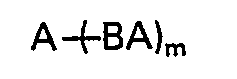
wherein each A independently is an organic radical having the formula

wherein each Z independently is hydrogen, hydroxyethyl, hydroxypropyl,
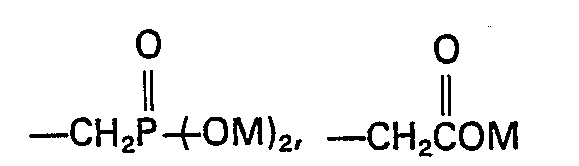
or BA wherein each M independently is hydrogen, an alkali metal or ammonium, and wherein each B independently is a divalent radical having one of the following structures


wherein each Ar independently is
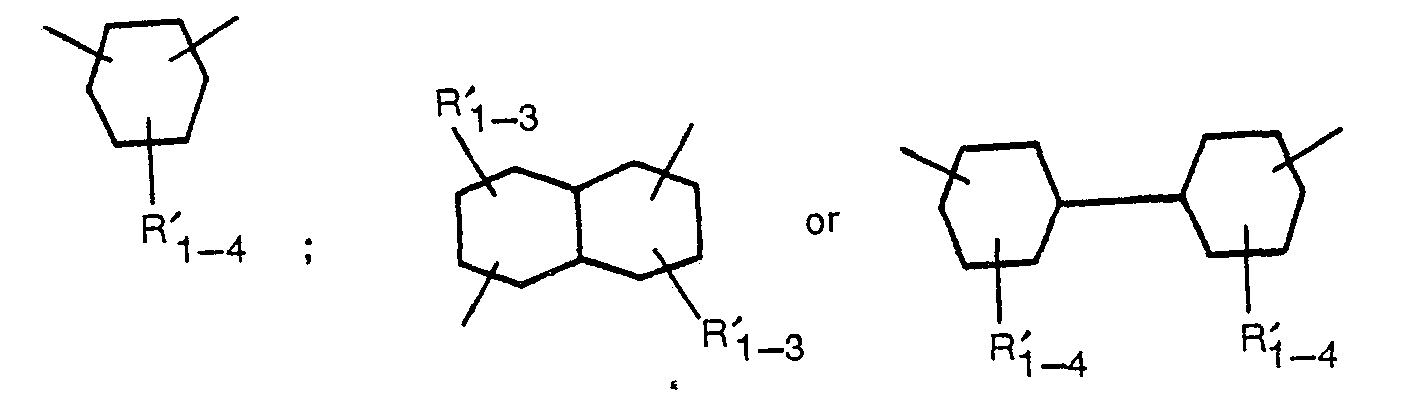
wherein each n independently is 1-10, each n' independently is 1-3, and wherein each R is independently hydrogen or methyl and each R' independently is hydrogen, an alkyl radical or a hydroxyalkyl radical having 1 to 4 carbons, a hydroxy radical or a halogen atom, m is from 1 to 10, and at least 50% of the Z groups are
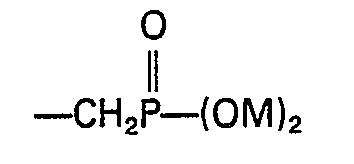
groups.
wherein each A independently is an organic radical having the formula
wherein each Z independently is hydrogen, hydroxyethyl, hydroxypropyl,
or BA wherein each M independently is hydrogen, an alkali metal or ammonium, and wherein each B independently is a divalent radical having one of the following structures
wherein each Ar independently is
wherein each n independently is 1-10, each n' independently is 1-3, and wherein each R is independently hydrogen or methyl and each R' independently is hydrogen, an alkyl radical or a hydroxyalkyl radical having 1 to 4 carbons, a hydroxy radical or a halogen atom, m is from 1 to 10, and at least 50% of the Z groups are
groups.
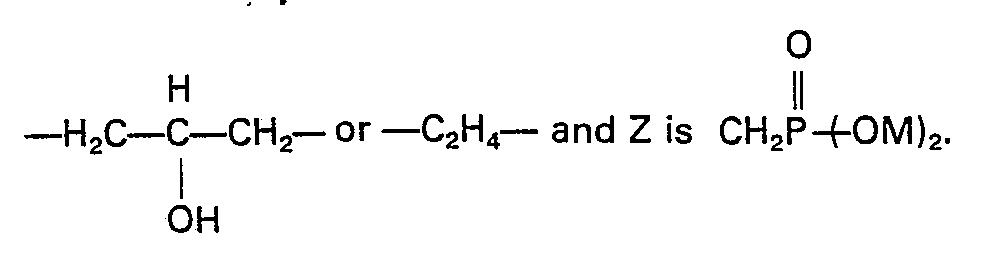
. 6. A compound as claimed in Claim 5, wherein m is 1 or 2, each B is
7. A process for inhibiting scale formation in aqueous solutions, comprising adding
to the solution an organic phosphonate compound, characterised in that the organic
phosphonate is a product as claimed in any one of the Claims 1 to 4, or a compound
as claimed in Claim 5 or Claim 6.
8. A process as claimed in Claim 7, wherein the compound is employed in an amount
which is less than stoichiometric with respect to metal ions in the aqueous solution.
9. A process as claimed in Claim 8, wherein the said amount is from 0.1 to 500 ppm
based on the weight of solution.
1. Dimeres oder polymeres Produkt, erhalten durch die Phosphonomethylierung des Reaktionsprodukts
von (1) 1-(2-Aminoethyl)-piperazin mit (2) einer C,- bis C2o-Dihalo- oder einer C3- bis Clo-Haloepoxyorganischen Verbindung, in einer Menge von 0,2 bis 1,0 Mol der Dihalo- oder
Haloepoxyverbindung pro Mol Aminoethylpiperazin.
2. Produkt nach Anspruch 1, wobei 0,2 bis 0,8 Mol der Dihalo- oder Haloepoxyverbindung
pro Mol Aminoethylpiperazin benutzt wird.
3. Produkt nach Anspruch 1, wobei 0,25 bis 0,6 Mol der Dihalo- oder Haloepoxyverbindung
pro Mol 1-(2-Aminoethyl)-piperazin benutzt wird.
4. Produkt nach Anspruch 2, bei dem die Dihalo- oder Haloepoxyverbindung Epichlorhydrin
oder 1,2-Dichlorethan ist.
5. Eine Verbindung der Formel
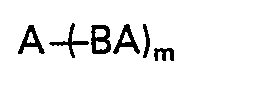
bei der jedes A unabhängig ein organischer Rest mit der Formel

wobei jedes Z unabhängig Wasserstoff, Hydroxyethyl, Hydroxypropyl,

oder BA, wobei jedes M unabhängig Wasserstoff, ein Alkalimetall oder Ammonium ist, und worin jedes B unabhängig ein divalenter Rest mit einer der folgenden Strukturen ist


wobei jedes Ar unabhängig
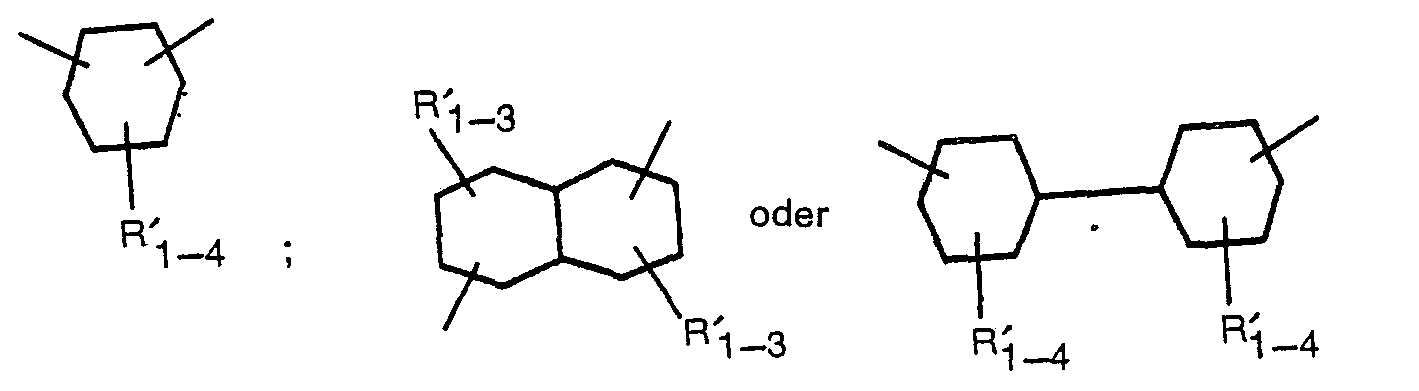
ist, wobei jedes n unabhängig 1 bis 10, jedes n' unabhängig 1 bis 3 ist und worin jedes R unabhängig Wasserstoff oder Methyl und jedes R' unabhängig Wasserstoff, ein Alkylrest oder ein Hydroxyalkylrest mit 1 bis 4 Kohlenstoffen, ein Hydroxyrest oder ein Halogenatom ist, m 1 bis 10 ist, und mindestens 50% der Z-Gruppen
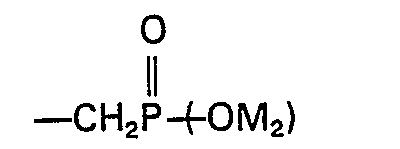
-Gruppen sind.
bei der jedes A unabhängig ein organischer Rest mit der Formel
wobei jedes Z unabhängig Wasserstoff, Hydroxyethyl, Hydroxypropyl,
oder BA, wobei jedes M unabhängig Wasserstoff, ein Alkalimetall oder Ammonium ist, und worin jedes B unabhängig ein divalenter Rest mit einer der folgenden Strukturen ist
wobei jedes Ar unabhängig
ist, wobei jedes n unabhängig 1 bis 10, jedes n' unabhängig 1 bis 3 ist und worin jedes R unabhängig Wasserstoff oder Methyl und jedes R' unabhängig Wasserstoff, ein Alkylrest oder ein Hydroxyalkylrest mit 1 bis 4 Kohlenstoffen, ein Hydroxyrest oder ein Halogenatom ist, m 1 bis 10 ist, und mindestens 50% der Z-Gruppen
-Gruppen sind.
6. Verbindung nach Anspruch 5, wobei m 1 oder 2 ist, jedes
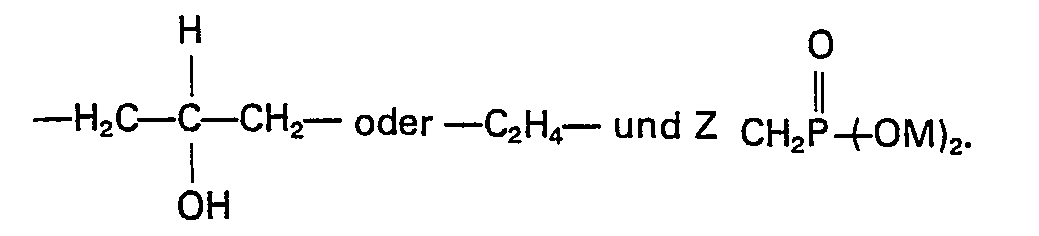
ist.
ist.
7. Verfahren zur Verhinderung der Kesselsteinbildung in wäßrigen Lösungen, umfassend
das Zugeben einer organischen Phosphonatverbindung zu der Lösung, dadurch gekennzeichnet,
daß das organische Phosphonat ein Produkt nach einem der Ansprüche 1 bis 4, oder eine
Verbindung, wie in den Ansprüchen 5 oder 6 beansprucht, ist.
8. Verfahren nach Anspruch 7, bei dem die Verbindung in einer Menge verwendet wird,
die geringer als die stöchiometrische Menge im Hinblick auf die Metallionen in der
wäßrigen Lösung ist.
9. Verfahren nach Anspruch 8, wobei die Menge zwischen 0,1 und 500 ppm, bezogen auf
das Gewicht der Lösung, beträgt.
1. Produit dimère ou polymère qu'on obtient par phosphonométhylation du produit de
réaction de (1) la 1-(2-aminoéthyl)-pipérazine avec (2) un composé organique dihalogéné
en C1-20 ou époxyhalogéné en C3-10, à raison de 0,2 à 1,0 mole du composé dihalogéné ou époxyhalogéné par mole de l'aminoéthyl-
pipérazine.
2. Produit selon la revendication 1, pour lequel on utilise 0,2 à 0,8 mole du composé
dihalogéné ou époxyhalogéné par mole d'aminoéthyl-pipérazine.
3. Produit selon la revendication 1, pour lequel on utilise de 0,25 à 0,6 mole du
composé dihalogéné ou époxyhalogéné par mole de 1-(2-aminoéthyl)pipérazine.
4. Produit selon la revendication 2, dans lequel le composé dihalogéné ou époxyhalogéné
est l'épichlorhydrine ou le 1,2-dichloroéthane.
5. Composé de formule:
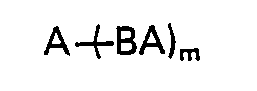
dans laquelle chaque A représente indépendamment un radical organique de formule:

dans laquelle chaque Z représente indépendamment un atome d'hydrogène, un groupe hydroxyéthyle, hydroxypropyle,
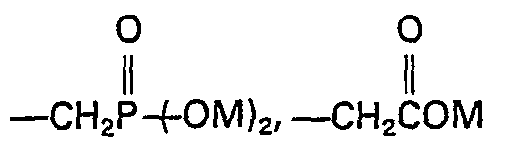
ou bien BA, où chaque M représente indépendamment un atome d'hydrogène, un métal'alcalin ou l'ammonium et chaque B représente indépendamment un radical divalent ayant une des structures suivantes:

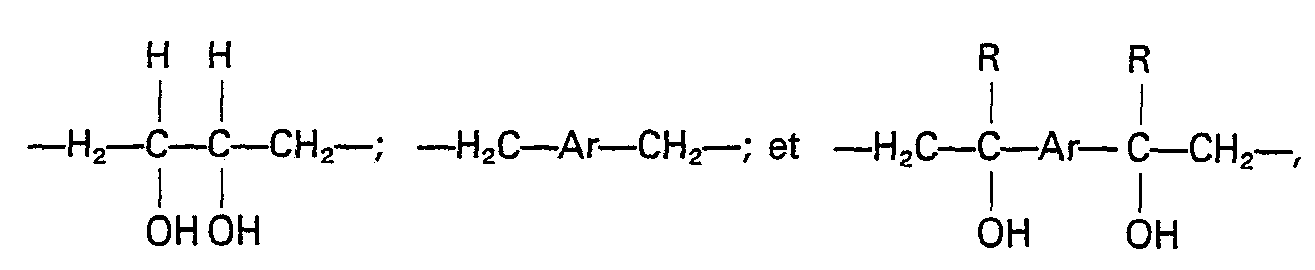
dans laquelle chaque Ar représente indépendamment
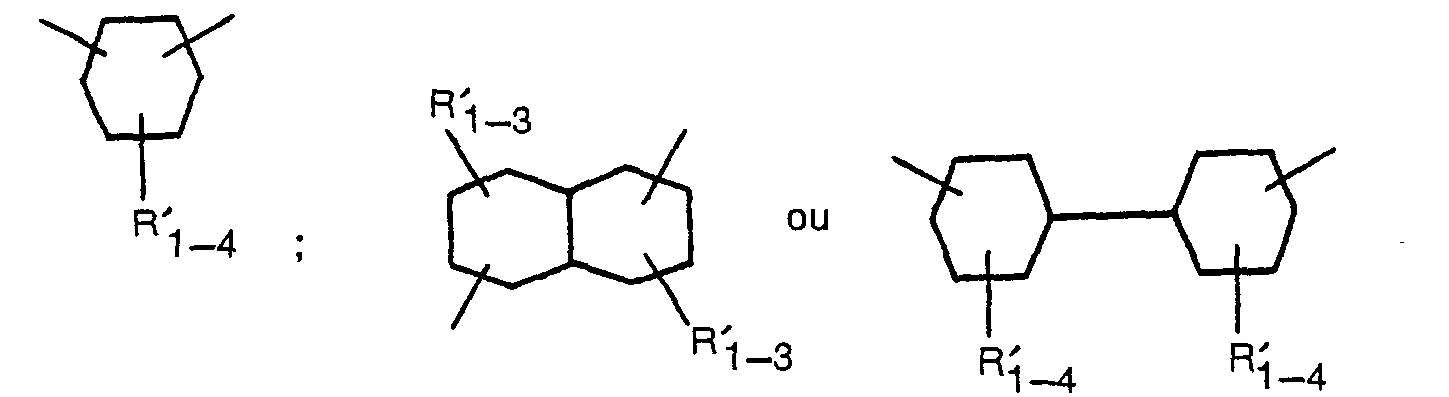
jans lesquelles chaque n est indépendamment un nombre de 1 à 10, chaque n' est indépendamment un nombre de 1 à 3, chaque R représente indépendamment un atome d'hydrogène ou le radical méthyle et :haque R' représente indépendamment un atome d'hydrogène, un radical alkyle ou hydroxyalkyle de 1 à 4 atomes de carbone, un radical hydroxy ou un atome d'halogène, et où m vaut de 1 à 10, au moins 50% des groupes Z étant des groupes
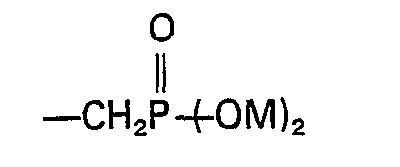
dans laquelle chaque A représente indépendamment un radical organique de formule:
dans laquelle chaque Z représente indépendamment un atome d'hydrogène, un groupe hydroxyéthyle, hydroxypropyle,
ou bien BA, où chaque M représente indépendamment un atome d'hydrogène, un métal'alcalin ou l'ammonium et chaque B représente indépendamment un radical divalent ayant une des structures suivantes:
dans laquelle chaque Ar représente indépendamment
jans lesquelles chaque n est indépendamment un nombre de 1 à 10, chaque n' est indépendamment un nombre de 1 à 3, chaque R représente indépendamment un atome d'hydrogène ou le radical méthyle et :haque R' représente indépendamment un atome d'hydrogène, un radical alkyle ou hydroxyalkyle de 1 à 4 atomes de carbone, un radical hydroxy ou un atome d'halogène, et où m vaut de 1 à 10, au moins 50% des groupes Z étant des groupes
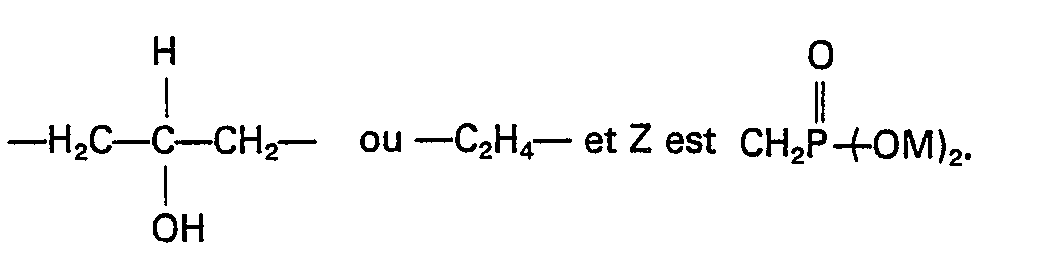
6. Composé selon la revendication 5, dans laquelle m vaut 1 ou 2, chaque B est
7. Procédé d'inhibition de la formation de tartre dans des solutions aqueuses, qui
comporte le fait d'ajouter à la solution un phosphonate organique, caractérisé en
ce que le phosphonate organique est un produit selon l'une quelconque des revendications
1 à 4, ou un composé selon la revendication 5 ou 6.
8. Procédé selon la revendication 7, dans lequel on utilise le composé en une proportion
inférieure à la stoechiométrie par rapport aux ions métalliques dans la solution aqueuse.
9. Procédé selon la revendication 8, dans lequel ladite quantité est de 0,1 à 500
ppm, par rapport au poids de la solution.