|
(11) | EP 0 174 729 B2 |

| (12) | NEW EUROPEAN PATENT SPECIFICATION |
|
|
| (54) |
Optical amplification Optische Verstärkung Amplification optique |
|
|
|||||||||||||||||||||||||||||||
[0002] The amplification of optical signals is of especial importance in optical communications. The radiation used in optical communications is not necessarily in the visible region, and the words "optical" and 'light" when used in this specification are not to be interpreted as implying any such limitations. Indeed, of silica optical fibres are used as the transmission medium, infra-red radiation is of especial usefulness because the loss mirima occur in such fibres at 1.3 µm and 1.55 µm approximately.
[0003] A semiconductor laser comprises in general an "active layer" of low band gap material with higher band gap "confinement" layers to either side and a p-n junction in the vicinity of the active layer. When current is passed from p- to n-type material, electrons and holes combine in the active layer to generate light The threshold current at which the onset of "lasing" occurs depends on the degree of feedback into the structure, e.g. by reflections from its end faces, on the (current dependent) gain through stimulated emission as photons pass along the active layer, and on other factors. At lower currents, the laser functions as a light emitting diode or as a superluminescent emitter. A laser in which the feedback is provided by reflections at end facets is known as a Fabry-Perot laser.
[0004] It is known that a semiconductor laser structure can be used as an optical amplifier cf. e.g. EP-A-0 060 033. Thus, it is known that if a laser structure is chosen having a wavelength of maximum gain close to the wavelength of the optical signal to be amplified and this signal is coupled into its active layer then it can be amplified if a driving current of less than the threshold value is passed through the structure from p- to n-type material. The phrase "laser structure" is used here and elsewhere in this specification to indicate the similarity of the amplifier structure to that of a laser without necessarily implying that lasing actually occurs in use.
[0005] We have given attention to the characteristic of such amplifiers that the amplifier gain for a given driving current is substantially constant from zero input power over a range of lower powers and then decreases to zero and then becomes negative (i.e. net absorption occurs) with higher powers. This is at least partly because the device saturates as the proportion of the available holes and electrons consumed increases. Increasing the driving current can be used to increase the supply of holes and electrons and therefore the gain; however, the extent to which this can be done is limited, because around the lasing threshold of the device injection-locked lasing occurs whereafterthe dependence or the power input of the power output at the single emission wavelength is slight, i.e. useful amplification does not occur.
[0007] The present invention in its first aspect is based on our surprising discovery that the effects of saturation are less marked on the long-wavelength side of the wavelength of maximum gain as measured for lower powers.
[0008] In its first aspect the present invention provides a method of amplifying an optical signal which comprises coupling the optical signal to be amplified into the active layer of a semiconductor laser hetero-structure through which a driving current is passed, the amplified signal being emitted from the active layer, in which method the wavelength of the gain maximum at that driving current for the low power limit of optical power input λmax, the longer of the two wavelengths of zero gain at the driving current for the low power limit of optical power input λupper, and the wavelength of the optical signal to be amplified A are related by the relationships
and
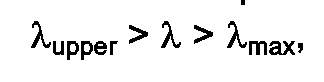
[0009] In its first aspect the present invention further provides an amplification assembly for amplifying an optical signal which comprises an optical signal source, a semiconductor laser hetero-structure, means for coupling the optical signal to be amplified into the active layer of the semiconductor laser hetero-structure, and means for passing a driving current through the semiconductor laser hetero-structure, the amplified signal being emitted from the active layer in use, wherein the wavelength of the gain maximum of the semiconductor laser hetero-structure at that driving current for the low power limit of optical power input λmax, the longer of the two wavelength of zero gain at the driving current λupper, and the wavelength of the optical signal to be amplified A are related by relationships
and
[0011] In a second aspect, our invention is based on our appreciation that if the input wavelength is sufficiently remote from the wavelength of the laser gain maximum to avoid injection-locking, whether on the high side or the low side, useful amplification of the input signal can be obtained with currents in excess of the threshold current.
[0012] In its second aspect, therefore, the present invention provides a method of amplifying an optical signal which comprises coupling the signal to be amplified into the active layer of a semiconductor laser structure and applying a driving current to the laser structure such that lasing occurs, the wavelength of the signal to be amplified being such that injection locking is avoided and the amplified signal is emitted from the active layer.
[0013] In its second aspect, the present invention further provides an amplification assembly for amplifying an optical signal which comprises an optical signal source, a semiconductor laser structure, means for coupling the optical signal to be amplified into the active layer of the semiconductor laser structure, and means for passing a driving current through the semiconductor laser structure such that lasing occurs, the wavelength of the signal to be amplified being such that injection locking is avoided and the amplified signal being emitted from the active layer.
[0014] In a third aspect, the present invention is based on our appreciation that the output of a laser structure under use as an optical amplifier is diminished over its entire emission range (not merely at the wavelength of the input signal) by the saturation referred to above and that this diminution offers a means of controlling the current so as to raise up the amplifier gain at higher input powers.
[0015] In this third aspect, therefore, the present invention provides a method of amplifying an optical signal which comprises coupling the signal to be amplified into the active layer of a semiconductor laser structure through which a driving current is passed, which layer emits the amplified signal, and monitoring the light emission from the active layer at a wavelength or over a wavelength range distinct from that of the amplified signal, and controlling the driving current to the laser structure so as at least partly to compensate for the decrease in the monitored output with increasing optical input.
[0016] In its third aspect, the present invention further provides an amplification assembly for amplifying an optical signal which comprises an optical signal source, a semiconductor laser structure, means for coupling the optical signal to be amplified into the active layer of the semiconductor laser structure, and means for passing a driving current through the semiconductor laser structure, the amplified signal being emitted from the active layer in use, wherein means is provided to monitor the output of the semiconductor laser structure at a wavelength or over a wavelength range distinct from that of the amplified signal, and a feedback control loop is provided which acts to control the driving current so as at least partly to compensate for the decrease in the monitored output with increased optical input power.
[0017] The invention can be employed independently in each of its three aspects, or in all three simultaneously, or in any of the three possible combinations of two aspects. In its first and third aspects, the invention can even be applied to a laser structure with so little feedback that it cannot be made to lase at any practical current (e.g. a travelling wave amplifier).
[0018] The invention will now be described by way of example only, with respect to the accompanying Figures 1 to 4 in which:-
Figure 1 shows the photon distribution along the cavity of a semiconductor laser amplifier;
Figure 2 shows the gain characteristics at different input powers of a particular semiconductor laser amplifier as calculated by means of a computer model (only selected results being shown);
Figure 3 shows (schematically, smoothed, and generalised) the results of calculations such as those selected for inclusion in Figure 2; and
Figure 4 shows, schematically and not to scale, a semiconductor laser amplification assembly which is an embodiment of the present invention in all three aspects.
[0019] Figure 1 shows how in a typical semiconductor laser amplifier the signal intensity S varies with length along the cavity of the amplifier. The signal intensity S comprises two components 21, 22 representing the forward and reflected waves travelling in opposed directions along the amplifier. The variation in signal intensity S along the length 1 of the amplifier leads to consequent variation in carrier density and gain.
[0020] We have constructed an analytical model of the laser amplifier in which the total axial photon distribution 23 is averaged over the cavity length and used to self-consistently determine a uniform carrier density. We have incorporated the refinement of a spectrally dependent gain function (the peak of which shifts with the carrier density) and the effect of carrier density on the refractive index within the cavity.
[0021] Figure 2 shows results for the gain characteristics obtained by use of this model for a Fabry-Perot laser amplifier operable near the 1.55 µm loss minimum of silica fibres in which the reflectivity of each end facet is taken to be 0.01. The current density is taken to be 0.97 times the threshold current density. The mode spacing of the laser is taken as 1 nm. The detailed results of calculations for various input powers are shown only for selected wavelengths so as to avoid congestion. The dotted lines which connect the results shown represent the general trend of the gain characteristics between these results without including detail.
[0022] It will be seen that the gain characteristics, as well as depending on wavelength and input power, show Fabry-Perot resonances. At the lowest input power the trend in the characteristics follows the trend of the material gain spectrum with the largest values of the amplification occurring at the gain peak at 1.5525 µm. With increasing input power the carrier density decreases. This reduces the amplification overall and shifts the gain peak to longer wavelengths as well as modifying the carrier-dependent refractive index.
[0024] Hence when the input power is increased from 10⁻¹⁰W to 10⁻⁶W, the gain peak has already shifted to a longer wavelength; 1.5572 µm. The reduction in gain (13.7 dB to 13.0 dB) seen at the wavelength of maximum gain at low power 1.5525 µm, when the input power is increased to 10⁻⁶W, can therefore be at least partially offset by operation at up to at least 1.5572 µm.
[0025] Referring still to Figure 2, as the input power is further increased, increasingly significant reductions in overall amplification are seen. At the same time the gain peak is shifted to increasingly longer wavelengths. The result is that increasing benefit is available, in offsetting the overall reduction in amplification by operating at longer wavelengths, as the input power is increased from 10⁻¹⁰W to 10⁻⁶W, 10⁻⁵W and through the values shown to 5×10⁻⁵W. It has further been observed, though not shown in Figure 2, that particularly significant benefit can be had at input powers of the order of 1 mW, for instance at input powers of 0.5 mW to 5 mW inclusive.
[0026] In Figure 3 the amplifier gain as a function of input power for a given current is shown for three different wavelengths, B near to the wavelength of maximum gain, A somewhere on the low wavelength side but within the positive part of the gain curve, and C on the long-wavelength side but likewise within the positive part of the gain curve, C showing a gain at lower power similar to that of curve A. The effect of Fabry-Perot resonances has been smoothed out. It will be seen from the part of the Figure where curve C lies highest why, if one wishes to amplify a higher input power at a particular wavelength, one can achieve best results (in accordance with the invention in its first aspect) by using a laser amplifier of which the maximum gain at low power is at a shorter wavelength than the signal to be amplified.
[0027] Referring again to Figure 2, it can be seen that there is a further benefit to be gained from operating at an input wavelength which is greater than the wavelength of maximum gain at low powers. The variation in gain due to increasing input powers for the wavelength of maximum gain at low powers, and for two wavelengths selected to be longer and shorter respectively, are shown in the following Table:
[0028] The further benefit referred to above is that of reduced sensitivity to increases over a range of input power. It can be seen that the reduction in gain at 1.5525 µm over the range of input powers shown is just over 37% whereas the reduction in gain at 1.5700 µm is slightly less than 27%. This reduced sensitivity to increases in input power gives the amplifier the desirable feature of having a more linear gain characteristic for increasing signal input powers. In contrast, the equivalent reduction in gain at 1.5400 µm is more than 47%.
[0030] In Figure 4, 1 represents an optical fibre carrying an input signal of wavelength 1580 nm (1.58 µm) from an optical signal source (not shown). This is coupled from the fibre end into activer layer 3 of a Fabry-Perot laser structure 2. This structure is one having a maximum gain at the low power limit of optical power input at a wavelength of 1550 nm (1.55 µm), the positive part of the gain spectrum at the low power limit of optical power input extending to 1600 nm (1.60 µm) on the long wavelength side and having an approximately similar extent to the low wavelength side. Current of above the threshold level is passed between electrodes 4 and 5 and lasing occurs in various Fabry-Perot modes distributed over the gain spectrum.
[0031] Amplification occurs at the wavelength 1580 nm of the input signal. Light emerges from 3 and is fed via lens 6 into interference filter 7. The interference filter reflects a band of radiation near to 1550 nm but not significantly the radiation at 1580 nm to lens 8 and optical detector 9. The signal including the amplified 1580 nm signal continues to lens 10 and the output optical fibre 11. (λ-λmax)/(λupper-λmax) as defined above is 0.6.
[0032] In accordance with the invention in its first aspect, the gain for high input powers from fibre 1 is higher than would have been the case had the wavelength of maximum gain of laser 2 been at 1.58 µm for the low power limit. In accordance with the invention in its second aspect, the difference between λ and λmax is such that amplification occurs even for currents of above threshold, and this higher permitted current makes also for high gain. (This latter effect would be present even had the input radiation been at (say) 1.52 µm, i.e. had the first aspect of the invention not been exploited).
[0033] In the Figure, a further although independent benefit is afforded, in accordance with the present invention in its third aspect, by the use of a feedback control loop. The loop comprises the filter 7, the lens 8, the detector 9 and the control circuit 12 which receives the output signal of the detector 9. The control circuit 12 is designed to adjust the current passed between electrodes 4 and 5 to maintain a constant output from detector 9, and thereby constant amplifier gain. This circuitry would, it should be mentioned, be of value even in operation with currents below lasing threshold.
[0034] For optimum performance in the device described, the end facets will normally be anti-reflection coated, e.g. to achieve reflectivities of 0.01.
[0035] Semiconductor laser structures other than that described above may be employed. However, their characteristics, such as the input power at which significant benefits may be gained by application of the present invention, will vary from those described above.
[0036] One use of the device shown, and indeed generally of methods and amplification assemblies in accordance with the present invention, is in optical communications systems where the light from the laser source is passed through lossy components such as modulators or optical isolators before being coupled into the optical fibre of the communications link. Such arrangements are of especial significance for coherent optical systems. By using the device shown, the signal emerging from these lossy components can be amplified to make up for the losses. The input powers desired in such cases are in general high ones in the context of this specification, and therefore ones where the present invention affords advantages. Gains of about 10 dB are achievable even for input powers of 5 mW. Power on launch into the communications link is of course of the greatest importance in determining repeater spacings.
[0037] In such an application it is possible to use as the source laser and the amplifying laser devices that are practically identical except that the latter is anti-reflection coated. The source laser will lase at relatively low currents with a wavelength longer than that of the amplifier laser when made to lase with the relatively high currents that are necessary, and longer than the wavelength of maximum gain at low powers of the amplifier laser. In this way one can with relative ease secure the benefits in accordance with the present invention in its first aspect.
1. A method of amplifying an optical signal which comprises coupling the optical signal
to be amplified into the active layer of a semiconductor laser hetero-structure through
which a driving current is passed, the amplified signal being emitted from the active
layer, in which method the wavelength of the gain maximum at that driving current
for the low power limit of optical power input λmax, the longer of the two wavelengths of zero gain at the driving current for the low
power limit of optical power input λupper, and the wavelength of the optical signal to be amplified λ are related by the relationships

and

and
2. A method according to claim 1, wherein

3. A method according to any preceding claim wherein λmax is in the range from 1.2 to 1. 7µm.
4. A method according to any preceding claim wherein the driving current is such that
lasing does not occur.
5. A method according to any of claims 1 to 3, wherein the driving current is such that
lasing occurs and the wavelength of the optical signal to be amplified is such that
injection locking of the laser does not occur.
6. A method of amplifying an optical signal which comprises coupling the signal to be
amplified into the active layer of a semiconductor laser structure and applying a
driving current to the laser structure such that lasing occurs, the wavelength of
the signal to be amplified being such that injection locking is avoided and the amplified
signal is emitted from the active layer.
7. A method according to any one of claims 1 to 6 wherein the output of the semiconductor
laser structure is monitored at a wavelength or over a wavelength range distinct from
that of the amplified signal and the driving current is controlled so as at least
partly to compensate for the decrease in the monitored output with increased optical
input.
8. A method of amplifying an optical signal which comprises coupling the signal to be
amplified into the active layer of a semiconductor laser structure through which a
driving current is passed, which layer emits the amplified signal, and monitoring
the light emission from the active layer at a wavelength or over a wavelength range
distinct from that of the amplified signal, and controlling the driving current to
the laser structure so as at least partly to compensate for the decrease in the monitored
output with increasing optical input.
9. A method according to any preceding claim, wherein the signal to be amplified has
a power which lies in the range from 1µW to 5mW inclusive.
10. A method according to any preceding claim, wherein the signal to be amplified has
a power which lies in the range from 10µW to 5mW inclusive.
11. An amplification assembly for amplifying an optical signal which comprises an optical
signal source, a semiconductor laser hetero-structure, means for coupling the optical
signal to be amplified into the active layer of the semiconductor laser hetero-structure,
and means for passing a driving current through the semiconductor laser hetero-structure,
the amplified signal being emitted from the active layer in use, wherein the wavelength
of the gain maximum of the semiconductor laser hetero-structure at that driving current
for the low power limit of optical power input λmax, the longer of the two wavelengths of zero gain at the driving current for the low
power limit of optical power input λupper, and the wavelength of the optical signal to the amplified λ are related by the relationships
and

and
12. An assembly according to claim 11, wherein

13. An assembly according to claim 11 or claim 12, wherein λmax is in the range from 1.2 to 1.7µm.
14. An assembly according to any of claims 11 to 13, wherein the driving current is such
that lasing does not occur.
15. An assembly according to any of claims 11 to 13 wherein the driving current is such
that lasing occurs and the wavelength of the optical signal to be amplified is such
that injection locking of the laser does not occur.
16. An amplification assembly for amplifying an optical signal which comprises an optical
signal source, a semiconductor laser structure, means for coupling the optical signal
to be amplified into the active layer of the semiconductor laser structure, and means
for passing a driving current through the semiconductor laser structure such that
lasing occurs, the wavelength of the signal to be amplified being such that injection
locking is avoided and the amplified signal being emitted from the active layer.
17. An assembly according to any one of claims 11 to 16 wherein means is provided to monitor
the output of the semiconductor laser structure at a wavelength or over a wavelength
range distinct from that of the amplified signal and a feedback control loop is provided
which acts to control the driving current so as at least partly to compensate for
the decrease in the monitored output with increased optical input power.
18. An amplification assembly for amplifying an optical signal which comprises an optical
signal source, a semiconductor laser structure, means for coupling the optical signal
to be amplified into the active layer of the semiconductor laser structure, and means
for passing a driving current through the semiconductor laser structure, the amplified
signal being emitted from the active layer in use, wherein means is provided to monitor
the output of the semiconductor laser structure at a wavelength or over a wavelength
range distinct from that of the amplified signal and a feedback control loop is provided
which acts to control the driving current so as at least partly to compensate for
the decrease in the monitored output with increased optical input power.
19. An assembly according to any one of claims 11 to 18, wherein the signal to be amplified
has a power which lies in the range from 1µW to 5mW inclusive.
20. An assembly according to any one of claims 11 to 18, wherein the signal to be amplified
has a power which lies in the range from 10µW to 5mW.
21. An assembly according to any one of claims 11 to 18, wherein the signal to be amplified
has a power which lies in the range from 0.5mW to 5mW inclusive.
22. An assembly according to any one of claims 11 to 21, wherein the semiconductor laser
structure is of a Fabry-Perot type.
1. Verfahren zur Verstärkung eines optischen Signals, das ein Koppeln des zu verstärkenden
optischen Signals in die aktive Schicht einer Halbleiterlaser-Heterostruktur umfaßt,
durch die ein Treiberstrom geleitet wird, wobei das verstärkte Signal von der aktiven
Schicht emittiert wird und bei dem Verfahren die Wellenlänge λmax mit der maximalen Verstärkung bei diesem Treiberstrom für die niedrige Leistungsgrenze
des optischen Leistungseingangs, die größere der zwei Wellenlängen λupper mit der Nullverstärkung bei dem Treiberstrom für die niedrige Leistungsgrenze des
optischen Leistungseingangs und die Wellenlänge λ des zu verstärkenden optischen Signals
die Verhältnisse
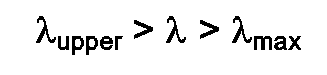
und

zueinander aufweisen.
und
zueinander aufweisen.
2. Verfahren nach Anspruch 1,
dadurch gekennzeichnet, daß

dadurch gekennzeichnet, daß
3. Verfahren nach einem der vorhergehenden Ansprüche,
dadurch gekennzeichnet, daß
λmax im Bereich von 1,2 bis 1,7 µm liegt.
dadurch gekennzeichnet, daß
λmax im Bereich von 1,2 bis 1,7 µm liegt.
4. Verfahren nach einem der vorhergehenden Ansprüche,
dadurch gekennzeichnet, daß
der Treiberstrom derart ist, daß keine Lasertätigkeit auftritt.
dadurch gekennzeichnet, daß
der Treiberstrom derart ist, daß keine Lasertätigkeit auftritt.
5. Verfahren nach einem der Ansprüche 1 bis 3,
dadurch gekeinnzeichnet, daß
der Treiberstrom derart ist, daß eine Lasertätigkeit auftritt und die Wellenlänge des zu verstärkenden optischen Signals derart ist, daß keine Injektionsblockierung des Lasers auftritt.
dadurch gekeinnzeichnet, daß
der Treiberstrom derart ist, daß eine Lasertätigkeit auftritt und die Wellenlänge des zu verstärkenden optischen Signals derart ist, daß keine Injektionsblockierung des Lasers auftritt.
6. Verfahren zur Verstärkung eines optischen Signals, das ein Koppeln des zu verstärkenden
Signals in die aktive Schicht einer Halbleiterlaserstruktur und das Anlegen eines
Treiberstroms an die Laserstruktur umfaßt, so daß eine Lasertätigkeit auftritt, wobei
die Wellenlänge des zu verstärkenden Signals derart ist, daß eine Injektionsblockierung
vermieden und das verstärkte Signal von der aktiven Schicht emittiert wird.
7. Verfahren nach einem der Ansprüche 1 bis 6,
dadurch gekennzeichnet, daß
der Ausgang der Halbleiterlaserstruktur bei einer Wellenlänge oder über einen Wellenlängenbereich, die bzw. der sich von der des verstärkten Signals unterscheidet, überwacht wird und der Treiberstrom gesteuert wird, um bei einem gesteigerten optischen Eingang zumindest teilweise die Verringerung des überwachten Ausgangs zu kompensieren.
dadurch gekennzeichnet, daß
der Ausgang der Halbleiterlaserstruktur bei einer Wellenlänge oder über einen Wellenlängenbereich, die bzw. der sich von der des verstärkten Signals unterscheidet, überwacht wird und der Treiberstrom gesteuert wird, um bei einem gesteigerten optischen Eingang zumindest teilweise die Verringerung des überwachten Ausgangs zu kompensieren.
8. Verfahren zur Verstärkung eines optischen Signals, das ein Koppeln des zu verstärkenden
Signals in die aktive Schicht einer Halbleiterlaserstruktur, durch die ein Treiberstrom
geleitet wird, wobei die Schicht das verstärkte Signal emittiert, und das Überwachen
der Lichtemission von der aktiven Schicht bei einer Wellenlänge oder über einen Wellenlängenbereich,
die bzw. der sich von der des verstärkten Signals unterscheidet, und eine Steuerung
des Treiberstroms für die Laserstruktur umfaßt, um bei einem steigenden optischen
Eingang zumindest teilweise die Verringerung des überwachten Ausgangs zu kompensieren.
9. Verfahren nach einem der vorhergehenden Ansprüche,
dadurch gekennzeichnet, daß
das zu verstärkende Signal eine Leistung aufweist, die im Bereich von 1 µW bis 5 mW liegt.
dadurch gekennzeichnet, daß
das zu verstärkende Signal eine Leistung aufweist, die im Bereich von 1 µW bis 5 mW liegt.
10. Verfahren nach einem der vorhergehenden Ansprüche,
dadurch gekennzeichnet, daß
das zu verstärkende Signal eine Leistung aufweist, die im Bereich von 10 µW bis 5 mW liegt.
dadurch gekennzeichnet, daß
das zu verstärkende Signal eine Leistung aufweist, die im Bereich von 10 µW bis 5 mW liegt.
11. Verstärkerbaugruppe zur Verstärkung eines optischen Signals, die eine Quelle für optische
Signale, eine Halbleiterlaser-Heterostruktur, eine Einrichtung zum Koppeln des zu
verstärkenden optischen Signals in die aktive Schicht der Halbleiterlaser-Heterostruktur
und eine Einrichtung zum Leiten eines Treiberstroms durch die Halbleiterlaser-Heterostruktur
umfaßt, wobei das verstärkte Signal von der verwendeten aktiven Schicht emittiert
wird und die Wellenlänge λmax mit der maximalen Verstärkung der Halbleiterlaser-Heterostruktur bei diesem Treiberstrom
für die niedrige Leistungsgrenze des optischen Leistungseingangs, die längere der
zwei Wellenlängen λupper mit Nullverstärkung bei dem Treiberstrom und die Wellenlänge λ des zu verstärkenden
optischen Signals die Verhältnisse
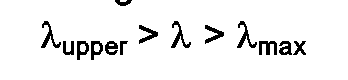
und

zueinander aufweisen.
und
zueinander aufweisen.
12. Baugruppe nach Anspruch 11,
dadurch gekennzeichnet, daß

dadurch gekennzeichnet, daß
13. Baugruppe nach Anspruch 11 oder 12,
dadurch gekennzeichnet, daß
λmax im Bereich von 1,2 bis 1,7 µm liegt.
dadurch gekennzeichnet, daß
λmax im Bereich von 1,2 bis 1,7 µm liegt.
14. Baugruppe nach einem der Ansprüche 11 bis 13,
dadurch gekennzeichnet, daß
der Treiberstrom derart ist, daß keine Lasertätigkeit auftritt.
dadurch gekennzeichnet, daß
der Treiberstrom derart ist, daß keine Lasertätigkeit auftritt.
15. Baugruppe nach einem der Ansprüche 11 bis 13,
dadurch gekennzeichnet, daß
der Treiberstrom derart ist, daß eine Lasertätigkeit auftritt und die Wellenlänge des zu verstärkenden optischen Signals derart ist, daß keine Injektionsblockierung des Lasers auftritt.
dadurch gekennzeichnet, daß
der Treiberstrom derart ist, daß eine Lasertätigkeit auftritt und die Wellenlänge des zu verstärkenden optischen Signals derart ist, daß keine Injektionsblockierung des Lasers auftritt.
16. Verstärkerbaugruppe zur Verstärkung eines optischen Signals, die eine Quelle für optische
Signale, eine Halbleiterlaserstruktur, eine Einrichtung zum Koppeln des zu verstärkenden
optischen Signals in die aktive Schicht der Halbleiterlaserstruktur und eine Einrichtung
zum Leiten eines Treiberstroms durch die Halbleiterlaserstruktur umfaßt, so daß eine
Lasertätigkeit auftritt, wobei die Wellenlänge des zu verstärkenden Signals derart
ist, daß eine Injektionsblockierung vermieden und das verstärkte Signal von der aktiven
Schicht emittiert wird.
17. Baugruppe nach einem der Ansprüche 11 bis 16,
dadurch gekennzeichnet, daß
eine Einrichtung zur Überwachung des Ausgangs der Halbleiterlaserstruktur bei einer Wellenlänge oder über einen Wellenlängenbereich, die bzw. der sich von der verstärkten Signal unterscheidet, und eine Rückführungssteuerschleife zur Steuerung des Treiberstroms vorgesehen sind, um bei einer gesteigerten Leistung des optischen Eingangs zumindest teilweise die Verringerung des überwachten Ausgangs zu kompensieren.
dadurch gekennzeichnet, daß
eine Einrichtung zur Überwachung des Ausgangs der Halbleiterlaserstruktur bei einer Wellenlänge oder über einen Wellenlängenbereich, die bzw. der sich von der verstärkten Signal unterscheidet, und eine Rückführungssteuerschleife zur Steuerung des Treiberstroms vorgesehen sind, um bei einer gesteigerten Leistung des optischen Eingangs zumindest teilweise die Verringerung des überwachten Ausgangs zu kompensieren.
18. Verstärkerbaugruppe zur Verstärkung eines optischen Signals, die eine Quelle für optische
Signale, eine Halbleiterlaserstruktur, eine Einrichtung zum Koppeln des zu verstärkenden
optischen Signals in die aktive Schicht der Halbleiterlaserstruktur und eine Einrichtung
zum Leiten eines Treiberstroms durch die Halbleiterlaserstruktur umfaßt, wobei das
verstärkte Signal von der verwendeten aktiven Schicht emittiert wird und eine Einrichtung
zur Überwachung des Ausgangs der Halbleiterlaserstruktur bei einer Wellenlänge oder
über einen Wellenlängenbereich, die bzw. der sich von der verstärkten Signal unterscheidet,
und eine Rückführungssteuerschleife zur Steuerung des Treiberstroms vorgesehen sind,
um zumindest teilweise die Verringerung des überwachten Ausgangs bei einer gesteigerten
Leistung des optischen Eingangs zu kompensieren.
19. Baugruppe nach einem der Ansprüche 11 bis 18,
dadurch gekennzeichnet, daß
das zu verstärkende Signal eine Leistung aufweist, die im Bereich von 1 µW bis einschließlich 5 mW liegt.
dadurch gekennzeichnet, daß
das zu verstärkende Signal eine Leistung aufweist, die im Bereich von 1 µW bis einschließlich 5 mW liegt.
20. Baugruppe nach einem der Ansprüche 11 bis 18,
dadurch gekennzeichnet, daß
das zu verstärkende Signal eine Leistung aufweist, die im Bereich von 10 µW einschließlich bis 5 mW liegt.
dadurch gekennzeichnet, daß
das zu verstärkende Signal eine Leistung aufweist, die im Bereich von 10 µW einschließlich bis 5 mW liegt.
21. Baugruppe nach einem der Ansprüche 11 bis 18,
dadurch gekennzeichnet, daß
das zu verstärkende Signal eine Leistung aufweist, die im Bereich von 0,5 mW bis einschließlich 5 mW liegt.
dadurch gekennzeichnet, daß
das zu verstärkende Signal eine Leistung aufweist, die im Bereich von 0,5 mW bis einschließlich 5 mW liegt.
22. Baugruppe nach einem der Ansprüche 11 bis 21,
dadurch gekennzeichnet, daß
die Halbleiterlaserstruktur eine Fabry-Perot-Halbleiterlaserstruktur ist.
dadurch gekennzeichnet, daß
die Halbleiterlaserstruktur eine Fabry-Perot-Halbleiterlaserstruktur ist.
1. Un procédé d'amplification d'un signal optique, qui consiste à appliquer le signal
optique à amplifier à la couche active d'une structure de laser semiconducteur au
travers de laquelle on fait passer un courant d'excitation, le signal amplifié étant
émis à partir de la couche active, procédé dans lequel la longueur d'onde du gain
maximal correspondant à ce courant d'excitation pour la limite inférieure de la puissance
optique d'entrée λmax, la plus grande des deux longueurs d'ondes de gain nul correspondant au courant d'excitation
pour la limite inférieure de la puissance optique d'entrée λupper, et la longueur d'onde du signal optique à amplifier λ sont liées par les relations
suivantes :

2. Un procédé selon la revendication 1, dans lequel :

3. Un procédé selon une quelconque des revendications précédentes, dans lequel :
λmax rentre dans la gamme comprise entre 1,2 et 1,7 µm.
λmax rentre dans la gamme comprise entre 1,2 et 1,7 µm.
4. Un procédé selon une quelconque des revendications précédentes, dans lequel le courant
d'excitation est tel qu'il ne se produit pas d'effet laser.
5. Un procédé selon une quelconque des revendications 1 à 3, dans lequel le courant d'excitation
est tel qu'il se produit un effet laser et que la longueur d'onde du signal optique
à amplifier est telle qu'il ne se produit pas de blocage d'injection du laser.
6. Un procédé d'amplification d'un signal optique qui consiste à appliquer le signal
à amplifier à la couche active d'une structure de laser semiconducteur et à appliquer
un courant d'excitation à la structure de laser de telle sorte qu'il se produise un
effet laser, la longueur d'onde du signal à amplifier étant telle qu'un blocage d'injection
soit évité et que le signal amplifié soit émis à partir de la couche active.
7. Un procédé selon une quelconque des revendications 1 à 6, dans lequel la puissance
de sortie de la structure de laser semiconducteur est contrôlée à une longueur d'onde
ou dans une gamme de longueurs d'ondes distincte de celle du signal amplifié et le
courant d'excitation est commandé de façon à compenser au moins partiellement la diminution
de la puissance de sortie contrôlée lors d'une augmentation de la puissance optique
d'entrée.
8. Un procédé d'amplification d'un signal optique, qui consiste à appliquer le signal
à amplifier à la couche active d'une structure de laser semiconducteur dans laquelle
on fait passer un courant d'excitation, ladite couche émettant le signal amplifié,
et à contrôler l'émission de lumière provenant de la couche active à une longueur
d'onde ou dans une gamme de longueurs d'ondes distincte de celle du signal amplifié,
et à commander le courant d'excitation fourni à la structure laser de façon à compenser
au moins partiellement la diminution de la puissance de sortie contrôlée lors d'une
augmentation de la puissance optique d'entrée.
9. Un procédé selon une quelconque des revendications précédentes, dans lequel le signal
à amplifier a une puissance qui rentre dans la gamme comprise entre 1 µW et 5 mW inclus.
10. Un procédé selon une quelconque des revendications précédentes, dans lequel le signal
à amplifier a une puissance qui rentre dans la gamme comprise entre 10 µW et 5 mW
inclus.
11. Un ensemble d'amplification pour amplifier un signal optique qui comprend une source
de signaux optiques, une structure de laser semiconducteur, des moyens pour appliquer
le signal optique à amplifier à la couche active de la structure de laser semiconducteur,
et des moyens pour faire passer un courant d'excitation au travers de la structure
de laser semiconducteur, le signal amplifié étant émis à partir de la couche active
en service, dans lequel la longueur d'onde du gain maximal de la structure de laser
semiconducteur en correspondance avec ce courant d'excitation pour la limite inférieure
de la puissance optique d'entrée λmax, la plus grande des deux longueurs d'ondes de gain nul correspondant au courant d'excitation
et pour la limite inférieure de la puissance optique d'entrée λupper, et la longueur d'onde du signal optique à amplifier λ sont liées par les relations
suivantes :

12. Un ensemble selon la revendication 11, dans lequel :

13. Un ensemble selon une quelconque des revendications 11 à 13, dans lequel λmax rentre dans la gamme comprise entre 1,2 et 1,7 µm.
14. Un ensemble selon une quelconque des revendications 11 à 13, dans lequel le courant
d'excitation est tel qu'il ne se produit pas d'effet laser.
15. Un ensemble selon une quelconque des revendications 11 à 13, dans lequel le courant
d'excitation est tel qu'il se produit un effet laser et que la longueur d'onde du
signal optique à amplifier est telle qu'un blocage d'injection du laser ne se produit
pas.
16. Un ensemble d'amplification pour amplifier un signal optique,qui comprend une source
de signaux optiques, une structure de laser semiconducteur, des moyens pour appliquer
le signal optique à amplifier à la couche active de la structure de laser semiconducteur,
et des moyens pour faire passer un courant d'excitation au travers de la structure
de laser semiconducteur de telle sorte qu'il se produise un effet laser, la longueur
d'onde du signal à amplifier étant telle qu'un blocage d'injection soit évité et que
le signal amplifié soit émis à partir de la structure active.
17. Un ensemble selon une quelconque des revendications 11 à 16, dans lequel il est prévu
un moyen pour contrôler la puissance de sortie de la structure de laser semiconducteur
à une longueur d'onde ou dans une gamme de longueurs d'ondes distincte de celle du
signal amplifié et il est prévu une boucle de commande de réaction qui agit de façon
à commander le courant d'excitation pour compenser au moins partiellement la diminution
de la puissance de sortie contrôlée lors d'une augmentation de la puissance optique
d'entrée.
18. Un ensemble d'amplification pour amplifier un signal optique, qui comprend une source
de signaux optiques, une structure de laser semiconducteur, des moyens pour appliquer
le signal optique à amplifier à la couche active de la structure de laser semiconducteur,
et des moyens pour faire passer un courant d'excitation au travers de la structure
de laser semiconducteur, le signal amplifié étant émis par la couche active en service,
dans lequel il est prévu des moyens pour contrôler la puissance de sortie de la structure
de laser semiconducteur à une longueur d'onde ou dans une gamme de longueurs d'ondes
distincte de celle du signal amplifié et il est prévu une boucle de commande de réaction
qui agit de façon à commander le courant d'excitation afin de compenser au moins partiellement
la diminution de la puissance de sortie contrôlée lors d'une augmentation de la puissance
optique d'entrée.
19. Un ensemble selon une quelconque des revendications 11 à 18, dans lequel le signal
à amplifier a une puissance qui rentre dans la gamme comprise entre 1 µW et 5 mW inclus.
20. Un ensemble selon une quelconque des revendications 11 à 18, dans lequel le signal
à amplifier a une puissance qui rentre dans la gamme comprise entre 10 µW et 5 mW.
21. Un ensemble selon une quelconque des revendications 11 à 18, dans lequel le signal
à amplifier a une puissance qui rentre dans la gamme comprise entre 0,5 mW et 5 mW
inclus.
22. Un ensemble selon une quelconque des revendications 11 à 21, dans lequel la structure
de laser semiconducteur est du type Fabry-Perot.