| (19) |
 |
|
(11) |
EP 0 177 491 B2 |
| (12) |
NEW EUROPEAN PATENT SPECIFICATION |
| (45) |
Date of publication and mentionof the opposition decision: |
|
27.04.1994 Bulletin 1994/17 |
| (45) |
Mention of the grant of the patent: |
|
30.05.1990 Bulletin 1990/22 |
| (22) |
Date of filing: 30.03.1984 |
|
| (51) |
International Patent Classification (IPC)5: G01L 13/06 |
| (86) |
International application number: |
|
PCT/US8400/473 |
| (87) |
International publication number: |
|
WO 8504/474 (10.10.1985 Gazette 1985/22) |
|
| (54) |
PRESSURE COMPENSATED DIFFERENTIAL PRESSURE SENSOR AND METHOD
DRUCKKOMPENSIERTER DIFFERENZDRUCKMESSER
PROCEDE ET DETECTEUR DE PRESSION DIFFERENTIEL COMPENSE PAR LA PRESSION
|
| (84) |
Designated Contracting States: |
|
BE DE FR GB NL SE |
| (43) |
Date of publication of application: |
|
16.04.1986 Bulletin 1986/16 |
| (73) |
Proprietor: ROSEMOUNT INC. |
|
Eden Prairie, MN 55344 (US) |
|
| (72) |
Inventor: |
|
- CUCCI, Gerald, R.
Minneapolis, MN 55410 (US)
|
| (74) |
Representative: Cross, Rupert Edward Blount et al |
|
BOULT WADE TENNANT,
27 Furnival Street
London EC4A 1PQ
London EC4A 1PQ (GB) |
| (56) |
References cited: :
EP-A- 0 178 368
DE-B- 2 318 280
US-A- 3 646 538
US-A- 4 163 387
US-A- 4 238 825
US-A- 4 392 382
US-A- 4 414 634
|
WO-A-83/00385
US-A- 3 232 530
US-A- 3 790 910
US-A- 4 226 125
US-A- 4 311 053
US-A- 4 399 515
US-A- 4 598 381
|
|
| |
|
|
- PATENT ABSTRACTS OF JAPAN, vol. 8, no. 23 (P-251)[1460], 31st January 1984; & JP-A-58
179 328
- "rtp - Regelungstechnische Praxis", 1983, Vol.25,, No. 11, Nov. 1983, p. 450
- "rtp - Regelungstechnische Praxis", Vol. 25, No. 12, Dec. 1983, pp. 531-535
- "etz - Elektronische Zeitschrift", Vol. 104, No. 22, 1983, p. 1174
- Honeywell Catalog D3V-41
- Honeywell Brochure DV-399
- "Taschenbuch der Mathematik", I.N. Bronstein and K.A. Semendjajew, 19th Ed., 1980,
pp. 818, 819
|
|
| |
|
[0001] The invention relates to an apparatus and method for sensing a difference in pressure
between a first pressure and a second pressure and providing an output signal representative
of the difference in pressure.
[0002] High accuracy is required for differential pressure measurements in the aerospace
industry. The need for high accuracy differential pressure measurement in aerospace
applications has forced the measurement of two absolute pressures using two absolute
pressure sensors and then computing the difference in pressure. This type of measurement,
even when pressure non-linearity and temperature dependent errors were digitally corrected
resulted in relatively large errors as a percent of required differential pressure
measurements because the difference in pressure is small compared to the absolute
pressures measured.
[0003] Differential pressure sensors whose differential pressure non-linearity and temperature
dependent errors were adjusted by analog circuitry and whose reference pressure dependence
was mechanically compensated also failed to meet the required accuracy for differential
pressure measurements. Differential pressure sensors using already available reference
pressure signals for compensation by non-interchangeable analog circuitry have also
failed to meet such standards.
[0004] According to this invention there is provided apparatus for sensing a difference
in pressure between a first pressure and a second pressure and providing an output
signal representative of the difference in pressure, comprising a differential pressure
sensing means for providing a differential sensor signal representative of the difference
in pressure; reference pressure sensing means for providing a reference sensor signal
representative of the first pressure; memory storage means for providing correction
data for known errors in the reference sensor signal and the differential sensor signal;
and correcting means for providing the output signal as a function of the reference
sensor signal, the differential sensor signal and the correction data, the output
signal being more representative of the difference in pressure than is the differential
sensor signal as a result of the correction by the correction data.
[0005] The present invention comprises an improved apparatus for providing an adjusted signal
representative of a difference in pressure between a first (reference) pressure and
a second pressure. The apparatus includes differential pressure sensing means for
providing a differential sensor signal representative of the difference in pressure.
Changing reference pressures can cause mechanical variations of the differential pressure
sensing means at equivalent differential pressures. Such variations cause undesirable
effects of the reference pressure on the differential pressure sensing means to be
reflected in the differential pressure signal. The reference pressure is also sensed
by a reference pressure sensing means which provides a reference signal representative
of the reference pressure. The reference signal may not vary linearly in response
to certain reference pressures. The reference signal and the differential sensor signal
are transmitted to a correcting means where the reference signal is adjusted for variances
due to reference pressure such as certain non-linear responses. The differential sensor
signal may not vary linearly in response to certain differential pressures and is
adjusted by the correcting means for variances due to differences in pressure such
as certain non-linear reponses and adverse reference pressure effects to provide an
improved output signal more representative of the difference in pressure than the
differential sensor signal.
[0006] In one preferred embodiment of the invention, a temperature sensing means is included
and senses a temperature representative of the temperatures of the differential pressure
sensing means and the reference pressure sensing means and provides a temperature
signal to the correcting means. The temperature signal may not be linearly representative
of certain temperatures sensed. The temperature can adversely affect the accuracies
of the reference pressure sensing means and the differential pressure sensing means
because of their thermal expansion characteristics. The correcting means adjusts the
temperature signal for nonlinearities, the reference signal for nonlinearities and
temperature dependence, and the differential sensor signal for nonlinearities, temperature
dependence and reference pressure dependence to provide an enhanced output signal.
The correcting means is also useful in processing the signals to reduce the effect
of other predictable undesired events such as hydraulic surges and to adjust the signals
for other correctable variables.
[0007] In a further preferred embodiment, the correcting means comprises a digital computer
which implements a function for adjusting the signals. Such function requires correction
data such as a plurality of coefficients and constants. A memory storage means provides
such coefficients and constants based on the characteristics of the temperature sensing
means, reference pressure sensing means, and the differential pressure sensing means.
Since individual sensing means may not be uniformly affected by the effects of nonlinearities,
temperature dependence and reference pressure, the memory storage means comprises
correction data specifically representative of each individual sensing means whose
characteristics are adjusted to obtain even greater accuracy.
[0008] Also according to this invention there is provided a method of determining a difference
in pressure between a first pressure and a second pressure and providing an output
signal representative of the difference in pressure, comprising the steps of sensing
the difference in pressure; providing a differential sensor signal representative
of the sensed difference in pressure; sensing the first pressure; providing a reference
sensor signal representative of the sensed first pressure; storing correction values
for known errors in the differential sensor signal and the reference sensor signal;
adjusting the reference sensor signal as a function of the stored correction values;
and providing the output signal as a function of the reference sensor signal, the
differential sensor signal and the stored correction values.
[0009] An advantage of the apparatus and method of the invention is that only one high accuracy
differential pressure sensor is required. The reference pressure sensing means need
not be of high accuracy because the reference signal is adjusted by the correcting
means thus allowing the use of a low cost, low weight, small size reference pressure
sensing means.
[0010] The invention will now be described by way of example with reference to the drawings,
in which:-
Figure 1 is a block diagram representation of a preferred embodiment of an apparatus
according to the invention;
Figure 2 is a block diagram representation of a further preferred embodiment of an
apparatus according to the invention;
Figure 3 is a block diagram representation of yet a further preferred embodiment of
an apparatus according to the invention;
Figure 4a is a symbolic representation of a vibrating beam type differential pressure
sensor which can be used in the apparatus of the invention;
Figure 5 is a symbolic representation of a capacitive type differential pressure sensor
which can be used in the apparatus of the invention; and
Figure 6 is a block diagram representation of a preferred two wire embodiment of an
apparatus according to the invention.
[0011] In Figure 1, a preferred embodiment of the invention comprises a differential pressure
sensing means 10 such as a vibrating beam pressure sensor. Differential pressure sensing
means 10 senses a difference in pressure between a first pressure or reference pressure
indicated at 12 and a second pressure indicated at 14. Such difference in pressure
is useful in determining air data characteristics such as airspeed and angle of attack
in aerospace applications where the reference pressure corresponds to a local static
pressure and the second pressure corresponds to a local pilot pressure.
[0012] Differential pressure sensing means 10 provides a differential sensor signal through
a conducting means 18, such as an oscillating voltage signal, whose frequency is representative
of the difference in pressure. The differential sensor signal can also be other types
of electrical, pneumatic, light, defined as including electromagnetic radiation in
the infrared, visible, and ultraviolet portions of the spectrum or other forms of
signals representative of the difference in pressure. Conducting means 18, which can
be any type of conductor compatible with the differential sensor signal, such as an
electrically conductive wire, couples the uncorrected signal to a first buffer means
20. First buffer means 20 preferably comprises known conditioning circuitry such as
a comparator circuit comprising an LM 193A comparator sold by National Semiconductor
Corp. with a differential line driver comprising a 54LS40 driver sold by Fairchild
Industries to condition the differential sensor signal for carrying by a conducting
means 22 to a correcting means 24 such that correcting means 24 is coupled to the
differential sensor signal. Correcting means 24 preferably is a digital computer and
comprises known converting means such as counters 25, 27 and analog-to-digital converter
29 suitable for converting the differential sensor signal and other signals to a digital
form compatible with correcting means 24.
[0013] The first pressure indicated at 12, is also sensed by a reference pressure sensing
means 26. Reference pressure sensing means 26 preferably is an inexpensive uncorrected
absolute pressure sensor such as a batch fabricated silicon piezoresistive sensor
or a solid state pressure sensor. Reference pressure sensing means 26 senses the reference
pressure and provides a reference signal, such as an analog voltage or an oscillating
voltage, whose frequency is representative of the reference pressure or other form
of signal which is carried by a conducting means 28, to a second buffer means 30 which
serves to isolate reference pressure sensing means 26 from correcting means 24. Second
buffer means 30 preferably comprises conditioning circuitry such as an LM 193A comparator
sold by National Semiconductor Corp. with a differential line driver comprising a
54LS40 driver sold by Fairchild Industries to condition the reference signal. The
reference signal is then carried to correcting means 24 by a conducting means 32.
When using piezoresistive sensor having an analog output as reference pressure sensing
means 26, second buffer means 30 comprises an operational amplifier and converting
means 25 comprises an analog-to-digital converter.
[0014] A temperature sensing means 34 such as a model 7006 5600 ohm ±2 percent temperature
sensor with a positive temperature coefficient available from AMF Incorporated/Electro
Components Division, 195 McGregor Street, Manchester, New Hampshire 03102 is positioned
in or proximate to the differential pressure sensing means 10 preferably in intimate
thermal contact therewith to sense the temperature of differential pressure sensing
means 10 which is preferably at the same temperature as reference pressure sensing
means 26. Temperature sensing means 34 provides a temperature signal such as an analog
voltage or other form of signal representative of the temperature of differential
pressure sensing means 10. The temperature signal is carried by a conducting means
36, to a third buffer means 38 for conditioning the temperature signal for carrying
by a conducting means 40 to correcting means 24. Third buffer means 38 can be a Model
LM158 operational amplifier available from National Semiconductor Corp.
[0015] Correcting means 24 preferably performs routines implemented by software or firmware.
Such routines comprise functions such as a suitable lookup table or polynomial function
for adjusting the reference signal as a function of the reference signal and temperature
signal and adjusts the differential sensor signal as a function of the reference signal,
temperature signal and differential sensor signal to provide a substantially corrected
output signal on line 41, preferably a digital signal which can be converted to a
4 to 20 milliampere signal or other form of signal representative of the difference
in pressure for direct readout or control purposes.
[0016] Differential pressure sensing means 10 may not respond exactly linearly to certain
differences in pressure. The resultant differential sensor signal from differential
pressure sensing means 10 comprises certain nonlinearities. The reference pressure
also causes effects on the differential pressure sensing means 10 not representative
of differences in pressure. At different magnitudes of reference pressure, differential
pressure sensing means 10 provides slightly different differential sensor signals
in response to the same difference in pressure, resulting in a reference pressure
dependence of the differential sensor signal. Differential pressure sensing means
10 is also affected by temperature because of varying thermal expansion coefficients
causing responses not representative of the difference in pressure, resulting in a
temperature dependence of the differential sensor signal. At least to the extent that
the above nonlinearities, reference pressure dependence and temperature dependence
of differential pressure sensing means 10 are repeatable, the differential sensor
signal is adjusted and substantially corrected by correcting means 24. Other predictable
dependencies can also be substantially corrected by correcting means 24. Other repeatable
nonlinearities and temperature dependence of reference pressure sensing means 26 reflected
in the reference signal are adjusted and substantially corrected by correcting means
24 for a more accurate adjustment of the differential sensor signal. The temperature
signal is also linearized by correcting means 24. A first function implemented by
correcting means 24 for adjusting the signals comprises the following polynomial series:
Q=a+bx+cx²...
where:
Q=output signal
x=Z₀-Z
Z₀=a constant
Z=differential sensor signal
and:
a=a₀+a₁Y+a₂Y²+...
b=b₀+b₁Y+b₂Y²+...
c=c₀+c₁Y+...
.
.
.
where:
Y=R₀-R
R₀=a constant
R=reference signal
and:
a₀=a₀₀+a₀₁T+a₀₂T²+...
a₁=a₁₀+a₁₁T+a₁₂T²+...
a₂=a₂₀+a₂₁T...
.
.
.
and:
b₀=b₀₀+b₀₁T+b₀₂T²+...
b₁=b₁₀+b₁₁T+...
.
.
.
and:
c₀=c₀₀+...
.
.
.
.
where:
T=temperature signal,
a₀₀, a₀₁, a₀₂,...,b₀₀, b₀₁...,
c₀₀, c₀₁,..., a₁₀, a₁₁,... are constants.
[0017] The orders of the first function are of a magnitude sufficient to reflect meaningful
correlation of Z, R, and T with respect to the sensed difference in pressure.
[0018] The first function can be reduced to comprise a preferred second function:
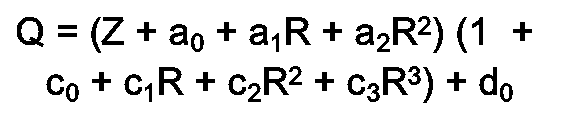
where a₀, a₁, a₂, c₀, c₁, c₂, c₃ and d₀ are polynomial functions of the temperature
signal of third order or less having correspondingly different constants than those
of the first function. Other functions or means of compensating the differential sensor
signal for nonlinearity, reference pressure dependence and temperature dependence
are within the scope of the present invention. For instance, the differential sensor
signal, reference signal and temperature signal can be adjusted by correcting means
24 comprising a Motorola 6800 series microprocessor based computer or an air vehicle
on board air data computer to implement one or more of the above functions.
[0019] For certain differences in pressure, the differential sensor signal does vary linearly.
The first and second functions accommodate such linearities with proper selection
of constants. Certain linear responses of the reference signal and the temperature
signal are similarly accommodated.
[0020] The first and second functions require a plurality of constants comprising correction
values or data. The correction data is preferably selected to be representative of
the characteristics of differential pressure sensing means 10 such that certain nonlinearities,
temperature dependence and reference pressure dependence reflected in the differential
sensor signal are accuracy compensated by correcting means 24. The differential pressure
sensing means 10, reference pressure sensing means 26 and temperature sensing means
34 are subjected to different known reference pressures, temperatures and differences
in pressure and the differential sensor signal, reference signal and temperature signal
are recorded at the known reference pressures, temperatures and differences in pressure.
Such recorded signals are then fit to the second function using for example a least
squares fit method to determine correction values such that the reference signal,
temperature signal and differential sensor signal are adjusted to provide an improved
output signal. The correction values are then stored in a memory storage means 42.
Such values can also be theoretically determined from known design characteristics
and construction materials of differential pressure sensing means 10 or an average
of the data can be used for all differential pressure sensing means 10.
[0021] Memory storage means 42 is preferably a read only memory device such as a 54S472
programmable read only memory available from National Semiconductor Corp. which comprises
correction data such as coefficients and constants representative of the particular
characteristics of differential pressure sensing means 10 with respect to nonlinearities,
reference pressure dependence and temperature dependence. Memory storage means 42
can also be integral to correcting means 24 such as core memory, disk, tape, or other
similar memory device. The correction data is also preferably representative of certain
nonlinearities and temperature dependence of reference pressure sensing means 26 and
certain nonlinearities of temperature sensing means 34. When memory storage means
42 is addressed by correcting means 24 along an address line 44, memory storage means
42 provides an enabling signal along an enable line 48 and provides the known data
to correcting means 24 through a data line 46.
[0022] The first and second functions simultaneously substantially correct the temperature
signal, reference signal and differential sensor signal to provide the output signal.
However, it is not necessary that corrections occur simultaneously. For example, in
one preferred embodiment, correcting means 24 compensates the temperature signal for
nonlinearity and then compensates the reference signal for nonlinearity and temperature
dependence. Finally, the differential sensor signal is compensated for nonlinearity,
temperature dependence and reference pressure dependence to provide the output signal.
Each compensation is a function of the previously compensated signals and correction
values after the temperature signal is compensated. Other compensation routines are
within the scope of the present invention.
[0023] In a further preferred embodiment as seen in Figure 2 wherein the numbering is consistent
with Figure 1, reference pressure sensing means 26 is physically coupled to the housing
of differential pressure sensing means 10. A circuit common is shown at 50. Memory
storage means 42 is also physically coupled to the housing of differential pressure
sensing means 10. Temperature sensing means 34 is physically coupled in intimate thermal
contact with differential pressure sensing means 10 and reference pressure sensing
means 26 such that the sensed temperature is representative of the temperature of
differential pressure sensing means 10 and reference pressure sensing means 26. When
physically coupled together, differential pressure sensing means 10, reference pressure
sensing means 26, temperature sensing means 34 and memory storage means 42 comprise
a sensor module 60. Correction data is then generated from tests or theoretical analysis
completed and the correction data representative of the characteristics of each sensor
module 60 comprising nonlinearities, temperature dependencies and reference pressure
dependence and other correctable variables are stored in memory storage means 42.
Sensor modules 60 are then interchangeably coupled with correcting means 24 without
altering the routine implemented by correcting means 24. Correcting means 24 then
adjusts the temperature signal, reference signal and differential sensor signal as
a function of the differential sensor signal, reference signal, temperature signal
and the correction data to provide the improved output signal.
[0024] The present invention is less expensive than using two absolute pressure sensors
as only one high accuracy differential pressure sensing means 10 at about the same
cost as one accurate absolute pressure sensor is required. By determining data for
sensor module 60 to be stored in memory storage means 42 by actual testing of sensor
modules 60, the nonlinearities, reference pressure dependence and temperature dependence
of differential pressure sensing means 10, nonlinearities and temperature dependence
of reference pressure sensing means 26 and nonlinearities of temperature sensing means
34 are represented in the data. Therefore inexpensive pressure sensors such as batch
fabricated silicon piezoresistive sensors or solid state pressure sensors can be used
as reference pressure sensors 26. Although such sensors may have high temperature
dependence and other dependencies on the order of ten (10) to twenty (20) percent,
such errors can be corrected to within two (2) percent of full scale or better by
correcting means 24. The inherent small size and low weight of such sensors permits
aerospace packaging advantages over the use of two high accuracy absolute pressure
sensors which weigh more and require more space than sensor module 60. Such packaging
advantages are further enhanced as shown in Figure 3, wherein the numbering is consistent
with Figure 2 with the addition of an "A" following each number, by including a reference
pressure sensing means 26A within the housing of a differential pressure sensing means
10A. The packaging advantages are further enhanced by including a memory storage means
42A and a temperature sensing means 34A within the housing of differential pressure
sensing means 10A.
[0025] As stated above, differential pressure sensing means 10 in Figure 1 is preferably
a vibrating beam pressure sensor which is the subject of US-A-4311053 which is incorporated
by reference herein and which is assigned to the same assignee as this application.
In Figure 4, a vibrating beam section 42V such as shown in US-A-4311053 is positioned
between a first and second isolator sections 43V and 44V which support the vibrating
beam section 42V under a tension or compression stress or load representative of a
differential pressure. A capacitor plate 61V forms a capacitor with beam section 42V
to pick off the differential pressure representative vibration frequency of beam section
42V. The vibrating beam pressure sensor is useful in aerospace applications. The linearity,
temperature and reference pressure adjustments described above greatly improve performance
at certain reference pressures.
[0026] In a further preferred embodiment, differential pressure sensing means 10 of Figure
1 comprises a capacitive type such as the sensor of US-A-3646538 or the capacitive
sensor of US-A-4389895 coupled with known circuitry of the capacitive transducer of
US-A-4370890 coupled with known circuitry. The difference in pressure when sensed
by the capacitive type sensor of US-A-3646538 is useful for determining velocity of
flow of a fluid through an orifice in a conduit where the reference pressure and the
second pressure correspond to pressures the fluid in the pipe exerts on opposite sides
of the orifice. The capacitive sensors are represented in Figure 5 and comprise a
sensing diaphragm 21 such as shown in US-A-3646538 whose position varies in response
to the difference in pressure which is applied across it. On opposite sides of sensing
diaphragm 21 are capacitor plates 39C and 40C. The changes in capacitance between
sensing diaphragm 21 and diaphragm plates 39C and 40C are representative of the difference
in pressure. Performance of the capacitive sensors is greatly enhanced by the linearity,
temperature and reference pressure adjustments of the present invention. In many velocity
of flow applications, the reference pressures can be many orders of magnitude higher
than the differential pressure desired to be sened. The two absolute pressure sensor
approach fails because its full scale errors can be large compared to the differential
pressure. Prior art differential pressure sensors' reference pressure errors are also
large compared to the differential pressure at high reference pressures. The present
invention compensates for reference pressure thus permitting accurate sensing of the
differential pressure.
[0027] The present invention also permits design considerations other than reference pressure
dependence, non-linearity and temperature dependence to be evaluated. Repeatability
of performance becomes primarily important. Materials and designs are selected for
repeatability of performance with respect to time, temperature, pressure and linearity.
With repeatable errors compensated for by the present invention, longer term performance
is permitted to be improved by the selection of appropriate materials and mechanical
designs. The invention as described above and further described below is powered in
a conventional manner.
[0028] In Figure 6, a typical arrangement for use of a compensated differential pressure
sensor 100 per the present invention in combination with a two wire process control
system is shown in block diagrams. In this instance, compensated sensor 100 comprises
a current control means 102. Compensated sensor 100 provides a control signal to the
current control means 102 for controlling a signal such as a DC current I
t, such that I
t is representative of a difference in pressure. The current I
t also provides power in a conventional two wire manner to compensated sensor 100.
[0029] The two wire system includes a direct current supply 110 having a line for carrying
the current I
t connected in series through a first terminal 112 through a line 113 to a first input
terminal 114 to compensated sensor 100 and current control means 102. The current
I
t is then carried through line to a second input terminal 116 through a line 117 to
a second terminal 118. A load means 120 is coupled to second terminal 118 and in turn
is connected in series with the supply 110 thus completing the two wire current path.
Load means 120 may comprise an actuator, a controller, a recorder or simply a current
indicating instrument. The connections of supply 110 and compensated sensor 100 can
also be made so that they are similar to that shown in US-A-3764880 which shows a
DC to DC converter.
[0030] Current control means 102 controls the total DC current I
t which is preferably an industry standard 4-20 milliamp signal or other form of signal
such that the current I
t is representative of the difference in pressure and provides power to compensated
sensor 100. When I
t is a 4-20 milliamp signal, components of compensated sensor 100 must be selected
to operate solely on 4 milliamps of current or less when I
t is 4 milliamps.
[0031] As previously stated, the apparatus of the invention can be used in determining airspeed
of an aircraft. Aeronautical Radio, Inc. (ARINC) of 2551 Riva Road, Annapolis, Maryland
21401 is a company that formulates standards for electronic equipment and systems
for airlines. The standards are finalised after investigation, co-ordination and general
agreement with the airlines, with other aircraft operators, with the military services
having similar requirements and with equipment manufacturers. For determining indicated
airspeed, the greatest differential pressure for subsonic aircraft to be measured
by the present invention is approximately 37.2 kPa (5.4 PSI). Reference pressure can
be as high as approximately 107.7 kPa (15.6 PSI) at about 500 meters below sea level
while second pressure can be as high as approximately 144.9 kPa (21 PSI) at speeds
approaching the speed of sound and at low altitudes. To meet a 1978 standard set by
ARINC, for indicated airspeed determination using two separate absolute pressure sensors,
the implied accuracy of the sensors respectively is .013 percent full scale and .014
percent full scale. The accuracies are based on a maximum error for the differential
pressure of approximately .034 kPa (.005 PSI). Presently available absolute pressure
sensors are accurate to about .02 percent full scale which would result in a possible
error of

considering just one of the absolute pressure sensors. The additional error of the
second absolute pressure sensor makes it improbable that the ARINC standard can presently
be met by the two absolute pressure sensor approach as the error of one absolute sensor
is about the same as the allowed maximum differential error of .034 kPa (.005 PSI).
In Figure 1 to determine airspeed using differential presure sensing means 10 with
reference pressure sensing means 26, differential pressure sensing means 10 is required
to have a range of at least 0 to 37.2 kPa (5.4 PSI) corresponding to the greatest
difference in pressure to be measured and reference pressure sensing means 26 is required
to have a range of from 0 to 107.7 kPa (15.6 PSI). The standard then implies from
the worst case error based on the indicated airspeed that the total accuracy of differential
pressure sensing means 10 must be at least .09 percent full scale to remain with .034
kPa (.005 PSI) of the differential pressure. Deviations in the differential sensor
signal caused by reference pressure dependencies can be .25 percent full scale for
reference pressures equivalent to full scale differential pressures, which is well
above the total .09 percent full scale accuracy required to meet the ARlNC standard.
If the total accuracy of reference pressure sensing means 26 is 2 percent, a 50:1
correction of reference pressure dependencies is achievable. The reference pressure
for subsonic aircraft varies between 17.6 kPa (2.56 PSI) at an altitude of approximately
12,600 meters and 107.6 kPa (15.6 PSI) at 500 meters below sea level for a total change
of 90 kPa (13 PSI). Such change is about twice full scale of differential pressure
sensing means 10 which doubles the total reference pressure dependency to .5 percent
of full scale. Thus the 50:1 correction reduces the reference pressure dependency
of differential pressure sensing means 10 thereby increasing accuracy with respect
to reference pressure dependency to about .01 percent full scale or .0037 kPa (.00054
PSI) resulting in embodiments of the present invention performing better than the
ARINC standard. Thus the present invention meets even greater performance standards
than are presently required.
[0032] Sensor devices in accordance with the present invention have been tested to determine
their effectiveness in improving the accuracy of differential pressure measurements.
The sensor device easily exceeded the ARINC standard when the corrections were taken
into account. The sensor devices utilised the second function. Such sensor devices
comprised a vibrating beam type differential pressure sensing means 10 with a range
of 0-110 kPa (16 PSI). For such sensor devices, the worst total deviations from actual
differential pressure varied from .015 kPa (.0021 PSI) to .027 kPa (.0039 PSI) while
subjected to wide ranges of temperature, reference pressure and differential pressures
exceeding those expected to be encountered in subsonic aerospace applications.
Claims for the following Contracting State(s): BE, SE
1. Apparatus for sensing a difference in pressure between a first pressure and a second
pressure and providing an output signal representative of the difference in pressure,
comprising a differential pressure sensing means (10) for providing a differential
sensor signal representative of the difference in pressure; reference pressure sensing
means (26) for providing a reference sensor signal representative of the first pressure;
memory storage means (42) for providing correction data for known errors in the differential
sensor signal; and correcting means (24) for providing the output signal as a function
of the reference sensor signal, the differential sensor signal and the correction
data, the output signal being more representative of the difference in pressure than
is the differential sensor signal as a result of the correction by the correction
data; characterised in that the reference sensor signal does not vary linearly in
response to variations in the first pressure and the correction data comprises data
representative of these reference sensor signal non-linearities.
2. Apparatus as claimed in Claim 1, characterised in that the differential sensor signal
does not vary linearly in response to variations in the difference in pressure between
the first and second pressures, the correction data comprising data representative
of the differential sensor signal non-linearities.
3. Apparatus as claimed in Claim 2, wherein the differential sensor signal is affected
by variations in the first pressure, the correction data comprising data representative
of the effects of variations in the first pressure on the differential sensor signal.
4. Apparatus as claimed in any preceding claim, characterised by temperature sensing
means (34) for providing a temperature signal representative of the temperature of
the apparatus.
5. Apparatus as claimed in Claim 4, characterised in that the temperature signal does
not vary linearly in response to variations in the temperature of the apparatus, the
correction data comprising data representative of the temperature signal non-linearities.
6. Apparatus as claimed in Claim 4 or Claim 5, characterised in that the reference sensor
signal is affected by variations in the temperature of the apparatus, the correction
data comprising data representative of the effects of variations in the temperature
on the reference sensor signal.
7. Apparatus as claimed in Claim 4, Claim 5 or Claim 6, characterised in that the differential
sensor signal is affected by variations in the temperature of the apparatus, the correction
data comprising data representative of the effects of variations in the temperature
on the differential sensor signal.
8. Apparatus as claimed in any one of Claims 4 to 7, characterised in that the correcting
means (24) comprises a digital computer which provides the output signal in accordance
with the formula
a+bx+cx²+...
where:
x=z₀-z
z=the differential sensor signal
z₀=correction data
and:
a=a₀+a₁Y+a₂Y²+...
b=b₀+b₁Y+b₂Y²+...
c=c₀+c₁Y+c₂Y²+...
.
.
.
where:
Y=R₀-R
R=the reference sensor signal
R₀=correction data
and:
a₀=a₀₀+a₀₁T+a₀₂T²+...
a₁=a₁₀+a₁₁T+a₁₂T²+...
a₂=a₂₀+a₂₁T+...
.
.
.
.
and:
b₀=b₀₀+b₀₁T+b₀₂T²+...
b₁=b₁₀+b₁₁T+...
.
.
.
and:
c₀=c₀₀+c₀₁T+...
.
.
.
.
where:
T=the temperature signal
and:
a₀₀, a₀₁, ..., b₀₀, b₀₁,...,
c₀₀, c₀₁, ..., a₁₀, a₁₁,...
are correction data.
9. Apparatus as claimed in Claim 8, characterised in that certain correction data are
chosen as a zero value and the formula

comprises the formula
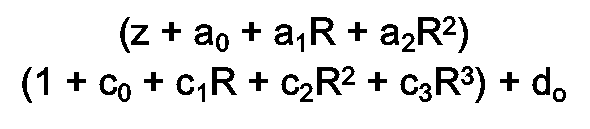
where:
a₀, a₁, a₂, c₀, c₁, c₂, c₃ and d₀ are
functions of the temperature signal of third order or less having correspondingly
different correction data.
10. Apparatus as claimed in any preceding claim, characterised in that the reference pressure
sensing means (26) is physically coupled to the differential pressure sensing means
(10) and the correcting means (24) adjusts the reference sensor signal simultaneously
with the adjustment of the differential sensor signal.
11. Apparatus as claimed in Claim 10 as dependent upon Claim 4, characterised in that
the temperature sensing means (34) is physically coupled in intimate thermal contact
with the differential pressure sensing means (10) and the correcting means (24) adjusts
for non-linearities in the temperature signal simultaneously with the adjustment of
the reference sensor signal and the output signal.
12. Apparatus as claimed in Claim 11, characterised in that the memory storage means (42)
is physically coupled to the differential pressure sensing means (10) such that the
differential pressure sensing means (10), reference pressure sensing means (26), temperature
sensing means (34) and memory storage means (42) comprise a sensor module which is
interchangeably connectable to the correcting means (24).
13. Apparatus as claimed in any preceding claim, characterised by two terminals (114,
116) for connection to two wires from a series connected source (110) of DC voltage
and a load (120), through which a direct current signal flows, and by current control
means (102) coupled to the two terminals (114, 116) for controlling the direct current
signal as a function of the said output signal such that the direct current signal
is representative of the difference in pressure and provides sole energisation of
the apparatus.
14. Apparatus as claimed in any preceding claim, characterised in that the differential
pressure sensing means (10) comprises a capacitive type differential pressure sensor.
15. Apparatus as claimed in any preceding claim, characterised in that the differential
pressure sensing means (10) comprises a vibrating beam type differential pressure
sensor.
16. Apparatus as claimed in any preceding claim, characterised in that the reference pressure
sensing means (26) comprises an absolute pressure sensor which can be adjusted to
two percent accuracy or less.
17. A method of determining a difference in pressure between a first pressure and a second
pressure and providing an output signal representative of the difference in pressure,
comprising the steps of sensing the difference in pressure; providing a differential
sensor signal representative of the sensed difference in pressure; sensing the first
pressure; providing a reference sensor signal representative of the sensed first pressure;
storing correction values for known errors in the differential sensor signal and the
reference sensor signal; adjusting the reference sensor signal as a function of the
stored correction values; and providing the output signal as a function of the adjusted
reference sensor signal, the differential sensor signal and the stored correction
values.
18. A method as claimed in Claim 17, characterised by the steps of sensing the temperature;
providing a temperature signal representative of the sensed temperature; storing correction
values for known errors in the temperature signal; adjusting the temperature signal
as a function of the stored correction values; adjusting the reference sensor signal
also as a function of the adjusted temperature signal; and providing the output signal
as a function of the adjusted temperature signal, the adjusted reference sensor signal,
the differential sensor signal and the stored correction values.
19. A method as claimed in Claim 18, characterised in that the output signal is provided
in accordance with the formula
a+bx+cx² +...
where:
x=z₀-z
z=the differential signal
z₀=a correction value
and:
a=a₀+a₁Y+a₂Y²+...
b=b₀+b₁Y+b₂Y² +...
c=c₀+c₁Y+c₂Y²+...
.
.
.
where:
Y=R₀-R
R=the reference signal
R₀=a correction value
and:
a₀=a₀₀+a₀₁T+a₀₂T²+...
a₁=a₁₀+a₁₁T+a₁₂T²+...
a₂=a₂₀+a₂₁T+...
.
.
.
.
and:
b₀=b₀₀+b₀₁T+b₀₂T²+...
b₁=b₁₀+b₁₁T+...
.
.
.
and:
c₀=c₀₀+c₀₁T+...
.
.
.
.
where:
T=the temperature signal
and:
a₀₀, a₀₁, ..., b₀₀, b₀₁, ...,
c₀₀, c₀₁, ..., a₁₀, a₁₁, ....
are correction values.
20. A method as claimed in Claim 19, characterised in that certain correction values are
chosen to have a zero value and the formula
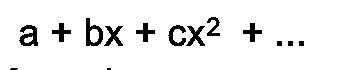
comprises the formula

wherein:
a₀, a₂, c₀, c₁, c₂, c₃, and d₀ are
functions of the temperature signal of third order or less having correspondingly
different correction values.
Claims for the following Contracting State(s): DE, FR, GB, NL
1. Apparatus for sensing a difference in pressure between a first pressure and a second
pressure and providing an output signal representative of the difference in pressure,
comprising a differential pressure sensing means (10) for providing a differential
sensor signal representative of the difference in pressure; reference pressure sensing
means (26) for providing a reference sensor signal representative of the first pressure;
temperature sensing means (34) for providing a temperature signal representative of
the temperature of the apparatus; memory storage means (42) for providing correction
data for known errors in the reference sensor signal and the differential sensor signal;
and correcting means (24) for providing the output signal as a function of the reference
sensor signal, the differential sensor signal, the temperature signal and the correction
data, the output signal being more representative of the difference in pressure than
is the differential sensor signal as a result of the correction by the correction
data; the differential pressure sensing means (10), the reference pressure sensing
means (26) and the temperature sensing means (34) being physically coupled together;
characterised in that the memory storage means (42) is physically coupled to the differential
pressure sensing means (10) such that the differential pressure sensing means (10),
the reference pressure sensing means (26), the temperature sensing means (34) and
the memory storage means (42) comprise a sensor module which is interchangeably connectable
to the correcting means (24), and in that the reference sensor signal does not vary
linearly in response to variations in the first pressure, and the correction data
comprises data representative of these reference sensor signal non-linearities.
2. Apparatus as claimed in Claim 1, characterised in that the differential sensor signal
does not vary linearly in response to variations in the difference in pressure between
the first and second pressures, the correction data comprising data representative
of the differential sensor signal non-linearities.
3. Apparatus as claimed in Claim 2, wherein the differential sensor signal is affected
by variations in the first pressure, the correction data comprising data representative
of the effects of variations in the first pressure on the differential sensor signal.
4. Apparatus as claimed in any preceding claim, characterised in that the temperature
signal does not vary linearly in response to variations in the temperature of the
apparatus, the correction data comprising data representative of the temperature signal
non-linearities.
5. Apparatus as claimed in any preceding claim, characterised in that the reference sensor
signal is affected by variations in the temperature of the apparatus, the correction
data comprising data representative of the effects of variations in the temperature
on the reference sensor signal.
6. Apparatus as claimed in any preceding claim, characterised in that the differential
sensor signal is affected by variations in the temperature of the apparatus, the correction
data comprising data representative of the effects of variations in the temperature
on the differential sensor signal.
7. Apparatus as claimed in any preceding claim, characterised in that the correcting
means (24) comprises a digital computer which provides the output signal in accordance
with the formula
a+bx+cx²+...
where:
x=z₀-z
z=the differential sensor signal
z₀=correction data
and:
a=a₀+a₁Y+a₂Y²+...
b=b₀+b₁Y+b₂Y²+...
c=c₀+c₁Y+c₂Y²+...
.
.
.
where:
Y=R₀-R
R=the reference sensor signal
R₀=correction data
and:
a₀=a₀₀+a₀₁T+a₀₂T²+...
a₁=a₁₀+a₁₁T+a₁₂T²+...
a₂=a₂₀+a₂₁T+...
.
.
.
.
and:
b₀=b₀₀+b₀₁T+b₀₂T²+ ...
b₁=b₁₀+b₁₁T+...
.
.
.
and:
c₀=c₀₀+c₀₁T+...
.
.
.
.
where:
T=the temperature signal
and:
a₀₀, a₀₁, ..., b₀₀, b₀₁, ...,
c₀₀, c₀₁, ..., a₁₀, a₁₁, ....
are correction data.
8. Apparatus as claimed in Claim 7, characterised in that certain correction data are
chosen as a zero value and the formula

comprises the formula

where:
a₀, a₁, a₂, c₀, c₁, c₂, C₃ and d₀ are
functions of the temperature signal of third order or less having correspondingly
different correction data.
9. Apparatus as claimed in any preceding claim, characterised in that the correcting
means (24) adjusts the reference sensor signal simultaneously with the adjustment
of the differential sensor signal.
10. Apparatus as claimed in Claim 9, characterised in that the correcting means (24) adjusts
for non-linearities in the temperature signal simultaneously with the adjustment of
the reference sensor signal and the output signal.
11. Apparatus as claimed in any preceding claim, characterised by two terminals (114,
116) for connection to two wires from a series connected source (110) of DC voltage
and a load (120), through which a direct current signal flows, and by current control
means (102) coupled to the two terminals (114, 116) for controlling the direct current
signal as a function of the said output signal such that the direct current signal
is representative of the difference in pressure and provides sole energisation of
the apparatus.
12. Apparatus as claimed in any preceding claim, characterised in that the differential
pressure sensing means (10) comprises a capacitive type differential pressure sensor.
13. Apparatus as claimed in any preceding claim, characterised in that the differential
pressure sensing means (10) comprises a vibrating beam type differential pressure
sensor.
14. Apparatus as claimed in any preceding claim, characterised in that the reference pressure
sensing means (26) comprises an absolute pressure sensor which can be adjusted to
two percent accuracy or less.
Patentansprüche für folgende(n) Vertragsstaat(en): BE, SE
1. Vorrichtung für das Erfassen einer Druckdifferenz zwischen einem ersten Druck und
einem zweiten Druck und für das Erzeugen eines Ausgangssignals, das die Druckdifferenz
wiedergibt, mit einer ersten Differenzdruck-Erfassungsvorrichtung (10) für das Erzeugen
eines Differential-Sensorsignals, das die Druckdifferenz wiedergibt; mit einer Referenzdruck-Erfassungsvorrichtung
(26) für das Erzeugen eines Referenz-Sensorsignals, das den ersten Druck wiedergibt;
mit einer Speichervorrichtung (42), mit welcher Korrekturdaten für bekannte Fehler
in dem Differential-Sensorsignal erzeugbar sind; und mit einer Korrigiereinrichtung
(24), mit welcher das Ausgangssignal als eine Funktion des Referenz-Sensorsignals,
des Differential-Sensorsignals und der Korrekturdaten erzeugbar ist, wobei infolge
der Korrektur durch die Korrekturdaten das Ausgangssignal die Druckdifferenz stärker
als das Differential-Sensorsignal wiedergibt; dadurch gekennzeichnet, daß sich das
Referenz-Sensorsignal nicht linear in Abhängigkeit von Änderungen des ersten Drucks
ändert und die Korrekturdaten Daten aufweisen, die diese Nichtlinearitäten des Referenz-Sensorsignals
wiedergeben.
2. Vorrichtung nach Anspruch 1, dadurch gekennzeichnet, daß sich das Differential-Sensorsignal
nicht linear in Abhängig- keit von Änderungen des Differenzdrucks zwischen dem ersten
und zweiten Druck ändert, wobei die Korrekturdaten Daten aufweisen, die die Nichtlinearitäten
des Differential-Sensorsignals wiedergeben.
3. Vorrichtung nach Anspruch 2, dadurch gekennzeichnet, daß das Differential-Sensorsignal
durch Änderungen des ersten Drucks beeinflußt wird und die Korrekturdaten Daten aufweisen,
die die Wirkungen von Änderungen des ersten Drucks auf das Differential-Sensorsignal
wiedergeben.
4. Vorrichtung nach einem der vorhergehenden Ansprüche, gekennzeichnet durch eine Temperatur-Erfassungsvorrichtung
(34) für das Erzeugen eines Temperatursignals, das die Temperatur der Vorrichtung
wiedergibt.
5. Vorrichtung nach Anspruch 4, dadurch gekennzeichnet, daß sich das Temperatursignal
nicht linear in Abhängigkeit von Änderungen der Temperatur der Vorrichtung ändert
und die Korrekturdaten Daten aufweisen, die die Nichtlinearitäten des Temperatursignals
wiedergeben.
6. Vorrichtung nach Anspruch 4 oder 5, dadurch gekennzeichnet, daß das Referenz-Sensorsignal
durch Änderungen der Temperatur der Vorrichtung beeinflußt wird und die Korrekturdaten
Daten umfassen, die die Wirkungen von Änderungen der Temperatur auf das Referenz-Sensorsignal
wiedergeben.
7. Vorrichtung nach Anspruch 4, 5 oder 6, dadurch gekennzeichnet, daß das Differential-Sensorsignal
durch Änderungen der Temperatur der Vorrichtung beeinflußt wird und die Korrekturdaten
Daten umfassen, die die Wirkungen von Änderungen der Temperatur auf das Differential-Sensorsignal
wiedergeben.
8. Vorrichtung nach einem der Ansprüche 4 bis 7, dadurch gekennzeichnet, daß die Korrigiereinrichtung
(24) einen Digitalrechner aufweist, der das Ausgangssignal entsprechend der Formel
a + bx + cx² +...
erzeugt, wobei
x = z₀ - z
z = Differential-Sensorsignal
z₀ = Korrekturdaten
und
a = a₀ + a₁Y + a₂Y² + ...
b = b₀ + b₁Y + b₂Y² + ...
c = c₀ + c₁Y + c₂Y² +...
.
.
.
wobei
Y = R₀ - R
R = Referenz-Sensorsignal
R₀ = Korrekturdaten
und
a₀ = a₀₀ + a₀₁T + a₀₂T² + ...
a₁ = a₁₀ + a₁₁T + a₁₂T² + ...
a₂ = a₂₀ + a₂₁T + ...
.
.
.
und
b₀ = b₀₀ + b₀₁T + b₀₂T² + ...
b₁ = b₁₀ + b₁₁T + ...
.
.
.
und
c₀ = c₀₀ + c₀₁T +...
.
.
.
wobei
T = Temperatursignal
und
a₀₀, a₀₁, ..., b₀₀, b₀₁, ...,
c₀₀, c₀₁, ..., a₁₀, a₁₁, ...
Korrekturdaten sind.
9. Vorrichtung nach Anspruch 8, dadurch gekennzeichnet, daß bestimmte Korrekturdaten
als Nullwert gewählt werden und die Formel

die Formel

umfaßt, wobei
a₀, a₁, a₂, c₀, c₁, c₂, c₃ und d₀ Funktionen des Temperatursignals dritter Ordnung
oder geringerer Ordnung sind, die entsprechend verschiedene Korrekturdaten aufweisen.
10. Vorrichtung nach einem der vorhergehenden Ansprüche, dadurch gekennzeichnet, daß die
Referenzdruck-Erfassungsvorrichtung (26) physikalisch mit der Differenzdruck-Erfassungsvorrichtung
(10) gekoppelt ist und die Korrigiereinrichtung (24) das Referenz-Sensorsignal zugleich
mit der Einstellung des Differential-Sensorsignals einstellt.
11. Vorrichtung nach Anspruch 10, unter Rückbeziehung auf Anspruch 4, dadurch gekennzeichnet,
daß die Temperatur-Erfassungsvorrichtung (34) physikalisch in engem thermischen Kontakt
mit der Differenzdruck-Erfassungsvorrichtung (10) gekoppelt ist und die Korrigiereinrichtung
(24) Nichtlinearitäten des Temperatursignals zugleich mit der Einstellung des Referenz-Sensorsignals
und des Ausgangssignals einstellt.
12. Vorrichtung nach Anspruch 11, dadurch gekennzeichnet, daß die Speichervorrichtung
(42) physikalisch mit der Differenzdruck-Erfassungsvorrichtung (10) derart gekoppelt
ist, daß die Differenzdruck-Erfassungsvorrichtung (10), die Referenzdruck-Erfassungsvorrichtung
(26), die Temperaturerfassungsvorrichtung (34) und die Speichervorrichtung (42) ein
Sensor-Modul aufweisen, das austauschbar mit der Korrigiereinrichtung (24) verbunden
werden kann.
13. Vorrichtung nach einem der vorhergehenden Ansprüche, gekennzeichnet durch zwei Anschlüsse
(114, 116) für die Verbindung mit zwei Drähten von einer seriell verbundenen Gleichspannungsquelle
(110) und einer Last (120), durch welche ein Gleichstromsignal fließt, und durch eine
Stromsteuereinrichtung (102), die mit den beiden Anschlüssen (114, 116) für die Steuerung
des Gleichstromsignals als eine Funktion des Ausgangssignals derart gekoppelt ist,
daß das Gleichstromsignal die Druckdifferenz wiedergibt und die alleinige Energieversorgung
der Vorrichtung bereitstellt.
14. Vorrichtung nach einem der vorhergehenden Ansprüche, dadurch gekennzeichnet, daß die
Differenzdruck-Erfassungsvorrichtung (10) einen Differenzdruck-Sensor kapazitiver
Art aufweist.
15. Vorrichtung nach einem der vorhergehenden Ansprüche, dadurch gekennzeichnet, daß die
Differenzdruck-Erfassungsvorrichtung (10) einen Differenzdruck-Sensor vom Schwingstrahltyp
aufweist.
16. Vorrichtung nach einem der vorhergehenden Ansprüche, dadurch gekennzeichnet, daß die
Referenzdruck-Erfassungsvorrichtung (26) einen Absolutdrucksensor aufweist, der mit
einer Genauigkeit von 2% oder genauer eingestellt werden kann.
17. Verfahren zur Bestimmung einer Druckdifferenz zwischen einem ersten Druck und einem
zweiten Druck und zur Erzeugung eines Ausgangssignals, das die Druckdifferenz wiedergibt,
mit dem Verfahrensschritt, die Druckdifferenz zu erfassen; ein Differential-Sensorsignal
zu erzeugen, das die erfaßte Druckdifferenz wiedergibt; den ersten Druck zu erfassen;
ein Referenz-Sensorsignal zu erzeugen, das den erfaßten ersten Druck wiedergibt; Korrekturwerte
für bekannte Fehler in dem Differential-Sensorsignal und dem Referenz-Sensorsignal
abzuspeichern; das Referenz-Sensorsignal als eine Funktion der abgespeicherten Korrekturwerte
anzupassen oder einzustellen; und das Ausgangssignal als eine Funktion des eingestellten
Referenz-Sensorsignals, des Differential-Sensorsignals und der abgespeicherten Korrekturwerte
bereitzustellen.
18. Verfahren nach Anspruch 17, gekennzeichnet durch die Verfahrensschritte, die Temperatur
zu erfassen; ein Temperatur- signal zu erzeugen, das die erfaßte Temperatur wiedergibt;
Korrekturwerte für bekannte Fehler des Temperatursignals abzuspeichern; das Temperatursignal
als eine Funktion der abgespeicherten Korrekturwerte einzustellen; das Referenz-Sensorsignal
ebenfalls als eine Funktion des eingestellten oder angepaßten Temperatursignals einzustellen;
und das Ausgangssignal als eine Funktion des eingestellten Temperatursignals, des
eingestellten Referenz-Sensorsignals, des Differential-Sensorsignals und der abgespeicherten
Korrekturwerte bereitzustellen.
19. Verfahren nach Anspruch 18, dadurch gekennzeichnet, daß das Ausgangssignal entsprechend
der Formel
a + bx + cx² + ...
erzeugt wird, wobei
x = z₀ - z
z = Differenzsignal
z₀ = Korrekturwert
und
a = a₀ + a₁Y + a₂Y² + ...
b = b₀ + b₁Y + b₂Y² + ...
c = c₀ + c₁Y + c₂Y² + ...
.
.
.
wobei
Y = R₀ - R
R = Referenzsignal
R₀ = Korrekturwert
und
a₀ = a₀₀ + a₀₁T + a₀₂T² + ...
a₁ = a₁₀ + a₁₁T + a₁₂T² + ...
a₂ = a₂₀ + a₂₁T + ...
.
.
.
und
b₀ = b₀₀ + b₀₁T + b₀₂T² + ...
b₁ = b₁₀ + b₁₁T + ...
.
.
.
und
c₀ = C₀₀ + C₀₁T + ...
.
.
.
wobei
T = Temperatursignal
und
a₀₀, a₀₁, ...,b₀₀, b₀₁, ...,
c₀₀, c₀₁, ..., a₁₀, a₁₁, ...
Korrekturwerte sind.
20. Verfahren nach Anspruch 19, dadurch gekennzeichnet, daß bestimmte Korrekturwerte so
gewählt werden, daß sie den Wert Null aufweisen und die Formel

die Formel

aufweist, wobei
a₀, a₁, a₂, c₀, c₁, c₂, c₃ und d₀ Funktionen des Temperatursignals dritter Ordnung
oder geringerer Ordnung mit entsprechend verschiedenen Korrekturwerten sind.
Patentansprüche für folgende(n) Vertragsstaat(en): DE, FR, GB, NL
1. Vorrichtung für das Erfassen einer Druckdifferenz zwischen einem ersten Druck und
einem zweiten Druck und für das Erzeugen eines Ausgangssignals, das die Druckdifferenz
wiedergibt, mit einer Differenzdruck-Erfassungsvorrichtung (10) für das Erzeugen eines
Differential-Sensorsignals, das die Druckdifferenz wiedergibt; mit einer Referenzdruck-Erfassungsvorrichtung
(26) für das Erzeugen eines Referenz-Sensorsignals, das den ersten Druck wiedergibt;
mit einer Temperatur-Erfassungsvorrichtung (34) für das Erzeugen eines Temperatursignals,
das die Temperatur der Vorrichtung wiedergibt; mit einer Speichervorrichtung (42),
mit welcher Korrekturdaten für bekannte Fehler in dem Referenz-Sensorsignal und dem
Differential-Sensorsignal erzeugbar sind; und mit einer Korrigiereinrichtung (24),
mit welcher das Ausgangssignal als eine Funktion des Referenz-Sensorsignals, des Differential-Sensorsignals,
des Temperatursignals und der Korrekturdaten erzeugbar ist, wobei infolge der Korrektur
durch die Korrekturdaten das Ausgangssignal die Druckdifferenz stärker als das Differential-Sensorsignal
wiedergibt; wobei die Differenzdruck-Erfassungsvorrichtung (10), die Referenzdruck-Erfassungsvorrichtung
(26) und die Temperatur-Erfassungsvorrichtung (34) physikalisch miteinander gekoppelt
sind; dadurch gekennzeichnet, daß die Speichervorrichtung (42) physikalisch mit der
Differenzdruck- Erfassungsvorrichtung (10) gekoppelt ist, so daß die Differenzdruck-Erfassungsvorrichtung
(10), die Referenzdruck-Erfassungsvorrichtung (26), die Temperatur-Erfassungsvorrichtung
(34) und die Speichervorrichtung (42) ein Sensormodul aufweisen, das austauschbar
mit der Korrigiereinrichtung (24) verbunden werden kann, und dadurch, daß sich das
Referenz-Sensorsignal nicht linear in Abhängigkeit von Änderungen des ersten Drucks
ändert, und die Korrekturdaten Daten aufweisen, die diese Nichtlinearitäten des Referenz-Sensorsignals
wiedergeben.
2. Vorrichtung nach Anspruch 1, dadurch gekennzeichnet, daß das Differential-Sensorsignal
sich nicht linear in Abhängigkeit von Änderungen im Differenzdruck zwischen dem ersten
und zweiten Druck ändert, wobei die Korrekturdaten Daten aufweisen, die die Nichtlinearitäten
in dem Differential-Sensorsignal wiedergeben.
3. Vorrichtung nach Anspruch 2, dadurch gekennzeichnet, daß das Differential-Sensorsignal
durch Änderungen des ersten Drucks beeinflußt ist und die Korrekturdaten Daten aufweisen,
die die Wirkungen von Änderungen des ersten Drucks auf das Differential-Sensorsignal
wiedergeben.
4. Vorrichtung nach einem der vorhergehenden Ansprüche, dadurch gekennzeichnet, daß sich
das Temperatursignal nicht linear in Abhängigkeit von Änderungen der Temperatur der
Vorrichtung ändert und die Korrekturdaten Daten aufweisen, die Nichtlinearitäten des
Temperatursignals wiedergeben.
5. Vorrichtung nach einem der vorhergehenden Ansprüche, dadurch gekennzeichnet, daß das
Referenz-Sensorsignal durch Änderungen der Temperatur der Vorrichtung beeinflußt ist
und die Korrekturdaten Daten aufweisen, die die Wirküngen von Änderungen der Temperatur
auf das Referenz-Sensorsignal wiedergeben.
6. Vorrichtung nach einem der vorhergehenden Ansprüche, dadurch gekennzeichnet, daß das
Differential-Sensorsignal durch Änderungen in der Temperatur der Vorrichtung beeinflußt
wird und die Korrekturdaten Daten umfassen, die die Wirkungen von Änderungen der Temperatur
auf das Differential-Sensorsignal wiedergeben.
7. Vorrichtung nach einem der vorhergehenden Ansprüche, dadurch gekennzeichnet, daß die
Korrigiereinrichtung (24) einen Digitalrechner aufweist, der das Ausgangssignal entsprechend
der Formel
a + bx + cx² + ...
erzeugt, wobei
x = z₀ - z
z = Differential-Sensorsignal
z₀ = Korrekturdaten
und
a = a₀ + a₁Y + a₂Y² + ...
b = b₀ + b₁Y + b₂Y² + ...
c = c₀ + c₁Y + c₂Y² + ...
.
.
.
wobei
Y = R₀ - R
R = Referenz-Sensorsignal
R₀ = Korrekturdaten
und
a₀ = a₀₀ + a₀₁T + a₀₂T² + ...
a₁ = a₁₀ + a₁₁T + a₁₂T² + ...
a₂ = a₂₀ + a₂₁T + ...
.
.
.
und
b₀ = b₀₀ + b₀₁T + b₀₂T² + ...
b₁ = b₁₀ + b₁₁T + ...
.
.
.
und
c₀ = c₀₀ + c₀₁T + ...
.
.
.
wobei
T = Temperatursignal
und
a₀₀, a₀₁, ..., b₀₀, b₀₁,...,
c₀₀, c₀₁, ..., a₁₀, a₁₁, ...
Korrekturdaten sind.
8. Vorrichtung nach Anspruch 7, dadurch gekennzeichnet, daß bestimmte Korrekturdaten
als Nullwert gewählt werden und die Formel

die Formel

umfaßt, wobei
a₀, a₁, a₂, c₀, c₁, c₂, c₃ und d₀ Funktionen des Temperatursignals dritter Ordnung
oder geringerer Ordnung sind, die entsprechend verschiedene Korrekturdaten aufweisen.
9. Vorrichtung nach einem der vorhergehenden Ansprüche, dadurch gekennzeichnet, daß die
Korrigiereinrichtung (24) das Referenz-Sensorsignal zugleich mit der Einstellung des
Differential-Sensorsignals einstellt.
10. Vorrichtung nach Anspruch 9, dadurch gekennzeichnet, daß die Korrigereinrichtung (24)
Nichtlinearitäten in dem Temperatursignal zugleich mit der Einstellung des Referenz-Sensorsignals
und des Ausgangssignals einstellt.
11. Vorrichtung nach einem der vorhergehenden Ansprüche, gekennzeichnet durch zwei Anschlüsse
(114, 116) für die Verbindung mit zwei Drähten von einer seriell verbundenen Gleichspannungsquelle
(110) und einer Last (120), durch welche ein Gleichstromsignal fließt, und durch eine
Stromsteuereinrichtung (102), die mit den beiden Anschlüssen (114, 116) für die Steuerung
des Gleichstromsignals als eine Funktion des Ausgangssignals derart verbunden ist,
daß das Gleichstromsignal die Druckdifferenz wiedergibt und die alleinige Energieversorgung
der Vorrichtung bereitstellt.
12. Vorrichtung nach einem der vorhergehenden Ansprüche, dadurch gekennzeichnet, daß die
Differenzdruck-Erfassungsvorrichtung (10) einen Differenzdruck-Sensor kapazitiver
Art aufweist.
13. Vorrichtung nach einem der vorhergehenden Ansprüche, dadurch gekennzeichnet, daß die
Differenzdruck-Erfassungsvorrichtung (10) einen Differenzdruck-Sensor vom Schwingstrahltyp
aufweist.
14. Vorrichtung nach einem der vorhergehenden Ansprüche, dadurch gekennzeichnet, daß die
Referenzdruck-Erfassungsvorrichtung (26) einen Absolutdrucksensor aufweist, der mit
einer Genauigkeit von 2% oder genaue eingestellt werden kann.
Revendications pour l'(les) Etat(s) contractant(s) suivant(s): BE, SE
1. Appareil pour détecter une différence de pression entre une première pression et une
seconde pression et fournir un signal de sortie représentant la différence de pression,
comprenant des moyens détecteurs de pression différentielle (10) pour fournir un signal
différentiel représentatif de la différence de pression; des moyens détecteurs de
pression de référence (26) pour fournir un signal de référence représentatif de la
première pression; des moyens de stockage en mémoire (42) pour fournir des données
de correction pour des erreurs connues dans le signal différentiel; et des moyens
de correction (24) pour fournir le signal de sortie en fonction du signal de référence,
du signal différentiel et des données de correction, le signal de sortie étant plus
représentatif de la différence de pression que le signal différentiel ne l'est, en
conséquence de la correction par les données de correction; caractérisé en ce que
le signal de référence ne varie pas linéairement en réponse à des variations de la
première pression et que les données de correction comportent des données représentatives
de ces non-linéarités du signal de référence.
2. Appareil selon la revendication 1, caractérisé en ce que le signal différentiel ne
varie pas linéairement en réponse à des variations de la différence de pression entre
les première et seconde pressions, les données de correction comprenant des données
représentatives des non-linéarités du signal différentiel.
3. Appareil selon la revendication 2, dans lequel le signal différentiel est affecté
par des variations de la première pression, les données de correction comprenant des
données représentatives des effets de variations de la première pression sur le signal
différentiel.
4. Appareil selon l'une quelconque des revendications précédentes, caractérisé par des
moyens détecteurs de temperature (34) pour fournir un signal de température représentatif
de la température de l'appareil.
5. Appareil selon la revendication 4, caractérisé en ce que le signal de température
ne varie pas linéairement en réponse à des variations de la température de l'appareil,
les données de correction comprenant des données représentatives des non-linéarités
du signal de température.
6. Appareil selon la revendication 4 ou 5, caractérisé en ce que le signal de référence
est affecté par des variations de la température de l'appareil, les données de correction
comprenant des données représentatives des effets de variations de température sur
le signal de référence.
7. Appareil selon l'une quelconque des revendications 4 à 6, caractérisé en ce que le
signal différentiel est affecté par des variations de la température de l'appareil,
les données de correction comprenant des données représentatives des effets de variations
de la température sur le signal différentiel.
8. Appareil selon l'une quelconque des revendications 4 a 7, caractérisé en ce que les
moyens de correction (24) comprennent un calculateur numérique qui fournit le signal
de sortie conformément à la formule
a + bx + cx² + ...
où:
x = Z₀ - Z
z = Signal différentiel
z₀ = Données de correction
et:
a = a₀ + a₁Y + a₂Y² + ...
b = b₀ + b₁Y + b₂Y² + ...
c = c₀ + c₁Y + c₂Y² + ...
.
.
.
où:
Y = R₀ - R
R = Signal de référence
R₀ = Données de correction
et:
a₀ = a₀₀ + a₀₁ T + a₀₂ T² + ...
a₁ = a₁₀ + a₁₁ T + a₁₂ T² +...
a₂ = a₂₀ + a₂₁ T + ...
.
.
.
et
b₀ = b₀₀ + b₀₁ T + b₀₂ T² + ...
b₁ = b₁₀ + b₁₁ T + ...
.
.
.
et:
c₀ = c₀₀ + c₀₁ T + ...
.
.
où:
T = Signal de température
et: a₀₀, a₀₁..., b₀₀, b₀₁, ...,
c₀₀, c₀₁, ..., a₁₀, a₁₁, ...
sont des données de correction.
9. Appareil selon la revendication 8, caractérisé en ce que certaines données de correction
sont choisies sous forme de valeur zéro et la formule

comprend la formule

où: a₀, a₁, a₂, c₀, c₁, c₂, c₃ et d₀ sont des fonctions du signal de température
de troisième ordre ou moins ayant des données de correction différentes de façon correspondante.
10. Appareil selon l'une quelconque des revendications précédentes, caractérisé en ce
que les moyens détecteurs de pression de référence (26) sont accouplés physiquement
aux moyens détecteurs de pression différentielle (10), et en ce que les moyens de
correction (24) réglent le signal de référence simultanément au réglage du signal
différentiel.
11. Appareil selon la revendication 10 prise comme dépendante de la revendication 4, caractérisé
en ce que les moyens détecteurs de température (34) sont accouplés physiquement en
contact thermique intime avec les moyens détecteurs de pression différentielle (10),
et en ce que les moyens de correction (24) compensent les non-linéarités du signal
de température simultanément au réglage du signal de référence et du signal de sortie.
12. Appareil selon la revendication 11, caractérisé en ce que les moyens de stockage en
mémoire (42) sont accouplés physiquement aux moyens de détection de pression différentielle
(10) de telle sorte que les moyens détecteurs de pression différentielle (10), les
moyens de détection de pression de référence (26), les moyens de détection de température
(34) et les moyens de stockage en mémoire (42) constituent un module détecteur qui
peut être raccordé de façon interchangeable aux moyens de correction (24).
13. Appareil selon l'une quelconque des revendications précédentes, caractérisé par deux
bornes (114, 116) pour la connexion à deux fils issus d'une source de tension de courant
continu (110) et d'une charge (120) montées en série, fils à travers lesquels passe
un signal de courant continu, et par des moyens de commande de courant (102) accouplés
aux deux bornes (114, 116) pour commander le signal de courant continu en fonction
dudit signal de sortie de telle sorte que le signal de courant continu soit représentatif
de la différence de pression et assure l'entière excitation de l'appareil.
14. Appareil selon l'une quelconque des revendications précédentes, caractérisé en ce
que les moyens de détection de pression différentielle (10) comprennent un détecteur
de pression différentielle du type capacitif.
15. Appareil selon l'une quelconque des revendications précédentes, caractérisé en ce
que les moyens de détection de pression différentielle (10) comprennent un détecteur
de pression différentielle du type à barre vibrante.
16. Appareil selon l'une quelconque des revendications précédentes, caractérisé en ce
que les moyens de détection de pression de référence (26) comprennent un détecteur
de pression absolue qui peut ètre réglé avec une précision de 2% ou moins.
17. Procédé pour la détermination d'une différence de pression entre une première pression
et une seconde pression et pour la fourniture d'un signal de sortie représentatif
de la différence de pression, comprenant les opérations consistant à détecter la différence
de pression; à fournir un signal différentiel représentatif de la différence de pression
détectée; à détecter la première pression; a fournir un signal de référence représentatif
de la première pression détectée; à mémoriser des valeurs de correction pour des erreurs
connues du signal différentiel et du signal de référence; à régler le signal de référence
en fonction des valeurs de correction mémorisées; et à fournir le signal de sortie
en fonction du signal de référence, du signal différentiel et des valeurs de correction
mémorisées.
18. Procédé selon la revendication 17, caractérisé par les opérations consistant à détecter
la température; à fournir un signal de température représentatif de la température
détectée; à mémoriser des valeurs de correction pour des erreurs connues du signal
de température; a régler le signal de température en fonction des valeurs de correction
mémorisées; à régler le signal de référence également en fonction du signal de température
réglé; et à fournir le signal de sortie en fonction du signal de température réglé,
du signal de référence réglé, du signal différentiel et des valeurs de correction
mémorisées.
19. Procédé selon la revendication 18, caractérisé en ce que le signal de sortie est fourni
conformément a la formule
a + bx + cx² + ...
où:
x = z₀ - z
z = Signal différentiel
z₀ = Valeur de correction
et:
a = a₀ + a₁Y + a₂Y² + ...
b = b₀ + b₁Y t b₂Y² + ...
c = c₀ + c₁Y + c₁Y + c₂Y² + ...
.
.
où:
Y = R₀ - R
R = Signal de référence
R₀ = Valeur de correction
et:
a₀ = a₀₀ + a₀₁ T + a₀₂ T² + ...
a₁ = a₁₀ + a₁₁ T + a₁₂ T² + ...
a₂ = a₂₀ + a₂₁ T + ...
.
.
.
et
b₀ = b₀₀ + b₀₁ T + b₀₂ T² + ...
b₁ = b₁₀ + b₁₁ T + ...
.
.
.
et:
c₀ = c₀₀ + c₀₁ T + ...
.
.
où:
T = Signal de température
et: a₀₀, a₀₁..., b₀₀, b₀₁, ...,
c₀₀, c₀₁, ..., a₁₀, a₁₁, ...
sont des valeurs de correction.
20. Procédé selon la revendication 19, caractérisé en ce que certaines valeurs de correction
sont choisies de façon à avoir une valeur zéro et la formule

comprend la formule

où: a₀, a₁, a₂ , c₀, c₁, c₂, c₃ et d₀ sont des fonctions du signal de température
de troisième ordre ou moins ayant des données de correction différentes de façon correspondante.
Revendications pour l'(les) Etat(s) contractant(s) suivant(s): DE, FR, GB, NL
1. Appareil pour détecter une différence de pression entre une première pression et une
seconde pression et fournir un signal de sortie représentant la différence de pression,
comprenant des moyens détecteurs de pression différentielle (10) pour fournir un signal
différentiel représentatif de la différence de pression; des moyens détecteurs de
pression de référence (26) pour fournir un signal de référence représentatif de la
première pression; des moyens détecteurs de température (34) pour fournir un signal
de température représentatif de la température de l'appareil; des moyens de stockage
en mémoire (42) pour fournir des données de correction pour des erreurs connues dans
le signal de référence et dans le signal différentiel; et des moyens de correction
(24) pour fournir le signal de sortie en fonction du signal de reférence, du signal
différentiel, du signal de température et des données de correction, le signal de
sortie étant plus représentatif de la différence de pression que le signal différentiel
ne l'est, en conséquence de la correction par les données de correction; les moyens
détecteurs de pression différentielle (10), les moyens détecteurs de pression de référence
(26) et les moyens de détection de température (34) étant accouplés physiquement les
uns aux autres, caractérisé en ce que les moyens de stockage en mémoire (42) sont
accouplés physiquement aux moyens de détection de pression différentielle (10) de
telle sorte que les moyens détecteurs de pression différentielle (10), les moyens
de détection de pression de référence (26), les moyens de détection de température
(34) et les moyens de stockage en mémoire (42) constituent un module détecteur qui
peut être raccordé de façon interchangeable aux moyens de correction (24), et en ce
que le signal de référence ne varie pas linéairement en réponse à des variations de
la première pression, les données de correction comprenant des données représentatives
des non-linéarités du signal de référence.
2. Appareil selon la revendication 1, caractérisé en ce que le signal différentiel ne
varie pas linéairement en réponse à des variations de la différence de pression entre
les première et seconde pressions, les données de correction comprenant des données
représentatives des non-linéarités du signal différentiel.
3. Appareil selon la revendication 2, dans lequel le signal différentiel est affecté
par des variations de la première pression, les donnees de correction comprenant des
données représentatives des effets de variations de la première pression sur le signal
différentiel.
4. Appareil selon l'une quelconque des revendications précédentes, caractérisé en ce
que le signal de température ne varie pas linéairement en réponse à des variations
de la température de l'appareil, les données de correction comprenant des données
représentatives des non-linéarités du signal de température.
5. Appareil selon l'une quelconque des revendications précédentes, caractérisé en ce
que le signal de référence est affecté par des variations de la température àe l'appareil,
les données de correction comprenant des données représentatives des effets de variations
de température sur le signal de référence.
6. Appareil selon l'une quelconque des revendications précédentes, caractérisé en ce
que le signal différentiel est affecté par des variations de la température de l'appareil,
les données de correction comprenant des données représentatives des effets de variations
de la température sur le signal différentiel.
7. Appareil selon l'une quelconque des revendications precédentes caractérisé en ce que
les moyens de correction (24) comprennent un calculateur numérique qui fournit le
signal de sortie conformément à la formule
a + bx + cx² + ...
où:
x = z₀ - z
z = Signal différentiel
z₀ = Données de correction
et:
a = a₀ + a₁Y + a₂Y² + ...
b = b₀ + b₁Y + b₂Y² + ...
c = c₀ + c₁Y + c₂Y² + ...
.
.
.
où:
Y = R₀ - R
R = Signal de référence
R₀ = Données de correction
et:
a₀ = a₀₀ + a₀₁ T + a₀₂ T² + ...
a₁= a₁₀ + a₁₁ T + a₁₂ T² + ...
a₂ = a₂₀ + a₂₁ T + ...
.
.
.
et
b₀= b₀₀ + b₀₁ T + b₀₂ T² + ...
b₁ = b₁₀ + b₁₁ T + ...
.
.
.
et:
c₀ = c₀₀ + c₀₁ T + ...
.
.
où:
T = Signal de température
et: a₀₀, a₀₁..., b₀₀, b₀₁, ...,
c₀₀, c₀₁, ..., a₁₀, a₁₁, ...
sont des données de correction.
8. Appareil selon la revendication 7, caractérisé en ce que certaines données de correction
sont choisies sous forme de valeur zéro et la formule

comprend la formule

où: a₀, a₁, a₂, c₀, c₁, c₂, c₃ et d₀ sont des fonctions du signal de température
de troisième ordre ou moins ayant des données de correction différentes de façon correspondante.
9. Appareil selon l'une quelconque des revendications précédentes, caractérisé en ce
que les moyens de correction (24) règlent le signal de référence simultanément au
réglage du signal différentiel.
10. Appareil selon la revendication 9, caractérise en ce que les moyens de correction
(24) compensent les non-linéarités du signal de température simultanément au réglage
du signal de référence et du signal de sortie.
11. Appareil selon l'une quelconque des revendications précédentes, caractérisé par deux
bornes (114, 116) pour la connexion a deux fils issus d'une source de tension de courant
continu (110) et d'une charge (120) montées en série, fils à travers lesquels passe
un signal de courant continu, et par des moyens de commande de courant (102) accouplés
aux deux bornes (114, 116) pour commander le signal de courant continu en fonction
dudit signal de sortie de telle sorte que le signal de courant continu soit représentatif
de la différence de pression et assure l'entière excitation de l'appareil.
12. Appareil selon l'une quelconque des revendications précédentes, caractérisé en ce
que les moyens de détection de pression différentielle (10) comprennent un détecteur
de pression différentielle du type capacitif.
13. Appareil selon l'une quelconque des revendications précédentes, caractérisé en ce
que les moyens de détection de pression différentielle (10) comprennent un détecteur
de pression différentielle du type à barre vibrante.
14. Appareil selon l'une quelconque des revendications précédentes, caractérisé en ce
que les moyens de détection de pression de référence (26) comprennent un détecteur
de pression absolue qui peut être réglé avec une précision de 2% ou moins.