|
(11) | EP 0 178 008 B1 |

| (12) | EUROPEAN PATENT SPECIFICATION |
|
|
| (54) |
Catalyst preparation Katalysatorherstellung Préparation d'un catalyseur |
|
|
|||||||||||||||||||||||||||||||
| Note: Within nine months from the publication of the mention of the grant of the European patent, any person may give notice to the European Patent Office of opposition to the European patent granted. Notice of opposition shall be filed in a written reasoned statement. It shall not be deemed to have been filed until the opposition fee has been paid. (Art. 99(1) European Patent Convention). |
[0001] The invention relates to a process for the preparation of catalysts comprising cobalt supported on a carrier as well as to the use of these catalysts in the preparation of hydrocarbons from mixtures of carbon monoxide and hydrogen.
[0002] The preparation of hydrocarbons from a H2/CO mixture by contacting this mixture at elevated temperature and pressure with a catalyst is known in the literature as the Fischer-Tropsch hydrocarbon synthesis. Catalysts suitable for this purpose are catalysts comprising cobalt supported on a carrier. Such catalysts can be prepared by contacting particles of a porous carrier for a considerable period of time with a solution of a cobalt compound, subsequently removing the solvent and calcining and activating the composition obtained. In this manner catalysts particles are generally obtained in which the cobalt is distributed homogeneously over the carrier material, viz. at each point of the catalyst particle the cobalt concentration present is virtually the same.
[0003] EP-A-174,696 which was not published at the priority date of the present invention but claims an earlier priority, describes an investigation into the use of catalysts comprising cobalt supported on a carrier for the preparation of hydrocarbons from H2/CO mixtures, which has shown that catalysts in which the cobalt is inhomogeneously distributed over the carrier material show a higher C; selectivity than similar catalysts in which the cobalt is distributed homogeneously over the carrier, provided that said inhomogeneous distribution meets certain requirements. In order to assess the inhomogeneity of the cobalt distribution over the catalyst particles, the latter are regarded as being composed of a kernel surrounded by a peel, the kernel being of such a shape that at every point of the kernel perimeter the shortest distance (d) to the perimeter of the peel is the same and that d is equal for all catalyst particles under consideration and has been chosen such that the quantity of cobalt present in the total peel volume (7-Vp) is 90% of the quantity of cobalt present in the total volume of the catalyst particles under consideration (∑Vc). For determining ∑Vp the "electron microprobe analysis" method can very suitably be used. It was found that the catalysts having an inhomogeneous cobalt distribution show no significantly improved C5 selectivity as related to catalysts with homogeneous cobalt distribution, unless the inhomogeneous cobalt distribution is such as to meet the requirement
[0004] Further investigation has shown that the catalysts have higher C; selectivities according as their
quotients are lower, the preferred catalysts for use on a technical scale are those having low quotients
and in particular those having quotients
The present patent application relates to a process for the preparation of such catalysts by immersing a porous carrier once or several times in a solution of a cobalt compound, removing the liquid from the composition after each immersion and finally calcining and activating the composition. It has been found that the quotient
of the catalysts prepared in this manner is largely dependent on the viscosity measured at 60°C (v in cS) and the temperature (T in °K) of the solution, and the immersion time (t in seconds), and that in order to prepare catalysts having a quotient
during the immersion the following relation between v, T and t should be satisfied:
[0005] The present patent application therefore provides a process for the preparation of catalysts comprising cobalt supported on a carrier, in which catalysts the cobalt is distributed over the carrier in such a manner as to satisfy the relation
which process comprises immersing a porous carrier once or several times in a solution of a cobalt compound, removing the liquid from the composition after each immersion and finally calcining and activating the composition, such that during each immersion the following relation between the viscosity measured at 60°C (v in cS) and the temperature (T in °K) of the solution, and the immersion time (t in seconds) is satisfied:
[0006] The patent application further relates to the use of the catalysts prepared in this manner for the preparation of hydrocarbons from mixtures of carbon monoxide and hydrogen.
[0007] In the process according to the invention the porous carrier should be immersed once or several times in a solution of a cobalt compound. Suitable for the purpose are both solutions of cobalt compounds in water, to which optionally a thickener, such as hydroxyethylcellulose, may be added, and solutions of cobalt compounds in organic solvents, such as ethanol or glycol.
[0008] The catalysts prepared according to the invention contain cobalt supported on a porous carrier. Very suitable carriers are, inter alia, silica, alumina and silica-alumina. Preference is given to the use of silica as carrier. The quantities of cobalt present on the catalysts may vary within wide ranges. Preference is given to the preparation of catalysts comprising 3-60, and in particular 5-50, parts by weight of cobalt per 100 parts by weight of carrier material. The catalysts prepared according to the invention preferably include one or more promoters. Suitable promoters for the present cobalt catalysts are iron, magnesium, zinc and thorium. It is preferred to prepare catalysts which include zirconium, titanium, chromium or ruthenium as promoter. Special preferance is given to the use of zirconium as promoter. The preferred quantities of promoter present in the cobalt catalysts are dependent on the way in which the promoter has been deposited. In the case of catalysts in the preparation of which the cobalt was deposited on the carrier first, and the promoter next, preference is given to catalysts comprising 0.1-5 parts by weight of the promoter per 100 parts by weight of carrier. In the case of catalysts in the preparation of which the promoter was deposited on the carrier first, and the cobalt next, preference is given to catalysts comprising 5―40 parts by weight of the promoter per 100 parts by weight of carrier.
[0009] A correct inhomogeneous distribution of the cobalt over the carrier is essential to the catalysts according to the invention. If, in addition to cobalt, the catalyst includes a promoter, such as zirconium, the latter may be distributed over the carrier either homogeneously or inhomogeneously. Homogeneous distribution of the promoter will occur when the promoter is deposited on the carrier by way of conventional impregnation, either preceding or following the deposition of the cobalt on the carrier. Inhomogeneous distribution of the promoter may occur when the cobalt and the promoter are deposited simultaneously by immersing the porous carrier in a solution comprising both a cobalt compound and a compound of the promoter.
[0010] The present patent application also relates to the use of the catalysts prepared according to the invention for the conversion of a Hz/CO mixture into hydrocarbons. Before becoming eligible for this use the cobalt catalysts should be activated. This activation can suitably be carried out by contacting the catalysts at a temperature between 200 and 350°C with hydrogen or a hydrogen-containing gas.
[0011] The conversion of a H2/CO mixture into hydrocarbons by using a catalyst according to the invention is preferably carried out at a temperature of 125-350°C and in particular of 175-275°C and a pressure of 5-100 bar and in particular of 10-75 bar. Further, the conversion is preferably carried out by contacting the H2/CO mixture with a catalyst which is present in the form of a fixed bed having an external surface area (SE) between 5 and 70 cm2/ml. In this case it is particularly preferred to use a catalyst wherein
[0012] HiCO mixtures which are eligible to be converted according to the invention into hydrocarbons can vary suitably be obtained by steam reforming or partial oxidation starting from light hydrocarbons, such as natural gas.
[0013] The H2/CO mixture which is converted according to the invention into hydrocarbons preferably has a H2/CO molar ratio higher than 1.5. If the feed has a H2/CO molar ratio lower than 1.5, it is preferred to increase the latter to a value lying between 1.5 and 2.5 and in particular between 1.75 and 2.25, before the feed is contacted with the cobalt catalyst. The H2/CO molar ratio of hydrogen-poor H2/CO mixtures can be increased, inter alia by addition of hydrogen, removal of carbon monoxide, mixing with a hydrogen-rich H2/CO mixture or by subjecting the hydrogen-poor H2/CO mixture to the CO-shift reaction.
[0014] The conversion of the H2/CO mixture according to the invention can suitably be used as an independent process in which unconverted synthesis gas can be recirculated, if desired. The conversion of the H2/CO mixture according to the invention can also very suitably be used as the first step in a two-step process for the preparation of middle distillates from H2/CO mixtures. For it has been found that catalysts containing silica, alumina or silica-alumina as carrier and cobalt together with zirconium, titanium, chromium and/or ruthenium as catalytically active metals, which catalysts have been prepared by depositing the metals concerned on the carrier material by impregnation, yield a product substantially consisting of unbranched paraffins the high-boiling part of which can be converted in high yield into middle distillates by subjecting it to a hydrocracking treatment.
[0015] Although in the preparation of middle distillates from the product obtained over the cobalt catalyst the part of the product whose initial boiling point lies above the final boiling point of the heaviest middle distillate desired as end product will do as feed for the hydrocracking, the total C5 fraction of the product prepared over the cobalt catalyst may also be used for the purpose, if desired..
[0016] The hydrocracking is carried out by contacting the fraction to be treated at elevated temperature and pressure and in the presence of hydrogen with a catalyst comprising one or more Group VIII noble metals on a carrier. The hydrocracking catalyst used by preference is a catalyst comprising 0.2-1 %w of platinum or palladium supported on silica-alumina as carrier. The hydrocracking treatment is preferably carried out at a temperature of 250-350°C and a pressure of 10-75 bar.
Example
Catalyst preparation
[0018] Fourteen Co/Zr/Si02 catalysts (catalysts 1-14) were prepared as follows, starting from a spherical silica carrier dried at 120°C.
Catalyst 1
[0019] The silica carrier was contacted at a temperature of 20°C for 15 minutes with a solution of cobalt nitrate in water. The quantity of solution used was such that its volume corresponded substantially with the pore volume of the carrier. The solution had a viscosity, measured at 60°C, of 1.7 cS. After drying and calcining at 500°C the cobalt-loaded carrier was kept in contact with a solution of zirconium nitrate in water. Again, the quantity of solution used was of such a volume as to correspond substantially with the pore volume of the carrier. Finally the cobalt- and zirconium-loaded carrier was dried and calcined at 500°C.
Catalyst 2
[0020] The silica carrier was kept immersed in water of 20°C for 30 minutes. After drip-drying the water-saturated carrier was immersed three times-each time for 30 seconds-at a temperature of 20°C in the same solution of cobalt nitrate in water as was used in the preparation of catalyst 1. After each immersion the material was dried and calcined at 500°C. Subsequently, zirconium was deposited on the cobalt-loaded carrier in a way identical to that described for the preparation of catalyst 1.
Catalyst 3
[0021] This catalyst was prepared in substantially the same way as catalyst 2, the difference being that in the present case four immersions in the cobalt nitrate solution were performed.
Catalyst 4-14
[0022] These catalysts were prepared by immersing the silica carrier once or several times-each time for t seconds-in a solution of cobalt nitrate in a solvent. After each immersion the material was dried and calcined at 500°C. Subsequently zirconium was deposited on the cobalt-loaded carriers in a way identical to that described for the preparation of catalyst 1.
[0023] Further information on catalysts 4-14, which, like catalysts 1-3, comprise 0.9 g of Zr per 100 g of Si02, is given in Table I.
Catalyst testing
[0024] Catalysts 1-3, 5, 7 and 11 were used in six experiments (experiments 1-6) in the preparation of hydrocarbons from a mixture of carbon monoxide and hydrogen having a H2/CO molar ratio 2. The experiments were carried out at a pressure of 20 bar and a space velocity of 600 NI · I-1 · h-1 in a reactor containing a fixed catalyst bed having an SE of 13 cm2/ml. Preceding the testing the catalysts were activated by subjection to a hydrotreatment at 250°C. Further information on experiments 1-6 is given in Table II.
[0025] Of the catalysts mentioned in Table I only catalysts 4, 5, 7, 11, 12 and 14, where
are catalysts according to the invention. In the preparation of these catalysts the requirement
was satisfied. Catalysts 1-3, 6, 8-10 and 13, where
fall outside the scope of the invention. They have been included in the patent application for comparison. In the preparation of catalysts 1, 6, 8-10 and 13 the requirement
was not satisfied. In the preparation of catalysts 2 and 3 the cobalt was deposited on a water-saturated carrier. Furthermore, in the preparation of catalysts 2 and 3 the requirement
was not satisfied.
[0026] Of the experiments mentioned in Table II only experiments 4-6 are experiments according to the invention. In these experiments, which were carried out by using catalysts where
very high C5+ selectivities were observed. Experiments 1-3 fall outside the scope of the invention. They have been included in the patent application for comparison. In these experiments, which were carried out by using catalysts where
considerably lower C5+ selectivities were attained.
1. A process for the preparation of catalysts comprising cobalt supported on a carrier,
in which catalysts the cobalt is distributed over the carrier in such a manner as
to satisfy the relation
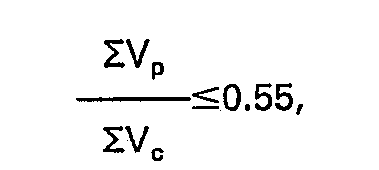
wherein ∑Vc represents the total volume of the catalyst particles under consideration and EVP is a value found by adding up the peel volumes present in the catalyst particles, the latter being regarded as being composed of a kernel surrounded by a peel, which kernel is of such a shape that at every point of the kernel perimeter the shortest distance (d) to the perimeter of the peel is the same, d being equal for all catalyst particles under consideration, and having been chosen such that the quantity of cobalt present in ∑VP is 90% of the quantity of cobalt present in IVc, which process comprises immersing a porous carrier once or several times in a solution of a cobalt compound, removing the liquid from the composition after each immersion and finally calcining and activating the composition, such that during each immersion the following relation between the viscosity measured at 60°C (v in cS) and the temperature (T in °K) of the solution, and the immersion time (t in s) is satisfied:
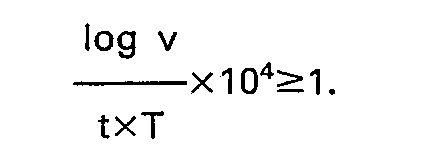
wherein ∑Vc represents the total volume of the catalyst particles under consideration and EVP is a value found by adding up the peel volumes present in the catalyst particles, the latter being regarded as being composed of a kernel surrounded by a peel, which kernel is of such a shape that at every point of the kernel perimeter the shortest distance (d) to the perimeter of the peel is the same, d being equal for all catalyst particles under consideration, and having been chosen such that the quantity of cobalt present in ∑VP is 90% of the quantity of cobalt present in IVc, which process comprises immersing a porous carrier once or several times in a solution of a cobalt compound, removing the liquid from the composition after each immersion and finally calcining and activating the composition, such that during each immersion the following relation between the viscosity measured at 60°C (v in cS) and the temperature (T in °K) of the solution, and the immersion time (t in s) is satisfied:
2. A process as claimed in claim 1, in which the catalyst comprises silica, alumina
or sil(ca-alumina as carrier.
3. A process as claimed in claim 1 or 2, in which the catalyst comprises 3-60 parts
by weight of cobalt per 100 parts by weight of carrier.
4. A process as claimed in claim 3, in which the catalyst comprises 5-50 parts by
weight of cobalt per 100 parts by weight of carrier.
5. A process as claimed in any one of claims 1-4, in which the catalyst comprises
one or more promoters chosen from zirconium, titanium, chromium and ruthenium.
6. A process as claimed in claim 5, in which per 100 parts by weight of carrier the
catalyst includes either 0.1-5 parts by weight of promoter, if during the preparation
the cobalt was deposited first and the promoter next, or 5-40 parts by weight of promoter,
if during the preparation the promoter was deposited first and the cobalt next.
7. A process as claimed in any one of claims 1-6, in which as carrier the catalyst
comprises silica and as promoter, zirconium.
8. A process for the preparation of hydrocarbons by catalytic reaction of carbon monoxide
with hydrogen, in which a mixture of carbon monoxide and hydrogen is contacted at
elevated temperature and pressure with a catalyst prepared as claimed in any one of
claims 1-7.
9. A process as claimed in claim 8, which is carried out at a temperature of 125-350°C
and a pressure of 5-100 bar.
10. A process as claimed in any one of claims 8 and 9 in which the H2/CO mixture is contacted with a catalyst which is present in the form of a fixed bed
having an external surface area (SE) between 5 and 70 cm2/ml.*
1. Verfahren zur Herstellung von auf einem Träger aufgebrachtes Kobalt umfassenden
Katalysatoren, in welchen Katalysatoren das Kobalt derart über den Träger verteilt
ist, daß die Beziehung
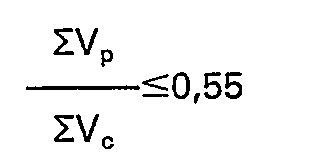
erfüllt ist, worin ∑Vc das Gesamtvolumen der in Betracht gezogenen Katalysatorteilchen ist und ∑Vp einen Wert darstellt, der durch Addieren der in den Katalysatorteilchen vorliegenden Schalenvolumina ermittelt wird, wobei die Katalysatorteilchen als aus einem Kern, umgeben von einer Schale, bestehend angesehen werden, wobei der Kern eine solche Form aufweist, daß an jedem Punkt des Kernumfanges der kürzeste Abstand (d) zum Schalenumfang gleich ist, wobei d für alle in Betracht gezogenen Katalysatorteilchen gleich ist, und derart gewählt worden ist, daß die Menge des in ZVp vorhandenen Kobalts 90% der in ∑Vc vorliegenden Kobaltmenge beträgt, welches Verfahren ein Eintauchen eines porösen Trägers ein- oder mehrmals in eine Lösung einer Kobaltverbindung, ein Entfernen der Flüssigkeitvon der Zusammensetzung nach jedem Eintauchen und schließlich ein Kalzinieren und Aktivieren der Zusammensetzung umfaßt, so daß während jedes Eintauchens die folgende Beziehung zwischen der Viskosität, gemessen bei 60°C (v in cS), und der Temperatur (T in °K) der Lösung und der Immersionszeit (t in Sekunden) erfüllt wird:
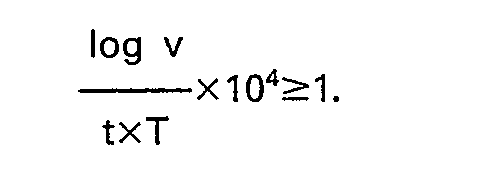
erfüllt ist, worin ∑Vc das Gesamtvolumen der in Betracht gezogenen Katalysatorteilchen ist und ∑Vp einen Wert darstellt, der durch Addieren der in den Katalysatorteilchen vorliegenden Schalenvolumina ermittelt wird, wobei die Katalysatorteilchen als aus einem Kern, umgeben von einer Schale, bestehend angesehen werden, wobei der Kern eine solche Form aufweist, daß an jedem Punkt des Kernumfanges der kürzeste Abstand (d) zum Schalenumfang gleich ist, wobei d für alle in Betracht gezogenen Katalysatorteilchen gleich ist, und derart gewählt worden ist, daß die Menge des in ZVp vorhandenen Kobalts 90% der in ∑Vc vorliegenden Kobaltmenge beträgt, welches Verfahren ein Eintauchen eines porösen Trägers ein- oder mehrmals in eine Lösung einer Kobaltverbindung, ein Entfernen der Flüssigkeitvon der Zusammensetzung nach jedem Eintauchen und schließlich ein Kalzinieren und Aktivieren der Zusammensetzung umfaßt, so daß während jedes Eintauchens die folgende Beziehung zwischen der Viskosität, gemessen bei 60°C (v in cS), und der Temperatur (T in °K) der Lösung und der Immersionszeit (t in Sekunden) erfüllt wird:
2. Verfahren nach Anspruch 1, worin der Katalysator Siliziumdioxid, Aluminiumoxid
oder Silizaiumdioxid - Aluminiumoxid als Träger umfaßt.
3. Verfahren nach Anspruch 1 oder 2, worin der Katalysator 3 bis 60 Gewichtsteile
Kobalt je 100 Gewichtsteile Träger umfaßt.
4. Verfahren nach Anspruch 3, worin der Katalysator 5 bis 50 Gewichtsteile Kobalt
je 100 Gewichtsteile Träger umfaßt.
5. Verfahren nach einem der Ansprüche 1 bis 4, worin der Katalysator ein oder mehrere
Promotoren, ausgewählt unter Zirkon, Titan, Chrom und Ruthenium, umfaßt.
6. Verfahren nach Anspruch 5, worin der Katalysator je 100 Gewichtsteile Träger entweder
0,1 bis 5 Gewichtsteile Promotor umfaßt, wenn während der Herstellung zuerst das Kobalt
und anschließend der Promoter abgelagert worden ist, oder 5 bis 40 Gewichtsteile Promotor
umfaßt, wenn während der Herstellung zuerst der Promotor und anschließend das Kobalt
abgelagert worden ist.
7. Verfahren nach einem der Ansprüche 1 bis 6, worin der Katalysator Siliziumdioxid
als Träger und Zirkon als Promotor umfaßt.
8. Verfahren zur Herstellung von Kohlenwasserstoffen durch katalytische Reaktion von
Kohlenmonoxid mit Wasserstoff, worin ein Gemisch aus Kohlenmonoxid und Wasserstoff
bei erhöhter Temperatur und erhöhtem Druck mit einem Katalysator, hergestellt gemäß
einem der Ansprüche 1 bis 7, in Berührung gebracht wird.
9. Verfahren nach Anspruch 8, das bei einer Temperatur von 125 bis 350°C und bei einem
Druck von 5 bis 100 bar ausgeführt wird.
10. Verfahren nach Anspruch 8 oder 9, worin das H2/CO-Gemisch mit einem Katalysator in Berührung gebracht wird, der in Form eines Festbettes
mit einer äußeren Oberfläche (SE) zwischen 5 und 70 cm2/ml vorliegt.
1. Un procédé de préparation de catalyseurs comprenant du cobalt déposé sur un support,
catalyseurs dans lesquels le cobalt est distribué sur le support de manière à satisfaire
à la relation
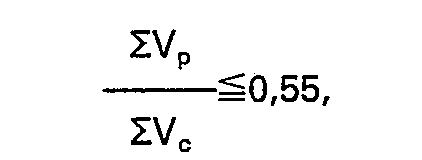
où ∑Vc représente le volume total des particules de catalyseur dont il s'agit et ∑Vp est une valeur trouvée en ajoutant les volumes de peau présents dans les particules de catalyseur, ces dernières étant considérées comme étant composées d'un noyau entouré par une peau, ce noyau étant d'une forme telle qu'à chaque point du périmètre du noyau la plus courte distance (d) au périmètre du noyau soit la même, cette distance d étant égale pour toutes les particules de catalyseur considérées et ayant été choisie de manière que la quantité de cobalt présente dans EVP soit 90% de la quantité de cobalt présente dans ZVc, procédé selon lequel on plonge un support poreux une seule ou plusieurs fois dans une solution d'un composé du cobalt, on sépare le liquide de la composition après chaque immersion et finalement on calcine et on active la composition, de manière que durant chaque immersion la relation suivante entre la viscosité mesurée à 60°C (v en cSt) et la température (T en °K) de la solution, et la durée d'immersion (t en secondes) soit satisfaite:
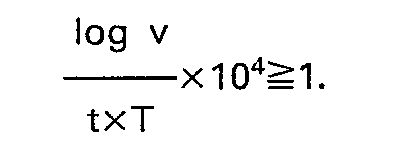
où ∑Vc représente le volume total des particules de catalyseur dont il s'agit et ∑Vp est une valeur trouvée en ajoutant les volumes de peau présents dans les particules de catalyseur, ces dernières étant considérées comme étant composées d'un noyau entouré par une peau, ce noyau étant d'une forme telle qu'à chaque point du périmètre du noyau la plus courte distance (d) au périmètre du noyau soit la même, cette distance d étant égale pour toutes les particules de catalyseur considérées et ayant été choisie de manière que la quantité de cobalt présente dans EVP soit 90% de la quantité de cobalt présente dans ZVc, procédé selon lequel on plonge un support poreux une seule ou plusieurs fois dans une solution d'un composé du cobalt, on sépare le liquide de la composition après chaque immersion et finalement on calcine et on active la composition, de manière que durant chaque immersion la relation suivante entre la viscosité mesurée à 60°C (v en cSt) et la température (T en °K) de la solution, et la durée d'immersion (t en secondes) soit satisfaite:
2. Un procédé selon la revendication 1, dans lequel le catalyseur comprend de la silice,
de l'alumine ou une combinaison silice-alumine comme support.
3. Un procédé selon la revendication 1 ou 2, dans lequel le catalyseur comprend 3-60
parties en poids de cobalt pour 100 parties en poids de support.
4. Un procédé selon la revendication 3, dans lequel le catalyseur comprend 5-50 parties
en poids de cobalt pour 100 parties en poids de support.
5. Un procédé selon l'une quelconque des revendications 1-4, dans lequel le catalyseur
comprend un ou plusieurs promoteurs choisis parmi le zirconium, le titane, le chrome
et le ruthénium.
6. Un procédé selon la revendication 5, dans lequel, pour 100 parties en poids de
support, le catalyseur comprend soit 0,1-5 parties en poids de promoteur, si durant
la préparation le cobalt a été déposé d'abord sur le support et le promoteur ensuite,
soit 5-40 parties en poids de promoteur, si durant la préparation le promoteur a été
déposé d'abord et le cobalt ensuite.
7. Un procédé selon l'une quelconque des revendications 1-6, dans lequel comme support
le catalyseur comprend de la silice et comme promoteur du zirconium.
8. Un procédé pour la préparation d'hydrocarbures par réaction catalytique d'oxyde
de carbone avec l'hydrogène, dans lequel un mélange d'oxyde de carbone et d'hydrogène
est mis en contact à température et pression élevées avec un catalyseur préparé selon
l'une quelconque des revendications ,1-7.
9. Un procédé selon la revendication 8, qui est mis en oeuvre à une température de
125-350°C et une pression de 5-100 bars.
10. Un procédé selon l'une quelconque des revendications 8 et 9, dans lequel le mélange
H2/CO est mis en contact avec un catalyseur qui est présent sous la forme d'un lit fixe
ayant une aire superficielle extérieure (SE) comprise entre 5 et 70 cm2/ml.