|
(11) | EP 0 178 762 B1 |

| (12) | EUROPEAN PATENT SPECIFICATION |
|
|
| (54) |
Composites Verbundmaterialien Matériaux composites |
|
|
|||||||||||||||||||||||||||||||
| Note: Within nine months from the publication of the mention of the grant of the European patent, any person may give notice to the European Patent Office of opposition to the European patent granted. Notice of opposition shall be filed in a written reasoned statement. It shall not be deemed to have been filed until the opposition fee has been paid. (Art. 99(1) European Patent Convention). |
[0001] This invention relates to resin-fibre composites having as a matrix resin a blend of an amide-imide copolymer and amide-imide phthalamide copolymer.
Background
[0002] Amide-imide polymers and copolymers are a relatively new class of organic compounds known for their solubility in nitrogen-containing organic solvents when in the largely polyamide form. In the past, the major application of these amide-imide polymers has been as wire enamels. This is illustrated in U.S. Patents 3,661,832 (1972), 3,494,890 (1970) and 3,347,828 (1967). Amide-imide polymers and copolymers have also been found useful for molding applications as shown in U.S. Patents 4,016,140 (1977) and 3,573,260 (1971). U.S. 4,136,085 (1979), U.S. 4,313,868 (1982), and U.S. 4,309,528 (1982) are incorporated herein by reference. These polyamides-imides are known for their outstanding mechanical properties; but they are also difficult to process and it is particularly difficult to form laminates from them. This difficulty is a consequence of insufficient flow of the polymer. The art has been looking for improvements in the flow and reduction in melt reactivity during fabrication of the polymers, but it is essential that an additive not impair the excellent mechanical properties of the amide-imide polymers and copolymers, when forming the laminate.
[0003] EP 0097434 discloses a blend of amide-imide polymer and polyamide having a single glass transition temperature, suitable for use in laminates.
[0004] The general object of this invention is to provide a miscible amide-imide/amide-imide-phthalamide copolymer blend as the matrix resin for fiber laminates.
[0005] A more specific object of this invention is to provide polyamide-imide and polyamide-imide phthalamide impregnated woven fiber laminates, wherein the polyamide-imide copolymer is 80 to 20 weight percent and the polyamide-imide-phthalamide copolymer is 20 to 80 weight percent of the total coating added.
[0006] The present invention provides a composite comprising a multiplicity of thermally stable continuous fibres and a resin matrix wherein the matrix comprises a miscible blend comprising 20% to 80% by weight of an amide-imide copolymer A comprising recurring units of:
and units of:
wherein the molar ratio of units I to units II is in the range 90:10 to 10:90 and from 80% to 20% by weight of an amide-imide-phthalamide copolymer B comprising units of
wherein the molar ratio of units V and VI to the total of units III and IV is in the range 5:95 to 80:20, and each Z is a trivalent benzene ring or lower alkyl substituted trivalent benzene ring, wherein two of the carbonyl groups are ortho to one another and are meta and para respectively to the third carbonyl group, X is a divalent aromatic radical, R₁, R₂, R₃ and R₄ are each a divalent aromatic hydrocarbon radical of from 6 to 10 carbon atoms or two divalent aromatic hydrocarbon radicals of from 6 to 10 carbon atoms joined directly or by a stable linkage selected from the group consisting of -O-, methylene, -CO-, -SO₂- and -S- radicals and R₁ and R₂ are different, R₃ and R₄ may be the same or different, R₁ is the same as R₄ and when R₃ and R₄ are different the molar ratio of R₃ and R₄ containing units is in the range 10:90 to 90:10 and wherein at least some of the free carboxylic acid groups in copolymer A and at least some of the free carboxylic acid groups in copolymer B have condensed with amide groups in the ortho position thereto to form imide groups.
[0007] Preferably,also, each Z is a trivalent benzene ring,
and the molar ratio of R₁ to R₂ containing units is in the range 30:70 to 70:30
We have now found that amide-imide copolymers obtained by reacting a polycarboxylic acid anhydride with a mixture of primary diamines in a blend containing 20 to 80 percent by weight of polyamide-imide-phthalamide moieties produces excellent impregnation resins for fiber laminates. When polyamide-imide alone is used, higher molding pressures are required. Suitable polyamide-imide phthalamides which can be used with polyamide-imides as impregnating resins for fiber laminates comprise recurring polyamide A units of:
especially
which are capable of undergoing imidization and polyamide B units of:
wherein the molar ratio of A units to B units is between 95 to 5 and 20 to 80, wherein R is a divalent aromatic hydrocarbon radical of from about 6 to about 20 carbon atoms or two divalent hydrocarbons joined directly or by stable linkages selected from the group consisting of -O-, methylene, -CO-, and -SO₂-, and wherein X is a divalent aromatic radical and → denotes isomerization.
[0008] In the injection molded form, the polyamide A units have converted to the polyamide-imide A' units and the copolymer is comprised of recurring polyamide-imide A' units of:
such as
and polyamide B' units of:
wherein the molar ratio of A' to B' units is 95 to 5 to 20 to 80, preferably 1 to 1, and wherein R and X are defined as above.
[0009] The polyamide-imide phthalamides are prepared from acyl halide derivatives of dicarboxylic acid HOOC-X-COOH, such as isophthalic acid or terephthalic acid and a suitable anhydride-containing substance and aromatic diamines having the structure H₂N-R-NH₂. Useful acyl halide derivatives of dicarboxylic acid include:
and related compounds. Suitably, the anhydride-containing substance is an acyl halide derivative of the acid anhydride having a single benzene or lower-alkyl substituted benzene ring. The preferred anhydride is the four-acid chloride of trimellitic anhydride (4-TMAC).
[0010] Useful aromatic diamines include para- and metaphenylenediamine, oxybis (aniline), thiobis (aniline), sulfonylbis (aniline), diaminobenzophenone, methylenebis (aniline), benzidine, 1,5-diaminonaphthalene, oxybis (2-methylaniline), thiobis (2-methylaniline), 2,2-bis-4-(p-aminophenoxy)phenylpropane, bis-4-(p-aminophenoxy) phenylsulfone, 2,2-bis-4-(p-aminophenoxy) phenylhexafluoropropane, bis-4-(p-aminophenoxy)benzene, bis-4-(3-aminophenoxy) benzene, and the like. Examples of other useful aromatic primary diamines are set out in U.S. Patent No. 3,494,890 (1970) and U.S. Patent No. 4,016,140 (1977) both incorporated herein by reference. The preferred diamine is metaphenylenediamine. A single diamine or a mixture of two diamines may be used.
[0011] The amount of the polyamide-imide-phthalamide added to the polyamide-imide polymer is in the range of 20 to 80 weight percent. The polyamide-imide-phthalamide is miscible with the amide-imide polymers, thus forming a single glass transition (Tg) matrix. When about 20 weight percent of the polyamide-imide-phthalamide was dry blended with our amide-imide polymer and molded, a single Tg was found. The Tg of the amide-imide polymer used as a control was about 230°C to about 240°C, as molded, while the polymer containing 20 percent by weight of polyamide-imide-phthalamide also had a glass transition temperature of about 230°C to about 240°C. After being cured at a temperature of about 160°C to about 260°C, the glass transition temperature for our control polyamide-imide polymer rose to about 270°C and for the sample containing 20 percent polyamide-imide-phthalamide the glass transition temperature also rose to 270°C.
[0012] It should be particularly emphasized that when our polyamide-imides are blended with polyamide-imide-phthalamide, a one-phase miscible polyamide-imide/ polyamide-imide-phthalamide system is obtained. This is critical in the effectiveness of our process and our novel laminate compositions, since if a one-phase miscible system is not formed, delamination of the incompatible components can readily occur with a multiphase polymer system.
[0013] The polyamide-imides are prepared by reacting an acyl halide derivative of an aromatic tricarboxylic-acid-anhydride with a mixture of largely- or wholly-aromatic primary diamines. The resulting products are polyamides wherein the linking groups are predominantly amide groups, although some may be imide groups, and wherein the structure contains free carboxylic acid groups which are capable of further reaction. Such polyamides are moderate molecular weight (3000-13,000 as prepared) polymeric compounds having, in their molecule, units of:
wherein the free carboxyl groups are ortho to one amide group, Z is an aromatic moiety containing 1 to 4 benzene rings or lower-alkyl-substituted benzene rings; R₁, R₂ and R₃ are different for copolymers and are divalent wholly- or largely-aromatic hydrocarbon radicals. These hydrocarbon radicals may be a divalent aromatic hydrocarbon radical of from 6 to about 10 carbon atoms, or two divalent aromatic hydrocarbon radicals each of from 6 to about 10 carbon atoms joined directly or by stable linkages such as -O-, methylene, -CO, -SO₂-, or -S-; for example, -R'-O-R'-, -R'-CH₂-R'-, -R'-CO-R'-, -R'-SO₂-R'- and -R'-S-R'-.
[0014] Said polyamides are capable of substantially complete imidization by heating, by which they form the polyamide-imide structure having, to a substantial extent, recurring units of:
wherein one carbonyl group is meta to and one carbonyl group is para to each amide group and wherein Z, R₁, R₂ and R₃ are defined as above. Typical copolymers of this invention have up to about 50 percent imidization prior to heat treatment, typically about 10 to about 40 percent.
[0015] The mixture of diamines contains two or more, preferably two or three, wholly- or largely-aromatic primary diamines. More particularly, they are wholly- or largely-aromatic primary diamines containing from 6 to about 10 carbon atoms or wholly- or largely-aromatic primary diamines composed of two divalent aromatic moieties of from 6 to about 10 carbon atoms, each moiety containing one primary amine group, and the moieties linked directly or through, for example, a bridging -O-, -S-, -SO₂-, -CO-, or methylene group. When three diamines are used, they are preferably selected from the class composed of:
said X being an -O-, -CH₂-, or -SO₂- group. More preferably, a mixture of two aromatic primary diamines is used selected from meta-phenylenediamine, p,p'-oxybis(aniline) and metaphenylenediamine, or p,p'-sulfonylbis(aniline) and p,p'-methylenebis(aniline). Most preferably, the mixture of primary aromatic diamines contains meta-phenylenediamine and p,p'-oxybis(aniline). The aromatic nature of the diamines provides the excellent thermal properties of the copolymers while the primary amine groups permit the desired imide rings and amide linkages to be formed.
[0016] Usually, the polymerization or copolymerization is carried out in the presence of a nitrogen-containing organic polar solvent such as N-methylpyrrolidone, N,N-dimethylformamide and N,N-dimethylacetamide. The reaction should be carried out under substantially anhydrous conditions and at a temperature below about 150°C. Most advantageously, the reaction is carried out from about 20°C to about 50°C.
[0017] The reaction time is not critical and depends primarily on the reaction temperature. It may vary from about 1 to about 24 hours, with about 2 to 4 hours at about 30°C to about 50°C being preferred for the nitrogen-containing solvents.
[0018] Laminates of amide-imide copolymer solution-impregnated fiber woven fabric have been produced at lower molding pressures when about 20 to about 80 percent by weight of the polyamide-imide-phthalamide is added to the impregnation solution.
[0019] High performance composites are usually made by lamination, i.e. the fixing together of sheets of aligned fiber reinforced polymers. The fiber directions used are chosen to suit the magnitudes and directions of the stresses that are expected to be encountered. The alignment of these reinforcement fibers can be in the same direction in unidirectional layups such as unitape and unidirectional fabric. Additionally, each successive layer of the laminate can have different fiber direction from the previous one, except for the two layers at the center. Typically, the fiber direction in each successive layer of the laminate can be shifted, for example, by 30°, 45°, or 90° from the previous layer. Usually the layers are "balanced", i.e. they consist of an even number of sheets, arranged so that the interface between the two sheets at the center is a mirror plane of symmetry. This is to avoid unwanted twisting and other distortions which occur with unbalanced laminates when the laminate is stressed. Very high volume fractions of reinforcement can be obtained in laminates, and this is much the most efficient way of providing bi-directional or approximately transversely isotropic reinforcement. The fiber used for reinforcement can be any material which can be processed as a continuous filament and has a modulus of 69000 MPa (10,000,000 psi) or greater and is thermally stable to at least 316°C (600°F) for at least 10 minutes. By thermally stable is meant the fiber emits insufficient volatiles to cause voids in the final composite structure. While any high temperature stable fiber material can be used according to the present invention, such as glass fibers, alumina, steel, silicon nitride, silicon carbide, boron, Kevlar, carbon fiber or the like.
[0020] The term carbon fiber is used herein in the generic sense and includes graphite fibers as well as amorphous carbon fibers which result after a thermal carbonization or graphitization treatment. Graphite fibers are defined herein to consist substantially of carbon and have a predominant X-ray diffraction pattern characteristic of graphite. Amorphous carbon fibers, on the other hand, are defined as fibers in which the bulk of the fiber weight can be attributed to carbon and which exhibit a predominantly amorphous X-ray diffraction. Graphite fibers generally have a higher Young's modulus than do amorphous carbon fibers and in addition are more highly electrically and thermally conductive.
[0021] The reinforcement fibers are coated or sized with a polyamic acid, an amide-imide polymer, an amide-imide copolymer or mixtures of these materials (hereinafter collectively referred to as amide-imide polymers or alternatively polyamide-imide) or a blend of an amide-imide copolymer and an amide-imide phthalamide copolymer. These materials are prepared from an anhydride-containing substance and a mixture of wholly- or partially-aromatic primary diamines or fully or partially acylated diamines. The amide-imide polymer sizing agents can be applied to the fiber in a suitable solvent, which is non-reactive with the sizing agent, to control the amount of size coated onto the fiber. The presence of solvent will improve the ability of the sizing agent to penetrate into the individual fibers of a staple yarn, filament yarn, or roving. The concentration of the size in the solvent is usually in the range of from about 0.05 to about 10%, and preferably from about 0.5 to about 5% by weight, based on the total weight of the solution. Examples of suitable solvents are N-methylpyrrolidone (NMP), N,N-dimethylformamide (DMF), N,N-dimethylacetamide (DMAC) and methyl ethyl ketone. Other materials to aid in the removal of the solvent such as methylene chloride and the like can be added to the solvent.
[0022] The sized reinforcement fibers are used to form reinforcement material for continuous fiber, unidirectional tape, and woven fabric for which amide-imide polymer/amide-imide phthalamide polymer blends are used as the matrix resin.
[0023] Unidirectional tape (unitape) formed by parallel reinforcement fiber bundles forming tape widths of 0.64cm to 60.96cm (0.25 inch to 24 inch) can be impregnated with polyamide-imide matrix resin in the following manner. The unitape is placed on release paper on a table or platen heated to a temperature of 38°C to 93°C (100 to 200°F). The release paper can be polyethylene coated paper. A concentrated solution of polyamide-imide in a suitable solvent such as NMP is pressed into the reinforcement fibers of the unitape and worked into the tape to provide uniform wetting and impregnation of the reinforcement fibers. The solution contains a solids concentration of 45 to 70% polyamide-imide in the solvent. A second release paper can be placed on top of the unitape after the matrix resin solution has been added before the unitape is pressure rolled. The solvent is removed by heating the unitape to a temperature of (149-260°C) (300-500°F). The unitape is cooled to room temperature and rolled up on a roll for shipment having a residual solvent content of 1 to 10%.
[0024] For single fiber or multiple fiber bundles up to 0.25 inch in diameter, these continuous fibers are impregnated with polyamide-imide by dip coating the continuous filament in a dip bath containing the impregnation material. The dip bath can be operated at room temperature to 200°F with a solids content of 25 to 40% polyamide-imide in a suitable solvent. The continuous filament is dried at temperatures of 149 to 260°C (300 to 500°F) and wound to form packages for use in spiral winding, pultrusion, and the like. The residual solvent content is about 1 to 10%.
[0025] The term "composite structure" is defined herein as fiber reinforced fabric, tape or broadgoods which has been impregnated with amide-imide polymer and is also referred to herein as "prepreg". In a batch operation, an appropriate quantity of the reinforcement fiber is spread in a parallel lay-up on a flat surface to the thickness and width needed. A measured quantity of resin is added to the fibers. The resin may be in a solvent, to improve uniformity of impregnation, with the solvent removed after coating.
[0026] In a continuous operation, the fibers, tapes, or fabrics can be spread and resin added by passing over and through a series of appropriately spaced rolls above and within a container of the matrix. resin or resin/solvent mixture. The solvent is removed by passage through a heating zone at a temperature sufficient to evaporate the solvent. Otherwise, the fibers can be impregnated by the so called melt transfer technique, where the resin is transferred to the fiber by contact with a moving belt containing the resin at a temperature high enough to maintain the resin in a plastic state without the addition of solvent.
[0027] Laminates of the desired thickness are formed by using multiple layers of prepreg and subsequently placing the layers under sufficient temperature and pressure to form a substantially void free laminate.
[0028] In a preferred method, a carbon fiber woven fabric for prepreg preparation, is formed by impregnating carbon fiber woven fabric with amide-imide polymer. The carbon fiber used to form the fabric is sized with amide-imide polymer to aid in the adhesion of the carbon fiber to the matrix resin. The fabric is drawn through a dip tank which contains a 25 to 40% solution of the amide-imide polymer in NMP solvent at a temperature in the range of room temperature to 93°C (200°F). The woven fabric must have sufficient residence time in the dip tank provided with numerous rollers to completely "wet-out" the fabric and provide for complete impregnation of the fabric with matrix resin. As the fabric exits the dip tank it must pass through nip rolls to control the solution/dry polymer content on the fabric. The dry resin content of the fabric is in the range of 30 to 50 weight percent based on the fabric. The prepreg is dried at 149 to 260°C (300 to 500°F) to give a residual solvent content of 1 to 10 weight percent.
Dried prepreg is cut to the desired dimensions and placed on a metal plate with each successive layer tacked together in some manner to form a lay-up. The number of layers or plies depends on the desired thickness of the laminate. Release and breather fabrics are placed on top of the lay-up with the breather fabric extending beyond the edges of the prepreg. Material to form a vacuum bag is placed over the lay-up and a vacuum bag is formed. The entire assembly of the lay-up in a vacuum bag is placed in a hydraulic press or a vacuum-bag autoclave. After forming a vacuum in the bag, the assembly is heated to the range of 349° (660°F) allowed to equilibrate, and a pressure of 690 to 3450 KPa (100 to 500 psig) is applied for about 5 to 30 minutes. The assembly is allowed to cool under pressure before the laminate is removed from the assembly.
[0029] In the following examples, Examples I to VIII illustrate the preparation of amide-imide polymers and copolymers and Example IX illustrates the preparation of an amide imide phthalamide polymer.
[0030] Example X illustrates a blend of polyamide-imide-phthalamide and polyamide-imide and Example XI illustrates the impregnation of a silicon carbide fabric.
EXAMPLE I
[0031] A 200-ml., round-bottom, 4-neck flask, equipped with a nitrogen inlet tube, stirrer, thermometer, and solids addition funnel, was charged with 99.9 (pbw) parts by weight of p,p'-oxybis(aniline) (OBA), 23.1 pbw metaphenylenediamine (MPDA) and 604 pbw N-methylpyrrolidone (NMP). When solution at room temperature 22°C (72°F) was complete, 142.5 pbw 4-trimellitoyl anhydride chloride (4-TMAC), having a purity of 99.5 percent ± 0.5 percent as determined from chloride content and 6.8 pbw of trimellitic anhydride (TMA) were added over 2.5 hours while maintaining a solution temperature of between 25-35°C (77°-95°F). When addition was complete the solution was stirred for 3 hours during which time the solution viscosity increased to a Gardner-Holdt value of Z5+ or about 110 poises.
[0032] Solid polymer was obtained by first pouring the viscous solution into twice its volume of distilled water in a Waring blender and then filtering. The filtrate was washed with 5 increments of 3000 pbw each of distilled water to remove hydrogen chloride that had been generated during reaction.
[0033] The solid was dried under a vacuum of 677mbar (20 inches of mercury) for 24 hours at 50°C (122°F). The above material was heated for 2 hours in an oven dryer set at 191-232°C (375-450°F) to give the final product.
EXAMPLE II
[0034] A 200-ml., round-bottom, 4-neck flask, equipped with a nitrogen inlet tube, stirrer, thermometer, and solids addition funnel, was charged with 99.9 parts by weight (pbw) of p,p'-oxybis(aniline) (OBA), 23.1 pbw metaphenylenediamine (MPDA) and 604 pbw N-methylpyrrolidone (NMP). When solution at room temperature 22°C (72°F) was complete, 144.0 pbw 4-trimellitoyl anhydride chloride (4-TMAC), having a purity of 99.5 percent ± 0.5 percent as determined from chloride content and 5.5 pbw of trimellitic acid anhydride (TMA) was added over 2.5 hours while maintaining a solution temperature of between 25°C-35°C (77-95°F). When addition was complete, the solution was stirred for 3 hours during which time the solution viscosity increased to a Gardner-Holdt value of Z5+ or about 110 poises.
[0035] Solid polymer was obtained by first pouring the viscous solution into twice its volume of distilled water in a Waring blender and then filtering. The filtrate was washed with 5 increments each of 3000 pbw of distilled water to remove hydrogen chloride that had been generated during reaction.
[0036] The solid was dried under a vacuum of 677mbar (20 inches of mercury) for 24 hours at 50°C (122°F). A 2 gram sample heated for 20 min. of 260°C (500°F) in an air-circulating oven showed a volatile's content of 10%.
[0037] A 2000-ml., round-bottom, 4-neck flask, equipped with a nitrogen inlet tube, stirrer, thermometer, and solids addition funnel was charged with 1000 pbw of NMP. After bringing the flask contents to 50-60°C, 598 pbw of the solid prepared are added with stirring. Solution is effected after stirring for 2-3 hrs at 50-60°C. After cooling to 25°C, the viscosity is 158 poises with a determined solids content of 37.8% (Sample of 2g heated for 2 hrs at 200°C).
EXAMPLE III
[0038] A sample of polymer as prepared by the method of Example 1 was heated for 2 hours in an oven dryer with a temperature range of 191-232°C (375-450°F).
EXAMPLE IV
[0039] Metaphenylenediamine (540 g) and acetic acid (900 ml) were placed in a five-liter, three-necked, round-bottom flask equipped with mechanical stirrer, pressure equalizing addition funnel and nitrogen sparge tube, and distillation head and condenser. The nitrogen sparge was set at 300 cc/min and 765 g of acetic anhydride was added over 5 min. This was followed by the addition of 415 g of isophthalic acid and 480 g of trimellitic anhydrice. The temperature of the bottom half of the spherical heating mantle surrounding the flask was set at 700°F and the top half of the mantle was heated with a Variac set at 50. After 105 min., 1730 ml. of distillate were collected and the polymer had become very viscous. The heat was turned off and the polymer was cooled under nitrogen.
EXAMPLE V
[0040] A 690-gram portion of dimethylacetamide (DMAC) was stirred and cooled to 5°C with dry nitrogen purging to keep the system dry. An intimate mixture composed of 252.2 grams of 4-TMAC, 119.0 grams of p',p-methylene-bis(aniline) (MBA), and 120.0 grams of OBA was then added to the solvent over a period of 30 minutes. The temperature of the reaction was allowed to rise to 50°C. At that temperature, it was controlled by means of an ice bath. An additional 100 grams of DMAC were then added to wash in all solids, and the reaction continued for another 3½ hours at 50°C. The reaction solution was then poured into a large excess of rapidly-agitated water, whereupon precipitation of the copolymer took place. The solids were then washed several times with distilled water and soaked overnight. Finally, the solids were dried at 49°C (120°F). A 443-gram yield of the copolymer was obtained.
EXAMPLE VI
[0041] A solution consisting of 533.3 grams of NMP, 300 grams of DMAC, and 58.0 grams of propylene oxide was stirred and cooled to 8°C. A mixture of 168.5 grams of 4-TMAC, 80.1 grams of OBA, and 79.3 grams of MBA was then added to the solvent over a period of 50 minutes. During this time, the reaction was allowed to warm to 36°C. An additional 66.7 grams of NMP were added to wash in all solids, then the reaction mixture was heated to 50°C and held at that temperature for 3½ hours. The solution was then filtered.
EXAMPLE VII
[0042] The general procedure for preparing a copolymer containing three diamines is illustrated by the reaction of OBA, MPDA, MBA and 4-TMAC in DMAC. Thus, a 242.0-gram portion of OBA (1.21 moles), a 130.7-gram portion of MPDA (1.21 moles) and a 239.6-gram portion of MBA (1.21 moles) were dissolved in 3900 grams DMAC contained in a 6-liter flask equipped with a nitrogen purge, stirrer, addition funnel and thermometer. A 765-gram portion of 4-TMAC (3.63 moles) in flake or lump form was then added to the solution in portions over 90 minutes. The reaction exotherm was allowed to raise the temperature to about 35°C. The reaction temperature was maintained at 33°-38°C for the remainder of the 4-TMAC addition using cooling water when necessary. After the 4-TMAC addition was completed, any residual 4-TMAC clinging to the addition funnel was completely washed into the reaction solution with 70 grams DMAC. A heating mantle was applied to the reaction flask and the temperature quickly rose (about 20 min.) to 50°C. The reaction solution was stirred at 50°C for 90 minutes and then the solution precipitated by admixing with water. Prior to precipitation, the solution viscosity was about 7.5 stokes (25°C, 20 percent solids). The polymer was precipitated in distilled water in a model D, W. J. Fitzpatrick Company, comminuting machine (Fitz mill). After precipitation, the polymer was washed with distilled water to aqueous pH 4 to 5 (3 to 4 hours washing time), then filtered onto large Buchner funnels. The polymer was dried overnight by drawing air through the funnels, then finally dried in an aeromat drier at 30°-35°C for 12-15 hours.
EXAMPLE VIII
[0043] A 37.85ℓ (10-gal), glass-lined Pfaudler kettle equipped with a water-cooled jacket and nitrogen inlet was charged with 4.48kg (9.87 lbs) of MPDA, 0.16kg (0.35 lbs) of trimellitic anhydride and 26.8kg (59.2 lbs) of N-methylpyrrolidone. After solution had occurred under a nitrogen purge, an intimate blend of 4.32kg (9.52 lbs) of 4-trimellitoyl anhydride chloride and 4.16kg (9.17 lbs) of isophthaloyl dichloride was added over 2.5 hrs. keeping the temperature below 35°C. The resulting viscous solution was brought to 50°C. When the Gardner viscosity had reached a Z1 viscosity, the solution was precipitated by passage through a Fitzpatrick comminuting mill. The polymer product was washed five times with deionized water followed by air-drying on a filter for 3 days. The product was then brought to a solids content of J98% by heating in a forced air oven for 2 hrs. at 243°C (470°F).
EXAMPLE IX
[0044] A round-bottom, 2000-ml., 4-necked flask was charged with 1045 g dry NMP, 162.1 g (1.5 mol) of MPDA, and 4.3 g of TMA (0.0225 mol). The flask was equipped with a mechanical stirrer, nitrogen inlet tube, thermometer, and a liquid addition funnel. During solution of the diamine and TMA, the addition funnel was charged with 248.0 g (1.178 mol) of 4-TMAC and 60.9 g (0.30 mol) isophthaloyl dichloride (IPCL₂) and melted at 80°C. When melting was complete, the solution of acid chlorides was added to the diamine/TMA solution over a 2-hour period at 25°-35°C. After addition was complete, the viscous solution was heated to 50°C and held for 1 hour.
EXAMPLE X
[0045] The polyamide-imide-phthalamide prepared as in Example IX was dissolved in NMP. This solution, having a solids content of 27.5 percent, was blended with a polyamide-imide prepared as in Example I and dissolved/NMP solution (27.5 percent solids) at an 80:20 weight ratio. The polyamide-imide solution was first heated to 66°C (150°F). The polyamide-imide-phthalamide solution was then added, and the blend was stirred with a high shear mixer for four hours. The blended solution was allowed to cool and sit 16 hours before using.
[0046] The blended solution of polyamide-imide and amide-imide-phthalamide copolymers was used to coat graphite fiber woven fabric. The W322 plain weave fabric was cleansed with NMP solvent to remove the epoxy fiber size. The laminates formed from these blends and a control are listed in the Table below.
Table 1
| Sample | Molded Pressure, KPa | Short Beam Shear (SBS), |
| Control | 10350 (1500 psi) | 1.2 (8.0 ksi) |
| Blend | 10350 (1500 psi) | 1.6 (10.0 ksi) |
[0047] The blend coating resulted in improved polymer flow during molding as indicated by increased flash and by improved wetting of the surface fiber.
Example XI
[0048] Woven silicon carbide fabric identified as Dow Corning Nicalon Silicon Carbide 8 Harness Satin was washed in acetone solvent to remove the epoxy size. The fabric was impregnated with a solution of polyamide-imide as prepared in Example I dissolved in NMP to give a solids content of 30%. Both the solution and the fabric were pre-weighed to yield a 30% dry resin content impregnated fabric after solvent extraction. The fabric was taped to a polyethylene film and the polyamide-imide solution was washed into the fabric with a polypropylene squeegee. The coated fabric was dried in a forced air oven for 4 days at room temperature, 2 hours at 121°C (250°F), 1 hour at 149°C (300°F), and 1 hour at 204°C (400°F) to lower the solvent content to about 1.5 wt. %. The fabric was cut to the desired dimensions with successive plys oriented 90° to each other. The plies were tacked together at two corners using a Seelye plastic welder with a tacking tip. The lay-up of four plys was placed in a vacuum bag autoclave to be molded. The vacuum bag autoclave had a 1 hour heatup time at full vacuum a 15 minute dwell time at 349°C (660°F) a 15 minute time at 3450KPa (500 psig) and 316°C (600°F), and was cooled at 3450KPa (500 psig) to 149°C (300°F) at the maximum rate. The thickness of the laminate ranged from 1.14 to 1.22mm (0.045 to 0.048 inch) with the laminate surface fairly uniform with a dark color, slightly semi-glossy and dry looking with fill fiber showing.
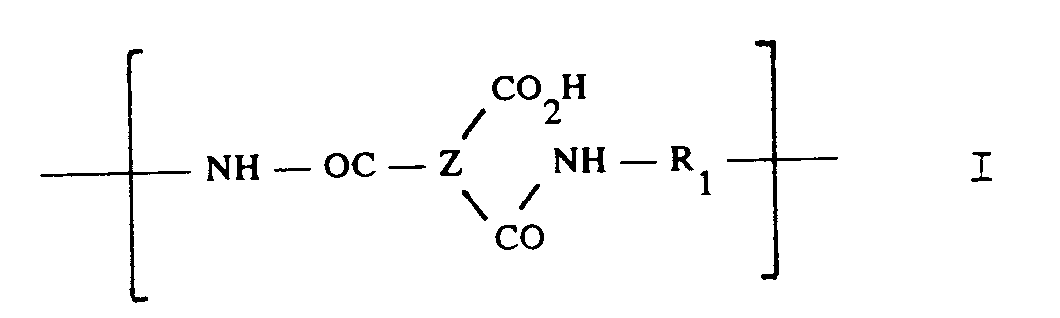
1. A composite comprising a multiplicity of thermally stable continuous fibres and a
resin matrix wherein the matrix comprises a miscible blend comprising 20% to 80% by
weight of an amide-imide copolymer A comprising recurring units of:
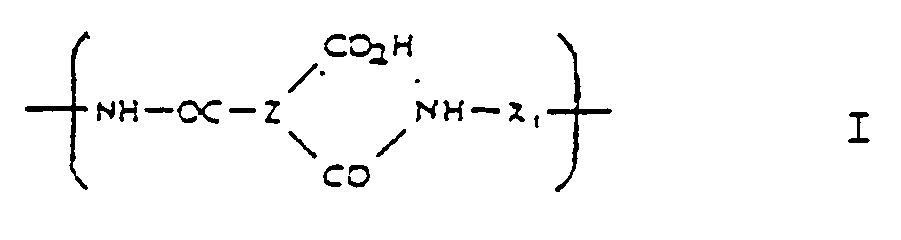
and units of:
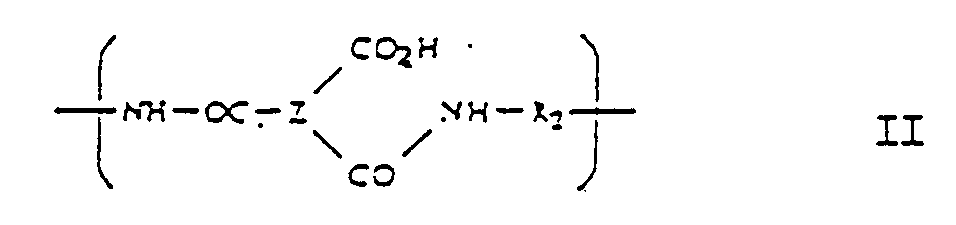
wherein the molar ratio of units I to units II is in the range 90:10 to 10:90 and from 80% to 20% by weight of an amide-imide-phthalamide copolymer B comprising units of
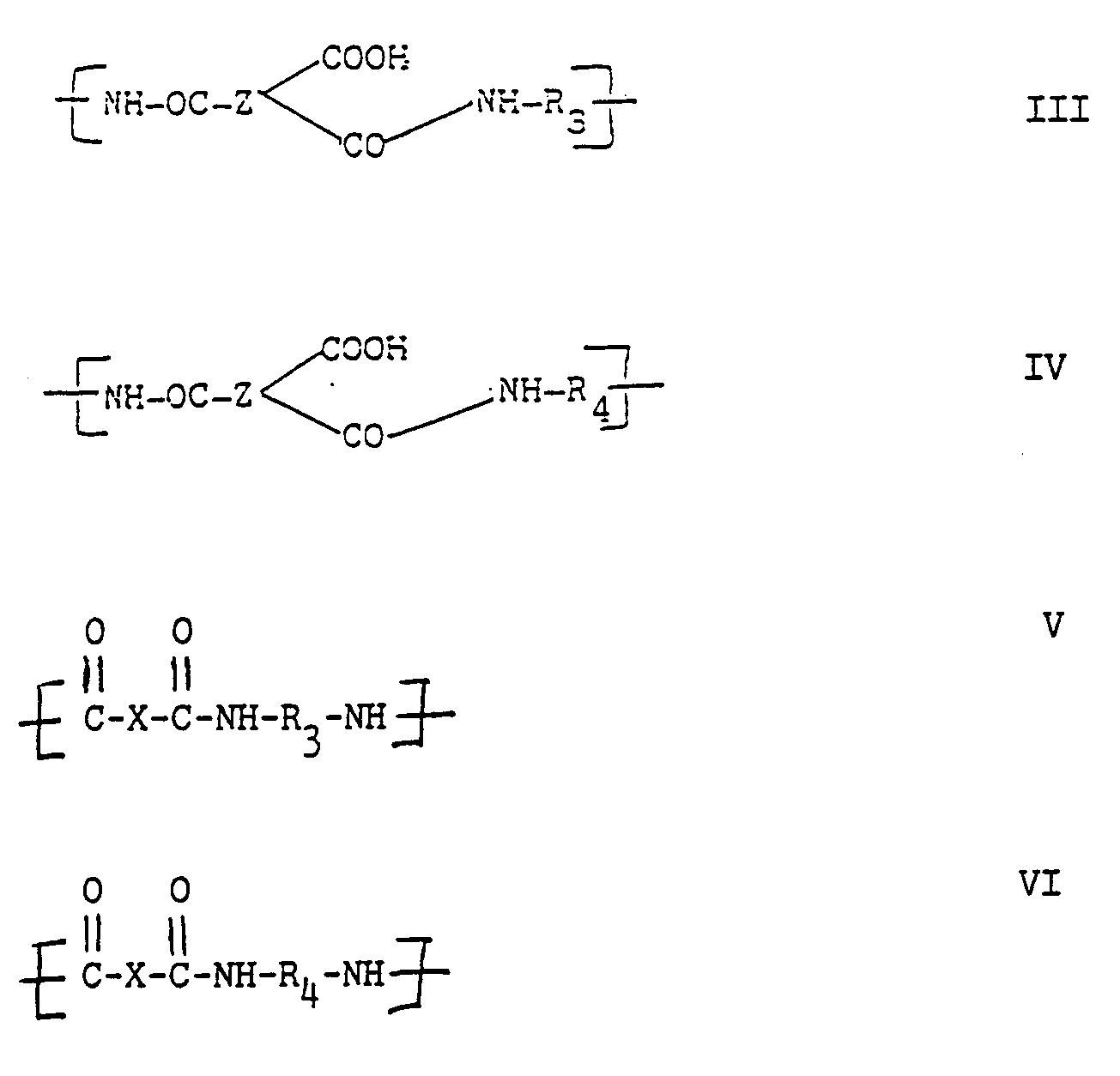
wherein the molar ratio of units V and VI to the total of units III and IV is in the range 5:95 to 80:20, and each Z is a trivalent benzene ring or lower alkyl substituted trivalent benzene ring, wherein two of the carbonyl groups are ortho to one another and are meta and para respectively to the third carbonyl group, X is a divalent aromatic radical, R₁, R₂, R₃ and R₄ are each a divalent aromatic hydrocarbon radical of from 6 to 10 carbon atoms or two divalent aromatic hydrocarbon radicals of from 6 to 10 carbon atoms joined directly or by a stable linkage selected from the group consisting of -O-, methylene, -CO-, -SO₂- and -S- radicals and R₁ and R₂ are different, R₃ and R₄ may be the same or different, R₁ is the same as R₄ and when R₃ and R₄ are different the molar ratio of R₃ and R₄ containing units is in the range 10:90 to 90:10 and wherein at least some of the free carboxylic acid groups in copolymer A and at least some of the free carboxylic acid groups in copolymer B have condensed with amide groups in the ortho position thereto to form imide groups.
and units of:
wherein the molar ratio of units I to units II is in the range 90:10 to 10:90 and from 80% to 20% by weight of an amide-imide-phthalamide copolymer B comprising units of
wherein the molar ratio of units V and VI to the total of units III and IV is in the range 5:95 to 80:20, and each Z is a trivalent benzene ring or lower alkyl substituted trivalent benzene ring, wherein two of the carbonyl groups are ortho to one another and are meta and para respectively to the third carbonyl group, X is a divalent aromatic radical, R₁, R₂, R₃ and R₄ are each a divalent aromatic hydrocarbon radical of from 6 to 10 carbon atoms or two divalent aromatic hydrocarbon radicals of from 6 to 10 carbon atoms joined directly or by a stable linkage selected from the group consisting of -O-, methylene, -CO-, -SO₂- and -S- radicals and R₁ and R₂ are different, R₃ and R₄ may be the same or different, R₁ is the same as R₄ and when R₃ and R₄ are different the molar ratio of R₃ and R₄ containing units is in the range 10:90 to 90:10 and wherein at least some of the free carboxylic acid groups in copolymer A and at least some of the free carboxylic acid groups in copolymer B have condensed with amide groups in the ortho position thereto to form imide groups.
2. A composite as claimed in claim 1 in which R₁ is:
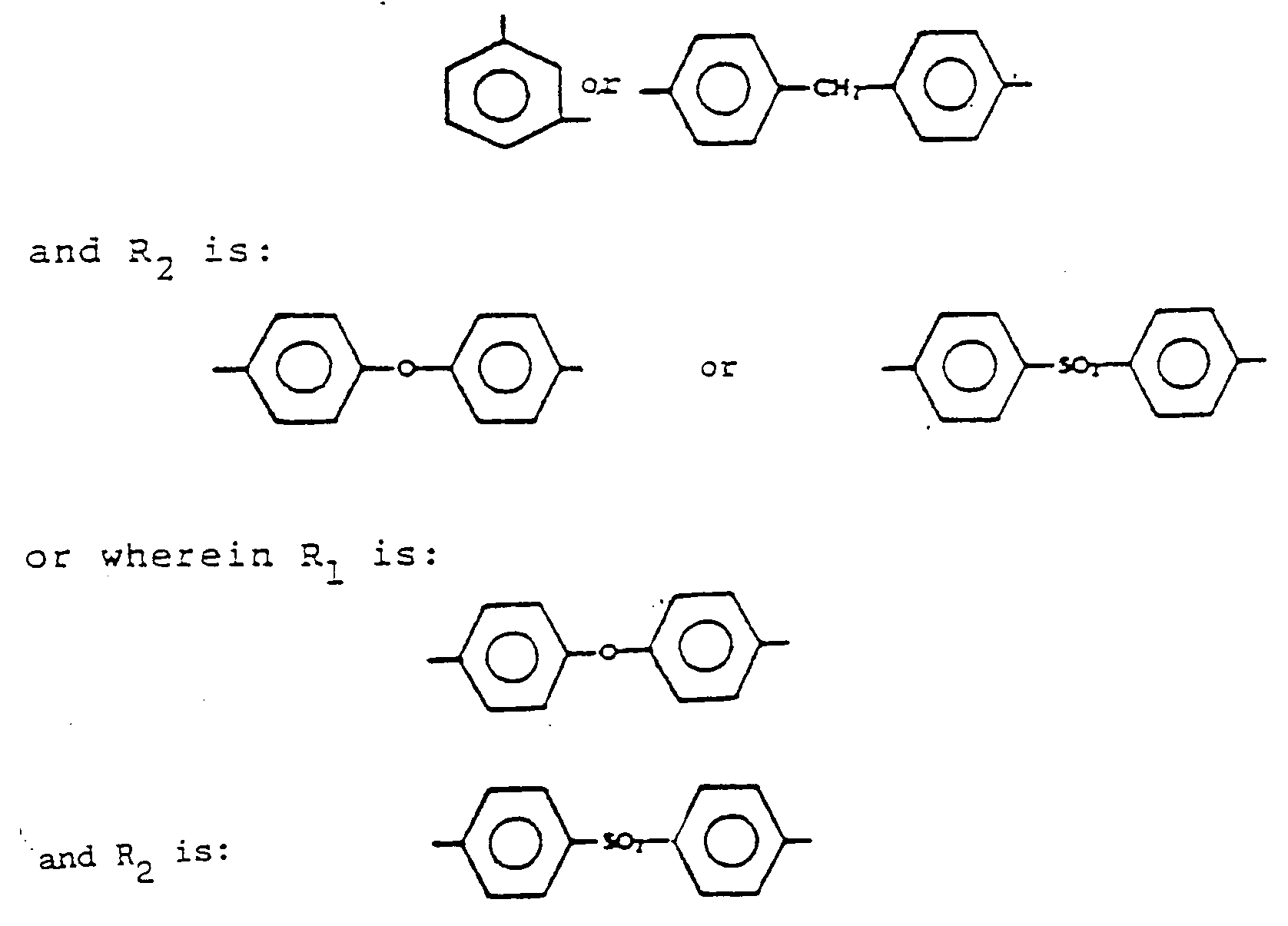
3. A composite as claimed in any one of claims 1 or 2 in which each Z is a trivalent
benzene ring, R₁ is:
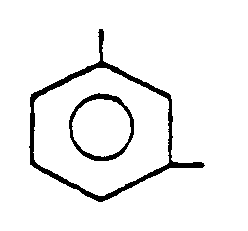
R₂ is:
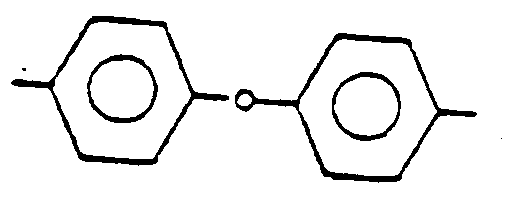
and wherein the concentration range runs from 30 mole per cent of the R₁ containing units and 70 mole per cent of the R₂ containing units to 70 mole per cent of the R₁ containing units and 30 mole per cent of the R₂ containing units.
R₂ is:
and wherein the concentration range runs from 30 mole per cent of the R₁ containing units and 70 mole per cent of the R₂ containing units to 70 mole per cent of the R₁ containing units and 30 mole per cent of the R₂ containing units.
4. A composite as claimed in any one of claims 1 to 3 wherein R₃ and X are each
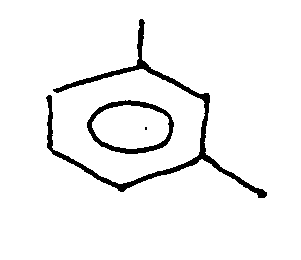
5. A composite as claimed in any one of claims 1 to 4 which has been formed by applying
the matrix to the fibres in the form of a solution.
6. A composite as claimed in any one of claims 1 to 5 wherein the fibres have been sized
with a size comprising an amide-imide polymer.
7. A composite as claimed in claim 6 wherein the size comprises an amide-imide copolymer
or blend as defined in any one of claims 1 to 6.
8. A composite as claimed in any one of claims 1 to 7, in the form of a multiplicity
of continuous fibres impregnated with said matrix.
9. A composite as claimed in any one of claims 1 to 8 in which said thermally stable
continuous fibres are selected from glass, alumina, steel, silicon nitride, silicon
carbide, boron, Kevlar, graphite and carbon fibres.
10. A composite as claimed in any one of claims 1 to 9 in which the thermally stable continuous
fibres comprise a layer of woven fibre.
11. A composite as claimed in any one of claims 1 to 10 in which the thermally stable
continuous fibres comprise unidirectional tape.
12. A composite as claimed in claim 10 or claim 11 wherein the fibres are carbon fibres.
13. A laminate comprising a plurality of layers of a composite as claimed in any one of
claims 1 to 12.
1. Verbundmaterial, das eine Vielzahl thermisch stabiler kontinuierlicher Fasern und
eine Harzmatrix umfaßt, worin die Matrix eine mischbare Mischung umfaßt, die 20 bis
80 Gew.-% eines Amid-Imid-Copolymers A umfaßt, das die wiederkehrenden Einheiten
und
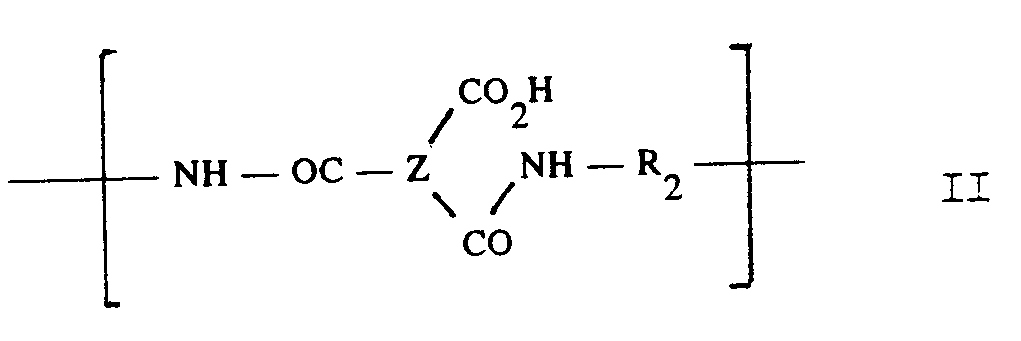
umfaßt, worin das Molverhältnis der Einheiten I zu den Einheiten II im Bereich von 90 : 10 bis 10 : 90 liegt,
und 80 bis 20 Gew.-% eines Amid-Imid-Phthalamid-Copolymers B, das die Einheiten
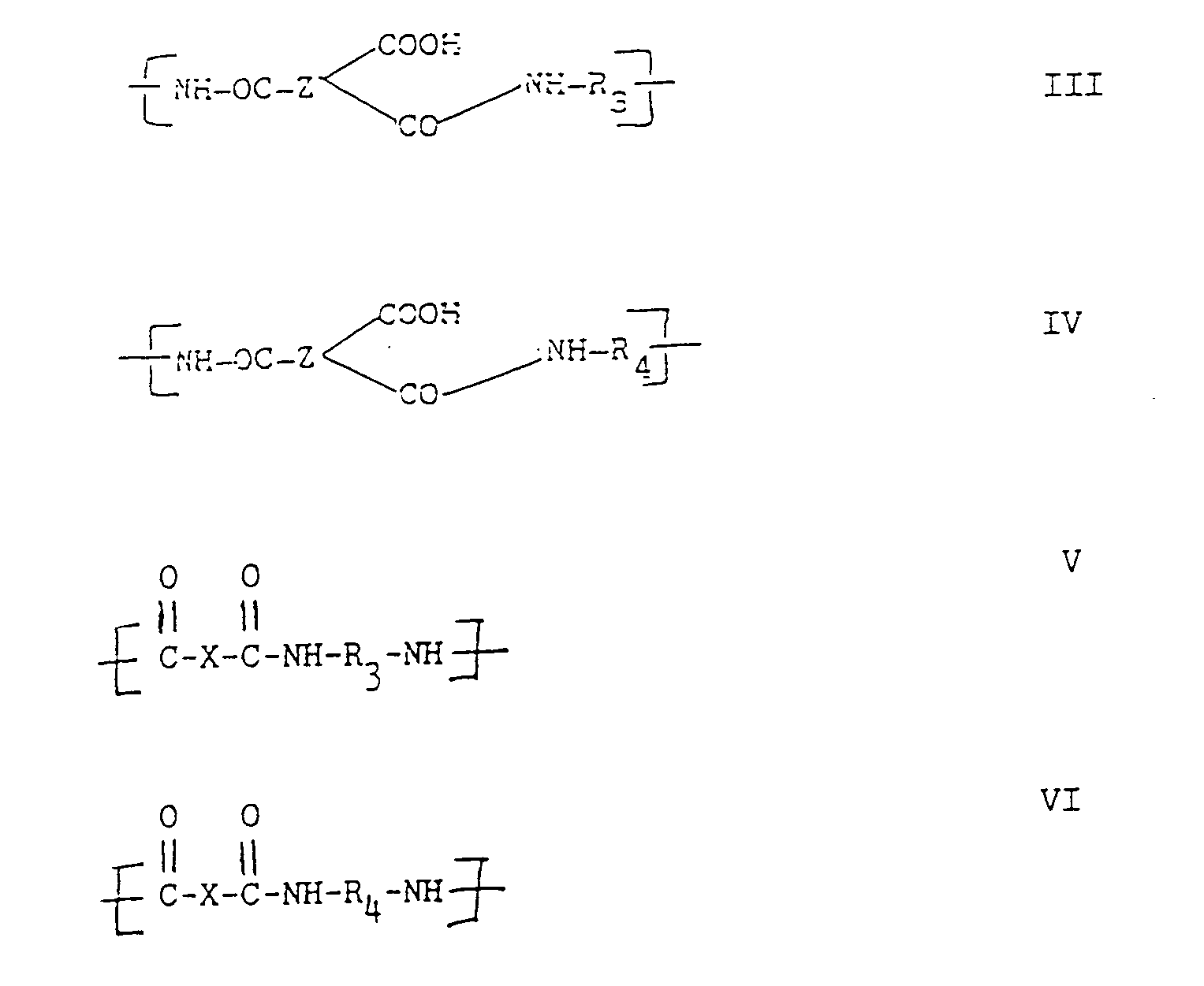
umfaßt,
worin das Molverhältnis der Einheiten V und VI zu den Einheiten III und IV insgesamt im Bereich von 5 : 95 bis 80 : 20 liegt, und
jedes Z ein dreibindiger Benzolring oder ein Niederalkyl-substituierter dreibindiger Benzolring ist, worin zwei der Carbonylgruppen zueinander ortho-ständig sind und meta- bzw. para-ständig zur dritten Carbonylgruppe,
X ein zweibindiger aromatischer Rest ist, R₁, R₂, R₃ und R₄ jeweils zweibindige aromatische Kohlenwasserstoffreste mit 6 bis 10 Kohlenstoffatomen sind oder zwei zweibindige aromatische Kohlenwasserstoffreste mit 6 bis 10 Kohlenstoffatomen, die direkt oder durch eine stabile Verknüpfung, ausgewählt aus der aus -O-, Methylen-, -CO-, -SO₂- und -S-Resten bestehenden Gruppe, verbunden sind, und worin R₁ und R₂ verschieden sind, R₃ und R₄ gleich oder verschieden sein können, R₁ gleich R₄ ist, und das Molverhältnis von R₃- und R₄-haltigen Einheiten im Bereich von 10 : 90 bis 90 : 10 liegt, wenn R₃ und R₄ verschieden sind, und worin mindestens einige der freien Carbonsäuregruppen im Copolymer A und mindestens einige der freien Carbonsäuregruppen im Copolymer B mit Amidgruppen in der ortho-Position dazu unter Bildung von Imidgruppen kondensiert sind.
und
umfaßt, worin das Molverhältnis der Einheiten I zu den Einheiten II im Bereich von 90 : 10 bis 10 : 90 liegt,
und 80 bis 20 Gew.-% eines Amid-Imid-Phthalamid-Copolymers B, das die Einheiten
umfaßt,
worin das Molverhältnis der Einheiten V und VI zu den Einheiten III und IV insgesamt im Bereich von 5 : 95 bis 80 : 20 liegt, und
jedes Z ein dreibindiger Benzolring oder ein Niederalkyl-substituierter dreibindiger Benzolring ist, worin zwei der Carbonylgruppen zueinander ortho-ständig sind und meta- bzw. para-ständig zur dritten Carbonylgruppe,
X ein zweibindiger aromatischer Rest ist, R₁, R₂, R₃ und R₄ jeweils zweibindige aromatische Kohlenwasserstoffreste mit 6 bis 10 Kohlenstoffatomen sind oder zwei zweibindige aromatische Kohlenwasserstoffreste mit 6 bis 10 Kohlenstoffatomen, die direkt oder durch eine stabile Verknüpfung, ausgewählt aus der aus -O-, Methylen-, -CO-, -SO₂- und -S-Resten bestehenden Gruppe, verbunden sind, und worin R₁ und R₂ verschieden sind, R₃ und R₄ gleich oder verschieden sein können, R₁ gleich R₄ ist, und das Molverhältnis von R₃- und R₄-haltigen Einheiten im Bereich von 10 : 90 bis 90 : 10 liegt, wenn R₃ und R₄ verschieden sind, und worin mindestens einige der freien Carbonsäuregruppen im Copolymer A und mindestens einige der freien Carbonsäuregruppen im Copolymer B mit Amidgruppen in der ortho-Position dazu unter Bildung von Imidgruppen kondensiert sind.
2. Verbundmaterial gemäß Anspruch 1, worin R₁
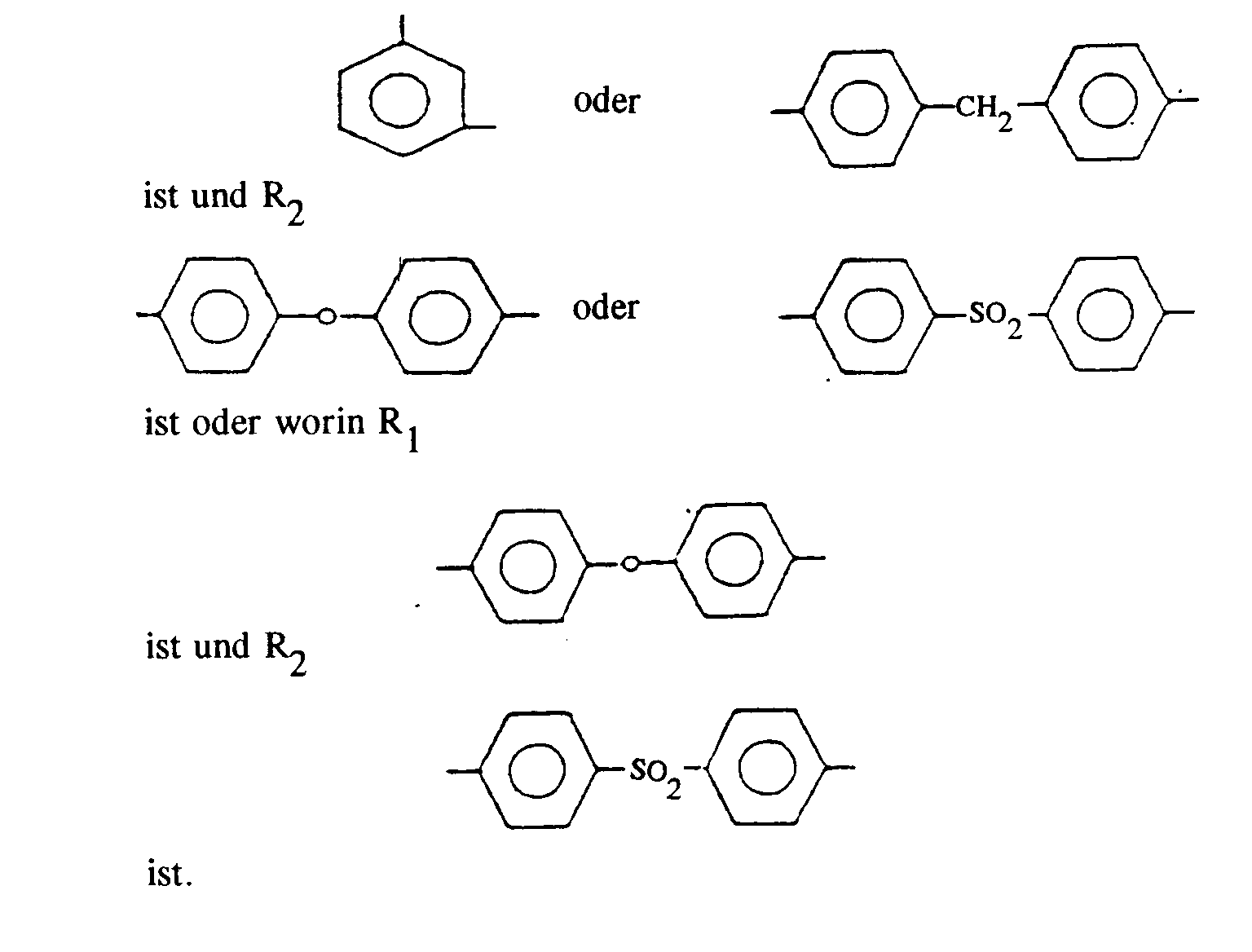
3. Verbundmaterial nach irgendeinem der Ansprüche 1 oder 2, worin jedes Z ein dreibindiger
Benzolring ist, R₁
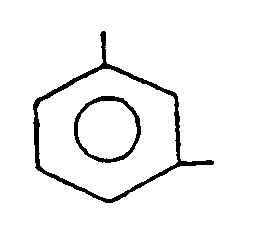
ist, R₂
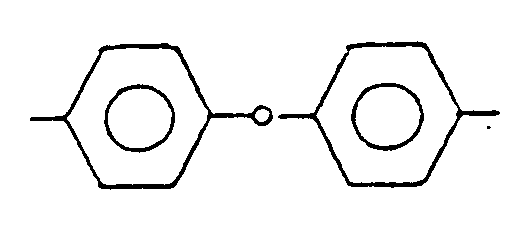
ist und worin der Konzentrationsbereich zwischen 30 Mol-% R₁-haltiger Einheiten und 70 Mol-% R₂-haltiger Einheiten und 70 Mol-% R₁-haltiger Einheiten und 30 Mol-% R₂-haltiger Einheiten liegt.
ist, R₂
ist und worin der Konzentrationsbereich zwischen 30 Mol-% R₁-haltiger Einheiten und 70 Mol-% R₂-haltiger Einheiten und 70 Mol-% R₁-haltiger Einheiten und 30 Mol-% R₂-haltiger Einheiten liegt.
4. Verbundmaterial nach irgendeinem der Ansprüche 1 bis 3, worin R₃ und X jeweils
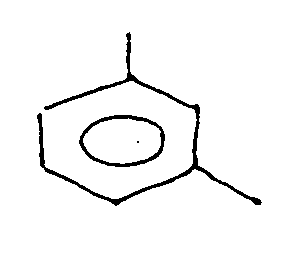
sind.
sind.
5. Verbundmaterial nach irgendeinem der Ansprüche 1 bis 4, das dadurch hergestellt wurde,
daß die Matrix in Form einer Lösung auf die Fasern aufgebracht wurde.
6. Verbundmaterial nach irgendeinem der Ansprüche 1 bis 5, worin die Fasern mit einem
Schlichtmittel geschlichtet wurden, der ein Amid-Imid-Polymer umfaßt.
7. Verbundmaterial nach Anspruch 6, worin das Schlichtmittel ein Amid-Imid-Copolymer
oder eine Mischung nach irgendeinem der Ansprüche 1 bis 6 umfaßt.
8. Verbundmaterial nach irgendeinem der Ansprüche 1 bis 7, in Form einer Vielzahl kontinuierlicher
Fasern, die mit der Matrix imprägniert sind.
9. Verbundmaterial nach irgendeinem der Ansprüche 1 bis 8, worin die thermisch stabilen
kontinuierlichen Fasern aus Glas-, Aluminiumoxid-, Stahl-, Siliciumnitrid-, Siliciumcarbid-,
Bor-, Kevlar-, Graphit- und Kohlenstoffasern ausgewählt sind.
10. Verbundmaterial nach irgendeinem der Ansprüche 1 bis 9, worin die thermisch stabilen
kontinuierlichen Fasern eine Schicht aus gewebten Fasern umfassen.
11. Verbundmaterial nach irgendeinem der Ansprüche 1 bis 10, worin die thermisch stabilen
kontinuierlichen Fasern kettenstarkes Band umfassen.
12. Verbundmaterial nach irgendeinem der Ansprüche 10 oder 11, worin die Fasern Kohlenstoffasern
sind.
13. Laminat, das eine Vielzahl von Schichten des Verbundmaterials nach irgendeinem der
Ansprüche 1 bis 12 umfaßt.
1. Composite comprenant une multiplicité de fibres continues stables thermiquement et
une matrice de résine, dans lequel la matrice comprend un mélange miscible comprenant
20% à 80% en poids d'un copolymère amide-imide A comprenant des motifs récurrents
de :
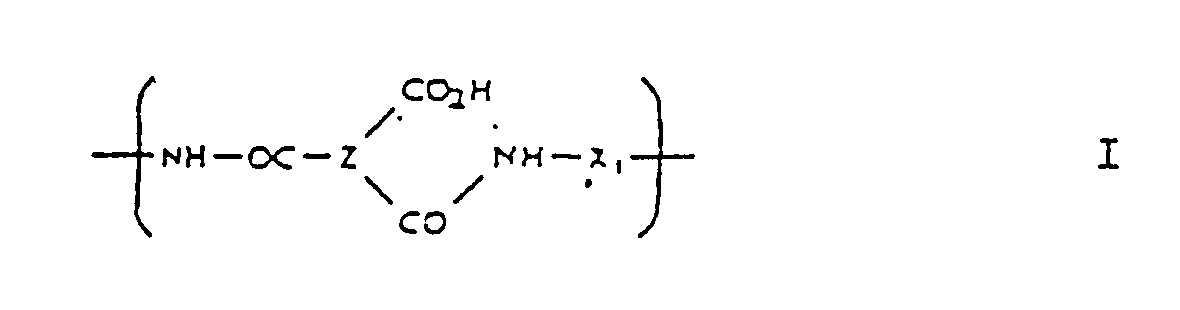
et des motifs de :
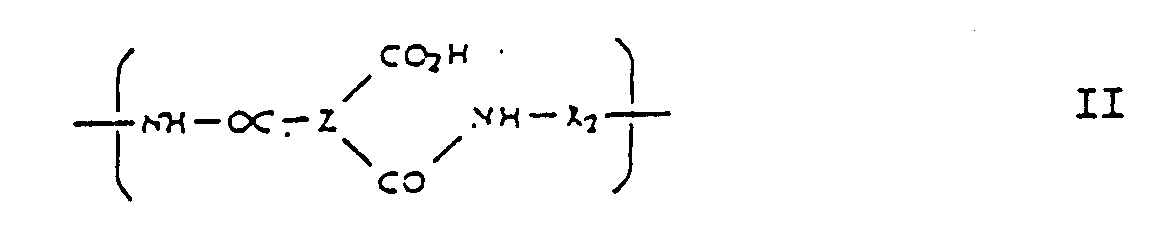
dans lequel le rapport molaire des motifs I aux motifs II est dans la gamme de 90:10 à 10:90, et de 80% à 20% en poids d'un copolymère amide-imide-phtalamide B comprenant des motifs de :
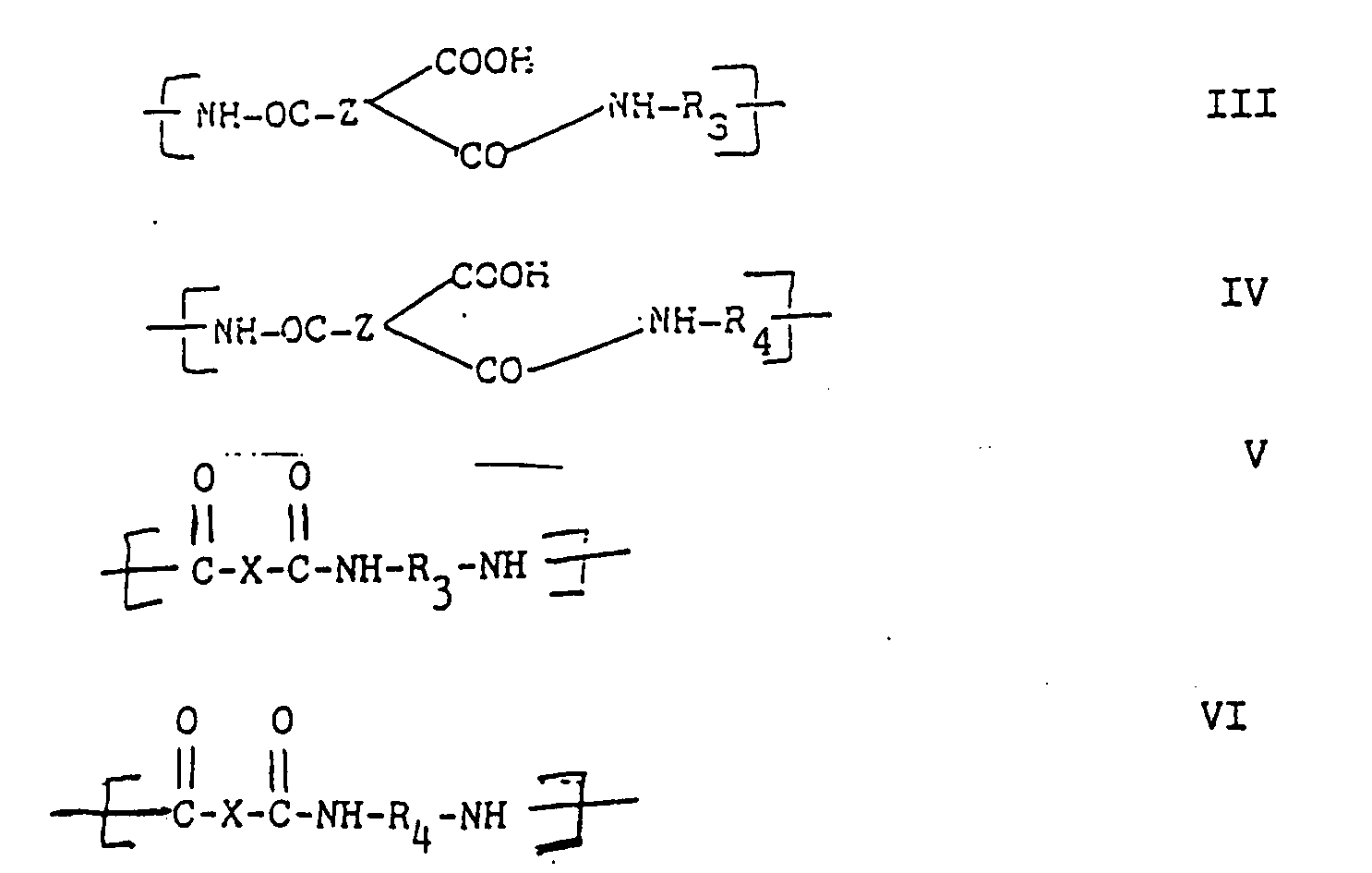
dans lequel le rapport molaire des motifs V et VI au total des motifs III et IV est dans la gamme de 5:95 à 80:20, et chaque Z est un noyau benzénique trivalent ou un noyau benzénique trivalent substitué par des groupes alkyle inférieurs, dans lequel deux des groupes carbonyle sont en ortho l'un par rapport à l'autre et en méta et en para, respectivement, par rapport au troisième groupe carbonyle, X est un radical aromatique divalent, R₁, R₂, R₃ et R₄ sont chacun un radical hydrocarboné aromatique divalent de 6 à 10 atomes de carbone ou deux radicaux hydrocarbonés aromatiques divalents de 6 à 10 atomes de carbone reliés directement, ou par l'intermédiaire d'un groupe de liaison stable choisi dans le groupe constitué par les radicaux -O-, méthylène, -CO-, -SO₂- et -S-, et R₁ et R₂ sont différents, R₃ et R₄ peuvent être identiques ou différents, R₁ est identique à R₄ et, lorsque R₃ et R₄ sont différents, le rapport molaire des motifs contenant R₃ et R₄ est dans la gamme de 10:90 à 90:10 et dans lequel au moins certains des groupes acides carboxyliques libres dans le copolymère A et au moins certains des groupes acides carboxyliques libres dans le copolymère B se sont condensés avec des groupes amide en position ortho par rapport à ces derniers pour former des groupes imide.
et des motifs de :
dans lequel le rapport molaire des motifs I aux motifs II est dans la gamme de 90:10 à 10:90, et de 80% à 20% en poids d'un copolymère amide-imide-phtalamide B comprenant des motifs de :
dans lequel le rapport molaire des motifs V et VI au total des motifs III et IV est dans la gamme de 5:95 à 80:20, et chaque Z est un noyau benzénique trivalent ou un noyau benzénique trivalent substitué par des groupes alkyle inférieurs, dans lequel deux des groupes carbonyle sont en ortho l'un par rapport à l'autre et en méta et en para, respectivement, par rapport au troisième groupe carbonyle, X est un radical aromatique divalent, R₁, R₂, R₃ et R₄ sont chacun un radical hydrocarboné aromatique divalent de 6 à 10 atomes de carbone ou deux radicaux hydrocarbonés aromatiques divalents de 6 à 10 atomes de carbone reliés directement, ou par l'intermédiaire d'un groupe de liaison stable choisi dans le groupe constitué par les radicaux -O-, méthylène, -CO-, -SO₂- et -S-, et R₁ et R₂ sont différents, R₃ et R₄ peuvent être identiques ou différents, R₁ est identique à R₄ et, lorsque R₃ et R₄ sont différents, le rapport molaire des motifs contenant R₃ et R₄ est dans la gamme de 10:90 à 90:10 et dans lequel au moins certains des groupes acides carboxyliques libres dans le copolymère A et au moins certains des groupes acides carboxyliques libres dans le copolymère B se sont condensés avec des groupes amide en position ortho par rapport à ces derniers pour former des groupes imide.
2. Composite selon la revendication 1, dans lequel R₁ est :
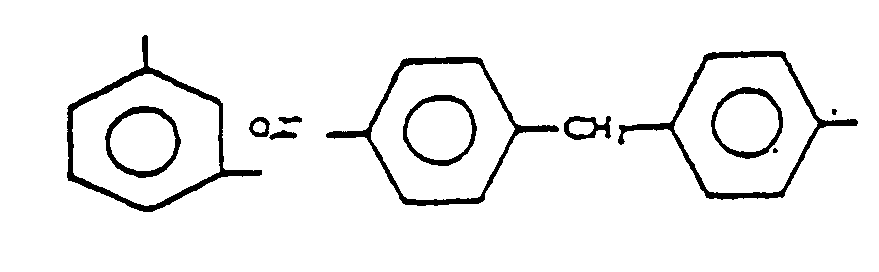
et R₂ est :

ou dans lequel R₁ est :
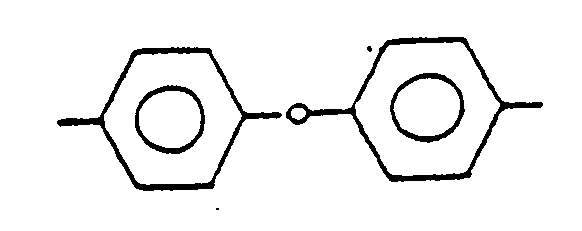
et R₂ est :
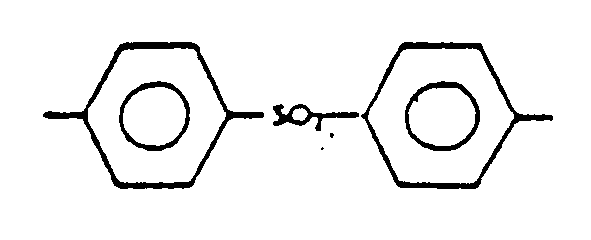
et R₂ est :
ou dans lequel R₁ est :
et R₂ est :
3. Composite selon l'une quelconque des revendications 1 et 2, dans lequel chaque Z est
un noyau benzénique trivalent, R₁ est :
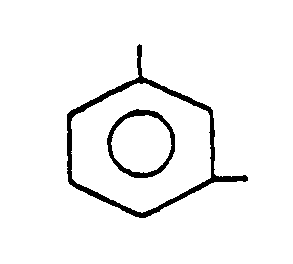
R₂ est :
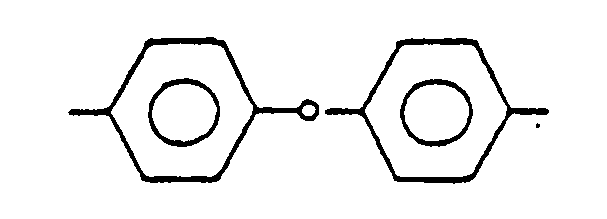
et dans lequel la gamme de concentrations s'échelonne de 30% en moles de motifs contenant R₁ et 70% en moles de motifs contenant R₂ à 70% en moles de motifs contenant R₁ et 30% en moles de motifs contenant R₂.
R₂ est :
et dans lequel la gamme de concentrations s'échelonne de 30% en moles de motifs contenant R₁ et 70% en moles de motifs contenant R₂ à 70% en moles de motifs contenant R₁ et 30% en moles de motifs contenant R₂.
4. Composite selon l'une quelconque des revendications 1 à 3, dans lequel R₃ et X sont
chacun
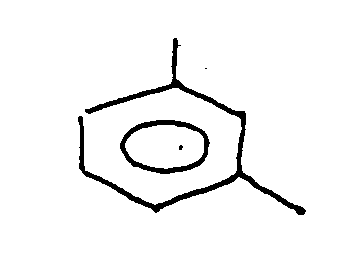
5. Composite selon l'une quelconque des revendications 1 à 4, qui a été formé par application
de la matrice sur les fibres sous la forme d'une solution.
6. Composite selon l'une quelconque des revendications 1 à 5, dans lequel les fibres
ont été encollées avec un produit d'encollage comprenant un polymère amide-imide.
7. Composite selon la revendication 6, dans lequel le produit d'encollage comprend un
copolymère amide-imide ou un mélange tel que défini dans l'une quelconque des revendications
1 à 6.
8. Composite selon l'une quelconque des revendications 1 à 7, sous la forme d'une multiplicité
de fibres continues imprégnées de ladite matrice.
9. Composite selon l'une quelconque des revendications 1 à 8, dans lequel lesdites fibres
continues stables thermiquement sont choisies parmi les fibres de verre, d'alumine,
d'acier, de nitrure de silicium, de carbure de silicium, de bore, de Kevlar, de graphite
et de carbone.
10. Composite selon l'une quelconque des revendications 1 à 9, dans lequel les libres
continues stables thermiquement constituent une couche de fibres tissées.
11. Composite selon l'une quelconque des revendications 1 à 10, dans lequel les libres
continues stables thermiquement constituent un ruban unidirectionnel.
12. Composite selon la revendication 10 ou la revendication 11, dans lequel les fibres
sont des fibres de carbone.
13. Stratifié comprenant une pluralité de couches d'un composite selon l'une quelconque
des revendications 1 à 12.