|
(11) | EP 0 180 325 B1 |

| (12) | EUROPEAN PATENT SPECIFICATION |
|
|
| (54) |
Process for the manufacture of (IR,CIS)-4-acetyl-6,6-dimethyl-3-oxa-bicyclo(3.1.0)hex-2-one Verfahren zur Herstellung von (1R,cis)-4-Acetyl-6,6-dimethyl-3-oxabicyclo(3.1.0)hex-2-on Procédé pour la préparation de (1R,cis)-4-acétyl-6,6-diméthyl-3-oxa-bicyclo(3.1.0)hex-2-one |
|
|
|||||||||||||||||||||||||||||||
| Note: Within nine months from the publication of the mention of the grant of the European patent, any person may give notice to the European Patent Office of opposition to the European patent granted. Notice of opposition shall be filed in a written reasoned statement. It shall not be deemed to have been filed until the opposition fee has been paid. (Art. 99(1) European Patent Convention). |
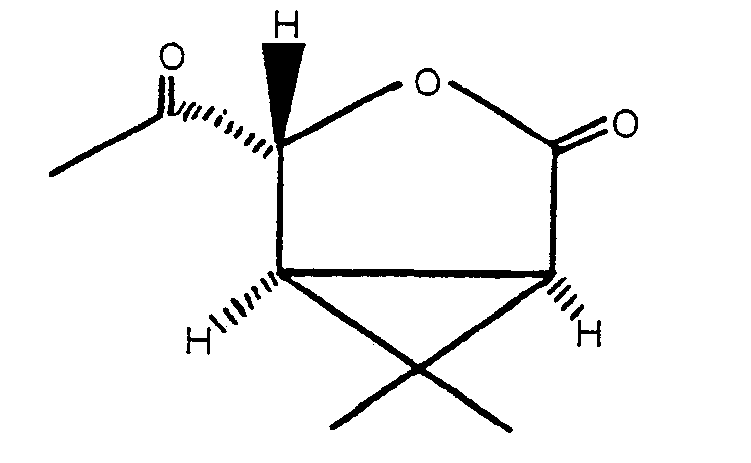
[0001] The present invention relates to the manufacture of pyrethroids which are useful as insecticides and which are remarkable for their low toxicity in mammals. More particularly, the present invention provides a novel process for the production of (1 R,Cis)-4-acetyl-6,6-dimethyl-3-oxabicyclo-(3.1.0)-hex-2-one which is a useful intermediate in the preparation of cyclopropane carboxylate esters which are known to be active pyrethroids. In the description and claims which follow, this intermediate will for convenience be identified and referred to as (1 R,Cis)-acetyl lactone.
[0002] (1R,Cis)-acetyl lactone can be represented by the following formula:
This compound is a convenient starting material for the manufacture of the (1R,Cis)-acid of the formula:
wherein X is chlorine or bromine and R is hydrogen. The (1R,Cis)-acid can in turn be converted to the corresponding (1R,Cis)-pyrethroid esters and one important class of these pyrethroid esters can be represented by the general formula:
wherein X is chlorine or bromine and R is
It has been established that for the pyrethroids to show maximum insecticidal activity, the acid portion of the esters should have the (1R,Cis) configuration.
[0003] The only knonw process for the production of the intermediate (1 R,Cis)-acetyl lactone is the one described in British Patent No. 2052479. According to this British Patent, (1R,Cis)-4,7,7-trimethyl-3- oxabicyclo-(4.1.0)-hept-4-en-2-one of the formula:
is reacted with one or more peracids such as m-chloroperbenzoic acid. Unfortunately, the peracids are expensive and pose potential hazards when employed in large scale operations.
[0004] The present invention avoids the drawbacks and disadvantages of the prior art and provides a novel process which is less expensive to work and avoids the employment of hazardous reagents such as peracids.
[0005] The process of the present invention for the production of (1 R,Cis)-4-acetyl-6,6,-dimethyl-3-oxabicyclo-(3.1.0)-hex-2-one of the formula:
comprises reacting (1R,Cis)-4,7,7-trimethyl-3-oxabicyclo-(4.1.0.)-hept-4-en-2-one of the formula:
with a halogen at a temperature of from 0°C to 25°C and treating the halogenated reaction mixture at ambient temperature with water, an aqueous solvent solution or an aqueous base solution.
[0006] The starting compound (1R,Cis)-4,7,7-trimethy)-3-oxabicycio-(4.1.0.)-hept-4-en-2-one can be obtained from (1R,Cis)-2,2-dimethyl-3-(2-oxapropyl)-cyclopropane-1-carboxylic acid of the formula:
(disclosed in European Patent Application No. 84300215.5, Publication No. 149289, and in Indian Patent No. 294/Cal/83) by employing any known means, for instance the method of U.S. Patent No. 4132717.
[0007] Conveniently, the halogenation reaction is effected in the presence of a solvent whcih is preferably a chlorinafed hydrocarbon solvent having a dielectric constant between 2 and 12. The solvent most preferred for the halogenation reaction is carbon tetrachloride which is employed at a concentration of halogen of from 0.25 M to 3.0 M, preferably 2.0 M.
[0008] The halogen best employed for the reaction has been found to be bromine, while the temperature range most preferred for the halogenation is from 0°C to 5°C.
[0009] The aqueous solvent solution which may be employed for the aqueous treatment of the halogenated reaction mixture can comprise a mixture of water and an ethereal solvent having a dielectric constant in the range of from 2 to 5. Preferred ethereal solvents are tetrahydrofuran and dioxane.
[0010] Preferred bases for the aqueous base solution include carbonates and hydrogen carbonates of alkali metals of which the most preferred is sodium hydrogen carbonate.
[0011] As stated, the aqueous treatment of the halogenated reaction mixture is effected at ambient temperature with a temperature of from 20°C to 30°C being particularly convenient.
[0012] The process of the present invention, which involves less expense and hazard then the prior art process, produces the desired (1R,Cis)-acety! iactone in excellent yields. This lactone is an intermediate in the production of (1R,Cis)-acid which in turn is convertible into the corresponding pyrethroids. One convenient method of employing the intermediate lactone to produce (1 R,Cis)-acid comprises reacting the lactone with a peracid such as m-chloroperbenzoic acid to produce (1 R,Cis)-acetoxy lactone of the formula:
wherein R is
hydrolysing the acetoxy lactone with a base to produce (1 R,Cis)-lactol having the same general formula but wherein R is hydrogen, and then converting the lactol to (1R,Cis)-acid of the formula shown above by employing a procedure analogous to that described in German Patent No. 2827627.
[0013] The invention is illustrated in the following non-limitative examples in each of which the identity and purity of the product were confirmed by spectroscopic and/or GLC analysis.
Example 1
(-)-(1 R,Cis)-4-acetyl-6,6-dimethyl-3-oxabicyclo-(3.1.0.)-hex-2-one
[0014] Solution of 15.2 g (0.1 mole) of (1R,Cis)-4,7,7-trimethyl-3-oxabicyclo-(4.1.0)-hept-2-en-2-one [(a)65 = -100°, C = 1, CHCl3] in 30 ml of carbon tetrachloride at 0°-5°C there were added dropwise with stirring 16 g (5.0 ml, 0.1 mole) of bromine in 25 ml of carbon tetrachloride. 50 ml of water were added and the reaction mixture was stirred at 25°C for 12 hours. The organic layer was separated and washed once with saturated aqueous sodium carbonate solution and dried over anhydrous sodium sulphate. Removal of carbon tetrachloride yielded 13.5 g (80%) of the desired product as a white microcrystalline solid which was further re-crystallised from ether as needles, m.p. 64°C to 65°C, (a)
= -48.5°, (C = 1.0, EtOH).
Example 2
(-)-(1 R,Cis)-4-acetyl-6,6-dimethyl-3-oxabicyclo-(3.1.0.)-hex-2-one
[0015] To a solution of 15.2 g (0.1 mole) of (1R,Cis)-4,7,7-trimethyl-3-oxabicyclo-(4.1.0)-hept-2-en-2-one [(a)
= -100°, C = 1, CHCl3] in 30 ml of carbon tetrachloride at 0.5 there were added a solution of 16.0 g (5.0 ml, 0.1 mole) of bromine in 20 ml of carbon tetrachloride. The reaction mixture was treated with 60 ml of a 1:1 mixture of tetrahydrofuran and water stirred at 25°C for from 8 to 10 hours. The organic layer was washed once with saturated aqueous sodium bicarbonate solution and dried. The removal of the solvent yielded 14.3 (85%) of the desired product as a white microcrystalline powder. Re-crystallisation was effected from ether, m.p. 64° to 65°,
= -48.6°, (C = 1.0, EtOH).
Example 3
(-)-(1 1R,Cis)-4-acetyl-6,6-dimethyl-3-oxabicycl0-(3.1.0.)-hex-2-one
[0016] To a solution of 15.2 g (0.1 mole) of (1R,Cis)-4,7,7-trimethyl-3-oxabicyclo-(4.1.0)-hept-2-en-2-one [(a)
= -100°, C = 1, CHC131 in 30 ml of carbon tetrachloride, there were added 16 g (0.1 mole) of bromine in 20 ml of carbon tetrachloride. The reaction mixture was stirred with saturated aqueous sodium bicarbonate solution for 4 hours. The organic layer was dried and the solvent removed to yield 13.9 (82%) of the desired product as a crystalline powder which was thereafter re-crystallised from ether, m.p. 64° to 65°, (a)
= -48.6°, (C = 2.0, EtOH).
1. A process for the production of (1 R,Cis)-4-acetyl-6,6-dimethyl-3-oxabicyclo-(3.1.0.)-hex-2-one
of the formula:
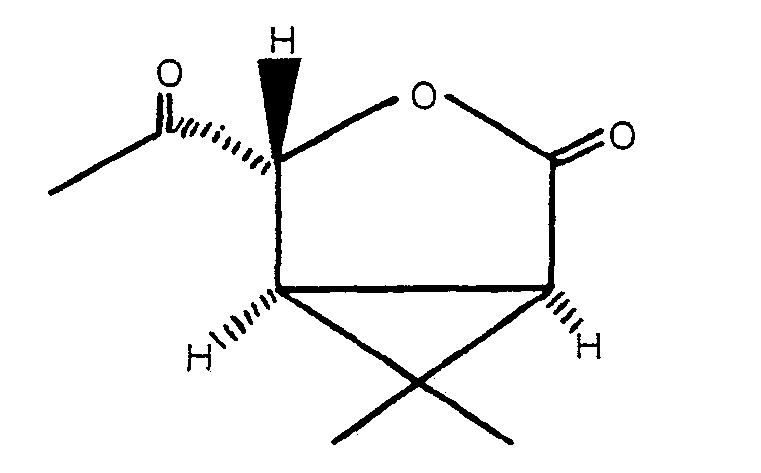
which comprises reacting (1R,Cis)-4,7,7-trimethyl-3-oxabicyclo-(4.1.0)-hept-4-ene-2-one of the formula:
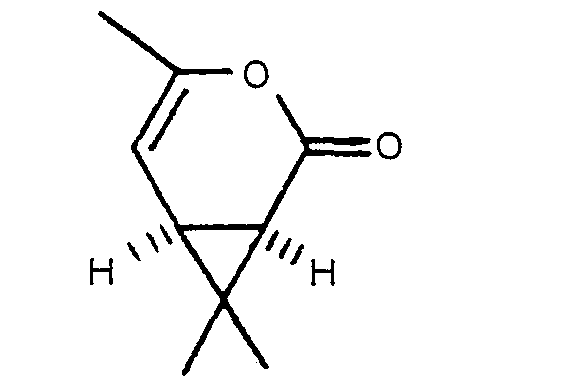
with a halogen at a temperature of from 0°C to 25°C and treating the halogenated reaction mixture at ambient temperature with water in the presence or absence of a solvent and/or a base.
which comprises reacting (1R,Cis)-4,7,7-trimethyl-3-oxabicyclo-(4.1.0)-hept-4-ene-2-one of the formula:
with a halogen at a temperature of from 0°C to 25°C and treating the halogenated reaction mixture at ambient temperature with water in the presence or absence of a solvent and/or a base.
2. A process as claimed in claim 1 wherein said halogenation reaction is effected
in the presence of a solvent.
3. A process as claimed in claim 2 wherein said solvent is a chlorinated hydrocarbon
solvent having a dielectric constant between 2 and 12.
4. A process as claimed in claim 2 wherein said solvent is carbon tetrachloride.
5. A process as claimed in any one of claims 1 to 4 wherein the said halogen is bromine.
6. A process as claimed in any one of claims 1 to 5 wherein the said halogenation
is effected at a temperature of from 0°C to 5°C.
7. A process as claimed in any one of claims 1 to 6 wherein the reaction is effected
in a mixture of water and one or more ethereal solvents having a dielectric constant
in the range of from 2 to 5.
8. A process as claimed in claim 7 wherein the said ethereal solvent is tetrahydrofuran,
dioxane or a mixture thereof.
9. A process as claimed in any one of claims 1 to 8 wherein the reaction is effected
in the presence of a carbonate or hydrogen carbonate of an alkali metal.
10. A process as claimed in claim 9 wherein the reaction is effected in the presence
of sodium hydrogen carbonate.
11. A process as claimed in any one of claims 1 to 10 wherein the said aqueous treatment
of the halogenated reaction mixture is effected at a temperature of from 20°C to 30°C.
1. Verfahren zur Herstellung von (1R,cis)-4-acety)-6,6-dimethyt-3-oxabicyc)o-(3.1.0)-hex-2-on
der Formel
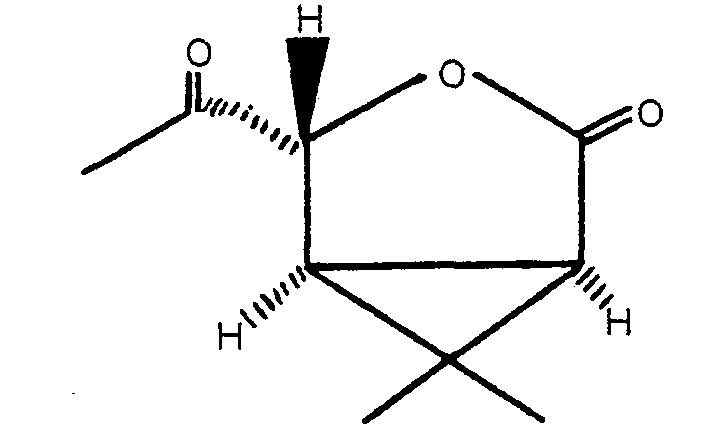
durch Umsetzung von (1R,cis)-4,7,7-trismethyl-3-oxa-bicyclo-(4.1.0)-hept-4-en-2-on der Formel
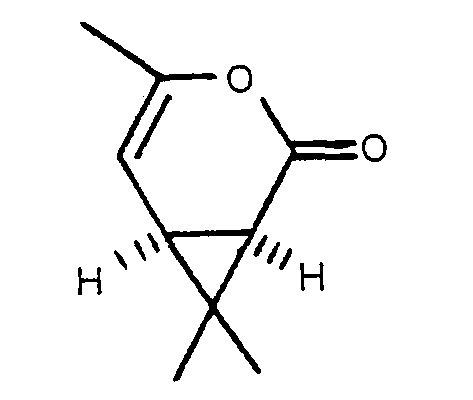
mit einem Halogen bei einer Temperatur von 0°C bis 25°C und Behandlung des halogenierten Reaktionsgemisches bei Umgebungstemperatur mit Wasser in Gegenwart oder Abwesenheit eines Lösungsmittels und/oder einer Base.
durch Umsetzung von (1R,cis)-4,7,7-trismethyl-3-oxa-bicyclo-(4.1.0)-hept-4-en-2-on der Formel
mit einem Halogen bei einer Temperatur von 0°C bis 25°C und Behandlung des halogenierten Reaktionsgemisches bei Umgebungstemperatur mit Wasser in Gegenwart oder Abwesenheit eines Lösungsmittels und/oder einer Base.
2. Das Verfahren nach Anspruch 1, worin die Halogenierungsreaktion in Gegenwart eines
Lösungsmittels durchgeführt wird.
3. Das Verfahren nach Anspruch 2, worin das Lösungsmittel ein chlorierter Kohlenwasserstoff
mit einer Dielektrizitätskonstanten zwischen 2 und 12 ist.
4. Verfahren nach Anspruch 2, worin das Lösungsmittel Kohlenstofftetrachlorid ist.
5. Verfahren nach einem der Ansprüche 1 bis 4, worin das Halogen Brom ist.
6. Verfahren nach einem der Ansprüche 1 bis 5, worin die Halogenierung bei einer Temperatur
von 0°C bis 5°C durchgeführt wird.
7. Verfahren nach einem der Ansprüche 1 bis 6, worin die Reaktion in einem Gemisch
aus Wasser und einem oder mehreren ätherischen Lösungsmitteln mit einer Dielektrizitätskonstanten
im Bereich von 2 bis 5 durchgeführt wird.
8. Verfahren nach Anspruch 7, worin das ätherische Lösungsmittel Tetrahydrofuran,
Dioxan oder ein Gemisch davon ist.
9. Verfahren nach einem der Ansprüche 1 bis 8, worin die Reaktion in Gegenwart eines
Karbonats oder Hydrogenkarbonats eines Alkalimetalls durchgeführt wird.
10. Verfahren nach Anspruch 9, worin das Reaktion in Gegenwart von Natriumhydrogenkarbonat
durchgeführt wird.
11. Verfahren nach einem der Ansprüche 1 bis 10, worin die wässrige Behandlung des
halogenierten Reaktionsgemisches bei einer Temperatur von 20°C bis 30°C durchgeführt
wird.
1. Un procédé pour la production de la (1R,cis)-4-acétyl-6-6-diméthyl-3-oxabicyclo-(3.1.0]-hexane-2-
one de formule
qui consiste à faire réagir la (lR,cis)-4,7,7-triméthyl-3-oxabicyclo-[4.1.01-hept-,4-ène-2-one de la formule
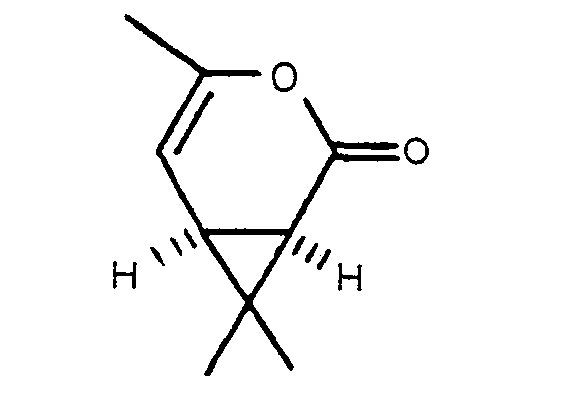
avec un halogène à une température de 0 à 25°C et à traiter le mélange de réaction halogéné à température ambiante par l'eau en présence ou en l'absence d'un solvant et/ou d'une base.
qui consiste à faire réagir la (lR,cis)-4,7,7-triméthyl-3-oxabicyclo-[4.1.01-hept-,4-ène-2-one de la formule
avec un halogène à une température de 0 à 25°C et à traiter le mélange de réaction halogéné à température ambiante par l'eau en présence ou en l'absence d'un solvant et/ou d'une base.
2. Un procédé selon la revendication 1, dans lequel ladite réaction d'halogénation
est effectuée en présence d'un solvant.
3. Un procédé selon la revendication 2, dans lequel ledit solvant est un solvant du
type hydrocarbure chloré ayant une constante diélectrique comprise entre 2 et 12.
4. Un procédé selon la revendication 2, dans lequel ledit solvant est le tétrachlorure
de carbone.
5. Un procédé selon l'une quelconque des revendications 1 à 4, dans lequel ledit halogène
est le brome.
6. Un procédé selon l'une quelconque des revendications 1 à 5, dans lequel ladite
halogénation est effectuée à une température de 0 à 5°C.
7. Un procédé selon l'une quelconque des revendications 1 à 6, dans lequel la réaction
est effectuée dans un mélange d'eau et d'un ou plusieurs solvants éthérés ayant une
constante diélectrique dans la gamme de 2 à 5.
8. Un procédé selon la revendication 7, dans lequel ledit solvant éthéré est le tétrahydrofuranne,
le dioxanne ou un de leurs mélanges.
9. Un procédé selon l'une quelconque des revendications 1 à 8, dans lequel la réaction
est effectuée en présence d'un carbonate ou bicarbonate d'un métal alcalin.
10. Un procédé selon la revendication 9, dans lequel la réaction est effectuée en
présence de bicarbonate de sodium.
11. Un procédé selon l'une quelconque des revendications 1 à 10, dans lequel ledit
traitement aqueux de mélange de réaction halogéné est effectué à une température de
20 à 30°C.