|
(11) | EP 0 180 561 B1 |

| (12) | EUROPEAN PATENT SPECIFICATION |
|
|
| (54) |
A method for mechanically working cobalt-containing metal, and a concentrate suitable, after dilution with water, for use in said method Verfahren zur maschinellen Bearbeitung von Kobalt enthaltendem Metall und ein Konzentrat, das nach Verdünnung mit Wasser für das Verfahren geeignet ist Procédé de travail mécanique de métal contenant du cobalt et solution concentrée qui, après dilution à l'eau convient à l'utilisation du procédé |
|
|
|||||||||||||||||||||||||||||||
| Note: Within nine months from the publication of the mention of the grant of the European patent, any person may give notice to the European Patent Office of opposition to the European patent granted. Notice of opposition shall be filed in a written reasoned statement. It shall not be deemed to have been filed until the opposition fee has been paid. (Art. 99(1) European Patent Convention). |
[0001] The present invention relates to a method for mechanically working cobalt-containing metals. The method is carried out in the presence of a specific alkanol amine capable of reducing both the release of cobalt ions and the corrosion of iron. Also described is a concentrate suitable, after dilution with water, for use in the mechanical working.
[0002] The mechanical working of cemented carbides, so-called hard metals, such as grinding of cobalt-containing hard metals, is usually carried out in the presence of an aqueous cooling lubricant which frequently contains an iron corrosion inhibitor, such as salts of triethanol amine, and a lubricant, such as a fatty acid salt. During the mechanical working, a large amount of chips is produced, having a large surface area which, when exposed to the aqueous cooling lubricant, participates in corrosion processes, whereby the content of ionic cobalt in the solution will reach high levels. Frequently, the cobalt concentration amounts to several hundreds of milligrams per litre of cooling lubricant.
[0003] Besides the negative effect which the corrosion processes have on the appearance and dimension tolerances of the metal surface, ionic cobalt constitutes a serious health hazard to human beings who come into contact therewith by touch and via airborne aerosol. Ionic cobalt is a strong allergen on man. One way of reducing the contents of ionic cobalt in recirculating cooling systems is to filter the cooling lubricant; another way is to make frequent changes of cooling lubricant, simultaneously as tanks and machines are thoroughly cleaned.
[0004] U.S. patent specification 4,315,889 describes a method of reducing the release of cobalt. According to this patent specification, metal working is carried out in the presence of a cooling lubricant containing, as the active component, a specific triazole or thiadiazole compound.
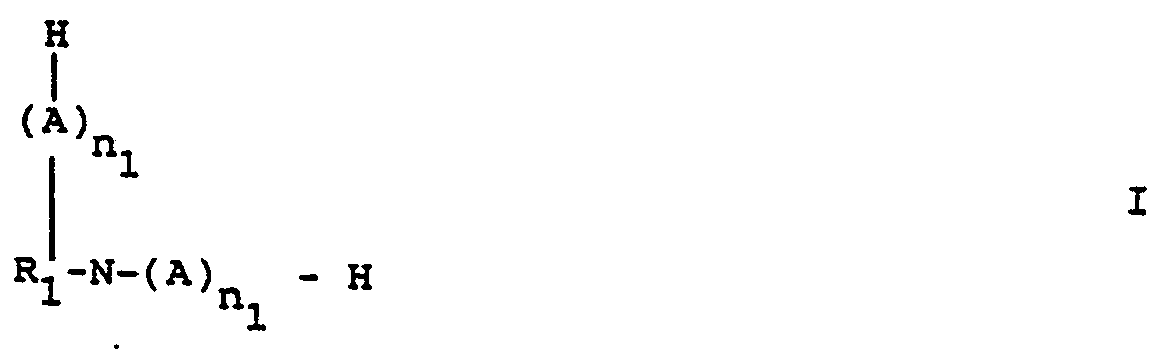
[0005] According to the present invention, it has now also proved possible, in the mechanical working of cobalt-containing metals, to substantially reduce the release of cobalt and simultaneously to maintain the corrosion of iron at a very low level, if the metal is worked in the presence of an alkaline (pH above 7) aqueous composition containing a specific alkanol amine. This alkanol amine compound which always contains a hydrophobic group, is characterised in that it has the general formula
wherein A is an alkylene oxy group derived from an alkylene oxide having 2-4 carbon atoms, R, is an alkyl group having 1-5 carbon atoms, or the group (A)n1―H, n, is an integer from 1 to 6, the number of groups derived from ethylene oxide in relation to the total number of groups derived from alkylene oxide being at most 1:2 and at the lowest 1: 15, or
wherein R2 is a hydrocarbon group having 6-18 carbon atoms, A is an alkylene oxide group derived from an alkylene oxide having 2-4 carbon atoms, and n2 is an integer from 1 to 5, or
wherein R3 and R4 represent hydrocarbon groups having 1-6 carbon atoms or, together with the nitrogen atom, form a six-membered ring which, in addition to carbon, may also contain an oxygen atom, A represents an alkylene oxy group derived from an alkylene oxide having 2-4 carbon atoms, and n3 is an integer from 1 to 10.
[0006] As will appear from the above formulae, the alkanol amine compounds will always contain one or more hydrophobic groups, such as alkyl groups or higher alkylene oxy groups. The presence of these hydrophobic groups is of essential importance to the reduction of both the release of cobalt and the corrosion of iron. Particularly suitable alkanol amine compounds are compounds of formula I showing a ratio of the number of groups derived from ethylene oxide to the total number of groups derived from alkylene oxide of from 1:3 to 1:10, compounds of formula II containing both ethylene oxy and higher alkylene oxy groups, and compounds of formula III wherein R3 and R4 are alkyl groups having a total sum of from 5 to 10 carbon atoms or a six-membered ring, and n3 is an integer from 2 to 8. The content of alkanol amine is 0.01-15%, preferably 0.2-3%, of the weight of the cooling lubricant.
[0007] The above-mentioned alkanol amines can advantageously be combined with organic carboxylic acids, preferably having up to 10 carbon atoms, such as azelaic acid, sulphonamido carboxylic acid, pelargonic acid and isononanoic acid, or inorganic acids, such as boric acid, whereby the protection against the release of cobalt and the corrosion of iron will be further improved. The protection may be still further improved by adding compounds of the type triazole or thiadiazole. The contents of these supplementary corrosion protection components, especially those in the form of organic carboxylic acids, preferably are from 0 to 10, preferably from 0.1 to 2% by weight.
[0008] To reduce the friction of the cooling lubricant, conventional lubricants may be added, provided that the lubricant does not corrode either cobalt or iron. Examples of suitable lubricants are monocarboxylic acids, preferably having more than 10 carbon atoms, such as fatty acids having 12-18 carbon atoms, and/or nonionic alkylene oxide adducts having a molecular weight of more than 400, such as polypropylene glycol or random added polypropylene polyethylene glycols, or block copolymers of ethylene and propylene oxide. The anionic lubricants are also capable of protecting iron against corrosion. The content of lubricant in the cooling lubricant may amount to 10, preferably 0.05-2.0% by weight.
[0009] Besides corrosion inhibitors and lubricants, the cooling lubricant preferably and in per se known manner may contain pH-controlling agents, bactericidal agents, perfumes, viscosity-controlling and solubility-improving agents. The solubility-improving agents usually are low-molecular hydroxy- containing compounds, such as propylene glycol, ethylene diglycol, butyl diethylene glycol, or glycerol.
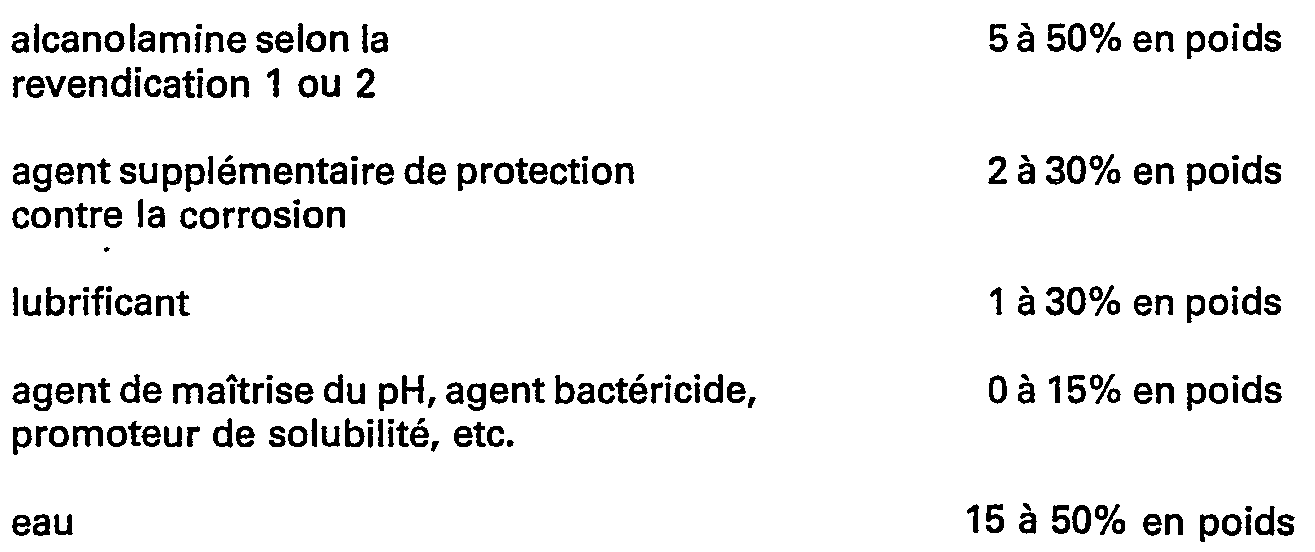
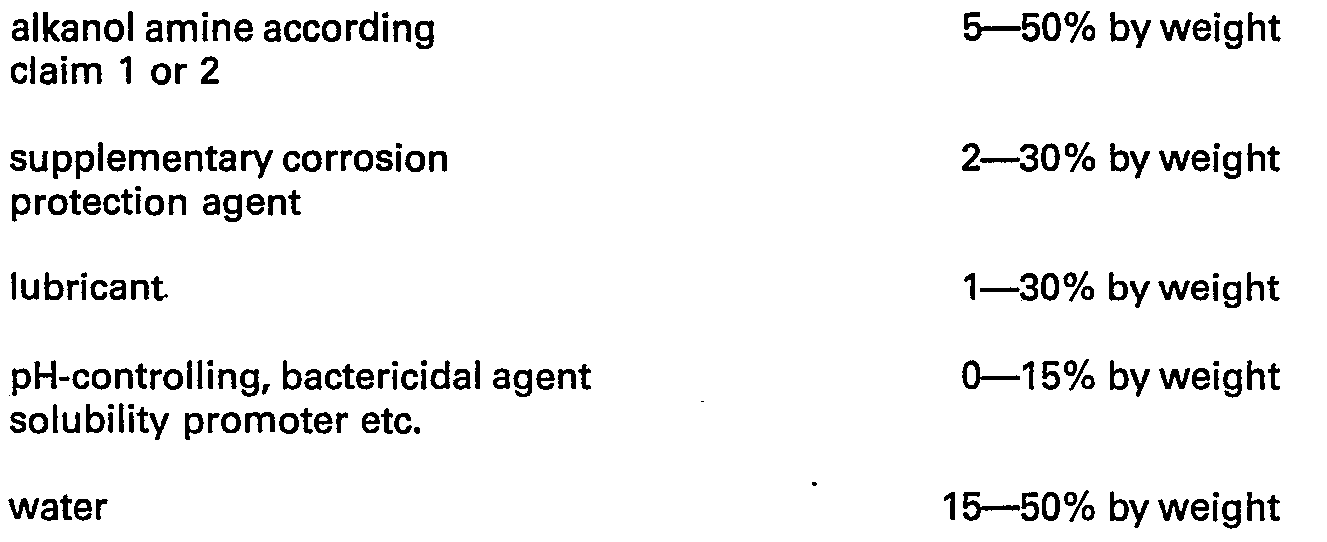
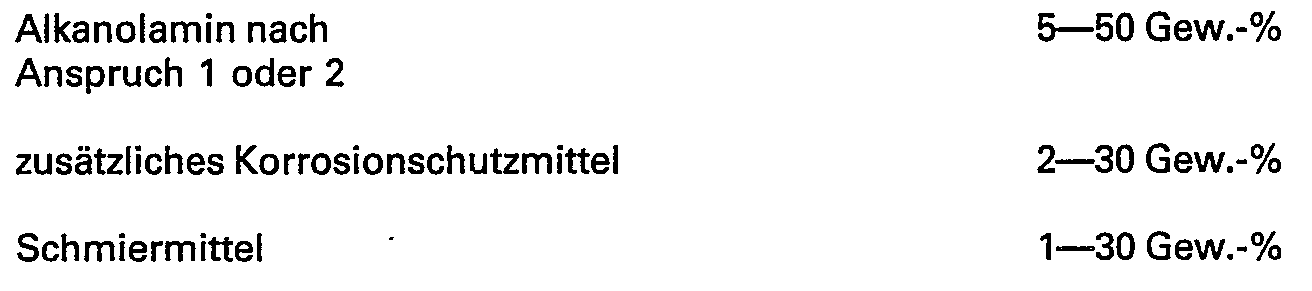
[0010] For preparing the cooling lubricant according to the present invention, it is preferred first to prepare a concentrate, preferably by adding to a suitable amount of water alkanol amine and then the remaining components. The amount of Water in relation to the remaining components is preferably selected so that a water content of about 10-70% by weight of the concentrate is obtained. A typical preferred concentrate formulation according to the present invention is
[0012] Before the concentrate is used, it is diluted with water so that the solution used will have a water content of 99-85% by weight.
Example 1
[0014] A number of compositions were prepared by adding to water 0.75% by weight of a corrosion protection agent in accordance with the Table below, and acetic acid in an amount such that the pH was 9.2. The tendency of the compositions to release cobalt was measured by shaking a vessel containing 100 ml of the composition together with 50 mg of cobalt powder having a surface area of 1.2 m2/g at room temperature for five days. After that, the content of cobalt in solution was measured by means of atom absorption spectrophotometry. The iron corrosion was determined by applying 1.25 g of the said compositions to a filter paper coated with cast-iron chips and determining, after 24 hours, the size of the surface covered with rust. A comparison test with water was also carried out.
[0015] It appears from the results that compositions A-G according to the invention are far superior to the comparison compositions H-J and give both low corrosion of iron and low release of cobalt. Test Kwas a test in water having a hardness of about 10°dH.
Example 2
[0016] A concentrate was prepared by adding to 150 g of water 600 g of an alkylene oxide adduct obtained by causing 1 mole of morpholine to react with 2 moles of propylene oxide, and then 200 g of azelaic acid and 50 g of polypropylene glycol having a molecular weight of 2000. The concentrate was then diluted with water to 40 times its own weight, and the pH was adjusted to 9.0 by means of lye. The tendency of the compositions to release cobalt and corrode iron was tested in the same manner as in Example 1. The cobalt content was 0.2 mg/l, while 0% of the surface of the filter paper was coated with rust. For comparison, the same composition was tested in the presence of triethanol amine as the amine compound, instead of morpholine adduct. The corresponding values were 150 mg/I and 0%.
[0017] The above-mentioned compositions were also tested as cooling liquid in a grinding machine working cobalt-containing hard metals for three days. The composition containing the morpholine adduct contained after three days a noticeably lower amount of released cobalt than the composition containing triethanol amine. The results obtained were comparable to the above-mentioned laboratory test.
1. A method for mechanically working cobalt-containing metals in the presence of an
aqueous alkaline metal working liquid capable of reducing the release of cobalt, characterised
in that the metal working liquid contains, as release and corrosion inhibiting agent,
an alkanol amine having the formula
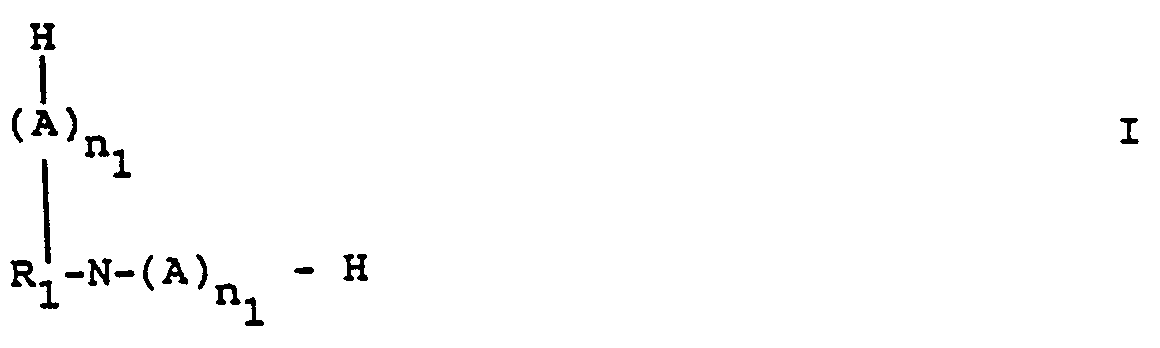
wherein A is an alkylene oxy group derived from an alkylene oxide having 2-4 carbon atoms, R, is an alkyl group having 1-5 carbon atoms, or the group (A)n1―H, n, is an integer from 1 to 6, the number of groups derived from ethylene oxide in relation to the total number of groups derived from alkylene oxide being at most 1:2 and at the lowest 1:15, or

wherein R2 is a hydrocarbon group having 6-18 carbon atoms, A is an alkylene oxide group derived from an alkylene oxide having 2-4 carbon atoms, and n2 is an integer from 1 to 5, or

wherein R3 and R4 represent hydrocarbon groups having 1-6 carbon atoms or, together with the nitrogen atom, form a six-membered ring which, in addition to carbon, may also contain an oxygen atom, A represents an alkylene group derived from an alkylene oxide having 2-4 carbon atoms, and n3 is an integer from 1 to 10.
wherein A is an alkylene oxy group derived from an alkylene oxide having 2-4 carbon atoms, R, is an alkyl group having 1-5 carbon atoms, or the group (A)n1―H, n, is an integer from 1 to 6, the number of groups derived from ethylene oxide in relation to the total number of groups derived from alkylene oxide being at most 1:2 and at the lowest 1:15, or
wherein R2 is a hydrocarbon group having 6-18 carbon atoms, A is an alkylene oxide group derived from an alkylene oxide having 2-4 carbon atoms, and n2 is an integer from 1 to 5, or
wherein R3 and R4 represent hydrocarbon groups having 1-6 carbon atoms or, together with the nitrogen atom, form a six-membered ring which, in addition to carbon, may also contain an oxygen atom, A represents an alkylene group derived from an alkylene oxide having 2-4 carbon atoms, and n3 is an integer from 1 to 10.
2. A method as claimed in claim 1, characterised in that the compounds of formula
I show a ratio of the number of groups derived from ethylene oxide to the total number
of groups derived from alkylene oxide from 1:3 to 1:10, that the compounds of formula
II contain both ethylene oxy and higher alkylene oxy groups, and that, in the compounds
of formula III, R3 and R4 are alkyl groups having a total sum of from 5 to 10 carbon atoms or. a six-membered
ring, and n3 is an integer from 2 to 8.
3. A method as claimed in claim 1 or 2, characterised in that the amount of alkanol
amine in the metal working liquid is from 0.01 to 15%, preferably from 0.2 to 3% of
the weight of the cooling lubricant.
4. A method as claimed in any one of claims 1-3, characterised in that the metal working
liquid also. contains a supplementary corrosion inhibiting agent, such as an organic
carboxylic acid having less than 10 carbon atoms, in an amount of from 0 to 10, preferably
from 0.1 to 2% by weight.
5. A method as claimed in any one of claims 1-4, characterised in that the metal working
liquid contains a lubricant, such as a monocarboxylic acid having more than 10 carbon
atoms, or a nonionic alkylene oxide adduct having a molecular weight of more than
400, in an amount of up to 10, preferably from 0.05 to 2% by weight.
6. A concentrate suitable, after dilution with water, for use in the mechanical working
of cast iron, as claimed in claims 1-5, characterised in that it contains the following
components:
1. Verfarhen zur mechanischen Bearbeitung von Kobaltenthaltenden Metallen in der Gegenwart
einer wäßrigen, alkalischen Metallbearbeitungsflüssigkeit, die in der Lage ist, die
Freisetzung von Kobalt zu vermindern, dadurch gekennzeichnet, daß die Metallbearbeitungsflüssigkeit
als Freisetzungs- und Korrosions-verhütendes Mittel ein Alkanolamin der Formel
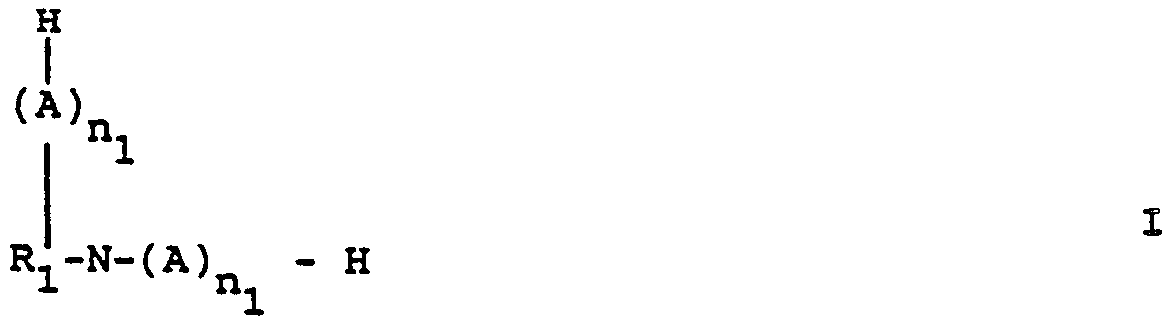
worin A eine Alkylenoxygruppe ist, die von einem Alkylenoxid mit 2 bis 4 Kohlenstoffatomen abgeleitet ist, R, eine Alkylgruppe mit 1 bis 5 Kohlenstoffatomen oder die Gruppe (A)n1―H ist, n, eine ganze Zahl von 1 bis 6 ist, wobei die Anzahl der Gruppen, die von Ethylenoxid abgeleitet sind, im Verhältnis zur Gesamtzahl der Gruppen, die von Alkylenoxid abgeleitet sind, höchstens 1:2 und mindestens 1:15 beträgt, oder
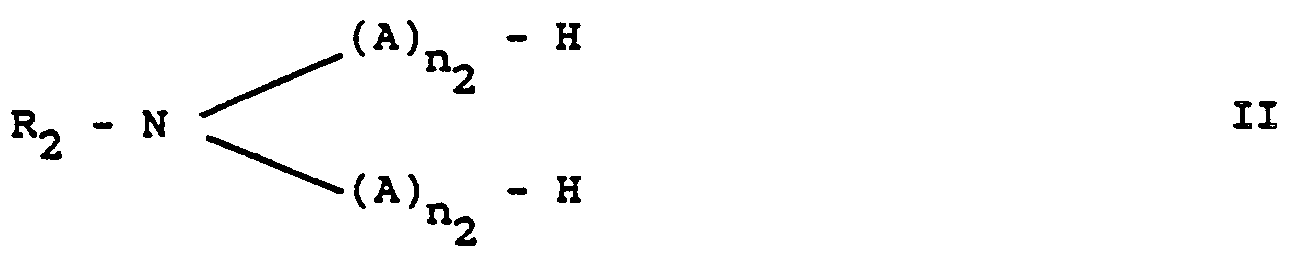
worin R2 eine Kohlenwasserstoffgruppe mit 6 bis 18 Kohlenstoffatomen ist, A eine Alkylenoxidgruppe ist, die von einem Alkylenoxid mit 2 bis 4 Kohlenstoffatomen abgeleitet ist, und n2 eine ganze Zahl von 1 bis 5 ist, oder

worin R3 und R4 Kohlenwasserstoffgruppen mit 1 bis 6 Kohlenstoffatomen darstellen oder zusammen mit dem Stickstoff atom einem Sechsring bilden, der zusätzlich zu Kohlenstoff auch Sauerstoff enthalten kann, A eine Alkylenoxygruppe darstellt, die von einem Alkylenoxid mit 2 bis 4 Kohlenstoffatomen abgeleitet ist, und n3 eine ganze Zahl von 1 bis 10 ist, enthält..
worin A eine Alkylenoxygruppe ist, die von einem Alkylenoxid mit 2 bis 4 Kohlenstoffatomen abgeleitet ist, R, eine Alkylgruppe mit 1 bis 5 Kohlenstoffatomen oder die Gruppe (A)n1―H ist, n, eine ganze Zahl von 1 bis 6 ist, wobei die Anzahl der Gruppen, die von Ethylenoxid abgeleitet sind, im Verhältnis zur Gesamtzahl der Gruppen, die von Alkylenoxid abgeleitet sind, höchstens 1:2 und mindestens 1:15 beträgt, oder
worin R2 eine Kohlenwasserstoffgruppe mit 6 bis 18 Kohlenstoffatomen ist, A eine Alkylenoxidgruppe ist, die von einem Alkylenoxid mit 2 bis 4 Kohlenstoffatomen abgeleitet ist, und n2 eine ganze Zahl von 1 bis 5 ist, oder
worin R3 und R4 Kohlenwasserstoffgruppen mit 1 bis 6 Kohlenstoffatomen darstellen oder zusammen mit dem Stickstoff atom einem Sechsring bilden, der zusätzlich zu Kohlenstoff auch Sauerstoff enthalten kann, A eine Alkylenoxygruppe darstellt, die von einem Alkylenoxid mit 2 bis 4 Kohlenstoffatomen abgeleitet ist, und n3 eine ganze Zahl von 1 bis 10 ist, enthält..
2. Verfahren nach Anspruch 1, dadurch gekennzeichnet, daß die Verbindungen der Formel
1 ein Verhältnis der Anzahl der Gruppen, die von Ethylenoxid abgeleitet sind, zur
Gesamtzahl der Gruppen, die von Alkylenoxid abgeleitet sind, von 1:3 zu 1:10 aufweist,
daß die Verbindungen der Formel II sowohl Ethylenoxy- als auch höhere Alkylenoxy-Gruppen
enthalten, und daß in den Verbindungen der Formel III R3 und R4 Alkylgruppen mit einer Gesamtzahl von 5 bis 10 Kohlenstoffatomen oder ein Sechsring
sind, und n3 eine ganze Zahl von 2 bis 8 ist.
3. Verfahren nach Anspruch 1 oder 2, dadurch gekennzeichnet, daß die Menge an Alkanolamin
in der Metallbearbeitungsflüssigkeit 0,01 bis 15%, vorzugsweise 0,2 bis 3% des Gewichts
des Kühl-Schmiermittels beträgt.
4. Verfahren nach einem der Ansprüche 1-3, dadurch gekennzeichnet, daß die Metalibearbeitungsflüssigkeit
auch ein zusätzliches Korrosions-verhütendes Mittel enthält, wie z.B. eine organische
Carbonsäure mit weniger als 10 Kohlenstoffatomen, in einer Menge von 0 bis 10, vorzugsweise
von 0,1 bis 2 Gew.- %.
5. Verfahren nach einem der Ansprüche 1-4, dadurch gekennzeichnet, daß die Metallbearbeitungsflüssigkeit
ein Schmiermittel enthält, wie z.B. eine Moncarbonsäure mit mehr als 10 Kohlenstoffatomen
oder ein nicht-ionisches Alkylenoxid-Addukt mit einem Molekulargewicht von mehr als
400, in einer Menge von bis zu 10, vorzugsweise von 0,05 bis 2 Gew.-%.
6. Konzentrat, das nach Verdünnen mit Wasser geeignet ist zur Verwendung bei der mechanischen
Bearbeitung von Gußeisen, gemäß den Ansprüchen 1-5, dadurch gekennzeichnet, daß es
die folgenden Komponenten enthält:

1. Procédé pour travailler mécaniquement des métaux contenant du cobalt, en présence
d'un liquide alcalin aqueux pour le travail de métaux, capable de réduire la libération
de cobalt, procédé caractérisé en ce que le liquide de travail de métaux contient,
comme agent inhibant la libération et la corrosion, une alcanolamine répondant à la
formule:
dans laquelle A est un groupe alkylèneoxy provenant d'un oxyde d'alkylène ayant 2 à 4 atomes de carbone; R, représente un groupe alkyle ayant 1 à 5 atomes de carbone ou le groupe (A)n1―H; n, est un nombre entier valant 1 à 6; le nombre de groupes provenant de l'oxyde d'éthylène, par rapport au nombre total de groupes provenant d'un oxyde d'alkylène étant au maximum égal à 1:2 et au minimum égal à 1:15, ou répondant à la formule:
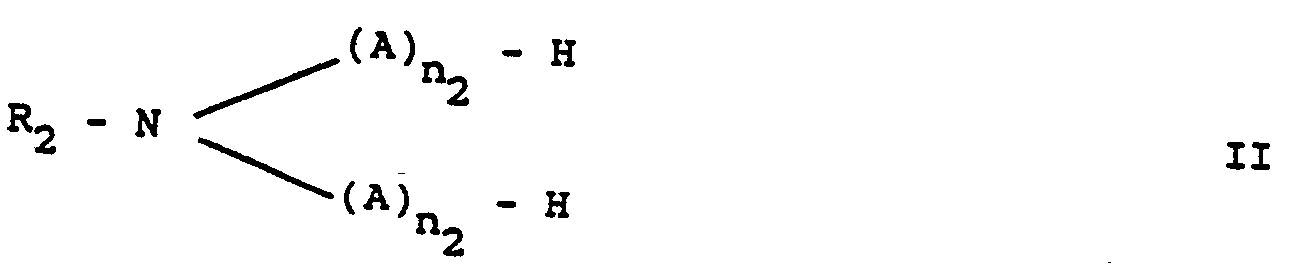
dans laquelle R2 représente un groupe hydrocarboné ayant 6 à 18 atomes de carbon; A représente un groupe oxyde d'alkylène provenant d'un oxyde d'alkylène ayant 2 à 4 atomes de carbone; et n2 est un nombre entier valant 1 à 5; ou répondant à la formule:

dans laquelle R3 et R4 représentent chacun des groupes hydrocarbonés ayant 1 à 6 atomes de carbone ou bien, pris avec l'atome d'azote, ils forment un noyau hexagonal qui, en plus du carbone, peut également contenir un atome d'oxygène; A représente un groupe alkylèneoxy provenant d'un oxyde d'alkylène ayant 2 à 4 atomes der carbone, et n3 est un nombre entier valant 1 à 10.
dans laquelle A est un groupe alkylèneoxy provenant d'un oxyde d'alkylène ayant 2 à 4 atomes de carbone; R, représente un groupe alkyle ayant 1 à 5 atomes de carbone ou le groupe (A)n1―H; n, est un nombre entier valant 1 à 6; le nombre de groupes provenant de l'oxyde d'éthylène, par rapport au nombre total de groupes provenant d'un oxyde d'alkylène étant au maximum égal à 1:2 et au minimum égal à 1:15, ou répondant à la formule:
dans laquelle R2 représente un groupe hydrocarboné ayant 6 à 18 atomes de carbon; A représente un groupe oxyde d'alkylène provenant d'un oxyde d'alkylène ayant 2 à 4 atomes de carbone; et n2 est un nombre entier valant 1 à 5; ou répondant à la formule:
dans laquelle R3 et R4 représentent chacun des groupes hydrocarbonés ayant 1 à 6 atomes de carbone ou bien, pris avec l'atome d'azote, ils forment un noyau hexagonal qui, en plus du carbone, peut également contenir un atome d'oxygène; A représente un groupe alkylèneoxy provenant d'un oxyde d'alkylène ayant 2 à 4 atomes der carbone, et n3 est un nombre entier valant 1 à 10.
2. Procédé tel que revendiqué à la revendications 1, caractérisé en ce que les composés
de formule 1 présentent un rapport entre le nombre des groupes provenant de l'oxyde
d'éthylène et le nombre total de groupes provenant d'un oxyde d'alkylène, de 1:3 à
1:10; en ce que les composés de formule Il contiennent à la fois des groupes éthylèneoxy
et alkylène (supérieur)-oxy; et en ce que, dans les composés de formule III, R3 et R4 représentent des groupes alkyles ayant au total 5 à 10 atomes de carbone ou forment
un noyau hexagonal, et n3 est un nombre entier valant 2 à 8.
3. Procédé tel que revendiqué à la revendication 1 ou 2, caractérisé en ce que le
quantité de l'alcanolamine dans le liquide pour travail des métaux est de 0,01 à 15%,
de préférence de 0,2 à 3% du poids du lubrifiant de refroidissement.
4. Procédé tel que revendiqué dans l'une quelconque des revendications 1 à 3, caractérisé
en ce que le liquide pour travail des métaux contient également un agent supplémentaire,
inhibiteur de la corrosion, tel qu'un acide carboxylique organique ayant moins de
10 atomes de carbone, présent en une quantité de 0 à 10, de préférence de 0,1 à 2,
% en poids.
5. Procédé tel que revendiqué dans l'une quelconque des revendications 1 à 4, caractérisé
en ce que le liquide pour travail de métaux contient un lubrifiant, tel qu'un acide
monocarboxylique ayant plus de 10 atomes de carbone, ou un produit non ionique d'addition
d'oxyde d'alkylène ayant un poids moléculaire supérieur à 400, présent en une quantité
pouvant aller jusque'à 10, et comprise de préférence de 0,05 à 2% en poids.
6. Concentré convenant, après sa dilution à l'eau, pour servir au travail mécanique
de la fonte, comme revendiqué dans les revendications 1 à 5, concentré caracterisé
en ce qu'il contient les constituants suivants: