| (19) |
 |
|
(11) |
EP 0 183 761 B1 |
| (12) |
EUROPEAN PATENT SPECIFICATION |
| (45) |
Mention of the grant of the patent: |
|
15.02.1989 Bulletin 1989/07 |
| (22) |
Date of filing: 03.06.1985 |
|
| (86) |
International application number: |
|
PCT/GB8500/235 |
| (87) |
International publication number: |
|
WO 8505/583 (19.12.1985 Gazette 1985/27) |
|
| (54) |
CASTING OF METAL ARTICLES
GIESSEN VON METALLGEGENSTÄNDEN
COULEE D'ARTICLES METALLIQUES
|
| (84) |
Designated Contracting States: |
|
BE CH DE FR IT LI NL SE |
| (30) |
Priority: |
02.06.1984 GB 8414129
|
| (43) |
Date of publication of application: |
|
11.06.1986 Bulletin 1986/24 |
| (73) |
Proprietor: COSWORTH RESEARCH AND DEVELOPMENT LIMITED |
|
Worcester WR2 5JS (GB) |
|
| (72) |
Inventor: |
|
- CAMPBELL, John
Hereford and Worcester WR1 3DA (GB)
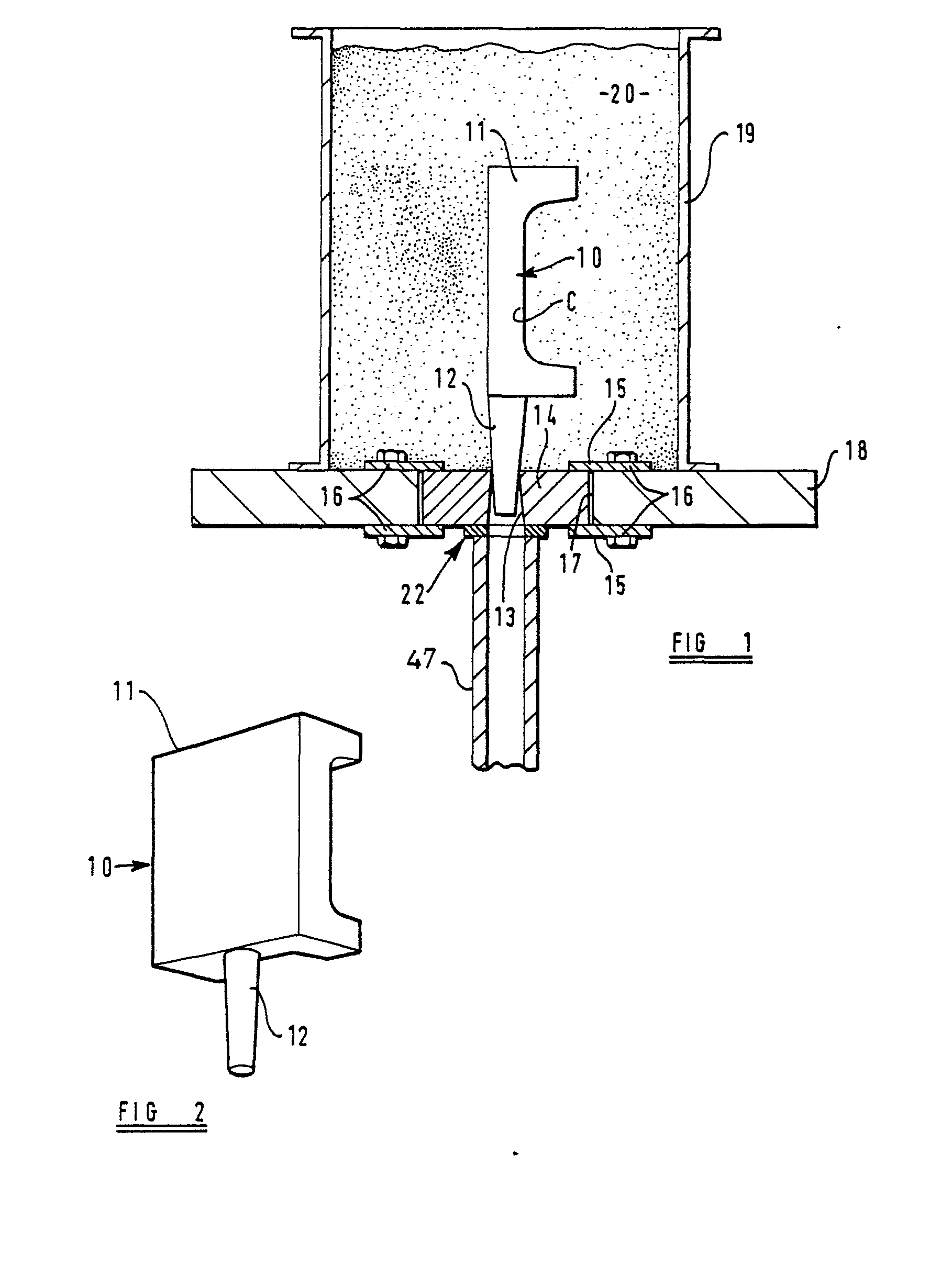
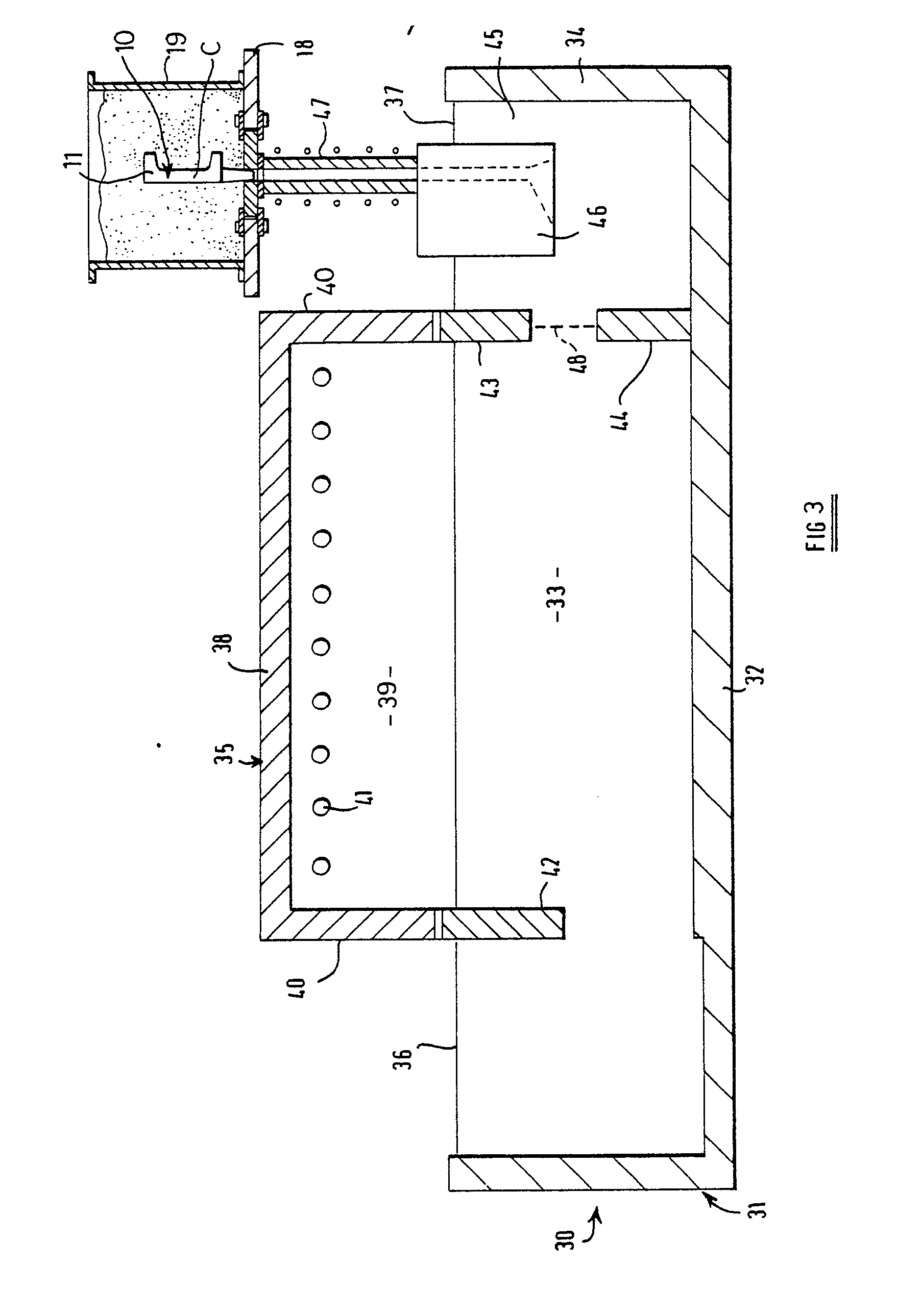
|
| (74) |
Representative: Leach, John Nigel et al |
|
FORRESTER & BOEHMERT
Franz-Joseph-Strasse 38
80801 München
80801 München (DE) |
| (56) |
References cited: :
EP-A- 0 152 754
FR-A- 2 177 466
GB-A- 1 219 779
US-A- 3 771 588
US-A- 4 222 429
|
BE-A- 631 205
FR-A- 2 295 808
US-A- 3 259 949
US-A- 4 003 424
|
|
| |
|
|
|
|
| |
|
| Note: Within nine months from the publication of the mention of the grant of the European
patent, any person may give notice to the European Patent Office of opposition to
the European patent
granted. Notice of opposition shall be filed in a written reasoned statement. It shall
not be deemed to
have been filed until the opposition fee has been paid. (Art. 99(1) European Patent
Convention).
|
[0001] This invention relates to the casting of metal articles. More particularly, it relates
to the casting of metal articles in which molten metal is poured into a mould cavity
formed in particulate material by destroying a pattern in situ.
[0002] One well known example of such a casting method comprises embedding a pattern of
foam plastics material, e.g. expanded polystyrene, in binder-free foundry sand, consolidating
the sand to form a mould, pouring molten metal into the mould to destroy the pattern
by burning or vaporising the pattern so that the metal replaces the pattern and an
article corresponding to the original shape of the pattern is cast in the mould cavity
previously occupied by the pattern.
[0003] US-A-3,259,949 forming the preambles of claims 1 and 18, respectively, discloses
a modification in which the pattern is destroyed prior to the casting operation.
[0004] Such a method has a number of advantages which include:-
1. the ability to produce castings without joint lines and thus with reduced flash
thereby requiring less fettling than with conventional moulds comprising cope and
drag parts;
2. the process is relatively easy to automate since moulding involves simple filling
of particulate material around the pattern using dry binder-free particulate material
such as foundry sand;
3. knock-out and de-coring are easy since the unbonded particulate material simply
runs off and out of the casting.
[0005] However, it suffers from the disadvantage of sporadic filling defects which are unacceptable
in castings which are safety critical, such as suspension and steering components
for automobiles.
[0006] It is accordingly an object of the present invention to provide a method of casting
metal articles whereby the above mentioned problem is overcome or is reduced.
[0007] According to the present invention we provided a method of casting metal articles
comprising the steps of embedding an in situ destroyable pattern in particulate moulding
material to form therein a mould cavity having a casting portion, then feeding molten
metal into the mould cavity, permitting the metal to solidify within the cavity and
interrupting the feed of said metal and removing the casting from the mould characterised
in that the metal is fed into the mould cavity by pumping metal, generally upwardly
against the force of gravity from a reservoir of molten metal which is at a level
which is below the level of the cavity through a passage having one end surrounded
by the molten metal and an opposite end which is connected to the mould cavity and
an intermediate part which extends through the free surface of the molten metal in
the reservoir, with a pump formed separately from the reservoir and which draws metal
from the reservoir into the pump and discharges metal from the pump into the mould
cavity.
[0008] The pattern may be destroyed in situ by the heat of the metal as it is fed into the
mould cavity.
[0009] Alternatively the pattern may be destroyed in situ prior to feeding the metal into
the mould cavity.
[0010] The pattern may comprise a casting part to provide the casting portion of the cavity
and a casting ingate part to provide a casting ingate portion of the cavity.
[0011] The pattern may also be provided with a runner system part to provide a runner system
portion of the cavity and a runner ingate part to provide a runner ingate portion
of the cavity.
[0012] The pattern may be supported within a container, by means of an ingate part which
is mounted within the container, introducing the particulate material into the container
to embed the pattern therein, and feeding said metal, through a cavity provided by
the ingate part, into the casting portion of the mould cavity.
[0013] The metal may be fed from a reservoir into the mould through an orifice in the container.
[0014] The ingate part of the pattern may be disposed in casting relationship with the orifice.
[0015] The pattern may be disposed within a peripheral wall extending upwardly from a mould
base to provide a mould box into which the particulate material is introduced to embed
the pattern therein.
[0016] The pattern may be coated with one or more washes, for example on aqueous ceramic
slurry, to support the mould during the casting process, followed by drying.
[0017] The particulate material in which the pattern is embedded may be compacted by vibration
or the application of a vacuum, or by other means, or by a combination of such means.
[0018] The metal may be pumped into the cavity at the bottom thereof.
[0019] The metal to be cast may be supplied to the reservoir by feeding metal in solid state
thereinto, and melting the metal in the reservoir.
[0020] The reservoir may have a feed region whereat said metal is fed into the reservoir
in solid state, and a casting region from which metal, in liquid state, is drawn by
said pump.
[0021] The reservoir may have a heating region, between the feed region and the casting
region in which heat is applied to the metal in the reservoir.
[0022] Alternatively, the metal to be cast may be supplied to the reservoir in molten state
from a source of molten metal separate from the reservoir.
[0023] The metal may be supplied to the reservoir by means of a ladle.
[0024] The metal may be supplied to the reservoir by means of a launder.
[0025] The metal may be supplied to the reservoir from a melting furnace separate from the
reservoir.
[0026] The metal may be pumped by an electro-magnetic pump or by a fluid pressure pump.
[0027] After the metal has solidified, the level of metal in the passage may be lowered
below the level of the entry to the mould and thereafter the mould and casting are
removed from casting relationship with the source of metal, together with the mould
base.
[0028] The casting may be removed from the mould by tipping out the particulate material
or by fluidising the particulate material or by any other desired means.
[0029] After removal of the casting from the mould, the ingate and any other running system
and feeding system, if present, may be removed from the casting.
[0030] The mould may be made of particulate moulding material which comprises any one or
a number of a variety of foundry sands, including silica, olivine, chromite, zircon,
chamotte, quartz, or synthetic material such as silicon carbide or iron or steel shot.
[0031] The particulate moulding material may comprise a ferro-magnetic material and the
particulate material is compacted by the use of a magnetic field.
[0032] A pressure below atmospheric pressure may be applied to the mould during casting
to assist consolidation and/or removal of vapour or other decomposition products of
the pattern.
[0033] The mould cavity may be filled by a flow of metal generally upwardly against the
force of gravity throughout the mould cavity.
[0034] The mould cavity may be filled without any substantial flow of the metal downwardly
under the influence of gravity within the mould cavity.
[0035] The metal may be fed to the casting portion at a single location and the casting
portion is designed so that no part thereof is fed from another part of the casting
portion along a path having any substantial flow downwardly under the influence of
gravity.
[0036] The metal may be fed to the casting portion at a plurality of locations so that the
casting portion is filled by generally upward flow of metal from a plurality of locations
against the force of gravity without any substantial flow of metal downwardly under
the influence of gravity.
[0037] The mould cavity may include a casting ingate portion which communicates directly
with the casting portion.
[0038] The casting ingate portion of the cavity may communicate with a runner system portion
of the cavity which is provided with a runner ingate portion of the cavity which communicates
with the source of metal.
[0039] The casting ingate portion may communicate with a source of metal without any runner
system.
[0040] The ingate may be placed in casting relationship with the orifice in the mould base
by inserting a portion of the ingate part of the pattern into close fitting engagement
within the orifice.
[0041] The orifice may be lined with, or integrally formed in, thermally insulated refractory
material capable of withstanding the liquid metal to be cast.
[0042] The orifice may be reused for a plurality of castings.
[0043] Alternatively the orifice may be disposed after each casting operation.
[0044] The orifice may be formed as an insert in the mould base.
[0045] The orifice may be placed in casting relationship with the source of metal and a
seal is effected by the use of a ceramic fibre gasket between a riser tube extending
from the source of metal and the member in which the orifice is formed.
[0046] Said feeding of molten metal generally upwardly against the force of gravity from
the source of molten metal into the mould cavity may be performed without any substantial
flow of metal downwardly under the influence of gravity between the source and the
entry into the cavity.
[0047] The filling defects encountered with the previously known process mentioned above
arise because of the action of the liquid metal whilst it falls downwards under gravity.
The uncontrolled tumbling, splashing, surging etc., introduces and entraps oxides,
gases and decomposition products from the pattern and mould materials into the metal.
Even when the flow is more gentle, cool streams of metal develop a carbon deposit
from decomposing styrene vapour, which prevents two such streams from effectively
merging in parts of the casting.
[0048] By feeding metal upwardly against the influence of gravity as called for by Applicant's
invention, we have found that the above mentioned problem is overcome or reduced because
the gentle rise of the substantially horizontal metal surface keeps the metal separate
from and unmixed with the decomposable pattern and its decomposition products since
decomposition of the pattern occurs progressively ahead of the advancing metal surface.
[0049] By an "in situ destroyable pattern", we mean a pattern which, when in a solid state,
is sufficiently strong to enable the particulate material to be formed therearound
and which can be destroyed in situ so as to leave a mould cavity. For example, the
pattern may be destroyed in situ by being at least substantially completely transformed
to the gaseous state, whilst within the particulate material, by subjecting the pattern
to heat to cause it to vaporise and/or burn and/or undergo some other heat initiated
chemical reaction. One example of a suitable destroyable pattern is a pattern made
of expanded polystyrene which is decomposed by combustion substantially to the gaseous
state on heating. Of course some of the decomposition products may be small solid
particles such as soot but these can leave the mould cavity together with the gaseous
products of combustion, for example by passing through the pores between the particles
of the particulate material. Although it is preferred that the pattern is destroyed
in situ by utilising the heat of the molten metal as it is cast into the mould, if
desired, the pattern may be predestroyed in situ, for example, by applying heat to
the pattern prior to casting.
[0050] An embodiment of the invention will now be described by way of example, with reference
to the accompanying drawings, wherein:-
Figure 1 is a diagrammatic cross-sectional view through part of an apparatus for performing
the method embodying the present invention;
Figure 2 is a perspective view of the pattern for the casting and ingate shown in
Figure 1, and
Figure 3 is a diagrammatic cross-section, to a reduced scale, through a melter/holder
furnace for use with the apparatus and pattern of Figures 1 and 2.
[0051] Referring to the drawings, a pattern made of expanded polystyrene is indicated at
10 and comprises two parts namely a casting part 11 of a desired shape of the final
casting to be produced, and a casting ingate part 12. The pattern 10 is made in conventional
manner by introducing polystyrene granules into a moulding machine where they are
injected into a die of the desired configuration. Steam is then injected which causes
the granules to expand and fuse together. The resultant expanded polystyrene pattern
is then water cooled and ejected from the die.
[0052] Although in the example illustrated the pattern is a one-piece moulding with the
casting parts 11 and 12 integral with each other, depending upon the shape of the
final casting and ingate or ingate and runner system, the pattern may be moulded in
two or more separate parts bonded together by a suitable adhesive or other means.
[0053] The pattern is then stored so that the normal pattern shrinkage occurs prior to use
of the pattern. Of course, the die in which the pattern is made is correspondingly
larger size to allow for the shrinkage both of the pattern and of the final casting.
[0054] The pattern is then coated with an aqueous refractory slurry by dipping or spraying
and allowing to dry.
[0055] The pattern 10 is then positioned so that the ingate part 12 is in close fitting
engagement with a cylindrical orifice 13 formed in an insert 14 made of suitable insulating
refractory material such as a lightweight refractory cement, removably mounted by
plates 15 secured in position by bolts 16 in an aperture 17 of a mould base board
18. An open bottomed and tapped container 19 is then positioned on top of the mould
base 18 and particulate moulding material 20 poured into the container 19 around the
pattern 10 so as to embed the pattern 10 in the particulate material 20 and form a
mould cavity C therein.
[0056] In the present example, the particulate material comprises zircon sand but may be
any other suitable particulate material, such as silica, olivine, chromite, chamotte,
quartz sand or synthetic material such as silicon carbide or iron or steel shot.
[0057] In the present example, the particulate material is then consolidated around the
pattern 10 by vibrating the assembly of mould base 18, container 19 etc., but it may
be consolidated by any other suitable means such as the application of suction to
the interior of the mould material, or by other means or by a combination thereof.
[0058] The mould base 18 carrying the moulding material 20 and pattern 10 therein is then
positioned in casting relationship with a melter/ holder furnace 30 so that a riser
tube 47 of the furnace is placed in sealing engagement with the insert 14 with a ceramic
fibre gasket 22 therebetween to provide a liquid-tight seal.
[0059] Referring particularly to Figure 3, the melt/ holder furnace 30 comprises a refractory
lined vessel 31 having a generally rectangular base 32, and vertical side and end
walls 33, 34 respectively. A roof 35 extends across the whole width of the vessel
31 but stops short of the end walls 34 to provide a charging well 36 and a pump well
37 at opposite ends of the vessel.
[0060] The roof 35 comprises a generally horizontal rectangular top part 38 and vertical
side and end walls 39, 40 respectively. The roof 38 comprises suitable refractory
material and within the roof are provided electrical radiant heaters 41.
[0061] The temperature of the heaters 41 and the number thereof and the area of the top
part 38 of the roof are arranged so as to provide sufficient heat to melt ingots fed
into the vessel 31 at the charging well 36 and to maintain the metal molten in the
remainder of the vessel. A downwardly depending refractory wall 42 is provided at
the charging well end of the vessel 31 to separate the charging well from the main
heating part of the vessel whilst downwardly depending and upwardly extending refractory
walls 43, 44 are provided at the pump well end of the vessel to define a casting vessel
region 45 within which a pump 46 is provided. In the present example the pump 46 is
an electro-magnetic pump which pumps metal from the region 45 through the riser tube
47 which is connected to the mould base 18. The riser tube 21 has a lower-end immersed
in the molten metal, an upper end for sealing engagement with the insert 14 and an
intermediate portion which extends through the free upper surface of the molten metal.
If desired a filter 48 may be provided between the walls 43 and 44 to filter metal
entering the casting vessel 45.
[0062] In the present example, the metal is an aluminium alloy, but may be other metal such
as aluminium, magnesium, copper and alloys based on such metals, cast iron or steel.
The molten metal is fed through the riser tube 47 and into the orifice in the insert
14 where the heat of the metal causes progressive decomposition of the ingate part
12 and casting part 11 so that the pattern 10 is destroyed by being decomposed into
gas and/or small solid or liquid particles which escape from the resultant cavity
through the pores between the particles of particulate material 20. Thus, the molten
metal occupies the mould cavity C in the granular material 20 which was previously
occupied by the pattern 10. The refractory coating provided by the slurry supports
the moulding material during casting and provides the cavity with a good surface finish.
[0063] If desired, a partial vacuum may be applied to the mould during at least the initial
stages of feeding metal into the mould to assist with consolidation and/or removal
of vapour or other decomposition products of the pattern.
[0064] After the mould cavity C has been filled with liquid metal, the metal is allowed
to solidify, or at least solidify to the extent so as to be self- supporting. Pressure
is then released or partially released to allow the metal to fall back or partially
fall back from the level of the ingate down the riser tube into the reservoir, and
then the mould and the casting therein are removed out of casting relationship with
the casting machine M together with the mould base 18 and thereafter the casting is
removed from the moulding material, either by tipping the moulding material out of
contact with the casting or by fluidising the moulding material to permit it to flow
or by other means.
[0065] The ingate is then removed from the casting.
[0066] Although in the present example, the orifice 13 is formed in a removable insert 14,
if desired, the orifice may be formed in other material than insulating refractory
material but be lined with insulating refractory material. For example the orifice
may be defined in a sleeve of the insulating refractory material provided in an opening
in an aluminium plate mounted on, or which itself forms the mould base 18. The insert
14 may be used for a considerable number of casts or replaced after each cast or a
small number of casts depending upon the metal being cast and the material of which
the orifice is made.
[0067] In the present example, the casting ingate is placed directly in casting relationship
with the riser tube. If desired, however, un any particular casting where feeding
is required to a plurality of locations to ensure that the casting is fed by movement
of metal upwardly against the influence of gravity, a plurality of casting ingates
may be provided interconnected to a runner system along which the molten metal passes
against the force of gravity without any substantial flow downwardly under the influence
of gravity, and the runner system itself having a runner ingate which is placed directly
in casting relationship with the riser tube.
[0068] Alternatively, a plurality of separate castings may be made at the same time by feeding
molten metal thereto by a similar feeder system extending from the feeder ingate to
a casting ingate of the cavity for each casting. Alternatively, more than one riser
tube may be provided to feed the metal to feeder ingates corresponding to the number
of riser tubes. Each feeder ingate may comprise also a casting ingate or each feeder
ingate may be connected to a plurality of casting ingates by a runner system.
[0069] The features disclosed in the foregoing description, or the accompanying drawings,
expressed in their specific forms or in terms of a means for performing the disclosed
function, or a method or process for attaining the disclosed result, may, separately
or in any combination of such features, be utilised for realsing the invention in
diverse forms thereof, within the scope of the claims.
1. A method of casting metal articles comprising the steps of embedding an in situ
destroyable pattern (10) in particulate moulding material (20) to form therein a mould
cavity (C) having a casting portion (11), then feeding molten metal into the mould
cavity (C), permitting the metal to solidify within the cavity (C) and interrupting
the feed of said metal and removing the casting from the mould characterised in that
the metal is fed into the mould cavity by pumping metal, generally upwardly against
the force of gravity from a reservoir (30) of molten metal which is at a level which
is below the level of the cavity through a passage (47) havine one end surrounded
by the molten metal and an opposite end which is connected to the mould cavity (C)
and an intermediate part which extends through the free surface of the molten metal
in the reservoir, with a pump (46) formed separately from the reservoir (3) and which
draws metal from the reservoir (30) into the pump (46) and discharges metal from the
pump (36) into the mould cavity (C).
2. A method according to Claim 1 wherein the pattern (10) is supported within a container
(18, 19), by means of an ingate part (12) which is mounted within the container (19),
introducing the particulate and material (20) into the container (18, 19) to embed
the pattern (10) therein and feeding said metal, through a cavity provided by the
ingate part (12) into the casting portion (11) of the mould cavity (C).
3. A method according to Claim 1 or Claim 2 wherein the metal is fed from the reservoir
(30) into the mould through an orifice (13) in the container (18, 19).
4. A method according to Claim 3 when dependent on Claim 2 wherein the ingate part
(12) is disposed in casting relationship with the orifice (13).
5. A method according to any one of the preceding claims wherein the metal is pumped
into the cavity (C) at the bottom thereof.
6. A method according to any one of the preceding claims wherein the metal to be cast
is supplied to the reservoir (30) by feeding metal in solid state thereinto, and melting
the metal in the reservoir (30).
7. A method according to Claim 6 wherein the reservoir (30) has a feed region (36)
whereat said metal is fed into the reservoir (30) in solid state, and a casting region
(45) from which metal, in liquid state, is drawn by said pump (46).
8. A method according to Claim 7 wherein the reservoir (30) has a heating region,
between the feed region (36) and the casting region (45) in which heat is applied
to the metal in the reservoir (30).
9. A method according to any one of Claims 1 to 5 wherein the metal to be cast is
supplied to the reservoir (30) in molten state from a source of molten metal separate
from the reservoir (30).
10. A method according to any one of the preceding claims wherein the metal is pumped
by an electro-magnetic pump (46) or by a fluid pressure pump.
11. A method according to any one of the preceding claims wherein, after the metal
has solidified, the level of metal in the passage (47) is lowered below the level
of the entry to the mould and thereafter the mould and casting are removed from casting
relationship with the source of metal, together with the mould base (15).
12. A method according to any one of the preceding claims wherein a pressure below
atmospheric pressure is applied to the mould during casting.
13. A method according to any one of the preceding claims wherein the mould cavity
(C) is filled by a flow of metal generally upwardly against the force of gravity throughout
the mould cavity (C).
14. A method according to Claim 13 wherein the mould cavity (C) is filled without
any substantial flow of the metal downwardly under the influence of gravity within
the mould cavity (C).
15. A method according to any one of the preceding claims wherein the metal is fed
to the casting portion (11) at a single location and the casting portion (11) is designed
so that no part thereof is fed from another part of the casting portion (11) along
a path having any substantial flow downwardly under the influence of gravity.
16. A method according to any one of Claims 1 to 14 wherein the metal is fed to the
casting portion (11) at a plurality of locations so that the casting portion (11)
is filled by generally upward flow of metal from a plurality of locations against
the force of gravity without any substantial flow of metal downwardly under the influence
of gravity.
17. A method according to any one of the preceding claims wherein said feeding of
molten metal generally upwardly against the force of gravity from the source (30)
of molten metal into the mould cavity (C), is performed without any substantial flow
of metal downwardly under the influence of gravity between the source (30) and the
entry into the cavity (C).
18. Apparatus for performing a method as claimed in any one of the preceding claims
comprising a container (18, 19) for an in situ destroyable (10) pattern embedded in
particulate moulding material (20) to form within the container (18,19) a mould cavity
(C) having a casting portion (11), means to feed molten metal into the container (18,
19) characterised in that the means to feed molten metal comprises a pump (46) to
pump molten metal into the container (18, 19), generally upwardly against the force
of gravity from a reservoir (30) of molten metal which is at a level which is below
the level of the container (18, 19) through a passage (47) having one end to be surrounded,
in use, by the molten metal and an opposite end which is connected, in use, to the
mould cavity (C) and an intermediate part which extends, in use, through the free
surface of the molten metal in the reservoir, the pump (46) being formed separately
from the reservoir (30) to draw metal from the reservoir (30) into the pump (46) and
discharge metal from the pump (46) into the container (18, 19).
1. Verfahren zum Gießen von Metallartikeln unter Einbetten eines in situ zerstörbaren
Musters (10) in besonderem Gußmaterial (20) zur Formung eines Gußformhohlkörpers (C)
in diesem mit einem Gußabschnitt (11), sodann Einführen von geschmolzenem Metall in
den Gußformhohkörper (C), Erstarrenlassen des Metalls in dem Hohlkörper (C) und Unterbrechen
des Einführens des Metalls und Entfernen des Gusses aus der Gußform, dadurch gekennzeichnet,
daß das Metall in den Gußformhohlkörper eingebracht wird durch Pumpen des Metalls
gegen die Schwerkraft von einem Reservoir (30) des geschmolzenen Materials, der auf
einer Höhe, die unterhalb der Höhe des Hohlkörpers liegt, durch eine Passage (74),
deren eines Ende von dem geschmolzenen Material umgeben wird und des- . sen gegenüberliegendes
Ende mit dem Gußformhohlkörper (10) verbunden ist, und einem Mittelabschnitt, der
sich durch die freie Oberfläche des geschmolzenen Materials in dem Reservoir erstreckt,
mit einer Pumpe (46), die gesondert von dem Reservoir (3) ausgebildet ist und das
Metall aus dem Reservoir (30) in die Pumpe (46) zieht und von der Pumpe (46) in den
Gußformhohlkörper (C) abgibt.
2. Verfahren nach Anspruch 1, wobei das Modell (10) in einem Behälter (18, 19) gestützt
wird mittels eines Ingate-Teiles (12), das in dem Behälter (19) befestigt ist, Einführen
des besonderen Materials (20) in den Behälter (18, 19) zum Umgeben des Modells (10)
in diesem und Führen des Metalls durch eine Höhlung, die durch das Ingate-Teil (12)
gebildet wird in den Gußabschnitt (11) des Gußformhohlkörpers (C).
3. Verfahren nach Anspruch 1 und Anspruch 2, wobei das Metall von dem Reservoir (30)
in die Gußform durch eine Öffnung (13) in dem Behälter (18, 19) geführt wird.
4. Verfahren nach Anspruch 3, in Abhängigkeit von Anspruch 2, wobei das Ingate-Teil
(12) in einer Gußbeziehung mit der Öffnung (13) angeordnet ist.
5. Verfahren nach einem der vorangehenden Ansprüche, wobei das Metall in den Hohlkörper
(C) an dessen Boden eingepumpt wird.
6. Verfahren nach einem der vorangehenden Ansprüche, wobei das zu gießende Metall
in den Behälter (30) eingebracht wird durch Führen des Metalls in einem festen Zustand
in diesen und Schmelzen des Metalls in dem Reservoir (30).
7. Verfahren nach Anspruch 6, wobei das Reservoir (30) einen Zufuhrbereich (30) hat,
an dem das Metall in das Reservoir (30) in festem Zustand eingeführt wird, und einen
Gußbereich (45), aus dem das Metall in flüssigem Zustand durch die Pumpe (46) abgesaugt
wird.
8. Verfahren nach Anspruch 7, wobei das Reservoir (30) einen Heizbereich hat zwischen
dem Zufuhrbereich (36) und dem Gußbereich (45), in dem Wärme auf das Metall in dem
Reservoir (30) aufgebracht wird.
9. Verfahren nach einem der Ansprüche 1 bis 5, wobei das zu gießende Metall in das
Reservoir (30) in geschmolzenem Zustand von einem Vorrat geschmolzenen Metalls gesondert
von dem Reservoir (30) eingeführt wird.
10. Verfahren nach einem der vorangehenden Ansprüche, wobei das Metall durch eine
elektrisch-magnetische Pumpe (46) oder aber durch eine Fluiddruckpumpe gepumpt wird.
11. Verfahren nach einem der vorangehenden Ansprüche, wobei, nach dem Erstarren des
Metalls, die Höhe des Metalls in der Passage (47) abgesenkt wird unterhalb der Höhe
des Einlasses der Gußform und anschließendes Entfernen der Gußform und des Gusses
aus einer Gießbeziehung mit dem Vorrat an Metall, gemeinsam mit der Gußbasis (15).
12. Verfahren nach einem der vorangehenden Ansprüche, wobei ein Druck unterhalb des
atmosphärischen Drucks auf die Gußform während des Gießens aufgebracht wird.
13. Verfahren nach einem der vorangehenden Ansprüche, wobei die Gußform (C) durch
einen Metallfluß gefüllt wird im wesentlichen aufwärts gegen die Schwerkraft über
den ganzen Gußformhohlkörper (C).
14. Verfahren nach Anspruch 13, wobei der Gußformhohlkörper (C) ohne einem wesentlichen
Fluß des Metalls nach unter Einfluß der Schwerkraft in dem Gußformhohlkörper (C) eingefüllt
wird.
15. Verfahren nach einem der vorangehenden Ansprüche, wobei das Metall zu dem Gußabschnitt
(11) geführt wird an einem einzigen Ort und der Gußabschnitt (11) derart ausgebildet
ist, daß kein Teil von diesem von einem anderen Teil des Gußabschnitts (11) gespeist
wird entlang eines Weges mit einem wesentlichen Fluß nach unten unter dem Einfluß
der Schwerkraft.
16. Verfahren nach einem der Ansprüche 1 bis 14, wobei das Metall in den Gußabschnitt
(11) an einer Vielzahl von Orten eingeführt wird, so daß der Gußabschnitt (11) gefüllt
wird durch einen im wesentlichen nach oben gerichteten Metallfluß von einer Mehrzahl
von Orten gegen die Schwerkraft ohne einen wesentlichen Metallfluß nach unten unter
Einfluß der Schwerkraft.
17. Verfahren nach einem der vorangehenden Ansprüche, wobei das Speisen des geschmolzenen
Metalls im wesentlichen nach oben gegen die Schwerkraft von der Quelle (30) des geschmoizenen
Metalls in den Gußformhohlkörper (C) durchgeführt wird ohne einen wesentlichen Metallfluß
nach unten unter dem Einfluß der Schwerkraft zwischen der Quelle (30) und dem Eintreten
in den Gußformhohlkörper (C).
18. Vorrichtung zur Durchführung eines Verfahrens nach einem der vorangehenden Ansprüche,
mit einem Behälter (18, 19) für ein in situ zerstörbares (10) Modell, das in einem
besonderen Gußmaterial (20) eingebettet ist zur Formung eines Gußformhohlkörpers (C)
in dem Behälter (18, 19) mit einem Gußabschnitt (11) Mitteln zum Führen des geschlossenen
Materials in den Behälter (18, 19), dadurch gekennzeichnet, daß die Mittel zum Führen
des geschmolzenen Metalls eine Pumpe (46) aufweisen zum Pumpen des geschmolzen Materials
in den Behälter (18,19) im wesentlichen nach oben gegen die Schwerkraft von einem
Reservoir (30) des geschmolzenen Metalls, der auf einer Höhe ist unterhalb der Höhe
des Behälters (18, 19) durch eine Passage (47), deren eines Ende bei Verwendung von
dem geschmolzenen Metall umgeben ist und dessen gegenüberliegendes Ende bei Verwendung
mit dem Gußformhohlkörper (C) verbunden ist, und einem Zwischenabschnitt, der sich,
bei Verwendung, durch die freie Oberfläche des geschmolzenen Materials in dem Reservoir
erstreckt, wobei die Pumpe (46) gesondert von dem Reservoir (30) ausgebildet ist,
um das Metall aus dem Reservoir (30) in die Pumpe (46) einzusaugen und von der Pumpe
(46) in den Behälter (18, 19) abzugeben.
1. Procédé pour couler des articles métalliques qui comporte les opérations consistant
à enrober un modèle (10) destructible sur place dans une matière moulante (20) faite
de particules de façon à y ménager une cavité (C) de moule possédant une partie (11)
pour la coulée, puis à amener du métal en fusion jusque dans la cavité (C) du moule,
à permettre au métal de se solidifier à l'intérieur de la cavité (C) et à interrompre
l'alimentation en ledit métal et à enlever du moule la pièce moulée caractérisé en
ce que le métal est amené jusque dans la cavité du moule par pompage de métal, dirigé
globalement vers le haut à l'encontre de la force de la pesanteur à partir d'un réservoir
(30) de métal en fusion qui se trouve à un niveau qui est au-dessous du niveau de
la cavité par l'intermédiaire d'un couloir (47) dont une extrémité est entourée par
ce métal en fusion et dont l'extrémité opposée est reliée à la cavité (C) du moule
et dont une portion intermédiaire s'étend à travers la surface libre du métal en fusion
situé dans le réservoir, au moyen d'une pompe (46) constituée séparément du réservoir
(30) et qui aspire du métal depuis le réservoir (30) jusque dans la pompe (46) et
refoule du métal depuis la pompe (46) jusqu dans la cavité (C) du moule.
2. Procédé selon la revendication 1 où le modèle (10) est supporté à l'intérieur d'un
récipient (18, 19), au moyen d'une attaque de coulée (12) qui est montée à l'intérieur
du récipient (19), avec introduction de la matière (20) faite de particules dans le
récipient (18, 19) de façon à y enrober le modèle (10) et avec amenée dudit métal,
par l'intermédiaire d'une cavité constituée par l'attaque de coulée (12) jusque dans
la partie (11) pour la coulée de la cavité (C) du moule.
3. Procédé selon la revendication 1 ou la revendication 2 où le métal est amené depuis
le réservoir (30) jusque dans le moule par l'intermédiaire d'un orifice (13) situé
dans le récipient (18, 19).
4. Procédé selon la revendication 3 lorsqu'elle est subordonnée à la revendication
2, où l'attaque de coulée (12) est disposée en liaison permettant la coulée avec l'orifice
(13).
5. Procédé selon l'une quelconque des revendications précédentes où le métal est pompé
jusque dans la cavité (C) par le bas de cette dernière.
6. Procédé selon l'une quelconque des revendications précédentes où le métal devant
être coulé est fourni au réservoir (30) par l'amenée de métal à l'état solide jusque
dans ce dernier, et par la fusion de ce métal dans le réservoir (30).
7. Procédé selon la revendication 6 où le réservoir (30) est pourvu d'une région (36)
d'amenée à laquelle ledit métal est amené à l'état solide jusque dans le réservoir
(30), et d'une région (45) de coulée à partir de laquelle le métal, à l'état liquide,
est aspiré par ladite pompe (46).
8. Procédé selon la revendication 7 où le réservoir (30) est pourvu d'une région de
chauffage, située entre la région (36) d'amenée et la région (45) de coulée dans laquelle
de la chaleur est appliquée au métal situé dans le réservoir (30).
9. Procédé selon l'une quelconque des revendications 1 à 5 où le métal devant être
coulé est fourni au réservoir (30) en l'état de métal en fusion à partir d'une source
de métal en fusion distincte du réservoir (30).
10. Procédé selon l'une quelconque des revendications précédentes où le métal est
pompé par une pompe électromagnétique (46) ou par une pompe à pression de fluide.
11. Procédé selon l'une quelconque des revendications précédentes où, après que le
métal s'est solidifié, le niveau de métal dans le couloir (47) est abaissée au-dessous
du niveau de l'entrée conduisant au moule et par la suite le moule et la pièce moulée
sont enlevés de leur liaison avec la source de métal permettant la coulée, en même
temps que la base (18) du moule.
12. Procédé selon l'une quelconque des revendications précédentes où une pression
inférieure à la pression atmosphérique est appliquée au moule pendant la coulée.
13. Procédé selon l'une quelconque des revendications précédentes où la cavité (C)
du moule est remplie au moyen d'un écoulement de métal dirigé globalement vers le
haut à l'encontre de la force de la pesanteur d'un bout à l'autre de la cavité (C)
du moule.
14. Procédé selon la revendication 13 où la cavité (C) du moule est remplie sans aucun
écoulement appréciable du métal dirigé vers le bas sous l'influence de la pesanteur
à l'intérieur de la cavité (C) du moule.
15. Procédé selon l'une quelconque des revendications précédentes où le métal est
amené jusqu'à la partie (11) pour la coulée à un seul emplacement et la partie (11)
pour la coulée a une configuration telle qu'aucune portion de cette partie n'est alimentée
à partir d'une autre portion de la partie (11) pour la coulée selon un circuit ayant
un quelconque écoulement appréciable dirigé vers le bas sous l'influence de la pesanteur.
16. Procédé selon l'une quelconque des revendications 1 à 14 où le métal est amené
jusqu'à la partie (11) pour la coulée à une pluralité d'emplacements si bien que la
partie (11) pour la coulée est remplie au moyen d'un écoulement dirigé globalement
vers le haut de métal à partir d'une pluralité d'emplacements à l'encontre de la force
de la pesanteur sans aucun écoulement appréciable de métal dirigé vers le bas sous
l'influence de la pesanteur.
17. Procédé selon l'une quelconque des revendications précédentes où lesdite opération
consistant à amener du métal en fusion globalement vers le haut à l'encontre de la
force de la pesanteur à partir de la source (30) de' métal en fusion jusque dans la cavité (C) du moule, est accomplie sans aucun écoulement
appréciable de métal dirigé vers le bas sous l'influence de la pesanteur entre la
source (30) et l'entrée dans la cavité (C).
18. Appareil destiné à mettre en oeuvre un procédé tel que revendiqué par l'une quelconque
des revendications précédentes qui comporte un récipient (18,19) pour un modèle (10)
destructible sur place enrobé dans une matière moulante (20) faite de particules de
façon à ménager à l'intérieur du récipient (18, 19) une cavité (C) de moule possédant
une partie (11) pour la coulée, des moyens d'amener du métal en fusion jusque dans
le récipient (18, 19) caractérisé en ce que les moyens d'amener du métal en fusion
comportent une pompe (46) destinée à pomper du métal en fusion jusque dans le récipient
(18, 19), globalement vers le haut à l'encontre de la force de la pesanteur à partir
d'un réservoir (30) de métal en fusion qui se trouve à un niveau qui est au-dessous
du niveau du récipient (18, 19) par l'intermédiaire d'un couloir (17) dont une extrémité
est destinée à être entourée, en service, par ce métal en fusion et dont l'extrémité
opposée est reliée, en service, à la cavité (C) du moule et dont une portion intermédiaire
s'étend, en service, à travers la surface libre du métal en fusion situé dans le réservoir,
la pompe (46) étant constituée séparément du réservoir (30) de manière à aspirer du
métal depuis le réservoir (30) jusque dans la pompe (46) et refouler du métal depuis
la pompe (46) jusque dans le récipient (18, 19).