|
(11) | EP 0 183 975 B1 |

| (12) | EUROPEAN PATENT SPECIFICATION |
|
|
| (54) |
5,6,7,8-Tetrafluoroanthraquinone derivatives 5,6,7,8-Tetrafluoranthrachinonderivate Dérivés de 5,6,7,8-tétrafluoranthraquinone |
|
|
|||||||||||||||||||||||||||||||
|
||||||||||||||||||||||||||||||||
| Note: Within nine months from the publication of the mention of the grant of the European patent, any person may give notice to the European Patent Office of opposition to the European patent granted. Notice of opposition shall be filed in a written reasoned statement. It shall not be deemed to have been filed until the opposition fee has been paid. (Art. 99(1) European Patent Convention). |
BACKGROUND OF THE INVENTION
Field of the Invention:
[0001] This invention relates to 5,6,7,8-tetrafluoroanthraquinone derivatives and to a method for the manufacture thereof.
Description of Prior Art:
[0002] Quinizarins and anthraquinonylamines are known as disperse dyes or pigments possessing high lightfastness and high heat-resisting property or as raw materials therefor. Their lightfastness and heat-resisting property, however, are still short of being fully satisfactory. Methods for the manufacture of these compounds have already been known to the art. For example, a quinizarin is synthesized by subjecting phthalic anhydride and a hydroquinone to Friedel-Crafts reaction. An anthraquinonylamine is synthesized by reducing a quinizarin into a leucoquinizarin with a reducing agent such as metallic tin, a tin compound, metallic zinc, or a reducing agent such as alkali metal thiosulfate and substituting the resultant leucoquinizarin for the hydroxyl group at the 1- or 4-position of an alkylamine or a phenylamine group.
[0003] In CA85, 1976, p.505, abract No. 14284311, 1-amino-5,6,7,8-tetrafluoroanthraquinone-compounds are described which are not suitable as cyan dyes since they posess a low absorption characteristic in the low wavelength zone.
[0004] An object of the present invention, therefore, is to provide 5,6,7,8-tetrafluoroanthraquinone derivatives, which are novel compounds, and a method for the manufacture thereof.
[0005] Another object of this invention is to provide 5,6,7,8-tetrafluoroanthraquinone derivatives, which serve as disperse dyes or pigments of very high lightfastness and heat-resisting property and as raw materials therefor and a method for the manufacture thereof.
SUMMARY OF THE INVENTION
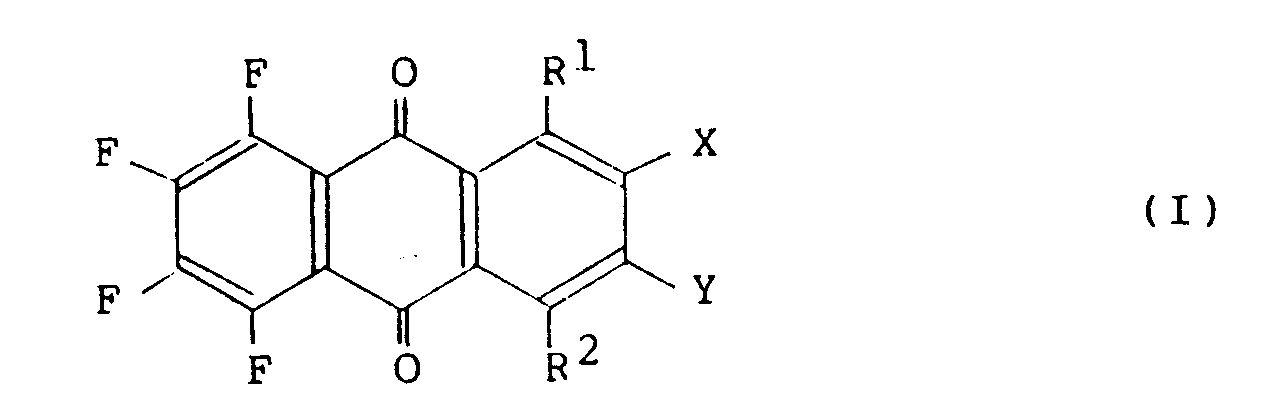
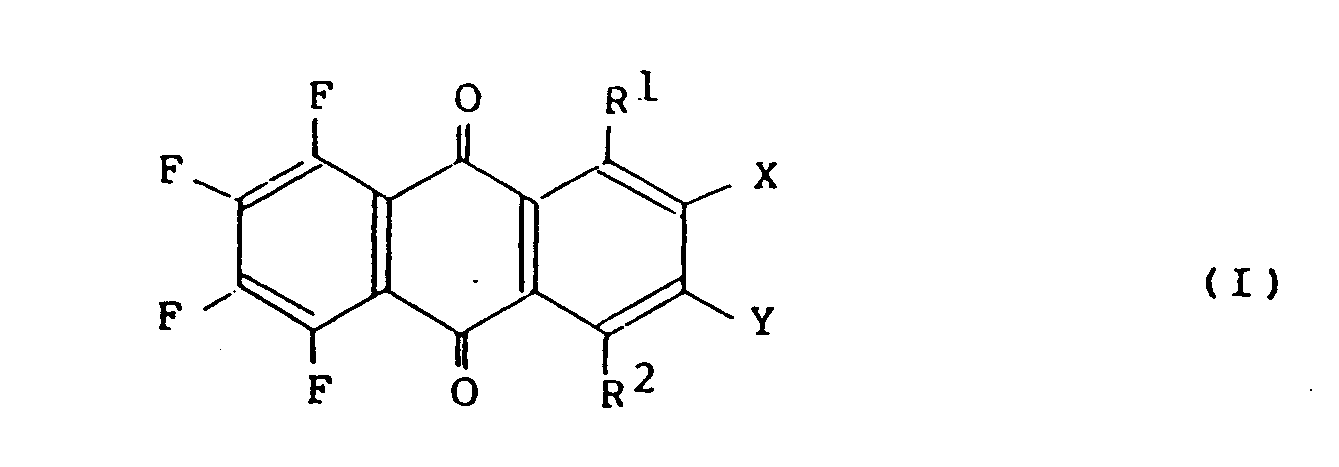
[0006] The objects described above are accomplished by 5,6,7,8-tetrafluoroanthraquinone derivatives which are represented by the general formula I:
wherein R¹ and R² independently stand for -OH or
(where R³ and R⁴ independently stand for hydrogen, an alkyl of 1 to 4 carbon atoms or a phenyl) and X and Y independently hydrogen atom or a halogen atom.
DESCRIPTION OF PREFERRED EMBODIMENT
[0007] The 5,6,7,8-tetrafluoroanthraquinone derivatives of the invention are the compounds which are represented by the aforementioned general formula I. In the formula, R¹ and R² independently stand for -OH or
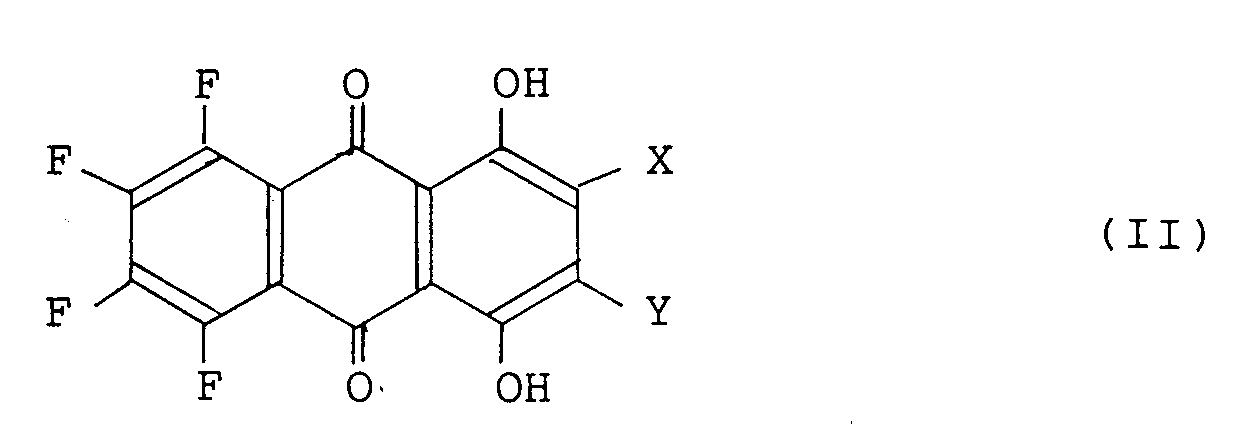
(where R³ and R⁴ independently stand for hydrogen, an alkyl of 1 to 4 carbon atoms or a phenyl) and X and Y independently for an hydrogen atom or a halogen atom. Where R¹ and R² both are -OH, X and Y are desired both to be a hydrogen atom or a halogen atom. The halogen atom may be fluorine, chlorine, bromine, or iodine. Among other halogens, bromine proves particularly desirable. The compounds meeting the description are 5,6,7,8-tetrafluoroquinizarins represented by the following general formula II.
[0008] Where R¹ is
(where R³ and R⁴ independently stand for a hydrogen atom an alkyl of 1 to 4 carbon atoms, or a phenyl) and R² stands for -OH or
(where R³ and R⁴ have the same meanings as defined above), X and Y are desired both to be a hydrogen atom. The compounds which meet the foregoing description are 5,6,7,8-tetrafluoroanthraquinonylamines represented by the following general formula III.
[0009] The 5,6,7,8-tetrafluoroquinizarins which are novel compounds represented by the general formula II possess more conspicuous characteristics than quinizarins containing no fluorine. For examples, they are useful as disperse dyes or pigments possessing high lightfastness and heat-resisting property or as raw materials for disperse dyes or pigments possessing high lightfastness and heat-resisting property. Further, these compounds are useful as raw materials for functional coloring matters possessing special functions different from the functions of quinizarins containing no fluorine.
[0010] Concrete examples of the 5,6,7,8-tetrafluoroquinizarin represented by the aforementioned general formula II are 5,6,7,8-tetrafluoroquinizarin, 2,3,5,6,7,8-hexafluoroquinizarin, 2,3-dichloro-5,6,7,8-tetrafluoroquinizarin, 2,3-dibromo-5,6,7,8-tetrafluoroquinizarin, 2,3-diiodo-5,6,7,8-tetrafluoroquinizarin, 2,5,6,7,8-pentafluoroquinizarin, 2-chloro-5,6,7,8-tetrafluoroquinizarin, 2-bromo-5,6,7,8-tetrafluoroquinizarin, and 2-iodo-5,6,7,8-tetrafluoroquinizarin.
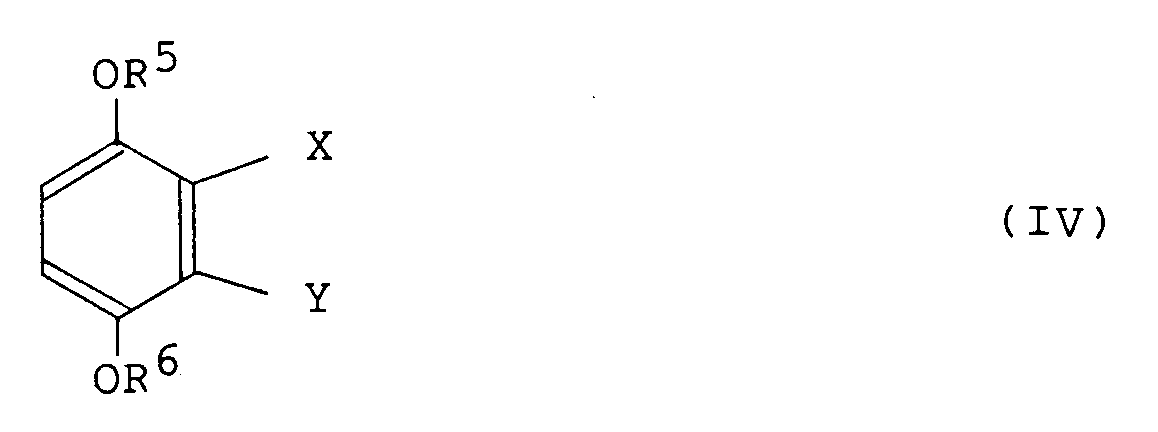
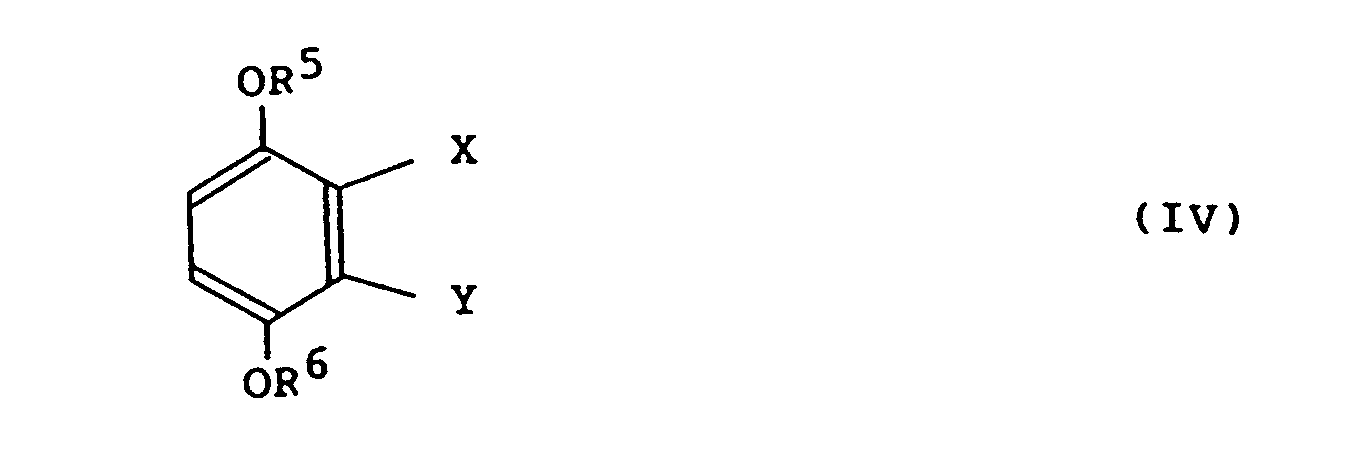
[0011] A 5,6,7,8-tetrafluoroquinizarin represented by the general formula II is produced by causing tetrafluorophthalic anhydride to react in the presence of an effective amount of a Friedel-Crafts catalyst with a hydroquinone compound represented by the general formula IV:
wherein R⁵ and R⁶ independently stand for a hydrogen atoms or an alkyl of 1 to 4 carbon atoms, preferably a hydrogen atom or methyl, and X and Y have the same meanings as defined above. Where X and Y are both a hydrogen atom, the aforementioned 5,6,7,8-tetrafluoroquinizarin is produced by causing tetrafluorophthalic anhydride to react with hydroquinone or 1,4-dialkoxybenzene. Similarly, a 5,6,7,8-tetrafluoroquinizarin having either or both of the 2- and 3-positions thereof halogenated can be produced by the reaction of tetrafluorophthalic anhydride with a hydroquinone having either or both of the 2- and 3-positions thereof halogenated and a 1,4-dialkoxybenzene having either or both of the 2- and 3-positions thereof halogenated. It may otherwise be produced by newly halogenating the 2- and/or 3-position of a 5,6,7,8-tetrafluoroquinizarin obtained by the aforementioned method.
[0012] The amount of the hydroquinone represented by the general formula IV, to be used in the reaction mentioned above, falls in the range of 1.0 to 2.0 mols, preferably 1.2 to 1.5 mols, per mol of the tetrafluoro-phthalic anhydride.
[0013] The Friedel-Crafts catalyst for use in the reaction mentioned above may be any of the Friedel-Crafts catalysts such as aluminum chloride and aluminum bromide which are used generally in the art. The amount of the Friedel-Crafts catalyst to be used is in the range of 2.0 to 20 mols, preferably 5 to 15 mols, per mol of the tetrafluoro-phthalic anhydride.
[0014] The reaction is generally effected by gradually adding tetrafluoro-phthalic anhydride and the compound of the general formula IV into the molten mass of the Friedel-Crafts catalyst, stirring the resultant mixture at an elevated temperature in the range of 90 to 250°C, preferably 120 to 220°C for a period of 15 to 120 minutes, preferably 20 to 60 minutes, and pouring the stirred mixture into cold water.
[0015] The 5,6,7,8-tetrafluoroanthraquinonylamines of the present invention which are noval compounds represented by the aforementioned general formula III possess more conspicuous characteristics than anthraquinonylamines containing no fluorine. For example, they are useful as disperse dyes or pigments of high color-fastness and heat-resisting property or as raw materials thereof.
[0016] Further, these compounds possess special functions different from the functions of anthraquinonylamines possessing no fluorine. For example, they are useful as raw materials for such functional coloring matters as dichromatic coloring matters for liquid crystal display and coloring matters for electrochromic display elements. Particularly, 5,6,7,8-tetrafluoro-1,4-bis(methylamino)-anthraquinone shown in Example 1 possesses an absorption wavelength at 662 nm and exbibits a color tone of the so-called turkey blue hue and, therefore, proves highly useful as a transfer type subliming dye, a transfer type ink, or a liquid crystal display dichromic coloring matter.
[0017] Typical examples of the 5,6,7,8-tetrafluoroanthraquinonylamine of this invention represented by the aforementioned general formula III are 1-amino-5,6,7,8-tetrafluoro-4-hydroxyanthraquinone, 1,4-diamino-5,6,7,8-tetrafluoroanthraquinone, 5,6,7,8-tetrafluoro-1-hydroxy-4-methylaminoanthraquinone, 5,6,7,8-tetrafluoro-1,4-bis(methylamino)-anthraquinone, 1,4-bis(isopropylamino)-5,6,7,8-tetrafluoroanthraquinone, 1,4-bis(butylamino)-5,6,7,8-tetrafluoroanthraquinone, 5,6,7,8-tetrafluoro-1,4-bis(dimethylamino)-anthraquinone, and 5,6,7,8-tetrafluoro-1,4-bis(phenylamino)-anthraquinone.
[0018] A 5,6,7,8-tetrafluoroanthraquinonylamine represented by the general formula III is obtained by reducing the aforementioned 5,6,7,8-tetrafluoroquinizarin into a 5,6,7,8-tetrafluoroleucoquinizarin and heating the reduced product, either simultaneously with or subsequently to the reduction, in conjunction with an amine represented by the general formula V:
wherein R³ and R⁴ have the same meanings as defined above, thereby effecting substitution of the hydroxyl group at the 1- and/or 4-position thereof.
[0019] The amount of the amine of the general formula V to be used is in the range of 0.5 to 200 mols, preferably 20 to 100 mols, per mol of the 5,6,7,8-tetrafluoroquinizarin. Examples of the reducing agent are metals such as metallic tin, a stannous compound such as stannous acetate and stannous chloride, metallic zinc or an alkali metal thiosulfate such as sodium thiosulfate and potassium thiosulfate. The amount of the reducing agent to be used is in the range of 0.5 to 5 mols, preferably 1 to 3 mols, per mol of the 5,6,7,8-tetrafluoroquinizarin. The reduction reaction is carried out at a temperature in the range of 60 to 200°C, preferably 90 to 130°C for a period of 0.1 to 24 hours, preferably 0.5 to 10 hours under autogeneous pressure. This reaction may be carried out in an organic solvent such as acetic acid and propionic acid, in an aqueous hydrochloric acid solution or in water as a solvent. The amination is carried out in the aqueous solution of the amine in the presence of molecular oxygen at a temperature in the range of 50 to 200°C, preferably 80 to 150°C under autogeneous pressure for a period of 10 to 100 hours, preferably 20 to 50 hours. After completion of the reaction, the reaction solution is cooled, poured into cold water, neutralized with hydrochloric acid, nitric acid, or sulfuric acid, and separated by filtration to afford a 5,6,7,8-tetrafluoroanthraquinonylamine.
[0020] Now, the method for the manufacture of the novel substance of this invention will be described more specifically below. The analyses of the substances obtained in the working examples for the determination of their structures will be also shown.
Example 1
Synthesis of tetrafluorophthalonitrile
[0021] In an autoclave made of stainless steel and having an inner volume of 500 ml, 200 g of benzonitrile, 80.0 g (0.301 mol) of tetrachloro-orthophthalonitrile, and 83.9 g (1.444 mols) of potassium fluoride in a dry finely divided form were placed and, with the entrapped air in the autoclave displaced with nitrogen gas, heated and stirred for reaction at 230°C for 10 hours. After completion of the reaction, the resultant reaction solution was cooled to room temperature and then filtered to remove suspended potassium chloride and unaltered potassium fluoride. The benzonitrile solution as mother liquid was analyzed by gas chromatography using a column packed with SE 52 in a length of 1 m and kept at 60°C. The analyses show that this reaction produced tetrafluoro-orthophthalonitrile in a yield of 87.7 mol% based on the tetrachloro-orthophthalonitrile used as the raw material. The mother liquid was vacuum distilled to expel benzonitrile and obtain crystals of tetrafluoro-orthophthalonitrile (m.p. 86 to 87°C) which solidified at room temperature.
Example 2
Synthesis of tetrafluorophthalic acid
[0023] In 60.0 g of an aqueous solution containing sulfuric acid in a concentration of 70.0% by weight, 20.0 g (0.100 mol) of the tetrafluorophthalonitrile obtained in Example 1 was stirred and heated at 157° to 162°C for 15 hours. The resultant reaction solution was diluted by addition of 15 g of water. The diluted reaction solution was left cooling. The resultant slurry was mixed with 100 ml of ether to extract tetrafluorophthalic acid in the organic layer. This extraction was repeated twice. The ether layer consequently obtained was dried with magnesium sulfate and then evaporated to dryness. Consequently, there was obtained 22.1 g of white tetrafluorophthalic acid (in a yield of 95.0 mol% based on tetrafluorophthalonitrile).
Example 3
Synthesis of tetrafluorophthalic anhydride
[0024] The amount 20.0 g of tetrafluorophthalic acid (0.0840 mol) was melted and left standing for dehydration at temperatures of 160° to 170°C for three hours. Thereafter, the dehydrated acid was left standing for sublimation at temperatures of 170° to 180°C under a vacuum (5 Torrs). Consequently, there was obtained 18.0 g of tetrafluorophthalic anhydride.
Example 4
Synthesis of 5,6,7,8-tetrafluoroquinizarin
[0025] Into a molten mixture (130° to 135°C) of 7 g of common salt and 70 g of aluminum chloride, 11.0 g (0.050 mol) of tetrafluorophthalic anhydride and 10.3 g (0.075 mol) of 1,4-dimethoxybenzene were added piecemeal. After completion of the addition, the resultant mixture was heated and stirred at 200°C for 30 minutes. Then, the resultant reaction mixture was poured into ice water. Subsequently, the cooled reaction mixture and 200 ml of concentrated hydrochloric acid added thereto were heated and stirred. The crystals which were consequently precipitated were separated by filtration, washed with cold water, and then dried. Consequently, there was obtained 11.1 g of 5,6,7,8-tetrafluoroquinizarin (in a yield of 71.1 mol% based on tetrafluorophthalic anhydride).
o Melting point: 230°C (recrystallized from benzene)
o
| Elementary analyses: | |||
| C (%) | H (%) | F (%) | |
| Calculated | 53.85 | 1.28 | 24.36 |
| Found | 53.79 | 1.38 | 24.2 |
o ¹H NMR (solvent: D₆-DMSO, inner standard substance: TMC)
δ = 7.36 (s, 2H)
δ = 12.23 (b-s, 2H)
o Mass analysis spectrum
m/e = 312 (M⁺, 100)
m/e = 293 (M⁺-19, 10)
o Visible ray absorption spectrum (in benzene)
λ max; 475 nm (ε; 6700)
λ max; 497 nm (ε; 7300)
λ max; 530 nm (ε; 4400)
Example 5
Synthesis of 2,3-dibromo-5,6,7,8-tetrafluoroquinizarin
[0026] In 100 ml of concentrated sulfuric acid, 5.6 g (0.0179 mol) of 5,6,7,8-tetrafluoroquinizarin and 2.0 g of iodine were left standing for dissolution 125°C. The resultant solution and 17.1 g (0.107 mol) of bromine added thereto were stirred and heated at 125°C for 50 minutes. The resultant reaction mixture was poured into ice water. The crystals which were precipitated were separated by filtration and washed with water. Consequently, there was obtained 7.17 g of 2,3-dibromo-5,6,7,8-tetrafluoroquinizarin (in a yield of 85.3 mol% based on 5,6,7,8-tetrafluoroquinizarin).
o Melting point: 275°C (recrystallized from benzene)
o
| Elementary analyses: | ||||
| C (%) | H (%) | Br (%) | F (%) | |
| Calculated | 35.76 | 0.42 | 34.01 | 16.18 |
| Found | 35.69 | 0.57 | 34.2 | 16.0 |
o Mass analysis spectrum
m/e = 468 (M⁺)
o Visible ray absorption spectrum (in benzene)
λmax; 498 nm (ε; 10200)
λmax; 505 nm (ε; 10400)
λmax; 540 nm (ε; 6200)
Example 6
Synthesis of 5,6,7,8-tetrafluoro-1,4-bis(methylamino)-anthraquinone
[0027] In 200 ml of glacial acetic acid, 7.80 g (0.025 mol) of the 5,6,7,8-tetrafluoroquinizarin obtained in Example 4 was dissolved. The resultant solution and 5.0 g of metallic tin added thereto were stirred and refluxed for one hour.
[0028] Then, the solution and 15 ml of concentrated hydrochloric acid added thereto dropwise were thermally refluxed for one hour. After completion of the reaction, the reaction mixture was diluted with water and left cooling. The precipitate consequently occurred was separated by filtration. This treatment produced 5,6,7,8-tetrafluoro-leucoquinizarin in a substantially quantitative yield. A solution of 3.30 g (0.0105 mol) of this 5,6,7,8-tetrafluoro-leucoquinizarin in 80 ml of an aqueous 40% methylamine solution was sealed in an autoclave in conjunction with air and stirred and heated at 100°C for 35 hours. After completion of the reaction, the reaction solution was left cooling, poured into cold water, and subsequently neutralized with hydrochloric acid. The precipitate consequnetly occurred was separated by filtration, and then dried. As the result, there was obtained 3.27 g of 5,6,7,8-tetrafluoro-1,4-bis(methylamino)-anthraquinone (in a yield of 92.1 mol% based on 5,6,7,8-tetrafluoro-leucoquinizarin).
o
| Elementary analyses: | ||||
| C (%) | H (%) | N (%) | F (%) | |
| Calculated | 56.80 | 2.96 | 8.28 | 22.48 |
| Found | 56.9 | 3.3 | 8.4 | 22.0 |
o Mass analysis spectrum
m/e = 338 (M⁺; 100)
m/e = 321 (M⁺-17; 70)
m/e = 306 (M⁺-32; 14)
m/e = 292 (M⁺-46; 9)
o Visible ray absorption spectrum (in benzene)
λmax; 662 nm (ε; 8300)
λmax; 612 nm (ε; 8300)
λmax; 580 nm (ε; 5150)
Example 7
[0029] In an aqueous 25% ammonia solution, 3.30 g (0.0105 mol) of 5,6,7,8-tetrafluoro-leucoquinizarin obtained by the procedure of Example 6 was dissolved. The resultant solution was sealed in an autoclave in conjunction with air and stirred and heated at 120°C for 30 hours. After completion of the reaction, the reaction solution was left cooling, then poured into cold water, and then neutralized with hydrochloric acid. The precipitate which consequently occurred was separated by filtration and dried. As the result, 2.20 g of 1-amino-5,6,7,8-tetrafuoro-4-hydroxyanthraquinone (in a yield of 67.4 mol% based on 5,6,7,8-tetrafluoro-leucoquinizarin).
o
| Elementary analyses: | ||||
| C (%) | H (%) | N (%) | F (%) | |
| Calculated | 54.02 | 1.61 | 4.50 | 24.44 |
| Found | 54.1 | 1.9 | 4.6 | 23.9 |
o Mass analysis spectrum
m/e = 311 (M⁺; 100)
m/e = 257 (M⁺-54; 25)
m/e = 214 (M⁺-97; 10)
m/e = 186 (M⁺-125;12)
o Visible ray absorption spectrum (in benzene)
λmax; 555 nm (ε; 6000)
λmax; 530 nm (ε; 5250)
λmax; 595 nm (ε; 4200)
1. A 5,6,7,8-tetrafluoroanthraquinone derivative represented by the general formula I:
wherein R¹ and R² independently stand for -OH or

(where R³ and R⁴ independently stand for hydrogen, an alkyl of 1 to 4 carbon atoms or a phenyl) and X and Y independently for hydrogen atom or a halogen atom.
wherein R¹ and R² independently stand for -OH or
(where R³ and R⁴ independently stand for hydrogen, an alkyl of 1 to 4 carbon atoms or a phenyl) and X and Y independently for hydrogen atom or a halogen atom.
2. A compound according to Claim 1, wherein R¹ and R² in said general formula are independently
hydroxyl, amino, or alkylamino.
3. A compound according to Claim 2, wherein R¹ and R² are both hydroxyl and X and Y in
said general formula are independently hydrogen atom or a halogen atom.
4. A compound according to Claim 3, wherein X and Y are independently hydrogen atom or
bromine atom.
5. A compound according to Claim 4, which is 5,6,7,8-tetrafluoroquinizarin.
6. A compound according to Claim 4, which is 2,3-dibromo-5,6,7,8-tetrafluoroquinizarin.
7. A compound according to Claim 2, wherein R¹ is

where R³ and R⁴ have the same meanings as defined above, R² is -OH or

and X and Y are both hydrogen atom.
where R³ and R⁴ have the same meanings as defined above, R² is -OH or
and X and Y are both hydrogen atom.
8. A compound according to Claim 7, wherein R³ and R⁴ are independently hydrogen atom
or methyl.
9. A compound according to Claim 8, wherein R¹ and R² are independently amino or methylamino.
10. A compound according to Claim 8, wherein R¹ is amino or methylamino and R² is hydroxy.
11. A compound according to Claim 10, which is 1-amino-5,6,7,8-tetrafluoro-4-hydroxyanthraquinone.
12. A compound according to Claim 9, which is 5,6,7,8-tetrafluoro-1,4-bis-methylaminoanthraquinone.
13. A method for the manufacture of a 5,6,7,8-tetrafluoroquinizarin represented by the
general formula II:
wherein X and Y independently stand for hydrogen atom or a halogen atom, which comprises causing tetrafluorophthalic anhydride to react, in the presence of an effective amount of a Friedel-Crafts catalyst, with a hydroquinone compound represented by the general formula IV:
wherein R⁵ and R⁶ independently stand for a hydrogen atom or an alkyl of 1 to 4 carbon atoms and X and Y have the same meaning as defined above.
wherein X and Y independently stand for hydrogen atom or a halogen atom, which comprises causing tetrafluorophthalic anhydride to react, in the presence of an effective amount of a Friedel-Crafts catalyst, with a hydroquinone compound represented by the general formula IV:
wherein R⁵ and R⁶ independently stand for a hydrogen atom or an alkyl of 1 to 4 carbon atoms and X and Y have the same meaning as defined above.
14. A method according to Claim 13, wherein said reaction is carried out at a temperature
in the range of 120 to 220°C.
15. A method for the manufacture of a 5,6,7,8-tetrafluoroanthraquinonylamine represented
by the general formula III:

wherein R², R³, and R⁴ have the same meanings as defined above, which comprises reducing a 5,6,7,8-tetrafluoroquinizarin according to claim 3 into a 5,6,7,8-tetrafluoro-leucoquinizarin and heating said reduction product, simultaneously with or subsequently to said reduction, in conjunction with an amine represented by the general formula V:

wherein R³ and R⁴ independently stand for hydrogen atom or an alkyl of 1 to 4 carbon atoms.
wherein R², R³, and R⁴ have the same meanings as defined above, which comprises reducing a 5,6,7,8-tetrafluoroquinizarin according to claim 3 into a 5,6,7,8-tetrafluoro-leucoquinizarin and heating said reduction product, simultaneously with or subsequently to said reduction, in conjunction with an amine represented by the general formula V:
wherein R³ and R⁴ independently stand for hydrogen atom or an alkyl of 1 to 4 carbon atoms.
16. A method according to Claim 15, wherein said reduction is carried out in the presence
of at least one reducing agent selected from the group consisting of metallic tin,
a stannous compound, metallic zinc and an alkali metal thiosulfate at a temperature
in the range of 90 to 130°C and said amination is carried out in the aqueous solution
of the amine of said general formula V in the presence of molecular oxygen at a temperature
in the range of 80 to 150°C.
1. Dérivé de la tétrafluoro-5,6,7,8-anthraquinone représenté par la formule générale
I :
dans laquelle R¹ et R² signifie indépendamment -OH ou

(où R³ et R⁴ signifient indépendamment un hydrogène, un alkyle de 1 à 4 atomes de carbone ou un phényle) et X et Y signifient indépendamment un atome d'hydrogène ou un atome d'halogène.
dans laquelle R¹ et R² signifie indépendamment -OH ou
(où R³ et R⁴ signifient indépendamment un hydrogène, un alkyle de 1 à 4 atomes de carbone ou un phényle) et X et Y signifient indépendamment un atome d'hydrogène ou un atome d'halogène.
2. Composé selon la revendication 1, caractérisé en ce que R¹ et R² dans ladite formule
générale sont indépendamment un radical hydroxyle, amino ou alkylamino.
3. Composé selon la revendication 2, caractérisé en ce que R¹ et R² sont tous les deux
un hydroxyle et X et Y dans ladite formule générale signifient indépendamment un atome
d'hydrogène ou un atome d'halogène.
4. Composé selon la revendication 3, caractérisé en ce que X et Y sont indépendamment
un atome d'hydrogène ou un atome de brome.
5. Composé selon la revendication 4, caractérisé en ce que c'est la tétrafluoro-5,6,7,8-quinizarine.
6. Composé selon la revendication 4, caractérisé en ce que c'est la dibromo-2,3-tétrafluoro-5,6,7,8-quinizarine.
7. Composé selon la revendication 2, caractérisé en ce que R¹ est

où R³ et R⁴ ont la même signification que celle donnée ci-dessus, R² est -OH ou

et X et Y sont tous les deux un atome d'hydrogène.
où R³ et R⁴ ont la même signification que celle donnée ci-dessus, R² est -OH ou
et X et Y sont tous les deux un atome d'hydrogène.
8. Composé selon la revendication 7, caractérisé en ce que R³ et R⁴ sont indépendamment
un atome d'hydrogène ou un méthyle.
9. Composé selon la revendication 8, caractérisé en ce que R¹ et R² sont indépendamment
un radical amino ou un radical méthylamino.
10. Composé selon la revendication 8, caractérisé en ce que R¹ est un radical amino ou
un radical méthylamino et R² est un hydroxyle.
11. Composé selon la revendication 10, caractérisé en ce que c'est l'amino-1-tétrafluoro-5,6,7,8-hydroxy-4-anthraquinone.
12. Composé selon la revendication 9, caractérisé en ce que c'est la tétrafluoro-5,6,7,8-méthylamino-1,4-bis-anthraquinone.
13. Procédé pour préparer la tétrafluoro-5,6,7,8-quinizarine représentée par la formule
générale II :

dans laquelle X et Y sont indépendamment un atome d'hydrogène ou un atome d'halogène, consistant à faire réagir l'anhydride tétrafluorophtalique, en présence d'une quantité appropriée d'un catalyseur de Friedel-Crafts, avec une hydroquinone représentée par la formule générale IV :
dans laquelle R⁵ et R⁶ signifient indépendamment un atome d'hydrogène ou un alkyle de 1 à 4 atomes de carbone et X et Y ont la même signification que ci-dessus.
dans laquelle X et Y sont indépendamment un atome d'hydrogène ou un atome d'halogène, consistant à faire réagir l'anhydride tétrafluorophtalique, en présence d'une quantité appropriée d'un catalyseur de Friedel-Crafts, avec une hydroquinone représentée par la formule générale IV :
dans laquelle R⁵ et R⁶ signifient indépendamment un atome d'hydrogène ou un alkyle de 1 à 4 atomes de carbone et X et Y ont la même signification que ci-dessus.
14. Procédé selon la revendication 13, caractérisé en ce que ladite réaction est effectuée
à une température comprise entre 120 et 220°C.
15. Procédé pour préparer une tétrafluoro-5,6,7,8-anthraquinonylamine représentée par
la formule générale III

dans laquelle R², R³ et R⁴ ont la même signification que ci-dessus, consistant à réduire une tétrafluoro-5,6,7,8-quinizarine selon la revendication 3 en une tétrafluoro-5,6,7,8-leucoquinizarine et à chauffer ledit produit de réduction, en même temps ou après ladite réduction en présence d'une amine représentée par la formule générale V

dans laquelle R³ et R⁴ sont indépendamment un atome d'hydrogène ou un alkyle de 1 à 4 atomes de carbone.
dans laquelle R², R³ et R⁴ ont la même signification que ci-dessus, consistant à réduire une tétrafluoro-5,6,7,8-quinizarine selon la revendication 3 en une tétrafluoro-5,6,7,8-leucoquinizarine et à chauffer ledit produit de réduction, en même temps ou après ladite réduction en présence d'une amine représentée par la formule générale V
dans laquelle R³ et R⁴ sont indépendamment un atome d'hydrogène ou un alkyle de 1 à 4 atomes de carbone.
16. Procédé selon la revendication 15, caractérisé en ce que ladite réduction est effectuée
en présence d'au moins un agent réducteur choisi dans le groupe comprenant de l'étain
métallique, des composés stanneux, du zinc métallique et des thiosulfates de métaux
alcalins, à une température comprise entre 90 et 130°C et ladite réaction d'amination
est réalisée dans une solution aqueuse d'une amine de ladite formule générale V en
présence d'oxygène moléculaire à une température comprise entre 80 et 150°C.
1. 5,6,7,8-Tetrafluoranthrachinon-Derivat der allgemeinen Formel I:

worin R¹ und R² unabhängig voneinander für -OH oder

stehen (in welchem R³ und R⁴ unabhängig voneinander Wasserstoff, einen Alkylrest von 1 bis 4 Kohlenstoffatomen oder einen Phenylrest darstellen und X und Y unabhängig voneinander ein Wasserstoffatom oder ein Halogenatom sind.
worin R¹ und R² unabhängig voneinander für -OH oder
stehen (in welchem R³ und R⁴ unabhängig voneinander Wasserstoff, einen Alkylrest von 1 bis 4 Kohlenstoffatomen oder einen Phenylrest darstellen und X und Y unabhängig voneinander ein Wasserstoffatom oder ein Halogenatom sind.
2. Verbindung gemäß Anspruch 1, in welcher R¹ und R² in der allgemeinen Formel unabhängig
voneinander eine Hydroxyl -, eine Amin - oder eine Alkylamingruppe sind.
3. Verbindung gemäß Amspruch 2, in welcher sowohl R¹ als auch R² eine Hydroxylgruppe
sind und X und Y in der allgemeinen Formel unabhängig voneinander ein Wasserstoffatom
oder ein Halogenatom darstellen.
4. Verbindung gemäß Anspruch 3, in welcher X und Y unabhängig voneinander ein Wasserstoffatom
oder ein Bromatom darstellen.
5. Verbindung gemäß Anspruch 4, welche 5,6,7,8-Tetrafluorchinizarin ist.
6. Verbindung gemäß Anspruch 4, welche 2,3-Dibrom-5,6,7,8 -tetrafluorchinizarin ist.
7. Verbindung gemäß Anspruch 2, in welcher R¹

ist, worin R³ und R⁴ die gleiche Bedeutung wie oben angegeben haben, R² -OH oder

ist und sowohl X als Y ein Wasserstoffatom darstellen.
ist, worin R³ und R⁴ die gleiche Bedeutung wie oben angegeben haben, R² -OH oder
ist und sowohl X als Y ein Wasserstoffatom darstellen.
8. Verbindung gemäß Anspruch 7, in welcher R³ und R⁴ unabhängig voneinander ein Wasserstoffatom
oder ein Methyl-Rest sind.
9. Verbindung gemäß Anspruch 8, in welcher R¹ und R² unabhängig voneinander eine Amino-
oder Methylamino-Gruppe sind.
10. Verbindung gemäß Anspruch 8, worin R¹ eine Amino- oder Methylamino-Gruppe und R² eine
Hydroxy-Gruppe sind.
11. Verbindung gemäß Anspruch 10, welche 1-Amino-5,6,7,8- tetrafluor-4-hydroxyanthrachinon
ist.
12. Verbindung gemäß Anspruch 9, welche 5,6,7,8-Tetrafluor-1,4- bis - methylaminoanthrachinon
ist.
13. Verfahren zur Herstellung eines 5,6,7,8-Tetrafluorchinizarins der allgemeinen Formel
II:

worin X und Y unabhängig voneinander für ein Wasserstoffatom oder ein Halogenatom stehen, in welchem Verfahren man Tetrafluorphthalsäureanhydrid in Gegenwart einer wirksamen Menge eines Friedel-Crafts-Katalysators mit einer Hydrochinon-Verbindung der allgemeinen Formel IV reagieren läßt:

worin R⁵ und R⁶ unabhängig voneinander für ein Wasserstoffatom oder einen Alkylrest von 1 bis 4 Kohlenstoffatomen stehen und X und Y die gleiche Bedeutung wie oben angegeben haben.
worin X und Y unabhängig voneinander für ein Wasserstoffatom oder ein Halogenatom stehen, in welchem Verfahren man Tetrafluorphthalsäureanhydrid in Gegenwart einer wirksamen Menge eines Friedel-Crafts-Katalysators mit einer Hydrochinon-Verbindung der allgemeinen Formel IV reagieren läßt:
worin R⁵ und R⁶ unabhängig voneinander für ein Wasserstoffatom oder einen Alkylrest von 1 bis 4 Kohlenstoffatomen stehen und X und Y die gleiche Bedeutung wie oben angegeben haben.
14. Verfahren gemäß Anspruch 13, in welchem die Reaktion bei einer Temperatur im Bereich
von 120 bis 220°C durchgeführt wird.
15. Verfahren zur Herstellung eines 5,6,7,8-Tetrafluoranthrachinonylamins der allgemeinen
Formel III:

worin R², R³ und R⁴ die gleiche Bedeutung wie oben angegeben besitzen, welches Verfahren die Reduktion eines 5,6,7,8-Tetrafluorchinizarins gemäß Anspruch 3 zu einem 5,6,7,8-Tetrafluorleukochinizarin und das Erhitzen des Reduktionsprodukts gleichzeitig oder nach der Reduktion zusammen mit einem Amin der allgemeinen Formel V umfaßt:

worin R³ und R⁴ unabhängig voneinander für ein Wasserstoffatom oder einen Alkylrest von 1 bis 4 Kohlenstoffatomen steht.
worin R², R³ und R⁴ die gleiche Bedeutung wie oben angegeben besitzen, welches Verfahren die Reduktion eines 5,6,7,8-Tetrafluorchinizarins gemäß Anspruch 3 zu einem 5,6,7,8-Tetrafluorleukochinizarin und das Erhitzen des Reduktionsprodukts gleichzeitig oder nach der Reduktion zusammen mit einem Amin der allgemeinen Formel V umfaßt:
worin R³ und R⁴ unabhängig voneinander für ein Wasserstoffatom oder einen Alkylrest von 1 bis 4 Kohlenstoffatomen steht.
16. Verfahren gemäß Anspruch 15, worin die Reduktion in Gegenwart von mindestens einem
Reduktionsmittel aus der Gruppe metallisches Zinn, Zinn-Verbindung, metallisches Zink
und Alkalimetall-Thiosulfat bei einer Temperatur im Bereich von 90 bis 130 °C durchgeführt
wird und die Aminierung in der wässrigen Lösung des Amins der allgemeinen Formel V
in Gegenwart von molekularem Sauerstoff bei einer Temperatur im Bereich von 80 bis
150 °C durchgeführt wird.