| (19) |
 |
|
(11) |
EP 0 185 001 A1 |
| (12) |
EUROPEAN PATENT APPLICATION |
| (43) |
Date of publication: |
|
18.06.1986 Bulletin 1986/25 |
| (22) |
Date of filing: 20.11.1985 |
|
| (51) |
International Patent Classification (IPC)4: F16B 1/02 |
|
| (84) |
Designated Contracting States: |
|
BE CH DE FR GB IT LI NL SE |
| (30) |
Priority: |
03.12.1984 SE 8406107
|
| (71) |
Applicant: SURTEVALL TRADING AB |
|
S-600 06 Norrköping (SE) |
|
| (72) |
Inventor: |
|
- Myhrman, Sören
S-602 19 Norrköping (SE)
|
| (74) |
Representative: Wideberg, Olle Sven et al |
|
AWAPATENT AB
Box 7402
S-103 91 Stockholm
S-103 91 Stockholm (SE) |
|
| |
|
| (54) |
Device for locking an object against a stop on a shaft, bar or the like |
(57) The present invention relates to a device for locking an object (A) against a stop
(C) on a shaft, bar or the like (B). The device comprises a sleeve (1) with a bore
conformed to the shaft, and a ring (2) movably connected to the sleeve in the axial
direction and also having a bore conformed to the shaft. A member (8) is arranged
in the sleeve and adapted to act on the ring (2) in such a manner that this is fixed
in an inclined position relative to the shaft (B), and thereafter to move the sleeve
(1) away from the ring (2) along the shaft so that the sleeve will urge the object
(A) against the stop (C).
|
|
[0001] The present invention relates to a locking device for locking an object against a
stop on a shaft, bar or the like. The invention relates in particular to a device
for locking the weights on a bar bell, but is of course not restricted to this field
of application but may be used whenever a quick and efficient locking device is needed.
[0002] It is previously known to use a locking device for a bar bell, which comprises a
sleeve or locking ring with a radially extending screw or the like for locking the
ring on the bar bell. This known device however suffers from the drawback that the
weights are not efficiently pressed against each other and against the stop on the
bar bell, such that there may exist a certain play, which is of course undesirable.
In order to obviate this drawback, it has previously been suggested to use locking
devices in the form of a split sleeve or the like which is secured on the bar by means
of a screw assembly, whereupon a wing nut cooperating with the sleeve is screwed off
to press the weights against the stop. This prior art device suffers from the drawback
of being relatively complicated and requiring several time-consuming manual operations
for locking and tightening.
[0003] The object of the invention thus is to overcome these drawbacks and provide an efficient
and quick- acting locking device.
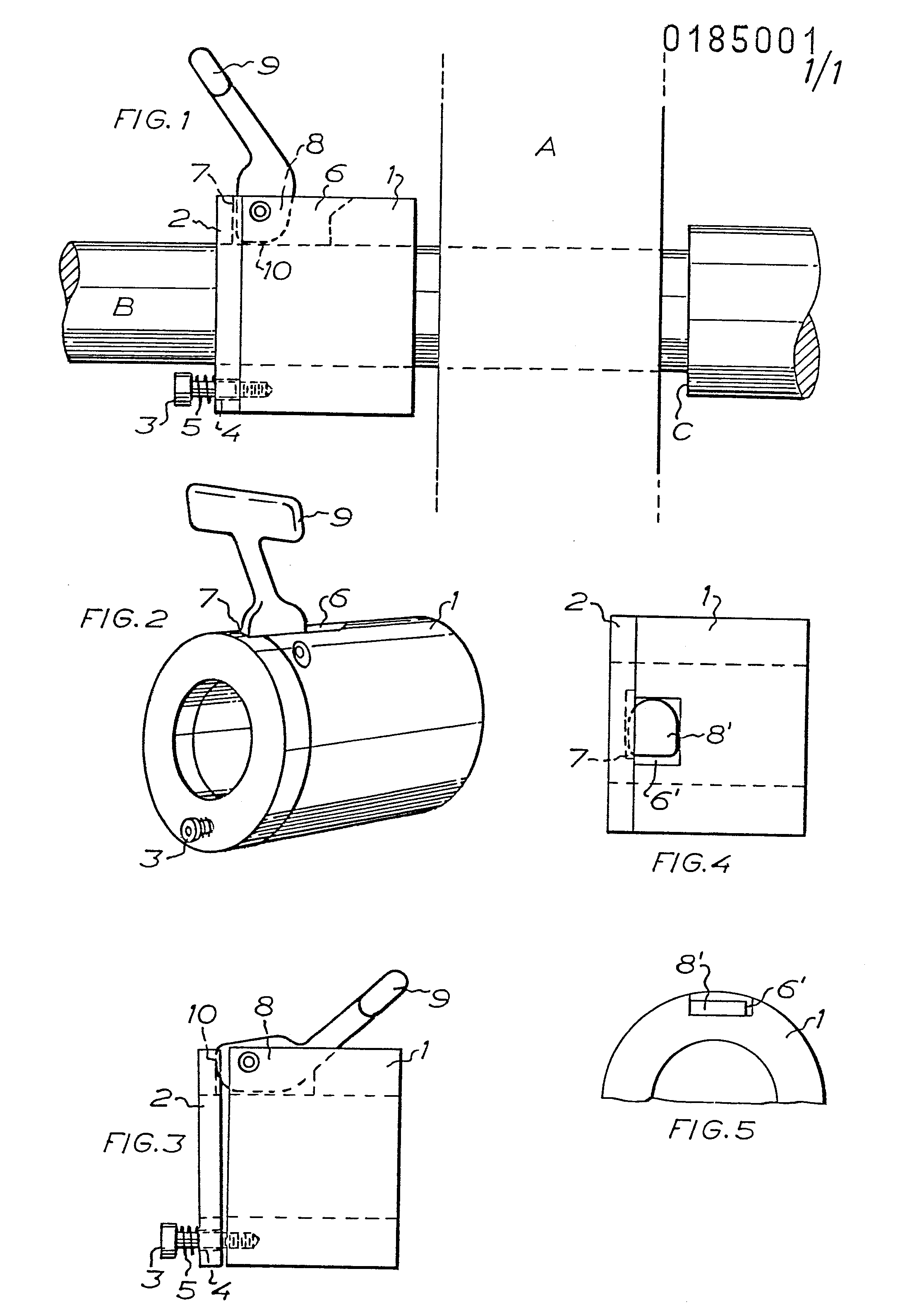
[0004] The invention will now be described in greater detail hereinbelow with reference
to the accompanying drawing, in which Fig. 1 shows the locking device in the unlocked
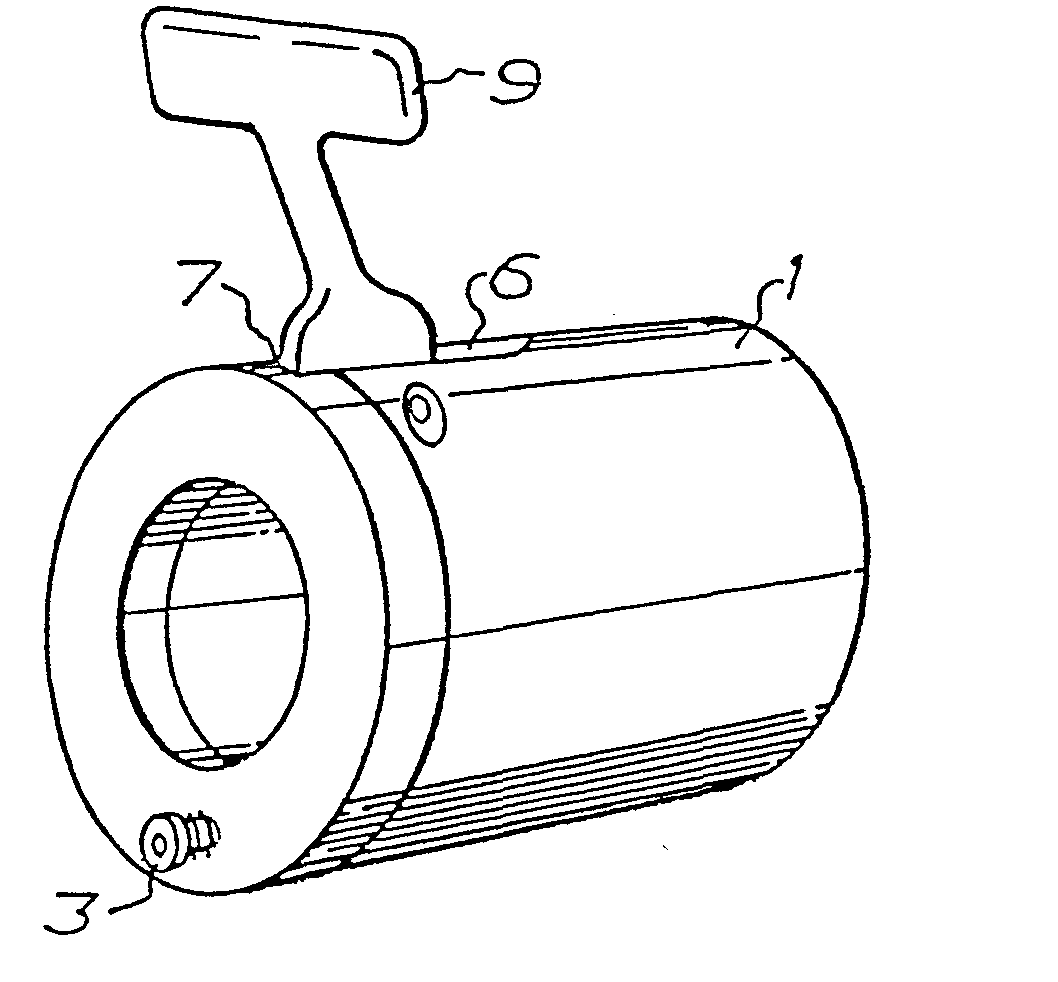
position, intimating an object to be locked against a stop on a shaft. Fig. 2 is a
perspective view of the device. Fig. 3 shows the device in locking position. Figs.
4 and 5 illustrate in an alternative embodiment the location of a locking eccentric
being part of the locking device.
[0005] The device according to the invention consists of a sleeve 1 and a ring 2 having
a bore conformed to the shaft. The ring is retained to the sleeve by means of a screw
3 which is passed with a certain clearance through a hole 4 in the ring, and is urged
against the sleeve by a spring 5. A locking eccentric 8 is mounted in a groove 6 in
the sleeve and projects into a corresponding groove 7 in the ring. The locking eccentric
is formed integrally with a handle 9.
[0006] To effect locking (Fig. 3), the handle 9 is pulled towards the object A and the stop
(to the right in the Figure), whereby the locking eccentric will first act on the
ring 2 so as to incline it with respect to the sleeve 1. The ring is thus locked on
the shaft (stick-slip effect). Continued pulling of the handle causes the sleeve to
move away from the ring (to the right in the Figure), while compressing the spring
5, and urge the object against the stop C. The locking eccentric 8 is suitably formed
with a planar portion 10 which in the locking position engages the groove 7 in the
ring such that the locking eccentric is maintained in this position.
[0007] Figs. 4 and 5 illustrate an alternative embodiment of the locking eccentric. In this
case, the grooves 6' and 7' in the sleeve and the ring, respectively, and the eccentric
8 are arranged perpendicularly in relation the preceding embodiment. The locking eccentric
can be actuated by means of a stationary or loose handle, a hexagon socket key or
the like (not shown).
[0008] Especially the embodiment according to Figs. 1-3 has proved an extremely quick and
efficient device for locking weights on bar bells. After the weights have been placed
on the bar, the sleeve, held by the handle 9, is moved along the bar into engagement
against the weights. A continued movement results in that the handle is lowered towards
the weights and, hence, that the locking eccentric is actuated. The removal of the
sleeve from the ring entails that the weights will be efficiently pressed against
each other and against the stop without the existence of any play.
[0009] The invention should of course not be considered restricted either to the field of
application described above or to the illustrated embodiment but may be modified in
various ways within the spirit and scope of the accompanying claims.
1. A device for locking an object (A) against a stop (C) on a shaft, bar or the like
(B), comprising a sleeve (1) with a bore conformed to the shaft, a ring (2) movably
connected to the sleeve in the axial direction and also having a bore conformed to
the shaft, said ring (2) being connected under spring load to the sleeve (1) by means
of a screw or the like (3) fixed in the sleeve and extending with substantial clearance
through a hole (4) in said ring, and means (8) in the sleeve for actuating the ring,
characterized in that said means (8) is located diametrically opposite the screw (3)
and adapted to act on the ring (2) such that this is fixed in an inclined position
relative to the shaft (B), and thereafter to move the sleeve (1) away from the ring
(2) along said shaft such that the sleeve will press the object (A) against the stop
(C).
2. Device as claimed in claim I, characterized in that the means (8) is an eccentric
which is disposed in a radial groove (6) in the sleeve (1) and which also partly projects
into a mating groove (7) in the ring.
3. Device as claimed in claim 2, characterized in that the eccentric (8) is fixedly
connected to a handle (9) and adapted to act on the ring upon actuation of the handle
(9) in the direction of the stop (C).
4. Device as claimed in claim 1, characterized in that the means (8) is an eccentric
which is disposed in a tangential groove or recess (6') in the sleeve and which also
partly projects into a mating groove or recess (7') in the ring.
5. Device as claimed in claim 4, characterized in that the eccentric (8) is adapted
to be actuated by a loose handle or the like in order to act on the ring.
6. Device as claimed in any one of claims 2-5, characterized in that the eccentric
is provided with a planar portion (10) which in the locked position of the device
engages the groove (7, 7') in the ring.