| (19) |
 |
|
(11) |
EP 0 188 824 B2 |
| (12) |
NEW EUROPEAN PATENT SPECIFICATION |
| (45) |
Date of publication and mentionof the opposition decision: |
|
13.01.1993 Bulletin 1993/02 |
| (45) |
Mention of the grant of the patent: |
|
22.02.1989 Bulletin 1989/08 |
| (22) |
Date of filing: 22.08.1985 |
|
| (51) |
International Patent Classification (IPC)5: B62D 33/06 |
|
| (54) |
Pivot connection for fastening a tilting cylinder to the chassis and the tiltable
cab of a vehicle
Zapfenverbindung zum Befestigen eines Kippzylinders am Fahrgestell und am kippbaren
Fahrerhaus eines Fahrzeuges
Joint à pivot pour attacher un cylindre basculant au châssis et à la cabine basculante
d'un véhicule
|
| (84) |
Designated Contracting States: |
|
DE FR GB IT NL SE |
| (30) |
Priority: |
23.01.1985 NL 8500180
|
| (43) |
Date of publication of application: |
|
30.07.1986 Bulletin 1986/31 |
| (73) |
Proprietor: Applied Power Inc. |
|
Brookfield
Wisconsin 53005 (US) |
|
| (72) |
Inventors: |
|
- Kerk, Gerardus Jacobus Anthonius
NL-7611 AX Aadorp (NL)
- Loevgren, Sonny
S-15187 Soedertalje (SE)
|
| (74) |
Representative: Boelsma, Gerben Harm, Ir. et al |
|
van Exter Polak & Charlouis B.V.,
P.O. Box 3241
2280 GE Rijswijk
2280 GE Rijswijk (NL) |
| (56) |
References cited: :
DE-A- 2 229 436
DE-C- 2 337 900
|
DE-A- 3 309 556
|
|
| |
|
|
- PATENT ABSTRACTS OF JAPAN, vol. 7, no. 63 (M-200)[1208], 16th March 1983
- PATENT ABSTRACTS OF JAPAN, vol. 7, no. 203 (M-241)[1348], 8th September 1983
- PATENT ABSTRACTS OF JAPAN, vol. 7, no. 165 (M-230)[1310], 20th July 1983
|
|
| |
|
[0001] The invention relates to a pivot connection according to the first point of claim
1.
[0002] Similar connections are known. They have the disadvantage that due to the contact
of metal with metal between the connecting eye and the pivot pin a ranling noise occurs
during driving. The application of rubber, e.g. in the shape of a silentblock, is
not possible due to the large load occurring during tilting of the cab, such silentblocks
being not able to stand up against such loads.
[0003] The invention aims at removing the said disadvantage. This is achieved according
to the features of claim 1.
[0004] During riding, the occurring forces, which are rather small, are received by the
rubber ring or rings: During the tilting of the cab the rings are compressed and the
resulting large load is received by the direct support of the eye by the pivot pin.
[0005] For a uniform loading the eye has two chambers which are provided symmetrically as
seen in the cross-section through the axis.
[0006] In order to permit assembling the tilting cylinder under a small angle relative to
the longitudinal axis of the vehicle, in connection with variations in the cab structure
mounting, it is preferable to have the eye aperture flaring outwardly at both ends
by giving it a beveled or convex shape in the direction of the axis.
[0007] In order to make the connections maintenance free, a.o. to make lubrication with
grease superfluous, it is preferable to manufacture the pivot pin of a non-corroding
material or to line it with such a material.
[0008] The invention will further be explained below with reference to the drawing which
shows an embodiment, given as an example, of the pivot connection according to the
invention.
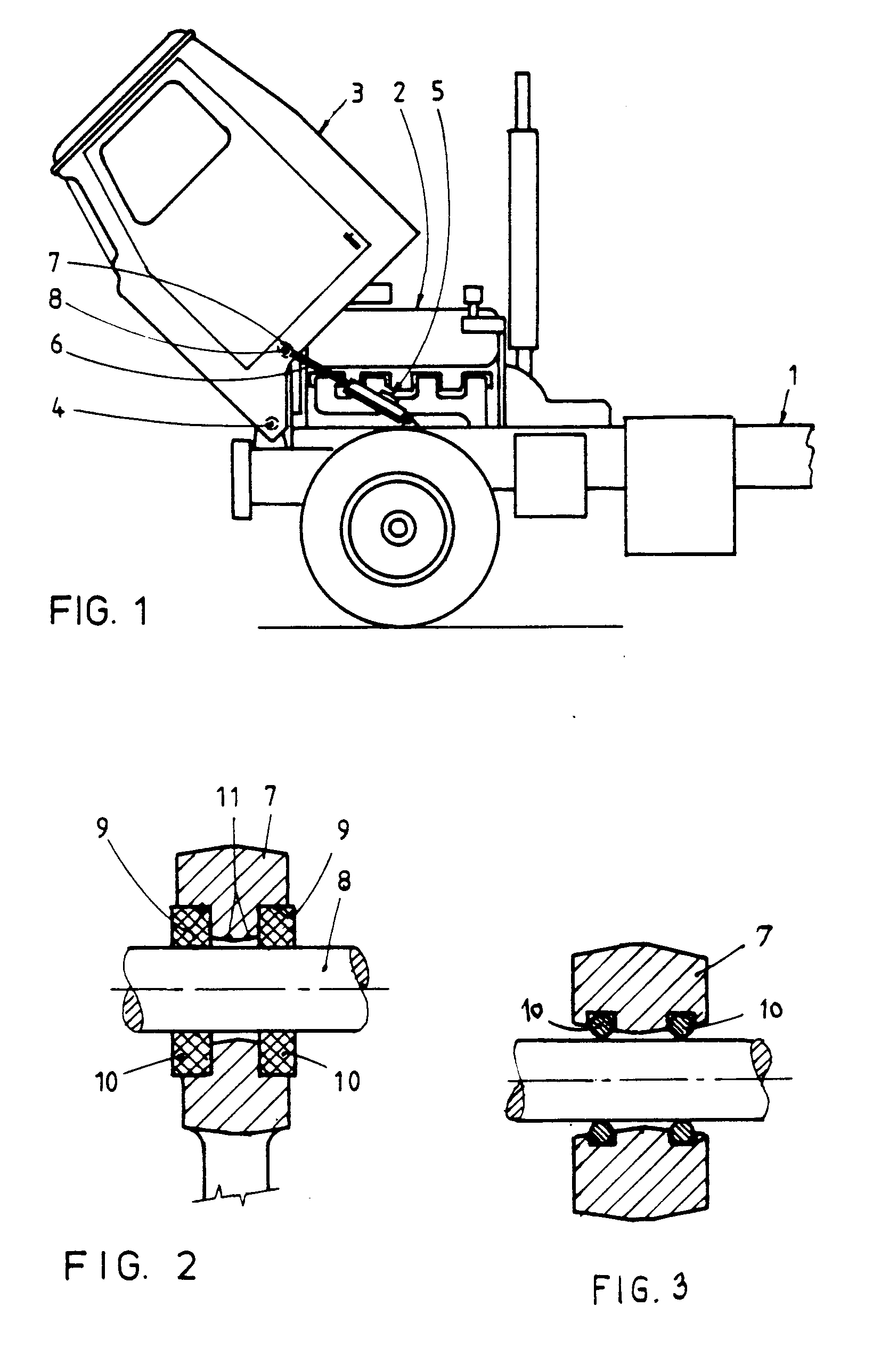
Fig. 1 shows a schematic side elevation of the front part of a vehicle having a tiltable
cab.
Fig. 2 shows a section through the axis of a pivot connection, applied to the cab
of fig. 1.
Fig. 3 shows a cross-section corresponding to fig. 2 of a modification.
Fig. 1 shows the front part of a vehicle chassis 1 having an engine 2 and a tiltable
cab 3. The cab is tiltable around pivot points 4 by means of a tilting cylinder 5.
Said cylinder has a piston rod 6. In the embodiment shown the piston rod 6 is connected
through an eye 7 to a pivot pin 8, which is secured to the cab 3.
[0009] The pivot connection is shown in detail in fig. 2. A similar eye 7 is secured to
the lower end of the cylinder 5 and a similar pivot connection is provided there with
the chassis. Hereunder only the pivot connection with the cab will be discussed.
[0010] In the embodiment shown, as seen in the cross-section of figure 2, recessed chambers
9 have been provided in the eye aperture of the eye 7 in symmetrical positions at
both ends of the eye aperture. In each chamber a ring 10 of rubber or a similar elastic
material is provided, having an interference fit with the side wall of the chamber.
Said rings 10 have an interference fit relative to the pivot pin 8. The stiffness
of the rubber material determines the force at which metallic contact will occur between
the eye aperture and the pivot pin. This does not happen during driving with the vehicle
but only when the cab is tilted, for which a large load is applied.
[0011] In order to permit assembling the cylinder 5 and the piston rod 6, as seen in plan
view on the vehicle, with a small angle of e.g. 3° with the longitudinal axis of the
vehicle, in connection with possible deviations of the mounting of the cab structure
on the vehicle and in that case yet to obtain a sufficient contact area between the
eye aperture and the pin 8, the eye aperture is beveled as seen in figure 2, such
that the aperture flares outwardly at both ends of the eye aperture. Said bevels are
indicated by reference number 11 in fig. 2. The same effect may be obtained by giving
a convex shape to the eye aperture cross-section at said positions.
[0012] The invention provides a very effective pivot connection, which, moreover, is very
simple.
[0013] The pivot connection according to the invention needs no lubrication and in order
to make the connection fully maintenance free, the pins should be manufactured from
non-corroding material or be lined with a similar material.
[0014] Due to the elasticity of the rings also slight errors in the alignment between cab
and cab pivot pin may be overcome.
[0015] It is further to be noted that the rings may also be so-called O-rings, provided
in groove shaped chambers, having a contour adapted to the O-ring cross-section.
1. A pivot connection between the tilting cylinder device and the tiltable cab or
the chassis respectively of a truck, a connecting eye being provided at one of the
cylinder device ends for cooperation with a pivot pin on the cab or the chassis repec-
tively, characterized in that rings (10) of rubber or similar material are placed
in two recessed chambers (9) symmetrically positioned at both ends of the eye aperture
and being coaxial with the eye aperture, said rings having an interference fit as
well relative to the chamber side wall as relative to the pivot pin (8), the or each
remaining portion of the eye aperture having a certain clearance relative to the pivot
pin.
2. A pivot connection according to claims 1, characterized in that the eye aperture
flares outwardly at both ends through a beveled (11) or convex contour in the direction
of the axis.
3. A pivot connection according to one of the preceding claims, characterized in that
the pivot pin (8) is manufactured of non-corroding material or is lined with such
a material.
1. Gelenkverbindung zwischen der Kippzylindervorrichtung und dem kippbaren Fahrerhaus,
bezw. dem Fahrzeugrahmen eines Lastkraftwagens, mit einem an einem Zylinderende vorgesehenen
Verbindungsauge zur Zusammenarbeit mit einem Gelenkzapfen am Fahrerhaus bezw. am Fahrzeugrahmen,
dadurch gekennzeichnet, dass Ringe aus Gummi oder ähnlichem Werkstoff in zwei ausgesparten
Kammern (9) angeordnet sind, welche Kammern symmetrisch an beiden Enden der Augenöffnung
vorgesehen sind und koachsial mit der Augenöffnung sind, welche Ringe einen Preszsitz
gegenüber der Kammerseitenwandung sowie gegenüber dem Gelenkzapfen (8) aufweisen,
während der oder jeder verbleibende Teil der Augenöffnung einen gewissen Spiel gegenüber
dem Gelenkzapfen aufweist.
2. Gelenkverbindung gemäss Anspruch 1, dadurch gekennzeichnet, dass die Augenöffnung
an beiden Enden überein abgeschrägtes (11) oderkonvexes Profil in Achsrichtung nach
aussen ausgeweitet ist.
3. Gelenkverbindung gemäss einer der vorangehenden Ansprüche, dadurch gekennzeichnet,
dass der Gelenkzapfen (8) aus nicht korrodierendem Werkstoff hergestellt oder mit
einem solchem Werkstoff verkleidet ist.
1. Connexion articulée entre le cilindre de basculement et la cabine basculante ou
respectivement le chassis d'un camion, un oeillet de connexion étant prévu à une des
extrémités de cilindre afin de coopérer avec un tenon d'articulation sur la cabine
ou respectivement sur le chassis, caractérisée en ce que des bagues (10) de caoutchouc
ou matière analoge ont été placées dans deux chambres (9) placées symmétriquement
aux deux extrémités de l'ouverture d'oeillet et étant coaxiale avec l'ouverture de
l'oeillet, lesdites bagues présentant un emboitage fixe par rapport a la paroi latérale
de la chambre, ainsi que le rapport au tenon d'articulation (8) tandis que la ou chaque
partie restante de l'ouverture de l'oeillet a un certain jeu par rapport au tenon
d'articulation.
2. Connexion articulée selon la revendication 1, caractérisée en ce que l'ouverture
de l'oeillet s'évase à l'exterieur au deux extrémitées selon un contour biseauté (11)
ou convexe dans la direction axiale.
3. Connexion articulée selon une des revendications précédentes, caractérisée en ce
que le tenon d'articulation (8) a été fabriqué de matière non-corrosive ou revêtu
d'une telle matière.