|
(11) | EP 0 190 265 B1 |

| (12) | EUROPEAN PATENT SPECIFICATION |
|
|
| (54) |
PYRIDONE ESTERS AS INOTROPIC AGENTS PYRIDONESTER ALS INOTROPE MITTEL ESTERS DE PYRIDONE UTILISES COMME AGENTS INOTROPES |
|
|
|||||||||||||||||||||||||||||||
|
||||||||||||||||||||||||||||||||
| Note: Within nine months from the publication of the mention of the grant of the European patent, any person may give notice to the European Patent Office of opposition to the European patent granted. Notice of opposition shall be filed in a written reasoned statement. It shall not be deemed to have been filed until the opposition fee has been paid. (Art. 99(1) European Patent Convention). |
BACKGROUND OF THE INVENTION
[0001] Cardiotonic agents have been used for the treatment of heart failure for some time with digitalis continuing to be one of the principle pharmacologic agents used for this purpose, although the cardiac glycosides as a class do have some limitations. Cardiac output is regulated by the integration of the contractile state of the heart and the dynamics of the peripheral circulatory system. When the heart fails, the primary problem is impairment of ventricular myocardial contractility which results in inadequate cardiac output to meet the metabolic and circulatory demands of the body. Effective therapy of heart failure is accomplished by either enhancing the contractile state of the heart with positive inotropic agents, or by adjusting the peripheral circulatory state with peripheral vasodilators. Agents which stimulate myocardial contractility are of considerable value in the treatment of heart failure. Conventional therapy for heart failure has been the use of digitalis preparations which are the only orally effective inotropic drugs available for use in the treatment of this condition. However, their peripheral vascular effects are undesirable. Sympathomimetic amines are the other major class of cardiac stimulants which are used for the treatment of heart failure. The use of these agents is likewise limited, because they are not fully effective when administered orally and because of undesirable peripheral vasoconstrictor action. Currently, dobutamine and dopamine are the sympathomimetic agents which are primarily used for heart failure, but they can only be administered parenterally.
[0002] Several promising inotropic agents which have been studied clinically are the pyridones, amrinone and milrinone, having the following formula:
Amrinone is effective in treating patients with heart failure but its use has been severely restricted to acute use only because it has been associated with a high incidence of serious side effects.
[0003] Milrinone is undergoing clinical testing as an inotropic agent and its usefulness has not yet been established.
[0004] Because of the limitations of currently available drugs in the treatment of heart failure, there is a clear need for new, effective and safe drugs of this type.
SUMMARY OF THE INVENTION
[0006] When Y is 2 pyridyl, the compound provided by the invention is 2-pyridylmethyl 3-cyano-6-methyl-2-pyridone-5-carboxylate.
[0007] The invention also provides pharmaceutically acceptable salts of the compounds referred to in the two preceding paragraphs.
[0008] The term "pharmaceutically acceptable salts" includes nontoxic acid addition salts of the compounds of the invention which are generally prepared by reacting the free base with a suitable organic or inorganic acid. Representative salts include the hydrochloride, hydrobromide, sulfate, bisulfate, acetate, oxalate, valerate, oleate, palmitate, stearate, laurate, borate, benzoate, lactate, phosphate, tosylate, citrate, maleate, fumarate, succinate, tartrate, and like salts. Also included are metallic salts such as the sodium or potassium salt of the acid.
[0009] The present compounds may be administered to warm-blooded animals orally or parenterally. They can generally be administered with a pharmaceutical carrier. The term "pharmaceutical carrier," for the purpose of the present invention, is intended to refer to any medium that is suitable for the preparation of a dosage unit form, and, thus, includes the tablet medium or a pharmaceuticaly acceptable vehicle or solvent such as is ordinarily used in the preparation of intravenous or intramuscular solutions.
[0010] A pharmaceutical composition containing the compound can be administered to warm-blooded animals in parenteral or oral dosage form. For parenteral administration, amounts of from about 10 to 100 mg/kg per day per patient are useful, with the total dose of up to 0.2 to 2 grams per day being a suitable range for large animals, including humans. A preferred dosage range is from about 1 to 10 grams total daily dosage in a single or divided dose.
[0011] For all dosage forms the above exemplified compounds can be placed in capsules, formulated into pills, wafers, or tablets in conventional fashion together with pharmaceutical carriers well known in the art. Tablets may be prepared for immediate release of the active compound or they may be made enteric, i.e., whereby the active ingredient is released slowly over a period of several hours from within the intestinal tract.
DETAILED DESCRIPTION OF THE INVENTION
[0012] In order to illustrate the manner in which the above compounds may be prepared reference is made to the following examples, which, however, are not meant to limit or restrict the scope of the invention in any respect. Only example 15 relates directly to a compound according to the invention.
[0013] In the following examples, melting points were obtained on a Thomas-Hoover melting point apparatus and are uncorrected. NMR spectra were obtained on a Varian T-60A spectrometer. IR spectra were obtained on a Perkin-Elmer 283 spectrometer. Examples 1 through 5 describe the preparation of intermediates:
EXAMPLE 1a
[0014] Ethyl ethoxymethyleneacetoacetate (1 a): Using the procedure of Crombie et al., Journ. of Chem. Soc. Perkin Trans. 1, 464-471 (1979), a solution of ethyl acetoacetate (26 g, 0.20 mol), triethyl orthoformate (29.6 g, 0.20 mol) and acetic anhydride (41 g, 0.40 mol) was refluxed for 90 minutes. Distillation under reduced pressure gave the product (1): 26 g, 70% yield; bp = 85-98° C at 0.5 mm Hg (The following value is reported in the Crombie et al. publication: bp = 85° C at 0.25 mm Hg); NMR (CDCIa) 8 1.2-1.5 (m ,6H), 2.4-2.5 (d,3H), 4.0-4.6 (m,4H), 7.7 (d,1 H). The signals were split into pairs of closely spaced lines indicative of the cis and trans isomers.
EXAMPLE 1b
[0016] Isopropyl ethoxymethyleneacetoacetate (1 b): From isopropyl acetoacetate (28.8 g, 0.20 mol) which can be made by the process described by Lawesson et al., Organic Synthesis, Coll. Vol.V, 155-157 (1973), triethyl orthoformate (29.6 g, 0.20 mol) and acetic anhydride (41 g, 0.40 mol): 14.3 g, 35.7%; bp = 85-90 C at 0.20 mm Hg; NMR (CDCI3) 8 1.3-1.6 (m,9H), 2.3-2.6 (d, 3H), 4.1-4.5 (m, 2H), 5.0-5.4 (m, 1H), 7.6-7.8 (d, 1 H).
EXAMPLE 1c
[0017] Benzyl ethoxymethyleneacetoacetate (1c): From benzyl acetoacetate (38.4 g, 0.20 mol), triethyl orthoformate (29.6 g, 0.20 mol) and acetic anhydride (41 g, 0.40 mol): 10.7 g, 21.5%; bp = 170-1830 C at 0.5 mm Hg; NMR (CDCl3) δ 1.0-1.4 (t, 3H), 2.2-2.3 (d, 3H), 4.0-4.4 (q, 2H), 5.2 (d, 2H), 7.4 (s, 5H), 7.8-8.0 (d, 1 H).
EXAMPLE 2a
[0018] Ethyl 3-cyano-6-methyl-2-pyridone-5-carboxylate (2a): Following the procedure described by Sunthan- kar et al., Indian Journ. of Chem. 11 (12), 1315-1316 (1973), to a solution of sodium metal (2.3 g, 0.1 g-atom) in ethanol (50 ml) was added slowly with stirring an ethanolic solution (200 ml) of cyanoacetamide (8.4 g, 0.1 mol). The reaction mixture was stirred for about 5 minutes, after which an ethanolic solution (20 ml) of compound 1 a (18.6 g, 0.1 mol) was added. The mixture was stirred for 10 minutes during which time it became turbid, yellow and warm. The mixture was refluxed for 45 minutes. Ethanol was then removed under reduced pressure leaving the yellow sodium salt residue. This was dissolved in 50 ml water (with heating) and acidified with 6N HCI to pH 2-3 in an ice bath. The off-white solids that precipitated out were filtered and washed with cold water until the filtrate was no longer acidic. The cyclization was done by refluxing the solids in 600 ml of 95% ethanol for two hours. After cooling to room temperature for 18 hours, white crystals precipitated out. These were filtered and washed with cold ethanol. More of the product was obtained by concentrating the filtrate under reduced pressure. A total of 11.5 g (56% yield) was obtained: mp = 214-216°C; NMR (DMSO-d6) δ 1.3-1.5 (t, 3H), 2.7 (s, 3H), 3.2-3.3) (NH), 4.1-4.5 (q, 2H), 8.5 (s, 1H); IR (KBr) 2220 cm-1 (CN), 1640-1710 cm-1 (C = O of pyridone and ester).
EXAMPLE 2b
EXAMPLE 3
[0021] Benzyl 3-cyano-6-methyl-2-pyridone-5-carboxylate (3): Using the method described by Hawaldar et al., Indian Journ. of Chem., Sect. B, 19B (2), 151-152 (1980) a mixture of compound 1c (2.5 g, 0.01 mol), cyanoacetamide (0.84 g, 0.01 mol), triethylbenzylammonium chloride (TEBA, 1.1 g 0.005 mol) and 50% NaOH solution (2 ml) was stirred for about 4 hours. The reaction was exothermic and became bright orange. The initially clear solution immediately solidified. A small amount of water was added to facilitate stirring. The mixture was then acidified with 6N HCI, the solids filtered and washed with water and methanol (MeOH) successively. A total of 0.94 g (35%) of off-white solids was obtained: mp = 265-270°C; NMR (DMSO-d6) δ 2.6 (s, 3H), 3.2-3.5 (NH), 5.4 ((s, 2H), 7.4 (s, 5H), 8.6 (S, 1 H); IR (KBr) 2240 cm-1 (CH), 1660 cm-1 (C = O of pyridone), 1730 cm-1 (C = O of ester).
EXAMPLE 4
[0022] 3-Cyano-6-methyl-2-pyridone-5-carboxylic acid (4): This compound was synthesized in the same manner as the compound of Example 3 from cyanoacetamide (0.01 mol), TEBA (0.005 mol), 1 (0.01 mol) and 50% NaOH solution (2 ml). A more efficient method of preparing this compound was refluxing the compound 2a (0.3 g, 1.5 mmol) with NaOH solution (1 ml, 50%) for 1 hour. White solids precipitated out when the solution was acidified with 6N HCI to pH = 1. These solids were filtered, washed thoroughly with water and dried to give 0.24 g (90% yield) of the product: mp = 285-287° C with decomposition; NMR (DMSO-d6) δ 2.6 (s, 3H), 8.4 (s, 1 H); IR (KBr) 2220 cm-1 (CN), 1640-1660 cm-1 (C = O of pyridone), 1710 cm-1 (C = 0 of carboxylic acid).
EXAMPLE 5
[0023] 3-(Methoxycarbonyl)-5-(ethoxycarbonyl)-6-methyl-2-pyrone (5a) and 3-(Methoxycarbonyl-5-(ethoxycarbonyl)-6-methyl-2-pyridone (5b): Using the procedure described by Baker et al., Journ. of Chem. Soc. Perkin Trans. I, 3, 677-685 (1979), ethyl cyanoacetate (3.5 g, 0.031 mol) was added to NaOMe solution (prepared from 0.72 g of sodium metal in 50 ml of MeOH), followed by 1 (5.77 g, 0.031 mol). The mixture was refluxed for 15 minutes, cooled and divided into two equal parts. The first portion was acidified with 2N HCI to pH 2-3 and extracted with CH2CI2. The extracts were washed, dried over MgSO4, and evaporated to give an orange-colored solid. After decolorizing with Nuchar activated carbon in ethyl acetate and recrystallizing from EtOAc-hexane, white, fluffy crystals, of 3-(methoxycarbonyl)-5-(ethoxycarbonyl)-6-methyl-2-pyrone were obtained: 0.22 g, 6% yield; mp = 94-96° C; NMR (DMSO-d6) δ 1.2-1.5 (t, 3H), 2.7 (s, 3H), 3.8 (s, 3H), 4.1-4.6 (q, 2H), 8.5 (s, 1 H); IR (KBr) 1700-1730 cm-1 (C= O of Me and Et ester), 1770 cm-1 (C = 0 of pyrone).
[0024] The second portion was treated with glacial acetic acid (0.8 ml) and refluxed for 2 hours. Some solids which formed during the reaction were filtered off. The filtrate was acidified with 6N HCI to pH = 1-2, precipitating out the desired pyridone as an orange solid. Purification of this solid with Nuchar activated carbon and recrystallization from MeOH-ether gave white, fluffy crystals of 3-(methoxycarbonyl)-5-(ethoxycarbonyl)-6-methyl-2-pyridone: 0.15 g, 4% yield; mp = 200-202° C; NMR (DMSO-d6) δ 1.2-1.5 (t, 3H), 2.6 (s, 3H), 3.8 (s, 3H), 4.1-4.4 (q, 2H), 8.6 (s, 1H); IR (KBr) 1660 cm-1 (C=0 of pyridone), 1700-1710 cm-1 (C=O of ester).
EXAMPLE 6
[0025] 3,5-Bis-ethoxycarbonyl-6-methyl-2-pyridone (6): Ethylcyanoacetate (2.26 g, 0.02 mol) was added to a NeOEt solution (prepared from 0.46 g of sodium metal in 50 ml EtOH), followed by compound 1 (3.72 g, 0.02 mol). The solution was refluxed for 12 hours. Shiny, light-yellow crystals precipitated out after 18 hours of standing at room temperature. After decolorizing with Nuchar activated carbon, white crystals of 3,5-bis- ethoxycarbonyl-6-methyl-2-pyridone were obtained: 1.45 g, 29% yield; mp = 195-197°C; NMR (DMSO-d6) δ 1.1-1.5 (t, 6H), 2.6 (s, 3H), 4.1-4.5 (q, 4H), 8.6 (s, 1H), 12.6 (NH); IR (KBr) 1660 cm-1 (C=O of pyridone), 1700 cm-1 and 1720 cm-1 (C = 0 of ester).
EXAMPLE 7
[0026] Ethyl 3-cyano-6-methyl-2-pyridone-4-carboxylate (7): Based on the method described by Fuchs et al., Chem. Abst., 72, 100533 f (1970), a solution of sodium metal (1.15 g, 0.05 g-atom) in ethanol (32 ml) was added to acetone (2.9 g, 0.05 mol) and diethyloxalate (7.31 g, 0.05 mol) in ethanol (10 ml), followed by cyanoacetamide (2.77 g, 0.033 mol) in water (15 ml). The solution was heated on an oil bath at 60-70° C for 30 minutes with constant stirring. The solvent was removed under reduced pressure giving an orange solid which was dissolved in a small amount of water and acidified with 6N HCI to pH = 2, giving a yellow solid. After filtering and drying, a crude yield of 5.4 g (79%) was obtained. Decolorizing with Nuchar activated carbon gave light-yellow, needlelike crystals: 2.52 g, 24% yield; mp = 215-217° C; NMR (DMSO- d6) δ 1.2-1.5 (t, 3H), 2.4 (s, 1 H), 4.2-4.6 (q, 2H), 6.6 (s, 1 H); IR (KBr) 2240 cm-1 (CN), 1640 cm-1 (C = 0 of pyridone), 1720 cm-1 (C = 0 of ester).
EXAMPLE 8
[0027] 3-(N-imidazolyl-carbonyl)-6-methyl-2-pyridone (8): To 4 g (0.026 mol) of 6-methyl-2-pyridone-3-carboxylic acid in 25 ml DMF was added 5.3 g (0.033 mol) of carbonyldiimidazole. The mixture was heated to 55° C with stirring for 2.5 hours. Bubbles and off-white precipitate were observed during this period. After filtering the solids, washing thoroughly with THF and drying in the vacuum dessicator for 18 hours, 4.7 g (89%) of the product was obtained: mp = 237-239° C with decomposition; NMR (DMSO-d6) δ 2.3 (s, 3H), 3.4 (NH), 6.2-6.4 (d, 1 H), 7.1 (d, 1 H), 7.6 (d, 1 H), 7.8-8.0 (d, 1 H), 8.2 (d, 1 H); IR (KBr) 1660 cm-1 (C = O), 1700 cm-1 (C = 0).
EXAMPLE 9
[0028] 5-(-N-imidazolyl-carbonyl)-2-pyridone (9): 6-Hydroxy-nicotinic acid (8.0 g, 0.06 mol) and carbonyldiimidazole (12.0 g, 0.074 mol) were heated at 55° C for 4 hours in 50 ml DMF. After filtering and washing with ether and water, light-beige crystals of product were obtained: 4.2 g, 38% yield; mp = 200-200.5° C; NMR (DMSO-d6) δ 6.4 (d, 1H), 7.2 (s, 1H), 7.6-8.1 (m, 3H), 8.4 (s, 1H); IR (KBr) 1600 cm-1, 1650-1680 cm-1 (C=O of pyridone and imidazolide).
EXAMPLE 10
[0029] 5-(-N-imidazolyl-carbonyl)-3-cyano-6-methyl-2-pyridone (10): To 0.20 g (1.1 mmol) of 12 in 10 ml DMF was added carbonyldiimidazole (0.223 g, 1.4 mmol). The solution was stirred for 24 hours at room temperature. Dimethylformamide was stripped off under reduced pressure giving an oil which crystallized upon further drying. The solid was washed with water and dried in the vacuum dessicator. Yellow solids were obtained: 0.11 g, 40% yield; mp = 237-238° C with decomposition; NMR (DMSO-d6) δ 2.5 (s, 3H), 7.2 (d, 1H), 7.8 (d, 1 H), 8.4 (2s, 2H); IR (KBr) 1670 cm-1 (C = O) of pyridone), 1710 cm-1 (C = O of imidazolide).
EXAMPLE 11
[0030] 5-(4,4-Dimethyl-2-oxazolin-2-yl)-2-pyridone (11): 2-Methyl-2-amino-1-propanol (0.94 g, 0.011 mol) and compound 10 (2.0 g, 0.011 mol) were refluxed for 12 hours in 100 ml DMF. The solvent was stripped off giving an oil which was washed with ether and CH2Cl2 and further dried under reduced pressure. Thionyl chloride (10 ml) was then added to the oil and the mixture stirred for 30 minutes. The thionyl chloride suspension was added dropwise to 100 ml of 15% NaOH, cooled in an ice-bath, and more base was added until pH reached 7-8. Insoluble materials were filtered off. The filtrate was extracted with CH2Cl2 (2x 50 ml) and the organic extract was separated out, dried over MgSO4 and concentrated to an oil, which crystallized on standing. Trituration with EtOAc removed the yellow color and gave 0.49 g (23% yield) of white crystal line solid: mp = 172-173° C; NMR (DMSO-d6) 8 1.4 (s, 6H), 4.0 (s, 2H), 6.5-6.7 (d, 1 H), 8.0-8.2 (m, 2H); IR (KBr) 1600 cm-1, 1650-1680 cm-1 (C = 0 of pyridone and C = N).
EXAMPLE 12
[0031] Ethyl 2-pyridone-5-carboxylate (12): To 6-hydroxynicotinic acid (1.0 g, 7.19 mmol) suspended in absolute ethanol (EtOH) (10ml) was added dropwise SOCI2 (0.55 ml, 7.5 mmol). The reaction mixture was warmed at reflux for 4 hours and concentrated under reduced pressure. The white solid obtained was stirred in hexanes, filtered, and dried to give the product as the hydrochloride salt (1.38 g, 94%), mp = 117-124° C, NMR (DMSO-d6) δ 1.45 (t, J = 7Hz, 3H), 4.27 (q, J = 7Hz, 2H), 6.35-8.17 (m, 3H).
[0032] Employing the above described procedure and starting with the appropriate alcohol, the following compounds were prepared.
EXAMPLE 13
[0033] Methyl 2-pyridone-5-carboxylate (13): mp 169-170° C; NMR (DMSO-d6) δ 3.8 (s,3H), 6.45 (d, 1H), 7.91 (m, 2H).
EXAMPLE 14
[0034] Ethyl 3-cyano-5,6-dimethyl-2-pyridone-4-carboxylate (14): Using the method of Example 7, a solution of NaOEt was prepared by dissolving sodium (1.15 g, 50 mmol) in absolute EtOH (50 ml). This solution plus an EtOH (2 ml) wash was added to a solution of methylethyl ketone (4.5 ml, 50 mmol) and diethyl oxalate (6.8 ml, 50 mmol) in EtOH (15 ml). A solution of cyanoacetamide (2.77 g, 33 mmol) in water (15 ml) was added and the reaction mixture warmed at 65°C for 35 minutes. The reaction mixture was concentrated under reduced pressure, taken up in H20 (250 ml), filtered, and the filtrate acidified with 6N HCI. Filtration afforded a mixture of the 5,6-dimethyl and 6-ethyl compounds. From the filtrate the product crystallized (400 mg, 6%) as a bright yellow solid, mp = 172-176 C, NMR (DMSO-d6) δ 1.33 (t, J = 7Hz, 3H), 1.92 (s, 3H), 2.33 (s, 3H), 4.42 (q, J = 7Hz, 2H), IR (KBr) 2230, 1740, 1650 cm-1.
EXAMPLE 15
[0035] Preparation of β-keto-ester enamines: Using the procedure of Lesher at al. as described in U. S. Patent 4,297,360, a solution of the appropriate ester 2-pyridyl methyl of acetoacetic acid (0.05 mole) and dimethylformamide dimethyl acetal (0.15 mole) was stirred at room temperature for 30 minutes to 2 hours, and, if necessary, refluxing for 30 minutes to 1 hour to complete the reaction. Concentration under reduced pressure gave a yellow-orange or brown oily residue. Vacuum distillation of the crude residue gave a yellow oil as the desired product. The crude oil was used without further purification since decomposition of product was observed after vacuum distillation. 1H-NMR analysis of the product showed the disappearance of the singlet peak at 3.4-3.6 ppm (2H) and the appearance of a sharp singlet at 7.6-7.8 ppm (1 H) and a large singlet at 3.0-3.2 ppm (6H).
1. A compound of the formula
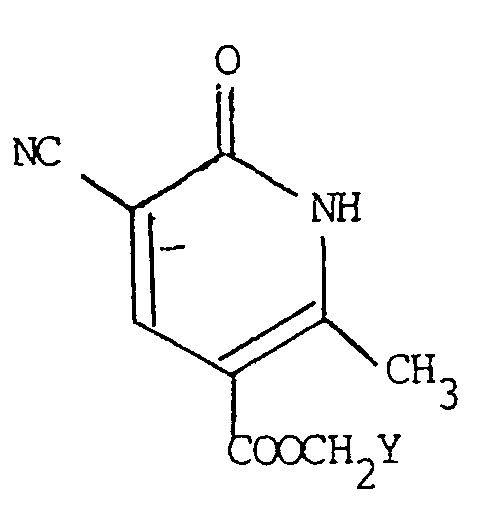
wherein Y is 2 or 3 pyridyl.
wherein Y is 2 or 3 pyridyl.
2. 2-pyridylmethyl 3-cyano-6-methyl-2-pyridone-5-carboxylate.
3. A compound, being a pharmaceutically acceptable salt of a compound according to
either preceding claim.
4. A compound according to any preceding claim, for use in a method of treatment of
the human or animal body by therapy.
5. A compound according to claim 4, for use in treatment of impaired myocardial contractility
by providing a positive inotropic effect.
6. A pharmaceutical composition comprising a compound according to any preceding claim
and a pharmaceutically acceptable carrier.
1. Un composé de la formule
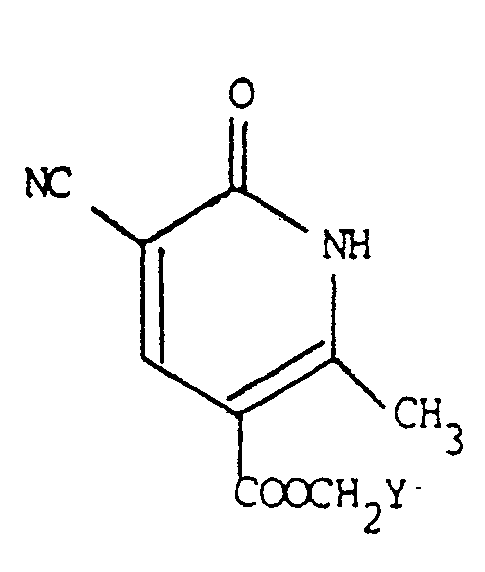
dans laquelle Y est un groupe 2- ou 3-pyridyle.
dans laquelle Y est un groupe 2- ou 3-pyridyle.
2. Le 3-cyano-6-méthyl-2-pyridone-5-carboxylate de 2-pyridylméthyle.
3. Un composé, qui est un sel pharmaceutiquement acceptable d'un composé selon l'une
ou l'autre des revendications précédentes.
4. Un composé selon l'une quelconque des revendications précédentes, pour son utilisation
dans un procédé de traitement du corps humain ou animal par thérapie.
5. Un composé selon la revendication 4, pour son utilisation dans le traitement d'une
contractilité myocardique altérée par production d'un effet inotrope positif.
6. Une composition pharmaceutique comprenant un composé selon l'une quelconque des
revendications précédentes et un véhicule pharmaceutiquement acceptable.
1. Verbindung der Formel
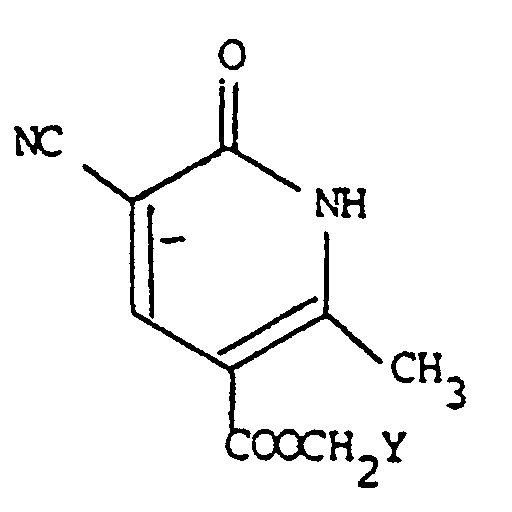
worin Y gleich 2- oder 3-Pyridyl ist.
worin Y gleich 2- oder 3-Pyridyl ist.
2. 2-Pyridylmethyl-3-cyano-6-methyl-2-pyridon-5-carboxylat.
3. Verbindung, die ein pharmazeutisch annehmbares Salz einer der Verbindungen nach
irgendeinem der vorstehenden Ansprüche ist.
4. Verbindung nach irgendeinem der vorstehenden Ansprüche zur Verwendung bei einer
Behandlungsmethode für menschliche oder tierische Körper durch Therapie.
5. Verbindung nach Anspruch 4 zur Verwendung bei der Behandlung gestörter Myokardkontraktilität
durch Erzeugung eines positiven inotropen Effekts.
6. Pharmazeutische Zubereitung, umfassend eine Verbindung nach irgendeinem der vorstehenden
Ansprüche und einen pharmazeutisch annehmbaren Träger.