|
(11) | EP 0 191 489 B1 |

| (12) | EUROPEAN PATENT SPECIFICATION |
|
|
| (54) |
Stabilized active forms of Vitamin D3 Stabilisierte aktive Formen von Vitamin-D3 Formes actives stabilisées de la vitamine D3 |
|
|
|||||||||||||||||||||||||||||||
| Note: Within nine months from the publication of the mention of the grant of the European patent, any person may give notice to the European Patent Office of opposition to the European patent granted. Notice of opposition shall be filed in a written reasoned statement. It shall not be deemed to have been filed until the opposition fee has been paid. (Art. 99(1) European Patent Convention). |
[0002] Active derivatives of vitamin D₃ represented by 1α,25-dihydroxyvitamin D₃ and 1α-hydroxyvitamin D₃ have the ability to improve calcium metabolism, especially bone metabolism, and find expensive clinical use not only in patients under blood dialysis therapy who suffer from bone diseases resulting from impaired vitamin D activity in kidneys but also in the treatment of diseases that are difficult to cure by conventional vitamin D₃ drugs, such as chronic renal insufficiency, hypoparathyroidism, vitamin D-resistant rickets and osteomalacia. These active forms of vitamin D₃ are also administered to premature babies to sustain their growth.
[0003] The active forms of vitamin D₃ have such strong physiological activities that their single doses are limited to very small amounts. In order to ensure uniformity in their levels in preparations and their stability as well, the active forms of vitamin D₃ are most often administered in the form of soft capsules filled with oily solutions such as middle-chain aliphatic acid triglycerides, or in the form of oily liquids.
[0004] Practicing doctors who are attending patients with chronic renal insufficiency see the strong need to develop injections of active forms of vitamin D₃ that can be directly administered into the patient's blood during blood dialysis. Active forms of vitamin D₃ administered in the form of oily liquids to premature babies and infants have the unpleasant taste of oils and cases have been reported that infants to whom the oily liquids had been repeatedly administered eventually refused to take further doses of the liquids. Oily liquids of active forms of vitamin D₃ may be administered to infants in the form of mixtures with milk or fruit juice, but the oily liquids will not mix uniformly with milk or fruit juice and present considerable difficulty in maintaining the exact amount of dose since the formulation will partly stick to the inner surface of nursing bottles or cups. Stability tests with active forms of vitamin D₃, which are fat-soluble vitamins, after they were solubilized with a variety of solubilizers to form liquid preparations or made into tablets or fine particles with the aid of various excipients showed that these preparations were unable to remain stable and degraded shortly at room temperature.
[0005] The present inventors therefore made concerted efforts to develop preparations containing active forms of vitamin D₃ that will remain stable for a long time. As a result, the present inventors found that the stability of the active forms of vitamin D₃ is markedly improved by incorporation of neutral or basic amino acids. Upon further research, it was unexpectedly found that the most effective amino acid is a neutral or basic amino acid having no sulfur atom or acid amide group (-CONH₂) in its structure but that basic amino acids in salt forms and acidic amino acids are deleterious to the stability of active forms of vitamin D₃.
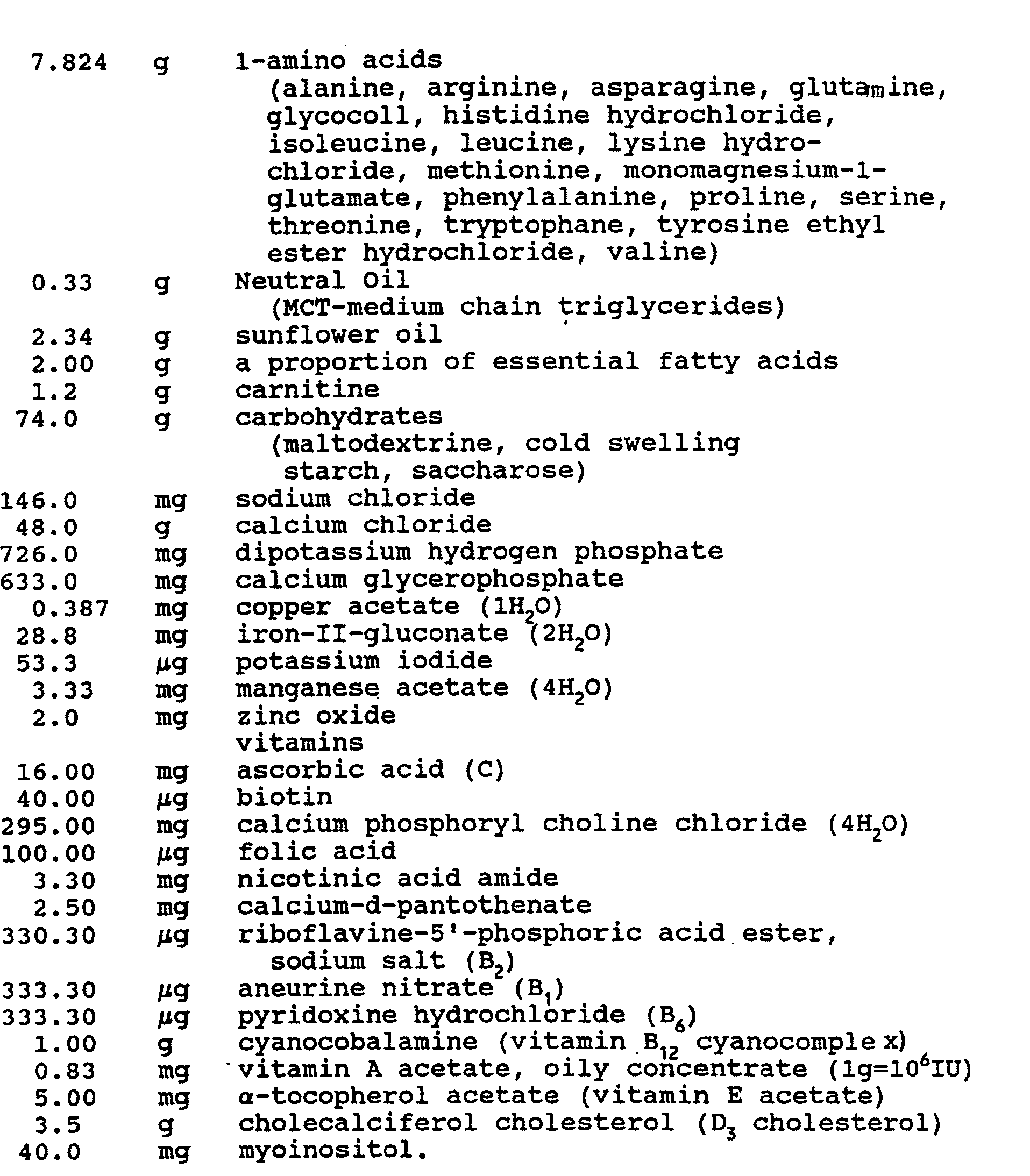
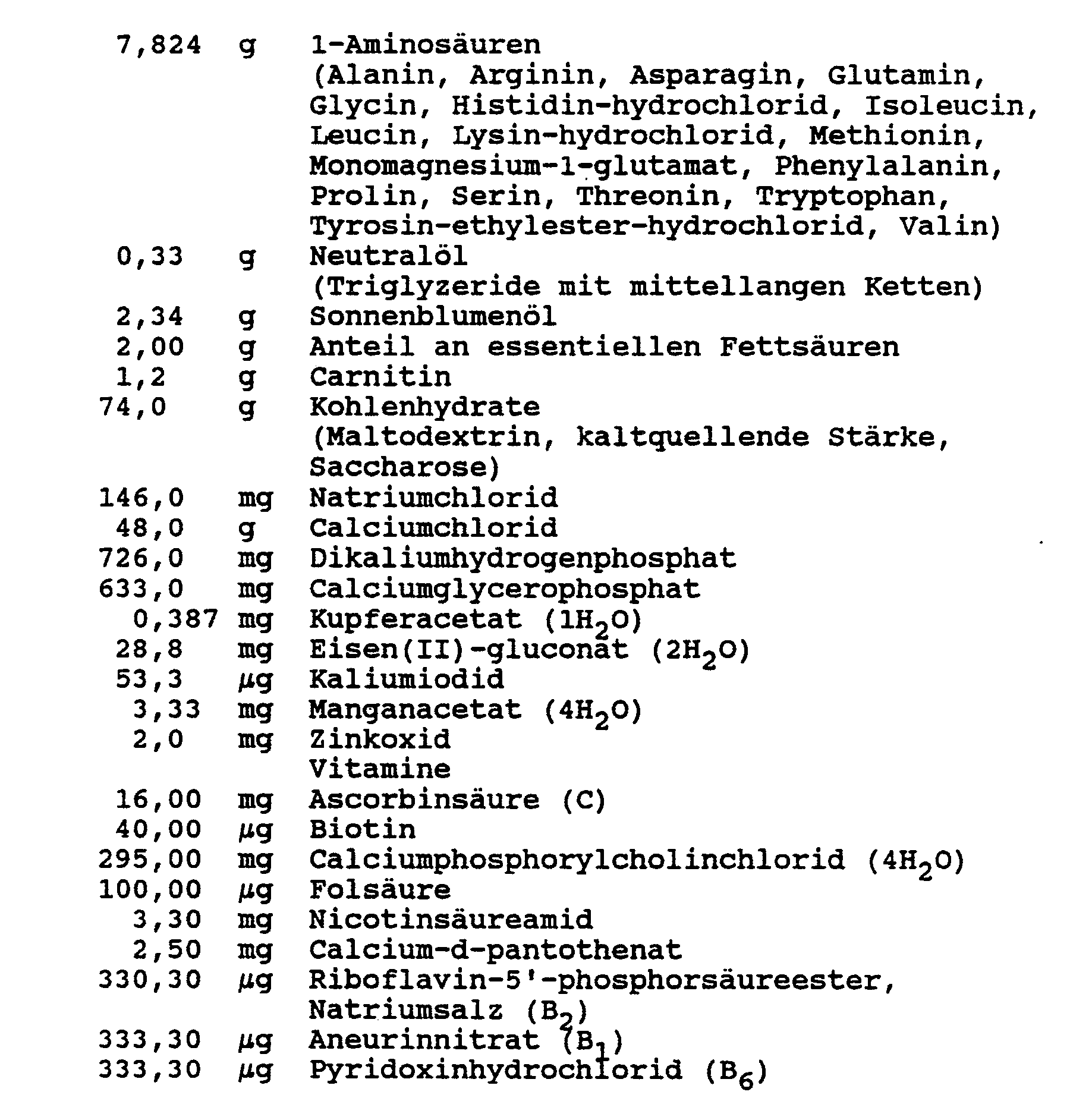
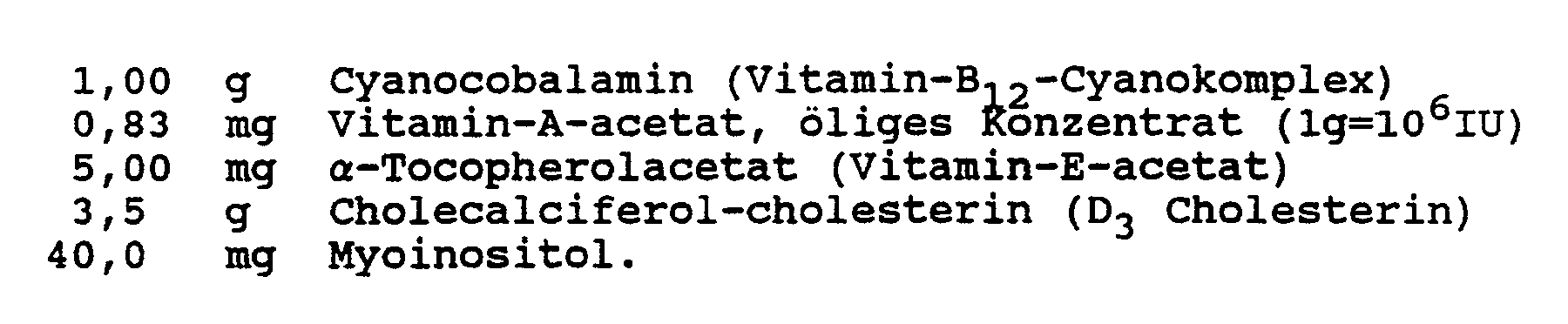
[0006] The present invention has been accomplished on the basis of these new findings and relates to a preparation of active form of vitamin D₃ that is stabilized by the addition of a neutral or basic amino acid containing no sulfur atom or acid amide group except the solid dietary mixture having the following composition:
as in GB-A-2052976.
[0007] Illustrative active forms of vitamin D₃ that are stabilized by the present invention include vitamin D₃ compounds having a hydroxyl group at 1α-position such as 1α-hydroxyvitamin D₃, 1α,24-dihydroxyvitamin D₃, 1α,25-dihydroxyvitamin D₃, 1α,24,25-trihydroxyvitamin D₃ and 26,27-hexafluoro-1α,25-dihydroxyvitamin D₃, as well as those which contain no 1α-hydroxyl group such as 24-hydroxyvitamin D₃ and 25-hydroxyvitamin D₃.
[0008] Illustrative amino acids that may be used as stabilizers in the present invention include neutral amino acids such as alanine, valine, proline, phenylalanine, tryptophan, leucine, isoleucine, glycine and serine, and basic amino acids such as lysine, arginine and histidine. The desired stabilizing effects are also exhibited by substances that have these amino acid portions in their structures and examples of such substances are N-glycylglycine having the glycine portion, and glycylalanine having the alanine portion.
[0009] In the practice of the present invention, the amount of the amino acid added to a specific active form of vitamin D₃ is in no way limited to any particular value and the amino acid may be used in any amount that will exhibit the intended effect upon incorporation into the active form of vitamin D₃. Usually, the amino acid is added in an amount ranging from 1 to 100,000 times the weight of the active form of vitamin D₃. In case of a liquid preparation, the amino acid is preferably used in an amount 10 - 500 times the weight of the active form of vitamin D₃; in case of a solid preparation, a preferred amount ranges from 5,000 to 50,000 times the weight of the active form of vitamin D₃. Two or more of the amino acids defined above may be employed.
[0010] In order to make a liquid preparation in accordance with the present invention using an aqueous medium, the active form of vitamin D₃ is solubilized with a nonionic surfactant and the stabilizer amino acid is then dissolved in the solution. If desired, pharmaceutically acceptable additives that will not adversely affect the stability of the active form of vitamin D₃ may be added, and they include, for example, isotonizers, buffers, flavorings, preservatives, pH modifiers and thickeners; the so prepared mixture may then be worked up into injections, syrups, emulsions or cream by routine procedures.
[0011] The concept of the present invention is also applicable to the making of solid preparations; in this case, the active form of vitamin D₃ is rendered compatible with the stabilizer amino acid most preferably by dispersing a predetermined amount of the amino acid directly in an alcoholic solution or an oily solution of the active form of vitamin D₃. The resulting mixture of the active form of vitamin D₃ and the amino acid may then be blended with an excipient, binder, disintegrator, lubricant, ointment base or a suppository base, followed by working up into tablets, granules, powders, capsules, ointments or suppositories in accordance with the usual practice.
[0012] The so obtained preparation of an active form of vitamin D₃ exhibits excellent stability with time, as will be described in greater detail by the following examples which are in no way intended as limiting the scope of the present invention.
Example 1
[0013] In 1 ml of an alcoholic solution containing 200 µg/ml of 1α-hydroxyvitamin D₃, 20 mg of polyoxyethylene (60 mole) hydrogenated castor oil derivative (Nikkol HCO-60) was dissolved. After addition of 40 mg of stabilizer arginine and 10 g of glucose (isotonizer), the mixture was diluted in distilled water for injection to make a total of 200 ml. The solution was passed through a membrane filter and charged into nitrogen-purged ampules in 2-ml portions. The ampules were fused and sterilized at 110°C for 30 minutes, thereby preparing injections each containing 2 µg of 1α-hydroxyvitamin D₃ in one ampule.
[0014] Stabilizer-free samples were prepared by repeating the same procedures and compared with the samples of the present invention for the stability of 1α-hydroxyvitamin D₃ by determining its quantities by HPLC both immediately after the preparation and after acceleration testing. The results are shown in Table 1, wherein each of the figures represents the percentage of residual 1α-hydroxyvitamin D₃ as a relative value with the level for the unsterilized sample being taken as 100.
Example 2
[0015] In 2 ml of an alcoholic solution containing 100 µg/ml of 1α,25-dihydroxyvitamin D₃, 60 mg of polyoxyethylene (50 mole) hydrogenated castor oil derivative (Nikkol HCO-50) was dissolved. After addition of 60 mg of stabilizer proline, the mixture was diluted in purified water to make a total of 400 ml. The solution was charged into glass vials in 20-ml portions. The vials were purged with argon gas and stoppered to make solutions each containing 0.5 µg/ml of 1α,25-dihydroxyvitamin D₃. A stabilizer-free sample was prepared as in Example 1. The results of a stability test conducted with the two kinds of samples are shown in Table 2, wherein each of the figures represents the percentage of residual 1α,25-dihydroxyvitamin D₃ as a relative value with the level for the solution just after preparation being taken as 100.
Example 3
[0016] In 5 ml of an alcoholic solution containing 100 µg of 26,27-hexafluoro-1α,25-dihydroxyvitamin D₃, 50 mg of polyoxyethylene (100 mole) hydrogenated castor oil derivative (Nikkol HCO-100) was dissolved. After addition of 100 mg of stabilizer alanine and 70 g of refined sucrose (sweetener), the mixture was diluted in purified water to make a total of 1,000 ml. The solution was charged into glass vials in 20-ml portions. The vials were purged with nitrogen gas and stoppered to make syrups each containing 0.5 µg/ml of 26,27-hexafluoro-1α,25-dihydroxyvitamin D₃. A stabilizer-free sample was prepared as in Example 1. The results of a stability test conducted with the two kinds of samples are shown in Table 3, wherein each of the figures represents the percentage of residual 26,27-hexafluoro-1α,25-dihydroxyvitamin D₃ as a relative value with the level for the sample just after preparation being taken as 100.
Example 4
[0017] In an alcoholic solution containing 200 µg of 24-hydroxyvitamin D₃, 20 mg of polyoxyethylene (60 mole) hydrogenated castor oil derivative (Nikkol HCO-60) was dissolved. After addition of 40 mg of stabilizer valine, the mixture was diluted in distilled water to make a total of 200 ml. The solution was charged into glass vials in 20-ml portions. The vials were purged with argon gas and stoppered to make solutions each containing 1 µg/ml of 24-hydroxyvitamin D₃. A stabilizer-free sample was prepared as in Example 1. The results of a stability test conducted with the two kinds of samples are shown in Table 4, wherein each of the figures represents the percentage of residual 24-hydroxyvitamin D₃ as a relative value with the level for the sample just after preparation being taken as 100.
Example 5
[0018] To 200 g of glycine, 50 ml of an alcoholic solution containing 2 µg of 1α-hydroxyvitamin D₃, was slowly added under agitation. Alcohol was evaporated from the intimate mixture, thereby producing a powder containing 0.5 µg/ml of 1α-hydroxyvitamin D₃. A control sample was prepared as above except that glycine was replaced by lactose. The results of a stability test conducted with the two powders are shown in Table 5, wherein each of the figures represents the percentage of residual 1α-hydroxyvitamin D₃ as a relative value with the level for the powder just after preparation being taken as 100.
Example 6
[0019] Histidine (150 g) was intimately mixed with 10 g of a middle-chain aliphatic acid triglyceride solution containing 500 µg/g of 1α,25-dihydroxyvitamin D₃. The slurry was mixed with 287.5 g of anhydrous lactose (excipient) and 2.5 g of magnesium stearate (lubricant). Using a die (6 mmφ), tablets each weighing 90 mg and containing 1 µg of 1α,25-dihydroxyvitamin D₃ were prepared. Control tablets were prepared as above except that histidine was replaced by anhydrous lactose. The results of a stability test conducted with the two powders are shown in Table 6, wherein each of the figures represents the percentage of residual 1α,25-dihydroxyvitamin D₃ as a relative value with the level for the powder just after preparation being taken as 100.
Example 7
[0020] Phenylalanine (20 g) was mixed under warming with 150 g of polyoxyethylene monostearate containing 10 µg/g of 1α,24,25-trihydroxyvitamin D₃. To the mixture, 330 g of macrogol ointment (Japanese Pharmacopoeia) was added in small portions to provide a homogeneous texture, thereby making an ointment containing 3 µg/g of 1α,24,25-trihydroxyvitamin D₃. A stabilizer-free sample was prepared as above except that phenylalanine was replaced by mannitol. The results of a stability test conducted with the two kinds of samples are shown in Table 7, wherein each of the figures represents the percentage of residual 1α,24,25-trihydroxyvitamin D₃ as a relative value with the level for the ointment just after preparation being taken as 100.
1. A preparation containing an active form of vitamin D₃ stabilized by incorporation
of an amino acid that is neither one containing a sulfur atom or an acid amide group
in its structure, nor an acidic amino acid nor a salt of a basic amino acid, except
the solid dietary mixture having the following composition:
2. A preparation according to Claim 1 wherein said amino acid is at least one
neutral amino acid such as alanine, valine, proline, phenylalanine, tryptophan, leucine, isoleucine, glycine and serine, or a basic amino acid such as lysine, arginine and histidine.
neutral amino acid such as alanine, valine, proline, phenylalanine, tryptophan, leucine, isoleucine, glycine and serine, or a basic amino acid such as lysine, arginine and histidine.
3. A preparation according to Claim 1 wherein said active form of vitamin D₃ is
1α-hydroxyvitamin D₃, 1α,24-dihydroxyvitamin D₃, 1α,25-dihydroxyvitamin D₃, 1α,24,25-trihydroxyvitamin D₃, 26,27-hexafluoro-1α,25-dihydroxyvitamin D₃, 24-hydroxyvitamin D₃, or 25-hydroxyvitamin D₃.
1α-hydroxyvitamin D₃, 1α,24-dihydroxyvitamin D₃, 1α,25-dihydroxyvitamin D₃, 1α,24,25-trihydroxyvitamin D₃, 26,27-hexafluoro-1α,25-dihydroxyvitamin D₃, 24-hydroxyvitamin D₃, or 25-hydroxyvitamin D₃.
1. Préparation contenant une forme active de vitamine D₃ stabilisée par incorporation
d'un amino-acide qui n'est ni un amino-acide contenant un atome de soufre ou un groupe
amide d'acide dans sa structure, ni un amino-acide acide, ni un sel d'un amino-acide
basique, à l'exception du mélange diététique solide ayant la composition suivante
:
7,824 g de 1-amino-acides
(alanine, arginine, asparagine, glutamine, glycocolle, chlorhydrate d'histidine, isoleucine, leucine, chlorhydrate de lysine, méthionine, 1-glutamate monomagnésique, phénylalanine, proline, sérine, thréonine, tryptophane, chlorhydrate d'ester éthylique de tyrosine, valine),
0,33 g d'Huile Neutre
(triglycérides à chaîne moyenne TCM),
2,34 g d'huile de tournesol,
2,00 g d'une proportion d'acides gras essentiels,
1,2 g de carnitine,
74,0 g d'hydrates de carbone
(maltodextrine, amidon gonflant à froid, saccharose),
146,0 mg de chlorure de sodium,
48,0 g de chlorure de calcium,
726,0 mg d'hydrogénophosphate dipotassique,
633,0 mg de glycérophosphate de calcium,
0,387 mg d'acétate de cuivre (1H₂O),
28,8 mg de gluconate de fer-II (2H₂O),
53,3 µg d'iodure de potassium,
3,33 mg d'acétate de manganèse (4H₂O),
2,0 mg d'oxyde de zinc
vitamines,
16,00 mg d'acide ascorbique (C),
40,00 µg de biotine,
295,00 mg de chlorure de phosphorylcholine calcique (4H₂O),
100,00 µg d'acide folique,
3,30 mg d'amine d'acide nicotinique,
2,50 mg de d-pantothénate de calcium,
330,30 µg du sel de sodium d'ester 5'-phosphorique de riboflavine (B₂),
333,30 µg de nitrate d'aneurine (B₁),
333,30 µg de chlorhydrate de pyridoxine (B₆),
1,00 g de cyanocobalamine (complexe cyané, vitamine B₁₂),
0,83 mg d'acétate de vitamine A, concentré huileux (1 g = 10⁶UI),
5,00 mg d'acétate de α-tocophérol (acétate de vitamine E),
3,5 g de cholécalciférol-cholestérol (D₃-cholestérol),
40,0 mg de méso-inositol.
7,824 g de 1-amino-acides
(alanine, arginine, asparagine, glutamine, glycocolle, chlorhydrate d'histidine, isoleucine, leucine, chlorhydrate de lysine, méthionine, 1-glutamate monomagnésique, phénylalanine, proline, sérine, thréonine, tryptophane, chlorhydrate d'ester éthylique de tyrosine, valine),
0,33 g d'Huile Neutre
(triglycérides à chaîne moyenne TCM),
2,34 g d'huile de tournesol,
2,00 g d'une proportion d'acides gras essentiels,
1,2 g de carnitine,
74,0 g d'hydrates de carbone
(maltodextrine, amidon gonflant à froid, saccharose),
146,0 mg de chlorure de sodium,
48,0 g de chlorure de calcium,
726,0 mg d'hydrogénophosphate dipotassique,
633,0 mg de glycérophosphate de calcium,
0,387 mg d'acétate de cuivre (1H₂O),
28,8 mg de gluconate de fer-II (2H₂O),
53,3 µg d'iodure de potassium,
3,33 mg d'acétate de manganèse (4H₂O),
2,0 mg d'oxyde de zinc
vitamines,
16,00 mg d'acide ascorbique (C),
40,00 µg de biotine,
295,00 mg de chlorure de phosphorylcholine calcique (4H₂O),
100,00 µg d'acide folique,
3,30 mg d'amine d'acide nicotinique,
2,50 mg de d-pantothénate de calcium,
330,30 µg du sel de sodium d'ester 5'-phosphorique de riboflavine (B₂),
333,30 µg de nitrate d'aneurine (B₁),
333,30 µg de chlorhydrate de pyridoxine (B₆),
1,00 g de cyanocobalamine (complexe cyané, vitamine B₁₂),
0,83 mg d'acétate de vitamine A, concentré huileux (1 g = 10⁶UI),
5,00 mg d'acétate de α-tocophérol (acétate de vitamine E),
3,5 g de cholécalciférol-cholestérol (D₃-cholestérol),
40,0 mg de méso-inositol.
2. Préparation selon la revendication 1, dans laquelle ledit amino-acide est au moins
un amino-acide neutre tel que l'alanine, la valine, la proline, la phénylalanine,
le tryptophane, la leucine, l'isoleucine, la glycine et la sérine, ou un amino-acide
basique tel que la lysine, l'arginine et l'histidine.
3. Préparation selon la revendication 1, dans laquelle ladite forme active de vitamine
D₃ est la 1α-hydroxyvitamine D₃, la 1α,24-dihydroxyvitamine D₃, la 1α,25-dihydroxyvitamine
D₃, la 1α,24,25-trihydroxyvitamine D₃, la 25,27-hexafluoro-1α,25-dihydroxyvitamine
D₃, la 24-hydroxyvitamine D₃ ou la 25-hydroxyvitamine D₃.
1. Zubereitung, die eine aktive Form des Vitamins D₃ enthält und stabilisiert ist durch
einen Gehalt einer Aminosäure, die weder ein Schwefelatom noch eine Säureamidgruppe
in ihrer Struktur aufweist, und auch keine saure Aminosäure oder das Salz einer basischen
Aminosäure ist, ausgenommen das feste Nahrungsmittelgemisch der folgenden Zusammensetzung:
2. Zubereitung nach Anspruch 1, wobei die Aminosäure mindestens eine neutrale Aminosäure,
wie Alanin, Valin, Prolin, Phenylalanin, Tryptophan, Leucin, Isoleucin, Glycin und
Serin, oder eine basische Aminosäure, wie Lysin, Arginin und Histidin, ist.
3. Zubereitung nach Anspruch 1, wobei die aktive Form des Vitamins D₃
1α-Hydroxyvitamin D₃, 1α,24-Dihydroxyvitamin D₃, 1α,25-Dihydroxyvitamin D₃, 1α,24,25-Trihydroxyvitamin D₃, 26,27-Hexafluor-1α,25-Dihydroxyvitamin D₃, 24-Hydroxyvitamin D₃ oder 25-Hydroxyvitamin D₃ ist.
1α-Hydroxyvitamin D₃, 1α,24-Dihydroxyvitamin D₃, 1α,25-Dihydroxyvitamin D₃, 1α,24,25-Trihydroxyvitamin D₃, 26,27-Hexafluor-1α,25-Dihydroxyvitamin D₃, 24-Hydroxyvitamin D₃ oder 25-Hydroxyvitamin D₃ ist.