| (19) |
 |
|
(11) |
EP 0 192 102 B1 |
| (12) |
EUROPEAN PATENT SPECIFICATION |
| (45) |
Mention of the grant of the patent: |
|
11.12.1991 Bulletin 1991/50 |
| (22) |
Date of filing: 31.01.1986 |
|
| (51) |
International Patent Classification (IPC)5: H01R 43/055 |
|
| (54) |
Device for applying terminals and similar metal elements to conductors, lengths of
elastic material and the like
Vorrichtungen für das Anbringen von Anschlusselementen und ähnlichen metallischen
Elementen an Leitern, Längen aus elastischem Material und dergleichen
Dispositifs pour appliquer des bornes et éléments métalliques similaires à des conducteurs,
des longueurs de matériau élastique et semblables
|
| (84) |
Designated Contracting States: |
|
AT BE CH DE FR GB LI LU NL SE |
| (30) |
Priority: |
21.02.1985 IT 1959785
|
| (43) |
Date of publication of application: |
|
27.08.1986 Bulletin 1986/35 |
| (73) |
Proprietor: SIAC
INDUSTRIA ACCESSORI CAVARIA S.p.A. |
|
I-21044 Cavaria
Varese (IT) |
|
| (72) |
Inventor: |
|
- Vaglini, Franco
I-21013 Gallarate
(Varese) (IT)
|
| (74) |
Representative: Luksch, Giorgio, Dr.-Ing. et al |
|
Ing. A. Giambrocono & C. S.r.l.
Via Rosolino Pilo, 19/b
20129 Milano
20129 Milano (IT) |
| (56) |
References cited: :
US-A- 3 239 924
|
US-A- 3 766 625
|
|
| |
|
|
|
|
| |
|
| Note: Within nine months from the publication of the mention of the grant of the European
patent, any person may give notice to the European Patent Office of opposition to
the European patent
granted. Notice of opposition shall be filed in a written reasoned statement. It shall
not be deemed to
have been filed until the opposition fee has been paid. (Art. 99(1) European Patent
Convention).
|
[0001] This invention relates to a device for applying terminals and similar metal elements
to conductors, lengths of elastic material and other filiform bodies, starting from
a strip composed of an interconnected succession of such elements. More precisely,
the invention relate to an applicator device of the type provided with a controllable
mobile head carrying tools for detaching an element from the strip and applying it
to the end of the filiform body, strip feed means driven by the movement of the head
by way of a cam and comprising a pawl and a roller cooperating with said cam, and
means for adjusting the feed and the point of commencement of the feed so as to enable
the device to operate on metal elements of different shapes and dimensions.
[0002] In these applicators, the adjustment and feed means are relatively complicated as
they are formed from several members, they require the use of two springs (one acting
on the pawl and the other maintaining the roller in contact with the cam), and generally
are not completely reliable. Such a device is known from US-A-3239 924
[0003] The main object of the present invention is to improve applicator devices of the
aforesaid type so as to make them more simple and reliable.
[0004] This and further objects which will be more apparent from the detailed description
given hereinafter are attained by a device characterised in that in the feed means
the pawl, which is spring-loaded, is supported at one end of a lever of adjustable
fulcrum, the other end of which is hinged in an adjustable position to slider means
carrying the roller, said adjustable fulcrum forming part of the feed adjustment means,
and said hinge of adjustable position forming part of the means for adjusting the
feed commencement point.
[0005] In a preferred embodiment of the invention, in the feed adjustment means the fulcrum
is mounted on a rotatable arm which can be locked in different angular positions,
said fulcrum penetrating into an elongated hole of the lever.
[0006] According to the preferred embodiment, in the means for adjusting the feed commencement
point, the position of the hinge is made adjustable by disposing this latter on a
straight pin which is mobile relative to a mobile guide member carrying the roller,
said straight pin and said guide member forming part of the said slider means. According
to a particular aspect of the invention, an abutment element, acting on the guide
member and movable along the straight pin, adjusts the position of this latter relative
to the guide member and transmits the thrust of the said spring to the roller.
[0007] The invention will be more apparent from the detailed description of a preferred
embodiment given hereinafter by way of non-limiting example with reference to the
accompanying drawing, in which:
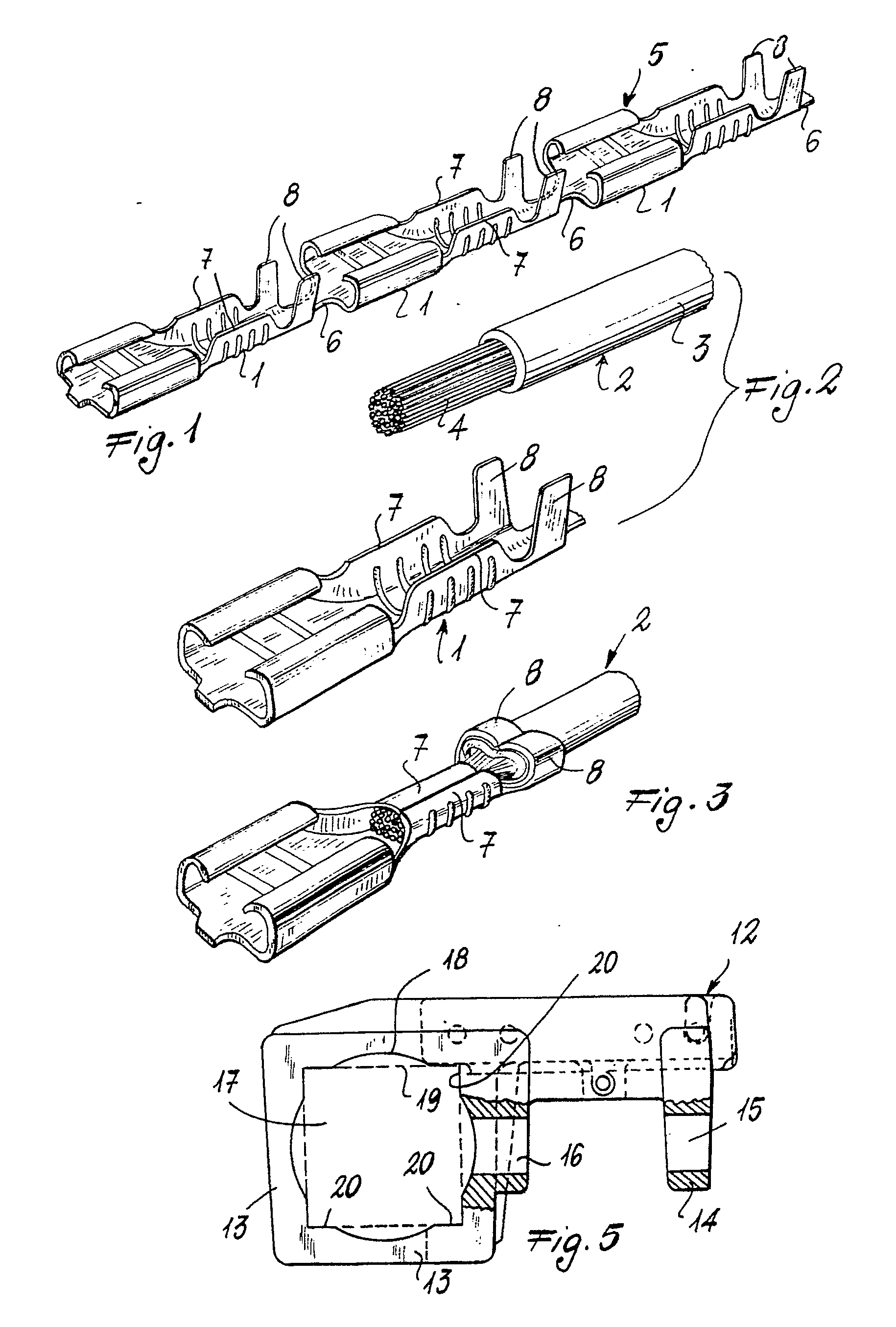
Figure 1 is a perspective view of a strip of terminals to be fixed, for example, to
the end of a conductor as shown in Figures 2 and 3, these figures being only explanatory
in scope;
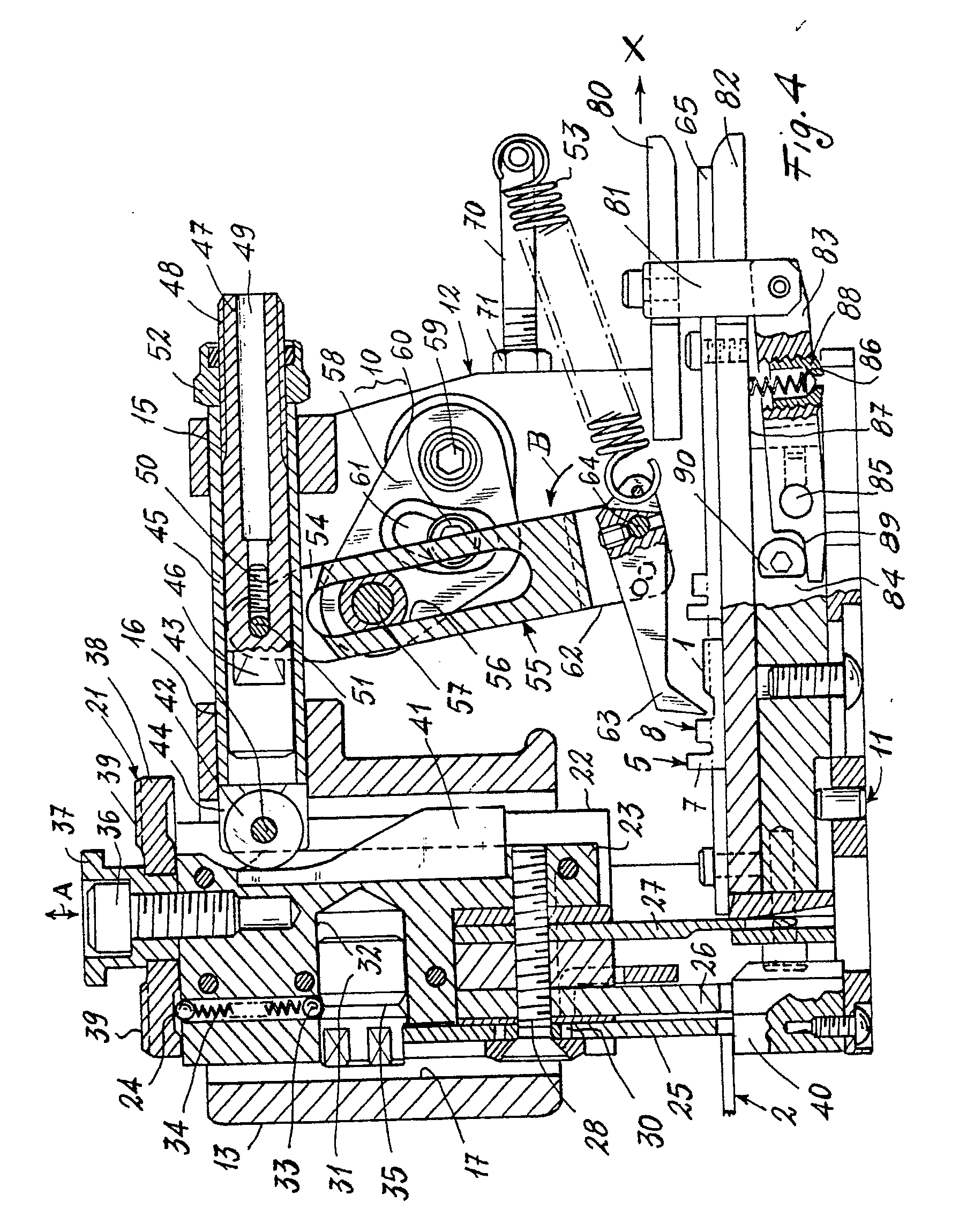
Figure 4 is a longitudinal vertical section through the device of the invention, with
some parts shown in full view; and
Figure 5 is a plan view of the frame of the device.
[0008] The purpose of the device according to the invention is to apply a metal terminal
1, for example of the type shown in Figures 1, 2 and 3, to the end of an electric
cable 2 comprising a sheath 3 surrounding the conjuctor 4, which projects from the
ends of the sheath. The terminal is detached from the strip 5 at the point where the
terminals are connected together in succession by connection pieces 6. For its fixing
to the cable 2, the terminal comprises two pairs of raised lugs 7, 8 of different
height which are bent over against the sheath and, respectively, against the conductor
by the device of the invention.
[0009] For this purpose, the device of the invention comprises a stationary structure 10
formed from a base 11 and frame 12 connected to said base and extending along one
side thereof. The frame 12 upperly comprises, projecting above the base 11, an annular
part 13 with its axis perpendicular to said base, and a jutting part 14 traversed
by a cylindrical bore 15 with its axis forming a right angle with the preceding. This
bore is aligned with a corresponding bore 16 which passes through a wall of the ring
13 and opens into the bore 17 of this latter. The cross-section of the bore 17 is
such as is ideally obtained by the intersection of a circle 8 with a square 19 where
these are coaxial. The right-angled corners 20 serve as a vertical guide for a working
head 21 having a cross-section corresponding to that of the square 19. The working
head comprises three vertical side-by-side plates connected together. The two outer
plates are substantially equal and one of them is visible in Figure 4, where it is
indicated by 22. The intermediate plate is indicated by 23. These plates are kept
joined together by screws 24.
[0010] The intermediate plate 23 carries conventional tools 25, 26, 27, used respectively
for bending the terminal lugs 7, 8 down and detaching the terminal from the connection
piece. They are removaly secured in place by a screw 28. The tool 25, in particular,
comprises an elongated hole 30 to allow height-adjustment of the tool by means of
a cam 31. This cam is mounted rotatably in a bore 32 of the intermediate plate 23,
in which it is retained by a ball 33 loaded by a spring 34 and lying in an annular
groove 35 of the cam. This latter acts on the end of the tool 25.
[0011] A flanged socket 37 and a disc 38 comprising a series of radially distributed steps
39 of different height are fixed to the top of the intermediate plate 23 by a screw
36. The socket is used to connect the working head 21 in known manner to a press or
double-acting cylinder-piston unit which drives the head in the direction of the arrow
A. Again in known manner, the disc 38 serves to adjust the extent to which the terminal
lugs 7, 8 are bent over, these lugs cooperating for this purpose, in known manner,
with a conventional anvil 40 fixed to the base 11.
[0012] A cam 41 is removably fixed by screws, not shown, to that side of the intermediate
plate facing the bore 16.
[0013] A roller 42 presses against the cam 41. The roller 42 is rotatably mounted on a pin
43 supported at its ends by the arms of a fork 44 formed at the end of a tubular slider
45. This slider is slidably mounted in the bores 15 and 16 of the frame 12, and comprises
two aligned apertures 46 in an intermediate position. A straight pin 47 threaded at
one end at 48 is movably mounted in the slider 45, and is provided with an axial bore
49 threaded at its inner end where a socket head screw 50 locks a transverse pivot
51 which projects from both sides of the straight pin 47 and through the apertures
46 of the slider 45. A nut 52 is screwed onto the threaded part 48 of the straight
pin and presses against the right hand end (with reference to Figure 4) of the slider
45 under the thrust of a spring 53, which is described hereinafter.
[0014] The forked end 54 of a lever 55 is hinged to the pivot 51. The lever comprises an
axial slot 56 through which a pivot 57 penetrates. The pivot 57 projects from an arm
58 which is hinged at 59 to the frame 12. The arm can be locked in different angular
positions by a screw 60, which is screwed into the frame, its shank passing through
an arcuate aperture 61 in the arm.
[0015] The lever 55 terminates lowerly in a fork at 62, where it supports a pawl 63 mounted
rotatably on a pivot 64. This pawl is subjected to the action of the said tension
spring 53, which exerts a moment tending to cause it to rotate in the direction of
the arrow B, ie towards the strip 5 disposed in a guide 65 (formed from two spaced-apart
fillets) present on the base 11. The spring 53 is hooked to the free end of an arm
70 which is bent at a right angle and is screwed into a bore in the frame 12, and
locked by the nut 71. This enables the spring tension and the moment tending to rotate
the pawl 63 in the direction of the arrow B to be adjusted. In order to adjust this
moment, it is necessary only to rotate the arm 70. As is apparent, the spring 53 exerts
a moment in the direction of the arrow B on the lever 55, so that the nut 52, by acting
on the right-hand end of the slider 45, forces the roller 42 against the cam 41.
[0016] In Figure 4, the head 21 is in its lower limiting position in which its tools 25,
26, 27 have detached the terminal 1 and applied it to the cable 2 (Figures 1, 2, 3).
The pawl 63 is applied against the lower lugs 7 of a terminal 1 of the strip 5.
[0017] The working head 21 is raised together with its tools and with the cam 41. On being
raised, the cam causes the roller 42 and thus the slider 45 to move towards the right
(with reference to Figure 4). The slider moves the nut 52 and thus also the straight
pin 47 in the same direction. The movement of the straight pin results in the rotation
of the lever 55 about the pivot 57. This rotation, which takes place in the opposite
direction to the arrow B, causes the strip 5 to advance through one step, ie by a
distance approximately equal to the length of one terminal, so that a new terminal
arrives under the tools 25, 26, 27.
[0018] The operator inserts the cable 2 into this new terminal. The head 21 is then lowered.
By virtue of the force exerted by the spring 53, the roller 42 follows the cam 41,
and the movements described heretofore take place in the reverse direction. The pawl
63 slides along the strip 5 and moves into its new operating position. To prevent
the strip 5 being dragged backwards, ie in the direction of the arrow X during the
rearward movement of the pawl, a braking device is provided comprising a plate 80
which presses on the strip and is fixed by a screw to an inverted U-piece 81. The
arms of the U-piece embrace a narrow part 82 of the base 11 and are hinged to a lever
83. This lever is situated in a chamber 84 within the base, to which it is hinged
by a pivot 85 counted in the base. A spring 86 acts between the upper wall 87 of the
chamber 84 and a bush 88 screwed into the lever 83. This spring tends to rotate the
lever 83 in such a manner as to apply the braking plate 80 against the strip. A manually
rotatable cam 90 comprising a circular and a flat contour part acts against the reduced-height
end 89 of the lever 83. The plate 80 is in its braking position only when the flat
part of the cam acts on the lever 83.
1. Device for applying terminals (1) and similar metal elements to conductors (2), to
lengths of elastic material and to other filiform bodies, starting from a strip (5)
composed of an interconnected succession of such elements, said devices comprising
a load-bearing structured (10), a controllable mobile head (21) carrying tools (25,26,27)
for detaching an element (1) from the strip (5) and applying it to the end of the
filiform body (2), strip feed means (63) driven by the movement of the head by way
of a cam (41) and comprising a roller (42) cooperating with said cam, and means (58,59,60,61)
for adjusting the feed and means (47,52) for adjusting the point of commencement of
the feed, whereby a pawl (63) in the feed means which pawl is loaded by a spring (53),
is mounted on a lever (55) which has an adjustable fulcrum (57) and is hinged (at
51) to slider means (45, 47, 52) carrying the roller (42), characterised by that said
adjustable fulcrum (37) is forming part of the feed adjustment means (58, 59, 60,
61); and said hinge (51) of adjustable position is forming part of the means (47,
52) for adjusting the feed commencement point.
2. Device as claimed in claim 1, characterised in that in the feed adjustment means (58,
59, 60, 61), the fulcrum (57) is mounted on a rotatable arm (58) which can be locked
in different angular positions, said fulcrum (57) penetrating into an elongated hole
(56) of the lever (55).
3. Device as claimed in claim 1, characterised in that in the means (47, 52) for adjusting
the feed commencement point, the position of the hinge (51) is made adjustable by
disposing this latter on a straight pin (47) which is mobile relative to a mobile
guide member (45) carrying the roller (42), said straight pin (47) and said guide
member (45) forming part of the slider means.
4. Device as claimed in one or more of the preceding claims, characterised in that an
abutment element (52), acting on the guide member (45) and movable along the straight
pin (47), adjusts the position of this latter relative to the former and transmits
the thrust of the spring (53) to the roller (42).
5. Device as claimed in one or more of the preceding claims, characterised in that the
tension of the spring (53) is adjustable.
6. Device as claimed in one or more of the preceding claims, characterised in that the
straight pin (47) is mounted inside the guide member (45), which comprises apertures
(46) through which the hinge (51) for the lever (55) is formed.
7. Device as claimed in claim 6, characterised in that the guide member (45) is slidably
mounted in supports (15, 16) of the load-bearing structure (10).
8. Device as claimed in one or more of the preceding claims, characterised in that the
load-bearing structure (10) comprises a projecting annular part (13) defining a guide
bore (17) having a cross-section ideally formed by the intersection of a circle (18)
with a rectangle or square (19).
9. Device as claimed in claim 8, characterised in that the roller (42), cooperating with
the cam (41) mounted in the head (21), penetrates into the bore (17).
10. Device as claimed in claim 1, characterised in that the head (21) comprises a block
of side-by-side plates (22, 23), of which the intermediate plate (23) carries the
cam (41).
11. Device as claimed in claim 1, characterised in that a can (31) for adjusting one of
the tools (25) is mounted in the head (21).
12. Device as claimed in one or more of the preceding claims, characterised by comprising
excludable braking means (80; 81, 83, 86) acting on the strip (5).
13. Device as claimed in claim 12, characterised in that the braking means comprise a
braking plate (80) hinge-supported by a lever (83) loaded by a spring (86).
14. Device as claimed in claim 13, characterised in that a manually controlled cam (90)
excludes or engages the braking means by acting on the lever (83).
1. Dispositif pour appliquer des bornes (1) et éléments métalliques similaires à des
conducteurs (2), à des longueurs de matière élastique et à d'autres corps filiformes,
en partant d'une bande (5) composée d'un chapelet de ces éléments, ces dispositifs
comprenant une structure de support de charge (10), une tête mobile contrôlable (21)
portant des outils (25, 26, 27) pour détacher un élément (1) de la bande (5) et l'appliquer
à l'extrémité du corps filiforme (2), un moyen d'amenage de la bande (63) commandé
par le mouvement de la tête au moyen d'une came (41) et comprenant un galet (42) coopérant
avec cette came, et un moyen (58, 59, 60, 61) pour régler l'avance et un moyen (47,
52) pour régler le point de départ de l'avance, par lequel un cliquet (63) dans le
moyen d'avance, cliquet qui est monté sur ressort (53) est monté sur un levier (55)
qui a un pivot réglable (57) et est articulé (en 51) par rapport à un moyen de coulissement
(45, 47, 52) portant le galet (42), caractérisé en ce que ce pivot réglable (57) fait
partie du moyen de réglage de l'avance (58, 59, 60, 61) ; et cette articulation (51)
dont la position est réglable fait partie du moyen (47, 52) pour le réglage du point
de départ de l'avance.
2. Dispositif suivant revendication 1, caractérisé en ce que, dans le moyen de réglage
de l'avance (58, 59, 60, 61), le pivot (57) est monté sur un bras tournant (58) qui
peut être bloqué à différentes positions angulaires, ce pivot (57) pénétrant dans
un trou oblong (56) du levier (55).
3. Dispositif suivant revendication 1, caractérisé en ce que, dans le moyen (47, 52)
pour le réglage du point de départ de l'avance, la position de l'articulation (51)
est rendue réglable en disposant cette dernière sur un axe droit (47) qui est mobile
par rapport à un élément de guidage mobile (45) portant le galet (42), cet axe droit
(47) et l'élément de guidage (45) faisant partie du moyen de coulissement.
4. Dispositif suivant une ou plusieurs des revendications précédentes, caractérisé en
ce qu'un élément de butée (52), agissant sur l'élément de guidage (45) et mobile le
long de l'axe droit (47), règle la position de ce dernier par rapport au premier et
transmet la poussée du ressort (53) au galet (42).
5. Dispositif suivant une ou plusieurs des revendications précédentes, caractérisé en
ce que la tension du ressort (53) est réglable.
6. Dispositif suivant une ou plusieurs des revendications précédentes, caractérisé en
ce que l'axe droit (47) est monté à l'intérieur de l'élément de guidage (45), qui
comprend des ouvertures (46) par lesquelles l'articulation (51) pour le levier (55)
est formée.
7. Dispositif suivant revendication 6, caractérisé en ce que l'élément de guidage (45)
est monté avec coulissement dans des supports (15, 16) de la structure de support
de charge (10).
8. Dispositif suivant une ou plusieurs des revendications précédentes, caractérisé en
ce que la structure de support de charge (10) comprend une partie annulaire en saillie
(13) définissant un alésage de guidage (17) ayant une section transversale formée
dans l'idéal par l'intersection d'un cercle (18) avec un rectangle ou un carré (19).
9. Dispositif suivant revendication 8, caractérisé en ce que le galet (42), coopérant
avec la came (41) montée dans la tête (21), pénètre dans l'alésage (17).
10. Dispositif suivant revendication 1, caractérisé en ce que la tête (21) comprend un
bloc de plaques (22, 23) juxtaposées, dont la plaque intermédiaire (23) porte la came
(41).
11. Dispositif suivant revendication 1, caractérisé en ce qu une came (31) pour régler
un des outils (25) est montée dans la tête (21).
12. Dispositif suivant une ou plusieurs des revendications précédentes, caractérisé en
ce qu'il comprend un moyen de freinage escamotable (80, 81, 83, 86) agissant sur la
bande (5).
13. Dispositif suivant revendication 12, caractérisé en ce que le moyen de freinage comprend
une plaque de freinage (80) supportée avec articulation par un levier (83) monté sur
un ressort (86).
14. Dispositif suivant revendication 13, caractérisé en ce qu'une came à commande manuelle
(90) met en ou hors service le moyen de freinage en agissant sur le levier (83).
1. Vorrichtung zum Anbringen von Anschlüssen (1) und ähnlichen metallischen Elementen
an Leitern (2), Längen aus elastischem Material und anderen fadenförmigen Körpern,
ausgehend von einem Streifen (5) aufeinanderfolgender und untereinander verbundener
derartiger Elemente, wobei die Vorrichtung eine tragende Struktur (10), einen steuerbar
beweglichen Kopf (21), welcher Werkzeuge (25, 26, 27) zum Abnehmen eines Elements
(1) von dem Streifen (5) und zum Anbringen des Elements an dem Ende des fadenförmigen
Körpers (2) trägt, eine Streifen-Zuführeinrichtung (63), welche durch die Bewegung
des Kopfes mittels einer Mitnehmerkurve (41) angetrieben wird und eine mit der Mitnehmerkurve
zusammenwirkende Rolle (42) aufweist, und Mittel (58, 59, 60, 61) zum Einstellen der
Zufuhr und Mittel (47, 52) zum Einstellen des Startpunkts der Zufuhr aufweist, wodurch
eine Klinke (63) in der Zufuhreinrichtung, welche Klinke durch eine Feder (53) belastet
ist, an einem Hebel (55) angebracht ist, welcher eine einstellbare Drehachse (57)
hat und an Gleiteinrichtungen (45, 47, 52), welche die Rolle (42) tragen, angelenkt
ist (bei 51), dadurch gekennzeichnet, daß die einstellbare Drehachse (57) einen Teil der Zufuhr-Einstelleinrichtung (58,
59, 60, 61) bildet; und daß das Gelenk (51) mit einstellbarer Position einen Teil
der Einrichtung (47, 52) zum Einstellen des Zufuhr-Startpunkts bildet.
2. Vorrichtung nach Anspruch 1, dadurch gekennzeichnet, daß in der Zufuhr-Einstelleinrichtung (58, 59, 60, 61) die Drehachse (57) an einem
drehbaren Arm (58) befestigt ist, welcher in verschiedenen Winkelpositionen feststellbar
ist, wobei die Drehachse (57) eine längliche Öffnung (56) des Hebels (55) durchdringt.
3. Vorrichtung nach Anspruch 1, dadurch gekennzeichnet, daß in der Einrichtung (47, 52) zum Einstellen des Zufuhr-Startpunkts die Position
des Gelenks (51) durch Anbringen des letzteren an einem geraden Zapfen (47) einstellbar
gemacht ist, welcher relativ beweglich zu einem beweglichen, die Rolle (42) tragenden
Führungsteil (45) ist, wobei der gerade Zapfen (47) und das Führungsteil (45) einen
Teil der Gleiteinrichtung bilden.
4. Vorrichtung nach einem oder mehreren der vorhergehenden Ansprüche, dadurch gekennzeichnet, daß ein Stopelement (52), welches auf das Führungsteil (45) stößt und entlang des
geraden Zapfens (47) beweglich ist, die Position des letzteren relativ zu dem ersteren
einstellt und die Kraft der Feder (53) auf die Rolle (42) überträgt.
5. Vorrichtung nach einem oder mehreren der vorhergehenden Ansprüche, dadurch gekennzeichnet, daß die Spannung der Feder (53) einstellbar ist.
6. Vorrichtung nach einem oder mehreren der vorhergehenden Ansprüche, dadurch gekennzeichnet, daß der gerade Zapfen (47) innerhalb des Führungsteils (45) angebracht ist, welches
Öffnungen (46) aufweist, durch die hindurchreichend das Gelenk (51) des Hebels (55)
gebildet ist.
7. Vorrichtung nach Anspruch 6, dadurch gekennzeichnet, daß das Führungsteil (45) gleitfähig in Trägern (15, 16) der tragenden Struktur
(10) angebracht ist.
8. Vorrichtung nach einem oder mehreren der vorhergehenden Ansprüche, dadurch gekennzeichnet, daß die tragende Struktur (10) ein hervorstehendes ringförmiges Teil (13) aufweist,
welches eine Führungsbohrung (17) mit einer Querschnittsfläche definiert, die sich
bei Überschneidung eines Kreises (18) mit einem Rechteck oder einem Quadrat (19) bildet.
9. Vorrichtung nach Anspruch 8, dadurch gekennzeichnet, daß die Rolle (42), welche mit der in dem Kopf (21) angebrachten Mitnehmerkurve
(41) zusammenwirkt, in die Bohrung (17) eindringt.
10. Vorrichtung nach Anspruch 1, dadurch gekennzeichnet, daß der Kopf (21) einen Block von aneinanderliegenden Platten (22, 23) aufweist,
von denen die mittlere Platte (23) die Mitnehmerkurve (41) trägt.
11. Vorrichtung nach Anspruch 1, dadurch gekennzeichnet, daß ein Kurventräger (31) zum Einstellen eines der Werkzeuge (25) in dem Kopf (21)
angebracht ist.
12. Vorrichtung nach einem oder mehreren der vorhergehenden Ansprüche, dadurch gekennzeichnet, daß lösbare Bremseinrichtungen (80; 81, 83, 86) vorgesehen sind, welche auf den
Streifen (5) einwirken.
13. Vorrichtung nach Anspruch 12, dadurch gekennzeichnet, daß die Bremseinrichtung eine Bremsplatte (80) aufweist, die durch einen mit einer
Feder (86) belasteten Hebel (83) schwenkbar gelagert ist.
14. Vorrichtung nach Anspruch 13, dadurch gekennzeichnet, daß ein handgesteuertes Nockenteil (90) durch Einwirkung auf den Hebel (83) die
Bremseinrichtung löst oder betätigt.