|
(11) | EP 0 194 554 B1 |

| (12) | EUROPEAN PATENT SPECIFICATION |
|
|
| (54) |
Process for production of oxime derivatives Verfahren zur Herstellung von Oximderivaten Procédé de préparation de dérivés d'oximes |
|
|
|||||||||||||||||||||||||||||||
| Note: Within nine months from the publication of the mention of the grant of the European patent, any person may give notice to the European Patent Office of opposition to the European patent granted. Notice of opposition shall be filed in a written reasoned statement. It shall not be deemed to have been filed until the opposition fee has been paid. (Art. 99(1) European Patent Convention). |
[0001] This invention relates to a process for producing an aliphatic, alicyclic, aromatic or heterocyclic oxime derivative. More specifically, this invention relates to the production of an oxime derivative which utilizes a new method of protecting a starting oxime compound whereby protection and deprotection can be performed by simple operations and the protected compound is stable under various reaction conditions.
[0002] Oxime compounds undergo various peculiar reactions under various reaction conditions because they have a hydroxyl group with relatively high activity. In an attempt to avoid such reactions, it has been proposed to protect an oxime compound as a benzyl ether [Helv. Chim. Acta, 60, 2294 (1977)] or to protect it with a phenyl thiomethyl ether [J. Org. Chem., 38, 3749 (1973)]. According to the former method, an oxime compound having a double bond cannot be used as a starting material because catalytic hydrogenation is essential in deprotection. The latter method is difficult to use in practice because it requires a large amount of a mercury salt for deprotection.
[0003] It is an object of this invention to remove these technical defects of the prior art. The present inventors have undertaken extensive investigations in order to achieve this object, and have found that when the hydroxyimino group of an oxime compound is converted into a 2-alkenyloxyimino group, the resulting product is stable to various reactions, and also can be easily deprotected.
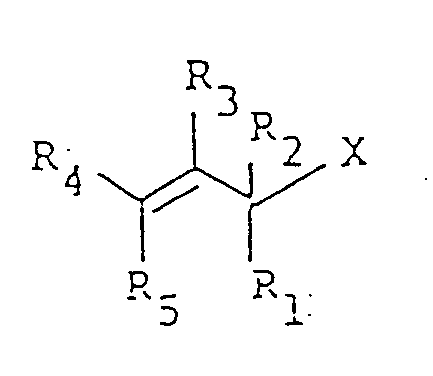
[0004] Thus, according to this invention, there is provided a process for producing an aliphatic, alicyclic, aromatic or heterocyclic oxime derivative, which comprises protecting the hydroxyimino group of an oxime compound with a protecting agent, subjecting the protected oxime compound to a given reaction, and thereafter deprotecting the reaction product, which is characterized by protecting the hydroxyimino group of the starting oxime compound with a protecting agent represented by the general formula
wherein each of R₁, R₂, R₃, R₄ and R₅ represents hydrogen or a hydrocarbon group which may have a substituent, and X represents a halogen atom, or a residue of a sulfonic residue of a sulfonic acid, subjecting the protected oxime compound to the following steps O-alkylation of the hydroxyl group, conversion of the amino group into a carbamate group, oxidation of the hydroxyl group, C-alkylation of the carbonyl group, conversion of the hydroxyimino group into a carbonyl group, or reduction, and deprotecting the protected reaction product by contacting it with a catalyst composed of the compound of a platinum-group metal and a ligand in the presence of a nucleophilic reagent wherein the nucleophilic reagent is a lower fatty acid or its salt, an alkali metal salt of a phenol, or an alkali metal salt of a 1,3-dicarbonyl compound.
[0005] The oxime compound used in this invention has at least one hydroxyimino group and at least one other functional group. The functional group, as used herein, denotes a functional group which does not adversely affect a reaction of protecting the hydroxyimino group and has higher activity than the 2-alkenyloxyimino group under reaction conditions for producing a protected oxime derivative.
[0006] Specific examples of the functional group include a hydroxyl group, an amino group, a cyano group, a sulfonyl group, a sulfone group, an ether linkage, a thioether linkage, and an acid amide linkage.
[0007] When a lower fatty acid or its salt is used as a nucleophilic reagent in deprotection, the starting oxime compound may further contain a carbonyl group, an epoxy group, an ester linkage (including lactones), an acetal linkage, a chlorine atom, etc.
[0008] When the functional group includes a hydroxyl group or an amino group, the hydroxyamino group can be selectively protected because such a group less reactive with the 2-alkenylating agent than the hydroxyimino group. When the functional group includes a group having higher reactivity than the hydroxyimino group, such as a carboxyl group, the desired protected oxime derivative can be obtained by 2-alkenylating both of these groups, and thereafter reacting only the more reactive 2-alkenyloxycarbonyl group.
[0009] The oxime compound may be of any of the aliphatic, alicyclic, aromatic and heterocyclic structures, and may contain a carbon-carbon double bond or a carbon-carbon triple bond in the molecule. The molecular weight of the oxime compound does not greatly affect the reaction. But usually, it has a molecular weight of not more than 5,000, and particularly contains not more than 100 carbon atoms, preferably not more than 50 carbon atoms.
[0010] There is no particular restriction on the method of converting the hydroxyimino group into a 2-alkenyloxyimino group, and it can be carried out in a customary manner. For example, for introduction of an allyl group, it is known to react the oxime compound with an allyl halide typified by allyl bromide in a suitable solvent such as tetrahydrofuran using a base such as sodium methylate [Zh. Org. Khim., 4, 567 (1968)], or to carry out the above reaction in a mixture of water and a hydrophobic organic solvent such as benzene in the presence of both a base such as sodium hydroxide and a phase transfer catalyst such as a tetraalkyl ammonium halide [Chem. Lett., 869 (1980)].
[0011] Examples for the sulfonic acid are p-toluenesulfonic acid or methanesulfonic acid. Specific examples of the 2-alkenyl group are an allyl group, a methallyl group, a crotyl group, a cinnamyl group, a prenyl group, a 2-pentenyl group, a 2-ethyl-2-butenyl group, a p-chlorocinnamyl group, a geranyl group, a neryl group, and lower alkoxy derivatives of these groups.
[0012] The number of carbon atoms of the 2-alkenyl group can be properly chosen by considering the ease of separating the alkene formed by the deprotection reaction, the ease of obtaining the starting material, etc. Usually, it is not more than 10. When the 2-alkenyl group has not more than 5 carbon atoms, the by-product alkene can be removed in gaseous form from the reaction system.
[0013] The resulting oxime compound having the 2-alkenyloxyimino group (i.e., protected oxime compound) is then subjected to a given reaction utilizing the other functional group of the compound to form a protected oxime derivative. The reaction may be any of reactions known heretofore with regard to oxime compounds protected with a benzyl ether, etc.
[0014] O-alkylation is carried out, for example, by reacting a protected oxime compound having a hydroxyl group with an alkyl halide in a suitable solvent such as tetrahydrofuran using a base such as sodium hydride.
[0015] The reaction of converting the amino group into a carbamate group is carried out by reacting a protected oxime compound having the amino group with a halogenocarbonic ester in a suitable solvent such as acetone in the presence of a base such as sodium hydrogen carbonate.
[0016] An oxidation reaction may, for example, be carried out by oxidizing a protected oxime compound having a hydroxyl group with an oxidizing agent such as a Jones' reagent (a mixture of chromic anhydride and dilute sulfuric acid) at 0oC to room temperature in a polar solvent such as acetone to convert it into a carboxylic acid or a ketone.
[0017] C-alkylation may, for example, be carried out by reacting a protected oxime compound having a carbonyl group with an alkyl metal such as methylmagnesium bromide at room temperature or below in a solvent such as diethyl ether to give an alkylated protected oxime derivative.
[0018] The reaction of converting the hydroxyimino group into a carbonyl group may be carried out, for example, by stirring a protected oxime compound having a non-protected hydroxyimino group in addition to a protected hydroxyimino group at room temperature in a mixed solvent of water and methanol in the presence of a reducing agent, such as an excess of titanium trichloride, and ammonium acetate to convert it into a protected oxime derivative having a carbonyl group.
[0019] As an example of reduction, a protected oxime compound having a carbonyl group is reacted with a reducing agent such as sodium borohydride in water-methanol to give a corresponding protected oxime derivative having a hydroxyl group.
[0020] It is known that an oxime compound not protected with the 2-alkenyl group, when placed under the conditions of the reactions illustrated above, undergo conversions corresponding to the individual reactions.
[0021] There is no particular limitation on the reaction conditions, and those conditions which are generally used in a particular desired reaction may be applied as such.
[0022] The protected oxime derivative so obtained is then converted into the desired oxime derivative by deprotection of the 2-alkenyl group.
[0023] The deprotection is carried out by using a catalyst consisting of a compound of a platinum-group metal and a ligand. The platinum-group metal compound may include salts or complexes of palladium, ruthenium, platinum and rhodium. Specific examples are tris(dibenzylideneacetone)dipalladium (0), tris(tribenzylideneacetylacetone)tripalladium (0), tetrakis(triphenylphosphine)palladium (0), palladium acetate, palladium propionate, palladium butyrate, palladium benzoate, palladium acetylacetonate, palladium nitrate, palladium sulfate, palladium chloride, dihydrotetrakis(triphenylphosphine)ruthenium, ruthenium acetylacetonate, platinous acetate and platinum acetylacetonate.
[0024] Of these, palladium compounds are preferred in view of their reactivity. It is especially preferred to use 0-valent palladium olefin complexes or divalent organic palladium compounds.
[0025] The ligand used is an electron donor compound having a metal of Group V of the Periodic table, i.e. nitrogen, phosphorus, arsenic or antimony, as a coordination atom. Specific examples include nitrogen-containing compounds such as pyridine, quinoline, trimethylamine, triethylamine, tributylamine, α,α'-dipyridyl and 1,10-phenanthroline; phosphorus-containing compounds such as triethylphosphine, tri-n-butylphosphine, triphenylphosphine, tri-o-tolylphosphine, tri-p-biphenylphosphine, tri-o-methoxyphenylphosphine, phenyldiphenoxyphosphine, triethyl phosphite, tri-n-butyl phosphite, tri-n-hexyl phosphite, triphenyl phosphite, tri-o-tolyl phosphite, triphenyl thiophosphite, α,β-ethylenedi(diphenyl)phosphine, α,β-ethylenedi(diethyl)phosphine and α,β-ethylenedi(dibutyl)phosphine; arsenic-containing compounds such as triethylarsenic, tributylarsenic or triphenylarsenic; and antimony-containing compounds such as tripropylantimony and triphenylantimony. Of these, the phosphorus-containing compounds are preferred in view of their activity and selectivity in the reaction and economy.
[0026] The amount of the ligand used is usually at least 0.1 mole per mole of the platinum-group metal compound, and from the viewpoint of its activity in the reaction, it is preferably at least 1 mole, especially 2 to 20 moles.
[0027] The amount of the catalyst can be properly chosen, and it is generally used in such a proportion that the amount of the platinum-group metal compound is 0.01 to 10 moles, preferably 0.1 to 5 moles, per 100 moles of the protected oxime derivative. This amount is for a material having one 2-alkenyloxyimino group, and the amount of a material haying two or more 2-alkenyloxyimino groups is increased according to the number of the 2-alkenyloxyimino groups. The platinum-group metal compound and the ligand may be reacted in advance, but usually, the catalyst is prepared in situ by contacting the individual components in the reaction system.
[0028] The deprotection reaction using the platinum-group metal compound as a catalyst is carried out in the presence of a nucleophilic agent selected from lower fatty acids or its salts, alkali metal salts of phenols and alkali metal salts of 1,3-dicarbonyl compounds.
[0029] Specific examples of the lower fatty acids are formic acid, acetic acid and propionic acid. Specific examples of their salts include ammonium salts or amine salts such as ammonium formate, pyridine formate, morpholine formate, monomethylamine formate, diethylamine formate, trimethylamine formate, diethylamine formate, trimethylamine formate, triethylamine formate, triethanolamine formate, ammonium acetate, ammonium propionate, triethylamine acetate, triethylamine propionate, pyridine acetate, monomethylamine propionate and monoethanolamine acetate; and metal salts such as sodium formate, calcium formate, sodium acetate, potassium acetate, potassium propionate and calcium acetate.
[0030] Specific examples of the alkali metal salts of phenols are sodium phenoxide, sodium methylphenoxide, potassium phenoxide and potassium methylphenoxide.
[0031] Specific examples of the alkali metal salts of 1,3-dicarbonyl compounds are a sodium salt of methyl acetoacetate, a lithium salt of ethyl acetoacetate, a sodium salt of dimethyl malonate, a potassium salt of diethyl malonate, a sodium salt of ethyl 2-oxocyclopentanecarboxylate, a sodium salt of cyclohexane-1,3-dione, and a potassium salt of dimedone.
[0032] Among these nucleophilic reagents, the formic acid compounds, particularly organic amine salts of formic acid, are preferred in view of their reactivity and operability.
[0033] The amount of the nucleophilic reagent can be properly chosen, and is usually at least one molecule, preferably 2 to 10 molecules, per protected oxime in the protected oxime derivative.
[0034] The deprotection reaction is carried out by contacting the protected oxime derivative with the catalyst in the presence of the nucleophilic reagent. By this reaction, the protected hydroxyimino group is removed, and simultaneously, the 2-alkenyl group is combined with the nucleophilic reagent to give an alkenyl-type by-product. The reaction temperature is usually at least 20oC, preferably 50 to 150oC. The reaction time is usually 5 minutes to 24 hours.
[0035] The reaction may be carried out in the further presence of a diluent. Specific examples of the diluent are nitriles such as acetonitrile, propionitrile, butyronitrile and benzonitrile; amides such as dimethylformamide, diethylformamide, dimethylacetamide, dimethylpropionamide and N-methylpyrrolidone; ethers such as tetrahydrofuran, dioxane, dibutyl ether and ethylene glycol dimethyl ether; alcohols such as methanol, ethanol, propanol, tert-butanol, ethylene glycol and diethylene glycol monoethyl ether; sulfoxides such as dimethyl sulfoxide and diethyl sulfoxide; and hydrocarbons such as n-hexane, cyclohexane, benzene, toluene and xylene. Of these, the nitriles, amides, ethers and alcohols are preferred. Water may be added to the diluent in order to increase the compatibility between the nucleophilic reagent and the protected oxime derivative.
[0036] The diluent is used usually in such a proportion that the concentation of the protected oxime derivative is 1 to 50 % by weight. The use of the diluent can lead to an increase in the activity of the reaction and the stability of the catalyst.
[0037] After the reaction, the reaction mixture is worked up by conventional methods, for example by extraction, distillation or recrystallization to give the desired oxime derivative of high purity.
[0038] The oxime derivatives obtained by the process of this invention may be various aliphatic, alicyclic, aromatic or heterocyclic compounds and are useful, for example, as industrial chemicals, medicines, agricultural chemicals and intermediates of these.
[0039] Thus, the present invention provides a simple, convenient and practical process which can also be applied to the protection of oxime compounds having a double bond which has previously been difficult.
EXAMPLE 1
Allyl etherification
[0041] A reactor was charged with 1 mole of 2-methyl-5-hydroxyimino-2-heptene, 8 moles of methanol containing 1.2 moles of sodium methylate, and 10 moles of tetrahydrofuran (THF). The mixture was cooled to 0oC, and with stirring, 1.3 moles of allyl bromide was added dropwise over 5 minutes. The mixture was stirred at room temperature for one day. The reaction mixture was concentrated, and 40 parts of methylene chloride was added. The mixture was washed with water, and the solvent was evaporated. The residue was purified by silica gel column chromatography to give 2-methyl-5-allyloxyimino-2-heptene in a yield of 80 mole %. Identification of this compound was performed by using IR, NMR and mass spectra (the same techniques were used to identify compounds appearing hereinafter).
Deprotection
[0042] An aliquot (0.5 mole) of the resulting compound was reacted under stirring for 1 hour together with 0.005 mole of palladium acetate, 0.02 mole of triphenylphosphine, 1.5 moles of triethylamine formate, 20 moles of ethanol and 12 moles of water. After the reaction, ethanol was evaporated from the reaction mixture under reduced pressure. Ten moles of methylene chloride was added to the residue, and the mixture was washed with water. The solvent was evaporated, and the residue was purified by silica gel column chromatography to give 2-methyl-5-hydroxyimino-2-heptene in a yield of 96 mole %. A quantitative analysis of the reaction mixture by gas chromatography showed that the reaction proceeded quantitatively.
[0043] The results demonstrate that the allyl etherification of an oxime compound is an effective protecting method and can be applied also to compounds having a carbon-carbon double bond.
EXAMPLE 2
Allyl etherification (synthesis of a protected oxime compound)
[0044] The same allyl etherification procedure as in Example 1 was repeated except that 3-hydroxyiminobutanol was used as a starting material. 3-Allyloxyiminobutanol was obtained in a yield of 75 mole %.
Benzyl etherification of the hydroxyl group (synthesis of a protected oxime derivative)
[0045] A reactor was charged with 0.1 mole of 3-allyloxyiminobutanol, 0.12 mole of benzyl chloride and 2 moles of THF. The mixture was cooled to 0oC, and 0.11 mole of sodium hydroxide was added little by little. The temperature of the mixture was returned to room temperature, and it was stirred for 2 hours. After the reaction, the product was isolated in a customary manner to give 3-allyloxyiminobutyl benzyl ether in a yield of 95 mole %.
Deprotection (synthesis of an oxime derivative)
[0046] The same deprotecting procedure as in Example 1 was repeated except that 3-allyloxyiminobutyl benzyl ether was used as the protected oxime derivative. 3-Hydroxyiminobutyl benzyl ether was obtained in a yield of 90 mole %.
[0047] The results demonstrate that 3-allyloxyiminobutyl benzyl ether is useful as a protected oxime.
EXAMPLE 3
Allyl etherification (synthesis of a protected oxime compound)
[0048] The same allyl etherifying procedure as in Example 2 was repeated except that m-aminoacetophenone oxime was used as the starting material. An allyl ether of the above oxime was obtained in a yield of 85 mole %.
Carbobenzoxylation (synthesis of a protected oxime derivative)
[0049] A reactor was charged with an aliquot (0.5 mole) of m-aminoacetophenone oxime allyl ether, 2 moles of carbobenzoxy chloride, 2.5 moles of sodium hydrogen carbonate and 15 moles of acetone, and the mixture was heated under reflux for 5 hours. After the reaction, the inorganic material was removed by filtration. The filtrate was extracted in a customary manner. The crude product was purified by column chromatography to give m-carbobenzoxyaminoacetophenone oxime allyl ether in a yield of 70 mole %.
Deprotection (synthesis of an oxime derivative)
[0050] The same deprotecting procedure as in Example 1 was repeated except that m-carbobenzoxyaminoacetophenone oxime allyl ether was used as the protected oxime derivative. m-Carbobenzoxyaminoacetophenone oxime was obtained in a yield of 90 mole %.
EXAMPLE 4
[0051] The same allyl etherification as in Example 1 was repeated except that crotyl bromide was used as the allylating agent. The corresponding crotyl ether was obtained in a yield of 78 mole %. Deprotection gave 2-methyl-5-hydroxyimino-2-heptene in a yield of 85 mole %.
EXAMPLE 5
[0052] A reactor was charged with 0.5 mole of allyloxyiminocyclohexane synthesized by the same method as in Example 1, 0.005 mole of palladium acetate, 0.02 mole of triphenylphosphine, 1.5 moles of triethylamine formate, 20 moles of ethanol and 12 moles of water. The mixture was heated under refluxing conditions and stirred for 1 hour. After the reaction, ethanol was evaporated from the reaction mixture under reduced pressure. Ten moles of methylene chloride was added to the residue, and the mixture was washed with a saturated aqueous solution of sodium chloride. The solvent was concentrated, and the residue was purified by silica gel column chromatography. Cyclohexanone oxime was obtained in a yield of 95 mole %.
[0053] A quantitative analysis of the reaction mixture by gas chromatography before purification showed that the reaction proceeded quantitatively.
EXAMPLE 6
[0054] Example 5 was repeated except that each of the palladium compounds indicated in Table 1 was used instead of palladium acetate. The results are shown in Table 1.
Table 1
| Run No. | Palladium compound | Yield of the final product (mole%) |
| 1 | palladium acetylacetonate | 90 |
| 2 | tris(dibenzylidenediacetone) dipalladium (0) | 92 |
EXAMPLE 7
[0055] Example 5 was repeated except that each of the formic acid compounds indicated in Table 2 was used instead of triethylamine formate. The results are shown in Table 2.
Table 2
| Run No. | Formic acid compound | Yield of the final product (mole%) |
| 1 | formic acid | 90 |
| 2 | pyridine formate | 95 |
| 3 | ammonium formate | 70 |
EXAMPLE 8
[0056] Example 5 was repeated except that each of the ligands indicated in Table 3 was used instead of triphenylphosphine, and the reaction was carried out for each of the periods indicated in Table 3. The results are shown in Table 3.
Table 3
| Run No. | Ligand | Reaction time (hours) | Yield of the final product (mole%) |
| 1 | tri-n-butylphosphine | 1 | 95 |
| 2 | triphenyl phosphite | 6 | 75 |
| 3 | α,β-ethylenedi(diphenyl) phosphine | 1 | 90 |
EXAMPLE 9
[0057] Example 5 was repeated except that each of the starting compounds indicated in Table 4 was used as the starting material. The results are shown in Table 4.
[0058] In the structural formulae of the starting materials and products indicated in Table 4, the straight line represents a carbon-carbon bond; Me represents a methyl group; and a hydrogen atom bonded to a carbon atom is omitted.
EXAMPLE 10
[0059] Example 5 was repeated except that 5 moles of triethylamine acetate was used instead of 1.5 moles of triethylamine formate. The reaction mixture was concentrated to remove the solvent, and the residue was purified by silica gel chromatography to give cyclohexanone oxime in a yield of 51 mole %.
[0060] A quantitative analysis of the reaction mixture by gas chromatography before purification showed that the selectivity of the reaction was quantitative.
EXAMPLE 11
[0061] Example 10 was repeated except that each of the palladium compounds indicated in Table 5 was used instead of palladium acetate. The results are shown in Table 5.
Table 5
| Run No. | Palladium compound | Yield (mole%) | Selectivity (mole%) |
| 1 | palladium acetylacetonate | 48 | 95 |
| 2 | tris(dibenzylidenediacetone) dipalladium (0) | 49 | 95 |
EXAMPLE 12
[0062] Example 1 was repeated except that each of the nucleophilic reagents indicated in Table 6 was used instead of triethylamine formate. The results are shown in Table 6.
Table 6
| Run No. | Nucleophilic reagent | Yield (mole%) | Selectivity (mole%) |
| 1 | acetic acid | 25 | 90 |
| 2 | pyridine acetate | 50 | 95 |
| 3 | sodium salt of methyl acetoacetate | 54 | 92 |
| 4 | triethylamine propionate | 45 | 95 |
| 5 | sodium phenoxide | 58 | 85 |
EXAMPLE 13
[0063] Example 10 was repeated except that each of the ligands indicated in Table 7 was used instead of triphenylphosphine, and the reaction was carried out for each of the periods indicated in Table 7. The results are shown in Table 7.
Table 7
| Run No. | Ligand | Reaction time (hours) | Yield (mole%) | Selectvity (mole%) |
| 1 | tri-n-butylphosphine | 1 | 50 | 95 |
| 2 | triphenyl phosphite | 6 | 45 | 93 |
| 3 | α,β-ethylenedi(diphenyl) phosphine | 1 | 49 | 94 |
EXAMPLE 14
1. A process for producing an aliphatic, alicyclic, aromatic or heterocyclic oxime derivative
which comprises protecting the hydroxyimino group of an oxime compound with a protecting
agent, subjecting the protected oxime compound to a given reaction, and thereafter
deprotecting the reaction product, characterised by
protecting the hydroxyimino group of the starting oxime compound with a protecting agent represented by the general formula
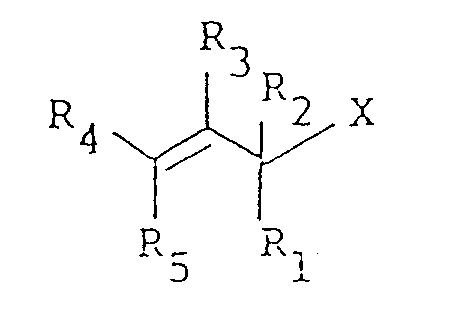
wherein each of R₁, R₂, R₃, R₄ and R₅ represents hydrogen or a hydrocarbon group which may have a substituent, and X represents a halogen atom, or a residue of a sulfonic residue of a sulfonic acid, subjecting the protected oxime compound to the following steps O-alkylation of the hydroxyl group, conversion of the amino group into a carbamate group, oxidation of the hydroxyl group, C-alkylation of the carbonyl group, conversion of the hydroxyimino group into a carbonyl group, or reduction, and deprotecting the protected reaction product by contacting it with a catalyst composed of a compound of a platinum-group metal and a ligand in the presence of a nucleophilic reagent wherein the nucleophilic reagent is a lower fatty acid or its salt, an alkali metal salt of a phenol, or an alkali metal salt of a 1,3-dicarbonyl compound.
protecting the hydroxyimino group of the starting oxime compound with a protecting agent represented by the general formula
wherein each of R₁, R₂, R₃, R₄ and R₅ represents hydrogen or a hydrocarbon group which may have a substituent, and X represents a halogen atom, or a residue of a sulfonic residue of a sulfonic acid, subjecting the protected oxime compound to the following steps O-alkylation of the hydroxyl group, conversion of the amino group into a carbamate group, oxidation of the hydroxyl group, C-alkylation of the carbonyl group, conversion of the hydroxyimino group into a carbonyl group, or reduction, and deprotecting the protected reaction product by contacting it with a catalyst composed of a compound of a platinum-group metal and a ligand in the presence of a nucleophilic reagent wherein the nucleophilic reagent is a lower fatty acid or its salt, an alkali metal salt of a phenol, or an alkali metal salt of a 1,3-dicarbonyl compound.
2. The process of claim 1 wherein the protecting agent is a compound in which the 2-alkenyl
moiety has not more than 10 carbon atoms.
3. The process of claim 1 wherein the starting oxime compound has a molecular weight
of not more than 5,000.
4. The process of claim 1 wherein the oxime compound contains not more than 100 carbon
atoms.
5. The process of claim 1 wherein the lower fatty acid is a fatty acid having 1 to 3
carbon atoms.
6. The process of claim 1 wherein the nucleophilic reagent is formic acid or its salt.
7. The process of any of the claims 1 to 6 wherein the ligand is an electron donor compound
having a metal of Group V of the Periodic Table as a coordination atom.
8. The process of claim 1 wherein the nucleophilic reagent is an organic amine salt of
formic acid.
9. The process of claim 1 wherein the electron donor compound is a phosphorous-containing
compound.
10. The process of claim 1 wherein the compound of a platinum-group metal is a salt or
complex of palladium, ruthenium, platinum or rhodium.
11. The process of claim 1 wherein the compound of a platinum-group metal is a salt or
complex of palladium.
12. The process of claim 10 wherein the palladium salt or complex is a O-valent or divalent
organic compound of palladium.
13. The process of claim 1 wherein the catalyst is used in a proportion of 0.01 to 10
moles per 100 moles of the protected oxime derivative.
14. The process of claim 1 wherein the nucleophilic reagent is used in a proportion of
at least one molecule per protected oxime in the protected oxime derivative.
15. The process of claim 1 wherein the deprotection is carried out in the presence of
a diluent.
16. The process of claim 1 wherein the deprotection is carried out at a temperature of
at least 20°C for 5 minutes to 24 hours.
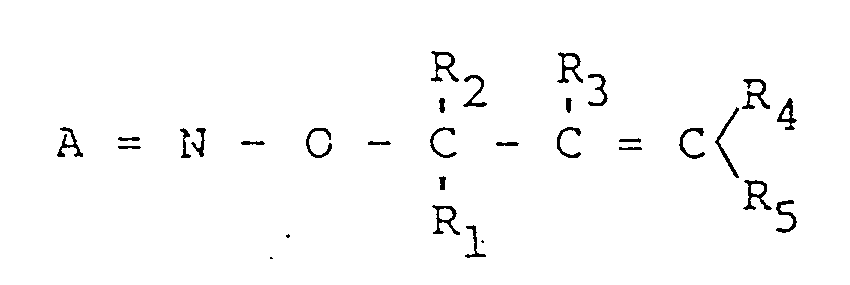
17. A process for deprotecting a protected oxime compound, characterised by contacting a protected oxime compound represented by the general formula
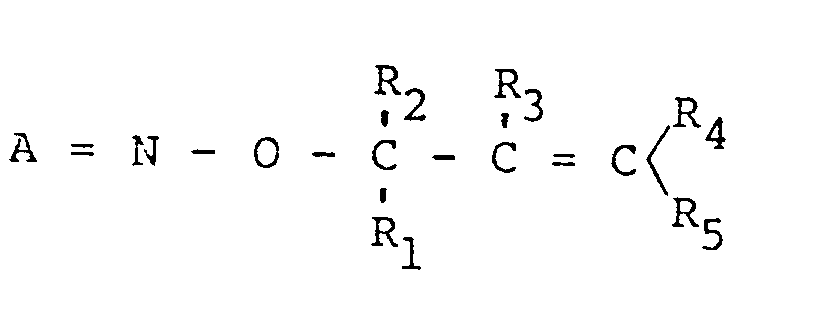
wherein A represents the body structure of the oxime compound, and each of R₁, R₂, R₃, R₄ and R₅ represents hydrogen or a hydrocarbon group which may have a substituent, with a catalyst composed of a compound of a platinum-group metal and a ligand in the presence of a nucleophilic reagent, whereby the ligand is an electron donor compound having a metal of Group V of the periodic table as a coordination atom and whereby the nucleophilic reagent is a lower fatty acid or its salt, an alkali metal salt of a phenol, or an alkali metal salt of a 1,3-dicarbonyl compound.
wherein A represents the body structure of the oxime compound, and each of R₁, R₂, R₃, R₄ and R₅ represents hydrogen or a hydrocarbon group which may have a substituent, with a catalyst composed of a compound of a platinum-group metal and a ligand in the presence of a nucleophilic reagent, whereby the ligand is an electron donor compound having a metal of Group V of the periodic table as a coordination atom and whereby the nucleophilic reagent is a lower fatty acid or its salt, an alkali metal salt of a phenol, or an alkali metal salt of a 1,3-dicarbonyl compound.
1. Verfahren zur Herstellung eines aliphatischen, alicyclischen, aromatischen oder heterocyclischen
Oximderivats durch Schutz der Hydroxyiminogruppe einer Oximverbindung mit einem Schutzmittel,
Durchführung einer gegebenen Reaktion mit der geschützten Oximverbindung und anschließend
Abspaltung der Schutzgruppe von dem Reaktionsprodukt, dadurch gekennzeichnet, daß die Hydroxyiminogruppe der Ausgangsoximverbindung mit einem Schutsmittel geschützt
wird, das durch die allgemeine Formel
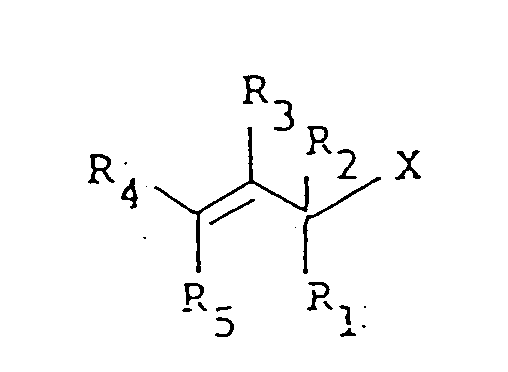
dargestellt wird, worin jeder von R₁, R₂, R₃, R₄ und R₅ Wasserstoff oder eine Kohlenwasserstoffgruppe, die einen Substituenten aufweisen kann, bedeuten, und X ein Halogenatom oder den Sulfonsäurerest einer Sulfonsäure bedeutet, die geschützte Oximverbindung den folgenden Stufen unterworfen wird: O-Alkylierung der Hydroxylgruppe, Umwandlung der Aminogruppe in eine Carbamatgruppe, Oxidation der Hydroxylgruppe, C-Alkylierung der Carbonylgruppe, Umwandlung der Hydroxyiminogruppe in eine Carbonylgruppe, oder Reduktion, und die Schutzgruppe aus dem geschützten Reaktionsprodukt abgespalten wird, indem dieses mit einem Katalysator, der aus einer Verbindung eines Metalls der Platingruppe und einem Ligand zusammengesetzt ist, in Anwesenheit eines nukleophilen Reagenses behandelt wird, wobei das nukleophile Reagens eine niedrige Fettsäure oder ihr Salz, ein Alkalimetallsalz eines Phenols oder ein Alkalimetallsalz einer 1,3-Dicarbonylverbindung ist.
dargestellt wird, worin jeder von R₁, R₂, R₃, R₄ und R₅ Wasserstoff oder eine Kohlenwasserstoffgruppe, die einen Substituenten aufweisen kann, bedeuten, und X ein Halogenatom oder den Sulfonsäurerest einer Sulfonsäure bedeutet, die geschützte Oximverbindung den folgenden Stufen unterworfen wird: O-Alkylierung der Hydroxylgruppe, Umwandlung der Aminogruppe in eine Carbamatgruppe, Oxidation der Hydroxylgruppe, C-Alkylierung der Carbonylgruppe, Umwandlung der Hydroxyiminogruppe in eine Carbonylgruppe, oder Reduktion, und die Schutzgruppe aus dem geschützten Reaktionsprodukt abgespalten wird, indem dieses mit einem Katalysator, der aus einer Verbindung eines Metalls der Platingruppe und einem Ligand zusammengesetzt ist, in Anwesenheit eines nukleophilen Reagenses behandelt wird, wobei das nukleophile Reagens eine niedrige Fettsäure oder ihr Salz, ein Alkalimetallsalz eines Phenols oder ein Alkalimetallsalz einer 1,3-Dicarbonylverbindung ist.
2. Verfahren nach Anspruch 1, dadurch gekennzeichnet, daß das Schutzmittel eine Verbindung ist, worin die 2-Alkenylgruppierung nicht mehr
als 10 Kohlenstoffatome enthält.
3. Verfahren nach Anspruch 1, dadurch gekennzeichnet, daß die Ausgangsoximverbindung ein Molekulargewicht von nicht mehr als 5000 besitzt.
4. Verfahren nach Anspruch 1, dadurch gekennzeichnet, daß die Oximverbindung nicht mehr als 100 Kohlenstoffatome enthält.
5. Verfahren nach Anspruch 1, dadurch gekennzeichnet, daß die niedrige Fettsäure eine Fettsäure mit 1 bis 3 Kohlenstoffatomen ist.
6. Verfahren nach Anspruch 1, dadurch gekennzeichnet, daß das nukleophile Reagens Ameisensäure oder ein Salz davon ist.
7. Verfahren nach einem der Ansprüche 1 bis 6, dadurch gekennzeichnet, daß der Ligand eine Elektronen-Donor-Verbindung mit einem Metall der Gruppe V des
periodischen Systems als Koordinationsatom ist.
8. Verfahren nach Anspruch 1, dadurch gekennzeichnet, daß das nukleophile Reagens ein organisches Aminsalz der Ameisensäure ist.
9. Verfahren nach Anspruch 1, dadurch gekennzeichnet daß die Elektronen-Donor-Verbindung eine Phosphor-enthaltende Verbindung ist.
10. Verfahren nach Anspruch 1, dadurch gekennzeichnet daß die Verbindung des Metalls der Platingruppe ein Salz oder ein Komplex von Palladium,
Ruthenium, Platin oder Rhodium ist.
11. Verfahren nach Anspruch 1, dadurch gekennzeichnet, daß die Verbindung des Metalls der Platingruppe ein Salz oder ein Komplex von Palladium
ist.
12. Verfahren nach Anspruch 10, dadurch gekennzeichnet, daß das Palladiumsalz oder der Komplex eine 0-wertige oder zweiwertige organische
Verbindung des Palladiums ist.
13. Verfahren nach Anspruch 1, dadurch gekennzeichnet, daß der Katalysator in einem Verhältnis von 0,01 bis 10 mol pro 100 mol geschütztem
Oximderivat verwendet wird.
14. Verfahren nach Anspruch 1, dadurch gekennzeichnet, daß das nukleophile Reagens in einem Verhältnis von mindestens einem Molekül pro
geschütztem Oxim in dem geschützten Oximderivat verwendet wird.
15. Verfahren nach Anspruch 1, dadurch gekennzeichnet, daß die Schutzgruppenabspaltung in Anwesenheit eines Verdünnungsmittels durchgeführt
wird.
16. Verfahren nach Anspruch 1, dadurch gekennzeichnet, daß die Schutzgruppenabspaltung bei einer Temperatur von mindestens 20°C während
5 Minuten bis 24 Stunden durchgeführt wird.
17. Verfahren zur Schutzgruppenabspaltung einer geschützten Oximverbindung, dadurch gekennzeichnet, daß die geschützte Oximverbindung, die durch die allgemeine Formel
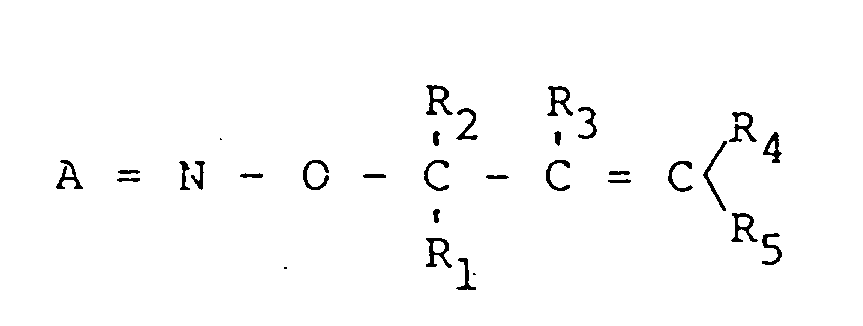
dargestellt wird, worin A die Grundstruktur der Oximverbindung und jeder von R₁, R₂, R₃, R₄ und R₅ einen Wasserstoff oder eine Kohlenwasserstoffgruppe, die einen Substituenten aufweisen kann, mit einem Katalysator, der aus einer Verbindung eines Metalls der Platingruppe und einem Liganden zusammengesetzt wird, in Anwesenheit eines nukleophilen Reagenses behandelt wird, wobei der Ligand eine Elektronen-Donor-Verbindung mit einem Metall der Gruppe V des periodischen Systems als Koordinationsatom ist, und wobei das nukleophile Reagens eine niedrige Fettsäure oder ein Salz davon, ein Alkalimetallsalz von Phenol oder ein Alkalimetallsalz einer 1,3-Dicarbonylverbindung ist.
dargestellt wird, worin A die Grundstruktur der Oximverbindung und jeder von R₁, R₂, R₃, R₄ und R₅ einen Wasserstoff oder eine Kohlenwasserstoffgruppe, die einen Substituenten aufweisen kann, mit einem Katalysator, der aus einer Verbindung eines Metalls der Platingruppe und einem Liganden zusammengesetzt wird, in Anwesenheit eines nukleophilen Reagenses behandelt wird, wobei der Ligand eine Elektronen-Donor-Verbindung mit einem Metall der Gruppe V des periodischen Systems als Koordinationsatom ist, und wobei das nukleophile Reagens eine niedrige Fettsäure oder ein Salz davon, ein Alkalimetallsalz von Phenol oder ein Alkalimetallsalz einer 1,3-Dicarbonylverbindung ist.
1. Procédé de production d'un dérivé d'oxime aliphatique, alicyclique, aromatique ou
hétérocyclique, qui consiste à protéger le groupe hydroxylimino d'une oxime avec un
agent protecteur, soumettre l'oxime protégée à une réaction donnée, puis éliminer
la protection du produit réactionnel, caractérisé en ce que
on protège le groupe hydroxylimino de l'oxime de départ avec un agent protecteur représenté par la formule générale
dans laquelle chacun de R₁, R₂, R₃, R₄ et R₅ représente l'hydrogène ou un groupe hydrocarboné qui peut porter un substituant, et X représente un atome d'halogène ou un résidu d'un résidu sulfonique d'un acide sulfonique, on soumet l'oxime protégée aux étapes suivantes : alkylation sur O d'un groupe hydroxyle, conversion d un groupe amino en un groupe carbamate, oxydation d un groupe hydroxyle, alkylation sur C d'un groupe carbonyle, conversion d'un groupe hydroxylimino en un groupe carbonyle ou réduction, et on élimine la protection du produit réactionnel protégé en le mettant en contact avec un catalyseur constitué d'un composé de métal du groupe du platine et d'un ligand en présence d'un réactif nucléophile, le réactif nucléophile étant un acide gras inférieur ou un sel d'un tel acide, un sel de métal alcalin d'un phénol, ou un sel de métal alcalin d'un composé 1,3-dicarbonylé.
on protège le groupe hydroxylimino de l'oxime de départ avec un agent protecteur représenté par la formule générale
dans laquelle chacun de R₁, R₂, R₃, R₄ et R₅ représente l'hydrogène ou un groupe hydrocarboné qui peut porter un substituant, et X représente un atome d'halogène ou un résidu d'un résidu sulfonique d'un acide sulfonique, on soumet l'oxime protégée aux étapes suivantes : alkylation sur O d'un groupe hydroxyle, conversion d un groupe amino en un groupe carbamate, oxydation d un groupe hydroxyle, alkylation sur C d'un groupe carbonyle, conversion d'un groupe hydroxylimino en un groupe carbonyle ou réduction, et on élimine la protection du produit réactionnel protégé en le mettant en contact avec un catalyseur constitué d'un composé de métal du groupe du platine et d'un ligand en présence d'un réactif nucléophile, le réactif nucléophile étant un acide gras inférieur ou un sel d'un tel acide, un sel de métal alcalin d'un phénol, ou un sel de métal alcalin d'un composé 1,3-dicarbonylé.
2. Procédé selon la revendication 1, dans lequel l'agent protecteur est un composé dans
lequel le groupement 2-alcényle ne compte pas plus de 10 atomes de carbone.
3. Procédé selon la revendication 1, dans lequel le poids moléculaire de l'oxime de départ
n'est pas supérieur à 5000.
4. Procédé selon la revendication 1, dans lequel l'oxime ne contient pas plus de 100
atomes de carbone.
5. Procédé selon la revendication 1, dans lequel l'acide gras inférieur est un acide
gras ayant 1 à 3 atomes de carbone.
6. Procédé selon la revendication 1, dans lequel le réactif nucléophile est l'acide formique
ou un sel de celui-ci.
7. Procédé selon l'une quelconque des revendications 1 à 6, dans lequel le ligand est
un composé donneur d'électrons ayant un élément du Groupe V du Tableau Périodique
comme atome coordinateur.
8. Procédé selon la revendication 1, dans lequel le réactif nucléophile est un sel d'amine
organique d'acide formique.
9. Procédé selon la revendication 1, dans lequel le composé donneur d'électrons est un
composé phosphoré.
10. Procédé selon la revendication 1, dans lequel le composé d'un métal du groupe du platine
est un sel ou complexe de palladium, ruthénium, platine ou rhodium.
11. Procédé selon la revendication 1, dans lequel le composé d'un métal du groupe du platine
est un sel ou complexe de palladium.
12. Procédé selon la revendication 10, dans lequel le sel ou complexe de palladium est
un composé organique de palladium zérovalent ou divalent.
13. Procédé selon la revendication 1, dans lequel le catalyseur est utilisé en une proportion
de 0,01 à 10 moles pour 100 moles du dérivé d'oxime protégée.
14. Procédé selon la revendication 1, dans lequel le réactif nucléophile est utilisé en
une proportion d'au moins une molécule par fonction oxime protégée dans le dérivé
d'oxime protégée.
15. Procédé selon la revendication 1, dans lequel l'élimination de la protection est effectuée
en présence d'un diluant.
16. Procédé selon la revendication 1, dans lequel l'élimination de la protection est effectuée
à une température d'au moins 20°C pendant 5 minutes à 24 heures.
17. Procédé d'élimination de la protection d'une oxime protégée, caractérisé en ce qu'on
met en contact une oxime protégée représentée par la formule générale
dans laquelle A représente la structure du corps de l'oxime, et chacun de R₁, R₂, R₃, R₄ et R₅ représente l'hydrogène ou un groupe hydrocarboné qui peut porter un substituant, avec un catalyseur constitué d'un composé d'un métal du groupe du platine et d'un ligand en présence d'un réactif nucléophile, le ligand étant un composé donneur d'électrons ayant un élément du Groupe V du Tableau Périodique comme atome coordinateur, et le réactif nucléophile étant un acide gras inférieur ou un sel d'un tel acide, un sel de métal alcalin d'un phénol, ou un sel de métal alcalin d'un composé 1,3-dicarbonylé.
dans laquelle A représente la structure du corps de l'oxime, et chacun de R₁, R₂, R₃, R₄ et R₅ représente l'hydrogène ou un groupe hydrocarboné qui peut porter un substituant, avec un catalyseur constitué d'un composé d'un métal du groupe du platine et d'un ligand en présence d'un réactif nucléophile, le ligand étant un composé donneur d'électrons ayant un élément du Groupe V du Tableau Périodique comme atome coordinateur, et le réactif nucléophile étant un acide gras inférieur ou un sel d'un tel acide, un sel de métal alcalin d'un phénol, ou un sel de métal alcalin d'un composé 1,3-dicarbonylé.